


Maslow’s Hierarchy of Needs and The True Quality of Life

“Maslow’s hierarchy of needs has always been a good reference for me in describing what exactly makes us have a safe, secure, happy, and fulfilling life. I do believe we need to have our hierarchy of needs in mind as people when we focus on what’s best for our fellow man or women and how to build a prosperous society.”

Everybody wishes to have a high quality of life but what exactly does that mean? We hear the term ‘quality of life’ a lot but what goes into the ‘quality’ of it and what makes for a satisfying ‘life’? Maslow’s hierarchy of needs has always been a good reference for me in describing what exactly makes us have a safe, secure, happy, and fulfilling life. I do believe we need to have our hierarchy of needs in mind as people when we focus on what’s best for our fellow man or women and how to build a prosperous society.
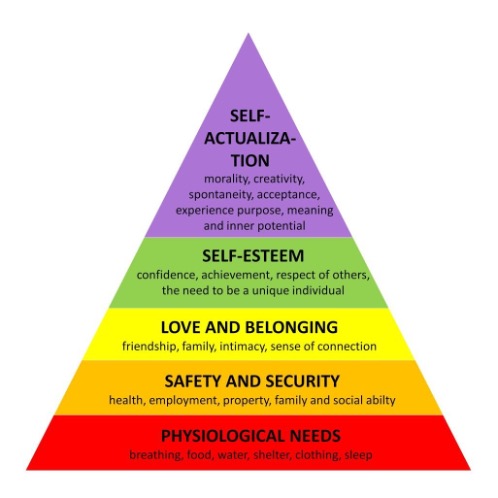
                                                                                                Source: SimplyPsychology.com

While I don’t wish to compare my own views on what true ‘quality of life’ is compared to Abraham Maslow’s ‘hierarchy of needs’ as shown in the pyramid diagram above, but it’s important to look at what makes a society flourish. I agree with Maslow at the base of the pyramid is the most important to ensure a life has some quality with it.

The societies that have the strongest base for ‘physiological needs’ usually are the happiest and satisfied with their quality of life. For example, you cannot focus on ‘safety and security’ as much as you can when you can’t even guarantee that the water you drink is clean and the air that you breathe is clean. Everything else on Maslow’s pyramid goes out the window if you are hungry, thirsty, don’t have a roof over your head or cannot clothe yourself or your family.

A lack or absence of ‘physiological needs’ is often found in the poorest or least developed of our societies and can still plague even our wealthiest and most developed societies. The key thing for all societies is that we should have an attitude of wanting to guarantee the ‘highest quality of life’ we can deliver to all people rather than just the few who can afford it financially. I do believe any society and its leadership is responsible for delivering on both ‘physiological needs’ and on ‘safety and security’ and once that is achieved, it will lead to better conditions whereas we go up Maslow’s pyramid, love, belonging, self-esteem, and self-actualization tend to be easier to achieve as well. True quality of life is knowing that if you fall on hard times, not by your fault, you’ll be looked after by your society and your government while you look to get back on your feet.

I don’t believe it’s anything farfetched or overly utopian to believe in everyone having the right to breathe clean air, drink clean war, have enough food each day, and have a roof over one’s head. I also think that while education and health care may not be on ‘physiological needs’, it ranks close in that regard to build that functional society. Everyone should be able to afford a good education and find good health care where they live and societies that accomplish this for their people are rewarded back and then some with citizens who are thriving as a result. Societies that are more educated, healthier, and with more opportunities to succeed tend to be those that have a true quality of life in my view.

You may be thinking that true quality of life is about having a big bank account, a bigger house, all the gadgets and electronics you could ever want, and all your material desires within reach, but to me, that would not go along at all with Maslow’s hierarchy. Having that stuff may make you happier but it doesn’t reflect a true quality of life in any society. If the roads are falling apart, people around you are suffering and in poverty, and you can go bankrupt for seeking medical care or a higher education, your quality of life will also suffer as a result even if you’re not directly affected by it.

When we are looked after or cared by others in the society who can ensure we have a good education, good health care, and to have affordable housing, the quality of life for everyone will go up. We are not islands unto ourselves alone and we are reflections of how we treat others. If you’re reading this article, think more about how your society or country could have a better quality of life not just for yourself but for the people living there too.

I ask that you believe in your ability to create change whether that’s advocating for more environmental regulations, prioritizing people’s access to basic needs including food and housing and thinking more about how we can include people in making them feel they belong in the society. We should collectively work towards providing more opportunities to everyone, so they don’t feel left out. Any healthy society has those public places to gather, discuss, and hopefully fix the quality-of-life issues going on in their community, town, city, or country.  

I don’t judge a society by how wealthy it is, how big the houses people live in are, or how much they have in material goods and services available. I judge a society by how they treat the least well-off members, how they prioritize the public good or not, and what they are doing to improve the overall quality of life rather than ignoring it or having it steadily decline under their watch.

It’s important for us to start thinking about not just ourselves and our own quality of life but those of our fellow man and woman. When they are worse off than us, let’s lift them up and look out for them instead of shunning them or isolating them instead. We should always be advocating for a ‘true quality of life’ where everybody is given the opportunity to succeed, grow, live healthy and happy lives, and pursue their dreams.

We all will be better off for having invested in the basic tenets of civilized society such as education, health care, transit, housing, and healthy food supply rather than just guarantee them for the few who can afford it. The higher the quality of life is not just for us but for every member of our society, the more likely we will all flourish together and reach our highest fulfillment.
Three Tips for Public Safety

A recent incident and rather close call as well regarding my personal safety reminded me of how important it is to take certain precautions when you are out and about especially in an unfamiliar setting. If you’re in a new city or a new country, you’ll want to double down even more on your own safety when you don’t know your way around or are not able to communicate well in the local language. Urban environments tend to be the most difficult safety wise which is why I am compiling a list of these three public safety tips that I often use and which you may also find useful.

Now, these three tips may not be able to keep you 100% safe, but they will lower the odds and substantially minimize your exposure to risky situations and potential danger. One tip that should be common sense to begin with but which I sometimes neglect is to always be on your guard in some measurable way. To let your guard down even just for a little while can be all someone needs to attack, harm, or rob you in some way. The most important thing you can do in an unfamiliar setting is never let your guard down and to stay vigilant.

These three tips add on to that basic philosophy and will help you in additional ways. While I am far of a safety expert and am not a security professional, I give these tips based on my own experiences and reasoning. I hope that you find them useful and are able to utilize them for your own personal security. While this is definitely not an exhaustive list, I definitely believe that these three tips are some of the most common sense and reasonable out there when it comes to exercising caution in public.

  1. Keep away from the sidewalk curb or edge

You may not see this tip as being very important, but I find this is an underrated one when it comes to staying safe in public. You’ll want to maintain your distance from oncoming traffic as much as possible and I find that it’s safer to be closer to the building than to the curb. These days, you simply never know if a car, bus, or even a truck could lose control and end up mounting the curb to cause serious harm to you or another person.

Also, if you happen to be in a city where snatch-and-grab robberies can happen quickly, you want to make it as hard as possible for those robbers in a car or in a motorcycle to nab your personal items. You will want to keep away from them as much as possible when walking on the sidewalk. It makes it easier for them to grab your purse, bag, backpack, or phone the closer you are in proximity to the street.

Lastly, regarding events in the past, intentional attacks by criminals or terrorists using vehicles while a very remote possibility is something you could keep in mind by staying away from the street traffic. You should maintain awareness when you’re walking on the sidewalk as well which will lead me to my next point in a later tip. If you have a loved one with you whether that’s a romantic partner or a family member who might be more vulnerable, consider putting yourself closer to the street and have them be at your side closer to the building. If they’re older, don’t move as well, or have to take a call or answer some texts, it would be the wise thing to do to have them walk by your side away from the street especially if they’re distracted by something else. While this tip isn’t very popular, I find that it makes a lot of sense and can enhance your awareness.

  1. Face towards the entrance of the café or restaurant

Maybe you’re out at a café enjoying a nice coffee or at a restaurant celebrating your birthday, regardless of the circumstance involved, I recommend that when your sitting at a table or a counter or a bar, try to always face towards the entrance or exit to be aware of what’s going around you. Restaurants, cafes, and bars can be loud, distracting, and disorientating but it’s key to your personal safety to know where the entrances and exits are at all times in case of an emergency. Emergencies are unlikely to happen in these public settings but it’s better to be safe than sorry by knowing who’s coming in and who’s leaving. It’s also good to scout out the additional entrances and exits of the place you’re at if you can do a walk-around after you arrive.

If you are in a big group or a larger party of people at a restaurant or bar, try to do your best to sit facing the exit as well. It can be more difficult, but most people are not aware of this safety tip, but it shows that you are being responsible in caring for the safety of the group by looking at what’s going on around you. While it is extremely unlikely that anything bad would happen in a restaurant or a bar or café, you are at a significant disadvantage to react to any situation if you are facing towards the wall or towards the kitchen. What would even be worse leads me to my third tip involving using the smartphone at these kinds of places instead of minding your surroundings or paying attention to the people with you or around you.

  1. Put the phone away in public as much as possible

Your smartphone can be a big hindrance to both your awareness in public of potential dangers and hazards as well as making you an easier target for theft or robbery. While it is usually safe to use your phone in most places, depending on the city or country, you may want to leave it at home or wait until you’re at a café, bank, or a restaurant to use it. To walk around with it and advertise its value is an increased risk which you may want to do without. While it can be helpful in mapping out your location and where you need to go next, it can highlight the fact that you are a tourist or are not aware of your surroundings even more.

On top of that, walking with your phone out is not a good idea because you will be completely unaware as to what is going on around you in terms of cars, buses, bikes, motorcycles, or potential street hazards. Having your phone out not only compromises your safety but your awareness as well. Try to memorize your immediate area so you will not be tempted to use your phone as much. Also, even when you are out at a restaurant, café, or bar, it is best to use your phone sparingly so as to not distract yourself from your surroundings or from your friends or family who are out with you. Your phone is a great tool, but it can take away from your public safety very easily if you use it too much or make it obvious as to how much street value it has.

My key point in writing this article is to make sure you don’t fall victim to some sort of accident or tragedy because you weren’t paying attention. You should always be striving to be aware of your surroundings and to make it a personal priority to maintain vigilance in public. Things can happen very quickly and it’s extremely important these days to stay ready in case something happens unlikely as that may be. Use these tips at your own discretion and if you would like to add your own public safety tips, please feel free to do so in the comments section.