

“Got to, This is America, Man…” – Anatomy of a Scene

“‘The Wire’ is the greatest television show of all-time. Even as the show nears the 20th anniversary since when it first aired on American cable television network, HBO, it still rings as culturally relevant and as emotionally stirring as it was when it first debuted in the Summer of 2002. While technology may be different now, the characters would not be the same, the setting could be different from the show, the overall themes, and messages from ‘The Wire’ as well as the institutions that the show focused on for five great seasons have not changed that much.”

‘The Wire’ is the greatest television show of all-time. Even as the show nears the 20th anniversary since when it first aired on American cable television network, HBO, it still rings as culturally relevant and as emotionally stirring as it was when it first debuted in the Summer of 2002. While technology may be different now, the characters would not be the same, the setting could be different from the show, the overall themes, and messages from ‘The Wire’ as well as the institutions that the show focused on for five great seasons have not changed that much.

I could write a thesis on ‘The Wire’ and devote at least 10,000 words on the show in terms of an in-depth breakdown on how it’s the modern equivalent to a Shakespeare tragedy or drama. However, in this ‘Anatomy of a Scene’, I am going to focus on one of my favorite scenes in this classic television show. This scene is the opening one for the entire five-season series and discusses a core tenet of the show not just about what kind of ‘game’ that the characters play, but also the ‘game’ inherent to the setting of Baltimore, Maryland as well as America as a country.

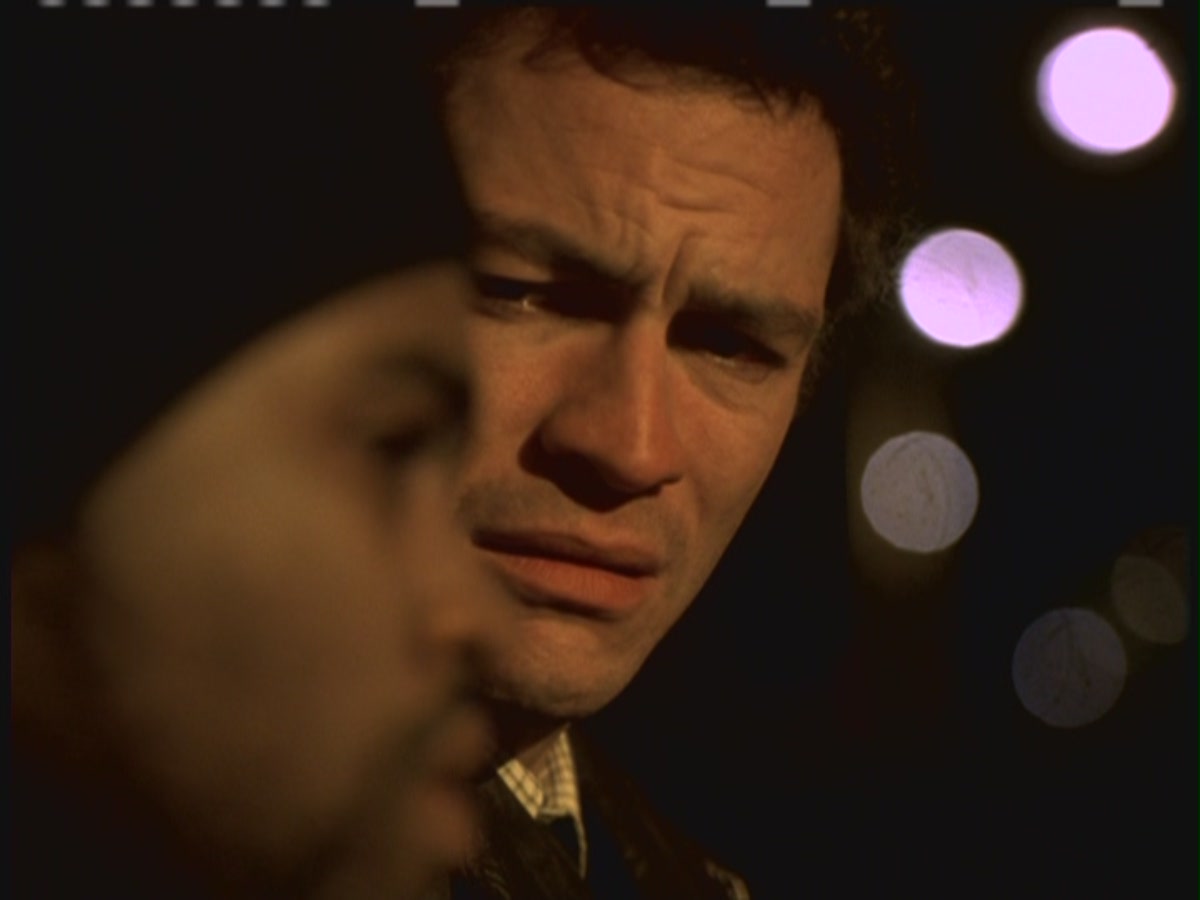
The opening scene, more than any other scene, even if it is the 1st, one pinpoints exactly what ‘The Wire’ is about. In the first shots, you can see a young man lay face down dead on the ground on some dark city street with the police collecting evidence and a main character, who is a detective, questioning a potential witness. The associate of the victim talks about how they were involved with street gambling and how it was not fair that it was not right to kill the victim, non-ironically known as ‘snot boogie’ to the game’s players. The victim of the crime has a real name but is endeared to the rest of the game’s players by that nickname alone.

As the witness explains to Detective Jimmy McNulty of Baltimore Police, ‘Snot Boogie’ was the victim of the crime, but his associate did not expect him to be killed for stealing from the other players of the street game for playing craps. The associate tells McNulty that the victim is known for stealing and grabbing the money to run away but they never want beyond just ‘beating his ass’ up a bit.

While it is a grim description of the dangers of gambling illegally on the streets, the witness to McNulty’s murder case explains that there is an unwritten rule to the ‘game’ of street gambling and that ‘Snot Boogie’ should not have been murdered for stealing from the other players. Nobody ever tried to kill the victim even after he was found guilty of stealing money from the street game players even if they did often catch him and beat him for having done it multiple times.

The witness refuses to tell McNulty who killed his associate in this game and does not want to go to court even though he believes it was disgraceful how ‘Snot Boogie’ was killed because they always let him play even though he would always steal from them.
“I got to ask ya, if every time Snot Boogie would grab the money and run away…why’d you even let him in the game?”
“…What?”
“If Snot Boogie always stole the money, why did you always let him play?”
“Got to, This America, man.”

McNulty looks incredulously as the witness tells him this reasoning because at its face, it does not make much sense for a guy who steals from folks repeatedly to continue playing a dangerous and illegal craps street game. It’s clear to both characters that life itself, and life in America is far from being fair at the end of the day especially a man got killed, which was against to how the game was being played, according to the witness, even if he was stealing from them.

Even if the game is fair or is rigged to some degree, it occurs to the witness and then McNulty after he sees the guy’s reasoning that even if the game was not meant to be won and the result would always be the same, you still let the game play out. The game may not be fair like life itself in general or in America, but it must be played by everyone. It may not be a fair shot and there is no equal outcome, but there is equal opportunity out there for each player to be involved even if someone cheats, steals, and comes back to play again. The game exists for everyone to be given a shot at it and if they don’t, that’s against the principle of life itself and life in America.

There are tragic consequences to this craps game for Snot Boogie who loses his life senselessly as well as for the men who will go to jail for it or lose all their money, but the game goes on and it’s open to everyone. Like the witness explains, the game deserves to be played by everyone equally although the outcome may not be something everyone will like or even will cost some people dearly. This excellent opening scene opens with the most prominent themes of The Wire perfectly and almost seems like a graphic novel come to life. Its visuals are striking, the characters are who you can relate to on a human level, and there is a lot of foreshadowing about the rest of the show and its messages to the viewers from this tone-setting scene.

‘The Wire’ is a show about the early stages of 21st century America in its first decade of the 2000s but it is as still as relevant about 20 years later. The metaphor of this opening scene for not just a couple of guys in a craps game gone wrong in the street can pair directly too what can happen when capitalism can go off the rails when someone tries to beat the rules or try to gain an advantage when they are put at a disadvantage to begin with. If the game is rigged from the get-go even if you’re given a shot at it, what’s the point in playing by the rules? If you can beat the system even if there are dire consequences, is it not worth trying?

‘Snot Boogie’s associates knew he was a thief and a cheater because they believed that he still deserved a shot at winning like everyone else even though it was likely rigged so he would never make it after multiple tries. As the opening scene of the greatest television show of all-time shows the viewer, everybody can play the game even if they are a cheater in the sense of having equal opportunity, but what happens when no one is held accountable when the odds are stacked against them from the start of the game and there is no other way to win than by cheating the system and facing serious consequences?

The show may not be defined by its iconic opening scene but as you find as you watch the entire series, the metaphor for what that scene represents about the show and about the ethic that binds American society together long after you finish watching each of its five seasons.
Anatomy of a Scene – Miracle Ceasefire

How we as humanity cling to hope is our investment into the future that better and brighter days are ahead as long as we persevere, push forward, and leave our world a little bit better for the next generation. ‘Children of Men’ is great because it poses the answer to the question of how does humanity hope for a future when no babies are being born?

The world without hearing children’s voices, laughter, and even cries can be a dark and hopeless place. That central message of the now classic movie ‘Children of Men’ (2006) has stayed with me especially in the current times of a pandemic that we are living in. How we as humanity cling to hope is our investment into the future that better and brighter days are ahead as long as we persevere, push forward, and leave our world a little bit better for the next generation. ‘Children of Men’ is great because it poses the answer to the question of how does humanity hope for a future when no babies are being born?

When you think deeply about it, humanity is restored generation after generation thanks to our youth, their ideas, their drive, their desire to not repeat the mistakes of the past and to learn from history. When you take humanity’s future away, what is there left to fight and live for? It is a powerful premise and one for which I am glad Director Alfonso Cuaron decided to focus on. His movie does not pull any punches and shows humanity at its worst when women are no longer able to have children.

Without children, playgrounds and swing sets remain empty. Refugees and immigrants are persecuted and forced into detention camps, suicide pills are common place, environmental degradation is the norm rather than an obscenity, and violent factions fight it out with the government in a post-apocalyptic United Kingdom where suicide bombings are an increasingly common occurrence as Theo (Clive Owen) discovers when he is almost the victim of one in one of the earliest scenes. Perhaps the most frightening part of the whole movie is that no one has figured out why women can’t have babies anymore and the novel that the film is based on is also clear when it shies away from saying why men can’t help in the reproduction process anymore.

In ‘Children of Men’, no child has been born for 18 years and it can be hard to retain hope after that long that things will change. The world is in a downward spiral and things get worse as the youngest person alive, Diego, is killed by an angry crowd. Theo takes solace in the fact that he has a good job at the government ministry and has a funny friend who goes by the name Jasper. Still, you can tell that Theo has lost faith in humanity especially after the death of his infant son due to a flu pandemic and his estranged relationship with Julian, his wife. However, when Julian tells Theo about Kee, a pregnant African woman, who may be carrying the first baby in almost two decades, everything changes, and Theo finds his purpose again to live and to fight for a tomorrow. Theo dedicates himself to protecting Kee and her future baby and wants to get her to safety, which means getting her to the Human Project, a group of the world’s best scientists discussing how best to make humans fertile again.

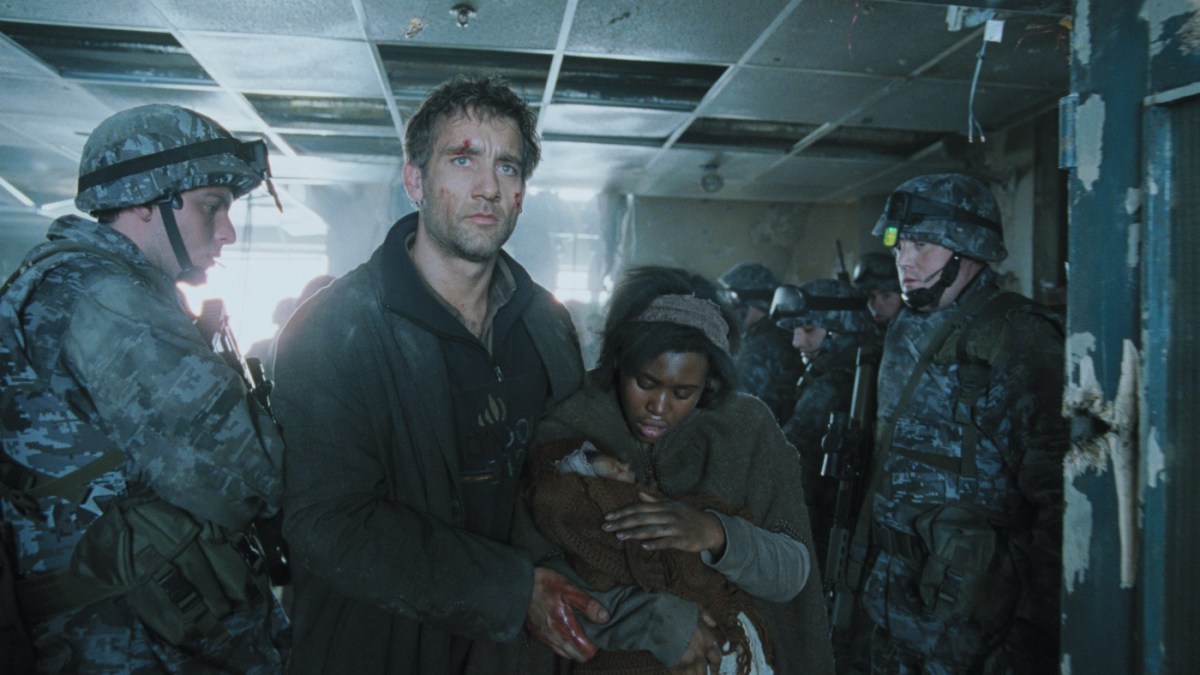
Theo’s journey with Kee involves getting her out of a refugee camp, escaping men who want to keep Kee’s baby for political purposes and who are also armed combatants, and avoiding fascist police forces who intend to get in their way. To escape the escalating urban violence around them as both the government and rebels fight it out in bombed out Bexhill, Theo and Kee take shelter in a refugee settlement in a former apartment building. The three of them come close to being killed and the baby’s cries echo throughout the building much to the stunned shock, joy, and awe it inspires among the refugees, the rebel forces, and the government troops.

The way the cinematographer follows Kee’s baby and Kee around in a wide tracking shot is absolutely beautiful making it one of the most memorable scenes in cinema history. “How is she?”, Theo asks Kee. “Annoyed.” Kee replies. A refugee woman reaches out her hand to touch the baby and another woman sings a sweet song in her native language. Prayers and aspirations are given to the baby as Theo and Kee walk through the crowd. The rebel soldiers acknowledge the baby as they get away from the advancing troops behind them. The government’s military soldiers are in absolute shock as one soldiers’ yell at his army unit: “Ceasefire! Ceasefire!” All of them stop shooting at once and look upon Kee’s baby in disbelief, many of them never having seen a human child before in person.

To see the armed men in tanks and heavy weapons and their technological mastery stop, think, and realize how humanity and its future must be preserved and let free without being in danger. Not much can stop a war from continuing but a baby’s cries can most certainly pause it for a few minutes as this brilliant scene exemplifies. An immediate symbol of hope for humanity and its possible redemption is realized in its newest addition and it is a wonderful allegory to how despite our differences, any human around the world will stop to comfort, aid, and protect for a baby as we would do for our own children or grandchildren or even nieces and nephews.

Those men who don’t see the baby continue to fire at each other in the distance but any soldier, man, or woman who hears the baby crying lowers their weapon, pays their respect, and let Theo and Kee have safe passage as they represent a glimpse of hope finally for humanity’s future rather than its eventual extinction. Some of the soldiers pray to their God and others peer in to get a look at the baby with their own eyes but all are silent and in disbelief thinking that finally there might be hope again.

After a minute or two of calm and as Kee and Theo are about to get away, a rocket RPG hits the government soldiers and the men ignore the baby again and get back to fighting the rebel forces in the building that Kee and Theo just left. To me, that is a tragic symbol of how once we have something out of sight and out of mind, we go back to fighting each other instead of uniting around a common cause. As that RPG fires, I think to myself watching this scene how somebody always has to ruin it for everybody else. Unfortunately, Kee’s baby does not lead right away to world peace and a cessation of arms. However, it is enough time for the two of them to escape and have a fighting chance of reaching the Human Project.

A baby’s cries are more powerful and everlasting than any weapon, any political cause, and any division between humanity. While human nature cannot be totally pacified by children and babies being born, it allows us to fight for better days and for a future freer of pain, sorrow, and tragedy.

I hope that when you watch this scene, you’ll realize that even in our current age when fertility is not extinct and is not a present issue that we are still fighting to preserve hope for the next generation and generations to come. Whether it is preventing pandemics, stemming the worst effects of climate change, or preventing nuclear war between nations, we all have a responsibility to be stewards like Theo in protecting the babies of the future against any manmade harm that could befall them due to our own neglect and ignorance.

Please do watch this ‘Miracle Ceasefire’ scene and the rest of ‘Children of Men’ when you have the chance. It is an excellent film to see and this scene may be the best one of the entire film. Hope and redemption are only as strong as our ability to have a better future.

‘First Reformed’ – Film Review and Analysis

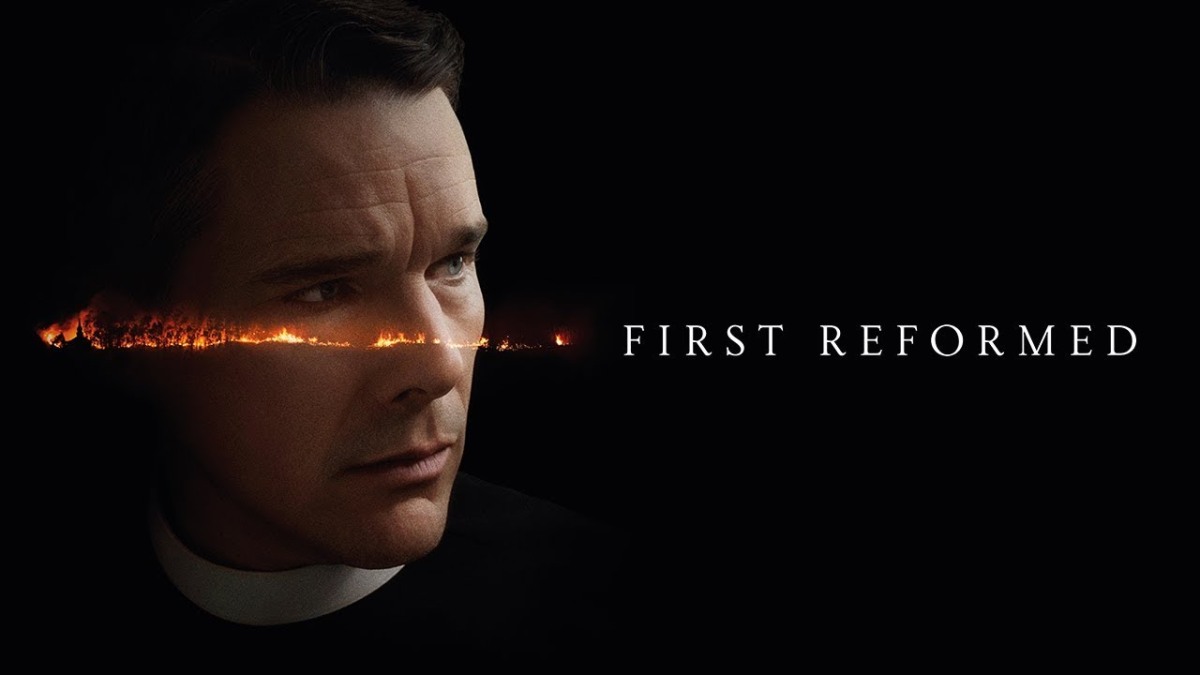
Man’s struggle with God can almost be as endearing yet painful as his struggle against man. If there is one way to sum up the excellent film, ‘First Reformed’, that would be it. First Reformed (2017) focuses on the environment, one’s faith, and the struggle to find hope when things seem rather bleak. “Can God forgive us for what we’ve done to the world?”, a troubled environmental activist asks Pastor Ernst Toller and the Pastor replies to his congregant, “Who can know the mind of God?”

While this movie did not receive any Oscar awards, the acting by Ethan Hawke (Pastor Ernst Toller) and also by Amanda Seyfried (Mary) is excellent as well as the cinematography, the adapted screenplay by Director Paul Schrader which helps this film earn its critical acclaim and some Independent Spirit award nominations as well as one Academy Award nomination. I still believe Mr. Hawke was snubbed from getting an Oscar nomination since this film’s performance was one of the best he has ever done and deserved more praise. In many of his films, I find him to be one of the best actors of his generation and able to produce genuine emotion regardless of the situation his character finds himself in.

In ‘First Reformed’, Reverend Ernst Toller (Ethan Hawke) finds himself faced with difficult questions surrounding his faith, morality, the environment in 2017, and what lies ahead in the future for humanity. These are weighty questions for anyone to deal with let alone a pillar of a community like Toller finds himself to be in Snowbridge, New York as the head pastor for the colonial era First Reformed church that dates back to the time of British colonization and the underground railroad movement later on.

This historical church is seen to be losing its membership and interest and Pastor Toller has to resort to touristic gimmicks and a small gift shop to help make ends meet to keep the church going. There is a noticeable parallel to the decline of Christianity in terms of active members of the Christian church in the United States so a fictional movie such as this one has some real-life parallels that seem plausible. The crisis of faith in churches in certain communities has a coinciding similarity with Toller’s own faith in God and in himself. He is an alcoholic struggling to find meaning and purpose in his life at the beginning of the film.

While making the church more touristy, he has also made the church more spiritual as well instead of its Calvinist origins. He sticks more to sermons than to scriptures and has enlisted the financial backing and ownership of an evangelical megachurch in nearby Albany, New York, which is likely to take over the church in the near future much to Toller’s apprehension. As we go through the film, we peel back the curtain on who this pastor is and like any of us, he has his own personal flaws and past sins but has also suffered for them and wishes to make amends in some way.

We find out that Pastor Toller lost his son, Joseph, recently while serving in the Iraq War and feels guilt for having told him to enlist having come from a military background himself as a chaplain. During that difficult time, he committed adultery and started drinking but also found his faith again to then become a pastor at First Reformed after going through grieving his son’s loss. However, a chance encounter with one of his congregants and his wife puts his faith in God and humanity to the ultimate test.

Mary, a devout congregant and believer in God and her skeptical husband, Michael, a stern environmentalist and becoming increasingly radical meet with Pastor Toller separately in their house. Mary has concerns about Michael’s well-being and tells the Pastor they expect to have a child soon. Michael is sincerely struggling with the fact that he will be a father soon when the world’s ecosystems are steadily collapsing, sea levels are rising, and the effects of global climate change are to be felt beginning in the next few decades. For any of us watching this pivotal scene including Pastor Toller himself, there are no easy answers from God or from man either regarding the future of humanity. Ernest finds it difficult to comfort Michael but asks to keep seeing him and to look out for Mary and the unborn child.

This particular scene leads to the rest of the film’s deeper dive into the effects of capitalism and greed on the environment as well as the relationship between big industry and religious institutions. Pastor Toller’s awakening from meeting with Mary and Michael leads him to questioning why the environmental situation is so dire, who is responsible for it, what can be done to stop it, and how far should measures be taken. Because the Pastor has no easy answers for Michael, he starts looking for them and is obviously dismayed by what he finds out regarding the local environmental situation in his community and how greed, industry, and the lack of stewardship for his community have led humanity down towards an unsustainable path.

Without spoiling the film, The Pastor struggles with what he can do as one individual to counteract the forces aligned against good stewardship of the planet and what a person can do to draw attention to the problem. Not only is there a crisis of faith in God but in each other and what is being done to the only planet we have ever known. The Pastor, with certain health issues related to alcoholism, is reconciling with the fact that he is mortal and what kind of impact he wants to leave behind.

He is comforted by the fact that Mary is still a believer in the future and wants to have a child even with the future of the planet looking relatively bleak. Pastor Toller knows however that he has the responsibility now to hold those accountable for their actions whether it’s the Evangelical church, a big industrialist doing environmental damage, or even himself when he strays from helping those in his congregation who need it the most.

‘First Reformed’ poses a lot of weighty questions and it is an extremely timely film in terms of its messages and themes. It is bleak because it has to be and raises a lot of issues that we have neglected regarding the environment and now we may be finding that time to make a difference in this escalating problem is running out. ‘First Reformed’ asks us how an ordinary man of faith yet a pillar of the community so respond to those in his congregation who are in despair regarding environmental damage and destruction.

How far should he go and how radical should he be to get people to listen and understand what is being done? Can love and faith overcome the desire to do harm and take revenge against those who have sinned against the planet? Like any good film, there are no easy answers and the director does not condone or condemn the thoughts or possible actions that Pastor Toller weights leading up to the climax of the last scene.

What this film does an excellent job of is warning its viewers about the consequences of greed, ignorance, lack of stewardship, valuing profits over the health and well-being of people, and the unholy alliance of organized religion and big industries. There are numerous fingers to point at regarding the worsening state of climate change going on in the world currently but perhaps those who watch this excellent film will realize that the finger should be pointed at ourselves first about the damage being done. Perhaps that kind of introspective thinking is what it will take for massive external action to occur and for the worst of the consequences to be avoided.