

English Corner – Second and Third Conditionals

To follow up on the previous article about the ‘Zero and First Conditionals’, it’s important to continue on with the ‘conditionals’ unit to explain the second and third conditionals as well. In order to fully understand conditionals, we need to know every type of conditional, and when and why do we use them in sentences. If you’re struggling with the second and third conditionals, it’s important to learn how to form either conditional in terms of its’ structure, and then learn how to use the conditionals by following the examples that I will be creating for you.

Let’s begin with the 2nd conditional first. As always, the second conditional is going to start with the word ‘If’ as is the case with the zero and first conditional. However, the second conditional focuses mainly on the ‘past simple’ grammatical tense, and how to make the second conditional compatible with expressing what you would do in the past if something were to have happened to you. Usually, the second conditional is good for talking about things in the future that are probably not going to become true.

It’s also used secondly for occurrences going on in the present, which are considered to be impossible or unfeasible because they are not true. The second conditional usually expresses desires, wants, and needs that are more unrealistic and unlikely than those that would be expressed in the first conditional. Also, with the second conditional, you’re going to focus on the past simple tense rather than the present simple tense to go along with the ‘If’ + the subject of the sentence. In order to get a better idea of the 2nd conditional, let us take a look at a few examples of this conditional in action.

Examples:

‘Talking about the future’

  • He would travel to Japan if he had the money.
  • If they did their homework earlier, they would have went to the movies.
  • If I won the Powerball lottery, I would have bought my parents a nice house.

‘Talking about impossibilities in the present’

  • If I were you, I wouldn’t do that.
  • If you had studied harder for the exam, you would have done better.

The main thing to remember about the 2nd conditional is the unlikeliness of something to happen in the future or in the present. You’re also referring to an unlikely possibility in the past to discuss what is not realistic in happening in the future.

Last but not least, it’s important to know about the third conditional in terms of its’ formation, usage, and examples. It’s a very simple formula when it comes to creating the third conditional. While the second conditional focuses on ‘If’ + past simple, the third conditional focuses on a formula of ‘If’ + past perfect à would + have + past participle’ in order to create a complete sentence.

When we use the third conditional in a sentence, we talk mainly about the past as well as to discuss a situation that didn’t really happen. We can also imagine the hypothetical results of a situation that didn’t actually occur, but that we would like to think about the possibility of. It’s important to remember that the ‘past participle’ is often added to the second part of a third conditional sentence, and can be switched to the first part of the sentence as long as the ‘if’ remains part of the other half of the conditional sentence.

Examples:

  • If I hadn’t eaten so much candy on Halloween, I wouldn’t have gotten sick.
  • She would have become a doctor if she had been able to afford medical school.
  • If we had taken the subway, we would have arrived at the airport earlier.
  • If they had been telling the truth about the food fight, they wouldn’t have gotten in trouble with the school principal.
  • If he had showed up for the job interview on time, he would have been hired on the company.

When it comes to any conditional whether its’ the zero, first, second, or third, it’s important to take the time to really study this grammatical concept. You need to put in the time and the effort to study the formula, the usage, and practice with some example problems in order to memorize how to create the sentence. There are plenty of ways to practice the conditional sentences, and it’s important to study this concept consistently in order to master it.
 

English Corner – Simple Future Tense

In the past couple of editions of the ‘English Corner’, we’ve gone from the past to the present in terms of understanding and using the grammar structures that encompass these lengths of time. Now, we’re going to take our knowledge of English grammar into the future by going over and analyzing the ‘Simple Future’ tense. If you have a good basis of understanding when it comes to the past tense and the present tense, you should have no trouble with the future tense, especially the ‘simple’ version of the tense to start out with.

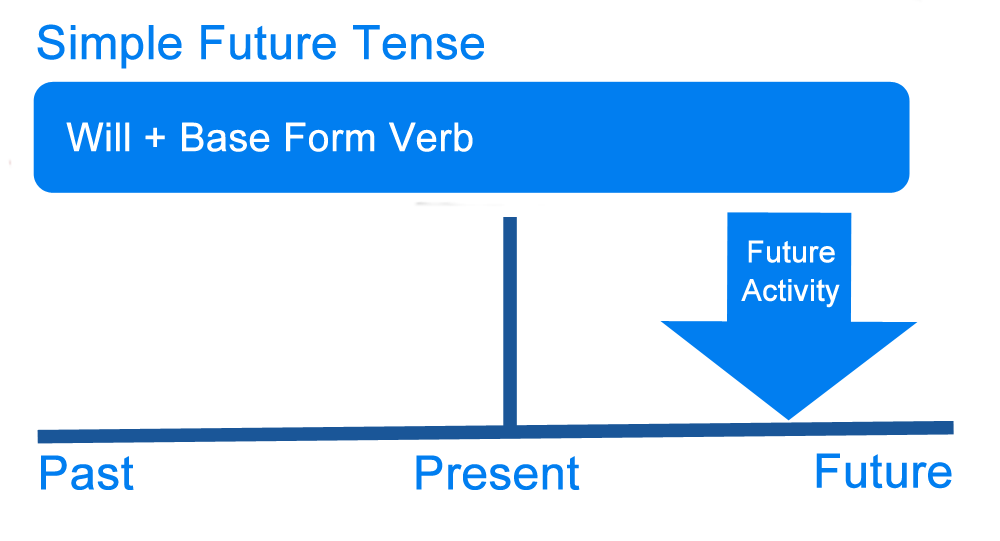
In order to master the simple future tense, we need to use the word ‘will’ and implement that word into the correct order of the sentence. This is why the simple future tense is sometimes known as the ‘will tense’ instead due to the importance of this particular word. In order to create the correct form of the simple future tense, we need to get the structure down without any problems.

As always in the English language, we are going to want to start our sentence even in the simple future tense with the ‘subject’ at the beginning whether it is ‘I, You, They, We, He / She, It, etc. After the subject comes the auxiliary verb first which in this case you are going to put the future indicator ‘will’ right after the subject. Once you have the subject and the auxiliary verb set up, you can then put the main verb after that to fill out the third part of the sentence. Lastly, you’re going to finish the sentence with the action taking place and the object that is being referred to. Overall, the structure of a ‘simple future’ tense sentence should be ‘subject + auxiliary verb + main verb + action (object).

Here are a few examples to consider:

  • I will go to the store today.
  • He will do his homework before tomorrow.
  • We will attend the theater musical later tonight.
  • They will finish the job as necessary.
  • She will study mathematics for her test tomorrow.

Sometimes, you’re going to want to make the simple future tense from its’ usual, positive form into the negative form which isn’t that much different except for one important difference. In order to make this grammar tense negative, you’re going to want to put the word ‘not’ between the auxiliary verb, which is the word ‘will’ and the main verb, which could be any number of verbs to express what you would like to be doing in the future.

If you want to go ahead and put the simple future tense into the question form, you’re going to want to exchange the usual placement of the subject for the auxiliary verb and switch them around with each other. In order to get a better understanding of the negative and question forms of the simple future tense, let us take a look at some examples that I have listed below:

Negative

  • I will not go to the store tomorrow.
  • He will not beg to keep his job.
  • You will not get a promotion unfortunately.

Questions

  • Will you do your homework please?
  • Will she go out with you to the dance this weekend?
  • Will we win the match if we practice hard today?

Another thing to be aware of when it comes to the simple future tense is that you don’t need to use ‘will’ in the auxiliary verb part of the sentence all of the time. To express the future, you can exchange ‘will’ for ‘shall’ in order to get your point across.

Examples

  • I shall not waver from this decision that I must make tomorrow.
  • I shall work my hardest to ace this job interview on Wednesday.

Beyond just writing correctly in the simple future tense, when it comes to the spoken form, you can be much more informal with your choice of words. If you’re speaking to someone about the future, you’re going to want to contract both the subject and the auxiliary verb. You should push them together to become one word with the help of a well-placed apostrophe. You don’t have to speak or write in the contracted form but you can do so if you’re being informal and don’t feel the need to sound everything out for the other person or for the audience.

Examples

I will –> I’ll

I’ll be sure to call you back after I’m done cooking.

You’ll need more time to study tonight since your exam is tomorrow.

In addition to contracting the positive form, you can also contract the negative form of ‘will’ with a slight difference in its’ wording. Instead of ‘will’ being contracted into ‘I’ll’, it becomes something else entirely.

Examples

I will –> I won’t

We won’t stop the strike until our demands are met.

They won’t stop playing their awful music in the house next door.

Now that we have the structure of the simple present tense down to a science, let’s focus on the ways in which we can use this grammar form to the best of our ability.

More often than not, the main reason we choose to use the simple future tense is because we have no plans or obligations ahead of us so we can choose to do things spontaneously instead without putting much thought into it. Sometimes, as human beings, we do things without much planning so using ‘will’ in a sentence to express a spontaneous action is quite useful. The decision that you make or the action that you take can occur right away or within a short notice.

Examples

  • I’ll bring you a drink.
  • We will go see the new Star Wars movie tonight.
  • They will leave after dessert is served.

It should be kept in mind that there are a few known exceptions where ‘will’ is actually the main verb in a sentence and the auxiliary verb is another word that can take its’ place to express a future action to take place. The primary example of this exception is the word ‘think’, which can exchange places with ‘will’ to become the auxiliary verb and to express what the subject may do in the future with regards to their plans or obligations.

Examples

  • I think I’ll buy a bike later today.
  • We think they’ll do the right thing and return the money.
  • She doesn’t think that you are guilty.

Another main use of the simple future tense is to try and predict the future. While these predictions aren’t foolproof and could end up being wrong, we try to be as certain as possible before using ‘will’ in a sentence to prove its’ inevitability. As human beings, we are prone to make mistakes but we try to predict the future as if it is set in stone.

Examples

  • It will snow heavily tomorrow.
  • He said the Yankees will win the World Series this season.
  • We will be victorious in the spelling bee next week.

Lastly, without changing the structure of the simple future tense, you can add the verb ‘to be’ after the important auxiliary verb ‘will’ to create some additional sentences with the same grammatical form. It is not necessary to use ‘be’ in a sentence with ‘will’ but it can help you to create additional examples such as the ones below.

Examples

  • I will be waiting for you outside the doctor’s office when you finish.
  • Will we be meeting at the ice skating rink at 8 PM?
  • They won’t be able to come tonight to dinner, should we reschedule?

Oftentimes, you can use ‘going to’, the present progressive (continuous) tense to express what plans or actions you have for the future. However, for now and for the next edition of ‘English Corner’, we are going to continue to focus on how to use ‘will’ to express the future including its’ continuous form, which we will review next month. Until then, keep studying your English and please let me know if you have any questions or comments!