

Anatomy of a Scene – ‘The Lady In The Red Dress’ (The Matrix)

“In a simulated world, which is built both on illusion and deception, distraction is the perfect weapon for keeping one complacent and from asking questions.”

In a simulated world, which is built both on illusion and deception, distraction is the perfect weapon for keeping one complacent and from asking questions. Few film moments capture that idea more powerfully than a short but iconic scene from The Matrix (1999): Neo (Keanu Reeves), newly unplugged from the simulated world he once thought of as reality or the ‘real world’, walks through a bustling cityscape inside a training simulation that is programmed to feel like ‘The Matrix’, but whose participants realize it is a simulation and not the ‘real world’.

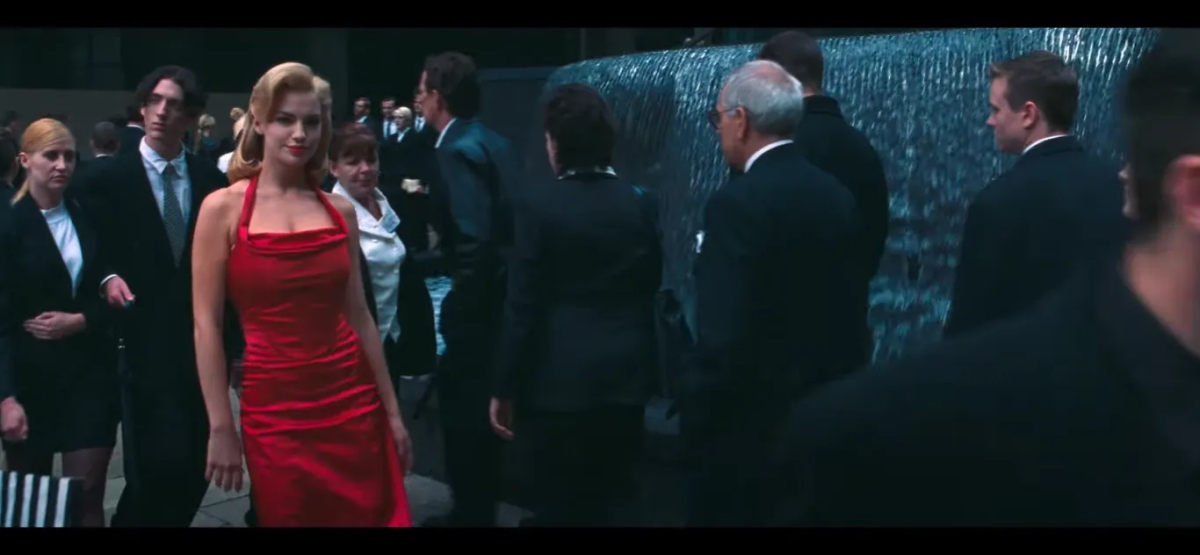
Suddenly, his attention is captured fully as he stops listening to Morpheus’s speech and focuses elsewhere. This distraction is not of danger, but by desire. A stunning blonde woman in a bright red dress walks past him on a city street. He turns to look at her and take in her beauty. A moment later, he’s staring down the barrel of a gun from an Agent of The Matrix.

This moment, while brief, is the Matrix in miniature form, a system that doesn’t just imprison the body, but hijacks the mind as well. In this scene, the Wachowski Brothers, who directed the Matrix film series, deliberate show the audience how distraction can be deadly, how perception can be manipulated, and how even the most liberated minds are vulnerable to illusion even after escaping from the simulated word of The Matrix. Over two decades later, this scene resonates more than ever as we live in a blurred world now of reality and simulation and of seemingly endless distractions like the lady in the red dress.

Let’s walk through how the scene unfolds similarly to how Neo and Morpheus experience the simulation themselves. Neo and Morpheus are in what appears to be a peaceful, clean city environment with sun-drenched streets, people in business attire moving in orderly fashion of different occupations and livelihoods. It’s not the gritty or green-tinted world Neo has just escaped from. Everything here is vibrant, bright, almost too perfect and calm. There’s a catch to it but we don’t know what it is yet as the audience.

Morpheus explains to Neo, “This isn’t the real world. It’s a computer-generated dreamworld built to keep us under control.” They’re inside a training program that mimics the Matrix, but this version is safe and controlled with seemingly no threats like what lurk inside the Matrix. As they walk, Morpheus encourages Neo to stay alert and keep up with him. However, Neo’s attention suddenly drifts elsewhere. A tall, blonde, and slightly smirking woman in a red dress glide past him, a stark contrast to the grayscale suits and muted tones of the crowd. The camera follows Neo’s gaze and not Morpheus’ words. Just as Neo turns around to look at her again, Morpheus interrupts: “Were you listening to me, Neo, or were you looking at the woman in the red dress?”

Neo turns again and instead of the woman, an Agent from the Matrix stands there with a gun to his head. The simulation freezes. Morpheus smiles. “Look again.” This is Neo’s wake-up call after he flinches from the sight of the Agent’s gun in his face. Neo is shaken as at any time in the Matrix, any of those ‘people’ are enslaved by the Matrix can turn into an Agent who is looking to prevent others from being freed from their enslavement by Neo, Morpheus and his crew. In The Matrix, distractions can be deadly because anyone can be an Agent and turn into one at any time. Neo learns his lesson and Morpheus instructs Neo about the real danger of going back into the Matrix, but they have a mission to free those from a reality that is not real, whatever the cost may be.

At its core, the Lady in the Red Dress scene isn’t just about Neo getting distracted having not been accustomed to the unique threat of an Agent. It’s about how the Matrix and by extension, any system of contro uses desire, beauty, and sensory overload to mask its true threat.

The woman in red is not a glitch, nor an accident of the simulation. She is designed by Morpheus’s crew to test Neo’s ability to focus and to challenge his awareness in an environment that constantly floods the senses, a virtual simulation that is meant to feel real but isn’t real. Morpheus isn’t just teaching Neo about the Matrix’s mechanics but also, he’s teaching him about vulnerability. The greatest danger isn’t always visible or known in the Matrix. Often, it’s hidden behind the things we want most or desire to have the most.

The red dress is more than a splash of color on a woman who is simulated to be a distraction. It’s a symbol in the overall movie of temptation, distraction, and the human tendency to follow what pleases us, rather than what protects us, even if it will end up hurting us later. In mythology, this kind of idea of ill-fated temptation appears often: sirens luring sailors to their doom in ‘Odysseus’, the forbidden fruit offered to Adam and Eve in Eden from the Old Testament, each of these illusions are designed to distract heroes from their quests or to lead to the fall of man and woman.

In this scene, the woman in the red dress is a test, one for which Neo fails, momentarily, and I think a lot of us would fail like he did with the distractions that are constantly thrown at us each day. His eyes are drawn away from his mentor, away from the lesson he is teaching, and toward something that feels more real than the truth. The result of his ill-fated choice? Instant danger and his potential demise if he were to make the same mistake again.

The brilliance of this scene lies in how it’s staged visually and shot from Neo’s perspective: everyone is dressed in grayscale, forming a camouflage of conformity and ordinariness. The woman is the only thing that stands out to Neo and the audience. She breaks the pattern of what we see and thus, attracts attention and an extra look. That’s what makes her the perfect distraction and allegory for ill-fated temptation, and that’s what makes this scene timeless.

Fast forward to today’s world where distraction has become the default mode for many of us. Our attention is fragmented by design, engineered by algorithms, applications, increasingly ‘real’ virtual and simulated realities, and seemingly endless digital stimuli, for which has dramatically shortened our attention spans. The modern “Matrix” isn’t an actual simulation in our brains, at least not yet as I write this, but it’s a network of more and more screens, news feeds, constant notifications, and seductive content. It’s the all-knowing algorithm pushing what it knows will make you pause mid-scroll and continue to feed your dopamine receptors.

Every time you find yourself watching a video you didn’t intend to watch, reacting to an outrage post on a political or social issue, comparing your life to curated influencer perfection on social media, or buying something new because it popped up at just the right time in your news feed, that’s the ‘red dress’ in action. While you’re watching the distraction, whatever kind it may be, something else is happening in the background of our lives: real threats are forming that pose real danger to us. Climate change. Political instability. Ongoing wars. Mental health crises. Surveillance capitalism. Social isolation. Economic inequality. Things that are far more dangerous and impactful than seeing ‘a lady in red’. Like Neo, we rarely see ‘the Agent’ or the real threats coming at us on the horizon.

In The Matrix, Morpheus teaches Neo that true liberation begins with awareness, not just of the system, but of how the system manipulates us and our desires. The Lady in the Red Dress is a metaphor for all the ways we’re trained to look away, to not pay attention, to surrender to the pleasure of the moment rather than focus on the issues of the present and the future. In 2025, this scene is more relevant than ever to our real world. It reminds us that to stay aware, engaged, and vigilant in a constantly distracted world is a small yet meaningful act of rebellion.

The focus and impact that you give to the world around you rather than cheap simulated or virtual distractions is actual power. Being able to have greater perception and awareness is everything these days and will allow you to help other people do the same. The next time something flashy, tempting, or beautifully packaged grabs your attention, you should ask yourself: “Am I listening, or was I looking at ‘the woman in the red dress’?”

Anatomy of A Scene – “I came in at the end…The best is over.”

“A lot of the best scenes in the show revolve around this conflicted mobster, Tony Soprano (played brilliantly by James Gandolfini), who suffers from both innate anxiety and depression, along with his dysfunctional families who intend to drag him down if he can’t help doing it himself.”

https://www.youtube.com/watch?v=0cQOej9nuho

‘The Sopranos’ is one of the most highly acclaimed television shows of all-time and is not just a show about a man caught between his real family and his mafia family but also about a certain period in American life. A lot of the best scenes in the show revolve around this conflicted mobster, Tony Soprano (played brilliantly by James Gandolfini), who suffers from both innate anxiety and depression, along with his dysfunctional families who intend to drag him down if he can’t help doing it himself.

There is a particular scene early in the 1st season where we are first getting to know the character of Tony Soprano and what makes him tick. The first scene in his therapist’s office, which would be a recurring motif throughout the show, has Tony trying to pin down the roots of his depression, which is what brought him to Dr. Jennifer Melfi (Lorraine Bracco) in the first place. Tony has no idea what is causing him the blues, pontificating openly that it could be “stress, maybe?” especially as he has recently started to have panic attacks occur out of nowhere.

Dr. Melfi asks him about what could be causing the stress he is feeling? Tony isn’t sure but believes that “it’s good to be at something at the ground floor.” Now, the audience can assume what he is referring to is the La Cosa Nostra or Italian-American mafia, which is on the decline as the show first aired in 1999 and could be on its way out. However, since Dr. Melfi isn’t aware yet who Tony Soprano is and what his life in the mafia like, she assumes he means about life in suburban America in the 1990s, which had a lot of amenities including bigger houses and bigger cars with a more privacy, but for which has left many Americans feel unfulfilled.

“I came in at the end…the best is over.” While Tony may be referring to the historical arc of the Italian mafia and how it’s in irrevocable decline, the show paints it to Melfi and the audience as something deeper yet not as pronounced. Melfi replies, “Many Americans, I think, feel that way”, implying that while the country has gotten materially wealthier and more prosperous to a degree, our family and perhaps spiritual life has been on the decline for quite some time and perhaps has led to a moral decline.

While Tony was inferred to be talking about the mafia and how he is now boss of his Soprano crime family unlike his father who never ‘reached the heights like him’ or wasn’t as successful materially in terms of his life in the suburbs, Tony still feels unfulfilled by his success.

While his father wasn’t as successful in the mafia life, he still passed it down to his son, but in those days, Tony feels as many Americans would relate to that there was more pride and togetherness in their communities among families of different backgrounds. In the atomized suburbs, it’s harder to connect with those in your family or to form as tight of cultural or religious or social bonds with people of your background.

“But in a lot of ways, he had it better. He (Tony’s father) had it better. He had his people. They had their standards. Their pride. Now, today, what do we got?” The scene also demonstrates that this was filmed in 1999, just at the turn to the 21st century, before 9/11 happened, the 2008 financial crisis, the election of Donald Trump as President, and the COVID-19 pandemic. Even on the cusp of 2000, the show demonstrates that not all was rosy in America and there was a sense of dissatisfaction back then with where the country was headed and that the ’best days may be behind us’ in more ways than one.

While the focus is on the decline of mob life in this scene and in the show, which does so consistently over six brilliant seasons, it also highlights a parallel loss of faith and trust in American institutions as well as the rise of greed, malaise, and apathy in our cultural attitudes, and a sense that maybe American decline is our future. While the scene is not overtly political, you have Tony reading the Newark Star-Ledger, a New Jersey daily paper, indicating that “President Clinton warns of Medicare going bust in Year 2000.”

The front-page newspaper headline tells you that even back then in 1999, there were worries about our institutions eroding, the promises meant to be kept at danger of being broken after many decades of effort, and the average middle-aged suburbanite feeling unsatisfied about the prospect of a dimmer future, especially for his or her children. While Tony’s parents were better off because of their closer family and community ties in the big city or the exurbs nearby, he was not able to say the same about his suburban life. Even at a time where his generation were able to still have had a better life materially and perhaps financially than their parents, would their children be worse off in both ways if the decline is to pass, both financially and spiritually?

Twenty-two years later since this scene first aired on HBO, it is interesting to look back at Tony’s anxieties as being prophetic rather than misplaced. Younger Americans of my generation and the generation behind me look at it reasonably and think that Tony Soprano, despite his crimes and misdeeds and his Mafia boss life, may have had one thing right: “I came in at the end, the best is over…” Now, the question remains, how do we deal with it as a country and as a people?

‘Office Space’ – Film Review and Analysis

“1999 was an incredible and unique year for movies in America. In an era where Hollywood would regularly produce thought-provoking content that did not dumb it down for audience and would tackle tricky real-life topics without a filter, it may have been the golden age of film for those of us in the Millennial generation.”

1999 was an incredible and unique year for movies in America. In an era where Hollywood would regularly produce thought-provoking content that did not dumb it down for audience and would tackle tricky real-life topics without a filter, it may have been the golden age of film for those of us in the Millennial generation. While not as ‘politically correct’, these movies such as ‘Office Space’ challenged our assumptions, made us question our modern comforts, and perhaps most importantly showed us the ridiculousness of having flair as a waiter or waitress at a chain restaurant as a part of the service given.

Poking fun at chain restaurants is far from the only good thing about ‘Office Space’, one of my favorite movies of all-time. During that year of 1999, two other excellent movies placed a mirror in front of our society and made us reflect on whether ‘modern’ was really that good and whether ‘materialism’ was that spiritually enlightening. While not as complex as ‘The Matrix’ or as serious as ‘American Beauty’, ‘Office Space’ is a comedy but not your average one. It chides you with wisecracking humor but also lays bare certain aspects of American adult life that are not just unpleasant but downright silly.

Whether it is a loud co-worker talking too much over the phone, a crappy printer that just won’t do its job, meaningless reports to file each week, or an obnoxious boss who makes you come in on the weekends, ‘Office Space’ is an ode to the white collar worker who despite the good health care benefits and the steady salary is unfulfilled with his life and is not sure why.

Peter Gibbons (Ron Livingston) is exasperated with his office job in IT (Information Technology) at a software company, Initech. He goes out of his way to avoid his obnoxious and micro-managing boss, Bill Lumbergh, who insists on him working on the weekends but also indicates wanting covers on the TPS reports, which is a mindless and meaningless task. Peter is comfortable with the job but knows deep down it isn’t satisfying him and he comes into work dreading it each day. Peter dislikes most of his co-workers including a lady who says to him, “Somebody has a case of the Mondays” to downplay his frustration of commuting to a suburban office park each and every week while dealing with traffic and the lack of purpose involved.

Probably the only reason Peter stays at his job are his two friends at work who sympathize with him, Michael Bolton (no relation to the singer as he makes clear) and Samir Nagheenanajar (who is obviously frustrated that no one in America can pronounce his last name). They are not as depressed as Peter but they also understand where he is coming from. Peter also gets sympathy from his neighbor, Lawrence, who lives next door. Lawrence does not work in an office and works on construction projects outdoors so he can’t relate to Peter so much with his drudgery at work but he emphasizes how nobody ever told him that he ‘has a case of the Mondays.’ He makes clear in a hilarious way that if somebody ever did that to him, they would get their ass kicked for that.

Peter’s unsatisfying life is also compounded by his girlfriend who is cheating on him and the fact that he is forced to go see a hypnotist who she thinks can help Peter get out of the funk that he is in. In perhaps the funniest scene in the film, the hypnotist / psychotherapist who is extremely overweight is in the process of hypnotizing Peter to snap him out of his lethargy regarding work and seemingly drops dead in front of him and his girlfriend.

Because the hypnotist died before taking Peter out of his temporary state of ease and relaxation, Peter’s whole personality changes and he stops worrying about work and his performance there with hilarious results. He starts to be honest about his work, his boss, and his forced weekend workdays and shockingly, instead of him getting fired, he gets promoted. Even though his girlfriend leaves him because of his lack of concern for the hypnotist’s death, Peter meets a new love interest shortly after.

His meeting with Joanna at an Applebee’s clone as he grabs a long lunch one day while skipping work; he is drawn to her because of her beauty, humor, and the fact that they both love kung-fu. Unbeknownst to her, she is also working a crummy job which is demeaning, and Peter starts to show her how to take control of her working life by caring less and being more honest.

After the hypnotist’s unfortunate death, Peter’s life does a complete 180 as he is more relaxed, less angry, and strangely more confident. He sleeps in more, gets a pay raise from two of his eight bosses (the Bob’s), and he devises a plan to steal a little bit of money from his company over a period of years. While not a good move on his part, Peter and his two co-workers, Michael and Samir, are also tired of the monotony and mistreatment at the hands of their bosses and co-workers. If they can get a little bit of money before quitting, they figure it won’t backfire on them.

While I do not want to spoil the rest of the movie, Peter is not innocent and bites off more than he can chew which causes him to wake up in a number of ways and to really fix his life instead of floating through it or resorting to a criminal action. He does realize that he is responsible for his own happiness or unhappiness and it is up to him alone to make his life fulfilling rather than meaningless. Peter is a likable character who a lot of people can relate to who have worked in an office type of setting. Still, what is blasé and unappealing to him, may be amazing and meaningful to others.

‘Office Space’ is not just about the negatives of office work and that kind of lifestyle but it is a meaningful referendum on a life not well lived. The film is a dark comedy by genre, but it also holds some deep truths within it. Director Mike Judge reminds everybody watching that you only get one life to live and how you really should consider spending it before time runs out. In addition to the fact that it is both a reflective and entertaining comedy, it is also of course a really funny movie worth a repeat viewing or two to catch all of the jokes.

While not very successful when it first released in 1999, it later became a cult classic film thanks to Blockbuster, DVDs, and the Internet’s growth. ‘Office Space’ is very quotable and I have myself referenced it multiple times especially when a printer I’m using is not working. The soundtrack of hip hop and rap from the 90s also makes it a true film from that decade. As many of America’s working men and women went from being in factories to office parks, this film has really hit a cord with not just Generation X but also the Millennial generation.

I would like to think that when you watch this film, you start to examine your own working life to figure out if it is ‘working’ for you or not. Maybe you prefer to be in another environment when you work or you prefer to work alone, this film probes the question of what office work is usually like and the downsides that it comes with. When this film was made, there were no remote work options and now it seems to be more popular. I like to think that one of the major effects of ‘Office Space’s later popularity in the 21st century is that it got more and more people to realize that cubicles aren’t and shouldn’t be for everyone. They just aren’t.