


Maslow’s Hierarchy of Needs and The True Quality of Life

“Maslow’s hierarchy of needs has always been a good reference for me in describing what exactly makes us have a safe, secure, happy, and fulfilling life. I do believe we need to have our hierarchy of needs in mind as people when we focus on what’s best for our fellow man or women and how to build a prosperous society.”

Everybody wishes to have a high quality of life but what exactly does that mean? We hear the term ‘quality of life’ a lot but what goes into the ‘quality’ of it and what makes for a satisfying ‘life’? Maslow’s hierarchy of needs has always been a good reference for me in describing what exactly makes us have a safe, secure, happy, and fulfilling life. I do believe we need to have our hierarchy of needs in mind as people when we focus on what’s best for our fellow man or women and how to build a prosperous society.
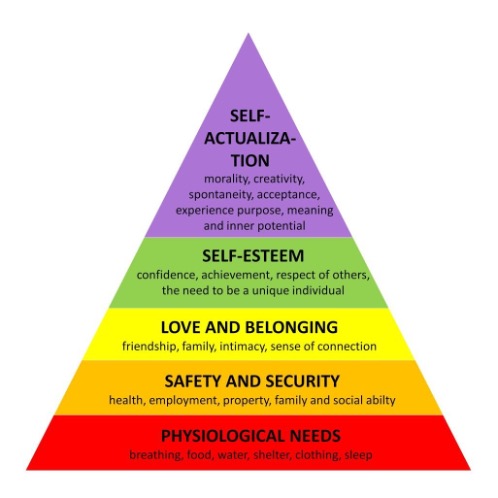
                                                                                                Source: SimplyPsychology.com

While I don’t wish to compare my own views on what true ‘quality of life’ is compared to Abraham Maslow’s ‘hierarchy of needs’ as shown in the pyramid diagram above, but it’s important to look at what makes a society flourish. I agree with Maslow at the base of the pyramid is the most important to ensure a life has some quality with it.

The societies that have the strongest base for ‘physiological needs’ usually are the happiest and satisfied with their quality of life. For example, you cannot focus on ‘safety and security’ as much as you can when you can’t even guarantee that the water you drink is clean and the air that you breathe is clean. Everything else on Maslow’s pyramid goes out the window if you are hungry, thirsty, don’t have a roof over your head or cannot clothe yourself or your family.

A lack or absence of ‘physiological needs’ is often found in the poorest or least developed of our societies and can still plague even our wealthiest and most developed societies. The key thing for all societies is that we should have an attitude of wanting to guarantee the ‘highest quality of life’ we can deliver to all people rather than just the few who can afford it financially. I do believe any society and its leadership is responsible for delivering on both ‘physiological needs’ and on ‘safety and security’ and once that is achieved, it will lead to better conditions whereas we go up Maslow’s pyramid, love, belonging, self-esteem, and self-actualization tend to be easier to achieve as well. True quality of life is knowing that if you fall on hard times, not by your fault, you’ll be looked after by your society and your government while you look to get back on your feet.

I don’t believe it’s anything farfetched or overly utopian to believe in everyone having the right to breathe clean air, drink clean war, have enough food each day, and have a roof over one’s head. I also think that while education and health care may not be on ‘physiological needs’, it ranks close in that regard to build that functional society. Everyone should be able to afford a good education and find good health care where they live and societies that accomplish this for their people are rewarded back and then some with citizens who are thriving as a result. Societies that are more educated, healthier, and with more opportunities to succeed tend to be those that have a true quality of life in my view.

You may be thinking that true quality of life is about having a big bank account, a bigger house, all the gadgets and electronics you could ever want, and all your material desires within reach, but to me, that would not go along at all with Maslow’s hierarchy. Having that stuff may make you happier but it doesn’t reflect a true quality of life in any society. If the roads are falling apart, people around you are suffering and in poverty, and you can go bankrupt for seeking medical care or a higher education, your quality of life will also suffer as a result even if you’re not directly affected by it.

When we are looked after or cared by others in the society who can ensure we have a good education, good health care, and to have affordable housing, the quality of life for everyone will go up. We are not islands unto ourselves alone and we are reflections of how we treat others. If you’re reading this article, think more about how your society or country could have a better quality of life not just for yourself but for the people living there too.

I ask that you believe in your ability to create change whether that’s advocating for more environmental regulations, prioritizing people’s access to basic needs including food and housing and thinking more about how we can include people in making them feel they belong in the society. We should collectively work towards providing more opportunities to everyone, so they don’t feel left out. Any healthy society has those public places to gather, discuss, and hopefully fix the quality-of-life issues going on in their community, town, city, or country.  

I don’t judge a society by how wealthy it is, how big the houses people live in are, or how much they have in material goods and services available. I judge a society by how they treat the least well-off members, how they prioritize the public good or not, and what they are doing to improve the overall quality of life rather than ignoring it or having it steadily decline under their watch.

It’s important for us to start thinking about not just ourselves and our own quality of life but those of our fellow man and woman. When they are worse off than us, let’s lift them up and look out for them instead of shunning them or isolating them instead. We should always be advocating for a ‘true quality of life’ where everybody is given the opportunity to succeed, grow, live healthy and happy lives, and pursue their dreams.

We all will be better off for having invested in the basic tenets of civilized society such as education, health care, transit, housing, and healthy food supply rather than just guarantee them for the few who can afford it. The higher the quality of life is not just for us but for every member of our society, the more likely we will all flourish together and reach our highest fulfillment.
What We Need vs. What We Want

Understanding that you must be able to divide up the two categories fairly and also be able to balance them healthily with our seemingly limitless desires at times is key to being a fully formed individual.

A key part of adulthood is being able to know the differences between knowing ‘what we want’ vs. knowing ‘what we need.’ Understanding that you must be able to divide up the two categories fairly and also be able to balance them healthily with our seemingly limitless desires at times is key to being a fully formed individual. As children, we are taught to temper our desires to manageable levels and to remember to not be selfish especially when it conflicts with the needs of others.

We are flawed as humans in that we often let our wants overtake our immediate needs and that we cannot distinguish the two in terms of actual importance. I may want a new suit but if I only have so much money, do I really need it? Am I being selfish by buying a suit when I already have a perfectly good one at you? These questions are especially important to pose when you have limited money or time to contribute towards either your needs or wants. What we focus on each day shows us if we care more about ‘needs’ or ‘wants.’

It has to be non-negotiable in your own life how your needs come first and will always come first. Your wants have to be considered in terms of whether you actually need them and how much they will actually add that much to your life. When it comes to your wants, you should not only be thinking about their utility in the short-term but also in the long-term. Will you be that much better off not just a day later, a week later, or a year later when you satisfy those wants? A short-term want will be fleeting and may end up not even be worth it whereas a long-term want like starting a business, getting your degree, or moving overseas are often worthwhile investments and satisfactory wants that will put you ahead in your life. If you do want to fulfill your wants, they should be in the interest of you moving forward, learning new things, and developing your interests.

Short-term wants are good every now and then like a new bicycle, a nice meal out with friends, or a trip to a day spa, but the gratification will be short-term, and you can’t rely on those wants to fulfill you in the long-term. Long-term wants are harder to achieve but they often have higher levels of satisfaction. These wants aren’t automatically given to you and you have to work for them but it’s often worth the effort more so than just things being handed to you automatically. Your wants have to be kept in moderation too because if you let your wants overwhelm your needs, you may be left with less than you had before. An adult keeps their wants in check and prioritizes their needs first to make sure that their life is headed in the right direction. Long-term gains have to always take priority over short-term gratification, which may give you happiness but won’t give you fulfillment in the long run.

Your needs in daily life should always come first in terms of securing them. Whether it is water to drink, clean air to breathe, food to eat, and a roof over your head; they are all part of the equation to keep you in good spirits and in good health. Do not let your wants take away from your immediate needs because when it comes down to it, your wants may come and go but your needs are your needs and that never really changes. Abraham Maslow’s ‘hierarchy of needs’ was pretty much on the money in terms of distinguishing what are most urgent needs are and beyond that, what could be considered wants. We have the physical needs of eating, drinking, sleeping, maintaining homeostasis (not too warm or too cold) but beyond that, we start to go into the wants territory of seeking out self-actualization as well as having a steady purpose in life.

We all need human connection along with friends and family who care about us but that is not given to everybody and that kind of need is something that you have to work for and what you have to ‘want’ in a way. We all need safety and security to carry out our lives but that is something that we have to work towards to and that is not guaranteed when we are born. What we need may not been given to us like friends and family or the security of a place we live in and we may have to take action to turn those needs into a reality by wanting them badly enough.

In Maslow’s ‘Hierarchy of Needs’, our basic needs must be taken care of first as the pyramid shows us but then you have our psychological needs such as love, relationships, friendships, and feelings of accomplishment and goal-setting. As you go up the pyramid, you get into the ‘self-fulfillment’ needs category of achieving our potential, reaching our set goals, and becoming the best version of ourselves through self-actualization. This category is tricky, but we may feel that we need to be fulfilled that way; how hard are you willing to work to achieve that and how much do you really want to achieve it?

I would argue that our basic needs of food, drink, shelter, warmth, etc. are real needs but our psychological or self-fulfillment needs are different in that while each of us need them in our life, they are really ‘wants’ that you have to earn and to work for. Our basic needs are not given to us either, but they are of such urgency that we will do almost anything to have them guaranteed and it often subsumes our other ‘needs’ like love, friendship, or career goals.

What we need to live is our number one priority. Everything after that is supplementary in life. What we want Is important but it’s clear that our wants are endless at times and we need to prioritize with our limited time and/or money what matters to us most to achieve or to have. Being able to prioritize while understanding this internal battle is key to being a fully formed individual capable of holding our wants at bay while getting our needs taken care of.

Lastly, it is important to distinguish between short-term needs and long-term needs. Short-term needs should always take priority over long-term needs, but you can work towards both at the same time. You can hunt for food and still have companionship with a loved one at the same time. You can watch your vegetables grow while you’re studying for your next course exam or replying to emails. However, if your immediate needs are unmet or neglected, your long-term needs will have to take a backseat because they are just not as critical as what short-term needs are in terms of daily occurrence. You need to eat and drink water a lot more than you need to see your family and friends as an adult. I’m sure you would love to see them every day but it’s more likely you would see them once a week or a month or maybe less if you’re really busy.

Your immediate needs can be balanced with long-term needs, however, if you can’t cook for yourself, make money to support yourself, or be able to clean and take care of yourself physically, not many or very few of your long-term needs can be met after. As an adult, you need to take care of the daily details before you can reach your lifelong dreams and goals. What we need vs. what we want is a constant battle taking place in our mind. If we don’t pay attention to how to win this battle by trusting in our innate knowledge of what we are capable of doing to achieve them one by one and what are healthy priorities to focus on, you won’t be able to get very far in life with either your needs or your wants.