

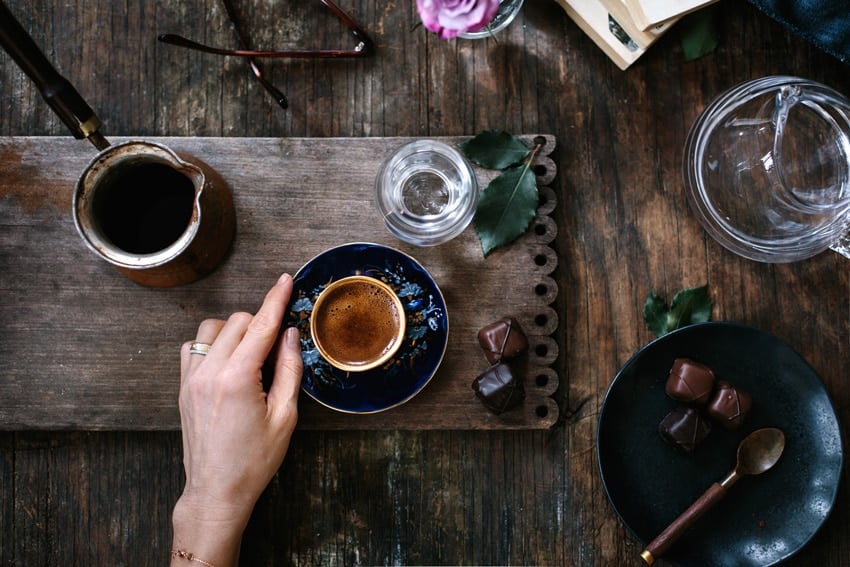
Thinking of Life Like It’s a Cup of Turkish Coffee

“Similarly to life itself, I find that the Turkish coffee experience is a lot like life and perhaps even more so than a box of chocolates (no offense to any Forrest Gump fans).”

I love Turkish coffee. Its roast, its scent, its strength, and subtle sweetness that I can’t get enough of. I don’t even mind the times I drink too much, leaving bitter remains on my tongue. I’m not too bothered by it because sometimes you must taste the bitter ends to get the sweetness out of most of the coffee you drink. Turkish coffee is unique, the jolt and caffeine rush unlike any other I’ve experienced in the world. Similarly to life itself, I find that the Turkish coffee experience is a lot like life and perhaps even more so than a box of chocolates (no offense to any Forrest Gump fans).

Preparing Turkish coffee to be served is an art, requiring patience, precision, and care, qualities life demands from us as well. The finely ground beans must be measured just right, water poured with attention, and heat applied slowly to coax out the perfect brew without letting it boil over. A slight misstep can change the flavor entirely, just as small choices in life can ripple into large consequences. Stirring the coffee gently, watching the foam rise, and letting it rest before serving mirrors the need to pause, reflect, and nurture the moments that matter most. In both coffee and life, the effort put into preparation shapes the richness of the experience and skipping the process only leaves you with a bitter, incomplete taste.

Just like a cup of Turkish coffee is carefully prepared with time and attention, life rewards those who pause to notice the details. The swirling patterns at the bottom of the cup hint at what’s to come, just as small choices ripple into larger consequences. Sometimes, life surprises you with unexpected flavors like a hint of cardamom, a twist of fortune, and other times it’s a sharp bitterness that makes you wince. But every sip, whether sweet or strong, shapes the experience and reminds you that the richness of life comes from paying attention, savoring the moment, and accepting the unknown.

When you first taste Turkish coffee, it’s like a jolt of pure energy and a rush that I would liken to the sun hitting your face as you wake up from a dream and when your consciousness first stirs in the morning. You try to recapture that feeling with each sip, chasing the sweetness that lingers consistently. You can even add a bit of sugar, stir it around to keep the bitterness at bay, and prolong the experience as much as you can. Life like a Turkish coffee cup is pretty small and the portion is not as big as you would expect. It’s a concentrated dose of caffeine and is a high-quality batch of brew.

Like life itself, you got to enjoy it to the fullest but also savor it at the same time. No matter your age, life rushes by, just like the last sip at the bottom of a Turkish coffee cup. Bitterness is inevitable in a Turkish coffee experience as it’s mixed in with the rest of the sweet flavor. There are bitter times in life to be had mixed in with the sweet times and as much as you try to avoid it or abstain from it, you need the bitter parts of life to truly realize how sweet the overall experience was. The bitterness reminds you to savor the good times and to not let it affect your perception of the life you had as a whole. Coffee, like life, can be bitter or strong at times, but that doesn’t mean we should stop living or stop drinking it. 

Especially towards the end of life, the bitterness is unavoidable and comes on strong. As health wanes and loved ones are lost, life goes on and you sip, and you savor it while it lasts. A good Turkish coffee is enjoyed ideally by a body of water like the Bosphorus Strait in Istanbul but ideally, it can be with a view of the ocean, the mountains, or even just on your back patio with the quiet of the day. Life, like Turkish coffee, should be embraced in all its sweetness, bitterness, and everything in between. You really don’t want to miss out on the whole experience having never fully lived it to the most extent. Don’t miss it. Drink it all.

Cuisine Spotlight – Feijoada

Feijoada: The National dish of Brazil. It is delicious, fulfilling, savory, and tasty. There are not enough adjectives in the English language to describe this scrumptious plate of goodness. While also prepared in other parts of the Portuguese-speaking world such as Portugal, Angola, Cape Verde, and Mozambique, Brazilian Feijoada is more than just beans and pork. It has a little bit of everything to make it a unique dish that has protein, carbs, and even sugar to satisfy one’s taste buds. The Brazilian Feijoada was born in Recife and developed in Rio de Janeiro but has now spread across the entire country reflecting its status as a beloved national dish.

From Salvador to Sao Paulo and from Recife to Rio, every Thursday and/or Saturday, the hearty Feijoada dish is prepared for families and friends to enjoy together. While there is some variation in terms of what is to be offered on your plate, you can definitely expect to find a big clay pot bubbling with black beans, different pork and beef parts including oxtail and tripe, as well as tongue perhaps. In the Northeast of the country, the clay pot can also include different vegetables such as kale, potatoes, okra, carrots, etc.

The side dishes can vary across the country, but it is quite common to serve couve, a kind of collard greens dish that is chopped up and stir fried adding to its overall flavor. You also can have chicken steak with fried yucca (mandioca) as well as fried plantains (bananas) as a kind of dessert or sweet tooth necessity if you still have room. To mix with the black beans and the couve, you also have cooked white rice, which is nicely mixed together with the meats as well to create a beautiful plate of both Brazilian history and culture.

To clean your palate afterwards, some fresh orange slices can also be added to the plates offered in order to help with digestion. Beforehand, usually, you will be offered a cup of savory black bean broth, kind of like the soup, to slurp down ahead of the feijoada, which can also be added to the dish if you so choose to. Of course, you have baked pieces of bread as well that can soak up the juices and the broth to add on to an already gigantic plate of heavenly food.

What you need to keep in mind about Feijoada before diving in is that you need to eat it on an empty stomach and to clear your schedule for the day because chances are good that you will need a nap and a glass of water after diving in. For those of you who get the ‘meat sweats’, it’s good to take your time and eat slowly. The Feijoada dish is very heavy so it’s good to relax, have a beer or caipirinha, talk with your friends, and make sure you pace yourself since you will be likely not to do anything else for the rest of the day.

This is not a national dish for vegetarians and Brazil is not the easiest country to be a vegetarian in. You can have Feijoada without the pork parts and the beef stew, but it is really not the same in my opinion. Vegetarians can join in on this delicious dish, but they are definitely not getting the same experience as meat lovers sadly enough. I do love that Feijoada is only offered once or twice per week showing that it’s kind of a national pastime to have it specifically on a Saturday and then you can take the rest of the weekend off as you will probably need to after gaining a few pounds or kilograms.

You can have Feijoada for lunch or for dinner, but it usually is only eaten one day a week. The only thing you should really plan to do after eating Feijoada is perhaps watching the big football match of the weekend and perhaps relaxing with a few glasses of water. You can compare it to the Colombian dish of Bandeja Paisa in a way, but the amount of different foods represented in Feijoada is definitely impossible to beat. You could compare it to the ‘soul food’ cuisine of the Southern United States but there’s still no dish from the American South that quite compares to Feijoada. Similar to the traditions of ‘soul food’, there is a complicated and rough history behind the beginnings of Feijoada which just goes to show how resilient people in very difficult situations regarding food can make a beautiful, tasty dish out of almost nothing or the scraps made available to them on purpose. In order to really know Feijoada, it’s important to dive into the history of the dish as well and what exactly makes it unique to Brazil.

From what I have learned, the origins of Feijoada are up for date but since this kind of stew with pork and beans was quite popular among European settlers, it can be inferred that it was brought over by the Portuguese during the colonization period. However, it seems that the dish was expanded upon by the slaves in Brazil who would add other ingredients such as the couve, the arroz (rice), and the mandioca as these were other foods available to them. Gathering all of these foods together and putting them as a mixture on a big plate would be a hearty yet simple meal to have when it came time to preparing it before or after a long day of work in the fields or farms. While slaves were restricted to rice and beans, special occasions such as holidays allowed them to get different pork parts or beef parts considered less desirable by their masters and to throw them together in a stew to help them feed themselves and get more protein as they worked in the kitchens. From the kitchens to the fields to the cities, Feijoada has earned its status as the national dish of Brazil.

Feijoada is very much a creative and improvisational dish where you have to do the best you can with what you have and put it all together when you don’t have much time to prepare a flashier meal. What Feijoada lacks in flashiness, it more than makes up for it in the sheer number of flavors and food groups the dish makes up. Between the rice and beans, the meats, the greens, and the after-meal delight of an orange slice or a shot or two of cachaça and you will definitely be satisfied with one of the greatest meals you could ever have in Brazil.