It is very rare where I must see a movie in theaters twice. That was exactly the case though for this summer’s blockbuster hit and clear Academy Awards contender, ‘The Odyssey’ (2026), directed by Christopher Nolan, which is a stunning film revival of the 3000-year epic. While it’s been a long time since I read Homer’s epic in high school, ‘The Odyssey’, the basic premise of Nolan’s film adaptation has stayed largely the same with some changes and subtractions needed to preserve a three-hour screen time.
This film deserves to be seen in theaters, at least once, preferably in the order of 1.) IMAX 70mm, 2.) IMAX regular, 3.) 70mm, depending on what is available in your local movie theater. This film is one of those rare ones where three hours flies by, there are no major weaknesses besides some small sound mixing difficulties, and the last third act of it may be the best of the 2020s decade so far.
Why am I so ebullient about ‘The Odyssey’? There are a lot of positives about this film but the biggest one for me was just how beautifully shot this film is, how the locations seem otherworldly and seem to come straight out of the pages of Homer’s epic poem, and how your mouth drops at certain points of the film wondering just how Nolan pulled filming these scenes off? I know there are no real spoilers for a 3000-year-old epic, but consider the Cyclops scene, the Hades scene, and the Troy scenes, for which all of them will go down in cinematic history as some of the best of all-time.
It’s not just the big battles that are done well in terms of clear direction and cinematography; there are the small moments in the film where you see Odysseus looking out at a pack of dolphins swimming in the sea by his ship, panoramic and sweeping views shot of Ithaca (Odysseus’s kingdom), and the various islands and islets that make up the ill-fated journey home but never really become that repetitive in terms of their setting.
More than how visually stunning ‘The Odyssey’ is as a film but also how complete of a movie it is when you focus on the beautiful music score of Ludwig Gorannson, one of the best composers in film today, if not the best, currently working in film music. It is a haunting score tied deeply into each unique scene, and for which never feels out of place or is too overbearing. Especially seeing it in IMAX, the score and sounds are immersive, so every Cyclops yell, clash of swords, and soldiers’ war cry feel amplified like you’re also there in Ancient Greece. Now, I understand there are complaints about the casting, costume design, authenticity of the period, but that never affected my judgment of the movie rarely, if at all. You could argue about the authenticity of this adaptation but the creativity, the direction, the acting, the scenery, and the overall messages and themes of the film are all phenomenal and speak to why this is the best film of 2026 so far.
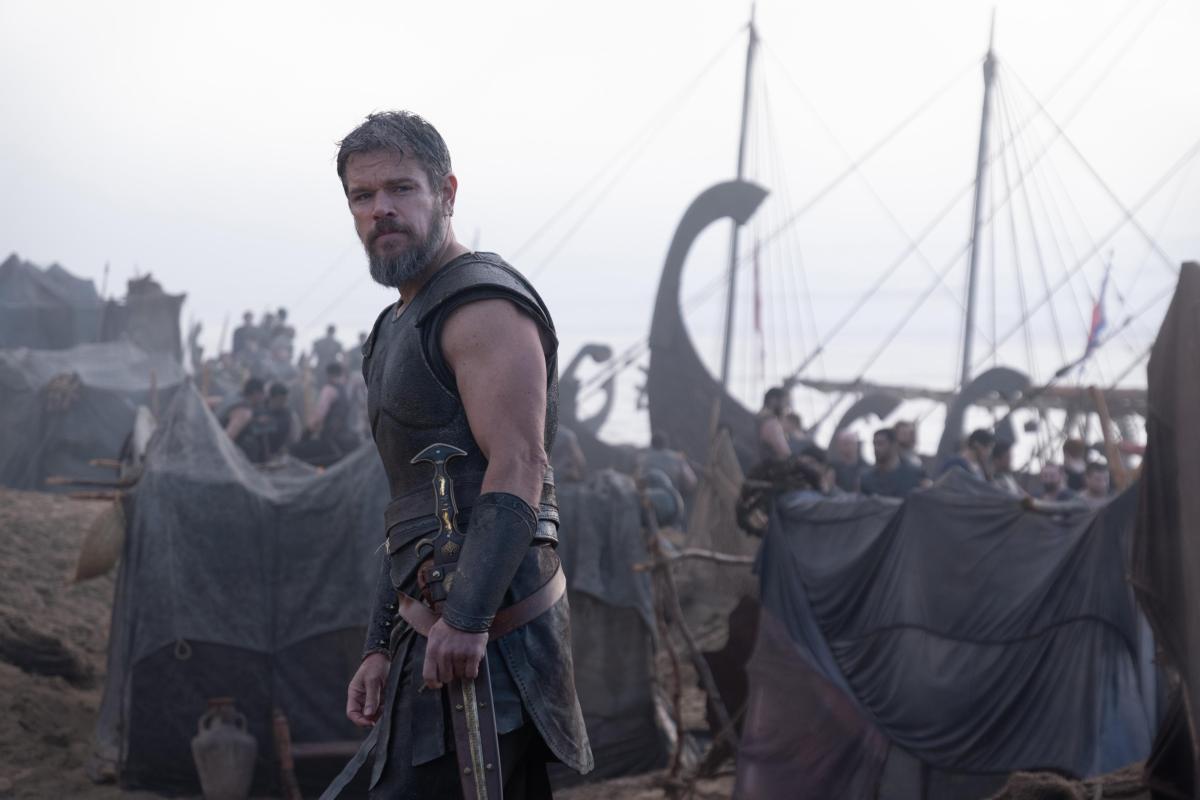
Matt Damon as ‘Odysseus’ was honestly much better than I had expected going into my viewing, and he is able to carry the sheer physicality and mental toll of playing this character. He looks convincing as a wily, cunning, aging, and most assuredly stubborn King of Ithaca whose hubris leads his men astray for more than ten years after the victory at Troy. Damon really puts his heart and soul into this role, and you can tell how dedicated he was to show how Odysseus’s fateful decisions at Troy affected how he viewed his decades-long journey home after that fateful night of what became a ‘hunt’ and not a ‘fight’ after pulling off the Trojan horse gambit at the film’s beginning. His anguish, regret, pain, sorrow, and other emotions boil to the surface of his ‘Odysseus’ character without feeling forced or out of place throughout the film, especially in its conclusion when he delivers an impactful monologue upon seeing his beloved ‘Penelope’ again.
Anne Hathaway deserves equal praise for her portrayal of ‘Penelope’, Odysseus’s wife, who provides the emotional counterweight to Damon’s Odysseus. While Odysseus spends the film fighting, wandering, scheming, and trying to find his way home to Ithaca after the Trojan War, Penelope is forced to endure the much quieter but arguably just as difficult burden of waiting, especially since she can’t usurp the throne in the meantime as a woman. Hathaway does a wonderful job portraying a woman who is resilient without becoming emotionally hardened, and hopeful without being naïve about where Odysseus is.
The importance of Ithaca throughout the film is largely embodied through Penelope’s dilemma of moving on with her life. It is not simply the physical destination that Odysseus is desperately trying to reach; it is his family, his identity, and the life that existed before the Trojan War transformed him. In that sense, Hathaway makes Penelope an essential part of the film’s larger meditation on what it means to come home.
Samantha Morton as the sorceress ‘Circe’ deserves considerable credit for making the human consequences of the Trojan War impossible to ignore. Troy is presented as a spectacular military achievement, but Nolan is far more interested in showing that victory does not necessarily mean anyone has truly won. The Greeks may have conquered Troy, but the war has left behind an enormous amount of suffering, grief, trauma, and resentment for which Circe is keenly aware of when she encounters some of Odysseus’s men in the aftermath.
Morton’s heart wrenching performance as ‘Circe’ helps demonstrate that the people who pay the greatest price for the ambitions of kings and warriors are often the people who had the least say in starting the conflict in the first place. The Trojan War may be the film’s great military triumph, but it is also the beginning of Odysseus’s tragedy. The victory at Troy is not the end, but rather the beginning of consequences that ripple outward through the epic, affecting every character, human and otherworldly alike, in a world defined by a “time of apparent magic” and humanity’s defiance of the gods.
Robert Pattinson deserves considerable praise for his portrayal of ‘Antinous’, one of the film’s most despicable characters. Pattinson leans into Antinous’s arrogance, cowardice, and entitlement without turning him into a stereotypical cartoon villain. He represents something fundamentally different from the external dangers Odysseus faces throughout his journey: the corruption that can develop inside a supposedly civilized society when the institution erodes without true leadership. Antinous has power, status, and access to Ithaca’s royal household, yet he uses those advantages to intimidate and exploit rather than protect, as he had promised Odysseus when he left for the Trojan War that he would look after Telemachus, Odysseus’s son.
His behavior toward Penelope, Telemachus, and the other suitors makes him particularly effective as a symbol of what happens when Zeus’s hospitality is abused. Guests are supposed to respect the household that welcomes them, but Antinous and the suitors increasingly act as though Odysseus’s and Penelope’s home belongs to them. Pattinson makes that arrogance believable, and his performance becomes vital to the film’s eventual final reckoning in Ithaca. The biggest danger facing Odysseus is ultimately not just the monsters and gods he encounters abroad; it is also the possibility that the civilization he has fought so hard to return to has been hollowed out from within, largely thanks to Antinous and his ilk.
John Leguizamo’s performance as Eumaeus provides almost the perfect counterpoint and is the film’s #1-character standout in my view. Where Antinous represents entitlement, Eumaeus represents loyalty, humility, and genuine hospitality. He is not a king, warrior, or powerful political figure in Ithaca, yet his humanity makes him one of the most important supporting characters in the epic.
Eumaeus demonstrates that civilization is not ultimately sustained by the people with the most power but by ordinary people who continue to treat others with dignity even when they have little to gain from doing so. His relationship with Odysseus also gives the homecoming storyline some of its emotional warmth. After everything Odysseus has endured, Eumaeus represents a version of Ithaca that is still worth returning to decades later: a place where loyalty and decency have survived despite the chaos surrounding it. Leguizamo brings a grounded humanity to the role that helps keep the film from becoming consumed entirely by its larger-than-life spectacle.
The major theme of moral reckoning becomes especially important when considering the film’s depiction of Troy and the broader world surrounding Odysseus. One of the more intriguing aspects of The Odyssey is its multiple references to the so-called ‘Sea Peoples’ and a Mediterranean world that increasingly feels as though it is coming apart at the seams. Historically, the Bronze Age collapse was an enormously complicated event with multiple possible causes, and it would be overly simplistic to suggest that the ‘Sea Peoples’ alone brought down the civilizations of the eastern Mediterranean.
However, as a cinematic device used by Nolan, the reference made to them is enormously effective when you watch the film. Nolan presents a world in which established civilizations are becoming increasingly unstable, populations are moving, kingdoms are fighting for survival, and the institutions that once connected different peoples for trade and cooperation are beginning to disappear because of the loss of ‘xenia’ or hospitality.
The seamless weaving of a powerful central theme is where The Odyssey becomes much more than an adventure epic. One of the most important concepts in Homer’s original epic is xenia, the ancient Greek tradition of hospitality toward strangers and guests. Throughout Odysseus’s journey, hospitality is treated almost as a moral law. How a person treats a stranger reveal something fundamental about that person’s character and the society in which they live. Some people welcome Odysseus and his men in the film. Others exploit them, imprison them, attack them, or treat them as something less than human. The consequences of Odysseus’s choices are often enormous, and it all started with his idea of the Trojan horse, leading to the invasion, capture, and the fall of Troy that led to the loss of Zeus’s hospitality being universally practiced.
Nolan’s film adaptation of the epic makes this ancient idea surprisingly relevant to our world today. Civilizations are not held together solely by armies, walls, ships, or kings. They depend upon trust, reciprocity, restraint, and the belief that people outside our immediate community still possess humanity and dignity. Once those principles disappear, every stranger becomes a potential enemy, every neighbor becomes a potential threat, and every disagreement becomes a reason for violence. The result is a world increasingly incapable of cooperating with itself.
That makes the Bronze Age setting of The Odyssey epic feel almost eerily contemporary without the movie ever needing to become explicitly political. The civilizations surrounding Odysseus are not destroyed simply because they lack powerful warriors. They are part of a world in which conflict, displacement, revenge, greed, and mistrust have become increasingly difficult to contain or avoid. The film suggests that civilization is more fragile than we like to believe. It can take generations to build a functioning society and remarkably little time to begin tearing it all apart.
Perhaps that is why the film’s emphasis on homecoming ultimately carries so much weight for everyone who has watched it in theaters. Odysseus is not simply trying to survive long enough to reach Ithaca and his family. He is trying to return to a world that existed before the war and before his own mistakes changed that world forever. The journey home forces him to confront the difference between being a great warrior and being a good king, between being clever and being wise, and between winning a war and understanding what that fateful victory cost you.
Ultimately, that is what makes The Odyssey such a compelling film in 2026. Beneath all the spectacular battles, enormous sets, incredible locations, visual effects, and booming IMAX sound is a remarkably old story about very familiar problems for humanity: pride, love, grief, revenge, loyalty, temptation, family, and the desire to return home after being changed by the world. Christopher Nolan has taken a story that is roughly three thousand years old and somehow made it feel alive and vibrant again, which is no small achievement at all.
That may be the most lasting achievement of Nolan’s The Odyssey as an adaptation. It takes an ancient story about one man trying desperately to get home and turns it into something much larger: a story about what happens when humanity loses its way, and what it takes to find its way home again. For me, that makes The Odyssey the best film of 2026 so far, and one of the rare Hollywood blockbusters that feels worthy of the word epic. I went to see it the first time in IMAX. Then I went back and saw it again in 70mm recently because it was that good. I suspect that says just about everything about how special this film is and why you should see it yourself.