The Hidden Harm of Toxic Positivity

“Toxic positivity often comes from a good place whether it’s a desire to encourage, comfort, or inspire. Yet, when optimism becomes an expectation rather than a choice, it can silence genuine emotions and leave people feeling isolated during life’s most difficult moments, personally or professionally.”

It’s good to stay positive in both professional and personal contexts, especially as being negative or pessimistic can be very isolating in American culture. I think of myself as a forward-looking person who likes to think things will eventually work out in the end and if not, at least you did your best to swing the outcome favorably. Being positive and ‘toxic positivity’ is very different though as there’s a clear difference between being positive all the time (toxic positivity) and being positive yet realistic. When you’re positive all the time and want others to do the same, you really gloss over the negatives of any situation and when real fixes need to be applied rather than brushed over.

When you’re hoping for a positive outcome, you need to understand clearly what the issue is, how to resolve it, and how to keep a realistic perspective on why that problem exists. Toxic positivity means never needing to acknowledge the problem at hand and can be easily compared to the ‘elephant in the room.’ Not only can this lead to individual issues but it can also affect larger organizations and institutions as a result.

Institutionally, it’s good to be optimistic and want everyone to be positive on how things are going, but if you’re constantly only thinking about what’s good and ignoring what’s bad or what could be improved and also not listening to the individuals pointing out the issues that could be fixed, the institution, whatever sector you’re in, will decline as a result. An after-effect of not acknowledging problems or even being allowed to voice them is that the ill effects of this attitude can spread where people end up being gaslit, silenced, or even isolated entirely causing the trust in the institution’s capacity to solve actual problems to suffer as a result.

Whether at an individual or larger level, you should be able to acknowledge the good and bad in every situation and be comfortable sharing it personally or professionally. It’s important to make sure you’re not too heavy in the positivity or the negativity but both sides must be shared for things to progress. If you’re constantly positive and not thinking about what could be improved or taken care of, nothing will change and small issues could become big ones if not addressed. The same goes for if you’re constantly negative and nitpicking every little thing, you won’t be able to foster cooperation or problem solving and end up hurting your reputation or your ability to deal with challenges or that of your organization in the future.

Being honest with yourself about what needs to change, am I responsible for what needs to be done, and how to think about the good and bad of any situation is key to being a full-fledged adult and having real introspection. The same can be said for any organization or institution looking to improve itself. If you are silencing dissent, aren’t transparent at all, and never solicit feedback from within the professional body you are apart of, things will end up much more negative as a result and problems will never get solved and likely lead to larger issues.

I’ve always thought that there is never going to be a perfect situation, result, or outcome individually or institutionally and that it’s important to acknowledge the positives while being clear about the negatives too. Sometimes, nothing can be done about a negative situation but it’s important to at least acknowledge that it exists instead of pretending that it doesn’t exist at all.

Personally, think of your own accountability in how you handle everyday situations when maybe you don’t do as well as on a test even though you passed it, you still could have done better and studied more. Yes, you may have gone to the gym once or twice a week and that’s a nice habit but perhaps you can do more still to improve your physical fitness. Professionally, is there a ‘lessons learned’ that you glean from a project or presentation on what went well and what could be improved for next time? Are you able to give feedback about your organization without worrying about what they’ll think of you, or will there be isolation because of expressing your views?

Toxic positivity often comes from a good place whether it’s a desire to encourage, comfort, or inspire. Yet, when optimism becomes an expectation rather than a choice, it can silence genuine emotions and leave people feeling isolated during life’s most difficult moments, personally or professionally. True positivity is not pretending that everything is fine all the time; it is having the courage to face reality while believing that better days are still possible.

By creating space for honesty, empathy, and authentic conversations, we build stronger relationships and healthier communities where people feel seen, heard, and supported. Sometimes the most powerful response isn’t offering a silver lining at all. It’s simply saying, “I’m here with you,” or “I understand where you’re coming from,” and giving someone the freedom to express both the highs and lows that make us human. After all, genuine compassion isn’t about replacing difficult emotions with positive ones, it’s about making sure no one has to face them alone.

Life’s Unlikely Cinematic Moments

“Every so often, without warning, life gives us something entirely different. It hands us a scene that could have come straight from a movie.”

Life certainly has its fair share of dreary or uninspiring moments like driving to work in heavy traffic, waiting in the doctor’s office for an appointment, or wandering down grocery store aisles searching for one specific item among hundreds of others. It’s easy to think that life is mostly made up of obligations, routines, and responsibilities. Every so often, without warning, life gives us something entirely different. It hands us a scene that could have come straight from a movie.

We spend so much of our lives chasing milestones: job promotions, weddings, vacations, birthdays, graduations, or other long-awaited accomplishments that we often overlook the quiet moments in between that are just as special. Ironically, those quieter scenes are often the ones that replay in our memory years later. They aren’t memorable because something extraordinary happened. They’re memorable because, for a moment, everything around us seemed perfectly composed, almost as if someone had carefully framed the world through a movie camera lens.

In these cinematic moments, nothing particularly significant happens that affects you deeply. There are no life-changing conversations or dramatic plot twists to go with this kind of cinematic moment. Instead, it simply feels as though everything is exactly as it should be. All your senses become heightened when this happens and you notice sounds that normally blend into the background, appreciate the way the light falls across a street or over a mountain, and become fully present rather than rushing toward whatever comes next.

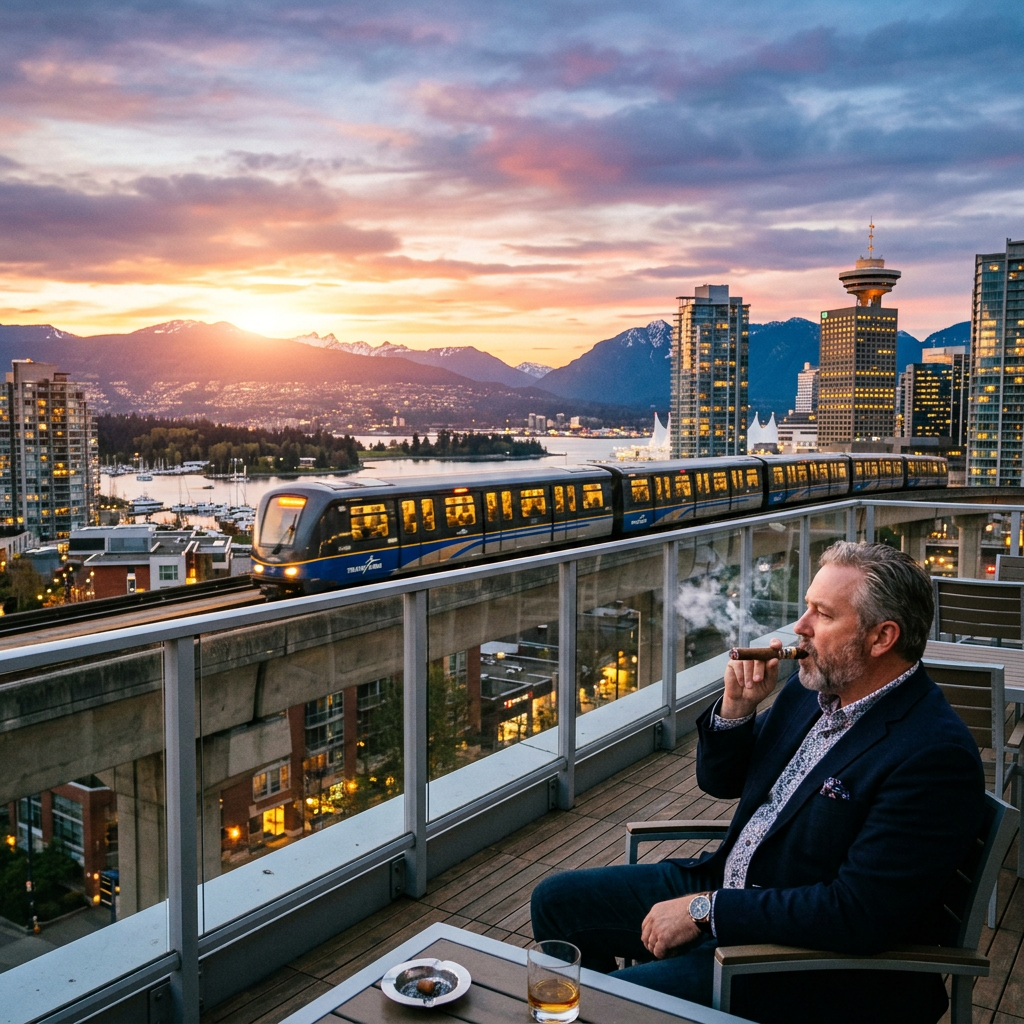
One evening in Vancouver, Canada earlier this summer, I wandered into Richmond’s Chinese food district with no agenda beyond enjoying a late-evening snack at the Yaohan Centre and exploring the different vendor offerings. As the sun slowly sank toward the Pacific, the distant mountains caught the day’s final light, glowing softly against the evening sky. I stepped outside with a cigar I had purchased earlier in the trip, lit it, and settled in to enjoy it while watching the sunset. Above me, the SkyTrain thundered overhead every few minutes as aircraft lined up for takeoff and landing at Vancouver International Airport.

Between bites of dumplings, conversations in Mandarin and Cantonese drifted through the air as cars quietly came and went from the Centre’s parking lot. The city never stopped moving, but for ten minutes, I did. This moment felt less like traveling and more like standing inside a perfectly framed movie scene, where I was somehow both the audience and one of the characters. There was no grand event taking place or resolution occurring for me or anyone else at the time. Nothing about those minutes would have made the local news or anyone else’s travel itinerary. Yet it remains one of the moments I remember most vividly from my time spent in Vancouver.

Looking back, I’ve realized that these cinematic moments are different from life’s highlights. Highlights are the events we intentionally chase throughout our lives. We save money for them, put them on our calendars, and count down the days until they arrive. They are weddings, birthdays, promotions, championship games, graduation ceremonies, concerts, national parks, and bucket-list vacations. They’re often the moments we photograph the most and eagerly share with friends and family. Cinematic moments are something else entirely in life. They aren’t destinations but rather they’re scenes that we set for ourselves, intentionally or otherwise.

The coffee you grab before the concert, where you unexpectedly strike up a conversation and meet someone special, becomes more memorable than the concert itself. The quiet walk back to your hotel late at night, with the city lights guiding your way after visiting a famous landmark, stays with you longer than the attraction itself. The stranger you briefly talk to and instantly connect with on a train for hours telling each other your life story ends up becoming your favorite memory from the trip itself. They are unexpected gifts hidden within ordinary moments that quietly become extraordinary. Highlights tell the story of what we accomplished or where we went. Cinematic moments remind us how life felt along the way within our accomplishments.

The more I’ve traveled, the more I’ve noticed these moments appearing in places I never expected. Walking down a quiet street after an unexpected snowfall with no one else around except the sound of my boots pressing into fresh snow. Enjoying a coffee in a plaza in Medellín while teenagers laughed and shouted encouragement to one another during an impromptu soccer match. Sitting alone on a quiet stretch of beach in Ubatuba, Brazil, listening to nothing but the waves, the wind, and seabirds overhead. Watching the clouds briefly part at Mount Rainier just long enough to reveal the majestic summit before closing again. Even sitting in a busy airport terminal as travelers from every corner of the world cross paths beneath a glowing departure board can unexpectedly feel cinematic and has captivated my full attention many times over.

None of these moments were planned. None of them appeared on a trip itinerary. None of them could have been recreated if I had tried. I’ve come to realize that life’s most cinematic moments rarely announce themselves. They happen beneath train tracks, along airport approach paths, inside neighborhood cafés, on ferry rides, during aimless walks, and in places that most people pass through without a second thought. They last only five or ten minutes before disappearing forever. Perhaps that’s exactly what makes them so meaningful to experience and take note of.

We often measure our lives by the promotions earned, the money made, countries visited, races completed, or milestones reached. These life achievements deserve to be celebrated and remembered. However, I believe life is equally shaped by its quieter scenes, the moments when the lighting is right, the sounds around us blend, and the world briefly feels perfectly composed.

Those moments cannot be scheduled, purchased, or manufactured. Our only responsibility is to slow down enough to recognize them while we’re fortunate enough to still be standing inside the scene and remembering it later. After all, some of the greatest scenes in our lives will never make anyone else’s highlight reel. They’ll simply become part of our own lifelong soundtrack.

The Modern Siren Is Endless Distraction

“Unlike Odysseus having his crew being able to restrain him with rope at the ship’s mast, most of us willingly untie ourselves from the mast because this Sirens song is irresistible and we often don’t have a choice but to play along.”

After watching the film adaptation of The Odyssey, directed by Christopher Nolan, I couldn’t stop thinking about one scene in particular: the Sirens and the particular song that Odysseus, the poem’s protagonist hears, which promises him ‘endless knowledge’ that he forces himself to listen while making sure his men put wax in their ears and steer by them oblivious to their song. In Homer’s epic, the Sirens don’t overpower the sailors through force. They do something far more dangerous, they tempt them with their deepest desires and promise them that if they only come closer, their desire will come to fruition.

Their irresistible song lures ships off course, tempting men to leap overboard in pursuit of false promises, only to be dashed against the rocks and killed. Odysseus, knowing he wants to hear the music but survives the perilous encounter of getting back home to his wife Penelope, orders his crew to plug their ears with wax and tie him tightly to the mast. No matter how much he begs to be released, they refuse out of loyalty and need his guidance so they can get home as well.

Thousands of years later, I think the Sirens are still with us in the modern era, but the song has changed as a result. Today’s ‘Sirens’ lives inside our phones, laptops, televisions, streaming services, and social media feeds. They don’t sing beautiful melodies or songs. They send notifications. They ping us with alerts. They autoplay another video without us asking them to do so. They recommend one more article, one more reel, one more breaking news alert, one more email to answer before bed.

Individually, none of these distractions seem harmful on the surface and are quite pleasurable like a relentless itch that you just must scratch to satisfy yourself. Collectively, they become incredibly powerful when amassed over the course of a day, a month, or a lifetime. The greatest challenge of the modern world isn’t necessarily a lack of information. It’s an abundance of it that we are forced to sift through and must spend valuable time finding the information that leads to real knowledge and understanding. Never have we had such unlimited entertainment, endless news, hundreds of sports events, millions of opinions, and practical communication available every second of the day with anyone in the world. Every company is competing for the same scarce resource: our attention.

Unlike Odysseus having his crew being able to restrain him with rope at the ship’s mast, most of us willingly untie ourselves from the mast because this Sirens song is irresistible and we often don’t have a choice but to play along. The irony is that modern technology has made us more connected than ever while making sustained concentration increasingly rare. Reading a book for an hour without checking your phone can feel difficult or nearly impossible, especially after a long day at the office, shop, or the factory. Working deeply on a project without interruptions has become almost a luxury. Even conversations with friends are often punctuated by glances at glowing screens. Studying for a certification, a class, or tutoring yourself continuously without being interrupted is also a challenge in it of itself.

This isn’t because we’re collectively lazy or impulsive. It’s because modern technology and their companies are extraordinarily effective at capturing our attention. Infinite scrolling, personalized recommendations, variable rewards, and carefully engineered notifications aren’t accidents, they’re features that are built in to extract our attention and our resources. The longer we stay engaged, the more valuable our attention becomes and the more content that is thrown our way to hook us in deeper.

That’s why I don’t think the answer is rejecting technology altogether and becoming a ‘luddite’. My career depends on using modern technology. I travel because of it. I learn through it. I stay connected with family and friends because of it. The challenge is making sure we remain the ones steering the ship and can take breaks or pauses when we need to and can limit these distractions as much as possible.

Odysseus understood something that feels surprisingly modern even if based off a 3000-year-old epic tale: willpower alone wasn’t enough. He knew he would be tempted, so he built systems before the temptation arrived. The wax in his crew’s ears and the ropes around the mast weren’t signs of weakness. They were acknowledgments of human nature and of our fallibility. Maybe our own “wax and rope” look different today. They may look like disallowing notifications, turning your phone off for certain times of the day, unsubscribing from useless subscriptions or email chains, or just detoxing entirely for a week or a month if you can.

Each day, you must choose willingly to put the safeguards on as best as possible. Even when you start small by leaving the phone in another room while reading or taking walks without earbuds, you can then set aside uninterrupted time for meaningful work or leisure. Choosing boredom occasionally instead of reaching for another dopamine hit. These aren’t anti-technology habits that are against these modern advancements that have made our lives more convenient. They’re pro-attention habits that allow us to create more, think more clearly, and be able to finish more projects and bolster our self-worth.

What we pay attention to is ultimately how we spend our lives. Every distraction carries an opportunity cost. Every hour spent mindlessly scrolling or doomscrolling is an hour not spent building relationships, learning a new skill, creating something meaningful, or simply sitting with our own thoughts.

The Sirens haven’t disappeared since Homer’s time. They’ve simply become digital. Every day, they call us; not with beautiful songs, but with vibrations in our pockets, breaking news alerts, endless news feeds, and the promise that happiness or fulfillment lies just one click away. Unlike Odysseus, we don’t encounter them once on a voyage to Ithaca. We encounter them dozens, if not hundreds, of times, each day.

The question, then, is the same now as it was for Odysseus: What are we willing to do to stay on course? Because every “yes” to distraction is often a “no” to something that matters more. A meaningful conversation. A difficult project. A great book. A new skill. Time with family. A quiet walk. Our own thoughts and ideas. Attention isn’t just what we focus on, it’s what we choose to give our lives to.

Perhaps that’s why The Odyssey still resonates nearly 3,000 years after it was first told and has now become a blockbuster motion picture success around the world. Beneath the monsters, witches, gods, and epic adventures lies a deeply human story about resisting temptation and remaining faithful to a destination worth reaching and a family worth preserving. Odysseus doesn’t survive because he is the strongest or most courageous man. He survives because, when it mattered most, he refused to let temporary pleasure pull him away from his long-term purpose.

The modern Sirens are unlikely to wreck our ships on jagged rocks in the middle of the sea. However, they can quietly steal something just as valuable: our time, our focus, and the years of our lives, one distraction or notification at a time. The challenge ahead isn’t to eliminate technology or diminish its relevance. It’s to master it before it masters us. Because in the end, the life we build will be shaped less by the things that demanded our attention than by the things we intentionally chose to give our attention to.

At Its Best, Sports Unites the World

“Whether it’s the FIFA World Cup, the NBA Finals, or the Olympics, sports at their best unite a city, a country, and even the world together.”

Beyond politics, religion, and the many divisions that shape our daily lives, sports remain one of humanity’s most powerful ways to gather. What other way can millions of people gather in New York City, Buenos Aires, or elsewhere to celebrate a victory in a major sport? Whether it’s the FIFA World Cup, the NBA Finals, or the Olympics, sports at their best unite a city, a country, and even the world together.

In these divided and turbulent times, events like the World Cup remind us of our common love of sports and competition. Even when nations face off against each other, it’s a great way to get peoples of different backgrounds together to try each other’s foods, to dance together, and to even share a stadium in a peaceful manner even when they might have nothing else in common. Singing, dancing, celebrating in the streets means that it’s more than just about kicking around a football / soccer ball, it’s about bringing a group of people together to have a real feeling of community again.

Yes, there are always controversies about the sporting world, and the World Cup is no different. Like any human endeavor, sports are often flawed and sometimes unfair. However, it is still the best way to bring people together to receive joy, happiness, and sometimes heartbreak. Sports are a microcosm of life as it may not go your way, but it can bring the best out of you and others when it’s at its best. I have nothing against any religion or anyone’s politics, but when you compare them to sports, there’s no contest in how the latter can bring people together, even in the billions of people to pay attention and cheer their team on in a peaceful and joyous manner.

Perhaps the greatest power of sports is that they allow us to experience belonging without requiring agreement on everything else. A person wearing a jersey in Los Angeles, São Paulo, Seoul, or Nairobi may have completely different political beliefs, religious traditions, or life experiences than the person standing next to them even if they are from the same city or country, yet for ninety minutes, four quarters, or three periods, they are connected by a common purpose. They are not strangers anymore. They are teammates in the moment invested in the same game.

Traveling around the world has shown me that sports are often a universal language that anyone can relate to. You may not speak the same language as someone from another country, but you can celebrate a goal, debate a referee’s decision, or laugh together about a missed chance. A simple conversation about a favorite player or a historic match can open the door to a new friendship. Sports create a bridge between cultures around the world, especially with the World Cup, because they start with something everyone understands on a fundamental level: the excitement of competition and the desire to be part of something bigger than yourself.

Some of my most memorable experiences on the road have not come from famous landmarks or tourist attractions, but from being surrounded by thousands of strangers during a sporting event regardless of if it was rugby, soccer, basketball, or tennis. There is something magical about standing in the crowd where everyone is singing the same song, wearing the same colors, and feeling the same emotions. For a moment, individual worries and biases disappear, and everyone becomes part of one collective experience.

That does not mean sports can solve all the world’s problems as sports like humanity are often flawed and imperfect too. A soccer match will not erase ongoing political disagreements, end active conflicts, or fix social or economic divisions. Perhaps that is exactly why sports matter to most of the world’s people. They give humanity a reminder of what is possible and strive for better. They show us that simple competition does not always have to lead to hatred, and that our differences do not have to prevent connection from happening.

At its best, sports are not about defeating another person or team; they are about sharing an unforgettable moment with millions of other people. A championship parade, a World Cup celebration, or an Olympic victory becomes a memory that people carry for decades or even the rest of their lives. Long after the final whistle blows, people remember where they were, who they celebrated with, and how they felt when it happened and they tell their children and even grandchildren about it.

In a world where so many forces try to divide us and cause hatred, sports remain one of the few places where people can still come together naturally. The scoreboard eventually resets, the trophies gather dust, and the players move on to other endeavors. However, the sense of community, joy, and shared humanity that sports create can last far longer than the game itself.

The Case for Silence in a Loud World

“For me, it’s rare to find places like that on the road where you can meditate, relax, and enjoy the surroundings.”

Recently, I was at a famous Japanese garden in Portland, Oregon, known for being the most authentic one outside of Japan, and it was as serene and peaceful as it could be. It was wonderful to experience such a physical space that was optimized for reflection and observation with how it is structured and organized. For me, it’s rare to find places like that on the road where you can meditate, relax, and enjoy the surroundings. To find a Japanese garden in the middle of Portland that made it feel like Kyoto or Sapporo was not what I was expecting. What would have made it even better though would have been for it to be a completely quiet zone for all visitors as the main rule.

You may be thinking that how would that make a difference? Well, it makes a huge difference to be able to enjoy the views, take in the sounds of nature, and observe more closely the koi fish and other wildlife who call the garden home. When you can focus more on enjoying such a beautiful garden, the last thing I want to hear as a solo traveler are other tourists talking about their recent surgery or angling to take the best selfie in front of a waterfall.

‘Quiet Zones’ in today’s America are increasingly rare and I find that rather unfortunate for our society. Whether it’s the beach where you sometimes need to pay the town or state to enjoy and still have to listen to another person’s music to the office where your colleague doesn’t bring headphones so everyone else can hear their conference call, there is a real lack of decorum or respect to lowering the noise level around us. Private places can do what they want in terms of the rules especially if they own the property but in public places or lands or modes of transport, having quiet areas would make a big difference to those of us who want that available option.

In my case, I do my best thinking and my best work when it’s quiet and I don’t believe I am alone in that. How different would things be for our society if quiet zones or places were an option to create, to reflect, to focus, without all the noisy distractions that keep us from doing what we do best? Whether it’s the beach, the airplane, the train, or just in your neighborhood, quiet hours really can do a lot of good, especially when you’re on a tight deadline or just are seeking some peace and time to reflect.

One example of how ‘quiet zones’ can work is on the Amtrak Northeast Regional train that can take you from Washington, DC up to Boston, Massachusetts over seven or so hours and on the Acela high speed rail option. As someone who rides these two trains a couple of times each year, I always do my best to book a seat or find a way to get to the ‘quiet car.’ I don’t mind it when I end up in a non-quiet car as may happen at times but being able to ride the rails in silence is quite a pleasant experience. Now, the ‘quiet car’ is only one train cars out of nine or ten cars usually so it’s not like every car is ‘quiet.’ Sometimes, on Amtrak, in other parts of the United States, there isn’t even a ‘quiet car’ option. I take it for granted due to my Northeastern roots, but why can’t we create that ‘quiet car’ option for all Amtrak trains and in other places we frequent?

Achieving more quiet in the workplace, on public transportation, in public areas, and even at a Japanese garden is possible. America is a loud and boisterous country and that has served us well over 250 years, but I find that it should be balanced out too. Introducing quieter, more introspection, more peaceful harmony with each other and with nature would be good over time and lead to a lot of different psychological and economic benefits.

When you can focus deeply and sit in quiet, whether surrounded by trees, wildlife, or the sound of waves crashing on the beach, it becomes easier to think clearly and create meaningful work. Yet being alone with one’s thoughts is not easy. Many American naturalists and writers, including Henry David Thoreau, Robert Frost, and John Muir, understood this and deliberately sought out solitude in nature to do their most important thinking. It raises a simple question: if they had been constantly interrupted by noise, crowds, and distraction in the 21st century, would their work have been the same or would it have even happened at all?

The landscapes in America that once gave thinkers space to observe and reflect still exist, but they are harder to hear over the noise of modern life. And yet the need remains unchanged: to think clearly, we must sometimes be willing to step out of the crowd and into silence, even if only for a while. Perhaps the real question is not whether great thinkers need silence, but whether we still allow ourselves to have it. In a world filled with constant noise, distraction has become the default setting rather than the exception. The ability to step away from it, even briefly, may not just shape better work, but a clearer way of seeing the world itself.

The Fan Pricing Crisis – How Sports and Entertainment Are Pricing Out Their Biggest Supporters

“There is a clear difference between paying a premium for a rare experience and being priced out of that experience, which most people find themselves facing today.”

If the value of a product or service is in high demand and the supply is limited, you’re going to be paying a lot for that good or service. I accept that inevitable fact of life and have paid that in my own life numerous times, especially for a concert, a sporting event, or even a last-minute show. Performers, artists, and athletes put their blood, sweat, and tears into their craft and they need that consistent revenue from fans for their livelihoods. I’m supportive of this kind of system, but what I am increasingly frustrated by is when dynamic pricing models, monopolistic practices, and sheer lack of affordability across these different types of entertainment have combined to cause inflated prices to occur for the average fan, where you can’t get in the arena.

Prices for special events like the Super Bowl, the FIFA World Cip, and the NBA Finals are always going to be inflated, but I find that they have become overinflated. Many special events don’t even match the cost of those events should charge if they matched the inflation-adjusted value compared to the event ten or twenty years ago. For example, When the New York Knicks last reached the Finals against the San Antonio Spurs in 1999, a typical Finals ticket generally ranged from roughly $150–$500 face value, with premium seats running higher. In the secondary market, many tickets sold for hundreds rather than thousands of dollars at that time. Adjusted for inflation, that ticket price would be approximately $300–$950 in 2026 dollars. However, if you look at any secondary market site as I write this article in June 2026, it costs between 3k-10k for nosebleed seats and there’s nothing available under $3,000, showing that these prestigious events are no longer affordable, except for the very wealthy in our society.

The issue is not that prices rise when demand exceeds supply, which is to be expected especially for special concerts or rare sporting events. That is a basic economic reality of supply and demand in a capitalist system. The current issue is that modern ticketing systems have evolved in ways that extract the maximum possible amount of money from consumers through dynamic pricing algorithms, excessive service fees, speculative resale markets, and limited competition among ticketing providers. There is a clear difference between paying a premium for a rare experience and being priced out of that experience, which most people find themselves facing today.

This unfortunate situation is especially the case since there’s nothing available for the average middle-class fan in their price range, including the sections that are further away from the action. Increasingly, average fans of median or lower income are finding themselves out of luck for any special entertainment events and even for regular concerts or theater performances. Notable performers including Taylor Swift, Bruce Springsteen, and Beyonce have taken advantage of the dynamic pricing situation to charge more for their concerts even as their fans find themselves squeezed not just by the ticket prices but also for paying concessions, parking, and even needing to fly or drive to the concert on top of the cost for entry to the event.

One of the most controversial developments in modern entertainment has been the rise of dynamic pricing, which is very much an American phenomenon at this point, but could become popular elsewhere soon. Like airline tickets or hotel rooms, ticket prices can now fluctuate dramatically based on demand. A seat that costs $250 in the morning may cost $750 by the afternoon simply because an algorithm determines that consumers are willing to pay more and track people’s spending patterns over time.

While defenders of dynamic pricing argue that this approach reflects market realities, critics are right to point out that these systems often reward sheer wealth rather than loyalty to the team, the athlete, or the musician. Fans who have supported a team, artist, or event for decades frequently find themselves competing against corporate buyers, professional resellers, and affluent consumers with far deeper pockets. These buyers don’t usually care about the team or the artist and will often surge the pricing to make a profit off the ticket and sell to the highest bidder rather than to lower the price for someone of moderate means who is a true fan or supporter of the event they want to see, but will never get the chance to do so now.

Sports and entertainment have historically served as one of the few places where people from different economic backgrounds could gather and share a common experience together without barriers between them. Yet as prices continue to rise and these kinds of events become geared to the top 1-10% of our society including private suites and with whole parts of the arenas or stadiums blocked off to the wealthiest, these events increasingly resemble luxury products reserved for those people with significant disposable income only.

The danger is not merely economic in terms of fostering greater inequality and already has resulted in a K-shaped economy in the United States as many economists have noted lately. There is cultural damage being done as well, which could be even more damaging to how different social classes relate to each other going forward. When the average fan or supporter can no longer attend a championship game, a major concert, or a global sporting event, something valuable is lost as a result. The shared experiences that once united different communities become increasingly exclusive and reflect a stratified society rather than preserve a rare opportunity to bring everyone together to celebrate an event or a person that unites us together.

The question that policymakers, leagues, promoters, and ticketing companies should be asking is not how much revenue can be extracted from consumers. It is whether future generations of fans will be able to participate in the events they love at all. I have no problem with people making money from what they do and selling at a higher price to reflect the sheer demand and the perceived value of their product. However, pricing a major portion of your supporters and fan base out of these events will ultimately result in growing antipathy toward the sports teams, entertainers, leagues, and ticketing companies involved. Loyal fans are the foundation upon which these brands are built. When lifelong supporters can no longer afford to attend the very events that helped make them successful, a sense of alienation and disenfranchisement begins to replace loyalty. Over time, that erosion of goodwill may prove more costly than any short-term revenue gains generated through excessive and dynamic pricing.

For many New York Knicks fans including myself, the 2026 NBA Finals represent the first championship opportunity of our lifetimes. Yet many lifelong supporters who endured decades of losing cannot afford even the cheapest seat inside Madison Square Garden for a Finals game. When a once-in-a-generation moment becomes inaccessible to the very fans who helped sustain a franchise through its worst years (of which there were many), it is fair to ask whether the pricing system is still serving its intended purpose. While organizations and individual artists may celebrate record profits today, they should remember that every lifelong fan who is priced out is a future customer, advocate, and ambassador lost. The strength of any sports league, artist, or event ultimately depends not on how much money can be extracted from its audience, but on how many people still feel they belong there.

The Nation’s Memory Is Not Yours to Rewrite

“When you erase, bulldoze, or alter these symbols forever, you change how a place is understood and strip future generations of history they would otherwise have witnessed firsthand.”

A civilization’s monuments, memorials, and symbols are its autobiography, chiseled in stone, cast in bronze, arranged in plazas and squares where citizens walk daily. They are not neutral objects and are often contested in terms of meaning and relevance. Each carries weight: the pride of founding, the grief of loss, and the uncomfortable truths of contested history. That historical weight is precisely why they matter, and precisely why they should not be altered, removed, or rewritten by any single political moment or leader.

One man or one woman should not have sway over the monuments, memorials, and symbols that dot the landscape of a country, nor should institutions be swayed by the whims of that person regardless of what public office or status they occupy. When the institutions entrusted with safeguarding national heritage defer to one executive’s preferences rather than the greater public’s, they abandon the very mandate that justifies their existence. The public and the representatives elected to speak for them should be the only ones with the power to change, remove, or replace the symbols and monuments that define a town, city, or nation. When you erase, bulldoze, or alter these symbols forever, you change how a place is understood and strip future generations of history they would otherwise have witnessed firsthand.

The impulse to reshape public memory is understandable as values and priorities shift with each passing generation, just as society itself does. Every historical era believes its moral clarity superior to the last. However, there is a meaningful difference between a society collectively working through its commemorative landscape, through legislation, local governance, and democratic deliberation, and a leader or institution beholden to one person rather than the public at large.

The latter uses executive authority to redecorate or revert the national story according to personal preference, by passing elected representatives and any meaningful public input on the proposed changes. The former is how mature democracies handle living history, with the consent of those being governed as the most important factor above all else. The latter is how authoritarian states operate when they revise a nation’s living memory as they see fit, without prior consultation or approval.

In Washington, D.C., the stakes feel particularly acute given the relatively short history of the city compared with other nations’ capitals that date back thousands of years. As the United States celebrates its 250th year as a sovereign nation, the capital’s memorials and monuments are not simply decorative; they are civic infrastructure at the heart of what makes this country’s history legible to its own people and the world.

The Lincoln Memorial, the Vietnam Wall, the MLK Memorial, the World War II Memorial, etc., these are foundational places where Americans of radically different politics and background go to grieve, to reconcile, to protest, to gather, and to feel something collectively true. Visitors travel from across the country and around the world to stand before these national landmarks in person, having known them only through photographs or screens. They deserve to find them intact, not altered or diminished without public consent.

When these symbols and monuments become pawns in a culture war, renamed, relocated, or removed at the stroke of a pen, something beyond stone and brick is damaged. The precedent it sets is equally corrosive: if any administration or political party can reshape national memory at will, then no symbol is truly secure. Preservation does not mean uncritical veneration or unobjective support. Controversial symbols have been removed or replaced before in the United States and in other countries, but those decisions carried weight because the people saw them as clearly divisive, racist, or unworthy of public honor. In those documented cases, no single leader or institution acted alone; the change was voted upon by the people or by their elected representatives who had to live alongside those symbols in their own communities.

Having reverence for national monuments and symbols means insisting that changes to shared symbolic space deserve public process and genuine review, not political expedience or unilateral decree. History, including its uncomfortable chapters, belongs to all of us, not to whichever administration or party currently holds the lease on the capital or controls the institutions managing these national heirlooms. The stroke of a pen that rewrites monuments and memorials today can just as easily be turned against the ones you hold dear tomorrow. Remember that and always stand up to those who would erase or alter a nation’s history without the support and consent of the citizenry.

Putting Yourself Out There Isn’t Optional Anymore

“With people being distracted constantly by emails, texts, and general life obligations, you really must advocate for yourself constantly because no one else will.”

As much as we would like to think that others can network for us, find business or professional opportunities for us, or just keep us in mind in general, I hate to be the bearer of bad news but rarely is that the case. With people being distracted constantly by emails, texts, and general life obligations, you really must advocate for yourself constantly because no one else will. Sure, you may have folks who you are familiar with and have reached out to help carry the burden for you but that takes you to open your mouth and reach out to them in the first place, even if they are a stranger.

No one is going to network for you or vouch for you unless they know who you are and what you’re able to do. In an extroverted world, as hard as it is for introverts or ambiverts (a bit of both), you must speak up for yourself before others will speak up for you. It’s not easy to engage new people professionally or personally but you often must take the first step and see where it leads. I’ve noticed that especially in the post-COVID world, most people are more tied to their groups, cliques, or general friends, and it’s become harder to find reliable people who will vouch for you. If you’re standing around waiting for professional or personal relationships to find you instead of the other way around, I believe that you are going to be waiting a long time.

I’ve noticed this in my own life where you get much more out of an event, an outing, a meetup when you start the conversation first then wait for others to approach you. Everybody’s different in the sense of how often they get approached first in a public setting, but I know that I often will need to make the first move or it will not be that successful of an event or outing. It may be frustrating and tiresome at first to step out of your comfort zone and engage new people in conversation or to advocate for yourself, but that’s the world we live in where opportunities are not being given out freely or it’s easy to just land a job or a business deal just through your presence alone. You must be making the effort, trying to make something happen, and being comfortable with failure because it’s guaranteed to happen the more you do put yourself out there.

You alone know yourself best and can advocate for who you are, what you’re about, what you bring to the table, and what makes you different from your competition, especially in the professional world. Strong resumes, cover letters, references, etc. are commonplace nowadays and it’s more than likely that an AI or automated system is reading them first so in-person or virtual networking Is becoming more key to move your career or business forward than in previous eras.

You should also not just be focusing on landing the business deal, turning a stranger into an advocate, or making new friends, but forming a network of people who you can rely on and being someone who can be relied upon in return. Getting your foot in the door is just the first step but in the long run, you need to show a person or other people that you’re reliable, responsive, and can back up what you say with your actions.

More than ever, there are scammers, con artists, liars, cheats, and other nefarious characters who will want to take advantage of you or who you must be careful not to be involved with. Putting yourself out there involves taking on a risk because you never know at first who you’re dealing with but if you can be a good judge of character and distinguish yourself in terms of being reliable, honest, and able to get the job done, you will put yourself in a category where others will want to work or do business with you because you’ve been proven to be of good character and repute. 

Advocating for yourself doesn’t just pay off in terms of creating a solid network of good people around you but it also builds up your confidence, charisma, and ability to talk to anybody. Getting rid of your shyness will open a lot of doors to you in life that you wouldn’t have had if you hadn’t introduced yourself or promoted what you have to offer. Once you can deliver a presentation or talk to a room full of strangers, you feel like the sky is the limit and your social anxiety will diminish quite a bit. This will take several times to overcome, and I know that it was the case for me.

I still get shy at networking or a business event even after having gone to dozens of them in past years, but I also understand that it’s possible that very few people, if anyone, will open that door for me to talk to them, so I must be the one to make that initial effort. You don’t want to waste an hour or two hours just standing around and people watching. Time is valuable, especially when it comes to your career or business prospects. Make sure to always advocate for yourself, do your best to carry yourself well, and remember to let them reciprocate by having them open to you about who they are and what they are all about.

Most people are likely to be as shy as you are or even more shy so let them feel comfortable getting to know you and I’m sure they will appreciate having someone listen to them, hear what they have to say (without interrupting) and build a new connection from scratch. Be there for other people, do what you say you’ll do, and I promise they will be there for you in return long after the first time you shake hands and introduce yourself to each other.

Bringing a Slice of ‘La Dolce Vita’ Into Your Daily Life

“The actual concept is far more radical, and far more boring: it’s a daily, granular insistence that pleasure, beauty, presence, and human connection are not rewards to be earned after the work is done. They are the work, in the sense that they’re the point of being alive. Everything else is logistics.”

There’s a particular look on the face of an American tourist watching Italians eat lunch. It’s a mix of envy, suspicion, and quiet panic — like the expression a border collie makes when the sheep stop moving. “Why are they sitting down? Why is there wine? Why does this take ninety minutes on a Tuesday?” The American instinct is to assume this is somehow unserious, a charming inefficiency that explains why “they” don’t run the world anymore. The Italian instinct, watching the American eat a sad desk salad over a keyboard as they still scroll through their Outlook inbox, is roughly the same look in reverse, except theirs comes with pity.

La dolce vita‘ or ‘the sweet life’ in English has been so thoroughly merchandised by travel magazines and Instagram that the phrase now mostly evokes linen pants and Aperol spritzes against a Positano sunset. That version is a vacation, not the culture itself. The actual concept is far more radical, and far more boring: it’s a daily, granular insistence that pleasure, beauty, presence, and human connection are not rewards to be earned after the work is done. They are the work, in the sense that they’re the point of being alive. Everything else is logistics.

Americans have a complicated relationship with this idea of work-life balance, and it seems to have regressed since the COVID pandemic has ended. We’ve built an entire economy, geography, and moral framework on the opposite premise that leisure is suspicious until proven to enhance productivity, that meals are fuel stops rather than meals to be enjoyed, that beauty is a luxury good rather than a daily requirement, and that the highest compliment you can pay a person is ” he’s / she’s so busy” or “he / she is such a hard worker at their job.” Adopting even fragments of la dolce vita or ‘the sweet life’ mentality in this context isn’t a lifestyle tweak. It’s mild cultural sedition, which is exactly why it’s worth doing.

Before going further, it’s worth clearing away what the phrase has become. La dolce vita in its current English usage is mostly a marketing layer like a vibe sold by linen brands, boutique hotels, and travel writers who need a shorthand for “expensive Mediterranean leisure.” The Fellini film that gave us the phrase was really about decadence and spiritual emptiness, which is a delicious irony nobody mentions when they’re captioning a photo of a Negroni.

The real thing, as practiced rather than performed, is less photogenic and more philosophical. It rests on a handful of assumptions that quietly contradict the American cultural operating system. First, that pleasure is not a reward but a baseline, something that deserves to be woven into ordinary days, not stored up for vacations. Second, meals are social and temporal events and should linger for a while, not refueling stops mostly spent alone or with people you are forced to have lunch with. Third, that beauty in your immediate environment like the cup you drink from, the square you walk through, the shirt you put on for no reason is a daily necessity, not a luxury. Fourth, that time spent with other people you care about, in person, without a professional or otherwise hidden agenda, is not “downtime” but the substance of a life. And fifth, perhaps most foreign to American ears: that being unproductive is not a moral failure, but rather slowing things down for a bit to savor life for what it is.

What ‘la dolce vita’ is not and what has been mistaken for: laziness, hedonism, anti-ambition, or a rejection of work. Italians work just as hard as anyone. Plenty of them work too much. However, work shouldn’t colonize every other category of existence. There’s a fence around it. Americans tend to assume the fence is the problem and that it prevents greatness. The Italian counterargument is that without the fence, you don’t get greatness; you just get a tired, lonely person who answers emails and makes spreadsheets until they die.

The American resistance to this kind of approach isn’t personal weakness or laziness but rather it’s structural, and it goes back centuries. The Protestant work ethic, however secularized, still runs underneath the culture like plumbing. Work isn’t just what you do; it’s evidence of your moral standing. Rest, by the same logic, requires justification. You don’t see your life as time to be inhabited; you see it as productivity to be optimized, with leisure as the reward you’ve theoretically earned but rarely can take because you feel guilty about it.

Layer on top of that is the physical environment. Postwar America bulldozed walkable neighborhoods, especially in most major cities, and built the suburbs, which is a geography that makes spontaneous social life functionally impossible. You cannot accidentally bump into a friend on your way home from the bakery if there is no bakery, no sidewalk(s), and no home you arrive at except by car. The “third place” in a walkable town or community like the café, plaza, pub, or stoop where unstructured human contact happens has been largely engineered out of American daily life. What remains is home and work, with a windshield between them.

Then, there’s the cultural premium on busyness as identity and with being identified by “what do you do?” that defines “who you are” as an individual. “How are you?” “Busy!” and we hear this as a thing to brag about, not a confession that we are overworked. We’ve inverted the older signal: in most of human history, leisure denoted status. In America, exhaustion does. Even our leisure has been infected as we optimize our hobbies, track our sleep, gamify our walks, turn vacations into itineraries that require recovery afterward or a vacation from our vacation.

The cruelest part is how this gets internalized in our overall outlook on life. Sitting at a café for an hour without a laptop, a book, or a goal feels actively wrong to most Americans. There’s a faint moral itch; shouldn’t I be doing something with my time? that Italians and other cultures simply do not have. Recognizing that itch as a disease rather than a virtue is step one.

You cannot import Rome, Italy into Bethesda, Maryland. However, you can import behaviors, and the behaviors are surprisingly portable. Some of my fondest memories are of long afternoons drinking tea by the Bosporus Strait in Istanbul, savoring freshly made coffee on a farm in Colombia, and passing the hours with no destination on evening strolls through major European and Latin American cities. Remember to start small and start with things that don’t require permission from your employer, your spouse, or your municipality.

The proper coffee ritual. Stop drinking coffee in the car or taking your coffee ‘to go’ from a drive-thru or on an application. Drink it sitting down, in a real cup (no Styrofoam), for ten minutes minimum, doing nothing else. That’s the challenge I ask you. This single change reframes the morning from a launch sequence into an actual beginning, where the world slows down and you can really think deeply without distractions. No use of the phone for ten minutes is a bonus if you can have that kind of self-control too.

The ‘passeggiata’ or ‘after meal walk’. The Italian after-dinner walk has no destination, no fitness target, no podcast, no phone. You walk because it’s evening, because digestion exists, because the neighborhood is worth being in. Twenty minutes minimum and make sure you can do it in a walkable area first. Bring a person if you have one and preferably do it around sunset.

Lunch, that isn’t sad. Eating at your office desk is the single most depressing American workplace practice and it produces measurably worse afternoons as a result. Leave the building or the facility, if you can. Eat something you’d describe to a friend that you would recommend to him or her. If you work from home, set the table and eat well. Yes, even for one.

Aperitivo hour. The deliberate transition from work-self to evening-self. A drink (doesn’t have to be alcoholic), a snack, sitting down, no screens, ideally with another human. It marks the day’s end and the night’s beginning. Without this kind of transition, work bleeds into dinner bleeds into Netflix bleeds into bed.

Sundays as actual Sundays. Not “meal prep and laundry and grocery run” day. Make sure to save time for at least one long meal, a walk, a nap, a book, and time with people you like. The protestant pull will be strong; resist it at least once a month.

Fare niente. “The art of doing nothing.” Sit. People watch. Meditate. Interact with nature. Look out the window. Touch grass, as the kids say. Don’t optimize each moment. This is the hardest one for many Americans because it triggers the productivity itch most acutely, which is precisely why it’s the most valuable to incorporate into your life.

Remember that you may be on your own when you adopt your own slice of ‘la dolce vita’ as best as you can. Your job will not endorse this. American work culture treats “I’m taking my full lunch” as either rebellion or weakness. Salaried knowledge workers have absorbed an unspoken rule that being reachable is the job. Carving out an actual hour in the middle of the day requires either seniority, audacity, or a willingness to be slightly misunderstood and possibly all three.

Your friends are also overscheduled. The ‘passeggiata’ works in Italy partly because everyone else is also outside at the same time, doing the same thing. In an American suburb, you are walking alone past dark houses where people are inside watching television. Building the social density that makes these rituals feel natural rather than performative is a lifelong project, not an average Tuesday decision. Your built environment is hostile. If you live somewhere designed for cars, you will have to drive to the place where you sit and have coffee. The friction is real, and it explains why these practices feel easier when you travel as the environment is doing half the work.

The shame response is the deepest obstacle. Most Americans, sitting at a café for an unhurried hour, will feel a low hum of guilt within twenty minutes. I should be answering that email. I should be at the gym. I should be using this time. That voice is not your conscience. It’s cultural conditioning, and it will get quieter only with repetition. Finally, here’s an honest admission:  Some elements of la dolce vita genuinely require structural conditions such as walkable cities, shorter workweeks, robust social ties, strong labor protections that no individual American can produce alone. You can adopt fragments of this lifestyle, but you cannot adopt the whole lifestyle unless these conditions adapt to foster better work-life balance in the greater society.

Given all these obstacles, the move is not “transform your life” but “claim one hour back.” A practical sequence for someone trying this without quitting their job or moving to Tuscany:

Pick one ritual, not all of them at once. The most common mistake is trying to overhaul the morning, the lunch, the evening, and the weekend simultaneously. Choose one part of the day to make yours again. Master it. Let it become unremarkable before adding the next part to be more enjoyable.

Start with the meal you control most. For most people, this is breakfast or dinner. Lunch is usually hostage to a workplace, especially when you’re forced into an office. If you can make one meal a day a non-optimized, sit-down, non-screen affair, you’ve already changed something structural about your lifestyle.

Find or create one third place within walking distance of you. A café, a bar, a park bench, a library, a bookstore; somewhere that isn’t home and isn’t at work, where you can be a regular patron. If nothing exists within walking distance, this becomes a clue about whether your geography is serving you and whether you and your neighbors can get together to change these structural conditions working against you in your own community.

Build one non-negotiable hour per day for yourself. Same time, same boundary. Not “when I have time” as that hour will never appear. Treat it like a meeting with someone you respect and don’t want to let down. It’s healthy for you, your family, and your health long-term.

Audit your current “relaxation” patterns. Be honest with yourself: is scrolling on your phone for an hour restful, or is it just numbing you? La dolce vita draws a sharp distinction between rest that restores you and consumption that sedates you. Most American leisure is the latter pretending to be the former. Please understand the difference to actually ‘rest well’ and do so consistently.

Accept the awkward phase at first. The first few weeks of this approach will feel slightly wrong, and you’ll catch yourself reaching for the phone, the emails, the drive to maximize productivity. That discomfort is the old operating system protesting this lifestyle change. Let it protest. Sit through it. On the other side is a version of your daily life that you might want to be inside of and that you look forward to each week.

Living ‘La Dolce Vita’ is not just a lifestyle but also a mindset for how you choose to spend your free time and with whom you spend it with. It’s not optimizing every moment but rather making the most of them by living in them and not just thinking about one moment leads to the next. Anyone should go to Italy if they have the chance to experience it for themselves but even if you don’t ever get to, you can experience ‘the sweet life’ by savoring more about life whether it’s a well-cooked meal, a delicious coffee in a park, and spending time just with your own thoughts and watching the world pass you by. It takes time to adjust to this kind of mentality, but you’ll end up finding that there is just as much beauty in doing nothing as there is in doing something.

A Society Without a Center – What Happens When Morality Fractures

“Today, that baseline feels increasingly unstable and it’s not because morality has disappeared, but because it has largely fragmented. There is no longer a shared moral consensus or compass that is keeping the glue that holds a functioning society together, which is harmful in the short run and devastating the longer it goes on.”

There was a time in my life when I was younger, and while not perfect, but real in my view, when people could disagree with politics yet still recognize a shared baseline of right and wrong. Today, that baseline feels increasingly unstable and it’s not because morality has disappeared, but because it has largely fragmented. There is no longer a shared moral consensus or compass that is keeping the glue that holds a functioning society together, which is harmful in the short run and devastating the longer it goes on.

We no longer argue from the same starting point when it comes to understanding what is moral and what is not. What one group sees as justice, another sees as inequity where this principle is not being equally distributed or followed. What one calls freedom for everyone; another calls it inflicted harm to a particular group who is having their freedoms limited as a result. These aren’t surface-level disagreements; they cut to the core of how people interpret truth, responsibility, and even reality itself.

A shared moral compass cannot survive in a system where consequences are inconsistent or not applied equally to everyone. When ordinary people are expected to follow rules and laws that the powerful and the well-connected routinely evade and mock, morality stops feeling like a standard and starts feeling like a tool, used or applied when convenient, and ignored when costly or detrimental to those people who have a lot to lose.

For example, the average employee notices when corporate leaders avoid consequences for actions that would destroy the career of an average employee. The average voter also notices when political figures excuse corrupt behavior from themselves, their allies, or their donors that they would condemn in their opponents or in their colleagues. They notice when public outrage seems selective, flaring up in some cases while remaining quiet in others showing a peculiar kind of hypocrisy that has only gained steam in recent years in a polarized political and social climate.

Over time, this kind of blatant inconsistency corrodes overall trust and fairness in one another. It sends a quiet but powerful message to everybody in society: morality is not universal and it is conditional and can be applied or not applied as such. As a result, more people begin to believe that the incentive to act morally weakens or erodes completely leaving an absence from that behavior, especially in our institutions. Why follow rules that others can bypass or not be held accountable to? Why uphold standards or norms that are not enforced equally to everyone in the society?

Part of this shift comes from the collapse of shared institutions, religion, local communities, even trusted media, that once anchored moral conversation. In their place, we’ve built personalized ecosystems of belief, reinforced by algorithms and tribal loyalty. The result is a culture where validation matters more than reflection, and outrage travels faster than understanding. However, the deeper issue isn’t disagreement, it’s disconnection. When people stop believing that others are arguing or acting in good faith, the possibility of persuasion disappears. Debate becomes performance, and morality becomes a tool for scoring points rather than seeking truth.

This doesn’t mean that most people suddenly abandon their values or morals entirely. It means those kinds of values become more tribal, more situational, and more defensive as a result. Morality becomes something we apply outward, toward others, rather than inward, toward ourselves. It becomes easier to justify our own actions while scrutinizing everyone else’s.

At the same time, we are facing a different kind of problem: a lack of education around how to think morally in the first place, which should start at a young age but for which schools and universities have long neglected in their curriculum. We’ve replaced moral education with moral reaction. People are often taught what to believe, what to support, and what to condemn but not how to reason through complex ethical situations or think critically about why enforcing standards, morals, and laws equally is so important. They inherit frameworks that have been established through centuries of precedent without examining them or understanding why they exist in the first place. Many people today absorb positions or opinions without questioning the principles or values behind them. In today’s environment that rewards speed and certainty, there is little incentive to slow down and reflect on how or why one should act in any given situation.

This untenable situation creates a kind of moral fragility that becomes more relevant each day. When individuals encounter perspectives that challenge their beliefs, they are more likely to react defensively than to engage thoughtfully on how someone came to develop those perspectives. This is not necessarily because they are unwilling to think critically, but because they were never taught how to navigate moral ambiguity. In a world where many issues are not black and white, that gap becomes a serious problem for the next generation(s) to solve on their own without guidance from previous generations.

Education systems, broadly speaking, prioritize absorbing complex information and developing technical skills. Those matter in developing one’s career and prospects in the 21st century. However, the current curriculum by and large often leaves out something just as important: the ability to weigh competing values, to recognize bias, and to wrestle honestly with difficult moral and ethical questions. Without that foundation, people default to the loudest voices, the most emotionally charged narratives, or the groups they feel most aligned with to guide their own morality. Perhaps most worrying to me is that we really do not teach ethics, values, having a strong moral compass or how to recognize a lack or absence of that kind of compass in other people in society regardless of who they are or what their status is. 

Layer on top of that the digital media environment is designed to amplify and cause division, and the problem continues to compound each day. Social media platforms reward content that provokes strong reactions and outrage. Nuance doesn’t spread as easily as certainty and thoughtful disagreement doesn’t travel as far as selective outrage. Over time, this shapes not only what people see, but how they think. It encourages a style of moral engagement that is quick, reactive, and shallow.

Where does that leave the future of morality? The loss of a shared moral compass does not mean society is doomed to fail or deteriorate. Still, it does mean the work ahead will be harder and be exceedingly difficult if this issue is not treated with the seriousness that it deserves. Rebuilding common ground and shared morality in a fragmented world requires more than louder arguments or sharper critiques. It requires a shift in how we approach and teach morality itself.

First, there must be a renewed emphasis on consistency, especially when it comes to applying morals to those who hold power, influence, or wealth. Rules, ethics, and norms cannot be optional at the top and mandatory for the rest of us. Accountability must apply across the board, or it loses its legitimacy with society. That doesn’t mean perfection in diagnosing who’s being moral and who is not and the consequences that the latter should face. It means a genuine effort to close the gap between what we say we value and how those values are enforced.

Second, we need to take moral education more seriously and to invest much more money, time, and effort in its teaching, especially to young people. This approach should not be done in the sense of telling people what to think, but in teaching them how to think. That includes engaging with different ethical frameworks, debating morality and how it is applied, understanding trade-offs, and developing the ability to question one’s own assumptions. It also means creating third spaces, whether in schools, communities, or in public discourse, where people can wrestle with difficult ideas without immediately being reduced to labels or judged harshly for what they see is moral or not.

Finally, there must be a cultural shift toward fomenting intellectual humility. That doesn’t mean abandoning convictions or pretending that all viewpoints are equally valid. It means recognizing that our understanding is limited, that we are capable of being wrong, and that other people, even those we strongly disagree with, may be operating from a framework that makes sense to them given their education, their background, and their life experiences.

A shared moral compass doesn’t require total agreement all the time on what is ‘morality’. It requires enough overlap to make conversation possible, enough trust to assume good faith, and enough consistency to believe that the standards we claim matter and they apply to everybody once agreed upon and instituted within the rules, laws, and regulations of that society as such.

Right now, that foundation feels shaky and declining across the world. The loss of a shared moral compass doesn’t mean society is doomed to regress further. It does mean though that we face a harder task ahead: rebuilding common ground in a world that increasingly rewards division and rancor. That kind of consensus building starts not with louder arguments, but with a willingness to question our own certainty and to listen, seriously, to those we instinctively dismiss and disagree with.

The question isn’t just whether we can rebuild a shared sense of morality and virtue immediately given the gravity of the current situation; it’s whether we’re willing to do the slower, less rewarding work required to get there in the future and establish it for the long term. Otherwise, we will continue down a path where right and wrong mean something different depending on who you ask and which person it applies to. If everything is debatable, eventually nothing is binding, including morals. A society where nothing is binding is one that cannot hold together.