


Keeping Your Cool When Others Try to Push Your Buttons

“The notion that you must fire back, get heated with your emotions, and lose your cool to do so is an unnecessary one and could end up costing you more.”

Your inner peace matters a lot more than you think. When other people, professionally or personally, try to get a rise out of you, don’t let them do it. Whether they are related to you by blood, or are in the same office building, or just a stranger on an airplane, some people get a kick out of pushing your buttons. It can be hard to not want to push back at them and not also be seen as a push over. The notion that you must fire back, get heated with your emotions, and lose your cool to do so is an unnecessary one and could end up costing you more.

What’s the alternative reaction you might ask? I suggest explaining yourself calmly, giving your side of it, and then moving away from that individual or de-escalating the situation as best as you can. Don’t let yourself be dragged down by their poor attitude, lack of self-awareness, or no emotional control. You deserve to be safe, respected, and not bullied into being quiet. Be firm, state how they made you feel, and then move on.

If that person or group of people won’t stop and keep escalating, you need to remove yourself from them and don’t associate with them as much as possible. If you must deal with them in a professional or personal manner going forward, let them know calmly in a spoken or written manner that you won’t tolerate such behavior from them anymore and you deserve to be treated better than how they have acted to you previously.  

Family and friends can sometimes push your buttons more than anyone else, even when they might not even mean any harm or inconvenience. Maybe it’s a sibling who always critiques your life choices, or a parent who insists they know what’s best for you even when you’re an adult. Instead of snapping back or holding in resentment for what they are suggesting, try calmly stating your perspective: “I understand your concern, but this is the decision I’m making for myself.” You don’t need to justify endlessly your choices but rather you can simply acknowledge their opinion while standing firm in your own decisions will help protect your peace and sets a clear boundary with those people closest to you in life.

Not everyone you encounter will treat you with respect or kindness in public, and that’s okay. They’re responsible for their own behavior. If someone cuts you off in traffic, sits in your assigned seat on an airplane pushes ahead in line in front of you, or acts rudely to you for no reason in public, your reaction is the only thing that you can control. Take a breath, respond politely if needed, or simply let it slide.

Protecting your composure doesn’t make you weak; it demonstrates self-control and keeps you from being dragged into unnecessary conflict. If anything, how they react to your calm behavior in response will tell you exactly what you need to know about this person, and you’ll know that you made the right choice not escalating the situation with a stranger who chooses to act out in public instead of acting politely and kindly.

Take my recent flight experience, for example: a lady sat in my assigned seat before I had even boarded the plane. I was also preoccupied with putting my carry-on in the overhead compartment nearby my assigned seat, and then when I got to my seat to settle in finally, she had the audacity to ask me to move to her seat. My first instinct that came to mind? Frustration and disbelief at her social ineptitude.

My better instinct(s) that I acted upon in this case: Take a deep breath, calmly reminded her it’s my seat, and be aware that the airline staff would handle any escalation if necessary. I explained that I paid for the seat and that if she wanted it, she should have asked me first and then the airline staff whether this would be a possibility. She backed down, moved to her correct seat, and I got to handle the rest of the flight without carrying someone else’s chaos.

Online interactions these days are a minefield for drama and bitterness. A heated comment or trolling post can provoke an instant emotional reaction but hitting “reply” while angry often escalates the situation and will make you feel worse for engaging with that person (like an AI bot or fake troll now). A more powerful approach is to pause, step back, and ask whether engagement is truly necessary with someone who wants to waste your time or provoke you into doing something you’ll regret. Sometimes, choosing not to respond is the strongest statement of all. It signals that you refuse to let negativity or vitriol invade your space.

When you feel provoked either offline or online, some mental tools or habits can be surprisingly effective. Count from one to ten. Take a deep breath and visualize a buffer between you and the instigator. You can also silently repeat a mantra like, “This is about them, not me.” These small actions give you a moment to choose a calm response rather than a reactive one. Over time, these actions can train your brain to prioritize your inner peace over the urge to “win” every confrontation or “one up” the other person. Often, the other person is not going to see your point of view, will choose to continue the argument, and it will only make you angrier and more miserable.

Maintaining composure in difficult situations pays off in every area of life. People notice when you stay calm under pressure and it earns respect professionally and personally. Your relationships benefit because you’re setting healthy boundaries, and you preserve your emotional energy for the life moments that truly matter. Most importantly, you gain peace of mind: fewer regrets, less stress, and the knowledge that you’re in control of your reactions, no matter what others do to you or how they act to you. Your calm is your emotional power in life so never give it away to someone else’s chaos.
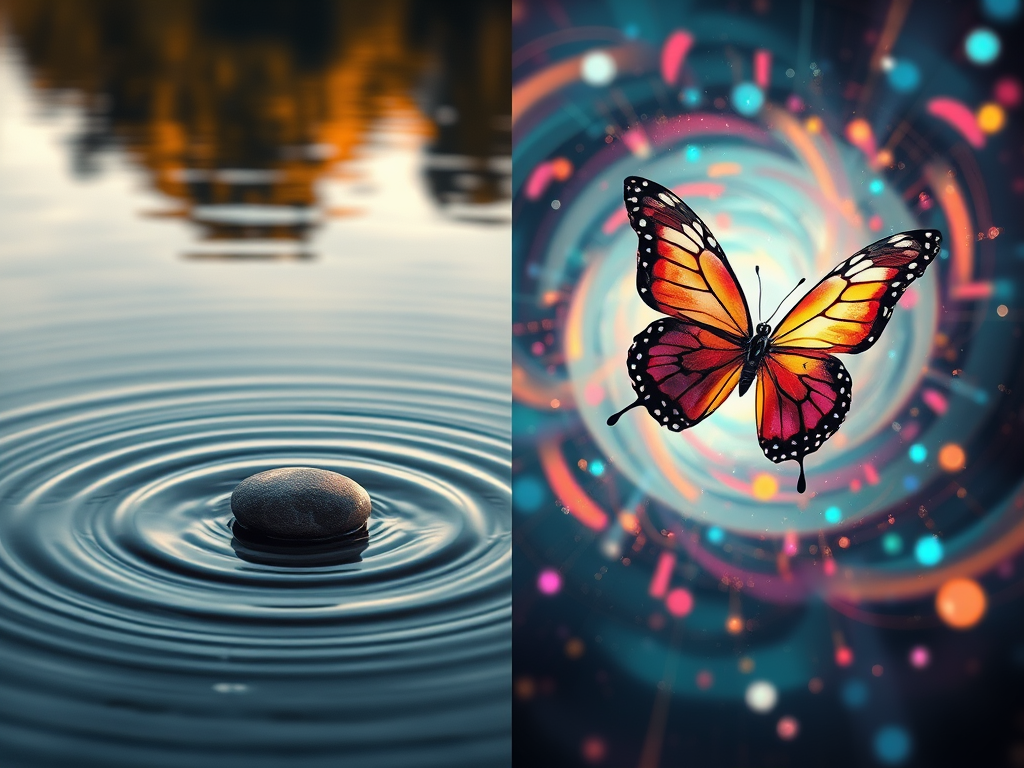
Cause, Chaos, and Consequence: Ripple vs. Butterfly Effect Explained

“I’ve written about the Ripple Effect before but while they sound like each other, The Butterfly Effect is far from being the same thing as a concept. They are philosophical cousins to be honest but while they are related, they were both raised in different households.”

I’ve written about the Ripple Effect before but while they sound like each other, The Butterfly Effect is far from being the same thing as a concept. They are philosophical cousins to be honest but while they are related, they were both raised in different households.

To give some further background on the Ripple Effect, it is one action that causes a series of consequences that spread outward like ‘ripples on the water.’ These are both linear and observable consequences that are clear to see, like water droplets hitting the ocean. For an example of this phenomenon, if you donate to a college scholarship fund, that money would directly help a student go to a college or university. Maybe that student goes on to start a non-for-profit because of the help you gave to help hundreds of other students who were in the same position as he or she was when you donated the money. The effects of your one action spread out logically from the original action taken. The ripple effect has been used in the social sciences, in business development, and in personal decision-making each day.

When it comes to the Butterfly Effect, the definition of it pertains to a very small or slight change in the initial conditions of someone’s day or a event that was rather small or insignificant at the time that ends up causing unpredictable and massive effects down the line affecting untold numbers of people. The key idea for this phenomenon is that events can be nonlinear and cause chaotic consequences when you think the effects would have been minimal or nonexistent instead. For an example, a butterfly flapping its wings in Mexico could theoretically start a chain of atmospheric events that cause a tornado to occur across the border in Texas. The Butterfly Effect is often used in describing chaos theory, meteorology, or how complex systems work together succinctly or can become dysfunctional rather rapidly.

AspectRipple EffectButterfly Effect
DefinitionOne action causes a series of predictable consequencesTiny change leads to massive, unpredictable outcomes
Nature of ImpactLinear and logicalChaotic and nonlinear
PredictabilityGenerally predictableHighly unpredictable
ExampleHelping one student who then impacts othersBeing late to an event and missing a life-changing meeting
Field of OriginSocial sciences, psychology, personal developmentChaos theory, meteorology, complex systems
Visual MetaphorPebbles dropped in water creating wavesButterfly flapping wings triggering a tornado
Control Over OutcomeModerate to high: effects unfold over timeLow: small causes can lead to wildly disproportionate results
Typical UsageCause-and-effect logic in planning or strategyDescribing randomness or complexity in systems

Regarding the main difference between The Ripple Effect and The Butterfly Effect, ripple effects are much more predictable to the average person, and you can trace the causality more easily. Butterfly effects and their events are unpredictable, chaotic, and can happen when you least expect them yet have been put into motion for quite some time. To sum it up, Ripple effects have an obvious cause and effect that are easy to explain and observe while butterfly effects show how tiny inputs or changes can lead to wildly disproportionate outcomes.

To explain how this would play out in the real world, a Ripple Effect in one’s personal life would be deciding to go to the gym three times a week consistently. You start to feel healthier, have more energy, sleep better at night, improve your mood, you’re more productive at work, which leads to a monetary raise or even a promotion in your title. That one small but consistent change to your lifestyle with a new habit consistently done can ‘ripple’ out across your whole life in a predictable way given the known yet useful benefits of consistent exercise. 

As for the Butterfly Effect example when it comes to your personal life, let’s say you show up five minutes late to an important networking event. As a result, you may miss meeting someone who could have been a business partner for your new venture. Your career ends up going in a completely different direction because of that missed opportunity. Because of that, you end up having to move and live in a different city, with different friends, and a different lifestyle, all because of that five-minute delay that happened once in your life. This is a key example of an unpredictable event with unforeseen consequences. You probably or will never realize how your life changed as a result unless someone observing your life full-time could tell you about the chain reaction that occurred because of that late networking event arrival.

We can also look back at history for key examples where the ripple and butterfly effects were present in what happened in retrospect. With regards to the ripple effect, the Civil Rights movement in the United States leads to the Civil Rights Act being passed by Congress. This law causes desegregation to take place in public schools, which opens more education and job opportunities for minority students and eventually leads to more diverse leadership in both government and business. It’s a chain of predictable and traceable events that go back a few decades, but for which still resonates up through the modern era.

A famous example of the Butterfly Effect in action from world history was when an obscure Serbian nationalist, Gavrilo Princip, assassinated the Archduke Franz Ferdinand of Austria, in 1914. After that momentous but surprising event happened, Austria-Hungary declared war on Serbia, alliances with France and Russia kicked in, which lit the spark that consumed Europe during the first World War.

This momentous event of World War I then led to the fall of empires like the Ottoman and British empires over time, the stale peace that led to World War II, and then the rise of Communism and the Cold War. Would a war have started regardless of if Franz Ferdinand had not been assassinated that day? Most likely, but there was a chance that it would not have happened had the assassination not occurred. That one moment created chaos and unforeseen consequences that no one in Europe or around the world could have foreseen at that time in 1914.

Understanding the differences between the ripple effect and the butterfly effect isn’t just academic, it’s practical for your own life. In our personal lives and careers, most of us try to make thoughtful choices, expecting reasonably predictable outcomes. That’s the ripple effect in action: you invest time in learning a skill, and it pays off in future opportunities. However, life doesn’t always play by those rules. Sometimes, a seemingly insignificant decision, sending a message, missing a meeting, crossing paths with someone new, spirals into consequences no one could’ve predicted. That’s the butterfly effect crashing into the party to say it has arrived. Knowing both concepts helps us become more intentional with what we can control while remaining humble about what we can’t control. It’s the mental toolkit for navigating both stability and chaos in this uncertain world.

The truth of the matter is that life is shaped by both ripples and butterflies. Some of your actions will create steady waves of impact over time while other choices might unleash unpredictable storms. That doesn’t mean you should live in perpetual fear of chaos or paralysis over tiny choices. It does mean though that we should approach life with a mixture of clarity and curiosity: plant the seeds you can in life, but don’t be shocked if something unexpected grows.

As the saying goes, “We make plans, and the universe laughs.” Still, you should plan anyway and be prepared with the awareness that every choice matters, even when the outcome doesn’t go according to plan. You might be one ripple away from changing your community or your world, or one butterfly flap from a wild new chapter in your life.