‘Springsteen: Deliver Me From Nowhere’ – Film Review and Analysis

“What I enjoyed about ‘Springsteen: Deliver Me from Nowhere’ (directed by Scott Cooper) is that for a biographical film, it really does dive into the effects of fame, expectations, struggling with one’s past, and reconciling it with a future very much unlike where you once came from.”

Everyone knows who Bruce Springsteen is by now, the Rock superstar and legend who has produced over twenty studio albums, won dozens of awards, and sold out shows over many decades. He is the extrovert’s extrovert on the stage producing marathon 3 ½ – 4 hour live shows with the powerful energy and stamina of a man half or one third of his age (Springsteen is 76 as of this writing). What I enjoyed about ‘Springsteen: Deliver Me from Nowhere’ (directed by Scott Cooper) is that for a biographical film, it really does dive into the effects of fame, expectations, struggling with one’s past, and reconciling it with a future very much unlike where you once came from.

‘Springsteen: Deliver Me from Nowhere’, the film has excellent source material in the book of the same name mostly due to interviews with the man (i.e. Springsteen) himself in the book, previously released in 2023 by author Warren Zanes. I highly recommend reading the book before seeing the movie to get a fuller picture of how Springsteen’s unlikely first solo album came to be in 1982. While the movie takes some time away for some side plots not related to the album’s making, it does do justice to how ‘Nebraska’ came to be and how it almost got completely derailed. The romantic subplot, while competently acted, feels tacked on and somewhat distracting from the core narrative. I found myself wishing the film had dedicated more screen time to the mechanics and mindset behind Nebraska’s creation as the book had done that it is based on; its stark originality is one of the most fascinating aspects of Springsteen’s career, and the film sometimes glides past that too quickly and not deeply enough.

Commercial success puts a lot of pressure on any musician and even Bruce Springsteen was exhausted both mentally and physically from ‘The River’ tour with his first taste of super stardom. It’s hard to top that kind of album so his decision after the tour to seek some peace and quiet at a rental home in Colts Neck, New Jersey seems like a good step to get the writing process started again. In the film, Bruce seems introverted almost to a fault when he gets off stage, must sit by himself to have some quiet and enjoy the peace of his dry towel hanging over his head.

While he responds warmly to fans and to his love interest especially during his guest set at The Stone Pony in Asbury Park, you still sense he’s caught between who he was and who fame is forcing him to become. I enjoyed how the film shows that he is battling himself at times in terms of what direction to take his life on top of his unresolved issues of his past highlighted by his turbulent relationship with his father (played by the great Stephen Graham). Even when you’re popular and famous for your music, sometimes anyone would want to do, including Bruce, is to isolate oneself for a while and be somewhere where you aren’t recognized or don’t want to be recognized. Bruce wants to focus on his musical range and channel his creativity away from the record executives’ wants, away from the band, and perhaps away from everyone.

Jeremy Allen White nails the role, embodying Springsteen’s physical stillness, haunted expressions, and the restless mind of a young artist wrestling with ideas he doesn’t yet fully understand. Being able to master guitar playing, the singing, the panic of not knowing who he is at times and searching for lyrics and the meaning behind them are tall tasks for any actor to convince an audience of and Jeremy nails it throughout the film. White’s performance works because he understands Springsteen not just physically but emotionally: a rising star caught between inspiration and uncertainty, trying to decode the meaning of his own lyrics as he writes them.

Coming up with an album different than anything you’ve ever done before takes time, effort, and introspection, which helps Bruce to look for movies, books, and stories that help create the theme for what Nebraska becomes. While Bruce and the E Street Band are shown in the film as a tight band, hitting on all cylinders, and creating great music for their own album, Bruce feels passionately about making something of his own and letting it not be changed or influenced beyond what he put together in an upstairs bedroom of his rental house on a simple four track cassette. Even in the early 1980s, technology could have given Nebraska a cleaner, more polished sound. But Springsteen refused to smooth out the edges. He believed the atmosphere, imperfections, and claustrophobic intimacy of the demos were the very thing that made the album special.

In both the book and the recent film, Springsteen is not afraid of Nebraska failing or his other music not being well received. Rather, he is afraid of how not to crack up from what is haunting him internally. Money, fame, and a bright future do not make him whole, and being able to carve out your own identity, deal with your past wisely, and find a way to deal with depression in a healthy manner takes time, support, and sometimes admitting when you need to seek help.

Luckily, Bruce has a loyal manager, Jon Landau (played by Jeremy Strong) who is more than looking out for making money off the next hit Springsteen album. He shows that he cares for Bruce as a person and more importantly as a dear friend and wants what’s best for him, even if Nebraska is not the album he would have hoped to promote or the kind of musical direction, he wants from Bruce either. Landau wants Bruce to find inner peace and happiness more than just fame, success, and wealth, which not every manager wants for their star.

Bruce, like the characters in Nebraska, are imperfect people in an imperfect world, and even if the stories are ghostly, gruesome, or unpolished, like the album, they must be told and given room to breathe. Even from great solitude and from introversion, Bruce’s personal struggle in that time led to one of his best albums and is still being covered and listened to over forty years later. Nebraska wasn’t built for radio or for Top 10 charts, even if it did outperform expectations, but it was built for truth and showed the underbelly of hard lives and harder circumstances. Bruce’s childhood and dealing with his past are covered in the film and you get the sense that there would be no Nebraska if the artist hadn’t any struggles in life or not been tested by family or by fame or by his search for the next song.

‘Deliver Me from Nowhere’ isn’t just a book or a film. It’s a reminder that even legends hit that crossroads where success, identity, and truth collide. It’s a thoughtful, beautifully acted portrait of an artist wrestling with his past to shape his future. For Springsteen fans, it adds new insight into one of his most daring albums; for newcomers, it’s an unforgettable introduction to the man behind the myth. Nebraska was never meant for radio or music videos; it was meant for honesty and truth-telling. More than forty years later after this album first came out, that honesty still cuts through all the noise.

‘The Perfect Storm’ – Film Review and Analysis

“In the fantastic 2000 film, ‘The Perfect Storm’, you get to see what it is like to be a full-time swordfish boat captain and his crew out of Gloucester, Massachusetts, who rely on catching enough fish, and specifically big swordfish, to make ends meet.”

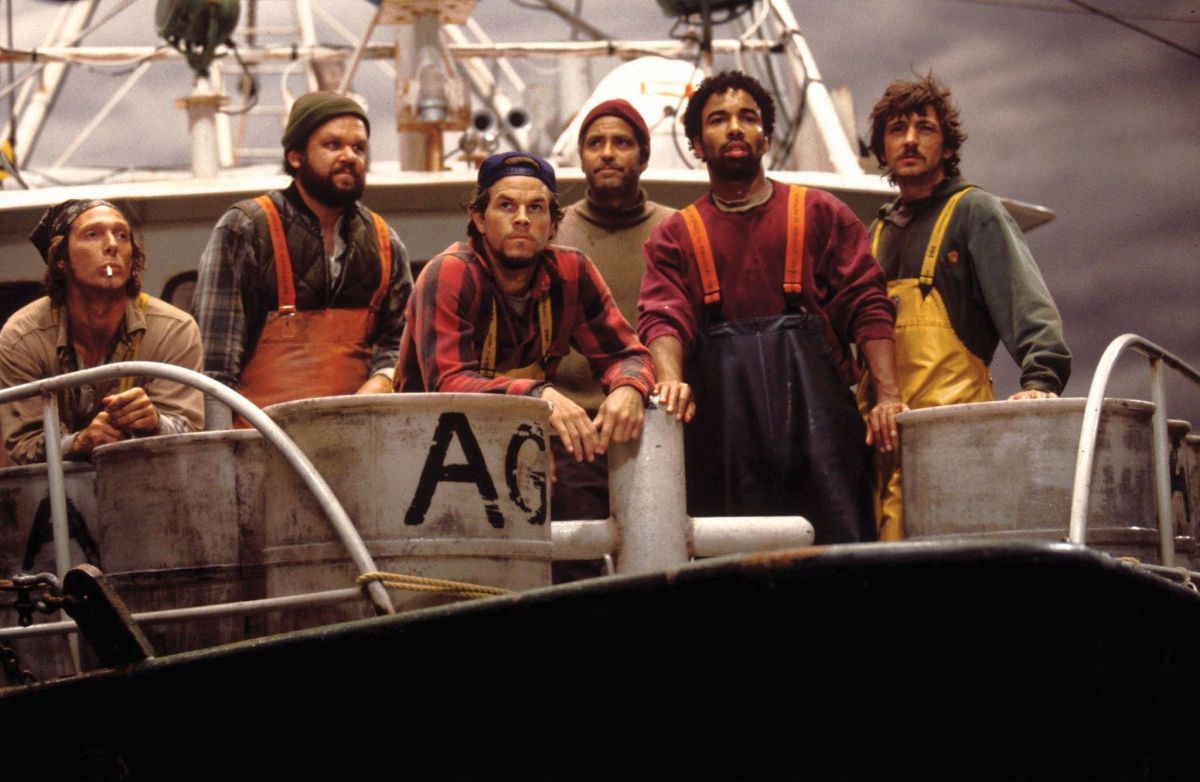
How far would you go to risk it all? If you had a family to provide for, a roof to keep over your head, or in need of enough money to make it through the next week or month, would you take up a livelihood that would often put your life at risk. If you are a fisherman or a fisherwoman especially those men and women who go hundreds or thousands of miles from home to do so, you know what it’s like to put your life at risk for your life’s work. In the fantastic 2000 film, ‘The Perfect Storm’, you get to see what it is like to be a full-time swordfish boat captain and his crew out of Gloucester, Massachusetts, who rely on catching enough fish, and specifically big swordfish, to make ends meet.

Whether or not you may be familiar with the lives of the fishermen and women who make catching fish their livelihoods, you cannot argue with how vital their jobs are to local economies like Gloucester. It’s not just Massachusetts but you consider the role fishing or crabbing or shrimping plays in states like Maine, Alaska, Louisiana, and elsewhere, which can provide a comfortable life for some while others struggle to make it depending on both the size and quality of their daily or weekly catch.

‘The Perfect Storm’ film, which is based upon a non-fiction novel of the same name, which was originally published in 1997 by talented American author Sebastian Junger, details the very rare occurrence in storm weather history from 1991, when a large-scale nor-easter or what’s known as an extratropical cyclone absorbed Hurricane Grace coming from off the coast of the southeastern United States. A lot of coastal damage and flooding occurred from this rare occurrence, but the worst effects happened to those vessels caught in between as the storms absorbed each other’s strength out in the north Atlantic.

Back in 1991, when technology was not as advanced, fishing boats did not have an advanced GPS and had to rely on old school maps, and did not have access to the latest weather reports. The one thing keeping them from being in the dark ages was an antenna and a fax allowing them to get reports via radio or from a machine. For the Andrea Gail fishing vessel, tragically, they were not able to avoid the worst of the ‘Perfect Storm’ and tragically, six men out of Gloucester lost their lives at the end of October 1991.

More than 24 years after the film’s release, it is considered maybe not as accurate to Junger’s book in terms of what were the last moments of the Andrea Gail or what the decision-making was like when Captain Frank William ‘Billy’ Tyne decided to go further out into the Flemish Cap beyond the Grand Banks where he and his crew usually fished in order to go above and beyond to bring back a catch that all of Gloucester would be able to appreciate.

While I admit that I have not read the book yet but hope to do so soon, ‘The Perfect Storm’ is one of those rare Hollywood disaster films that does not trivialize the risk that these men and women take to make a living as fishermen/women. ‘The Perfect Storm’ does a good job in fleshing out Billy Tyne and his five crew members, Robert ‘Bobby’ Shatford, Dale ‘Murph’ Murphy, David ‘Sully’ Sullivan, Michael ‘Bugsy’ Moran, and Alfred Pierre, and honors their memory by the actors who portray them such as George Clooney, Mark Wahlberg, and John C. Reilly.

The film sets up the story quite well including how a smaller than average catch or a lesser return on investment can put a strain on a captain and crew to go out sooner than they would want in the hopes that they can change their luck with the fishing ‘gods.’ It’s clear that these men and women are brave, bold, and love what they do regardless of the risk involved. They know the risk involved, are willing to do what it takes to feed their families and to put a roof over their heads, and even though the risks may outweigh the benefits, as Captain Billy Tyne says as part of the film’s opening monologue, “you know what? you’re a goddamn sword boat captain, is there anything better in the world?”

As ‘The Perfect Storm’ makes clear, this job is more than just a job, it’s a livelihood and a lifestyle for fishing communities like Gloucester, Massachusetts, which has had generations of fishermen for over four centuries since before the United States of America became a country. It is part of the identity of those towns and communities like Gloucester. When fishing is all that, you knew as a child from your parents, grandparents, and beyond, why wouldn’t it be what you attach your livelihood to as an adult?

In 1991, I’d imagine that the job itself had higher risk, but higher rewards given how lucrative it could be when the seas were not overfished or not as affected by climate change as they are now in 2024. The film does not judge the sword boat fishermen for the risks they make during that fateful period in late October 1991 because we will never hear from the six men who lost their lives then tragically.

We only have glimpses into their thought processes or the lack of information they had to make at the time. They not only had to contend with the stress of an ice machine breaking down, but also with not being able to fish as well in the Grand Banks, have an arrogant boss who owned the boat and was expecting them to deliver or face the consequences of losing their place on the Andrea Gail. A crew is also forced together in tight quarters for days or weeks at a time and they may end up disliking or fighting each other. There are also mishaps with a misplaced fishing trap, an errant wave casting a man overboard, or even catching an accidental shark that can harm or kill you if you are not careful.

Being a sword boat fisherman or woman is not for the weary or the weak-hearted. It is for sturdy, strong, and risk-takers who love what they do because they do what they love. It is not usually a job that you can get very wealthy from, but it can provide stability, a livelihood, and help you provide for your wife or husband or for a family if you do well enough. The film does an excellent job on not making the actors who play the six men of the Andrea Gail who lost their lives in ‘The Perfect Storm’ as caricatures but they really feel as they do exist and still exist today in terms of what they do for a living.

Their backgrounds, their motivations, their fears, and their doubts are fully fleshed out over the course of the film. The story is intriguing especially since it happened and was a tragic event in 1991 that affected millions of people in North America. We also think about how storms such as hurricanes are still with us today and are affecting people around the country regardless of if we believe that it can happen to us or not. We are always at the whims of mother nature, and we must realize that it’s important to be prepared for whatever it may throw at us regardless of if we are on land, sea, or air.

The men of the Andrea Gail knew that their job entailed risks, but they also knew that the love of the work, the livelihood and purpose it brought them, and how much it meant to others for what they did will help enshrine their memory in the hearts of their fellow Gloucester men and women forever as well as around the country and the world. Each man had love not just for the ocean, but also a love for their friends, family, and loved ones, which shines through in the film adaptation of ‘The Perfect Storm.’

One of the most beautiful parts of the film for me is when one of the youngest crewmen on the Andrea Gail, Robert ‘Bobby’ Shatform, who loses his life in the storm, tells his girlfriend Christina in a dream where she envisions him being there with her, for the last time, “Remember I’ll always love you, Christina, I’ll love you now, and I’ll love you forever. There’s no Goodbye, only love.”

The lives of the six men who were lost tragically at the end of October 1991 live on forever in the hearts and memories of the people they loved and for the lives they touched in Gloucester and elsewhere. The movie, ‘The Perfect Storm’ is a great tribute to who they were, what they did for a living, and the courageous and bold actions they took to make a living and to help feed others in that community and elsewhere with their lives as fishermen.

I hope you’ll watch this excellent film and read the book it’s based on as I hope to do so for the latter soon. Between an excellent cast, great story pacing, stirring music from the dearly departed composer James Horner, beautiful cinematography, and impactful visuals that have held up to this day almost 25 years later since the film’s original release, ‘The Perfect Storm’ is an excellent movie and one of my favorite films I’ve ever watched.

I’ll leave you with the entire portion of the excellent monologue from the film’s opening and closing scenes to describe the lived experience of being a fisherman or women out on the sea and the pure joy and peace it can bring them when they are heading out to the sea:
“The fog’s just lifting, you throw off your bowline, throw off your stern, you move out the South Channel, past Rocky Neck and Ten pound Island, past Niles Pond — where I skated as a kid — on to Black Bess Point, blow your airhorn, and throw a wave to the lighthouse keeper’s kid on Thatcher Island — then the birds arrive — Blackbacks and Herring Gulls, Big Dump Ducks and Green-Legged Coots. The sun hits you; you head north and open up to twelve — steaming now — the guys are busy and you’re in charge…And you know what? You’re a goddamn sword boat captain. Is there anything better in the world?”

‘The Edge’ – Film Review and Analysis

“Whether it was ‘The Revenant’ with Leonardo DiCaprio or ‘The Grey’ with Liam Neeson, these films highlight man’s struggle to overcome the elements, the animals, and even his own demons. Many of these ‘man v. nature’ films focus on one main lead and a small cast of supporting characters but most of the film’s runtime is about the sole main character. ‘The Edge’ is different.”

I have always really liked Man vs. Nature type of films. Even though they have similar premises and conclusions, it really is a raw kind of film that grips you and leaves you wondering what you would do in a similar kind of situation. Whether it was ‘The Revenant’ with Leonardo DiCaprio or ‘The Grey’ with Liam Neeson, these films highlight man’s struggle to overcome the elements, the animals, and even his own demons. Many of these ‘man v. nature’ films focus on one main lead and a small cast of supporting characters but most of the film’s runtime is about the sole main character. ‘The Edge’ is different.

In ‘The Edge’ (1997), this survival film does something else by highlighting two men who have different intentions and different backgrounds. One is a wealthy man named Charles Morse (played by Anthony Hopkins) and the other is a photography presumably who take pictures of models and is very much a person of the city who is not used to nature or wildlife. Bob Green (played by Alec Baldwin) has ulterior motives in mind but comes off as affable and friendly enough in giving Charles a gift for his birthday in the form of a hunting knife. Charles is accompanied by his beautiful wife, a model named Mickey, who Bob takes pictures of as well as Bob’s assistant, Stephen, who is also new to being in wildlife. The small group are joined by a few friends in a cabin in the Canadian wilderness to celebrate Charles’s birthday.

From the beginning of this film, you can tell that Charles is more comfortable with his intellectual pursuits than with his friends. He loves Mickey, his wife, but he understands that he is more interested in books than in people. Charles is particular obsessed with a survival book / guide that he is reading and is fascinated by the natural surroundings that he has brought the group to and the people who hunt there for bears and other wildlife.

Charles’s fondness for nature and of survival are to come in handy later on in the film and is an excellent use of foreshadowing when things go haywire later on. During this birthday celebration, the viewer can also tell that Bob while he is kind to Charles is envious of him, his life, his money, and his wife. He openly flirts with Mickey and kisses her platonically. Charles can sense this animosity and is wary of Bob’s intentions.

Part of the reason why they all have come up to the Canadian wilderness besides Charles’s birthday is to find, interview, and take photographs of a famous Alaskan Indian hunter. During their flight, as Bob and Charles make small talk, Charles blurts out of the blue to him: “How do you plan to kill me?”. Before Bob has a chance to respond, a flock of birds come out of nowhere and strike the plane’s engines and its windshield killing the pilot and causing a downward crash.

The plane crash lands in the lake and all three men (Bob, Charles, and Stephen) are all shook up but survive the crash. The pilot does not but the men quickly realize they may be stranded for a while. Charles, given his survival skills knowledge, takes charge and encourages the other two men not to panic and to learn from him. Using his encyclopedic knowledge from his memory, he is able to make a compass to plot their course forward, make a small fire, and also give them advice about how to proceed.

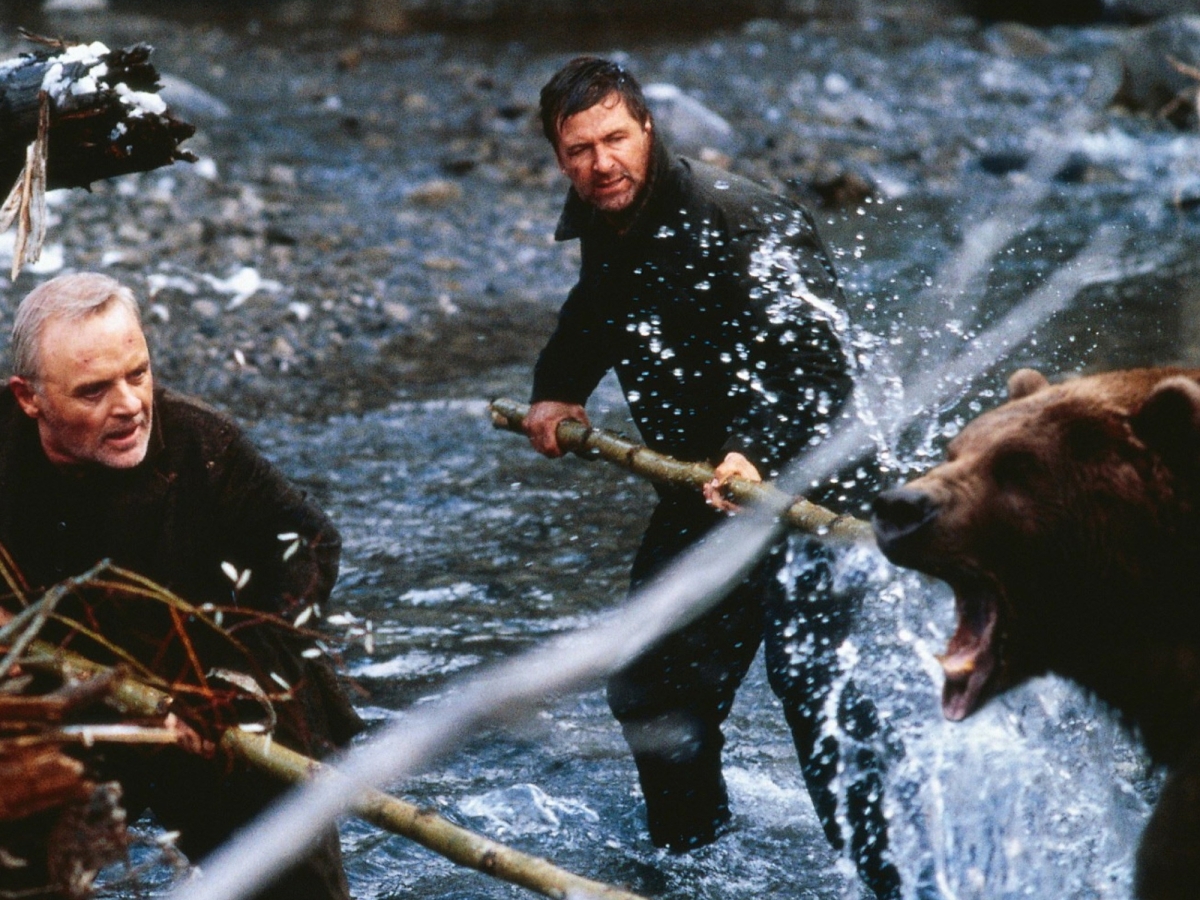
Charles is not perfect in his survival skills and he almost gets swallowed up by a river rapid that almost carries him away until Bob pulls him out. For most of the film, it is unclear to the viewer how the two men really feel about each other. Their survival and getting out of the wild takes first priority. This becomes even more pressing when they wander into the territory of a giant Kodiak bear who is a real ‘manhunter’ as Charles calls him.

Stephen injures himself while climbing and Bob mistakenly hangs up the blood-soaked clothes of Stephen later on at night around the fire drawing the bear to him. This costly mistake leads to the Kodiak bear tracing their scent and finding them. Instead of burying the clothes, Bob lets them hang above their campsite causing Stephen to be attacked and brutally killed by the bear. Bob and Charles barely escape and realize that if they want to survive this ordeal, they must band together to trick the bear and then kill him.

Food is also a concern for both men as they haven’t eaten anything since they crashed and will starve to death if they don’t kill the bear. This is another instance where Charles comes in handy as he is able to distract the bear while Bob goads the bear into falling into their trap. By working together as a team and using a hidden spear to impale the bear, Bob and Charles are able to kill the bear together even when they both end up wounded from the encounter.

This is a small victory in the long road to survival for both men as they are able to eat well, don bear skins, and even find a cabin where they can get supplies. However, this is not the end of their animosity or wariness of each other. Man’s most fatal enemy is not nature or animals but often his fellow man and that comes into play.

While Charles is a smart and dedicated man to have achieved his wealth and success, he may have been naïve to who Bob is and what his wife Mickey was doing with him. Bob is not a survivalist and relies on Charles to survive but with the bear vanquished and having reached a cabin with some ability to reside there for some time, does Bob need Charles anymore and will his wife Mickey miss him if he didn’t come back?

The viewer has a lot to absorb and while I don’t want to spoil the film’s ending, ‘The Edge’ is not just about survivalism, but the edge of our tolerance of one another or our shared cooperation when a woman or money or prestige comes between people. Both men are not perfect, and they gain more when they cooperate rather than try to kill one another. Bob has the negative traits of hubris, envy, and short-sightedness. He is not able to survive the woods without Charles but wonders how much he truly needs him now that they have conquered the bear. He also covets Bob’s wife and wonders if he could murder Charles and get away with it by making it look like an accident.

Charles is an avid survivalist but may be naïve about the people around him. He also knows that Mickey and Bob and other people may take advantage of him and he may not know if they truly love him for him or if it is for his wealth and influence. While Bob is a personable, fun, and outgoing, Charles is an introvert with a love for knowledge and learning. They are opposite personalities, which is why they clash at times during this film.

While being in a precarious, life-threatening situation can bring the best out of people, it can also bring the worst out of the people, which is why ‘The Edge’ is a great film. Survival films like it do not just focus on the brutal realm of the wilderness where our creature comforts and our money cannot protect us, but they can also focus on man’s cruelty to man as well as our ability to work together too. ‘The Edge’ does a good job of pointing out how we can rise to the occasion when our survival counts on it but also shows us how dark human nature can be when we feel compelled to act out of jealousy, rage, and deceit.

‘The Edge’ is a great and underrated film, which I do highly recommend. The vistas of the Canadian wilderness are brilliant shown through the cinematography. The Kodiak bear, which was played by a real bear, named Bart, does a great job of showing how terrifying and powerful a giant bear can be when it is attacking you. Anthony Hopkins and Alec Baldwin are respectively some of the best actors of their generations and they do a great job of highlighting the unique personalities of their characters. You really believe the scenarios that they could find themselves in having been stranded in the wilderness for weeks. It is a believable kind of film from being able to make a fire, to finding fish in the river, to being attacked by a bear, to climbing and hiking day after day in unknown territory.

‘The Edge’ is overall a very compelling and realistic film. It does a great job of blending elements of ‘man vs. nature’, ‘man vs. animal’, and most importantly ‘man vs. man’, which is an element missing from our survival films. I would be lying if watching ‘The Edge’ didn’t make me want to buy my own survivalist guide to learn about how to survive in the wild for days or weeks. A terrifying plane crash, a boat whose engine doesn’t start, or a car engine that goes dead is enough to make anyone panic.

I believe it is important to prepare like Charles did for that kind of horrible situation and not to panic or dwell with shame. As Charles says at the beginning of the film, “Those who get lost in the woods often die of shame because they were ashamed that it happened to them.” This is an important quote of his to keep in mind. When the chips are down, you have to use your knowledge, resources, and will to survive whatever the circumstances. The best time to start preparing for that kind of occurrence is now.

‘Sideways’ – Film Review and Analysis

notdrinkingmerlot
“Miles is not drinking any Merlot!”

Sideways (2004) is an excellent film about the topsy-turvy nature of middle-age life and how to cope with the curveballs that life throws at us to challenge us. Critically acclaimed at the time and nominated for many awards, Sideways, directed by Alexander Payne is a good tale about male friendship, how to deal with mid-life problems, and finding love and purpose during difficult times.

The very title of the film ‘Sideways’ is symbolic of the best way in which wine bottles should be preserved by being laid on its’ side in order to age properly. Also, men and women who are going through their mid-life ‘sideways’ must embrace the challenges that lie ahead and the changes that come to them with this part of life in order to grow and mature as a person.

The basic premise of the film ‘Sideways’ involves two middle-aged men who are close friends, Miles Raymond (played by Paul Giamatti) and Jack Cole (starring Thomas Haden Church) that decide to take a week long Bachelor’s trip up to the wine country of Napa Valley in California to celebrate Jack’s upcoming wedding and the end of his singledom. Both of these men are in their forties and have a sinking feeling that the best of life is behind them.

Miles is in a depressive state due to the fact that he feels like a failed writer due to the uncertain future success of his yet-to-be published book. While he has a steady job as a high school English teacher, he feels unfulfilled by his life and wants to achieve greater success as a novelist but has yet to break through. On top of that, he has gone through a recent divorce that he has yet to recover from fully and is newly single.

Luckily or unluckily for Miles, he has a friend, Jack, who is hoping to have a good time for his last few days as a single man. Jack Cole, Miles’ friend is an actor who may be past his prime. While he used to be a TV soap opera star years ago, now, he is mostly relegated to doing voiceovers for silly commercials and seems to be getting tired of the acting business. Jack loves his fiancé but has the problem of not being able to control him when it comes to women.

Unlike Miles, Jack is not a big wine connoisseur and is more into playing golf and hooking up with a local woman before he takes those fateful steps down the aisle. Jack is hoping to not screw up his marriage but he obviously misses the single life while his friend, Miles dreads being single again. Jack may love his fiancée but he is also hoping to get involved with the real estate business that his soon-to-be father-in-law is running in Los Angeles, which Jack wants to be apart of in order to get away from acting once and for all.

Beyond just writing novels and teaching his students, Miles’s true passion in life is wine, which is why he proposes Jack that they go to Napa Valley to drink some great wine, play some golf, and eat some good food together. While Jack enjoys all of those activities, he has other plans in mind for his last days as a single guy leading to hilarious and disturbing results for the both of them. Before Jack wants to get married, he wants one last fling as a ‘single’ guy before he becomes the husband to his wife. In the meantime, Miles encounters a woman he never expected to meet.

Maya, (played by Virginia Madsen), is a kind and intelligent waitress at a local restaurant in Napa Valley known as ‘The Hitching Post II.’ She is someone who Miles has encountered before during his previous solo trips to Napa Valley. While they were friendly to each other, it’s only on this Bachelor’s trip to the wine country where Miles with the help of Jack’s support gets to know Maya better. Maya and Miles really hit it off with each other especially over their shared love of good wine and they start to develop a relationship.

Luckily for Jack, Maya knows a local wine keeper, Stephanie, (played by Sharon Oh), who has a lot of the characteristics that Jack likes in a woman. The two men end up dating and hooking up with both women but with unforeseen and negative consequences. Jack’s adulterous philandering almost catches up with him and causes Miles a lot of unneeded stress. Miles also suffers during this trip from the lack of hope for his novel in finding a publisher to sell and advertise it.

He also struggles to give up on his ex-wife, Vicki, who he did cheat on leading to their divorce and breakup. The almost breaking point for Miles comes when he finds out that his ex-wife, Vicki, got re-married and has a newborn daughter causing him to regret his divorce from her. While his wife has moved on from him, he still struggles with the fact that his book is going nowhere, he is single in his 40’s, and has no legacy or children at the moment.

Despite all of mid-life struggles that both Miles and Jack go through during the film, they remain loyal and true friends despite the pain and suffering they cause each other. Miles and Jack are almost complete opposites of each other in terms of their personality and character. Miles is serious yet forlorn and an intelligent, well-spoken man while Jack is a cocky womanizer who never really grew out of his teenage years.

However, despite their differences from each other, they do help lift each other out from their problems. Jack gives Miles encouragement to keep working on his novel and to self-publish it if he has to. He wants Miles to succeed at starting a relationship with Maya and really gets him to start going out with her. Miles saves Jack from himself multiple times throughout the film and even though Jack’s integrity is compromised, Miles is there to clean up the damage and makes sure that his friend follows through on his marriage commitment to his fiancée, Stephanie.

Every character in this film is flawed in some way and even though each of them, both men and women, are in their forties, they still have some growing up to do and don’t have everything figured out when it comes to life. Each of these characters has their own personal demons with Miles having depression and a lack of success in his passion and Jack being an adulterer and a compulsive liar.

While they are not perfect men and the women they are involved with make that clear to them, they are still good guys at heart and want to do the right thing. Life has thrown them ‘Sideways’ and they are trying to keep up with all of the curveballs that they must dodge and move forward against. It is really no surprise to me that similar to ‘Lost In Translation’, this film has become a cult classic that can warrant multiple viewings.

While it may not be your typical feel good movie, it’s a ‘real’ film about ‘real’ people who are trying to succeed both personally and professionally against the odds. If you decide to watch ‘Sideways’ for the first time, you’re going to be rooting for each of these characters to find happiness. They are endearing to us as the audience because they make mistakes and have setbacks just like those of us watching the film. In addition to the brilliant acting especially by Virginia Madsen, Paul Giamatti, and Thomas Haden Church, the adapted screenplay is brilliantly written and thought out.

Even though most viewers would consider it a dark, morose film, it also has a lot of comedy in it and some great lines about wine. There are a lot of moments in ‘Sideways’ that will make you sad, happy, angry, and even make you relate to the characters themselves. A great film overall directed by Alexander Payne, Sideways was released way back in 2004 but still remains a popular and heart-warming film that will leave you satisfied. I highly recommend checking ‘Sideways’ out when you get the chance and to remember after watching the whole film to never order a tall glass of Merlot again.

‘Road to Perdition’ – Film Review and Analysis

One of the most underrated movies of the 2000’s was Sam Mendes’s ‘Road to Perdition’, which was released to critical acclaim back in 2002 and did pretty well at the box office with around $200 million in ticket sales. While some people would be skeptical of watching ‘Road to Perdition’ at first because they think it’s your average crime / mafia movie that doesn’t have much to offer in terms of storyline and symbolism, they would be wrong when it comes to this film.

Sam Mendes, who directed two other great films ‘American Beauty’ and ‘Revolutionary Road’, does an excellent job here as this movie is beautifully shot and has a stellar cast. ‘Road to Perdition’ also benefited from the legendary cinematography work of the departed Conrad L. Hall for which he won a posthumous Oscar for ‘Best Cinematography’ for this film after he passed away in 2003. The scenery and settings for this movie help to create quite a unique atmosphere and the wide shots, long angles that are used help to make this film stand out as being above average. Beyond just the cinematography, the acting by the cast also stands out.

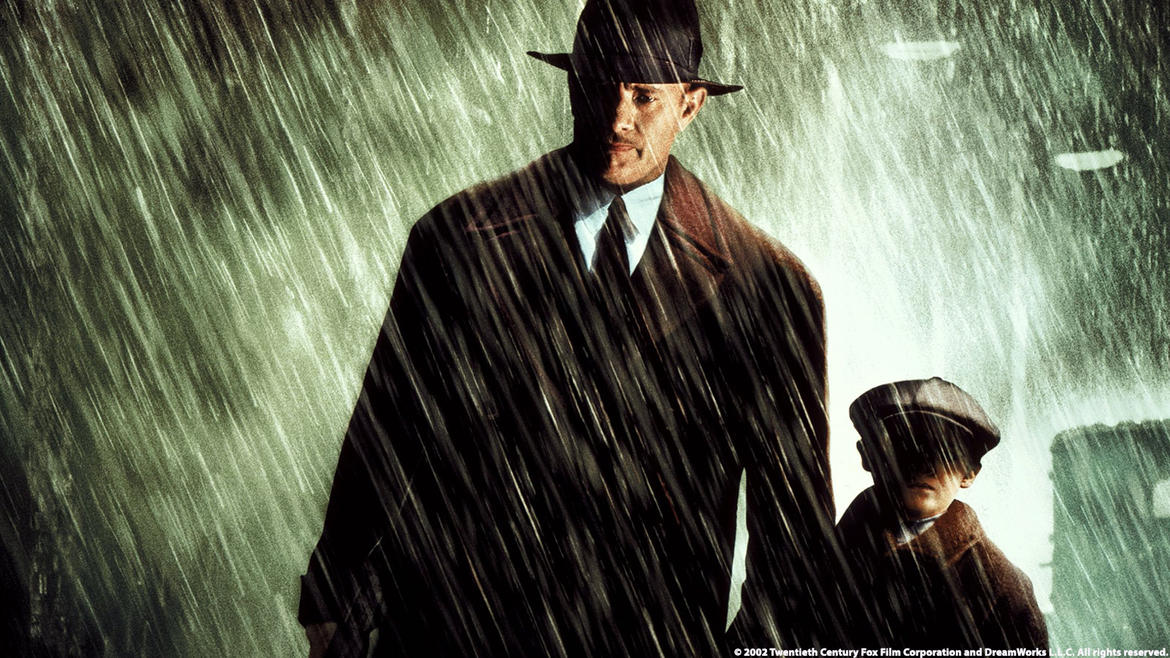
When you look back to see who was starring in the main roles for ‘Road to Perdition’, it is a very impressive list. Tom Hanks plays Michael Sullivan Sr., the lead role of the film and a conflicted Irish mafia man caught between his past and keeping his son sheltered from the consequences of his actions. Paul Newman, one of the greatest American actors of all-time plays the role of John Rooney, an Irish mafia boss, who is also conflicted between his paternal feelings of love for Michael Sr., and his wish to protect his own son, Connor, played by a young Daniel Craig, from his own destructive sins. Rounding out the list is Jude Law, who plays a gifted hit-man / grisly photographer known as Harlan McGuire, and Stanley Tucci, who plays a high-ranking member of the Italian mafia known as Frank Nitti. A young actor who steals most of his scenes is the young but talented Tyler Hoechlin who is Michael Sullivan Jr. in the film, a boy who is coming to terms with his father’s lifestyle and his ties to the mafia. A truly impressive cast of Academy Award winners and nominees, which makes this film even more of a lasting treasure.

‘Road to Perdition’ really brings the atmosphere and makes the setting feel real as it portrays life in Great Depression-era America by focusing on specifically both on the city of Chicago and its’ rural hinterlands, cornfields of greater Illinois. The movie really portrays well the last decade of America being discovered and settled, while undergoing deep economic difficulties, as the Irish and Italian mafias become a source of income and employment when none could be had.

Most movies don’t seem to want to portray the mafia as having been a well-oiled machine that acted like a legitimate business, but ‘Road to Perdition’ makes clear that there are ways to look at the criminal enterprises that achieved a lot of prominence during the Great Depression due to their ability to bootleg and their appeal to provide a good income to men without work.

Without spoiling too much of the plot, Michael Sullivan Jr. (Tom Hanks) is an enforcer and bodyguard for the Irish mafia in the Chicago area of Illinois who has a close relationship with his boss, John Rooney (Paul Newman), who is implied to have helped Michael Sr. a lot with a home, a steady income, and a purpose which is quite difficult to come by during the height of the Great Depression. Michael Sr. is a flawed man who has done murder and committed other crimes for his boss, Mr. Rooney, and knows that it may cost him his life. Despite his past transgressions, he wants to protect his family from his sins and wants to keep his boys from knowing about what he does for a living.

Connor Rooney (Daniel Craig) is shown to be jealous of the close relationship that his father, John, and Michael Sr. have and is resentful of him. Michael Sullivan Jr. (Tyler Hoechlin) is distant from Michael Sr., his father due to late working hours and distant lifestyle. As any boy would like to know about his father, Michael Jr. decides to find out the truth about who his father, Michael Sr. is, and what he does for Mr. Rooney. At this point, the plot really takes off in tragic and unexpected ways leaving the viewer engaged in the storyline and the eventual outcome. As mentioned before, the acting done by this legendary cast helps make the film what it is and what it still is today.

Beyond just being a typical mobster movie, ‘Road to Perdition’ has a number of poignant and thought-provoking themes that stay with you even after the end credits begin to roll. This film goes over the trials and tribulations that fathers and sons can have with each other even when they love and care for each other dearly. Michael Sr. and John Rooney are not related by blood by have a relationship similar to a father and son as Mr. Rooney was around for Michael and his family when they had nothing. He is heavily indebted to Mr. Rooney even if he knows what he is doing is wrong by committing violent acts for the mafia. Still, their bond appears to be unbreakable and they get along quite well with each other.

To the contrary, both of their relationships with their respective sons are shaky at best and hostile at worst. There is a considerable distance between Michael Sr. and Michael Jr. due to the fact that Michael Sr. makes his lifestyle and his work for Mr. Rooney a well-kept secret. Michael Sr. does not show much affection or love for his boy and it’s not made clear until the end of the film why that is. Michael Sr. obviously cares for his boy but likely doesn’t want his son to know about the horrible things he’s done to keep him, his brother, and his wife save from harm or want. Still though, Michael Jr. does not want to be kept away from his father and who he is.

He ends up pursuing the truth whether or not his father wants him to or not leading to quite a turn of events when the truth comes to light. Connor Rooney, John’s son is quite envious of the close relationship that Michael Sr. has with his father compared to him. However, this is for a number of reasons. Connor is very much unlike his father, John, and has a number of character and personality flaws that make him a liability to the family. Connor is shown to be impulsive, manipulative, untrustworthy, and greedy but the conflict comes to light when John Rooney must decide if he should stick by his son’s side or give him up due to his past misdeeds. As John Rooney says to Michael Sullivan Sr. during one of the movie’s best scenes, “Sons were put on this Earth to trouble their fathers.”

During one of the movie’s most touching scenes, Michael Sr. tells Michael Jr. about a town called an idyllic town called Perdition, Illinois, which has beautiful scenery along the beach of Lake Michigan, and where the Sullivan family has visited before when Michael Jr. was a little boy. Perdition is portrayed as a goal for the two Michaels to get to in order to start their lives anew and escape the sins of the past. It’s a way for Michael Sr. to get redemption after taking care of his ties to the mafia and by trying to make up for what he did wrong as both a father and a man. The word ‘Perdition’ as defined in other words is ‘hell’ or ‘complete and utter damnation’ in more religious terms. Michael Sr. may try to redeem his sins by going to church or by rectifying the wrongs he’s done by getting revenge on the men who wronged him in the past but he knows deep down that it may not be enough.

If he is on the ‘Road to Perdition’ or the road to hell, the film shows the audience that he wants to keep his son, Michael Jr., from going down that same path. He wants badly for his son to have a better life and a brighter future away from violence and death. Michael Sr. won’t let his downfall lead to that of his son’s as well. Even if Michael Sr. is a murderer and a sinner, he knows what’s still right from wrong and he is going to do his best to preserve the innocence and goodness of his son. As a father, he is flawed but he still loves his son dearly and wants the best for him still.

Certain moves fit a certain season of the year well and ‘Road to Perdition’ is no exception. The winter setting, the Chicago cold, and the mature themes help lead it to being an ideal film to be watched during the depths of winter in January and February. Without spoiling anything, the film is a real story with real characters who are flawed in their own ways but who each have their own complex motives that drive the plot forward. This film, most of all, touches the audience emotionally and will pull on your heartstrings.

‘Road to Perdition’ is very underrated film that remains one of my favorite movies to this day. I highly recommend ‘Road to Perdition’ to other movie buffs who are looking to watch a crime / mafia film that has a soul. In addition to having an all-star cast, a renowned director, and a legendary cinematographer at the helm, ‘Road to Perdition’s music score composed by Thomas Newman is excellent and fits perfectly into the many moods of the film and has some stirring moments that add to the film’s setting. If you’re snowed in this weekend from the blizzard, do yourself a favor and go watch ‘Road to Perdition.’

‘Lost In Translation’ – Film Review and Analysis

suntory-time
“For a relaxing time, make it…Suntory time.”

One of the great films of the 2000’s, Lost In Translation is a film that is often underrated but which deserves a lot of praise and acclamation. Directed and produced by Sofia Coppola, daughter of the highly acclaimed director Francis Ford Coppola, Lost In Translation is the story of two Americans of different ages who are visiting Japan for different reasons but who are struggling with similar existential crises.

Bob Harris, played by the wonderful Bill Murray, is an aging actor and movie star from Hollywood who is struggling with a mid-life crisis. He comes to Tokyo to film whiskey commercials and appear on some popular Japanese talk shows. In one of her first roles on film, the talented Scarlett Johansson plays Charlotte, a young college graduate from Yale, who is struggling to figure out what she wants to do in her life.

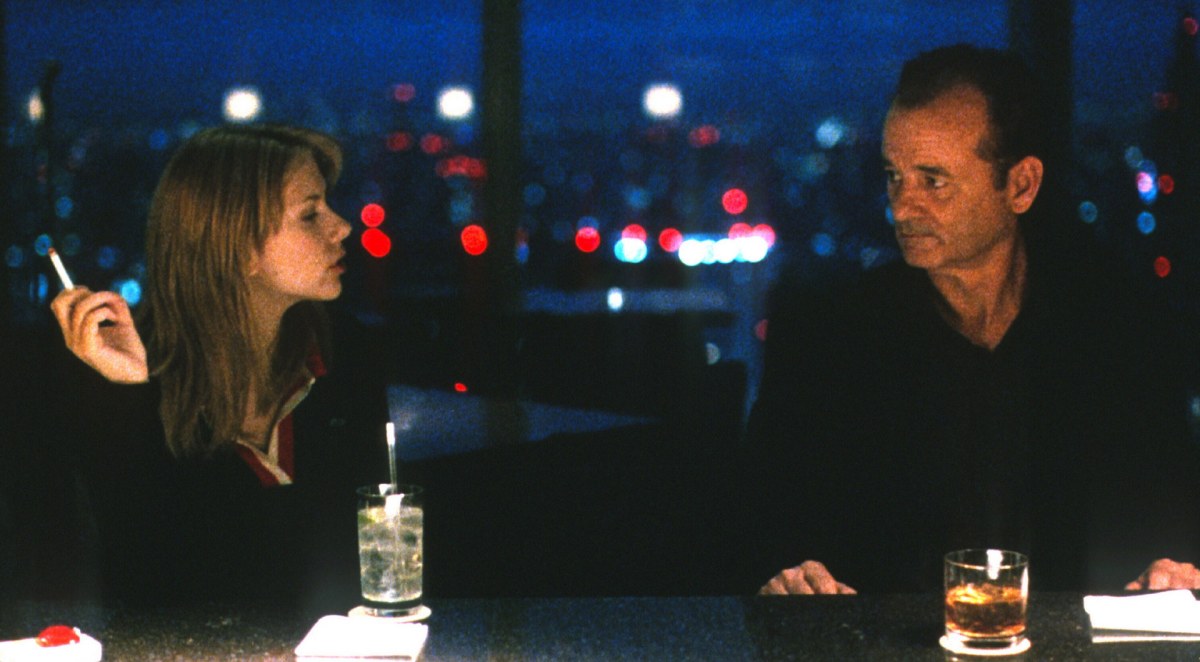
While Bob and Charlotte come from different backgrounds and are of different ages, they are both struggling with adult concerns such as marriage, work, and the search for overall meaning. Bob has been married for twenty-five years whereas Charlotte has only been marries for two years. While they are at different stages in their marriages, both of them have doubts about being or staying with their partners. In addition, once they meet each other in the hotel lounge for the first time, they are drawn to each other’s personality, humor, and the fact that they are adjusting to Japanese culture for the first time.

One of the best things about Lost In Translation is the way Tokyo, Japan becomes a character in the film. The city is a sprawling metropolis with a population of over twenty million people that seems to go on forever. Since Charlotte’s husband is a director and is busy shooting for a new film and Bob’s wife is five thousand miles away, they both find time to explore and immerse themselves in the bright lights and diverse sounds of Tokyo.

The most illustrative scenes in describing the developing relationship of Bob and Charlotte take place in the karaoke bars and the hibachi restaurants where they try to adapt to the culture shock and the persistent jet-lag together. Despite being married, they feel alone and unhappy in their relationships for different reasons.

They take solace and comfort in each other’s company as they navigate the intricacies of Japanese language and culture. They start off as complete strangers in the hotel bar but then become friends over the course of their stay. Bob also acts as a life mentor to Charlotte who is in her early 20’s by giving her lessons on life, marriage, and what it’s like to have children. Bill Murray’s character comes across as someone who’s halfway through life and is honest to Charlotte about the ups’ and downs’ of it all.

Charlotte’s youth and curiosity about the world helps to change Bob too as he rediscovers the joys and thrills of being care-free and being able to laugh with someone who puts no pressure on him. After appearing on cheesy talk shows and doing uninspiring whiskey commercials, Bob is able to have fun and enjoy himself around Charlotte. From the one-sided phone conversations you hear from Bob and his wife back in Los Angeles, neither of them seem happy or fulfilled about their marriage. I don’t want to spoil the ending for those of you who haven’t watched the film but it is possible that Bob and Charlotte will find romance or love when they least expected it to happen.

I have to admit that the first time I saw Lost In Translation, it made me really want to visit Japan. The nightlife and crowded streets of Tokyo interest me quite a bit. I was also intrigued by a scene from the movie that was set in Kyoto, where Charlotte takes a high-speed train to the city to see the Shinto temples and the beautiful cherry blossoms. The cinematography and settings of the film are very moving and beautiful. Lost In Translation has a reputation of being a serious and deep film with little humor mixed in.

However, I would disagree with this assessment because there are a lot of scenes of light-hearted humor especially when Bob Harris, Bill Murray’s character is on the set for a Japanese commercial. Many things are ‘lost in translation’ as he looks for guidance and help from his translator but she never gives him the full story of what the Japanese director wants. There are other humorous scenes where Bob appears as a guest on a goofy talk show with a quirky host. Another classic moment is when a Japanese escort is sent to Bob’s hotel room and asks Mr. Bob Harris to “lip her stockings.” It’s a subtle English faux pas but I found it hilarious the first time I watched it.

Two strangers who meet in a hotel bar and get to know each other over a drink is not a new movie concept. However, the relationship that develops after that chance meeting is what makes Lost In Translation a great film. The on-screen chemistry between the two great actors, Bill Murray and Scarlett Johansson also draws the viewers in to the plot. There can be few other cities as magical, crazy, and hypnotizing as modern Tokyo.

The neon lights, huge skyscrapers, and hoards of people make it a unique setting, which is rarely used in Hollywood films. Lost In Translation isn’t your typical romance movie and it doesn’t have a clear-cut ending. What it does offer the viewer are the special moments of two lost souls making a deep connection with each other in a foreign city, and enjoying those experiences during the short time that they have together.