


Why Constant Ratings and Reviews Are Hurting Your Business

“As any business owner such as myself will tell you, getting customer feedback is extremely important to see how your business or company is doing.”

As any business owner such as myself will tell you, getting customer feedback is extremely important to see how your business or company is doing. Customers won’t sugarcoat it and won’t hide their feelings, especially when they’ve spent money on something they see as either useful or valuable. Having ratings and reviews is a good way to get feedback on how your business can improve. From a customer’s perspective, it is nice to make one’s opinion known, to have an impact on the product or service you use and have their input lead to actual changes to keep them around longer as a customer.

However, where this reviewing and rating system can run into trouble, is when you are constantly reviewing every single service and product, it’s become compulsory instead of optional, and it’s spread to industries where direct responses can be a bit too on the nose when they serve the public and not private interests. From restaurants to ride-sharing applications to doctor’s offices, every transaction in society now comes with a mandatory rating request, leaving more customers fatigued and desensitized.

Being asked to constantly review every single business, public or private, doesn’t always lead to better or more in-depth feedback, and there are other ways companies can strike the right balance going forward. One of the ways to do so is to go beyond the basic ‘stars’ or out of 10 scale that is being used by most providers today. Its surface-level, lacks nuance, and rarely captures how the customer truly feels. In this case, less is more. Anonymous, optional surveys completed at the customer’s discretion generate more meaningful feedback than shallow ratings from everyone at once.

For example, if you are a small business or company, and you are getting 100 five-star ratings, but they are from bots or fake accounts with no actual written reviews, can you claim to be a reputable business? Instead, especially with more of the Internet being filled with AI, bots, and fake accounts, real verification methods with anonymized surveys, which can be filled out over time, will make for a happier and less stressed customer base.

If you are getting scores or ratings constantly but with no real feedback, how can you possibly gain real insights from these ratings? Also, how can customers trust these cursory ratings when they could be fake or not with anything real backing up their star rating? Personally, I would rather get 10 real reviews from customers who opt to voluntarily leave a review for my business that’s in-depth and insightful about the product or service rather than 100 fake ones with no substance or trustworthiness. Beyond the risk of fake reviews, there’s also the problem of overwhelming customers with constant rating requests.

Forcing customers to rate every interaction is stressful, disingenuous, and harmful. Business owners should always make any kind of rating or review optional and only prompt the customer to leave the review every now and then and not after every interaction. There should not be a penalty for not leaving reviews as well and they should remain optional yet encouraged. Companies or firms can also incentivize reviews or ratings with a referral offering, a discount, or perhaps a free trial to encourage greater participation. If they really dislike or like your product or service, they often will want you to be the first to know but they should have the autonomy to do so on their own initiative. In addition to incentivizing voluntary feedback, companies must consider the ethical implications of rating individuals directly.

Moreover, I do not think it’s wise for some companies to review their customers even with the gig economy unless they consent to it as certain ridesharing companies have done up to this point. It’s good to have responsible customers using your platform or service but having anonymous reviews of your customers without their knowledge or feedback about their own ratings is morally gray at best and potentially illegal too. I also think it should be discouraged to rank teachers, doctors, lawyers, and other professionals directly even if it is a private practice or company. Evaluating the institution rather than individual professionals is more responsible; rating certified individuals in sensitive fields is ethically questionable.

In the end, more reviews and ratings do not automatically mean better feedback for a company. Overloading your customers with constant rating requests leads to superficial or lack of candid responses, stress, and even distrust, while fake or bot-generated reviews undermine the credibility of a business. The solution is simple but often overlooked: make feedback selective, anonymized, and meaningful.

Encourage customers to share their insights thoughtfully rather than compulsively and consider thoughtful incentives to reward genuine engagement. Beyond numbers and stars, businesses should focus on creating systems that respect their customers’ time, autonomy, and privacy. By doing so, companies not only gain actionable insights but also cultivate trust, loyalty, and a happier customer base, proving that sometimes, less truly is more.
A Study in Contrasts – the Medellin Metro and the Boston T

I’ve used a lot of different metropolitan transit systems in cities I’ve either visited or lived in. From Istanbul to Berlin to Washington, DC, it’s fascinating to see how different cultures and countries treat their metro systems. Some cities emphasize the ability to eat and drink at established vendors right next to the platform, while others emphasize the ability to know exactly when the next train will be arriving with real-time updates. In a way, these metro systems are a microcosm of a country’s culture. Unbeknownst to most travelers, you can learn a lot about a city and a country as a whole based on how they approach their public transportation. Each metro system I’ve used has had their own kind of flair to them whether it’s the London Underground’s cleanliness, New York Subway’s 24-hour service, and Istanbul’s kind food merchants.

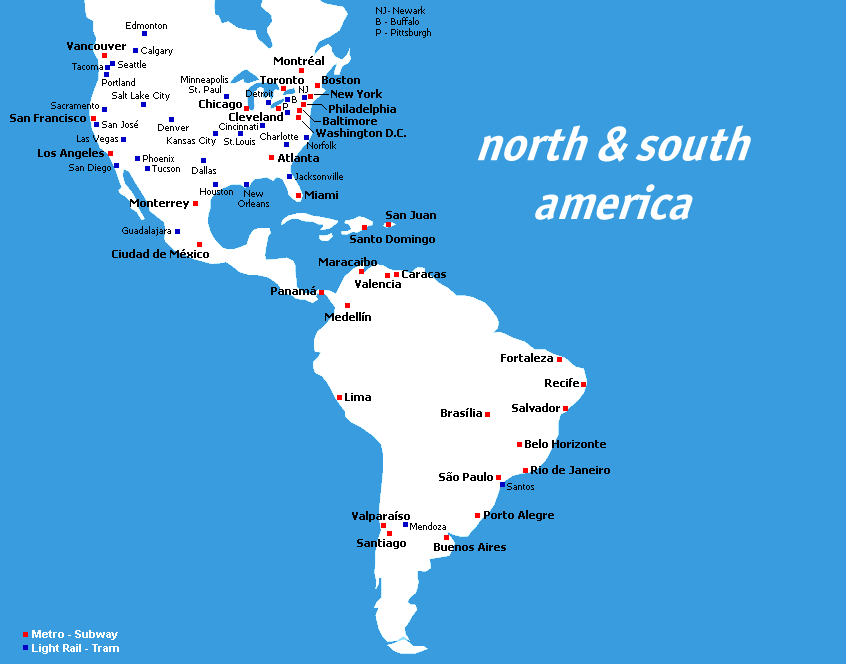
Out of all the metro systems I’ve rode on, there are currently two in the world that stand out to me in their approach to customer service. While most systems rarely have attendants to help people enter or leave the train, the two cities that are the exception to this rule are Boston and Medellin. These two transit systems actually have attendants working on behalf of the transportation authority to help passengers to use the metro effectively but with different approaches. For example, the way Boston does its’ customer service would be more hands-off while in Medellin it is much more hands on.

This difference in culture may play into the fact that the Boston T system has been in operation since 1897 and the locals are pretty adept at navigating the transit system considering its’ more than a century old. When it comes to Medellin, the metro system there began in 1995, which is a little over twenty years old. Medellin currently has the only urban train network in Colombia. Still though, you could draw the conclusion that the way the customer service of these two transit systems functions is reflective of the overall culture. In the U.S., we tend to be more individualistic especially when it comes to our urban transportation. When I lived in Medellin, I was enamored with how collective the metro system was when compared to where I’m currently living. In Boston, it’s much more about every man or woman for himself or herself as they try to navigate the system regardless of whether you’re a long-time local or a first-time visitor.

For Medellin, the aspect of their metro system that stood out most to me was the number of attendants who would help riders enter the train platform, instruct users on how to board and exit the trains, and how to refill and use their metro cards. Instead of just one or two attendants there on behalf of the transportation authority, there were usually up to a dozen workers assisting customers at each station. It was really nice for me to see the attention to detail that the metro system had in terms of assisting passengers to use the system effectively. This approach was crucial especially during a busy rush hour when there would be thousands of passengers wanting to enter and exit the train station.

Having a dedicated group of workers on hand to help smooth things over and make sure passengers were respecting each other and the transit system was a really impressive thing to witness. It doesn’t hurt that the entire Medellin metro system is well kept and has no littering, little rats running around etc. at any of its’ dozens of train stations. Compared to other cities, Medellin does a great job with its’ communal approach to the metro system. One of the catchphrases of their advertising is to ‘Vive La Cultura de Metro’, which basically translates to living the metro culture by respecting others and keeping the system clean.

Other cities could benefit from replicating the effective customer service, the emphasis on cleanliness, and the easy access to information that the Medellin Metro provides. Like any other transit system in a major city, it still does get quite congested during rush hour, and it can be hard to get on the train during peak hours due to lack of trains available. I know this from my own past experiences of having to fight to get on the train at 6 AM some mornings when I was a teacher there.

When it comes to the Boston T system, it’s the oldest in the United States and doesn’t take much time to get acclimated to. However, compared to the New York or Washington, DC transit systems, there is some customer service and assistance given. However, when you compare Boston to Medellin in this regard, it’s really no contest. While there are usually one or two attendants from the transit authority present, they don’t really actively help passengers. Sometimes, you can see a transit worker more interested in a smartphone game than to see if anyone needs help or has a question. Instead of being on the train platform to help riders get on and get off the train without issue, they usually just stand by the entrance to the station making sure everybody pays their fare.

Coming from where I was living in Medellin before I moved to Boston, this was a bit of a culture shock to me. It’s nice to have one or two more customer service attendants around to ask questions but I wish there were more attendants on the platform handling crowd control and enforcing the unwritten rules of getting on or leaving the train especially during rush hour. Also, compared to the dozen workers at any train station platform in Medellin, a city like Boston should have a few more people helping out compared to one or two workers per station.

Perhaps this cultural contrast is due to the fact that metro systems in the United States are much more individualistic in nature and the fact that public transit has been part of cities’ makeup for decades especially in the Northeast. I’m guessing that the majority of Bostonians would prefer to be left alone during the morning and evening commute rather than have hands-on help from transit service officials especially at a station platform. However, it might make everyone’s day a bit better and smoother if there were workers actively helping to assist people to refill their transit cards, making sure the rush hour commute goes smoothly, and aiding travelers to the city with directions.

When you travel to different countries, it is tempting to compare and contrast approaches to daily life. In any city, the transit system is an extension of the culture and I find it interesting to see the similarities and differences between countries in how they run their metro systems. It’s good to see how other cities and other countries do things because you’re able to see within your own culture what could be better or more improved. However, what may suit your own tastes may not suit others as much, even your own countrymen.

Train systems like whole cultures tend to be more individualistic or communal. What one city may lack in efficiency, they can make up for it in customer service. I believe it’s best to shoot for improvement in all areas to create a better travel experience. Having the trains run on time, being treated fairly by attendants, and enjoying clean, safe rides are keys for any metro system to achieve. Hopefully as more and more people travel and see the world, we can better see what ways we can improve our own cities and countries by seeing how others do it themselves.