
In a simulated world, which is built both on illusion and deception, distraction is the perfect weapon for keeping one complacent and from asking questions. Few film moments capture that idea more powerfully than a short but iconic scene from The Matrix (1999): Neo (Keanu Reeves), newly unplugged from the simulated world he once thought of as reality or the ‘real world’, walks through a bustling cityscape inside a training simulation that is programmed to feel like ‘The Matrix’, but whose participants realize it is a simulation and not the ‘real world’.
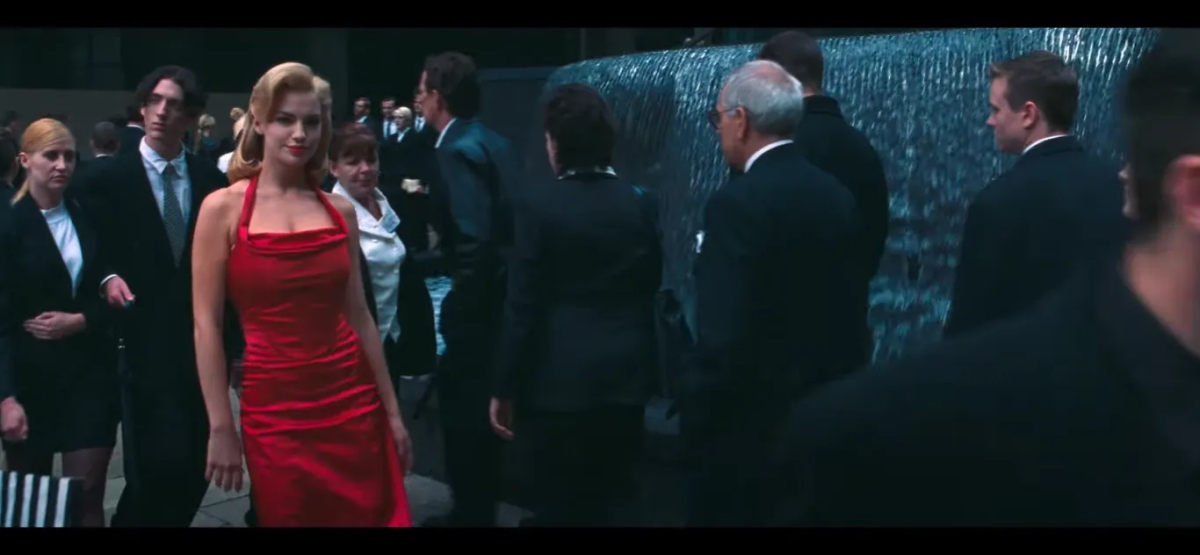
Suddenly, his attention is captured fully as he stops listening to Morpheus’s speech and focuses elsewhere. This distraction is not of danger, but by desire. A stunning blonde woman in a bright red dress walks past him on a city street. He turns to look at her and take in her beauty. A moment later, he’s staring down the barrel of a gun from an Agent of The Matrix.
This moment, while brief, is the Matrix in miniature form, a system that doesn’t just imprison the body, but hijacks the mind as well. In this scene, the Wachowski Brothers, who directed the Matrix film series, deliberate show the audience how distraction can be deadly, how perception can be manipulated, and how even the most liberated minds are vulnerable to illusion even after escaping from the simulated word of The Matrix. Over two decades later, this scene resonates more than ever as we live in a blurred world now of reality and simulation and of seemingly endless distractions like the lady in the red dress.
Let’s walk through how the scene unfolds similarly to how Neo and Morpheus experience the simulation themselves. Neo and Morpheus are in what appears to be a peaceful, clean city environment with sun-drenched streets, people in business attire moving in orderly fashion of different occupations and livelihoods. It’s not the gritty or green-tinted world Neo has just escaped from. Everything here is vibrant, bright, almost too perfect and calm. There’s a catch to it but we don’t know what it is yet as the audience.
Morpheus explains to Neo, “This isn’t the real world. It’s a computer-generated dreamworld built to keep us under control.” They’re inside a training program that mimics the Matrix, but this version is safe and controlled with seemingly no threats like what lurk inside the Matrix. As they walk, Morpheus encourages Neo to stay alert and keep up with him. However, Neo’s attention suddenly drifts elsewhere. A tall, blonde, and slightly smirking woman in a red dress glide past him, a stark contrast to the grayscale suits and muted tones of the crowd. The camera follows Neo’s gaze and not Morpheus’ words. Just as Neo turns around to look at her again, Morpheus interrupts: “Were you listening to me, Neo, or were you looking at the woman in the red dress?”
Neo turns again and instead of the woman, an Agent from the Matrix stands there with a gun to his head. The simulation freezes. Morpheus smiles. “Look again.” This is Neo’s wake-up call after he flinches from the sight of the Agent’s gun in his face. Neo is shaken as at any time in the Matrix, any of those ‘people’ are enslaved by the Matrix can turn into an Agent who is looking to prevent others from being freed from their enslavement by Neo, Morpheus and his crew. In The Matrix, distractions can be deadly because anyone can be an Agent and turn into one at any time. Neo learns his lesson and Morpheus instructs Neo about the real danger of going back into the Matrix, but they have a mission to free those from a reality that is not real, whatever the cost may be.
At its core, the Lady in the Red Dress scene isn’t just about Neo getting distracted having not been accustomed to the unique threat of an Agent. It’s about how the Matrix and by extension, any system of contro uses desire, beauty, and sensory overload to mask its true threat.
The woman in red is not a glitch, nor an accident of the simulation. She is designed by Morpheus’s crew to test Neo’s ability to focus and to challenge his awareness in an environment that constantly floods the senses, a virtual simulation that is meant to feel real but isn’t real. Morpheus isn’t just teaching Neo about the Matrix’s mechanics but also, he’s teaching him about vulnerability. The greatest danger isn’t always visible or known in the Matrix. Often, it’s hidden behind the things we want most or desire to have the most.
The red dress is more than a splash of color on a woman who is simulated to be a distraction. It’s a symbol in the overall movie of temptation, distraction, and the human tendency to follow what pleases us, rather than what protects us, even if it will end up hurting us later. In mythology, this kind of idea of ill-fated temptation appears often: sirens luring sailors to their doom in ‘Odysseus’, the forbidden fruit offered to Adam and Eve in Eden from the Old Testament, each of these illusions are designed to distract heroes from their quests or to lead to the fall of man and woman.
In this scene, the woman in the red dress is a test, one for which Neo fails, momentarily, and I think a lot of us would fail like he did with the distractions that are constantly thrown at us each day. His eyes are drawn away from his mentor, away from the lesson he is teaching, and toward something that feels more real than the truth. The result of his ill-fated choice? Instant danger and his potential demise if he were to make the same mistake again.
The brilliance of this scene lies in how it’s staged visually and shot from Neo’s perspective: everyone is dressed in grayscale, forming a camouflage of conformity and ordinariness. The woman is the only thing that stands out to Neo and the audience. She breaks the pattern of what we see and thus, attracts attention and an extra look. That’s what makes her the perfect distraction and allegory for ill-fated temptation, and that’s what makes this scene timeless.
Fast forward to today’s world where distraction has become the default mode for many of us. Our attention is fragmented by design, engineered by algorithms, applications, increasingly ‘real’ virtual and simulated realities, and seemingly endless digital stimuli, for which has dramatically shortened our attention spans. The modern “Matrix” isn’t an actual simulation in our brains, at least not yet as I write this, but it’s a network of more and more screens, news feeds, constant notifications, and seductive content. It’s the all-knowing algorithm pushing what it knows will make you pause mid-scroll and continue to feed your dopamine receptors.
Every time you find yourself watching a video you didn’t intend to watch, reacting to an outrage post on a political or social issue, comparing your life to curated influencer perfection on social media, or buying something new because it popped up at just the right time in your news feed, that’s the ‘red dress’ in action. While you’re watching the distraction, whatever kind it may be, something else is happening in the background of our lives: real threats are forming that pose real danger to us. Climate change. Political instability. Ongoing wars. Mental health crises. Surveillance capitalism. Social isolation. Economic inequality. Things that are far more dangerous and impactful than seeing ‘a lady in red’. Like Neo, we rarely see ‘the Agent’ or the real threats coming at us on the horizon.
In The Matrix, Morpheus teaches Neo that true liberation begins with awareness, not just of the system, but of how the system manipulates us and our desires. The Lady in the Red Dress is a metaphor for all the ways we’re trained to look away, to not pay attention, to surrender to the pleasure of the moment rather than focus on the issues of the present and the future. In 2025, this scene is more relevant than ever to our real world. It reminds us that to stay aware, engaged, and vigilant in a constantly distracted world is a small yet meaningful act of rebellion.
The focus and impact that you give to the world around you rather than cheap simulated or virtual distractions is actual power. Being able to have greater perception and awareness is everything these days and will allow you to help other people do the same. The next time something flashy, tempting, or beautifully packaged grabs your attention, you should ask yourself: “Am I listening, or was I looking at ‘the woman in the red dress’?”