


Being a Specialist vs. a Jack of All Trades in 2025

“There’s a saying that’s been repeated so often it’s lost its bite these days: “A jack of all trades is a master of none.” However, what most people forget is the full quote: “…but oftentimes better than a master of one.” That second half hits home for me as someone who likes to consider myself a man of many interests and likes.”

There’s a saying that’s been repeated so often it’s lost its bite these days: “A jack of all trades is a master of none.” However, what most people forget is the full quote: “…but oftentimes better than a master of one.” That second half hits home for me as someone who likes to consider myself a man of many interests and likes. I’ve been a jack of all trades most of my life, by design, and not by accident. I’ve always had too many interests to narrow myself into one lane, from teaching English and managing international projects to running side businesses, writing, and exploring new skills like photography and video creation. In 2025, this flexibility isn’t a flaw but rather its survival and adaptation in an ever-changing and acceleratingly fast world.

Let’s be real here too: the world doesn’t reward loyalty to one craft the way it used to in my parents or grandparents’ generations. The days when someone could spend thirty years perfecting a single skill at one company and retire with a gold watch are long gone. Industries move at the speed of AI updates and quarterly market shifts. The specialist like the surgeon, the dentist, the coder, the data scientist still has immense value, of course, and they should be commended for their craft and their dedication to their field.

Those are the people who go deep rather than wide, mastering one corner of a field to the point where they can innovate within it and do so for decades luckily. However, the specialist also lives or dies by their niche or calling. When that niche collapses, loses favor in terms of employability, or evolves faster than they can adapt to the changes to the industry, their expertise in one area can quickly become a liability.

On the other hand, generalists or ‘jack of all trade’s types, people like me, tend to thrive when change is the only constant in life. We’re used to juggling multiple domains, learning on the fly, and connecting dots others don’t even see or don’t wish to see. When AI starts writing code or generating content faster than humanly possible, the jack of all trades doesn’t panic; they pivot to adapt to that change and to see how they can go with the flow. They find new intersections where creativity, management, and soft skills still matter in a world that is increasingly tech-first, question later. In 2025, the ability to synthesize ideas across fields like education, technology, business, culture is arguably more valuable than mastery of just one skillset.

Still though, let’s not sugarcoat it: being a generalist or ‘jack of all trades’ comes with tradeoffs. You’re rarely the “go-to” expert in the room. You may not command the highest salary, or you may constantly feel spread thin, working to keep up with several evolving interests instead of going all-in on one interest. There’s a sense of restlessness built into the generalist’s DNA. However, that same restlessness is what keeps us generalist types adaptable and flexible. We’re built for the gig economy, the hybrid or remote workplace, the new industries, and the unpredictable career paths that define this modern era.

Specialists, for their part, enjoy a kind of depth that the generalists envy. They can focus, dig deep, and master a single language, whether that’s the language of law, medicine, finance, or engineering. Their work can bring a deep sense of purpose and respect that comes from being the person that people rely on when things get complex or challenging. Specialization can be a trap too though as it can make you resistant to change, or worse, blind to possible opportunities outside your comfort zone. The moment your expertise or your sole skillset is no longer in demand, your value can plummet unless you reinvent yourself and to do so quickly.

The reality is that 2025 doesn’t belong exclusively to either camp of ‘generalists’ or ‘specialists’. It belongs to the hybrids instead, who the ones who know enough across different professional disciplines to connect the dots and have enough depth in one or two areas to back it up with credibility and experience. The future as I see it will reward those people who can learn fast, adapt faster, and translate knowledge across industries.

Also, if you know how to communicate well, can solve problems, and meet deadlines consistently, you will always be in demand in my view to work for a company, organization, or other professional body. Whether you’re a generalist who’s learning to specialize or a specialist learning to broaden your scope beyond your field, the key remains the same as you should stay curious, stay humble, and never stop evolving.

Yes, I’m a jack of all trades and I don’t see that changing anytime soon in my own life. If anything, I’ve learned to wear it as armor in a world that’s constantly trying to box people into a corner. I’ve been told I should “pick a lane,” specialize, and double down on one thing alone but that’s never been me or my personality. My curiosity doesn’t fit neatly into a job title or a sole industry. I like moving between worlds, connecting people and ideas that weren’t supposed to meet in the first place.

I’ve realized that being a generalist isn’t about doing everything halfway; it’s about mastering having adaptability itself. It’s about knowing enough across fields to spot the patterns others miss and having the guts to reinvent yourself when the winds change direction. Specialists might thrive when the road is straight and predictable, but I thrive when the map is being redrawn in real time. So no, I don’t apologize for my curiosity or for the eclectic path I’ve taken in life so far. Being a jack of all trades in 2025 isn’t a weakness, rather, it’s an operating system for the modern world. In a time when rigidity gets punished and reinvention gets rewarded; versatility isn’t just a skill; it’s a survival strategy to get by. Honestly, I wouldn’t have it any other way.
A Study in Contrasts – the Medellin Metro and the Boston T

I’ve used a lot of different metropolitan transit systems in cities I’ve either visited or lived in. From Istanbul to Berlin to Washington, DC, it’s fascinating to see how different cultures and countries treat their metro systems. Some cities emphasize the ability to eat and drink at established vendors right next to the platform, while others emphasize the ability to know exactly when the next train will be arriving with real-time updates. In a way, these metro systems are a microcosm of a country’s culture. Unbeknownst to most travelers, you can learn a lot about a city and a country as a whole based on how they approach their public transportation. Each metro system I’ve used has had their own kind of flair to them whether it’s the London Underground’s cleanliness, New York Subway’s 24-hour service, and Istanbul’s kind food merchants.

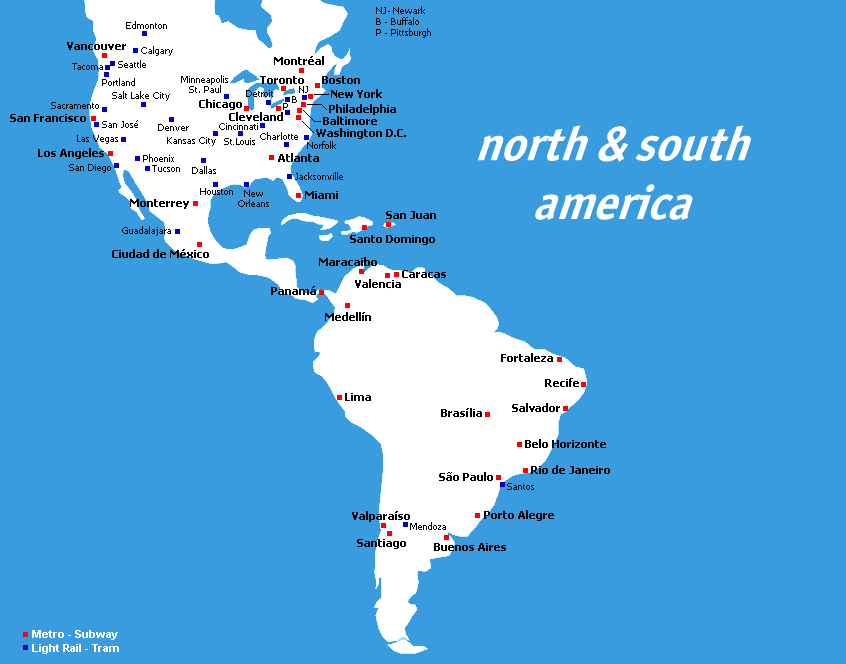
Out of all the metro systems I’ve rode on, there are currently two in the world that stand out to me in their approach to customer service. While most systems rarely have attendants to help people enter or leave the train, the two cities that are the exception to this rule are Boston and Medellin. These two transit systems actually have attendants working on behalf of the transportation authority to help passengers to use the metro effectively but with different approaches. For example, the way Boston does its’ customer service would be more hands-off while in Medellin it is much more hands on.

This difference in culture may play into the fact that the Boston T system has been in operation since 1897 and the locals are pretty adept at navigating the transit system considering its’ more than a century old. When it comes to Medellin, the metro system there began in 1995, which is a little over twenty years old. Medellin currently has the only urban train network in Colombia. Still though, you could draw the conclusion that the way the customer service of these two transit systems functions is reflective of the overall culture. In the U.S., we tend to be more individualistic especially when it comes to our urban transportation. When I lived in Medellin, I was enamored with how collective the metro system was when compared to where I’m currently living. In Boston, it’s much more about every man or woman for himself or herself as they try to navigate the system regardless of whether you’re a long-time local or a first-time visitor.

For Medellin, the aspect of their metro system that stood out most to me was the number of attendants who would help riders enter the train platform, instruct users on how to board and exit the trains, and how to refill and use their metro cards. Instead of just one or two attendants there on behalf of the transportation authority, there were usually up to a dozen workers assisting customers at each station. It was really nice for me to see the attention to detail that the metro system had in terms of assisting passengers to use the system effectively. This approach was crucial especially during a busy rush hour when there would be thousands of passengers wanting to enter and exit the train station.

Having a dedicated group of workers on hand to help smooth things over and make sure passengers were respecting each other and the transit system was a really impressive thing to witness. It doesn’t hurt that the entire Medellin metro system is well kept and has no littering, little rats running around etc. at any of its’ dozens of train stations. Compared to other cities, Medellin does a great job with its’ communal approach to the metro system. One of the catchphrases of their advertising is to ‘Vive La Cultura de Metro’, which basically translates to living the metro culture by respecting others and keeping the system clean.

Other cities could benefit from replicating the effective customer service, the emphasis on cleanliness, and the easy access to information that the Medellin Metro provides. Like any other transit system in a major city, it still does get quite congested during rush hour, and it can be hard to get on the train during peak hours due to lack of trains available. I know this from my own past experiences of having to fight to get on the train at 6 AM some mornings when I was a teacher there.

When it comes to the Boston T system, it’s the oldest in the United States and doesn’t take much time to get acclimated to. However, compared to the New York or Washington, DC transit systems, there is some customer service and assistance given. However, when you compare Boston to Medellin in this regard, it’s really no contest. While there are usually one or two attendants from the transit authority present, they don’t really actively help passengers. Sometimes, you can see a transit worker more interested in a smartphone game than to see if anyone needs help or has a question. Instead of being on the train platform to help riders get on and get off the train without issue, they usually just stand by the entrance to the station making sure everybody pays their fare.

Coming from where I was living in Medellin before I moved to Boston, this was a bit of a culture shock to me. It’s nice to have one or two more customer service attendants around to ask questions but I wish there were more attendants on the platform handling crowd control and enforcing the unwritten rules of getting on or leaving the train especially during rush hour. Also, compared to the dozen workers at any train station platform in Medellin, a city like Boston should have a few more people helping out compared to one or two workers per station.

Perhaps this cultural contrast is due to the fact that metro systems in the United States are much more individualistic in nature and the fact that public transit has been part of cities’ makeup for decades especially in the Northeast. I’m guessing that the majority of Bostonians would prefer to be left alone during the morning and evening commute rather than have hands-on help from transit service officials especially at a station platform. However, it might make everyone’s day a bit better and smoother if there were workers actively helping to assist people to refill their transit cards, making sure the rush hour commute goes smoothly, and aiding travelers to the city with directions.

When you travel to different countries, it is tempting to compare and contrast approaches to daily life. In any city, the transit system is an extension of the culture and I find it interesting to see the similarities and differences between countries in how they run their metro systems. It’s good to see how other cities and other countries do things because you’re able to see within your own culture what could be better or more improved. However, what may suit your own tastes may not suit others as much, even your own countrymen.

Train systems like whole cultures tend to be more individualistic or communal. What one city may lack in efficiency, they can make up for it in customer service. I believe it’s best to shoot for improvement in all areas to create a better travel experience. Having the trains run on time, being treated fairly by attendants, and enjoying clean, safe rides are keys for any metro system to achieve. Hopefully as more and more people travel and see the world, we can better see what ways we can improve our own cities and countries by seeing how others do it themselves.