A Future To Believe In

It is very rare in American politics these days to have a candidate running for high office who is sincere, genuine, and committed to his principles and ideals. A candidate who will not bow to the special interests, who will look out for all citizens and not just the wealthy few, and who has the ideas to make the United States a more fair, equal, and prosperous country. Because of these reasons, I am supporting  Bernie Sanders’ candidacy for President and why I will be voting for him in the upcoming Democratic primary in New York on April 19th.

While there is no such thing as the “perfect Presidential candidate”, Senator Bernie Sanders is the best choice not only for the Democratic Party but for the nation as a whole. He has served not only as a U.S. Senator for Vermont, but also as a member of the U.S. House of Representatives, and the Mayor of Burlington before that. For over thirty years, Senator Sanders has been a faithful and dutiful public servant. Over the course of his political career, he has always been a staunch defender for the rights of working class people, the middle class, and the poor.

From a young age of 22 when he was apart of the historic ‘March on Washington for Jobs and Freedom’ along with Dr. King and other civil rights leaders, he has continuously fought for equality of opportunity and greater freedom for minorities, women, and the LGBT community. What is also notable to mention from his past was his willingness to participate in an anti-segregation protest in Chicago in 1963. Because he stood up for his beliefs, he ended up being arrested and was taken away by the police for living up to those principles of fairness, justice, and equality.

Mr. Sanders has made his Presidential campaign “of the people, by the people, and for the people.” He refuses to take money from SuperPACs unlike his Democratic and Republican rivals. He also does not accept donations from big corporations and the millionaires, billionaires of the country. He wishes to nominate Supreme Court justices who will attempt to overturn the disastrous Citizens United decision, which allowed large corporations the ability to donate huge sums of money to their favored candidates for elected office. I applaud his commitment to making his campaign about the individual supporters, donors rather than about corporate sponsorship and special interest contributions. More so than any other Presidential candidate in recent history, he has shown a commitment to running a national campaign that’s fueled and powered by the average voter.

In addition, I believe in his policy proposals for a national minimum wage of $15 per hour, a Medicare-for-all policy that would ensure universal health care for all U.S. citizens, and to reduce the incarceration rate significantly over time to end the unfortunate distinction of being the country that has the biggest prison population in the world. Over the past few weeks since I returned from Colombia, it has been a pleasure for me to knock on doors, make phone calls, and to volunteer for his campaign at the Washington Square Park rally on April 13th.

About 30,000 people attended one of the largest rallies of the 2016 election season at Washington Square Park this past Wednesday night to see Senator Bernie Sanders speak about his vision for America. As a volunteer at the event, I helped with crowd control by keeping the huge lines orderly and moving cordially. The atmosphere was filled with excitement and anticipation. The mood of the people attending the rally was happy and even joyous at times. It was a cold evening in lower Manhattan but you could feel the energy and the passion people felt about this particular campaign. In addition to Senator Sanders’ rousing one-hour stump speech, notable celebrities, public officials and figures also lent their voices during the massive rally. The most notable names were Tim Robbins, Spike Lee, Rosario Dawson, and Shailene Woodley.

I enjoyed the rally immensely and I was lucky enough to be close to the stage after a hectic day of volunteering and keeping order among the large crowds of people waiting in line. I shook Senator Sanders’ hand after the end of his speech and wished him well in Tuesday’s New York primary. It was an exciting moment for me and I was glad to be apart of such a large and historic campaign event. I can only hope that this rally will lead to a large turnout and a successful result at the polling places across New York State in just a few days from now.

While I usually avoid writing blog posts about politics, I have to make an exception in this case because I feel strongly about Bernie Sanders’ candidacy and believe that he is the best choice not only for the Democrats but for the country too. Similar to Candidate Obama in 2008, Candidate Sanders has created a lot of enthusiasm, held huge rallies, and has earned support from diverse groups of voters due to his campaign’s message and consistency.

Time will tell if his candidacy will be successful enough to be nominated as the Democratic Party’s standard-bearer and to continue on to the 2016 general election against the Republican nominee. However, so far, he has shocked all of his doubters and made it further than anyone would have originally thought possible. Despite what may happen in Tuesday’s New York primary and beyond, I know that I will continue to “Feel The Bern.”

______________________________________

Disclaimer: The views and opinions expressed in this blog post represent solely my own and do not reflect or represent those of any outside party, organization, company, or group. Thank you.


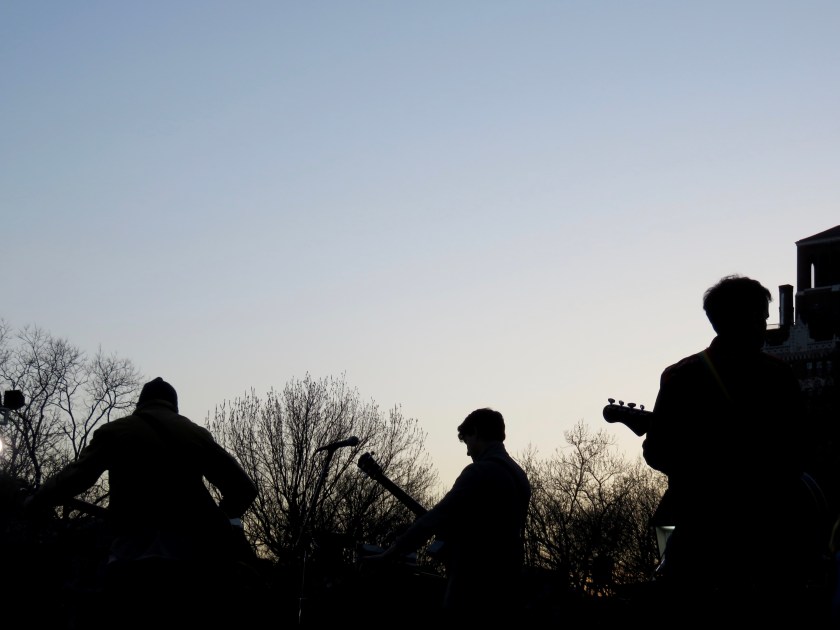
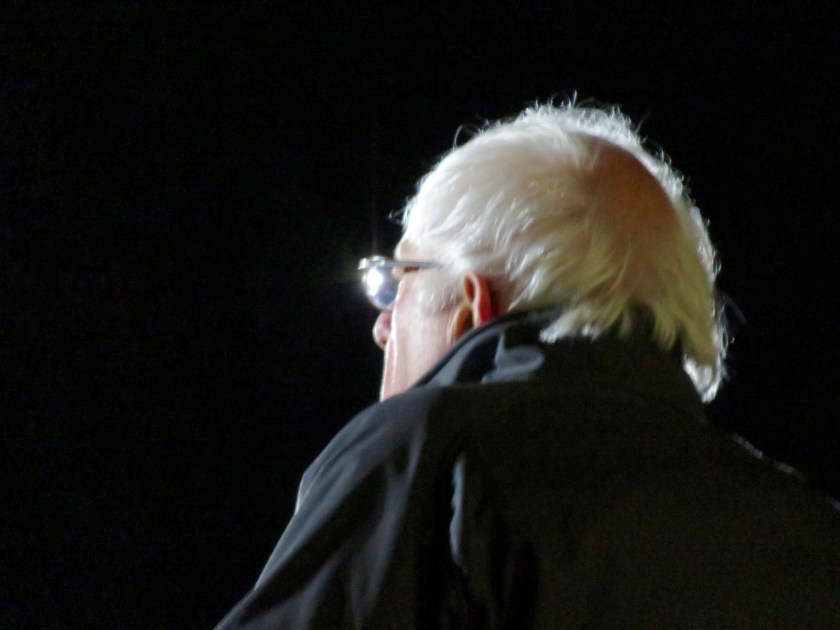
Bernie Sanders Rally in NYC

“What the American people want to see in their president is somebody who not necessarily can win every fight, but they want to see him stand up and fight for what he believes in, and takes his case to the American people.”

-Bernie Sanders

IMG_0089

IMG_0091

IMG_0090

IMG_0094

IMG_0100

IMG_0123

IMG_0127

IMG_0146

IMG_0139

IMG_0133

IMG_0144

IMG_0154

Camera: Canon PowerShot SX710 HS

Location: Washington Square Park; New York, New York


‘The Godfather’ – Film Review and Analysis

don-vito
“I’ve spent my life trying not to be careless. Women and children can be careless, but not men.”

One of the great classic American films of the 20th century, The Godfather, directed by the legendary Francis Ford Coppola and based off of the novel of the same title by Mario Puzo is often considered to be the most influential film that created the ‘organized crime’ or mafia/gangster genre in cinemas.

Since its’ release in theaters in 1972, it has garnered a cult following among fans who led to ‘The Godfather’ becoming a trilogy with Parts Two and Three both released in following years. Because of its significance culturally and historically, the Library of Congress preserved it in the United States National Film Registry in 1990. Because of its success at the box office and with film critics alike, ‘The Godfather’ garnered many Academy Award nominations and won four Academy Awards including ‘Best Actor’ for Marlon Brando and ‘Best Picture’.

In addition to adding to the legendary career of Brando, ‘The Godfather’ also introduced to Hollywood a young Al Pacino and a very talented Robert Duvall. Both men would have extremely successful careers in American film but I believe that it was ‘The Godfather’ which helped catapult their early careers into noteworthy stardom.

Drawing parallels to the real life ‘Five Families’ of New York that dominated the Italian mafia during the 20th century, the fictional Corleone family, led by Don Vito Corleone, is highlighted as being the ‘pariah’ and at odds with the other crime families throughout the film. Vito Corleone, played by Marlon Brando, acts like the quintessential mob boss whose cunning and intellect has made him to this day a very quotable character that has become apart of American popular culture.

In The Godfather, we see Vito nearing the end of his reign as boss of the family and looking for his eventual successor. Vito has three sons: Sonny, the oldest whose lack of foresight and hotheaded temper makes him a liability albeit is the favorite initially to replace Vito as Don of the Corleone family. Fredo is the middle child and is a consistent womanizer. Considered neither to be reliable nor intelligent, Fredo is kept to the side often and is not a suitable person to lead the family due to his lack of cunning and intellect. Michael, a U.S. Army Veteran and the youngest child of Vito Corleone is portrayed as being very innocent and often has requested to be kept out of the family business if he can avoid it.

However, as the viewers of the film can understand and interpret, a mafia family reels everyone in to its business whether or not it’s intentional. One of the best aspects of The Godfather is watching the changes in Michael’s behavior and demeanor as extenuating circumstances involving the family forces his hand and he is forced to take on more responsibilities and duties as a Corleone and the son of Vito. His loss of innocence and the transformation that occurs with Michael from dignified U.S. Army Veteran to cunning, ruthless Mafia boss is a great strength of this timeless film.

For those critics who are against violent Mafia films and choose not to watch them, that is fine but it should be considered that there is more to this movie than meets the eye. Above all else, it is the story of a father trying to repent for the sins of the past and trying to keep his sons from avoiding the same mistakes that he has made.

The relationship between Vito and his son, Michael in particular is memorable for how Vito expects so much from Michael considering he is the most levelheaded and intelligent of the Corleone brothers. There is one great scene in the film where Vito and Michael are discussing the ongoing drama of the war between “The Five Families.” Vito laments to Michael on how he is sorry that he was thrust into the mafia business when he expected his son instead to become “Governor Corleone” or “Mayor Corleone.” Michael simply looks at his father lovingly, and says: “We’ll get there, pop. We’ll get there.”

Other classic scenes that I enjoyed involve the courtship between Michael and a beautiful Sicilian woman named Apollonia. What I liked most was highlighting the very old-school dating process of asking Apollonia’s father for permission to date and then later marry his daughter with all respect given. It’s a touching moment in the film, which reveals that Michael’s humanity has not been totally wiped out because of the mafia. It was also great of Director Coppola to show the traditional procession of the Sicilian wedding and how all of the townspeople were involved in wishing Michael and Apollonia well.

Without trying to spoil the rest of the film for those of you readers who haven’t watched The Godfather yet, I can’t recommend it enough to avid movie fans. The directing by Francis Ford Coppola, the cinematography, the acting performances by Al Pacino, Marlon Brando, Robert Duvall, James Caan, etc. are phenomenal and they deserved every heap of credit that was bestowed upon them at the Oscars and elsewhere.

The Godfather is simply more than just a mafia film in my opinion. It is a story about a complex family, fathers and sons, human nature, and the thirst for power and respect. Have an open mind and see this film if you get the chance. I promise that you won’t regret it even if the running time is three hours in total. You can always tell your friends and family that I wrote a blog post that you couldn’t refuse to read.

Expanding National Service

nationalservice
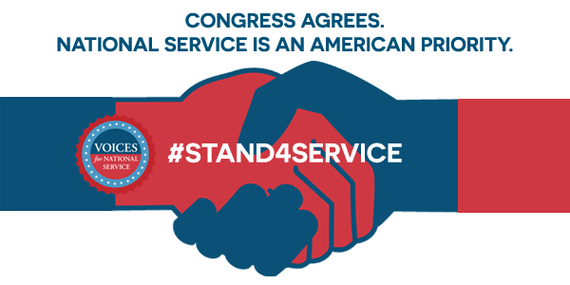
“Congress agrees…but will that turn into actual legislation in the future?”

If you are a young American thinking about what to do next with your life after finishing high school or college, and you’re interested in serving greater causes than your own personal goals and pursuits, you should seriously consider becoming a volunteer. You may have your own preferences when it comes to serving but what matters is that you choose to do something to give back to those in your country and those around the world who are less fortunate than yourself. Your career goals, your family, and even your friends will understand if you choose to put things on hold for a few years, especially if you’re in your 20s still. You may like your volunteer service so much that you choose to make a career out of it too.

Currently, in the United States, a country which continues to be divided more and more along political and economic fault lines, I think it is vital that young Americans choose to put their differences aside and contribute to bettering their country or the wider world in some measurable way. Volunteering or serving a community can help you to become a better person and a better citizen. There are many options out there if you decide to take the leap and apply for some programs. Not only will you be doing good for a school, a community, a city, etc., you will be helping your own future out with the experience, knowledge, and skills that you will gain from the type of service you commit to.

Contrary to popular belief, joining the Military, while a very noble and brave pursuit, is not the only way to serve one’s country or community. There are many other options for those of us in the United States. The most popular volunteer programs include AmeriCorps, Peace Corps, Habitat for Humanity, CommunityHealth Corps, Teach for America, City Year, FEMA Corps, etc. Those are some of the most well-known and reputable organizations and agencies that have successfully made in a difference in the lives of thousands of people both in the United States and around the world. Besides these national programs, there is also thousands of other more local and community-based volunteer service organizations located in different towns and cities across America. While the options to serve are out there in global, national, and local settings, most young people do not commit to any type of service after college and choose instead to go into the private sector and begin their careers right away.

While the number of applications number in the thousands and continue to grow for service programs like Teach for America and the Peace Corps, there are not nearly enough spots available for all the young people who would like to serve but can’t due to a lack of funding or not enough spaces for them. Demand is not the overall issue when it comes to the issue of national service but rather the supply. Less than 1% of the American population currently serves in the Military and while other national service programs enroll tens of thousands of volunteers and the competition to get accepted is intense, only 25% of adult Americans are known have served in some capacity, which is quite a low number when you think about it.

Senator John McCain of Arizona and U.S. Army General Stanley McChrystal recently wrote an excellent Op-Ed article for CNN where they also argued for an expansion of choices and options when it comes to national service for young Americans. They both believe that this issue is non-partisan and should be heartily agreed upon by both political parties and the American public as well. They go on to discuss the idea of a year or more of mandatory national service in order to foster a greater sense of citizenship, mutual investment, and commitment among young people for the country and the world. I agree with their sentiment wholeheartedly.

While there are a great amount of people my age who commit a few years in their 20’s to public and national service, many of my fellow citizens do not have the chance to or do not want to. Mandating a year or two of national service for all American citizens after college or high school would be an excellent policy idea and would be a great benefit to institutions like Teach for America, AmeriCorps, etc. Creating the opportunity for every young American to give back to their community and country is a noble endeavor and can only help the future rather than hinder it.

Overall trust in the American government, national institutions, and even other citizens are at all-time lows. Expanding opportunities for young Americans to serve would be a great way to begin to restore that faith and confidence in our civil society, and to rebuild that national fabric that holds us together as one people. Recent legislative efforts like the Edward M. Kennedy Serve America Act and the 21st Century Conservation Service Corps have been great in expanding national service in certain ways by increasing AmeriCorps membership by 250,000 volunteers per year and focusing on putting more resources towards improving our national parks and forests respectively.

However, none of the legislation thus far has gone far enough to make at least one year of national service mandatory for every citizen and to provide enough opportunities and programs available to make it a feasible commitment. I would hope that the next President and Congress will strive to involve more young people in building a better America and a better world. One or more years of national service from millions of young Americans would make such a positive and sizable impact on the country as a whole. It would be definitely worth the money it would take to make this public policy idea a reality.

As President Theodore Roosevelt once said, “We have fallen heirs to the most glorious heritage a people ever received, and each one must do his part if we wish to show that the nation is worthy of its good fortune.”

Sources:

1.) https://www.washingtonpost.com/blogs/therootdc/post/why-volunteer-programs-like-the-peace-corps-teach-for-america-reward-children/2012/02/02/gIQAOXl8mQ_blog.html
2.) http://www.cnn.com/2015/08/10/opinions/mccain-mcchrystal-national-service-legislation/
3.) http://www.nationalservice.gov/about/legislation/edward-m-kennedy-serve-america-act
4.)http://www.nationalservice.gov/sites/default/files/documents/10_0421_saa_implementation.pdf
5.) http://www.mccain.senate.gov/public/index.cfm/2015/8/senators-john-mccain-michael-bennet-introduce-bill-to-expand-national-service-opportunities-for-american-youth
6.) http://www.huffingtonpost.com/michael-brown/americorps-funding_b_1280200.html
7.) http://www.people-press.org/2014/11/13/public-trust-in-government/
8.) http://21csc.org/

Made In America?

free-trade-cartoon

Have you ever noticed this small yet important detail when you’re out at the store buying a consumer good whether it’s a pair of pants, a carpet, or some brand new shoes? For those of you who are confused right now, there’s a tag attached to the item indicating that the final product was “Made in …..” which indicates the origin of the country the good has come from. I doubt that most people notice this small detail when they’re out shopping and it’s probably not their biggest concern.

However, I do believe it’s very important as consumers to know where our goods and services are coming from and to what sort of quality they are made. It’s also important to ask the question of these companies who make these consumer products, both foreign and domestic, how well are they treating their employees and what do they pay them for their hard work? Do they receive good health benefits and vacation time? Are the working conditions in their factories and shops safe and hospitable?

I have noticed that most of the clothing, household items, and electronic products that I have bought were not made in the United States. I am not against wearing or buying consumer goods that were created and manufactured in other countries. However, I do worry that we are relying too heavily on these foreign-made products in our daily lives instead of having some of these same goods made in the U.S.A., which could improve the lives of many people looking for decent-paying jobs. Many abandoned and dilapidated factories, plants, and mills could be re-opened again if we change the way we look at free trade.

According to the official and most recent numbers on United States International Trade Data, there was a sizable overall trade deficit in goods and services of $43.9 billion dollars in October of 2015. Since ‘The Great Recession of 2007-2008’, the trade balance has not changed greatly in terms of lowering the overall deficit. Over the past five years alone, the monthly trade deficit has ranged from $40 to $65 billion. There has been very little sign of this trade imbalance being decreasingly significantly or being entirely eliminated recently. This means that the U.S. is importing a much larger quantity of goods than we are exporting overseas. While some people would argue that this is not a big deal, I would say that in order to grow the economy at a higher output and decrease unemployment further, increasing our exports overseas with the stamp “Made in America” should be a higher priority especially with the upcoming presidential election.

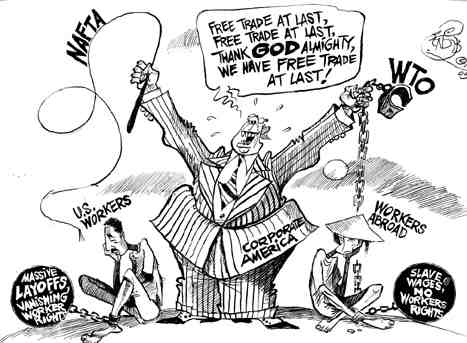
With the decline in American manufacturing, the U.S. has increasingly looked to its trading partners overseas to fill the void that has been created. Due to free-trade agreements such as NAFTA and the recent passing of the Trans-Pacific Partnership, many American companies and jobs have moved overseas causing the trade deficit to increase over the past generation. This has led to many good-paying middle class jobs with health and other benefits to disappear. There has also been a steady decline in the Unions and their total membership and influence within the U.S.

Examples of the shift towards the growing importation of manufactured goods and products that used to be made in here at home can be found in companies such as Wal-Mart and Apple. These iconic companies that were created by Americans such as Steve Jobs and Sam Walton have changed significantly like many others since their early days. They have become multi-national in nature and have expanded their facilities and operations to multiple countries around the world. Even though their company headquarters are in Silicon Valley and in the heartland of Arkansas, these companies are not taxed like other U.S. companies and carry out their manufacturing and production of goods from overseas suppliers.

American workers are known to be more expensive to train and hire than those workers found in countries such as China, Vietnam, and Cambodia. That’s an unfortunate truth that has led many companies to take the easy way out by calculating how much they would save due to the fact that foreign labor is cheaper. For these firms, there is little to no need to worry about strict labor laws that don’t exist outside the U.S. and other parts of the Western world. For example, huge multi-national companies such as Apple have used subsidiary companies like the ‘Foxconn Technology Group’ for years in order to manufacture their iPhones and other high-tech products. There have been many investigative reports done by The New York Times and other news outlets about the harsh working conditions, poor salary, long hours, and reported suicides and riots occurring at these plants in China.

In a lot of developing countries, the taxes associated with doing business are much cheaper which allows a lot of big manufacturing firms to operate there more freely. Even though multinational companies have to pay U.S. taxes on the profits that they earn from products that they make and sell in other countries, Apple and others can avoid paying these taxes by re-investing their profits made from outside the U.S. on overseas factories, stores, warehouses, etc. Because of that, they won’t have to pay the higher taxes. It’s a significant loophole that hasn’t been closed yet and allows U.S. companies to store billions in profits overseas. “Apple is not alone in this strategy. U.S. companies have $2.1 trillion in foreign profit stashed overseas, according to Capital Economics.”

Once the multi-national companies decide to move their manufacturing and production operations overseas, it’s very difficult to bring them back to the U.S. Competitors like China have the infrastructure and a vast amount of workers willing to work in the factors for these supplier companies. It is the responsibility of companies like Apple to break their agreements with manufacturing giants like Foxconn if they ever decided to move their production operations back to the U.S. However, Apple would have to invest in billions of dollars to build these new factories and pay these workers a fair wage with benefits. This proposition is entirely unlikely to occur in the near future for Apple, Wal-Mart, GE, and others to move their manufacturing back to the U.S. due to the higher taxes, the higher costs of the workers and their desire to make the most profits that they can secure.

Free trade is a complicated subject but I decided to write about this issue because I think as consumers, we should know where our money is going. I am guilty like many other Americans in supporting these popular multi-national companies who have gotten away with sketchy business practices and who have shied away from creating jobs here in the U.S. However, it’s never too late to be informed about where your clothes, your cars, and your electronics come from. Do your research and be informed about these issues.

Globalization and free trade have lifted millions of people out of poverty and allowed many countries to boost their economies but it’s also led to a higher amount of competition, the stagnation of wages, and many environmental concerns. I am not a protectionist and I believe that some free trade is good. However, it’s more important than ever that we support fair trade and business practices from these companies. Workers around the world should be treated fairly with good wages, good health and vacation benefits, and they shouldn’t be taken advantage of whether they are located in Saigon or Detroit.

We have free trade with other countries so that we can exchange goods and services with them to better our economies and our peoples. Lets’ not create a situation where we are importing more goods than we should be at the expense of the American worker and taxpayer. These companies need to be held accountable for what they do both here in the U.S. and overseas.

I would encourage everyone reading this entry to think about where your goods and products come from. If you have the chance and opportunity to do so, I would argue that you should try to buy from the U.S. companies making the goods and services right here in America. I am not against buying foreign goods either but we have to know whether these large companies out there are playing by the rules and are not being exploitative.

By ‘Buying American’, it’s good to show those small businesses and firms that we still support them and that we want them to succeed. If you would like to support buying American-made goods and products, check out this website: http://madeinusachallenge.com/ (Made In America – Master List)

Sources

Reverse Culture Shock In The USA

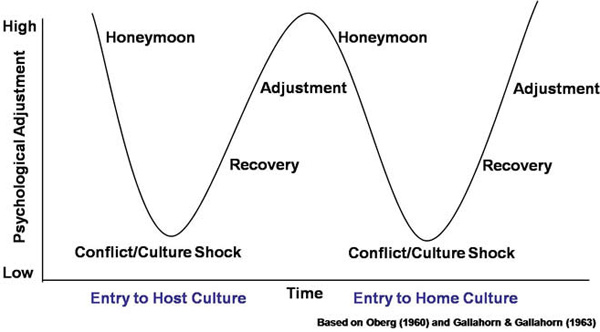
“Adjusting to one’s home country and culture can take a while. This graph sums it up quite well.”

After being away from the United States, my home country, for the past year, I have been dealing with ‘reverse culture shock’ since I have returned as many people who come back to their home culture experience after an extended time overseas. There is a natural recovery and adjustment process but it takes time to get back into the swing of things. As a writer, I like to gather my thoughts on paper about what I have noticed about my home country since returning from my time spent overseas. These observations have helped me to deal with my ‘reverse culture shock’ so far and to comment on what could be improved or changed to make my country better. I have traveled to 20 other countries, and have lived in Turkey and Costa Rica thus far so I believe I have some knowledge about how the U.S. compares to the rest of the world in different ways.

I would like to note that I do love my country and have enjoyed being born and growing up here. The United States is a great country and I only wish to see it become better and better in the future. I intend to use this blog post to merely bring up some outstanding issues and problems that the U.S. must deal with as a whole. No country I’ve lived in or have been to will ever be perfect and every country has different flaws/issues to work out. That’s part of the reason why I love to travel and explore the world. It’s interesting to see the variation among cultures and societies along with how they tackle their own internal and external problems to make their own countries better. Listed below are the items that I write in detail about which have caused me some ‘reverse culture shock’ since my return to the United States in late July of 2015.

  1. Lack of Using the Metric System in the 21st Century: The U.S. is one of only three nations in the world who don’t fully use the Metric System (International System of Units, SI). Liberia, Myanmar are currently our only counterparts in this anomaly. There’s no excuse for that and it harms our international commerce procedures and our ability to conduct foreign relations properly.
  2. Lack of High Speed Rail, and Efficient Public Transportation: This can be quite jarring after visiting developed nations like Germany, France and also from what I have read about China and Japan who are way ahead of the U.S. in developing high-speed rail networks. Part of this is the fault of state governors who refuse federal stimulus funding for high-speed rail projects. (Examples: Wisconsin, Florida, Ohio, etc.)
  3. Large and Unhealthy Food Portions: This may be part of the reason for the ongoing obesity problem in the country. I’m all for enjoying a good meal of course but I think the food portions I’ve had in the U.S. have been the biggest than all of the other countries that I’ve visited so far. I also believe that having ‘free refills’ and ‘soda fountains’ at restaurants, while a tempting proposition, is not something that should be offered to promote a healthy diet.
  4. Reliance on Tipping (Mandatory?) to pay workers’ wages: I’m fine with throwing in an extra 10% on top of my meal and tax for good service but I don’t believe it should be 15-20% every time in order for these workers to meet and go above their very low hourly Minimum Wage as ‘tipped workers’. I believe that these service workers in the U.S. should be paid a higher minimum wage altogether by law and that they should be guaranteed a good wage each shift rather than fighting for tips each day.
  5. Obesity crisis and an astounding proportion of adults/children who are overweight: It’s a drain on an already expensive health care system and contributes to our total health care expenses. There needs to be more emphasis in our society on daily exercise and getting out of the house for both children and adults. Healthier eating and taking a walk/going for a run each day can go a long way to helping to solve this problem. I believe that companies and schools should play a larger role in keeping their employees/students in good physical shape with certain incentives.
  6. Heavy reliance on cars, trucks and other motor vehicles to get around suburban and urban areas: There is a lack of walking around towns and cities because there is much more sprawl and open space in the U.S. However, I believe that having trams/streetcars, more extensive public bus transportation systems in both suburban and urban areas could relieve part of the traffic jams and gridlock that affects a lot of the country nowadays.
  7. Big Businesses and Corporations get the benefit of the doubt too often: When it comes to beating out smaller businesses and enterprises, these big box stores are winning out. These major companies contribute to this problem by monopolizing their industry and not allowing others to compete in a free market environment. This, in part, contributes to suburban sprawl because these huge megastores contribute to the layout that contributes to the car culture. (i.e. Wal-Mart, Bed Bath and Beyond, Dick’s Sporting Goods, Best Buy). I can’t remember the last time I’ve seen a family-owned coffee shop in my town or neighborhood. There are three Starbucks’ around though for a good cup of joe…
  8. General lack of curiosity about foreign cultures and peoples: Many Americans do not speak a 2nd language or don’t pay attention to international affairs beyond what they learned about briefly in high school and college. This is a generalization but I still believe it applies to the majority of people within this vast country. Still, only about 30-35% of Americans own a Passport. I would encourage more Americans to travel and see the world especially if they’re younger. Taking a “gap year” before or after college would be a good way to travel and there are ‘work-study’ programs available for Americans to take advantage of in western European countries (Ireland, UK, etc.) along with Australia.
  9. Very conservative laws about alcohol possession and consumption: “21” as the minimum legal age for consuming alcohol makes no sense to me especially considering you can start operating a motor vehicle at 16, join the military at 18 and also vote for President and other elected officials at that same age. Having someone check your ID to get into bars/clubs or at a sporting event to purchase beer or wine is also ridiculous. I’ve seen people in their 40’s and 50’s get carded when they are clearly over the legal age here. The United States is one of the few countries where the drinking age is 21 along with Pakistan, the UAE, and Indonesia.
  10. Mind-numbing advertisements: I have noticed that there are way too many drug commercials (Cialis, Prozac, Ambien etc.) that appear on television especially during the day. In the U.S., We are constantly bombarded in our homes, in public events, on public transportation, etc. with these silly advertisements. It’s predictably a way for marketers to get people to feel insecure enough about themselves to want to buy things to fill some kind of missing “void” in our lives.
  11. Political Gridlock / No ability to get big things done legislatively: The recent threats of a government shutdown, the debt ceiling threats, continuous gerrymandering, the electoral college deciding a Presidential election instead of the popular vote, too much of an influence of organized money in politics in the upcoming 2016 elections, (Citizens United decision). These occurrences harm our ability to boost our education system, solve long-term Medicare and Medicaid solvency along with the broken immigration system and the need for more investments in our antiquated transportation and infrastructure systems.
  12. Expensive costs of Higher Education: A lot of Western countries completely subsidize higher education institutions but the United States has seen a rapid growth in the amount of students going into debt to pay for college and graduate school. There have also have been cuts over the years to the Public University systems in certain states such as California. Wages have not kept up with inflation and the pace of tuition increases is out of control. $1 trillion of total student debt is disturbing and is a poor reflection of our country’s priorities.
  13. High level of income inequality between the richest and poorest Americans: The top 1% of Americans earns about 20% of the total national income. This is unacceptable and shows a widening gulf between the wealthy and poor. This level of inequality is at its’ highest since the gilded age of the 1920’s. Many economists say this is one, if not the top economic issue facing the country into the future. If not dealt with, our country runs the risk of turning into an actual “banana republic.”
  14. Too much emphasis on Military Spending: The U.S. continues to spend more on its military and armed forces at about 650 billion dollars total. This is 40% of the total world share and is more than the next 11-12 nations combined. It may only account for 4% of the total Gross Domestic Product but has much more of an influence on the federal budget than State, HUD, Education, HHS, EPA combined. The Cold War has been over for twenty years and the wars of the 21st century will be fought through specialized forces, by drones, or over the cyber-web so there’s no need for such an expansive budget into the future. It’s important to maintain a strong military but a nation should have other priorities as well and balance them out successfully.
  15. Our prison system needs real reform: The United States has the largest incarceration rate in the world. 2.3 million citizens are in its jails which is 22% of the world’s total amount of incarcerated prisoners, (Source: World Prison Population). Unfortunately, we are ahead of other nations such as Russia, Iran, China, UAE, etc. when it comes to this rather dubious distinction. While the Netherlands is closing down prisons because of a lack of need, my country continues to build up a massive private prison industry which is unheard of in most other industrialized nations. This is, in part, a result of the failed “War on Drugs” which involves serious sentencing measures for non-violent drug offenders. Recently, politicians in both major parties in the U.S. have called for prison and sentencing reform but no concrete legislation has been passed by Congress and signed by the President up until this point.