English Corner – Possessive Nouns

Being able to discuss ownership in English over a person, place, or thing is quite key when it comes to developing your grammar proficiency. In order to do that, you must be able to understand, use, and master possessive nouns. The function of possessive nouns is to essentially demonstrate ownership or some similar relationship over something else. Plural nouns indicate more than one person, place or thing. Listed below is a key hint about how to create the possessive noun as well as the five key rules that you can utilize in order to figure out if there is ownership of an object or not.

When you’re unsure of how to find the ‘possessive noun’ you have to look for the Apostrophe! Possessive nouns typically include an apostrophe!

Examples:

  • Jennifer’s imagination ran wild as she pictured the horrible car accident.
  • The kitten’s toy is a stuffed mouse, which she plays with every day.

You should be able to think of the apostrophe mark as a ‘hook’ reaching out to take possession of the object or person involved. Without the little hook or hand grabbing onto the ‘s’ or the next word, the noun is in its’ plural form simply but not actually possessive of anything or anyone.

In addition to looking out for the apostrophe to indicate that the noun is possessive, there are five major grammar rules for possessive nouns to understand and use.

Grammar Rules for Possessive Nouns

There are five basic grammar rules that cover the majority of times where writers encounter possessive nouns.

Rule #1: Making singular nouns possessive

You must add an apostrophe (‘) + s to most singular nouns and to plural nouns that do not end in the letter -s.

You’ll use this rule the most, so pay particular attention to it. English has some words that are plural but do not add the letter ‘s’. Words like children, sheep, women and men are examples of some plural words that do not end with an ‘s.’ These plural words are treated as if they were singular words when making the noun possessive.

Examples:

  • Singular nouns: kitten’s toy, Joe’s car, MLB’s ruling
  • Plurals not ending in s: women’s dresses, sheep’s pasture, children’s toys

Rule #2: Making plural nouns possessive

Add an apostrophe only to plural nouns that already end in the letter -s. You don’t need to add an extra ‘s’ to plural nouns that already end with the letter ‘s’. You only need to put the apostrophe onto the end of the word to indicate that the plural noun is now a plural possessive noun as well.

Examples:

  • Companies’ workers
  • Horses’ stalls
  • Countries’ armies

Rule #3: Making hyphenated nouns and compound nouns plural

Compound words can be tricky for the average grammar student. However, you’ll need to add the apostrophe (‘) + ‘s’ to the end of the compound word or the last word in a hyphenated noun.

Examples:

  • My father-in-law’s recipe for meatloaf is my husband’s favorite.
  • The United States Post Office’s stamps are available for purchase in rolls or packets.

Rule #4: Indicating possession when two nouns are joined together

You may be writing about two people or two places, or two things that share possession of an object. If two nouns share ownership of the object or the person in question, indicate the possession of that noun only once, and on the second noun itself. Add the apostrophe (‘) + ‘s’ to the second noun only.

Examples:

  • Jack and Jill’s pail of water is a common nursery rhyme.
  • Abbot and Costello’s comedy skit “Who’s On First” is a classic comedy sketch.

Rule #5: Indicating possession when the two nouns are joined, yet ownership remains separate

This is the trickiest rule of them all, but luckily you’ll only need to use this rule infrequently. When two nouns indicate ownership, but the ownership is separate, each noun gets the apostrophe (‘) + ‘s’. The written examples below may help you to understand exactly what this rule means.

Examples:

  • Lucy’s and Ricky’s dressing rooms were painted pink and blue.

Explanation – (Each person owns his or her own dressing room, and they are different rooms).

  • President Obama’s and Secretary Clinton’s educations are outstanding.

Explanation – (Each government official owns his or her education, but they attained separate educations).

Possessive nouns is a tricky grammar topic but by understanding the need to use the apostrophe in the correct place and studying the rules surrounding its’ usage, you’ll be going in the right direction. Nouns can be singular, plural, compound, hyphenated, etc. so that is why you must be aware that the formation of the possessive will change depending upon how the noun is formed.

These rules, examples, and explanations for possessive nouns will help you develop your English grammar proficiency especially for this particular topic. However, you as the student must take the time to create your own sentences, study these examples and review this blog post in order to master the subject of possessive nouns.


English Corner – Singular and Plural Nouns

Nouns, as they are popular known in English, are a fundamental building block in English grammar. Nouns are a fundamental part of speech in English. They can be found in nearly every sentence, every phrase, and make a vast amount of words. If you’re familiar with basic English grammar, you’ll know that the basic definition of a noun is that it is a person, place, thing, or idea. When it comes to the topic of singular and plural nouns, we have two separate categories to break our nouns into. In order to understand nouns, we need to know about the difference between singular and plural nouns.

To make the distinction between singular and plural nouns, we must first understand the definition of both concepts. The singular noun describes only one person, place, thing, or idea. The plural noun, in contrast, names more than one person, place, thing, or idea. It’s pretty easy to tell the difference then to distinguish between singular and plural nouns. When you think of singular nouns, think of the word ‘single’, which is similar in both meaning and how the word is written. Let us take a look at some examples to better illustrate what singular and plural nouns are.

Singular: Cat, Dog, Whale, Donkey

Plural: Cats, Dogs, Whales, Donkeys

As you can see from the examples above, the way that we distinguish the singular noun words from the plural noun words is the addition of the ‘s.’ In order to make a noun plural, you’re most often going to add the letter ‘s’ to the end of the word.

However, it’s important to keep in mind that there are certain singular noun words that don’t become plural from adding ‘-s’ to the end of the word and are irregular in their change. Let’s look at some examples of the change made from singular nouns to irregular plural nouns below.

Singular: Bench, Ash, Bus

Plural: Benches, Ashes, Buses

From these examples, you can see that in order to make the singular nouns to become plural, you need to add ‘-es’ to the end of the word and not just ‘-s.’ Specifically, for those singular nouns that end in s, x, z, ch, sh, you’re always going to add ‘-es’ after those letters to make the singular noun plural.

For those singular nouns that end in the letter ‘-y’, in order to make that same noun plual, you need to drop the ‘-y’ and add ‘-ies’ to make the plural noun. Here are some examples.

Singular: Baby, Candy, Party

Plural: Babies, Candies, Parties

As you can see, the ‘y’ is dropped and the ‘ies’ is added to make these words plural.

It’s also important to be aware that there are a few cases where singular nouns can become plural without adding s, es, ies, etc. These are unique words but they become plural nouns through different changes. Here are some examples below:

Man –> Men

Woman –> Women

Mouse –> Mice

There are also some nouns that don’t make any changes to their structure at all and maintain the same form whether they are singular or are plural.

Here are some word examples where they stay the same: deer, sheep, fish.

Some nouns can also maintain a plural form with an ‘-s’ ending but never be able to have a singular noun form given their structural makeup.

These words include: news, sports, billiards.

Other nouns will only have a singular form without a ‘-s’ ending but won’t be able to become plural due to their structural makeup as well.

These words include: bowling, music, badminton.

Having an understanding of and being able to use singular and plural nouns proficiently in English is extremely important. Luckily, this topic is one of the most straightforward to follow and to memorize. There are variations to the rules that make a singular noun plural so it’s vital to study the possible changes that can be made. Whether it’s adding a simple ‘s’ to the end of the word or changing the whole structure of the word such as mouse à mice, studying this grammar topic will take time and effort. Do your best with singular and plural nouns because it is a fundamental part of English speech.

English Corner – Regular and Irregular Verbs

Having a deep knowledge of verbs is crucial in order to develop one’s English vocabulary especially when it comes to differentiating between their varied forms. In order to understand verbs in general, we need to know that there are both ‘regular’ and ‘irregular’ verbs depending upon how their past tense and past participle are formed. It can be difficult to distinguish between the two types, as there is no set rule on what specifically makes a verb regular while another one can be irregular. In the case of this particular grammar topic, memorization and practice will make you better at using the correct form of the verb and to have a list of the verbs to study whenever possible.

When it comes to regular verbs, you should know that most verbs are regular verbs and that it’s very easy to change them to the past tense or the past participle. You’re simply going to add ‘-d’ or ‘-ed’ to the end of the verb in order to make it regular in the past tense. A good example of a regular verb would be ‘to play.’ In order to keep ‘play’ as a regular in either the past tense or in the past participle, you would add ‘-ed’ to the end of this word to make it ‘played.’

Example: “I played soccer with my friend Jeremy last night.”

Sometimes, you don’t even need to add –ed to the end of the regular verb but rather just the letter ‘-d’ to make it grammatically correct. A good example of that would be for the verb ‘to dance.’ In this case, you could add ‘-d’ to ‘dance’ to make it ‘danced’ for it to be a regular verb in the past tense.

Example: “We danced as a couple for the first time on our wedding night.”

Short List of Regular Verbs

Talk

Create

Walk

Want

Use

Help

Move

Call

Live

Follow

In each of these ten regular verbs, the simple past and the past participle are both the same and come with an –ed at the end of the verb. When it comes to a few select regular verbs, you may change a ‘y’ in the word for ‘-ied.’ For example, ‘try’ is the regular form of the verb in the present but to change it to the past tense, you need to drop the ‘y’ and add ‘ied’ to become ‘tried.’ Also, the regular verb ‘stop’ is an exception in that you add an additional ‘p’ after ‘stop’ as well as put on ‘-ed’ after the ‘p’ to create ‘stopped’ for the simple past and past participle. Regular verbs may have some variation to their formation but not as much when compared to irregular verbs.

Unfortunately, to the consternation to those English learners looking for an easy fix to the regular v. irregular verb debate, there is no magic wand or solution to know a rule to differentiate the two categories. It is known to most that there are over two hundred and fifty irregular verbs in the English language, which is a manageable amount for the average learner to remember since there are thousands of active verbs in the English language. While there is no strict formula or rule behind what separates a regular vs. an irregular verb, there are some fairly common forms of the irregular verb to be aware of.

Short List of Irregular Verbs

Arise

Become

Choose

Deal

Drink

Eat

Forget

Leave

Lose

Mean

Examples:

(Simple Present – Simple Past – Past Participle)

Break – Broke – Broken

Swim – Swam – Swum

Drive – Drove – Driven

Bear – Bore – Borne

Begin – Began – Begun

Examples:

  1. He broke his guitar strings from jamming too hard.
  2. Ben drove all through the night to get to his brother’s soccer game today in Chicago.
  3. Jackie swam for over ten miles to reach the final line of the triathlon competition.
  4. The Russian army bore the mass majority of military casualties during World War II for the allies.
  5. We began our day with a hearty breakfast before beginning the climb to the summit of Mount Kilimanjaro.

When it comes to irregular verbs, there are three types of verbs that we can remember in terms of formation.

The first type is when the verb is the same for the simple present, simple past, and even the past participle. (Examples: put, hit, read)

Put – put – put, hit – hit – hit, read – read – read

The second type is when the verb is the same for two of the three grammar forms. (Examples: sit, keep, lend)

Sit – sat – sat, keep – kept – kept, lend – lent – lent

The third and last type is when the verb is formed directly for each of the three grammar tenses. (Examples: know – grow – freeze)

Know – knew – known, grow – grew – grown, freeze – froze – frozen

Regular and irregular verbs can be even trickier when you realize that a verb can be both regular and irregular at the same time. Now, while that isn’t very common, it can happen every now and then so it’s important to familiarize yourself with those few examples that can be both regular and irregular as a verb.

Examples:

Burn – burned – burned (regular)

Burn – burnt – burnt (irregular)

Learn – learned – learned (regular)

Learn – learnt – learnt (irregular)

Smell – smelled – smelled (regular)

Smell – smelt – smelt (irregular)

In the case of these verbs, the difference between what’s regular and irregular is the ending of the word. Instead of adding an ‘-ed’ to the simple past or the past participle, you can add an ‘-t’ to the verb to make it irregular.

Overall, the topic of regular and irregular verbs can cause some confusion to the average English learner. However, the best way to be better adept at this topic is to really study these grammar tables and to consult your dictionary as well. Building up your vocabulary by using these verbs in your sentences will help you better understand whether or not it is regular or irregular in terms of its’ usage in the past.

Having a list of both regular and irregular verbs is key in terms of mastering the usage of them. There are also only two hundred and fifty irregular verbs so with time and effort; you will be able to separate them out from the thousands of regular verbs in the English language. Patience, diligence, and a good dictionary will help you become proficient in learning and using both regular and irregular verbs.

English Corner – Question Words

Knowing how to pose a question in English is a key component towards developing proficiency in the language. You’ll be able to better get around a city, ask for directions, find nearby places, and ask for the meaning of something among other uses. When it comes to getting the specifics in characteristics, times, places, people, and things; having the ability to create a question is a key part towards getting the information you need to make a decision or understand something new.

In order to do that, we need to become familiar with the different options for question words in English. Question words mainly come at the beginning of a sentence and come in seven different forms although there are variations within each question word. For this article, we will be focusing on the seven main question words: ‘why, when, where, what, who, which, and how.’ Each of these seven question words are used under different circumstances and for different reasons. First, I’ll break down how we use each question word and also give examples about how to use each of these words in a basic sentence.

Why

When you use the question word ‘why’, you’re trying to get a reason, a meaning, or an explanation from someone about something that happened. You are trying to get the purpose out of what has happened or occurred. ‘Why’ is most often used in the past tense and can be related to a prior event or procedure. If you’re looking to understand what the cause or reason for something is, you’ll want to use ‘why’ for this kind of question.

Examples:

  • Why did you cheat on your final exam?
  • Why is he not telling the truth?
  • Why were you chewing gum during class?

When

For the question word ‘when,’ its usage centers around being able to know about a general or specific time and/or place. If you’re on public transportation, ‘when’ would definitely come in handy when you need to ask about the arrival or departure of a bus, plane, or train. Asking about a person’s preferences when it comes to how they manage their time is also useful for ‘when.’ The past, present, and future tenses can all be used with ‘when’ as well with no problem.

Examples:

  • When are you and your friends going to the movies later?
  • When did your flight arrive from Istanbul?
  • When will the next train be leaving the station?

Where

If you want to inquire specifically about places and locations, you’ll need to use the question word of ‘where.’ In order to get to know somebody better, you can also ask about where they have been to as well as where are they going. ‘Where’ is often focused about inquiring about places but it can be used to get to know somebody better as well.

Examples:

  • Where is the bathroom?
  • Where did you go on vacation this year?
  • Where is your family from?

What

Out of all of the question words, the word ‘what’ has the most potential uses compared to the others. You can ask about people’s preferences such as their likes and dislikes. You can use ‘what’ in order to describe people, places, and things in greater detail. The physical and character descriptions are easy to make when you ask the question starting with ‘what.’ Lastly, one can inquire about the kind / type of people, place or thing by beginning the question with ‘what’ in order to get more details.

Examples:

  • What does she do for fun on the weekend?
  • What were the Pyramids in Egypt like?
  • What does New York City look like?
  • What kind of person is Jack?

Who

For the question word of ‘who’, you’re always going to be using it to ask about people. You’ll never be using ‘who’ to describe a thing or an object. With ‘who’, you’ll mainly be making object kind of questions as ‘who’ will form the subject and which will also form the answer to this question. The person’s name and/or their personal preferences will be highlighted in the answer to a ‘who’ question.

Examples:

  • Who does Tina like?
  • Who is studying both Spanish and Portuguese?
  • Who went to the post office earlier today to send the package?

Which

The last of the –Wh question words is ‘which.’ While it may be the least used of all English question words, its purpose is quite important. If you’re making a choice between a number of options such as people, things, or objects, you’re going to start this kind of question off with ‘which.’ Additionally, if you’re inquiring about the type or the kind of an object or thing, you will use ‘which’ to understand the specific model or function.

Examples:

  • Which boy did Tim choose for his Kickball team?
  • Which Harry Potter book did you like the best?
  • Which kind of sports car do you want to buy?

How

Not every question word in the English language begins with –Wh and so last but not least, we have the important question word of ‘How.’ When you use this question word, you usually combine ‘How’ with an adjective right after to form the sentence. The main usage of ‘How’ is to ask about the specific characteristics, qualities, and quantities of persons, places, or things. When it comes to discussing a price, a length of time, a frequency of an event, or height / weight measurements; using ‘How’ would be your best bet.

Examples:

  • How old are you?
  • How long was the drive from New York to California?
  • How much does this fruit cost?

In order to use question words, we first must understand and memorize why and how they are used. The functions of each question word are very important to know about. Without a base knowledge of their similarities and differences to each other, it will be much more difficult to form the correct question. These seven question words in English have a lot of overlap but it’s important to know how they are unique as well as how they can best be used to make sure you’re understood.

English Corner – ‘Will’ and ‘Going To’

The phrases ‘will’ and ‘going to’ are very commonly used to express oneself in the future tense. It’s important however to know the difference in how they are used and under what circumstances should they be applied.

If you’re making a quick decision about something or someone, you’re going to use ‘will’ instead of the alternative of ‘going to.’ Also if you’re offering to help or assist someone, then you would use ‘will’ as well. When it comes to making a promise or a threat, ‘will’ is what you should be using before the verb. Lastly, ‘will’ is also used when you want to refuse a gesture or a gift from somebody. The five instances of making a quick decision, offering something, making a promise and/or threat, and refusing a gesture or a gift will all use ‘will’ when it comes to the future tense.

Examples:

1.) I will buy you dinner tomorrow night.

2.) He will help you get out of the car.

3.) She will promise us to watch the dog while we go out to brunch.

4.) If they don’t stop marching, we will shut down the bridge to stop them.

5.) They won’t help us if we are not willing to cooperate with them.

When it comes to using ‘going to’, the circumstances of usage are not as frequent when compared to using ‘will’ for the future tense. When ‘going to’ is placed in a sentence, it’s often for discussing a prior plan that you have confirmed with friends, family, or other people in your life and is a definitive plan. When something is likely to happen and the result is inevitable based on the current evidence, you would also use ‘going to’ to describe the outcome. The last instance where you would use ‘going to’ over ‘will’ is when something imminent is about to happen and there’s not much time left until it occurs such as an event.

Examples: 

1.) I’m going out dancing with my best friends tonight at the Salsa club in Havana.

2.) New England is likely going to win this football game. They’re up by 21 points at halftime.

3.) The race is going to start immediately after the gun fires in the air.

The one instance where ‘will’ and ‘going to’ overlap with each other in terms of usage deals with making predictions that are likely to happen in the future. In this regard, both ‘going to’ and ‘will’ are equal and both create the same kind of meaning in the sentence.

Example:

1.) I think it’s going to rain tomorrow evening in Seattle.

2.) I think it will rain tomorrow evening in Seattle.

As you can see in this example above, there is no discernible difference between these two sentences in terms of meaning even though they use ‘going to’ or ‘will’ interchangeably without any issues. If a student of the English language is to master the future tense in grammar, he or she will need to know the differences and similarities between the phrases ‘will’ and ‘going to.’ They can be applied in a number of different ways so it’s important to study the examples above and also think about their reasons for being used in the future tense.

English Corner – Demonstratives

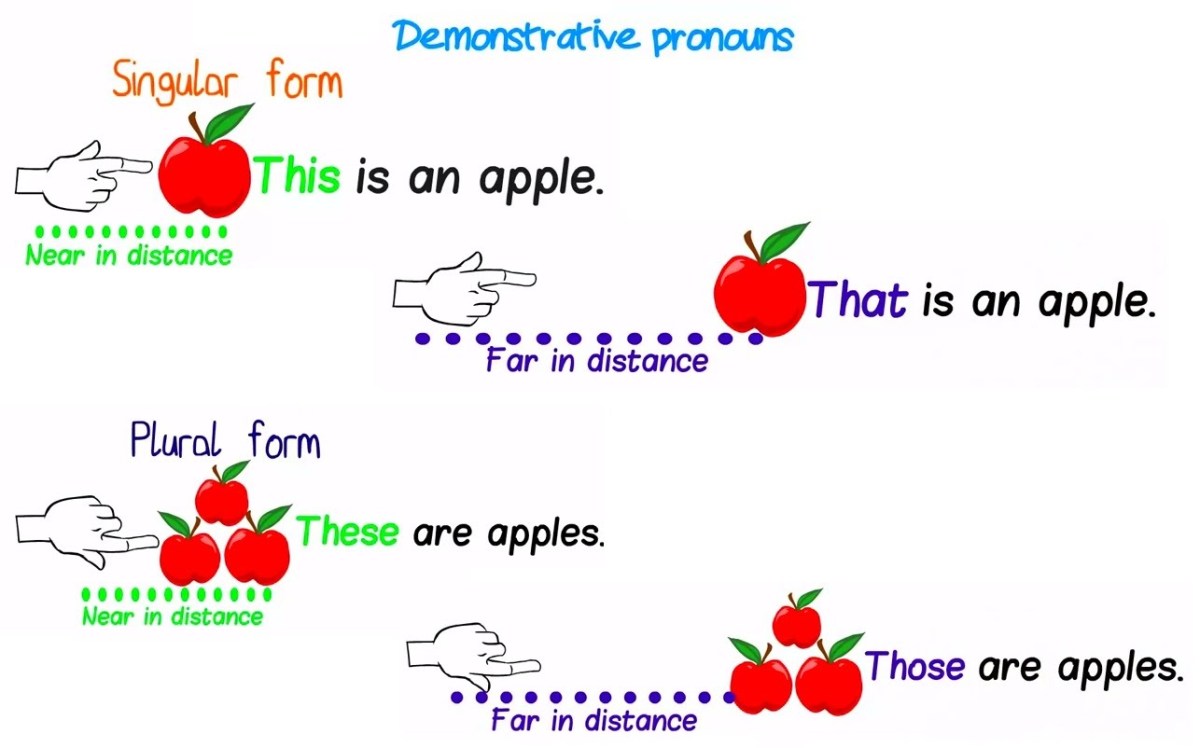
When it comes to discussing one’s distance from objects, things, or other people, it’s necessary to master the grammatical concept of demonstratives. To describe the physical distance of something or someone to another is a key aspect of demonstratives. Depending if the speaker is near or far from the other object, person, place or thing, the demonstrative will change to reflect that change in closeness.

A key aspect of demonstratives to remember is that they can either be adverbs or pronouns for both singular and plural nouns. You can use demonstratives as well to describe both countable and uncountable nouns. In addition, when it comes to discussing actual events, you would use ‘near’ forms of the demonstrative to refer to the present while ‘far’ forms of the demonstrative would refer to the past.

For the demonstrative adverbs, the word ‘here’ refers to the subject who is close by and near to the object, thing, or person. For the opposite, the adverb ‘there’ refers to the subject that is far away from the object, thing, or person.

Here are some examples of demonstrative adverbs for near / far usage:

  • I am here at the police station.
  • They are here for the Science exam.
  • She was there for the graduation ceremony.
  • We will be there at 9 o’clock.

Based on these examples, it’s important to remember that the adverb ‘here’ for near situations should be used in the present tense whereas for far situations, ‘there’ is heavily used and often with either the past or future tenses.

As mentioned before, if you are near to an object, thing, or person and you’re looking to use a demonstrative pronoun, you’ll want to use the words of ‘this’ or ‘these’ depending upon if its’ with a singular, uncountable noun or with plural, countable nouns. The demonstrative ‘this’ or ‘that’ would be used with singular and uncountable nouns while ‘these’ or ‘those’ would be used with plural and countable nouns.

Here are some examples of how ‘this’ and ‘these’ would be used in sentences to describe objects, things, or people that are close in distance to the subject:

  • This cup is for my tea.
  • Is this your jacket?
  • Where have you been traveling to these days?
  • These bananas are delicious.
  • This is my friend, Dan.

As you can see from these examples, these objects or things are close to the subject rather than far away in distance. You can also see how the demonstrative ‘this’ is used for singular nouns while the pronoun ‘these’ are being used with plural nouns.

If the opposite occurs and you or another subject in your sentence is far away in distance from another, person, place or thing, you’re going to want to use the demonstratives ‘that’ or ‘those.’

Here are some examples of how ‘that’ and ‘those’ would be used in sentences to describe objects, things, or people that are far in distance to the subject:

  • What are those men doing over there?
  • That book in my shelf was really enjoyable.
  • That printer has a paper jam that needs to be fixed.
  • Those boys are heading off to play in the park.
  • Those tires are flat. They need air.

It’s clear from those examples above that those objects or things are considered to be far away from the subject of the sentence. You can also see how the demonstrative ‘that’ is used for singular nouns while the pronoun ‘those’ are being used with plural nouns.

When it comes to placing a demonstrative like ‘that’, ‘this’, ‘these’, ‘those’ in a sentence, you should remember that those pronouns can be placed before the noun or adjective that modifies the noun even if there is more than one noun in the same sentence.

Examples:

  • Those hungry people need to eat soon.
  • These tired citizens are waiting long hours in the unemployment line.

Another way to use the demonstrative is that it can be placed before any number by itself when the noun is understood within the context of a larger paragraph.

Examples:

  • These four need to be fixed.
  • That one gave me some trouble.

Sometimes, a demonstrative pronoun or adverb can be used by itself in a sentence without a noun even being present after the demonstrative. The noun can be understood from the context of a previous sentence or larger paragraph making the demonstrative clear the only necessary subject to have.

Examples:

  • This was not very fair to me.
  • That is really cool.
  • Those were really interesting.
  • What was the issue with these?

As with many other grammatical concepts in English, there are some rules and circumstances that have to be remembered in order to develop both spoken and written fluency. In order to become comfortable with demonstratives, study the examples, create sentences of your own, and re-read this article to remember the rules of usage.

English Corner – More Fun with Modals

In the last ‘English Corner’ post, I focused on introducing the topic of modals by beginning with ‘modals of ability.’ As I mentioned previously, there are different types of modals in the English language. We have already covered the modals of ability and permission so now this article will concentrate on those modals that deal with making suggestions, having obligations, seeking advice, going through with a decision, and getting an invitation. The modal verbs of must, shall, should, will, would are going to be highlighted in this article in terms of when to use them in sentences and how those sentences are to be structured.

For making suggestions, the modal verb of ‘shall’ can be used to offer up something to someone or to give advice to them. You can also use this auxiliary verb in the future tense if you plan on doing some action decisively. The modal ‘shall’ can be used both in the positive for and also be posed as a question.

Examples:

1) Shall I pick you up from your house at 8 pm tonight?

2) I shall travel to Morocco and Brazil in 2018.

Once again, it should be noted that ‘shall’ like other modals is to be used as an auxiliary verb in the sentence and often goes before the main verb like ‘travel’ or ‘pick up.’

When it comes to giving out advice or seeking it from somebody else, the modal verb of ‘should’ will come in handy for English learners. You can use ‘should’ at both the beginning of a sentence if it’s in the question form and towards the middle of the sentence after the subject word if you’re using it in the positive form. Should can also be used negatively when you change the word to ‘shouldn’t’ to express that modal in its’ negative form.

Examples:

1.) You should go to the doctor since you have a high fever.

2.) Should we wait for the presentation to end before leaving here?

3.) They shouldn’t have been rude to the doctor yesterday.

When you have an obligation that you simply can’t get out of or a duty to fulfill that cannot be delayed, the modal verb of ‘must’ is key to put in your sentences. Similar to other modal verbs, it is auxiliary and comes before the main verb in the sentence structure. You can also use ‘must’ in the form of a question as well.

Examples:

1.) He must do his homework by tomorrow.

2.) Must I bear this burden alone?

When it comes to making a firm decision to be carried out in the future, choosing the modal word of ‘will’ is a good choice. It is a definite verb that can be used as a question, a positive and a negative. To create the negative form, you simply have to change ‘will’ to ‘won’t’ after conjugating ‘will’ and ‘not’ together to form ‘won’t. When you use ‘will’, you’re not just making a decision but you’re also making a promise to someone that you shouldn’t break.

Examples:

  1. I will play football with you guys this weekend.
  2. Won’t you join us for dinner tonight?
  3. She will be so tired from the party that she won’t be able to study later.

As shown above in the third example, you can use both the positive and negative form of the modal ‘will’ in the same sentence, and the same modal can be used more than once in the same sentence too.

For the last modal ‘would’, you are going to want to use this one when it comes to seeking permission, giving a request, or extending an invitation to somebody. There are a couple of different uses for this last main modal verb but it’s important to keep in mind that it can be used in all forms including positive, negative, and question. As with the other modals, it is an auxiliary verb that will always come before the main verb in the sentence.

Examples:

  1. Would you join me at the birthday party Friday night?
  2. I would like to go home now if that is fine with you.
  3. We wouldn’t climb Mount Everest because it is so dangerous.

The modal verbs of must, shall, should, will, would are focused on the future tense and are very strong in terms of making suggestions or going through with a decision. In total, you now have a basis of understanding the nine main modal verbs. There are others in the English language but these nine words ‘can, could, may, might, must, shall, should, will, would’ come up the most and are the most important to master.

English Corner – Introduction to Modals

There are many different kinds of modals to study but in this ‘English Corner’ blog post, we’re going to start out with an introduction dealing with the modals of ability. Modals of ability are the most common and the most important to master firstly. Modals are verbs usually and the ones that I am going to be focused on in this article are can, could, be able to, may, might.

Modal verbs act as auxiliary verbs in your average sentence and can express different ideas. These ideas include expressing one’s ability, one’s possibility, and sometimes necessity. Modal verbs often have more than one meaning and can be significant in a variety of ways. A simple form of a verb always follows a modal verb in a regular sentence as well.

Example:

  • Ben can do his homework.

The modal verb ‘can’ is followed by the simple form of the verb ‘to do’ followed by the object part, which refers to his homework.

An Introduction to Modals can be broken down into three separate parts: modals for ability, modals for possibility, and modals for permission. Each type of modals is unique in their own way but they each help to express oneself in some form or another.

For ‘Modals of Ability’, you can express your own ability or that of someone else by using the words ‘can, be able to, could’ in order to highlight your ability to do something.

Present Ability: I can speak three languages.

Negative Form: I cannot read this book.

Past Ability: Jack could play on the swings when he was a child but not anymore.

Negative Past Ability: Jane couldn’t go to the dance last night because she was sick.

In any regular sentence, the verb after the modal ‘can, could, be able to’ is always in the simple form and always follows the auxiliary (modal) verb. It’s important to note that the simple verb after the modal verb never changes either.

Examples:

-Ben can doing his homework. X

-Ben can to do his homework. X

-Ben can did his homework. X

All of these examples listed above give us the understanding we need to see that the simple form of the verb such as ‘to do’ never changes from its’ original intention. ‘Ben can do his homework’ is the only correct answer in this case.

In order to turn the ability modal into a question, it’s also quite easy to do. The form of the sentence should look like ‘modal verb + subject + main verb + object…? For any of the ability modals whether it’s can, could, etc., you can use them in the form of a question.

Examples:

  1. Can she play the flute?
  2. Could you go to the store to pick up some fruit?
  3. Are you able to do your homework tonight?

‘Able to’ is an exception in that as a modal of ability verb, the structure of the question form looks like: ‘to be’ + subject + able to + main verb + object…?’

For Modals of Possibility, it’s important to understand how to express ‘possibility’ in a sentence through showing what’s possible and what’s not possible for someone or something. The modals of possibility include ‘may, might, and could’ now and in the future. All of these three modals have the same meaning and can be used interchangeably regardless of the type of sentence.

Examples:

  • I might be late to the business meeting tomorrow.
  • You may want to re-take the exam next year.
  • You could get into college if you study harder.

Possibility cannot be expressed for the past but only for the present and the future when it comes to grammar.

For ‘Modals of Permission’, you can express ways to ask for or to give permission in a regular sentence. In order to create this modal sentence, we need to use the modals of ‘may, could, and can’, which are also apart of permission and ability modals. Permission modals are very polite and formal so it’s important to know how to write and verbally use them correctly in a sentence.

Examples:

  • May I go to the bathroom please?
  • Could I borrow your lawnmower today?
  • Can he have the last piece of chocolate cake?

For the main verb that comes after the subject and before the modal verb, it’s always going to be in its’ regular, simple form which never changes. When it comes to modals of permission, it’s important to remember that using ‘may’ especially at the beginning of the sentence is the most formal of the three options. Also, if someone were to answer you to grant that permission so you can go to the bathroom or to use your lawnmower, you can answer with:

-Yes, you may or No, you may not.

There’s also the possible positive or negative response to the modal question with ‘Yes, you can’ or ‘No, you can’t.’

While not the most popular grammar topic, there are many kinds of modals and knowing some of them especially those modals concerning permission, ability, and possibility is key to improving your English proficiency. This article is simply an introduction to modals and in the coming weeks and months; I hope to highlight other types of modals that are likely to come up in your grammar studies. “You can do it!”


English Corner – Personal Pronouns

When you begin to learn the English language and specifically English grammar, it is very important to be able to address people whether it’s a man, a woman, or a collective group of people. You won’t be able to become personal with people unless you understand and know about personal pronouns.

The good news is that learning about personal pronouns is quite easy and doesn’t take much time compared to other grammar topics. Personal pronouns can be divided into two separate categories: subject pronouns and object pronouns. It’s important to recall that we use pronouns in place of a full noun. Pronoun words tend to be shorter than regular nouns in terms of syllables and length too.

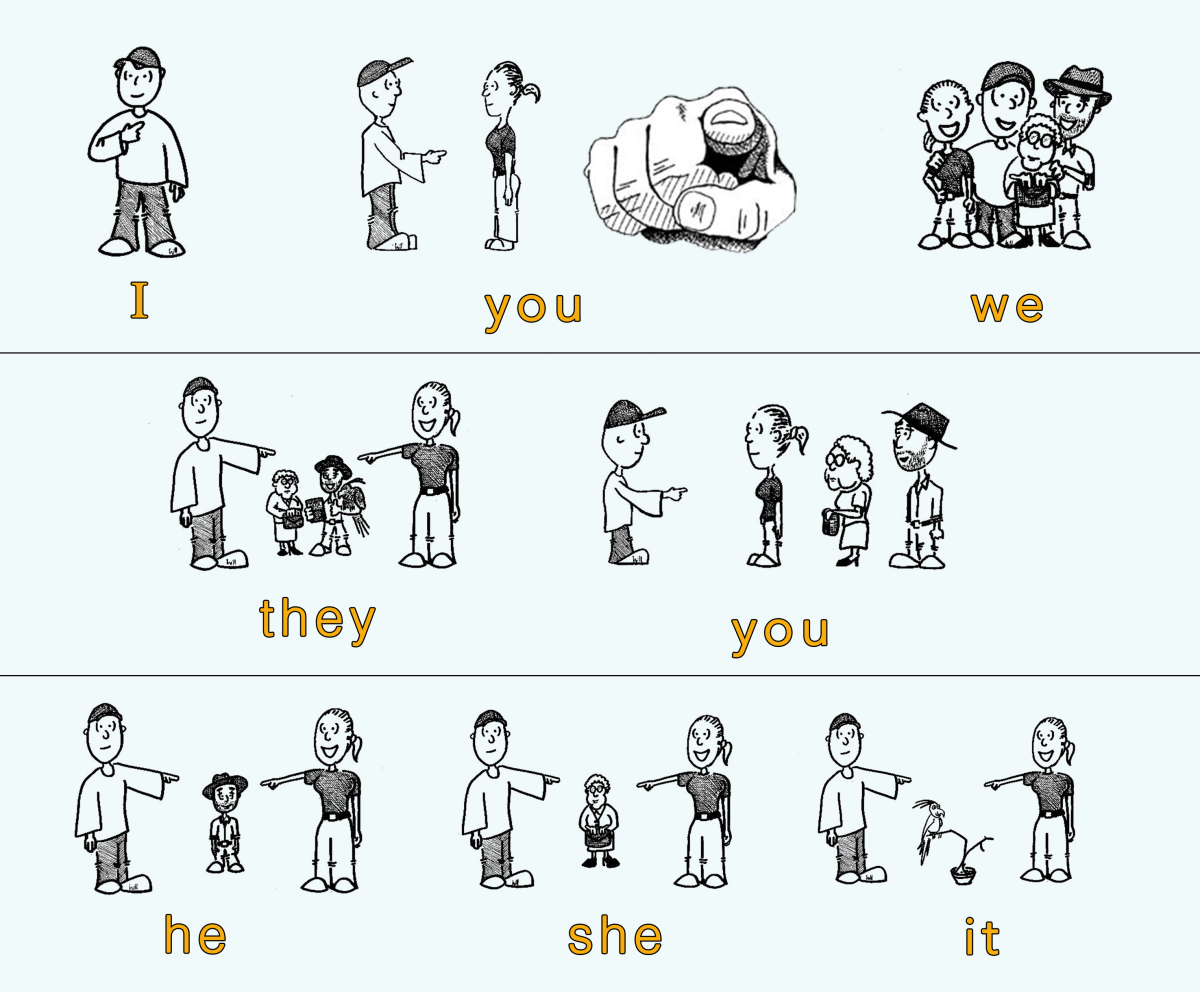
The subject pronouns are as follows in the list below:

I         (Singular)

You   (Plural)

He     (Singular)

She     (Singular)

It         (Singular)

We      (Plural)

They   (Plural)

These subject pronouns are personal and apply to both singular and plural subjects. The singular subject pronouns are ‘I, he, she, it’ while the plural subject pronouns are ‘you, we, they.’ Regardless if you are using the present, past, or future tense of the verb form, the singular pronouns stay singular and the plural pronouns stay plural.

The object pronouns are as follows in the list below:

Me    (Singular)

You   (Plural)

Him   (Singular)

Her   (Singular)

It       (Singular)

Us     (Plural)

Them (Plural)

These object pronouns are also to be used for personal reasons and apply to both singular and plural subjects. The singular object pronouns are ‘me, him, her, it’ while the plural subject pronouns are ‘you, us, them.’ Regardless if you are using the present, past, or future tense of the verb form, the singular pronouns stay singular and the plural pronouns stay plural when it comes to objects. If you study both the subject and object pronouns consistently, you’ll be able to tell which words are singular and which words are plural.

It’s important to remember that in the English language, gendered nouns are not as prominently used compared to other languages such as Spanish or Italian. However, he / him is always used to refer to a man or boy while she / her is used to refer to a woman or girl. ‘It’ is often used to refer to a non-human entity such as an animal (whose gender is unknown) or an object like a desk.

Another key thing to keep in mind is that ‘you’ is a singular pronoun in terms of it referring to just one person, thing, or object. However, ‘you’ goes along with the plural form of a verb such as ‘to be’ making it more of a plural pronoun. For example, instead of putting ‘you’ and ‘is’ (to be) together, you would instead put ‘you’ and ‘are’ (to be) together, which is the plural form of the verb and not the singular form.

‘You is smart’ is a sentence that is not grammatically correct in English while ‘You are smart’ is correct instead. I like to call this English rule of personal pronouns the ‘You’ exception. Similar to ‘I, He, She, It’, ‘You’ is singular in its’ meaning yet it can be used with the plural form of the verb ‘to be’ instead of the singular form. Due to this exception, ‘You’ should be grouped more with ‘We, They’, which are both plural subject pronouns rather than with the former singular subject pronouns.

Here are some examples to show you how the singular and plural subject pronouns can be formed in complete yet simple sentences:

Subject Pronouns (Singular)

  1. I am doing okay.
  2. He is feeling good.
  3. She is playing tennis.
  4. It is raining outside.

Subject Pronouns (Plural)

  1. You are being mean.
  2. They are going to the movies.
  3. We are hungry for dinner.

From the examples above, you can see that the singular subject pronouns go with the ‘am, is’ form of the verb ‘to be’ in the simple present tense while the plural subject pronouns all use the ‘are’ form of the verb ‘to be.’ By following the examples above, you’ll have a better understanding of how to use the subject pronouns correctly in order to be personal in English.

One of the main differences between the subject and object pronouns is that the ‘subject’ pronouns begin the sentence while the ‘object’ pronouns often come at the end of the sentence. The English language follows a structure of ‘subject – verb – object’ and that is a formula of a basic sentence that rarely changes. The singular ‘object’ pronouns are words like ‘me, him, her, it’ while the plural ‘object’ pronouns are words like ‘you, us, them.’ As mentioned before, the word ‘you’ falls into the plural category with object pronouns like it does for the subject pronouns.

Here are some examples to show you how the singular and plural object pronouns can be formed in complete yet simple sentences:

Object Pronouns (Singular)

  1. The horse jumped over me.
  2. Think about him.
  3. Sing loudly with her.
  4. They did it.

Object Pronouns (Plural)

  1. I like
  2. The reservation is for us.
  3. We were here before

Without being able to address anyone or anything properly, your English will not advance that much. If you want to be comfortable forming sentences either verbally or in the written form, you must study and master the personal pronouns to the best of your ability.

———————

If you’re looking to improve your English through private lessons with me on a one-to-one basis please check out my ‘Learn English with Ben‘ page here: https://benjweinberg.com/learn-english-with-ben/

You can also check out my ‘English Grammar’ courses on Teachable.com here: https://benjweinberg.com/my-grammar-courses/

English Corner – Prepositions of Place

In this ‘English Corner’ blog post, we are going to go deeper into the topic of prepositions, which we have covered previously but I want to highlight the specific ‘prepositions of place’ that are a large part of this expansive grammatical topic. The thing to keep in mind when reading this article is to focus mainly on the examples listed below to see how, when, and why these preposition words such as ‘at, on, and in’ are used. There are different reasons that are given when it comes to each of the ‘preposition of place’ words and how they end up being used in a sentence. Later on, I will highlight the ‘prepositions of time’ and how they are utilized when compared to the ‘prepositions of place.’

When it comes to ‘prepositions of place’, the main point of this type of prepositions is to show where something or someone is located, usually in a physical sense. The three major words that are ‘prepositions of place’ are ‘at, in, and on’, which also come up the most frequently in terms of usage. ‘At’ is used in a very specific manner in terms of being referred to for a specific location, place, or position.

Here are some examples where we can use ‘at’ as a ‘preposition of place’ in the right way:

  1. I was at Jonathan’s birthday party last night.
  2. We lived together at 8 Drury Lane for two years.
  3. They danced with each other for the first time at the Senior Prom.

When you use the prepositional word ‘on’, the meaning and usage for it is a little bit different than ‘at.’ For ‘on’, you’re going to use it to indicate the position of an object, thing, or person on a horizontal or vertical surface such as a desk, table, floor, etc.

Here are some examples of how we can the preposition ‘on’ in a sentence:

  1. The boy is playing on the playground.
  2. The basketball was bouncing on the court surface.
  3. I put my cowboy hat on the kitchen table.

Similarly to ‘at’, ‘on’ can also be used for positioning when it comes to streets, roads, and avenues.

Example: I used to live on Beacon Street.

The last major ‘preposition of place’ would have to be ‘in’ which is quite frequent in its’ usage. In terms of its’ meaning, the preposition ‘in’ is used for something or someone that is enclosed or surrounded.

Here are some examples of how we can use the preposition ‘in’ in a sentence:

  1. The check is in the mail.
  2. The letters are in the mailbox.
  3. She is in the high-speed train going home from work.

In addition to discussing enclosed or closed off places and spaces, the preposition ‘in’ can also refer to a position within a general area such as a town, city, country, region, country, continent, etc.

Example: I used to live in Istanbul, Turkey but now I live in London, England.

It’s important that the average English learner be made aware that there are many more prepositions of place besides the main ones, which are ‘at, in, on.’ There are many other prepositions of place words, and it would be an exhaustive list to go over the meaning and usage of each one. However, it would be better to highlight another couple of preposition of place words that come up frequently but not as often as ‘in, on, at.’ The other ‘preposition of place’ words would be after, among, behind, between, in front of, next to, beside, by, over, above, under, below, and beneath. Here are some examples of sentences that use these other preposition of place that were just mentioned above:

  1. The dog jumped over the wheelbarrow.
  2. He was hanging out by the pool on his off day from work.
  3. She checked under her bed to see if her pet gerbil was there.

There are dozens of examples that could be made with prepositions of place. However, it’s best to focus mainly on the particular prepositions of place such as ‘at, on, in’ and to understand clearly when, why, and how we use them correctly. While a sub-topic within ‘prepositions’, knowing what prepositions of place are and how to use them correctly in the grammatical sense will help you to become a better English learner and student.

———————

If you’re looking to improve your English through private lessons with me on a one-to-one basis please check out my ‘Learn English with Ben‘ page here: https://benjweinberg.com/learn-english-with-ben/

You can also check out my ‘English Grammar’ courses on Teachable.com here: https://benjweinberg.com/my-grammar-courses/