Made In America?

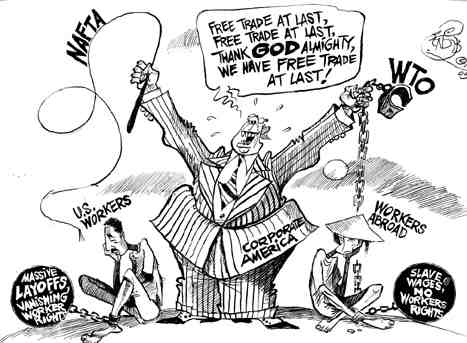
free-trade-cartoon

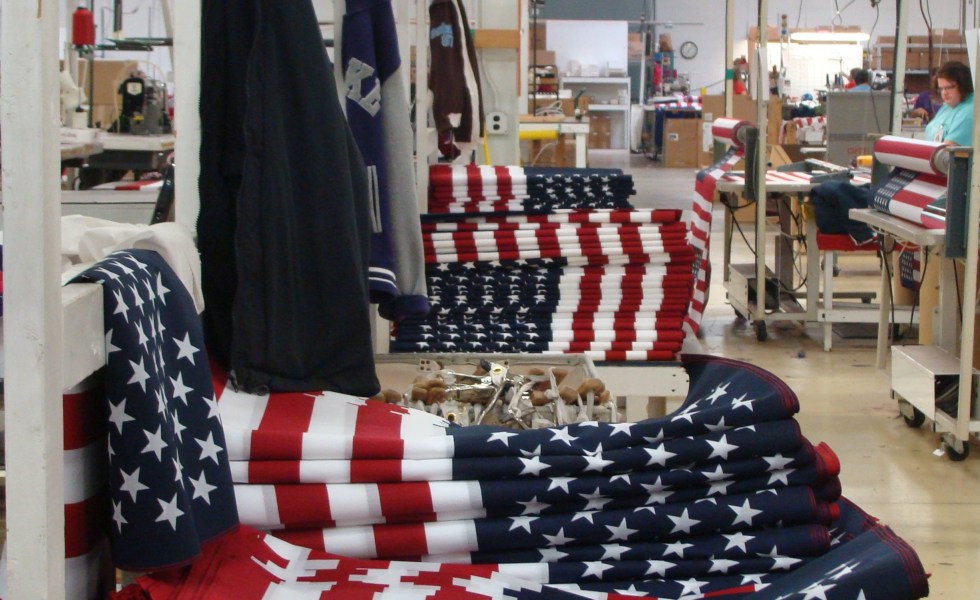
Have you ever noticed this small yet important detail when you’re out at the store buying a consumer good whether it’s a pair of pants, a carpet, or some brand new shoes? For those of you who are confused right now, there’s a tag attached to the item indicating that the final product was “Made in …..” which indicates the origin of the country the good has come from. I doubt that most people notice this small detail when they’re out shopping and it’s probably not their biggest concern.

However, I do believe it’s very important as consumers to know where our goods and services are coming from and to what sort of quality they are made. It’s also important to ask the question of these companies who make these consumer products, both foreign and domestic, how well are they treating their employees and what do they pay them for their hard work? Do they receive good health benefits and vacation time? Are the working conditions in their factories and shops safe and hospitable?

I have noticed that most of the clothing, household items, and electronic products that I have bought were not made in the United States. I am not against wearing or buying consumer goods that were created and manufactured in other countries. However, I do worry that we are relying too heavily on these foreign-made products in our daily lives instead of having some of these same goods made in the U.S.A., which could improve the lives of many people looking for decent-paying jobs. Many abandoned and dilapidated factories, plants, and mills could be re-opened again if we change the way we look at free trade.

According to the official and most recent numbers on United States International Trade Data, there was a sizable overall trade deficit in goods and services of $43.9 billion dollars in October of 2015. Since ‘The Great Recession of 2007-2008’, the trade balance has not changed greatly in terms of lowering the overall deficit. Over the past five years alone, the monthly trade deficit has ranged from $40 to $65 billion. There has been very little sign of this trade imbalance being decreasingly significantly or being entirely eliminated recently. This means that the U.S. is importing a much larger quantity of goods than we are exporting overseas. While some people would argue that this is not a big deal, I would say that in order to grow the economy at a higher output and decrease unemployment further, increasing our exports overseas with the stamp “Made in America” should be a higher priority especially with the upcoming presidential election.

With the decline in American manufacturing, the U.S. has increasingly looked to its trading partners overseas to fill the void that has been created. Due to free-trade agreements such as NAFTA and the recent passing of the Trans-Pacific Partnership, many American companies and jobs have moved overseas causing the trade deficit to increase over the past generation. This has led to many good-paying middle class jobs with health and other benefits to disappear. There has also been a steady decline in the Unions and their total membership and influence within the U.S.

Examples of the shift towards the growing importation of manufactured goods and products that used to be made in here at home can be found in companies such as Wal-Mart and Apple. These iconic companies that were created by Americans such as Steve Jobs and Sam Walton have changed significantly like many others since their early days. They have become multi-national in nature and have expanded their facilities and operations to multiple countries around the world. Even though their company headquarters are in Silicon Valley and in the heartland of Arkansas, these companies are not taxed like other U.S. companies and carry out their manufacturing and production of goods from overseas suppliers.

American workers are known to be more expensive to train and hire than those workers found in countries such as China, Vietnam, and Cambodia. That’s an unfortunate truth that has led many companies to take the easy way out by calculating how much they would save due to the fact that foreign labor is cheaper. For these firms, there is little to no need to worry about strict labor laws that don’t exist outside the U.S. and other parts of the Western world. For example, huge multi-national companies such as Apple have used subsidiary companies like the ‘Foxconn Technology Group’ for years in order to manufacture their iPhones and other high-tech products. There have been many investigative reports done by The New York Times and other news outlets about the harsh working conditions, poor salary, long hours, and reported suicides and riots occurring at these plants in China.

In a lot of developing countries, the taxes associated with doing business are much cheaper which allows a lot of big manufacturing firms to operate there more freely. Even though multinational companies have to pay U.S. taxes on the profits that they earn from products that they make and sell in other countries, Apple and others can avoid paying these taxes by re-investing their profits made from outside the U.S. on overseas factories, stores, warehouses, etc. Because of that, they won’t have to pay the higher taxes. It’s a significant loophole that hasn’t been closed yet and allows U.S. companies to store billions in profits overseas. “Apple is not alone in this strategy. U.S. companies have $2.1 trillion in foreign profit stashed overseas, according to Capital Economics.”

Once the multi-national companies decide to move their manufacturing and production operations overseas, it’s very difficult to bring them back to the U.S. Competitors like China have the infrastructure and a vast amount of workers willing to work in the factors for these supplier companies. It is the responsibility of companies like Apple to break their agreements with manufacturing giants like Foxconn if they ever decided to move their production operations back to the U.S. However, Apple would have to invest in billions of dollars to build these new factories and pay these workers a fair wage with benefits. This proposition is entirely unlikely to occur in the near future for Apple, Wal-Mart, GE, and others to move their manufacturing back to the U.S. due to the higher taxes, the higher costs of the workers and their desire to make the most profits that they can secure.

Free trade is a complicated subject but I decided to write about this issue because I think as consumers, we should know where our money is going. I am guilty like many other Americans in supporting these popular multi-national companies who have gotten away with sketchy business practices and who have shied away from creating jobs here in the U.S. However, it’s never too late to be informed about where your clothes, your cars, and your electronics come from. Do your research and be informed about these issues.

Globalization and free trade have lifted millions of people out of poverty and allowed many countries to boost their economies but it’s also led to a higher amount of competition, the stagnation of wages, and many environmental concerns. I am not a protectionist and I believe that some free trade is good. However, it’s more important than ever that we support fair trade and business practices from these companies. Workers around the world should be treated fairly with good wages, good health and vacation benefits, and they shouldn’t be taken advantage of whether they are located in Saigon or Detroit.

We have free trade with other countries so that we can exchange goods and services with them to better our economies and our peoples. Lets’ not create a situation where we are importing more goods than we should be at the expense of the American worker and taxpayer. These companies need to be held accountable for what they do both here in the U.S. and overseas.

I would encourage everyone reading this entry to think about where your goods and products come from. If you have the chance and opportunity to do so, I would argue that you should try to buy from the U.S. companies making the goods and services right here in America. I am not against buying foreign goods either but we have to know whether these large companies out there are playing by the rules and are not being exploitative.

By ‘Buying American’, it’s good to show those small businesses and firms that we still support them and that we want them to succeed. If you would like to support buying American-made goods and products, check out this website: http://madeinusachallenge.com/ (Made In America – Master List)

Sources

The Ripple Effect

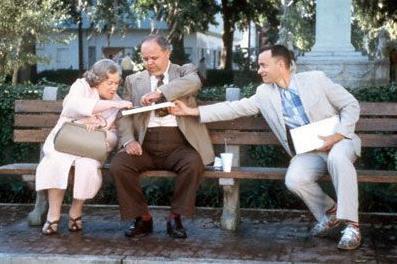
chocolates-forrest-gump-1814922-397-264
Which chocolate will you decide to choose?

Throughout the course of our lives, actions and events occur that we don’t see coming or have little control over. While these small events and actions seem unimportant at the time, their results continue to spread and manifest in changing things about yourself, and your path in life. This is known as the ‘Ripple Effect’, and is often overlooked by certain people who refuse to recognize that actions have consequences and what we say or do now has lasting effects on who we will become in the future.

The most famous example signifying the ‘Ripple Effect’ is when drops of water or other objects, fall into a larger pool of water causing ‘ripples’ to manifest themselves while affecting the initial state and changing its physical makeup. Similar in overall meaning to the ‘Ripple Effect’ is the ‘Butterfly Effect’ and also the ‘Domino Effect’ often cited in sociological terminology.

The older you get, the more you realize that certain things in life are going to be outside your control. Some people refuse to recognize this fact and try to direct and manage everything in life to prevent any surprises, twists, or turns that will come your way. However, this approach is a recipe for disaster because it is a fact that we cannot control everything that happens to us and that it is pointless to try to do so.

I don’t want to turn this into a “Predestination v. Free Will” debate because that is too black and white for a world that has a lot of grey matter. If you had asked me about the concepts ‘Free Will’, ‘Destiny’, and ‘Fate’ when I was ten years younger, I would have said that I have complete control over my life and that my destiny is totally in my hands. At my current age and the older I get, I believe that it is a intertwining mix of destiny and your own will that sees you through both the highs and lows of life.

From my own personal experiences, especially as I enter my mid-20’s, there have been many unexpected occurrences that have changed my life in different ways which would have been unimaginable to me in the past. I never would have thought that I would become an ESL teacher, move overseas and travel to different countries, and change my career path for the time being. There are cities that I have visited, cool experiences that I have had, and lessons that I have learned about life that would not have had happened had I stayed in the same town, kept my first job after college, and not gone out of my way to meet new people, make new friends.

It’s occurred to me now more than ever that we should not plan for everything in the future because the future is not up to us and life can throw unexpected curveballs when we least expect it. Instead of ‘cursing our fate’ and ‘falling into gloom and doom’ about the things we cannot control: (job security, natural disasters, deaths of family and friends), we should make an effort to change what we can control to benefit out lives: (relationships, where we live, and our physical and mental health.)

‘Free Will’ for human beings is limited as is ‘Pre-Destination.’ I would like to believe that I have some control over my life and the direction(s) it can take. However, I cannot change anything about my past and I am limited in what I can do about my future. Do not feel totally helpless about your future because you still have the power of decision-making, reasoning, and foresight, which can help you with your personal and professional goals.

It’s much easier to be angry at the world and to curse about the wrongs that have been committed against you but it won’t do much to make you feel better or to improve your future. Instead of feeling powerless, take charge and do your best with what you have now. Make every day a chance to improve yourself in some way so that your future will be a little bit brighter than before.

Never give up, and if challenges and set-backs come your way, meet them head-on and have the resolve to face them given your previous experiences in life. As was once said famously by the character, Forrest’s mother, in the critically acclaimed film, Forrest Gump, “Life is like a box of chocolates, Forrest, you never know what you’re going to get.” Even if you get a bad chocolate every now and then, there will still be plenty more to choose from.

The Culture of Dressing Down

Personal appearance is very important to how human beings generally judge one another even before we have a chance to open our mouths to to say something verbally. That’s a harsh truth for some to deal with but it is absolutely correct that what you wear can leave a positive or negative impact on how you are perceived by others. A major factor that plays into our overall appearance is how we dress ourselves. I am no fashion expert by any means but I have noticed recently and many others have as well that our culture has embraced dressing down in almost every situation, whether in a public or private setting. Instead of putting some work into our style and our appearance, most people today do not put in any effort at all and it’s very disappointing to see on a daily basis.

"Women in the 1940's - Fashion"
“Women in the 1940’s – Fashion”

Going back to my parents’ and grandparents’ generations by looking at old photographs, watching old movies from that era, and seeing the attire that both men and women committed themselves to, it’s quite impressive to witness when compared to the lack of effort that most people subscribe to nowadays. Whether it was going to the supermarket, watching a film or play, and especially going out to a restaurant, both the rich and the poor, the young and the old, did their best to look their best. I would say that it’s becoming increasingly rare for most people to dress up even if its’ just to go out to dinner or to see a live show.

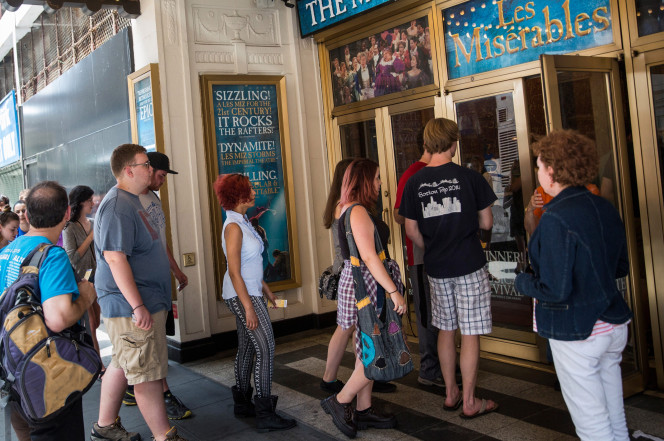
There was a recent news story that caught my attention where it showed the photographs of people in line to go see ‘Les Miserables’ on Broadway in New York City but instead of wearing suits and dresses, the photos showed most of the theater-goers wearing cargo shorts, tank tops, and flip flops. I can’t fault these people for not knowing how others dressed in the past to watch plays, or enjoy the opera but it shows a lack of awareness of the situation and type of event that you’re going to. When you’re going to the theater or the opera, you shouldn’t be dressing up like you’re attending a baseball game.

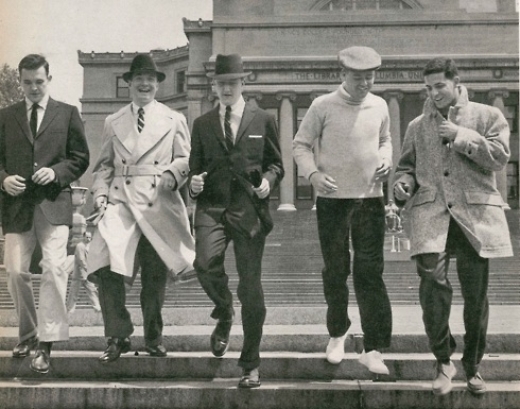
"Men in the 1950's - Fashion"
“Men in the 1950’s – Fashion”

Some may say that how we dressed in previous generations was conformist, boring, and dated but you cannot doubt that those same folks displayed class, sophistication, and attention to detail at the same time. No generation is perfect or has all of the answers but the fact that they put effort into their appearance and how they looked everyday says a lot overall. ‘Dressing Up’ didn’t use to be for only a special occasion but was a day-to-day ritual for most. I also believe that nice dress clothes were more affordable back then and, the major clothing companies encouraged their sale to the American public. It’s only been since the 1960’s and onwards where casual became cool and wearing blue jeans, shirts, and shorts out in public became normal and culturally acceptable.

"Compare and contrast the fashion today with that of the 1940's and 1950's..."
“This picture is a great example of how not to dress when going to the theater…”

I have to admit that I am guilty of not dressing up for most social occasions these days but it is something in my own life that I am going to start changing. Recently, I’ve made it a point to look my best if it’s for a dinner out on the town, a theater play, or another classier type of social gathering. I don’t envision most people suddenly changing their ways too much where men will wear suits to the grocery store or women will wear dresses when going to the dry cleaners but I think that a balance between casual and formal wear has to be struck.

Instead of wearing a tank top, shorts, and flip flops when you’re shopping and/or running errands, try to wear a button-down shirt, a pair of khakis, and a nicer pair of shoes. You may be surprised on how much more seriously people will begin to take you in your personal and professional life if you start taking care of your appearance and your style. Regardless, if you’re attending a nighttime gala or heading to the local supermarket to get groceries, clothes will always make the man or woman.

The Importance of Community

“Be part of a group. Life is better that way.”

“Being apart of a community is what makes you happy…not rising to the top and sequestering yourself from community.” This quote is from one of my favorite podcasts, “Tangentially Speaking” with Dr. Christopher Ryan. During this show, he conducted an interview with travel host and producer, Jonathan Legg of ‘The Road Less Traveled’ who is the author of the quote above. I was listening to the podcast while I was driving through my hometown when the subject of ‘community’ came to the forefront of their interview. The two of them, who are both very intelligent and worldly men, explained to the listeners how chasing money, fame, and fortune doesn’t ultimately make us happy as human beings.

I absolutely agree with this assessment made on the podcast and believe that while possessions, money, and owning property can create happiness in the short-term, long-term happiness and fulfillment can only come from strong bonds with your friends, family, and community. Dr. Ryan and Mr. Legg also mentioned in one segment of the podcast how isolating oneself while traveling, and staying in hotels does not create a great life experience. I couldn’t agree more having stayed in nice hotels, hostels, and guesthouses during my own travels.

While one could be very comfortable and relaxed in a hotel, you won’t meet other travelers and potential friends as easily compared to when you’re staying in a cheaper hostel that’s in the city center. Dr. Ryan and Mr. Legg concluded in their discussion on communal living that the best way to live is to have your own space to eat and sleep, but to live in close enough proximity to others nearby that you can still have a sense of community and sharing without being isolated. I believe that compared to recent generations and even further back, the idea of community is starting to weaken and become less important which is in direct contrast to human nature and true happiness.

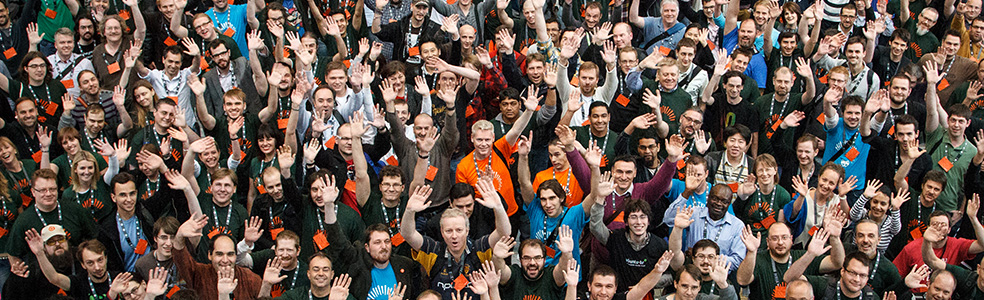
Harvard Political Scientist and Professor, Robert D. Putnam, was one of the first people to bring to national attention the change and decline in communities with his book, “Bowling Alone: The Collapse and Revival of American Community.” He makes the argument that people have been interacting with each other less and less over the past few decades. Instead of going out to socialize in public through bowling leagues, picnics, sport clubs, religious organizations, etc., more and more people are opting out and have been expanding the amount of time spent using technology as a substitute.

With the ability to have groceries, electronics, books, restaurant food, etc. delivered right to one’s doorstep in major cities and towns now, people have less and less motivation to leave the house. Telecommuting and ‘working from home’ have become more popular as well making ‘office work’ and ‘happy hours’ less obligatory. Social and traditional forms of media have exploded in the sheer amount of offerings whether its’ through websites, TV channels, and/or digital gadgets.

When it comes to community life, religious and social organizations have often formed the backbone and glue that holds people together. However, many different news media outlets have reported that attendance at churches and synagogues have been taking a downward spiral. A growing percentage of Americans are identifying themselves as ‘atheist’ or ‘agnostic’ when it comes to their religious beliefs. Personally, I have no problem with our generation being an irreligious one but I do think it’s tough to replicate that type of community within other types of social organizations.

In addition to the close bonds between neighbors that shared religious beliefs can bring, it can provide a sense of belonging just like many other social groups. Beyond religious affiliated groups, membership in long-standing organizations such as the Boy Scouts and other volunteer organizations is also on the decline as well.

Newsweek.com highlighted this trend illustrated this disturbing trend with official numbers from the Bureau of Labor Statistics: “In recent years, the percentage of Americans volunteering has dwindled and is now at its lowest level in a decade. Last year, In 2014, the official volunteer rate was 25.4 percent, or 62.6 million people, compared with 29 percent of the population in 2003, according to the U.S. Bureau of Labor Statistics. (Official statistics on volunteer rates go back only to 2002.)”

Recently, one of the pillars of my community that I was born into and grew up with shuttered its’ doors last year. My local synagogue where I was Bar Mitzvah’d, went to Shabbat services, and celebrated the Jewish holidays was not able to fund itself due to overall lack of membership and decided to merge with another still functional congregation. This was disappointing for me to hear about because I have a lot of fond memories of that place and the people I met there. It was more than just about religion but it was also a gathering place for Jewish residents of the local area to come together and get to know one each other better and form bonds of friendship. While members of the former synagogue have moved on to another synagogue nearby, it’s not the same as it once was and it’s difficult to integrate oneself into a new community.

This is a trend that seems to be replicating itself across the country. Most Americans don’t know their neighbor next door like they used to and beyond the local school PTA of the local town or city, there’s not much anymore to bring people together. The increasing atomization and isolation of people is worrying for me to hear about. However, I am quite positive about the power and spread of the internet to bring people from different backgrounds and beliefs all over the world together.

While it’s not perfect, you can still remain connected to old friends, former classmates, past roommates, etc. through social networking. Instead of bowling leagues, sports clubs, the local YMCA, now we have Meetup.com and Groupspaces. As technology continues to advance, the meaning of ‘community’ will continue to change and adapt to the times. However, we as human beings must not forget the importance of being apart of a community and how much it means to our mental health and overall happiness.

References:

http://www.saddleback.edu/faculty/agordon/documents/Bowling_Alone.pdf

http://www.newsweek.com/2014/10/03/volunteering-america-decline-272675.html

http://www.reuters.com/article/2015/01/17/us-usa-boyscouts-idUSKBN0KQ05O20150117

The Case Against Tipping

Tipping

A story that has captured the headlines of most major media outlets recently is New York City restaurateur, Danny Meyer’s decision to end the practice of tipping in his many well-known dining establishments in the city. Unsurprisingly, this caused a bit of an uproar as some people praised him for this decision while others fumed about how this would cause poorer service and lead to higher food prices when dining out at a restaurant. This small decision could eventually gain momentum and cause dining establishments around the country to end an outdated cultural practice here that has been prevalent since the early 1900’s but has been absent in most European countries, Japan, China, and elsewhere.

Both viewpoints hold valid concerns, however, I believe that the overall culture of tipping while helpful to servers, waiters, bartenders, hairdressers in helping them to make a living now is not the best that our society can do for them in the long run. When the minimum wage for tipped workers federally is still an extremely $2.13 per hour, and you have to fight and scrap for tips to make up the difference to crack the $7.25 per hour minimum wage that is in place for non-tipped workers, I believe we have a problem.

More and more U.S. states have taken it upon themselves to raise the minimum wage for both tipped and non-tipped workers, and I applaud those actions. However, eliminating the ‘tipped worker’ minimum wage standard along with the raising the federal wage for both tipped and non-tipped workers to between $15-$20 an hour would be the right and just thing to do. Tipped workers should be able to earn a guaranteed hourly wage that is fair and livable just like every other hard worker in the United States. Yes, with tipping involved, a server and a bartender could make more than $20 an hour especially if they provide great service but that’s not always the case and I can imagine that they could come up short of what they were expecting to make during some hours of their daily shift.

If I were a worker in the service industry, I would rather be paid a $15 or higher wage per hour than have to fight for tips each and every workday. Distribution of tips is not always equal in that not every worker from the dishwasher to the bus boy gets compensated fairly in terms of payment. Cooks and other workers at the back end of the restaurant have to compete with the servers for their tips, which could create an uneasy, and hostile work environment. Also, there are racial and gender biases that come into play as well when it comes to tipping workers that has been a problem in the past and still today.

The argument that by getting rid of tipping, the waiters, bartenders, hairdressers, etc. would then provide mediocre or worse service to their customers is a faulty one. If tipped workers suddenly found themselves making a $15 or $20 minimum wage and had a chance to advance in their business or industry through other incentives like vacation time, health care coverage, sick days off, etc. then they would feel better about their jobs. They would want to provide good service because how much better their employers would be treating them due to the changes in laws and regulations. I have traveled to countries in Europe and the Middle East where there is little to no tipping culture yet the service is still fine. The servers there may not have asked me how my meal was but I got used to it after a while and appreciated that they would let me eat and talk in peace. If I needed something from them, I would just call them over politely as well. I also left them an extra 10% on top of the cost of my meal despite the tip not being mandatory to show my appreciation for their hard work.

Lastly, when the time the bill comes, it’s often a struggle to figure about how much of a percentage out of the total to give the waiter/waitress, whether or not the service charge is already included or not, what is the amount of tax added on to the food, and/or alcohol that was ordered. To me, it’s always been a giant headache to pay the bill at the end of the meal, especially in larger groups. It’s because you end up doing the calculations on your own and you never know how much you’ll be paying in total until the end. I would prefer to have the extra costs of the service and taxes be added onto the costs of the food. This is what type of system that Danny Meyer and others will be implementing in their business. If this change gets implemented on a wide scale, every customer will know exactly what is to be paid at the end of the meal. By the time you sit down and look at the menu, you will know how much everything will cost and how much money you’ll be throwing down to pay without worrying about the added tip and tax.

As it still stands now, the culture of tipping in the United States is heavily entrenched and has been around for over a hundred years now. However, given that some leading restaurant business owners are starting to set their own policies, against using the service/tip charge than maybe a real change is finally going to happen. I believe that these tipped workers in different sectors will be happy with these changes to the industry and will still provide ‘service with a smile.’

The Value of Perseverance

“The road to the top is paved with obstacles but the view is worth the struggle.”

Perseverance: Noun. Steadfastness in doing something despite difficulty or delay in achieving success. (Source: Webster Dictionary)

One of my favorite words in the English language recently is the one I just listed above along with the definition. Perseverance. The innate will to finish what you started, and to become successful despite all of the obstacles thrown at you. Life can be pretty difficult to deal with sometimes and it’s hard to remain committed to your goals, hopes, and dreams.

I’m writing you to tell you, dear reader, that despite the long odds, and struggles that you may encounter in your life, you have to push on each and every day to make it one step closer to becoming successful and making those dreams come true. It won’t happen overnight and there will be setbacks and false starts, but your will and determination will set you apart from others in getting to where you want to be in life.

Whether success to you is in monetary form in making a lot of money and having a lot of possessions, or changing the world by helping the poor or cleaning up the environment, or simply just raising a family and passing on the torch to the next generation, perseverance will be needed in order to make any of these hopes a reality. As the saying goes, “Rome was not built in a day. “

Remember, Each day, each month, and each year: you have to make small deposits in the game of life. Progress takes time and don’t be discouraged if you don’t achieve your success overnight. Remaining true to yourself and your vision of the future is important. Make sure that you surround yourself with those people (friends or family) who are supportive of you and your goals.

Do not let yourself be dragged down by others who would wish you ill or divert you away from your path. Even if you fail and suffer at first, never ever give up. I happen to believe that everyone’s luck changes and that if you keep pushing forward and you work hard at anything in life, success will become a reality. Steve Jobs, Bill Gates, Michael Jordan, Abraham Lincoln, etc. are a few of the countless examples of famous individuals who struggled and failed in life at first but were able to persevere and overcome obstacles to become great and successful. One’s willpower and determination goes a long way in seeing who will make it in life and those who will just skate by in mediocrity.

Your teachers, mentors, friends, and family will be there for you and will help guide you to future success but it is up to you, and you alone to make something of yourself. Each day you should ask yourself: How can I make myself better?, What do I want to achieve?, How can I be a better person?, etc. Even if you fail multiple times, use it as motivation to do better and better each time.

Do not throw in the towel. Life is short and we do not have unlimited time on planet Earth. Make the most out of the opportunities given to you, and if none have been given or handed to you, take them and run with it. Only after blood, sweat, and tears will any of us achieve to what we set out to do. That’s the way it always has been and will be in the future. The road to success has always been paved with hardships and setbacks but that does not mean that we should give up or stop trying. To persevere is to set yourself apart from the rest, and I hope that each and every one of you reading this blog will keep that in mind.


Smartphones: Man’s New Best Friend?

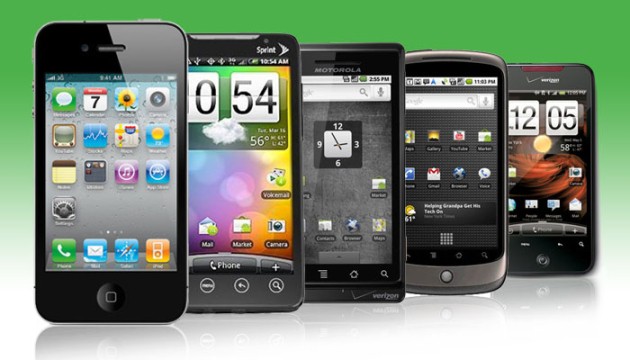
Our choices for which Smartphone we use keeps increasing each year...
“Our choices for which Smartphone we use keeps increasing each year…”

 There is no invention more prominent in today’s society than the Smartphone. It is used everyday for things as simple as making a call to as complex as using an application to pinpoint your exact location on Earth. I am the owner of an iPhone and it befuddles me to this day as to how a phone has come to be so advanced and influential within our daily lives.

There’s not a couple of minutes that go by when I’m out walking where I see people absolutely absorbed to what’s happening on their smartphones, completely oblivious to their immediate surroundings. I fear that is a trend that is only going to get worse as technology continues to advance in the future. It can be a bit tiresome and annoying to have a conversation or dinner with friends when some people are too busy answering a text or checking their twitter.

 Now, I’m not against checking one’s phone from time to time or killing some time by looking at it but person to person communications have been changed significantly by the smartphone and I’m not sure if it’s for better or worse. The great irony of the smartphone is that while it has improved communications through texting, calling, social networking, etc., person to person contact has seem to be quite harmed by this technology.

There have been countless instances where people have whipped out their smartphones out of sheer boredom, nervousness or on purpose when they are out on dates, at dinner or waiting in line for a coffee. I recently watched a news report where they reported an increase in smartphone-related car accidents where people were too occupied in texting while driving or others were too busy texting then to look both ways before crossing the street.

 I am sometimes guilty of paying too much attention to my smartphone and I am trying to limit the amount of times I use it during the day. It is a greatly useful tool and has made my life and the lives of others a lot easier. I do worry about the negatives though in terms of causing too much distraction and also harming the way people interact with each other on a personal basis. I read in a recent Newsweek article that a lot of Americans sleep with their smart phone. I was a bit incredulous about this but I guess that’s what it should come to when a smartphone can basically do anything that we need ten different devices to do before.

 I’ll leave you with a moment that left me quite skeptical about the positives of the smartphone; I was hanging out with friends and having a couple of laughs when there was a moment of stillness in the midst of conversation. One by one, each of them started to take out their phones and I was then left as the only one not gazing into the alluring screen of an iPhone and other smartphones. I was disappointed by kind of resigned to the fact that I have to get used to this tendency of people today to grab for their phones for instant stimulation but I do miss those days when I didn’t have to worry about a smartphone coming between another human being and I.