English Corner – Simple Past Tense

For this edition of ‘English Corner’, we’re going into the past to figure out and understand the ‘Simple Past Tense.’ In order to successfully master the English language, you need to be able to use the simple past tense correctly. Whether it’s talking about what you did yesterday or last week or even five years ago, the structure and formation of the simple past tense should not be overlooked. As we discussed previously with the simple present tense and the present progressive tense, having a good grasp of these basic grammar forms will help you to get better in English really quickly.

In this blog post, I’ll go over when and how we should use the simple past tense and you will be able to see a few examples of how to put this grammar tense into action. If you have any questions or comments, please leave them for me below the article, as I am happy to help anyone out who needs additional assistance with the simple past tense. After going through this grammar tense for this post, be on the lookout for the next edition of ‘English Corner’ when we go over the past progressive tense.

If you have heard about the ‘preterite tense’ but don’t know about the ‘simple past tense’, then you can be at ease knowing that they are one in the same. While there are different forms of the past tense, the ‘simple past tense’ has become the most commonly used form and is quite easy to master if you are able to understand and apply the structures and the different ways you can use the grammar tense in a sentence.

When it comes to creating the simple past tense, the structure is quite simple. There are three types of sentences that you can form with the simple past tense: positive, negative, and questions. For positive sentences, you’ll put the ‘subject’ first and then add the ‘main verb’, which will be in the simple past tense. For negative sentences, you put the subject first and then an auxiliary verb with the verb ‘to do’, put into the past tense, which becomes ‘did’ followed by the word ‘not’ afterwards to indicate the negation in the sentence. The last part of the ‘negative’ sentence with simple past is the ‘main verb’ so the structure should be ‘subject’ + ‘auxiliary verb and ‘not’ + ‘main verb’ to complete the sentence fully. The question form of the ‘simple past tense’ is very similar to the negative form but there’s one exception that makes them different from each other.

The ‘auxiliary verb’ comes first before the ‘subject’ and then after the subject comes the ‘main verb’ and the ‘object’, which completes the sentence’s overall purpose. Positive sentences for the simple past tense do not have any auxiliary verbs as the negative and question sentences do reply upon. The verb ‘to do’ is the most important one when it comes to forming the simple past sentence regardless if its’ a positive, negative, or question form of the grammar tense. Lastly, the negative sentences you create must have the ‘not’ word after the auxiliary verb and before the main verb in order for it to make grammatical sense.

Examples

Positive Sentences:

I did go to the mall last weekend. (to go)

         I did play with my friends at the park yesterday. (to play)

Negative Sentences:

I did not think you were polite at the lecture on Monday. (to think)

I did not believe you when you said the stock market crashed. (to believe)

Question Sentences:

Did you do your homework last night? (to do)

Did you tell her you were late for class? (to tell)

When it comes to the verb ‘to be’, there is a different structure for the simple past tense that the average ESL student should be made aware of. In order to put ‘to be’ in the past tense form, it’s either going to become ‘was’ or ‘were’ depending upon what subject is being used at the beginning of the sentence. For the positive form of the was/were usage of ‘to be’ in the past tense, you start with I/He/She/It (subjects) and then the verb, which in this case for singular subjects would be was, followed by the object of the sentence.

For sentences with subject plurals like We/They/You, you are going to change ‘to be’ from was to were to reflect the change followed by the action / object again. For the negative form, you’re just going to add ‘not’ between the main verb and the object at the end of the sentence. ‘Was or were’ are going to be placed at the beginning of a question sentence followed by the subject and the actions that are involved in the sentence.

Examples

Positive Sentences:

He was here yesterday evening at the dinner table. (to be)

         You were in Istanbul last weekend for a friend’s birthday. (to be)

Negative Sentences:

I was not at the park last night because I had work to do. (to be)

They were not at the party because they were not invited. (to be)

Question Sentences:

Was she nice to her date last Thursday night? (to be)

Were you happy with how you did on the Spanish exam? (to be)

Compared to the verb ‘to do’ in the simple past tense, ‘to be’ has no auxiliary verbs at all even for the question and negative forms of the verb tense. However, it is the same in that ‘not’ always comes after the main verb for a negative sentence. The subject also becomes the past tense form of the verb ‘to be’ while the main verb moves to the middle of the sentence and is actually the subject words such as he / she / they, etc.

If you simply would like to use the past simple tense with most of the verbs you’ll be using in your sentences, you will add the letter ‘d’ or ‘-ed’ to the end of the verb in order for it to make sense grammatically. There are a couple of examples we should take a look at it when it comes to forming the simple past tense of the verb with ‘d’ or ‘ed.’

Examples

  1. After school, he walked home in the rain.
  2. He danced really well with his date at the senior prom.
  3. She planned to go to Europe this summer but she couldn’t save up enough money.
  4. Because his mother was sick, he baked a chocolate cake.
  5. We went to the movies after we ate at a Mexican restaurant.

It’s important to note that there may be some irregular verbs that are formed differently when it comes to the simple past tense. For example, ‘go’ in the simple present tense will become ‘went’ when it comes to being grammatically correct in the simple past tense. Another verb like ‘eat’ will become ‘ate’ and ‘drink’ will also change slightly to become ‘drank.’ While most of the verbs only need a ‘d’ or an ‘ed’ to be properly simple past, there are a few irregular verbs that should be memorized for the fact that they are exceptions to the rule when it comes to going from present to past in terms of how the word is written and pronounced.

Now that we know how to use the structure of the simple past tense, you’ll also want to be aware of what kinds of uses do we have for this particular grammar tense. The main purpose of the simple past tense is to talk about the past meaning that we want to shed light about a thing, an action, or a situation that happened in the past. These events can be as recent in the past as in they happened last night or they can be events that occurred long ago such as discussing a sports championship that happened over a decade ago.

Examples

  1. I played my violin last night for my parents and brother. (short time ago)
  2. I had a great time living in Istanbul, Turkey back in 2015. (long time ago)

When we use the simple past tense, you cannot refer to events or actions that are happening currently in the present or are slated to happen anytime in the future. The simple past tense only focuses on those events and actions that were completed sometime in the past. It simply doesn’t matter if the event was finished ten years ago or ten seconds ago. The fact is that it’s still in the past and the sentence structure should reflect the grammatical tense that fits the place and time.

Lastly, it should be noted that the books you’ve read or the movies you seen who occur in the past are mainly going to use the simple past tense. The present perfect and simple present tense may be used in stories or movies as well but you’re going to want to pay attention and listen to the sentences with the simple past tense because they are going to be the most common.

If you want to practice your simple past tense after reading this article, I recommend listening to songs, reading books, watching movies that take place in the past. Besides speaking or writing about the past, participating in the active listening and / or reading about events or moments in the past will help to take your English language skills to the next level. I hope you enjoyed this ‘English Corner’ post and please leave a comment if you have any questions, queries, or comments.

English Corner – Present Progressive Tense

present_progressive_tense
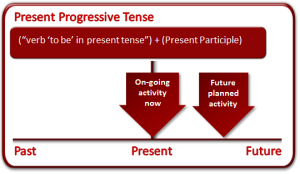
“If you’re not sure where the Present Progressive Tense fits into the timeline, I have a useful chart for you to study.”

As a student of the English language, once you’re able to understand and use the ‘Simple Present Tense’ with proficiency and are ready to move on to the next grammar step, it would be wise to start learning about the ‘Present Progressive Tense.’ This particular grammar tense can help you to describe a number of different topics and can be used in a variety of ways. By studying the examples listed in this blog post and knowing when to apply the present progressive tense, you’ll be able to advance and get better in your study of English grammar rules.

The ‘Present Tense’ is divided into two kinds: the ‘Simple’ present tense and the ‘Continuous’ or ‘Progressive’ present tense. In order to fully understand the present tense grammar form, it’s important to understand both the ‘simple’ and ‘progressive’ aspects to this concept. Please follow along and read through this blog post if you’re a student of English grammar and want to better understand the ‘Present Progressive Tense.’ We will start by looking at a couple of examples regarding how this grammar tense is supposed to be structured. I would recommend that you copy these particular examples so you have some idea on how to use the present progressive tense in a sentence.

Examples

  1. I am going to the store today.
  2. We are planning on coming to your wedding tonight.
  3. What are you doing for dinner later this evening?

For the actual structure of the Present Progressive tense, it’s a little bit different when compared to the Simple Present tense. It’s necessary to begin the sentence with the ‘subject’ word whether it is “I, You, We, They, He / She, etc.” and you can also use the question form as well with “What, When, Where, Why, etc.” at the beginning of a sentence. The auxiliary verb, which is supposed to be conjugated in the Simple Present tense would come next and is modified depending upon which ‘subject’ word is used at the beginning of the sentence.

The auxiliary verb “to be” is the most popular form when it comes to the present tense so it is meant to be used often when it comes to creating the sentence. When you conjugate “to be” in the simple present form, you’ll end up with “is, are, am, etc.” depending upon the subject word. The auxiliary verb is always followed by the main verb, which is supposed to be displayed in present participle form. When we mention the present participle form, it basically involves the verb such as “do” and adding an “ing” to the end of the verb.

For negative sentences, the form of the present progressive sentence is a little bit different compared to regular sentences. It’s necessary to put the word ‘not’ in between the auxiliary verb and the main verb in order for the sentence to make grammatical sense.

Examples

  1. I am not dancing at the ball tonight.
  2. You are not playing basketball tomorrow.

If you’re thinking about making a question sentence with the present progressive tense, there’s a clear step that you need to take in order to make it work. The ‘subject’ at the beginning of the sentence must be exchanged for the ‘auxiliary verb’ due to a necessary change in the structure of the sentence in order to make the question work.

Examples

  1. Am I doing the right thing?
  2. Are you playing the piano for the recital?

As you can see, the ‘am’ which is the auxiliary verb comes at the beginning of the sentence this time and the ‘I’ word comes after and becomes secondary in terms of its’ placement. The positive and negative forms of the present progressive tense are quite similar to each other with the only difference being that the ‘not’ is added into the structure of the sentence in order to create that difference but the actual structure of the present progressive tense does not change at all. When it comes to the question form however, there is a change in the actual structure of the present progressive tense with the fact that the ‘subject’ and the ‘auxiliary verb’ essentially change places in order to form the actual question.

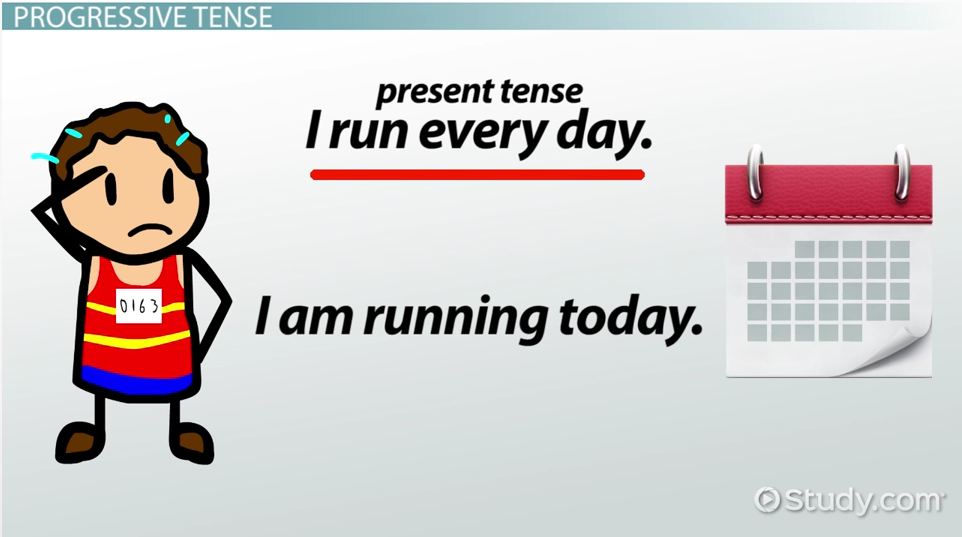
Now that we know the structure of the present progressive tense in its’ main forms of usage, how do we know when to put this grammatical tense into action? Well, it’s quite simple actually. There are some fundamental principles that guide the use of the present progressive tense in formal sentences. The present progressive tense can describe actions that are happening in real time and are continuing into the near future.

These could be actions or occurrences that are happening right now and have not been finished yet. These are actions that are in progress and have not reached the completion stage yet. This is why we add the –ing to our verbs to indicate that the action is ongoing and hasn’t reached an end yet.

Examples

  1. The wheels are spinning.
  2. The tables are turning.
  3. The guns are firing.

In addition to those actions that are occurring right now, there are also actions that have no set time frame or completion date yet but are ongoing and will require some time to finish. This is the most popular use for the –ing form and there are a lot of examples that can be construed from it.

Examples

  1. John is taking Salsa lessons.
  2. Martha is learning how to cook.
  3. Bob is starting a new job.

Despite being known as the ‘present progressive’ tense, this grammatical tense can also be used to describe actions or habits that will be occurring in the near future. In order to make this work though, you must add a word to indicate that something will happen in the future. Some examples of these words include ‘tonight, tomorrow, next week, this weekend, two days from now, etc. Usually, you are describing something that has been planned out to occur in the future with a specific date or timeframe in mind. People are long-term planners and thus, we are able to talk about actions that we will take in the future having made the plans ahead of time.

Examples

  1. I am going to attend university next August.
  2. I am planning to go to Mexico this winter.
  3. We are thinking about having our honeymoon in Hawaii next month.

The plan has already been set in motion and that’s why you’re discussing what you’re going to be doing but at a future time and place. It’s vital to remember that the present progressive tense does not exist without adding -ing to any verb regardless of which verb it is. The present progressive tense may not be the most popular grammatical tense but it is extremely important to practice, create examples, and master it both in its’ written form and its’ spoken form. Before you can go on to the ‘past’ and ‘future’ grammatical tenses, I believe that it’s necessary to have a good handle on the present progressive tense first before moving on to something else. Keep my explanations and examples in mind and look out for another ‘English Corner’ coming to you all soon.

New Year’s Resolutions

LFP-Resolutions
“It’s that time of year again…”

When the clock strikes midnight in a few hours from now, I will be very happy to see the end of 2015 and to look forward to beginning of 2016. Overall, 2015 was a very challenging yet rewarding year for me with many new experiences, new perspectives on life, and changes to my lifestyle.

I immersed myself in traveling to different cities and countries, becoming better at being a teacher, and developing my abilities as a writer through this blog that I’ve been experimenting with for the last few months. I think that I have grown as a person into someone more mature, wise, and knowledgeable.

2016 is going to be another big, life-changing year for me and over the next few weeks, I will be divulging about how my life will be different soon and what changes will be made to this burgeoning blog of mine as well.

I have never really been that big on New Year’s Resolutions but I think that it is an admirable concept to try your best to set goals and make improvements for the coming year. As human beings, we must always try to improve and better ourselves in any way that we can. Without further ado, here are my personal resolutions in 2016:

1) Continue to improve my Spanish language skills and reach an advanced level of proficiency.

2) Develop the layout, style, and substance of my blog and develop a stricter and more refined posting schedule.

3) Improve and become better as an English as a Second Language Teacher so that my students can continue to benefit from my knowledge and expertise.

4) Working out at the gym, running, and other forms of exercise are important to do for myself three to four times per week. This also goes along with maintaining a good diet and nutrition in order to stay healthy.

5) Make an effort to stay in touch with my family and my close friends around the world wherever they are.

6) Learn how to dance Salsa and develop some moves. I’m really serious about this one in particular.

7) Keep traveling, exploring new places, and gaining a better appreciation for different cultures and ways of life. This will prove to be key for me in 2016.

To all of my readership and those who support my blog, Thank you very much and I want to wish everyone a very happy and healthy new year. Here’s to a great 2016!


The Value of Perseverance

“The road to the top is paved with obstacles but the view is worth the struggle.”

Perseverance: Noun. Steadfastness in doing something despite difficulty or delay in achieving success. (Source: Webster Dictionary)

One of my favorite words in the English language recently is the one I just listed above along with the definition. Perseverance. The innate will to finish what you started, and to become successful despite all of the obstacles thrown at you. Life can be pretty difficult to deal with sometimes and it’s hard to remain committed to your goals, hopes, and dreams.

I’m writing you to tell you, dear reader, that despite the long odds, and struggles that you may encounter in your life, you have to push on each and every day to make it one step closer to becoming successful and making those dreams come true. It won’t happen overnight and there will be setbacks and false starts, but your will and determination will set you apart from others in getting to where you want to be in life.

Whether success to you is in monetary form in making a lot of money and having a lot of possessions, or changing the world by helping the poor or cleaning up the environment, or simply just raising a family and passing on the torch to the next generation, perseverance will be needed in order to make any of these hopes a reality. As the saying goes, “Rome was not built in a day. “

Remember, Each day, each month, and each year: you have to make small deposits in the game of life. Progress takes time and don’t be discouraged if you don’t achieve your success overnight. Remaining true to yourself and your vision of the future is important. Make sure that you surround yourself with those people (friends or family) who are supportive of you and your goals.

Do not let yourself be dragged down by others who would wish you ill or divert you away from your path. Even if you fail and suffer at first, never ever give up. I happen to believe that everyone’s luck changes and that if you keep pushing forward and you work hard at anything in life, success will become a reality. Steve Jobs, Bill Gates, Michael Jordan, Abraham Lincoln, etc. are a few of the countless examples of famous individuals who struggled and failed in life at first but were able to persevere and overcome obstacles to become great and successful. One’s willpower and determination goes a long way in seeing who will make it in life and those who will just skate by in mediocrity.

Your teachers, mentors, friends, and family will be there for you and will help guide you to future success but it is up to you, and you alone to make something of yourself. Each day you should ask yourself: How can I make myself better?, What do I want to achieve?, How can I be a better person?, etc. Even if you fail multiple times, use it as motivation to do better and better each time.

Do not throw in the towel. Life is short and we do not have unlimited time on planet Earth. Make the most out of the opportunities given to you, and if none have been given or handed to you, take them and run with it. Only after blood, sweat, and tears will any of us achieve to what we set out to do. That’s the way it always has been and will be in the future. The road to success has always been paved with hardships and setbacks but that does not mean that we should give up or stop trying. To persevere is to set yourself apart from the rest, and I hope that each and every one of you reading this blog will keep that in mind.