

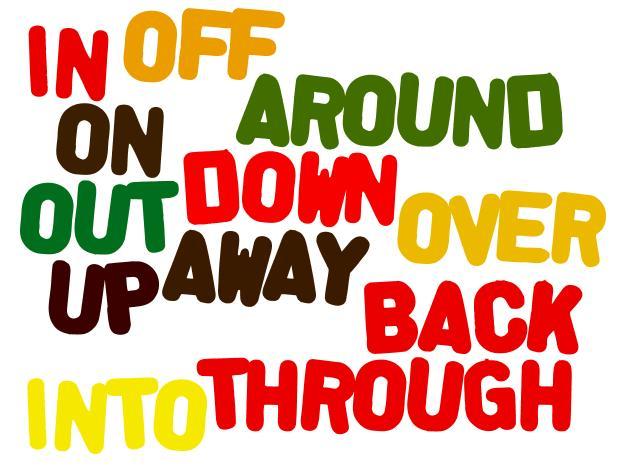
English Corner – Prepositions

The ‘English Corner’ will be a new blog post series from me with a new post every month to help English language learners to better understand the vocabulary, grammar, and syntax in order to better develop their own proficiency. I have over two years of experience of teaching the English language to non-native speakers, both online and in person. I hope to use these posts to help you, the reader, improve your understanding of English, and also develop your fluency.

If you have any questions about this ‘English Corner’ post, please leave a comment and I will answer them to the best of my ability. Any constructive feedback is appreciated and I hope that this will become a popular series of posts within my website. If you enjoy my ‘English Corner’ series, you can also request private English lessons with me through the WordPress message system.

One of the biggest struggles that new learners of the English language will encounter during their studies is mastering the grammatical concept of the ‘Preposition.’ The most common issue that a lot of my ESL students have come across is how to better understand and memorize the grammar rules of the ‘Preposition.’

It’s nearly impossible to memorize all of the ‘Prepositions’ and their specific uses in English. I find that it’s best to examine certain examples where the individual preposition is being used in the sentence and for what context does it most apply fittingly. It’s important to remember that a preposition is considered to be a part-of-speech that comes before a noun type of phrase and connects it to another part of the sentence. The name of ‘Preposition’ can be broken down into pre-position which gives us a good hint that this part-of-speech needs to be placed before the noun. There are different types of noun phrases such as the noun phrase (the short boy), the noun (meat), the pronoun (us), and the ‘gerund or before the verb in –ing form’ (dancing).

The most common prepositions are on, in, to, for, with, by, and. There are numerous other prepositions and for a full list of them, I highly recommend going to this link: https://www.englishclub.com/grammar/prepositions-list.htm

There are three types of relationships that the preposition has with the rest of the sentence. They are relationships in time, in space, and of a certain method.

For some examples of prepositions in these three different relationships, let’s look at the following sentences:

  • The soccer ball is on the floor. (relationship in space)

Note: The physical location of the soccer ball is located on the floor. ‘On’ is a good example of a preposition that is used to demonstrate the relationship in space between itself and the noun.

  • You will meet him in October to discuss the business deal. (relationship in time)

Note: When it comes to date / time / place, a preposition like in is perfect for highlighting the relationship of time when it comes to a noun like ‘October.’ For months, days, weeks, and other words for time, it’s important to use the correct preposition to express this relationship.

  • I sent the wedding invite to you by postal mail. (relationship of method)

Note: When describing a method with a preposition, using by is the most popular and the most useful. Whether its’ mailing a package, or writing a reply to your boss, this kind of preposition will come in handy especially when it comes to connecting the gerund (verb + ing) to the part of speech.

There are several kinds of relationships that are expressed with the help of prepositions but the most common relate to space, time, and method.

Prepositions can either be one word (after, in, by, etc.) or a couple of words, which makes them more complex in their overall nature. (according to, despite that, because of, etc.)

Prepositions will usually come in the middle of a sentence to connect two parts of a whole sentence. However, there are exceptions and sometimes they will appear at the beginning or end of a sentence.

Examples:

Which person did you talk to?

To which person did you talk?

____________________________________________

Another important distinction between prepositions is related to whether they involve place or time.

Prepositions of place describe the relation of an object or thing to another object or thing in terms of space.

This chart below provided by http://www.englishclub.com explains this phenomenon along with a list of corresponding prepositions of place:
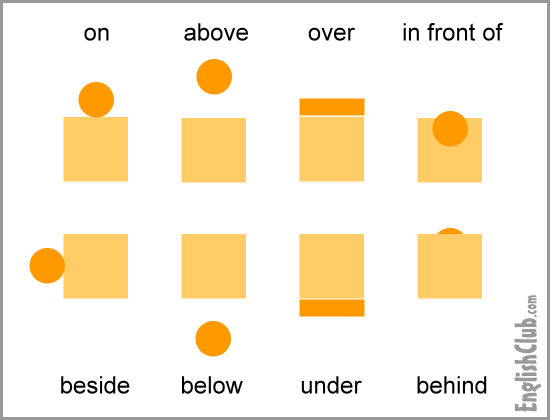
prepositions-of-place

Here are some example sentences for preposition of place:

  • My dinner plate is on the table.
  • The boy hid under his bed.
  • He stood in front of the door.
  • The bird flew above the crowd.
  • He looked over his assembled troops on the battlefield.

Prepositions of time usually involve prepositions like at, in, on, by, etc. We use at to describe a specific time or date. We use in to highlight months, years, decades, and long periods of time. The last preposition of on is the most specific and deals with days of the week, and dates in time. By is the least common preposition of time but can be used to express important due dates when it comes to days and weeks.

Here are some example sentences for preposition of time:

  • I have a salsa class at 8 pm tonight.
  • In September, I started my new job.
  • We ended our job strike on Tuesday because our demands were met.
  • You need to finish this project by next week.
  • We will be back from our vacation by Friday night at 11 PM.

This chart below from http://www.englishlearnsite.com is very useful in giving us more examples on how to use these prepositions of time in the correct manner without getting frustrated.
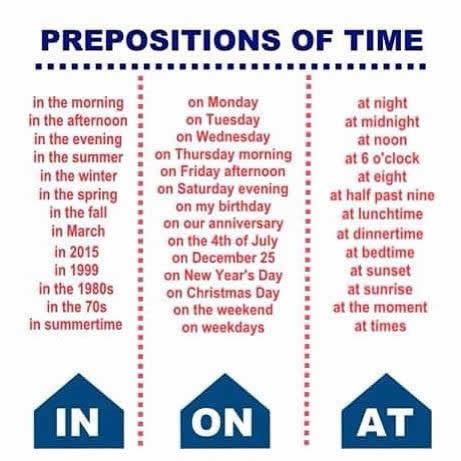
prepositions-of-time

Prepositions are an important grammatical concept to master in order to become fluent in the English language. I hope this first ‘English Corner’ session was helpful to you as a reader of my website. Remember that a preposition is always followed by a noun, and never by a verb. Prepositions usually appear in the middle of a sentence but sometimes at the beginning or end too. Placing your prepositions before the ‘noun’ and after the subject/verb will help you greatly with regards to your English grammar.

I hope you enjoyed this first edition of ‘English Corner’ and I look forward to sharing another topic with all of my visitors again soon.

A Wealth of Knowledge

knowledge-translation-and-exchange1
“The sharing and exchange of knowledge is easier now than it has ever been in human history.”

There has been no other time in human history than in today’s era where the average person with access to the Internet can seemingly have unlimited amounts of information available to him or her. When you truly think about the magnitude of it, untold amounts of data are being created every day. According to IBM, “The current estimate is 2.5 quintillion bytes of data per day and over 90% of the data in the world today has been created in the past two years alone.”

A common response nowadays from both family and friends when I ask a question to them about a random query is not a straight-forward answer but rather an off-handed suggestion to “Google it.” Living in this era of ‘Big Data’ can be quite overwhelming to the average person but one could also look into it as an opportunity to gain knowledge and further ones’ understanding on a limitless amount of subjects with the simple click of a mouse. The Internet is an amalgamation of thousands of libraries of Alexandria at the beck and call of one’s fingertips.

Compared to past ages when information and knowledge was more exclusive and harder to come by, today’s era allows everyone with an Internet connection to search and find information to their heart’s content. Instead of going to a library to find what you need on a subject, websites like Google, Wikipedia, and other online encyclopedias have largely replaced the main role of the physical library. I remember when I was younger and in my high school days having to seek out certain books in order to write a research paper or complete a book report.

However, now more than ever, you can easily find the sources of information you need online in order to facilitate your research and evidence. While I love libraries and hope that they never go out of style, the reality is that online encyclopedias and eBooks are largely replacing their original purpose. In order for libraries to stay relevant, they need to start incorporating computers, free Wi-Fi, and technical classes in order to remain useful.

From the 18th to the 20th centuries, universities and colleges across America were the standard bearers and purveyors of higher education. Originally for the elite, wealthy, and well connected, those students who were able to get accepted and afford undergraduate and graduate studies believed that they would have an advantage in the job market and in achieving the American Dream. More recently, as colleges and universities have become more inclusive than exclusive, tuition prices have inversely risen as well.

While higher education has become accessible to more and more young Americans, it also has become more expensive especially over the past decade. These events have led to an ongoing debate as to whether college is really worth the price tag and whether the average student gains anything from earning a four-year degree. With student loan debt at an all-time high of $1.3 trillion in 2015 in the United States and tuition rates at both public and private universities continuing to rise, people are beginning to look for alternatives to the current higher education system.

Over the past decade, there has been a drastic proliferation of massive open online courses (MOOCs) provided by both private companies and traditional universities. At a much lower price and sometimes free, people from all over the world can sign-up for these courses and partake in lectures, tests, quizzes, and papers as if they were actual enrolled undergraduate and graduate students at the physical form of the university. As the credentials and certifications bestowed upon these courses continue to increase and become more widely accepted, we may begin to see ‘the end of college’ as we know it.

Examples like Khan Academy, edX, Coursera, Udacity, etc. and other MOOCs have leveled the playing field. Tech entrepreneurs from Silicon Valley have allowed students from all over the world to access unlimited online courses to further their academic knowledge at a lower price. With the subsequent rise in online university programs for undergraduates and graduates, the physical college experience of dormitories, lecture halls, football stadiums, etc. may become less appealing to students as tuition prices continue to increase. While the social and networking benefits of college life are numerous, they may not be enough to compete with this era of free information that we are living in.

Compared to past decades, we’re living in a time when access to the Internet is at an all-time high and is increasingly rapidly due to the rise of mobile technology. Traditional havens of knowledge such as the library or the public university will have to adapt to stay relevant in this unlimited information age. In a worldwide job market that is evolving rapidly and where the average child today will work in an industry not yet created, the free exchange of knowledge must continue to spread through the worldwide web.

Countless others and I have benefited from taking online coding courses on ‘Codeacademy’ to learning new languages on ‘Duolingo.’ As MOOCs and online universities continue to develop their courses and credentials, we may begin to see an era where the average person can earn a degree or two without breaking the bank. MOOCs are cheaper, less time intensive, and can adapt more easily to the rapidly changing employment market.

A well-educated population is now more possible now than ever with the wealth of knowledge and information that is available. That fact is evident but it also is up to the individual to be willing to search for that information and actually apply it. Instead of getting frustrated with people asking me to ‘Google’ the answer, I find that it’s worth the hassle because it’s often true that I will find the answers I’m looking for and in greater detail than if I were to ask a friend or family member for a quick description. That’s the power of the Internet. That’s the wealth of knowledge that we are able to take advantage of.

Sources

Sites Mentioned

The Limits of Perception

dreamstime_2907801
“Do you see what I see?”

“Perception” is an interesting word when you think deeply about it. No, I’m not just talking about your two eyes, and the vision that allows you to perceive the world visually. In other words, we can only perceive the experiences that we have or had in the past, the people we met, the places we visited and lived in, and the choices that we make or made.

Human beings are mortal which means we have limited time on this Earth to see and experience all that life has to offer. For some people, this is a very frightening and gloomy notion. However, others would see this fact as a way to get the most out of life and expand their perception of the world as much as possible.

A limited “perception” of life and the world has consequences when you think about it. If you don’t have the ability to put yourself into someone else’s shoes or to imagine or experience life as they do, then your ability to emphasize with them would be diminished. Yes, you can have sympathy for their plights or jubilation for their successes but you wouldn’t be able to connect with them on a deeper level.

A consistent problem in human nature is our lack of ability to put ourselves in someone else’s shoes and see life as they do. When we are unable to break down barriers between social classes, races, religions, and gender, disagreements and hostilities between these groups is likely to continue. From my perspective and my past travels, the similarities of humans around the world drastically outweigh the differences. That doesn’t mean that these differences are bad or that they should be eliminated. I happen to believe that cultural and social differences are part of what makes humanity unique and should not be demonized.

This leaves the question that my blog readers would wonder to themselves hopefully after reading this entry: How do I expand my perception of life and the world around me? Now, when I ask this question, I do not mean for you to go out to the nearest pharmacy and get yourself some contacts or a pair of prescription glasses.

What I mean and what I believe is that we humans have limited time on Earth and we can’t live forever to experience everything and to meet everybody around the world. However, there are ways to expand this perception by traveling the world, reading books, and meeting different kinds of people. These three concepts are not crazy ideas but rather novel concepts to create greater empathy in yourself and for others along with a more profound view of humanity as a whole.

Traveling has always had the highest return on investment for me and the experiences I have had have helped me view the world in a different way. I know that it’s not feasible for everyone to travel but if you can’t make a huge jump to another country, try to travel to different places and cities within your own country. Learning about the local culture and customs, enjoying the local cuisine, and indulging in the history and background of the society are important for any seasoned traveler.

You will start to view the world in shades of grey rather than pure black and white. You would also learn that cultures and societies are complex and that it takes a lot of time to immerse yourself in its deeper reaches. Most of all, you are communicating in a different language which is fascinating and complex in its own right. Above all else, you are seeing the commonalities and similarities that exist between your family and their family, your town and their town, and your country and their country.

Meeting new people from different backgrounds and places ties into traveling as well but it really makes your perception of the world grow. If you stay in the same town where you grow up and never leave, chances are that you’ll have a limited perception of people and life itself. Talking to different people, hearing their stories, cooking with them, and sharing a meal or drink has many benefits. You may be able to build a friendship that lasts for years even if you don’t speak the same language or come from the same culture.

By hearing their story and listening to them, you expand your own perception of the world and the people who inhabit it. You can get beyond the stereotypes and the clichés and really get into deeper social connections with people, especially in this interconnected world that we all live in.

Lastly, reading books is an integral park for learning about the world and facilitating a deeper perception. As individuals, we cannot experience everything or know everything there is to know. However, by reading about the stories of others who have come before you and who had lived, and died, you will gain greater knowledge and wisdom. Regardless of whether the book is fiction or non-fiction, you’re reading someone’s life story or reading about a subject that spans a part of human history.

Book by book, you are enlightening yourself by learning about the experiences and perceptions of others. By learning about the men and women who have come before you and who have lived exemplary and distinguished lives, you can take lessons from their existence and apply those lessons to your own life. If you can’t travel or meet different kinds of people, reading books by those authors who have and whom shared those unique experiences with their readers is the next best thing.

We all have one live to life, and you can only see what’s right in front of your eyes. Make sure that you continue to give yourself the opportunities and chances to indulge in the knowledge and wisdom that can be gained by expanding your perception of the world and its inhabitants. Travel, read books, and meet different people for as long as you may live. Only then will you gain true enlightenment and wisdom.