

English Corner – Making Sure to Edit Your Presentations

“Getting peer edits or a peer review of the written part of the presentation will set you apart in a good way.”

Nothing takes away from a good presentation more than careless and recurring spelling and grammar errors that are noticeable to the audience. You could have an excellent looking PowerPoint with supporting details, crisp bullet points, and a stylish design, but if it is filled with English spelling and grammar errors, it will be a distraction from the overall presentation. As an English as a Second Language instructor, it is one of the first things I notice from a presentation, and it is an issue that I believe must be resolved before you present in front of an audience.

The presenter’s speaking ability, their cadence, tone, voice intonation, etc. are all key to having a good presentation but is not everything to its overall success. You have to remember the little details in a presentation and that includes making sure to edit and review your presentation as a non-native English speaker and learner. I am not singling out non-native English language learners alone because I have noticed grammar and spelling errors even from native English speakers due to being careless about it.

When you are learning English for professional purposes, it does no good for you to be careless about an important presentation. When you are just going through the motions of drafting up your presentation slides, it can be easy to just copy, paste, and hope that people understand your writing. People will not point these errors out to you after the presentation itself, but they will be taking note of the errors in the presentation, and it will be distracting them as they review what you presented on and how they feel about the subject matter itself.

In my view, it does show a lack of care and concern for your presentation when you don’t check for errors, review your spelling, or edit the grammar if necessary to make sure the written part of it is as good or if not to be better than what you verbally presented on. Depending on the type of professional English language presentation you are given, these kind of spelling, grammar, or written errors could hurt your ability to sell a product, to convince a business to partner with you, or to get the audience to agree with your thesis or your conclusion. When you put all your efforts into your 5-10-15 minute presentation in terms of your spoken English but neglect the hour or so needed to edit the PowerPoint slides for the visual aspect of it, the whole presentation will be setback as a result.

Do not let your presentation be derailed due to a few careless errors that could have been revised with just a few minutes of review and revisions. Your spoken part of the presentation is likely to be more intense, stressful, and time-consuming. However, it does not mean you should neglect the ability to write about what you’re presenting and to do so with as good of written English that you can muster. You are doing a disservice to your audience if you do not edit your written presentation whether they are notes, slides, or another form of written output that they will have to understand and digest.

If you are not comfortable with editing your presentation before you give it, be sure to check with your colleagues if they also know written English at the same level or higher than you, especially if they are advanced learners or it is their native language. Getting peer edits or a peer review of the written part of the presentation will set you apart in a good way. It shows that you care about all aspects of your presentation and are not self-conscious about your writing as a non-native English learner.

The peer editor will assist you immensely especially if you take the time to sit with them ahead of the presentation to review your errors, fix them together, and understand how you made them in the first place. The point of these professional presentations beyond just business or personal growth is to make you a better English speaker and writer. You can fix as many mistakes as necessary but if you are not learning from them for future presentations, you will continue to make them for future presentations much to your own professional detriment.

Getting your presentation reviewed by a peer or colleague you trust will help you immensely in various ways. It will help build your confidence, help you become a better writer by understanding the mistakes that were made, and even help you with networking purposes since you will be building a good relationship with your peer editor or reviewer in your field of study or work.

A presentation has two components usually: the written word and the spoken word. There may be an audio or a visual component but in professional English, the key parts that must be mastered in giving a presentation are to speak eloquently and with a concise and understandable tone, and for the written part, is to not make serious spelling, grammar, and other errors that are easily avoided with editing your presentations beforehand.

Please make sure to review and edit your written slides or notes before you present them to an audience in a professional or academic setting. If you need to get a peer to edit or review your written presentation, you should be doing that before you get on the stage or in front of the podium. You will become more respected and admired for your abilities to present in English as your 2nd or 3rd language when you put the necessary efforts in beforehand to master the art of speaking in front of an audience and having your written work presented without major errors or mistakes. The English language is not an easy language to master, especially when it comes to using it for professional purposes, but you will become that much more of an advanced learner if you are able to write and speak in front of an audience on a serious topic or subject matter so others in your professional field will appreciate and recognize your hard work and efforts.
English Corner – Different Spelling and Vocabulary (US, UK, Canada)

“Part of the beauty of the English language is the diversity amongst the countries where it is the primary language of communication. Like many other languages around the world, there are different accents, words, and expressions unique to that particular country where it is the primary language.”

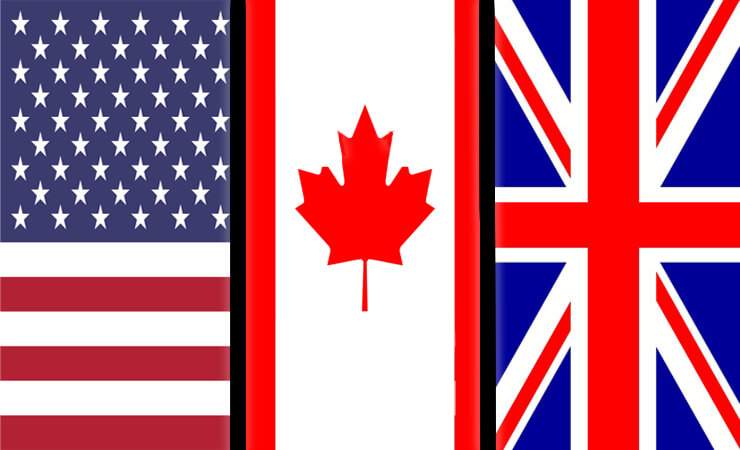
Part of the beauty of the English language is the diversity amongst the countries where it is the primary language of communication. Like many other languages around the world, there are different accents, words, and expressions unique to that particular country where it is the primary language. There’s a popular saying that goes: “The United States and the United Kingdom are two nations separated by a common language.” It is a funny result of the quirks, changes, and adaptations that come with being separated by a natural border such as an ocean or a man-made border. However, it goes to show you that a language can be molded over time by a culture leading towards small yet noticeable differences in the words we use, the phrases we say, and even the way we spell individual words.

In this article, I want to focus on the different words and spelling that while similar are not the same between the U.S., U.K., and Canada. I believe an English language learner should be familiar with these differences in spelling and vocabulary to build an even richer understanding of this language and how it can differ by country. While Australia, Ireland, New Zealand, and South Africa also have their own differences from the United Kingdom, I find that the former colonies of Great Britain have followed the UK in terms of the spelling and vocabulary used.

Canada tends to be similar in some ways to the US and in other ways similar to the UK so I would call it a mixture of the two countries, and you will see why this is the case in a chart detailing both these similarities and differences. I will analyze the chart a little bit and ask you to think about other words and phrases unique to these three countries and how you have come across them in your own studies or travels.

From this ‘International English Spelling Chart’, we can see some slight changes to the spelling of multiple words with each country being different from each other (color-colour, center, centre, defense-defence). As you can also make out from the spelling chart, there are certain words that the US is alone with using such as ‘gray’ compared to ‘grey’, which is backed up by Canada, the UK, and Australia. However, the UK is alone with using ‘globalisation’ whereas you have Canada and the US using ‘globalization’ with the change from ‘s’ to ‘z’ instead. This is also the case with ‘aluminum’ (Canada/US) compared to ‘aluminium’ for the UK.

Also, this spelling chart indicates to us that Canada is aligned with the US on some words in terms of spelling and aligned with the UK on other words. You never see Canada with its own spelling where they are alone in usage, but you do see that for the US and the UK being unique in their own spelling with Canada siding with one mode of spelling over the other version.

With the exception of the word ‘concert programme’, Australia and New Zealand (not featured) are totally aligned with the United Kingdom on each word presented above in terms of spelling highlighting their common history together and cultural heritage ties.

Most of these spelling changes are quite minor in difference and usually are either an addition of a letter such as a ‘u’ (color (USA) –> colour (UK)), or with an ‘i’ (aluminum (USA) –> aluminium (UK). They can also involve simply switching one letter in the word to another as we see with defence (UK) –> defense (US) with ‘c’ becoming an ‘s’ or globalization (USA) –> globalisation (UK) with ‘z’ becoming an ‘s’ with that change. Besides adding a letter to the word or changing one letter for another, these spelling changes among English of different variants according to country origin are quite minor. Although spelling changes are few and far between, differences in vocabulary words are greater when you compare the U.S. and the U.K. especially.


While the American / Canadian English tend to use the same words in a common vocabulary, British and American English words differ fundamentally in terms of word meanings and word usage. Still though, given the expansive list above, you realize just how rich and varied the English language is. Even if you are an American or if you are British, learning the dialect of each other’s country may require a bit of time and translation work. Despite sharing the same language, we don’t always share the same words, or the same meaning tot those words. It is important for both native and non-native speakers to familiarize yourself with the different dialects of the English language even if you’re not living in that country.

If you are planning to travel to different countries of the English-speaking world from Toronto to New York or from Los Angeles to Sydney, you should take the time to study the vocabulary sheets to know the difference in word usage as well as the slight spelling changes from other words that the charts above cite. When you adapt your English language skills to the local dialects, the people in those towns and cities will be quite impressed and it will make it a more fun trip or stay for you to use those common expressions or slang that will help you interact with others and even make a new friend. Please take some time to review these charts I have shared with you and try to use these different vocabulary words from each country in written sentences to help you understand. Don’t be shy also in pronouncing each one and being aware that while the meaning is the same, the word used by country is different.

I would just ask you to remember though not to get them confused and end up saying ‘chips’ in America when you meant ‘fries’ while ordering food or when you ask the kind British police officer for help in opening the ‘trunk’ instead of the ‘boot’. Those accidental cultural faux pas can be hard to avoid especially when you’re not from that country originally which is why it’s important to learn about and study these spelling and vocabulary distinctions that make the English language such a diverse and rich one in the world.