English Corner – Singular and Plural Nouns

Nouns, as they are popular known in English, are a fundamental building block in English grammar. Nouns are a fundamental part of speech in English. They can be found in nearly every sentence, every phrase, and make a vast amount of words. If you’re familiar with basic English grammar, you’ll know that the basic definition of a noun is that it is a person, place, thing, or idea. When it comes to the topic of singular and plural nouns, we have two separate categories to break our nouns into. In order to understand nouns, we need to know about the difference between singular and plural nouns.

To make the distinction between singular and plural nouns, we must first understand the definition of both concepts. The singular noun describes only one person, place, thing, or idea. The plural noun, in contrast, names more than one person, place, thing, or idea. It’s pretty easy to tell the difference then to distinguish between singular and plural nouns. When you think of singular nouns, think of the word ‘single’, which is similar in both meaning and how the word is written. Let us take a look at some examples to better illustrate what singular and plural nouns are.

Singular: Cat, Dog, Whale, Donkey

Plural: Cats, Dogs, Whales, Donkeys

As you can see from the examples above, the way that we distinguish the singular noun words from the plural noun words is the addition of the ‘s.’ In order to make a noun plural, you’re most often going to add the letter ‘s’ to the end of the word.

However, it’s important to keep in mind that there are certain singular noun words that don’t become plural from adding ‘-s’ to the end of the word and are irregular in their change. Let’s look at some examples of the change made from singular nouns to irregular plural nouns below.

Singular: Bench, Ash, Bus

Plural: Benches, Ashes, Buses

From these examples, you can see that in order to make the singular nouns to become plural, you need to add ‘-es’ to the end of the word and not just ‘-s.’ Specifically, for those singular nouns that end in s, x, z, ch, sh, you’re always going to add ‘-es’ after those letters to make the singular noun plural.

For those singular nouns that end in the letter ‘-y’, in order to make that same noun plual, you need to drop the ‘-y’ and add ‘-ies’ to make the plural noun. Here are some examples.

Singular: Baby, Candy, Party

Plural: Babies, Candies, Parties

As you can see, the ‘y’ is dropped and the ‘ies’ is added to make these words plural.

It’s also important to be aware that there are a few cases where singular nouns can become plural without adding s, es, ies, etc. These are unique words but they become plural nouns through different changes. Here are some examples below:

Man –> Men

Woman –> Women

Mouse –> Mice

There are also some nouns that don’t make any changes to their structure at all and maintain the same form whether they are singular or are plural.

Here are some word examples where they stay the same: deer, sheep, fish.

Some nouns can also maintain a plural form with an ‘-s’ ending but never be able to have a singular noun form given their structural makeup.

These words include: news, sports, billiards.

Other nouns will only have a singular form without a ‘-s’ ending but won’t be able to become plural due to their structural makeup as well.

These words include: bowling, music, badminton.

Having an understanding of and being able to use singular and plural nouns proficiently in English is extremely important. Luckily, this topic is one of the most straightforward to follow and to memorize. There are variations to the rules that make a singular noun plural so it’s vital to study the possible changes that can be made. Whether it’s adding a simple ‘s’ to the end of the word or changing the whole structure of the word such as mouse à mice, studying this grammar topic will take time and effort. Do your best with singular and plural nouns because it is a fundamental part of English speech.


English Corner – The Oxford Comma

One of the key debates in English grammar is the role of the ‘serial’ comma or what’s otherwise popularly known as the ‘oxford’ comma. Depending on whom you might ask, there are constructive arguments to be made as to why the Oxford comma is useful or why it may not be necessary at all. It all depends upon your personal preference in using or not using this kind of comma but it is important to be aware of how it is used and why it is used. Having proper grammar is a key part into developing one’s fluency in English and the Oxford comma is often considered to be necessary to developing that skillset.

The Oxford or serial comma is the last comma for a list of things, people, or places. I’ve listed some examples as to make it clear what this kind of comma is. The Oxford comma is always the last comma and cannot be classified as a serial comma if there is only one comma in the sentence. There has to be at least two or more commas in the sentence to have an Oxford comma take its’ place as the serial comma.

Examples

  1. Please bring your books, pencils, and some paper to class tomorrow.
  2. Remind Jimmy, Patrick, and Tina that they have a Math test today.
  3. I had a salad, an appetizer, steak, and dessert at the restaurant tonight.

As you can see from the examples, the Oxford comma is highlighted and bolded as the last of the commas in the sentence whether the subject(s) are people, things, or places. The thing with the Oxford comma to understand is that it is not mandatory to use and that there is a lot of debate over whether it should be even used at all. The use of the Oxford comma is stylistic and different style guides differ in terms of their views on the serial comma.

For example, the AP style guide for English grammar does not mandate the use of the Oxford comma. However, this is in contrast to other style guides such as the Chicago Manual of Style or The Elements of Style, which mandate and support the use of the Oxford comma. Certain professional organizations and agencies such as the United States Government Printing Office and the American Medical Association are supportive of the Oxford comma and encourage its’ use in their employees. Depending upon whom you work for or what line of work you’re in, views on the Oxford comma are likely to differ.

The debate over the Oxford comma extends to across the pond in the United Kingdom where there is also a divide over if it should be used at all. The Oxford Style Manual and the MHRA Style guide support the use of the Oxford comma whereas well-known national publications such as The Times Style Manual and The Economist Style Guide oppose the use of the Oxford comma. When it comes to the serial (Oxford) comma, British and American style guides both fall on opposing sides of this debate.

The main argument in support of using the Oxford comma is based around how it can clear up any ambiguity that comes with using ‘and’ instead of another comma to finish up the sentence. Supporters of the Oxford comma generally wants to make them understood without confusing the audience regardless if they’re writing a newspaper article or a research paper. I’ll give you an example to see how a sentence’s meaning could be ambiguous without the Oxford comma being used.

Example

I love my siblings, George Clooney and Katy Perry.

Because there’s no Oxford comma here, it’s definitely strange if you read it out loud. Instead of the intended meaning being that you love your siblings separately and then you also love George Clooney and Katy Perry who are known celebrities, it comes off as being that your siblings are George Clooney (brother) and Katy Perry (sister) which is likely not true.

Let’s look at the same example with the Oxford comma implemented into the ending of the sentence.

Example

I love my siblings, George Clooney, and Katy Perry.

From this re-written example with the Oxford comma included, it becomes more clearly that the subject known, as ‘I’ loves his or her siblings, George Clooney, and Katy Perry. It’s clearly distinguished in this case that the siblings are not the famous celebrities and that they are separate people. However, if you are really opposed to the Oxford comma, you can re-structure the sentence so that it can make sense grammatically and you won’t have to insert the serial comma for it to work.

Example

I love George Clooney, Katy Perry and my siblings.

In this re-written example, you don’t need the Oxford comma to clear up the ambiguity.

Unlike other debates, this debate within English grammar about the Oxford comma will never end. There are always going to be supporters and opposition to its usage. However, it’s important that every English learner or teacher be adaptable to its usage or non-usage. If your student wants to use the Oxford comma, they should be able to because it’s apart of how they learned English grammar and they are technically allowed to do so. If the teacher doesn’t want to teach the Oxford comma to their English students, they also should not have to if they don’t believe in it. We can learn and teach English in a world where the Oxford comma can exist and not exist.

English Corner – Regular and Irregular Verbs

Having a deep knowledge of verbs is crucial in order to develop one’s English vocabulary especially when it comes to differentiating between their varied forms. In order to understand verbs in general, we need to know that there are both ‘regular’ and ‘irregular’ verbs depending upon how their past tense and past participle are formed. It can be difficult to distinguish between the two types, as there is no set rule on what specifically makes a verb regular while another one can be irregular. In the case of this particular grammar topic, memorization and practice will make you better at using the correct form of the verb and to have a list of the verbs to study whenever possible.

When it comes to regular verbs, you should know that most verbs are regular verbs and that it’s very easy to change them to the past tense or the past participle. You’re simply going to add ‘-d’ or ‘-ed’ to the end of the verb in order to make it regular in the past tense. A good example of a regular verb would be ‘to play.’ In order to keep ‘play’ as a regular in either the past tense or in the past participle, you would add ‘-ed’ to the end of this word to make it ‘played.’

Example: “I played soccer with my friend Jeremy last night.”

Sometimes, you don’t even need to add –ed to the end of the regular verb but rather just the letter ‘-d’ to make it grammatically correct. A good example of that would be for the verb ‘to dance.’ In this case, you could add ‘-d’ to ‘dance’ to make it ‘danced’ for it to be a regular verb in the past tense.

Example: “We danced as a couple for the first time on our wedding night.”

Short List of Regular Verbs

Talk

Create

Walk

Want

Use

Help

Move

Call

Live

Follow

In each of these ten regular verbs, the simple past and the past participle are both the same and come with an –ed at the end of the verb. When it comes to a few select regular verbs, you may change a ‘y’ in the word for ‘-ied.’ For example, ‘try’ is the regular form of the verb in the present but to change it to the past tense, you need to drop the ‘y’ and add ‘ied’ to become ‘tried.’ Also, the regular verb ‘stop’ is an exception in that you add an additional ‘p’ after ‘stop’ as well as put on ‘-ed’ after the ‘p’ to create ‘stopped’ for the simple past and past participle. Regular verbs may have some variation to their formation but not as much when compared to irregular verbs.

Unfortunately, to the consternation to those English learners looking for an easy fix to the regular v. irregular verb debate, there is no magic wand or solution to know a rule to differentiate the two categories. It is known to most that there are over two hundred and fifty irregular verbs in the English language, which is a manageable amount for the average learner to remember since there are thousands of active verbs in the English language. While there is no strict formula or rule behind what separates a regular vs. an irregular verb, there are some fairly common forms of the irregular verb to be aware of.

Short List of Irregular Verbs

Arise

Become

Choose

Deal

Drink

Eat

Forget

Leave

Lose

Mean

Examples:

(Simple Present – Simple Past – Past Participle)

Break – Broke – Broken

Swim – Swam – Swum

Drive – Drove – Driven

Bear – Bore – Borne

Begin – Began – Begun

Examples:

  1. He broke his guitar strings from jamming too hard.
  2. Ben drove all through the night to get to his brother’s soccer game today in Chicago.
  3. Jackie swam for over ten miles to reach the final line of the triathlon competition.
  4. The Russian army bore the mass majority of military casualties during World War II for the allies.
  5. We began our day with a hearty breakfast before beginning the climb to the summit of Mount Kilimanjaro.

When it comes to irregular verbs, there are three types of verbs that we can remember in terms of formation.

The first type is when the verb is the same for the simple present, simple past, and even the past participle. (Examples: put, hit, read)

Put – put – put, hit – hit – hit, read – read – read

The second type is when the verb is the same for two of the three grammar forms. (Examples: sit, keep, lend)

Sit – sat – sat, keep – kept – kept, lend – lent – lent

The third and last type is when the verb is formed directly for each of the three grammar tenses. (Examples: know – grow – freeze)

Know – knew – known, grow – grew – grown, freeze – froze – frozen

Regular and irregular verbs can be even trickier when you realize that a verb can be both regular and irregular at the same time. Now, while that isn’t very common, it can happen every now and then so it’s important to familiarize yourself with those few examples that can be both regular and irregular as a verb.

Examples:

Burn – burned – burned (regular)

Burn – burnt – burnt (irregular)

Learn – learned – learned (regular)

Learn – learnt – learnt (irregular)

Smell – smelled – smelled (regular)

Smell – smelt – smelt (irregular)

In the case of these verbs, the difference between what’s regular and irregular is the ending of the word. Instead of adding an ‘-ed’ to the simple past or the past participle, you can add an ‘-t’ to the verb to make it irregular.

Overall, the topic of regular and irregular verbs can cause some confusion to the average English learner. However, the best way to be better adept at this topic is to really study these grammar tables and to consult your dictionary as well. Building up your vocabulary by using these verbs in your sentences will help you better understand whether or not it is regular or irregular in terms of its’ usage in the past.

Having a list of both regular and irregular verbs is key in terms of mastering the usage of them. There are also only two hundred and fifty irregular verbs so with time and effort; you will be able to separate them out from the thousands of regular verbs in the English language. Patience, diligence, and a good dictionary will help you become proficient in learning and using both regular and irregular verbs.

English Corner – Demonstratives

When it comes to discussing one’s distance from objects, things, or other people, it’s necessary to master the grammatical concept of demonstratives. To describe the physical distance of something or someone to another is a key aspect of demonstratives. Depending if the speaker is near or far from the other object, person, place or thing, the demonstrative will change to reflect that change in closeness.

A key aspect of demonstratives to remember is that they can either be adverbs or pronouns for both singular and plural nouns. You can use demonstratives as well to describe both countable and uncountable nouns. In addition, when it comes to discussing actual events, you would use ‘near’ forms of the demonstrative to refer to the present while ‘far’ forms of the demonstrative would refer to the past.

For the demonstrative adverbs, the word ‘here’ refers to the subject who is close by and near to the object, thing, or person. For the opposite, the adverb ‘there’ refers to the subject that is far away from the object, thing, or person.

Here are some examples of demonstrative adverbs for near / far usage:

  • I am here at the police station.
  • They are here for the Science exam.
  • She was there for the graduation ceremony.
  • We will be there at 9 o’clock.

Based on these examples, it’s important to remember that the adverb ‘here’ for near situations should be used in the present tense whereas for far situations, ‘there’ is heavily used and often with either the past or future tenses.

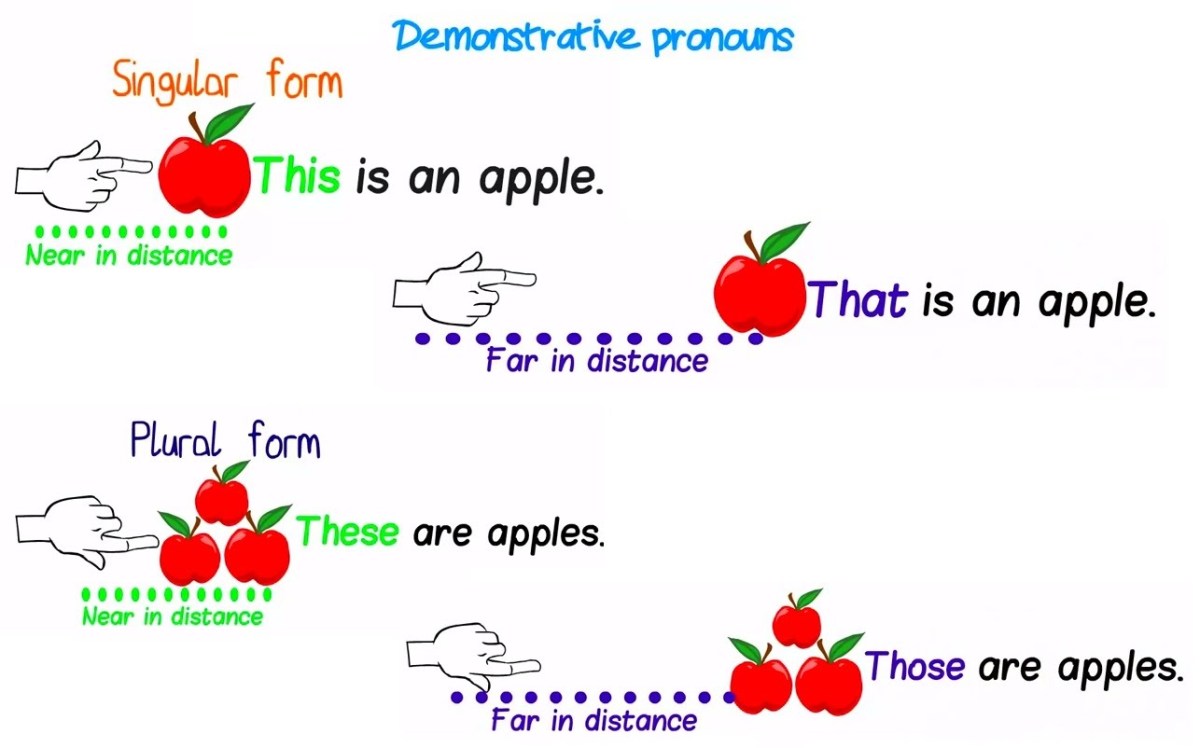
As mentioned before, if you are near to an object, thing, or person and you’re looking to use a demonstrative pronoun, you’ll want to use the words of ‘this’ or ‘these’ depending upon if its’ with a singular, uncountable noun or with plural, countable nouns. The demonstrative ‘this’ or ‘that’ would be used with singular and uncountable nouns while ‘these’ or ‘those’ would be used with plural and countable nouns.

Here are some examples of how ‘this’ and ‘these’ would be used in sentences to describe objects, things, or people that are close in distance to the subject:

  • This cup is for my tea.
  • Is this your jacket?
  • Where have you been traveling to these days?
  • These bananas are delicious.
  • This is my friend, Dan.

As you can see from these examples, these objects or things are close to the subject rather than far away in distance. You can also see how the demonstrative ‘this’ is used for singular nouns while the pronoun ‘these’ are being used with plural nouns.

If the opposite occurs and you or another subject in your sentence is far away in distance from another, person, place or thing, you’re going to want to use the demonstratives ‘that’ or ‘those.’

Here are some examples of how ‘that’ and ‘those’ would be used in sentences to describe objects, things, or people that are far in distance to the subject:

  • What are those men doing over there?
  • That book in my shelf was really enjoyable.
  • That printer has a paper jam that needs to be fixed.
  • Those boys are heading off to play in the park.
  • Those tires are flat. They need air.

It’s clear from those examples above that those objects or things are considered to be far away from the subject of the sentence. You can also see how the demonstrative ‘that’ is used for singular nouns while the pronoun ‘those’ are being used with plural nouns.

When it comes to placing a demonstrative like ‘that’, ‘this’, ‘these’, ‘those’ in a sentence, you should remember that those pronouns can be placed before the noun or adjective that modifies the noun even if there is more than one noun in the same sentence.

Examples:

  • Those hungry people need to eat soon.
  • These tired citizens are waiting long hours in the unemployment line.

Another way to use the demonstrative is that it can be placed before any number by itself when the noun is understood within the context of a larger paragraph.

Examples:

  • These four need to be fixed.
  • That one gave me some trouble.

Sometimes, a demonstrative pronoun or adverb can be used by itself in a sentence without a noun even being present after the demonstrative. The noun can be understood from the context of a previous sentence or larger paragraph making the demonstrative clear the only necessary subject to have.

Examples:

  • This was not very fair to me.
  • That is really cool.
  • Those were really interesting.
  • What was the issue with these?

As with many other grammatical concepts in English, there are some rules and circumstances that have to be remembered in order to develop both spoken and written fluency. In order to become comfortable with demonstratives, study the examples, create sentences of your own, and re-read this article to remember the rules of usage.

English Corner – More Fun with Modals

In the last ‘English Corner’ post, I focused on introducing the topic of modals by beginning with ‘modals of ability.’ As I mentioned previously, there are different types of modals in the English language. We have already covered the modals of ability and permission so now this article will concentrate on those modals that deal with making suggestions, having obligations, seeking advice, going through with a decision, and getting an invitation. The modal verbs of must, shall, should, will, would are going to be highlighted in this article in terms of when to use them in sentences and how those sentences are to be structured.

For making suggestions, the modal verb of ‘shall’ can be used to offer up something to someone or to give advice to them. You can also use this auxiliary verb in the future tense if you plan on doing some action decisively. The modal ‘shall’ can be used both in the positive for and also be posed as a question.

Examples:

1) Shall I pick you up from your house at 8 pm tonight?

2) I shall travel to Morocco and Brazil in 2018.

Once again, it should be noted that ‘shall’ like other modals is to be used as an auxiliary verb in the sentence and often goes before the main verb like ‘travel’ or ‘pick up.’

When it comes to giving out advice or seeking it from somebody else, the modal verb of ‘should’ will come in handy for English learners. You can use ‘should’ at both the beginning of a sentence if it’s in the question form and towards the middle of the sentence after the subject word if you’re using it in the positive form. Should can also be used negatively when you change the word to ‘shouldn’t’ to express that modal in its’ negative form.

Examples:

1.) You should go to the doctor since you have a high fever.

2.) Should we wait for the presentation to end before leaving here?

3.) They shouldn’t have been rude to the doctor yesterday.

When you have an obligation that you simply can’t get out of or a duty to fulfill that cannot be delayed, the modal verb of ‘must’ is key to put in your sentences. Similar to other modal verbs, it is auxiliary and comes before the main verb in the sentence structure. You can also use ‘must’ in the form of a question as well.

Examples:

1.) He must do his homework by tomorrow.

2.) Must I bear this burden alone?

When it comes to making a firm decision to be carried out in the future, choosing the modal word of ‘will’ is a good choice. It is a definite verb that can be used as a question, a positive and a negative. To create the negative form, you simply have to change ‘will’ to ‘won’t’ after conjugating ‘will’ and ‘not’ together to form ‘won’t. When you use ‘will’, you’re not just making a decision but you’re also making a promise to someone that you shouldn’t break.

Examples:

  1. I will play football with you guys this weekend.
  2. Won’t you join us for dinner tonight?
  3. She will be so tired from the party that she won’t be able to study later.

As shown above in the third example, you can use both the positive and negative form of the modal ‘will’ in the same sentence, and the same modal can be used more than once in the same sentence too.

For the last modal ‘would’, you are going to want to use this one when it comes to seeking permission, giving a request, or extending an invitation to somebody. There are a couple of different uses for this last main modal verb but it’s important to keep in mind that it can be used in all forms including positive, negative, and question. As with the other modals, it is an auxiliary verb that will always come before the main verb in the sentence.

Examples:

  1. Would you join me at the birthday party Friday night?
  2. I would like to go home now if that is fine with you.
  3. We wouldn’t climb Mount Everest because it is so dangerous.

The modal verbs of must, shall, should, will, would are focused on the future tense and are very strong in terms of making suggestions or going through with a decision. In total, you now have a basis of understanding the nine main modal verbs. There are others in the English language but these nine words ‘can, could, may, might, must, shall, should, will, would’ come up the most and are the most important to master.

English Corner – Introduction to Modals

There are many different kinds of modals to study but in this ‘English Corner’ blog post, we’re going to start out with an introduction dealing with the modals of ability. Modals of ability are the most common and the most important to master firstly. Modals are verbs usually and the ones that I am going to be focused on in this article are can, could, be able to, may, might.

Modal verbs act as auxiliary verbs in your average sentence and can express different ideas. These ideas include expressing one’s ability, one’s possibility, and sometimes necessity. Modal verbs often have more than one meaning and can be significant in a variety of ways. A simple form of a verb always follows a modal verb in a regular sentence as well.

Example:

  • Ben can do his homework.

The modal verb ‘can’ is followed by the simple form of the verb ‘to do’ followed by the object part, which refers to his homework.

An Introduction to Modals can be broken down into three separate parts: modals for ability, modals for possibility, and modals for permission. Each type of modals is unique in their own way but they each help to express oneself in some form or another.

For ‘Modals of Ability’, you can express your own ability or that of someone else by using the words ‘can, be able to, could’ in order to highlight your ability to do something.

Present Ability: I can speak three languages.

Negative Form: I cannot read this book.

Past Ability: Jack could play on the swings when he was a child but not anymore.

Negative Past Ability: Jane couldn’t go to the dance last night because she was sick.

In any regular sentence, the verb after the modal ‘can, could, be able to’ is always in the simple form and always follows the auxiliary (modal) verb. It’s important to note that the simple verb after the modal verb never changes either.

Examples:

-Ben can doing his homework. X

-Ben can to do his homework. X

-Ben can did his homework. X

All of these examples listed above give us the understanding we need to see that the simple form of the verb such as ‘to do’ never changes from its’ original intention. ‘Ben can do his homework’ is the only correct answer in this case.

In order to turn the ability modal into a question, it’s also quite easy to do. The form of the sentence should look like ‘modal verb + subject + main verb + object…? For any of the ability modals whether it’s can, could, etc., you can use them in the form of a question.

Examples:

  1. Can she play the flute?
  2. Could you go to the store to pick up some fruit?
  3. Are you able to do your homework tonight?

‘Able to’ is an exception in that as a modal of ability verb, the structure of the question form looks like: ‘to be’ + subject + able to + main verb + object…?’

For Modals of Possibility, it’s important to understand how to express ‘possibility’ in a sentence through showing what’s possible and what’s not possible for someone or something. The modals of possibility include ‘may, might, and could’ now and in the future. All of these three modals have the same meaning and can be used interchangeably regardless of the type of sentence.

Examples:

  • I might be late to the business meeting tomorrow.
  • You may want to re-take the exam next year.
  • You could get into college if you study harder.

Possibility cannot be expressed for the past but only for the present and the future when it comes to grammar.

For ‘Modals of Permission’, you can express ways to ask for or to give permission in a regular sentence. In order to create this modal sentence, we need to use the modals of ‘may, could, and can’, which are also apart of permission and ability modals. Permission modals are very polite and formal so it’s important to know how to write and verbally use them correctly in a sentence.

Examples:

  • May I go to the bathroom please?
  • Could I borrow your lawnmower today?
  • Can he have the last piece of chocolate cake?

For the main verb that comes after the subject and before the modal verb, it’s always going to be in its’ regular, simple form which never changes. When it comes to modals of permission, it’s important to remember that using ‘may’ especially at the beginning of the sentence is the most formal of the three options. Also, if someone were to answer you to grant that permission so you can go to the bathroom or to use your lawnmower, you can answer with:

-Yes, you may or No, you may not.

There’s also the possible positive or negative response to the modal question with ‘Yes, you can’ or ‘No, you can’t.’

While not the most popular grammar topic, there are many kinds of modals and knowing some of them especially those modals concerning permission, ability, and possibility is key to improving your English proficiency. This article is simply an introduction to modals and in the coming weeks and months; I hope to highlight other types of modals that are likely to come up in your grammar studies. “You can do it!”


English Corner – Prepositions of Place

In this ‘English Corner’ blog post, we are going to go deeper into the topic of prepositions, which we have covered previously but I want to highlight the specific ‘prepositions of place’ that are a large part of this expansive grammatical topic. The thing to keep in mind when reading this article is to focus mainly on the examples listed below to see how, when, and why these preposition words such as ‘at, on, and in’ are used. There are different reasons that are given when it comes to each of the ‘preposition of place’ words and how they end up being used in a sentence. Later on, I will highlight the ‘prepositions of time’ and how they are utilized when compared to the ‘prepositions of place.’

When it comes to ‘prepositions of place’, the main point of this type of prepositions is to show where something or someone is located, usually in a physical sense. The three major words that are ‘prepositions of place’ are ‘at, in, and on’, which also come up the most frequently in terms of usage. ‘At’ is used in a very specific manner in terms of being referred to for a specific location, place, or position.

Here are some examples where we can use ‘at’ as a ‘preposition of place’ in the right way:

  1. I was at Jonathan’s birthday party last night.
  2. We lived together at 8 Drury Lane for two years.
  3. They danced with each other for the first time at the Senior Prom.

When you use the prepositional word ‘on’, the meaning and usage for it is a little bit different than ‘at.’ For ‘on’, you’re going to use it to indicate the position of an object, thing, or person on a horizontal or vertical surface such as a desk, table, floor, etc.

Here are some examples of how we can the preposition ‘on’ in a sentence:

  1. The boy is playing on the playground.
  2. The basketball was bouncing on the court surface.
  3. I put my cowboy hat on the kitchen table.

Similarly to ‘at’, ‘on’ can also be used for positioning when it comes to streets, roads, and avenues.

Example: I used to live on Beacon Street.

The last major ‘preposition of place’ would have to be ‘in’ which is quite frequent in its’ usage. In terms of its’ meaning, the preposition ‘in’ is used for something or someone that is enclosed or surrounded.

Here are some examples of how we can use the preposition ‘in’ in a sentence:

  1. The check is in the mail.
  2. The letters are in the mailbox.
  3. She is in the high-speed train going home from work.

In addition to discussing enclosed or closed off places and spaces, the preposition ‘in’ can also refer to a position within a general area such as a town, city, country, region, country, continent, etc.

Example: I used to live in Istanbul, Turkey but now I live in London, England.

It’s important that the average English learner be made aware that there are many more prepositions of place besides the main ones, which are ‘at, in, on.’ There are many other prepositions of place words, and it would be an exhaustive list to go over the meaning and usage of each one. However, it would be better to highlight another couple of preposition of place words that come up frequently but not as often as ‘in, on, at.’ The other ‘preposition of place’ words would be after, among, behind, between, in front of, next to, beside, by, over, above, under, below, and beneath. Here are some examples of sentences that use these other preposition of place that were just mentioned above:

  1. The dog jumped over the wheelbarrow.
  2. He was hanging out by the pool on his off day from work.
  3. She checked under her bed to see if her pet gerbil was there.

There are dozens of examples that could be made with prepositions of place. However, it’s best to focus mainly on the particular prepositions of place such as ‘at, on, in’ and to understand clearly when, why, and how we use them correctly. While a sub-topic within ‘prepositions’, knowing what prepositions of place are and how to use them correctly in the grammatical sense will help you to become a better English learner and student.

———————

If you’re looking to improve your English through private lessons with me on a one-to-one basis please check out my ‘Learn English with Ben‘ page here: https://benjweinberg.com/learn-english-with-ben/

You can also check out my ‘English Grammar’ courses on Teachable.com here: https://benjweinberg.com/my-grammar-courses/

English Corner – Second and Third Conditionals

To follow up on the previous article about the ‘Zero and First Conditionals’, it’s important to continue on with the ‘conditionals’ unit to explain the second and third conditionals as well. In order to fully understand conditionals, we need to know every type of conditional, and when and why do we use them in sentences. If you’re struggling with the second and third conditionals, it’s important to learn how to form either conditional in terms of its’ structure, and then learn how to use the conditionals by following the examples that I will be creating for you.

Let’s begin with the 2nd conditional first. As always, the second conditional is going to start with the word ‘If’ as is the case with the zero and first conditional. However, the second conditional focuses mainly on the ‘past simple’ grammatical tense, and how to make the second conditional compatible with expressing what you would do in the past if something were to have happened to you. Usually, the second conditional is good for talking about things in the future that are probably not going to become true.

It’s also used secondly for occurrences going on in the present, which are considered to be impossible or unfeasible because they are not true. The second conditional usually expresses desires, wants, and needs that are more unrealistic and unlikely than those that would be expressed in the first conditional. Also, with the second conditional, you’re going to focus on the past simple tense rather than the present simple tense to go along with the ‘If’ + the subject of the sentence. In order to get a better idea of the 2nd conditional, let us take a look at a few examples of this conditional in action.

Examples:

‘Talking about the future’

  • He would travel to Japan if he had the money.
  • If they did their homework earlier, they would have went to the movies.
  • If I won the Powerball lottery, I would have bought my parents a nice house.

‘Talking about impossibilities in the present’

  • If I were you, I wouldn’t do that.
  • If you had studied harder for the exam, you would have done better.

The main thing to remember about the 2nd conditional is the unlikeliness of something to happen in the future or in the present. You’re also referring to an unlikely possibility in the past to discuss what is not realistic in happening in the future.

Last but not least, it’s important to know about the third conditional in terms of its’ formation, usage, and examples. It’s a very simple formula when it comes to creating the third conditional. While the second conditional focuses on ‘If’ + past simple, the third conditional focuses on a formula of ‘If’ + past perfect à would + have + past participle’ in order to create a complete sentence.

When we use the third conditional in a sentence, we talk mainly about the past as well as to discuss a situation that didn’t really happen. We can also imagine the hypothetical results of a situation that didn’t actually occur, but that we would like to think about the possibility of. It’s important to remember that the ‘past participle’ is often added to the second part of a third conditional sentence, and can be switched to the first part of the sentence as long as the ‘if’ remains part of the other half of the conditional sentence.

Examples:

  • If I hadn’t eaten so much candy on Halloween, I wouldn’t have gotten sick.
  • She would have become a doctor if she had been able to afford medical school.
  • If we had taken the subway, we would have arrived at the airport earlier.
  • If they had been telling the truth about the food fight, they wouldn’t have gotten in trouble with the school principal.
  • If he had showed up for the job interview on time, he would have been hired on the company.

When it comes to any conditional whether its’ the zero, first, second, or third, it’s important to take the time to really study this grammatical concept. You need to put in the time and the effort to study the formula, the usage, and practice with some example problems in order to memorize how to create the sentence. There are plenty of ways to practice the conditional sentences, and it’s important to study this concept consistently in order to master it.


English Corner – Zero and First Conditionals

These are the first two types of conditionals to be aware of when it comes to studying this particular grammar topic of conditionals. The ‘zero’ conditional is formed when it comes to discussing general truths and things that can happen under certain circumstances. It’s important to know how to form the ‘zero’ conditional, and how to create sentences using it.

The second type of conditional to study is the ‘first’ conditional and is used for discussing possibilities that can occur in the present or in the future. I will be writing about the first conditional and how its’ made along with its’ usage in English grammar. The ‘zero’ and ‘first’ conditionals are the most frequently used and it’s important to be aware of how to use them and when to use them in sentences.

When you form a ‘zero’ conditional sentence, there are two parts or clauses to it that make it a complete sentence. The first clause in the sentence is the ‘if’ clause and the second clause is the main clause that completes the sentence. The ‘if’ clause usually begins at the beginning of the sentence followed by the main clause. It’s important to note that you don’t need to begin the ‘if’ clause with if but rather use ‘when’ instead to start the sentence.

Here are some examples of how to form and put the zero conditional into action:

Example:

If you cool water to 0 degrees Celsius, it freezes.

When you use the ‘if’ clause first, you’re going to have to put a comma there before using the main clause which in this case is ‘it freezes.’

However, if you were to put the ‘if’ clause second in the sentence, you don’t need to use a comma at all to connect the sentence’s clauses together.

Example:

Water freezes if you cool water to 0 degrees Celsius.

When it comes to the grammatical basis for an ‘if clause’ sentence, you’re going to want to follow this formula of formation.

‘if clause’ – ‘if’ + subject + simple present verb = complete sentence

‘main clause’ – subject + simple present verb = complete sentence

Now that you know how to form the ‘zero’ conditional, it’s important to see some other examples in order to get a better sense of how this particular conditional is used.

Examples:

  • If you heat the snow, it melts.
  • If it rains a lot, the flowers get wet.
  • Forest fires don’t start if there is no drought.
  • If you cross time zones, the time changes.

When it comes to the first conditional, you have to make sure to follow a similar formula to the zero conditional but with keeping a few differences in mind. The first conditional or conditional type 1 is used for talking about current possibilities or those that are possible to happen in the near future. Similar to the zero conditional, the first conditional has a basic structure that should be memorized.

A first conditional sentence has two clauses which consist of the ‘if’ clause and the main clause. Instead of simply addressing the simple present tense as the zero conditional does, the first conditional can reference the future with the simple future tense in its’ sentences. The ‘if’ clause can either come first or second in the structure of a first conditional sentence; it’s really up to your personal preference as the learner. You can have the main clause go first instead or have it come second after the ‘if’ clause. The most important thing to remember is that the first conditional must address the future primarily and not the present as the zero conditional does.

Here below are a few examples of the first conditional in action:

Example:

  • If you do your homework, you will pass the class.

The ‘if’ clause goes first in this sentence followed by the main clause and the use of the future simple tense with ‘will.’

Example:

  • You will catch the train if you run fast.

In this first conditional sentence, the main clause goes before the ‘if’ clause, and there is also no comma used because of this change in the sentence structure. You should notice that ‘will’ and the simple future tense is still being used regardless of which clause is used first or second.

Example:

  • I will dance Salsa if I hear the music.

For this particular example, you should note that there are two different verbs being used for their respective clauses. ‘Dance’ comes with the main clause while ‘hear’ goes with the ‘if’ clause for the second part of the sentence. Since the sentence begins with the main clause, you don’t need the comma to make a complete sentence.

Now that you know how to form the ‘first’ conditional, it’s important to see some other examples in order to get a better sense of how this particular conditional is used.

Examples:

  • If you drop the glass, it will break.
  • If the airplane is full, I will leave.
  • We will not go to the movies if the tickets cost $12 each.
  • They will not leave Disneyland if they do not get a refund.

Conditionals are a popular English grammar topic and it’s important to know how and when to use them with your sentence. The zero and first conditionals are only the first two types of conditionals that can be used in English. For the next ‘English Corner’ blog post, I will be focusing on the other types of conditionals that are sure to come up in your English grammar studies. Study the examples above and you should start seeing some progress with this particular grammar topic!

English Corner – Past Perfect Tense

Now that we’ve gone over the present perfect tense with the last post, let’s go back into the past. I’m going to cover the how, when, and why’s of when we use the past perfect tense and how to do so with the correct form and usage. While not the most well know or often used grammatical tense, by improving your knowledge and understanding of the ‘past perfect tense’, you’ll be able to take your English proficiency to new heights. Remember this blog post in the future because it may help you for years to come.

The past perfect tense goes deeper than other past tenses in that you’re going to be referring to two separate yet interrelated events that occurred at some point in the past but at different times and places. The past perfect tense, like other past tenses, refers to an action, event, or thing that took place at a time earlier than now or in the present. The past perfect tense goes further in that it connects two events in the past and ties them together because they are somehow interrelated to some degree. This grammar tense refers to one past event happening before the other event and it’s usually clear which event happened first and which event happened second.

When it comes to the past perfect tense, the first event will be mentioned at the beginning of the sentence and then the second event will be mentioned towards the end of the same sentence and is noted as having happened after the first event.

Examples

  1. Alex had gone out to eat dinner when his phone rang suddenly.
  2. When they had arrived to the birthday party, the cake was already being eaten.
  3. She was already exhausted at 10 o’clock that night because she had studied for the Chemistry exam all day.
  4. You had finished the 5K race when I was just getting started.

Forming the past perfect tense for usage in sentences is quite simple. There is always going to be two parts to forming this particular grammar tense that you should be aware of. Firstly, you’re going to use the verb ‘to have’ in the past tense form, which would change into the word had. Right after the word ‘had’, you’re going to add the past participle of the main verb to be used in the heart of the sentence.

As listed in the examples above, the ‘had + past participle’ combination should come one right after the other to form the past perfect grammar tense. You can use verbs like started, studied, finished, danced, etc. to go along with the past tense form of ‘to have.’ There are only some slight changes to be made to the past perfect tense when it comes to the negative or question form of this grammatical tense. I’ll also use another example of the ‘positive’ form of the past perfect tense to compare the three versions together.

Example – Positive

  1. I had realized my mistake in the equation but it was too late to change.

Example – Negative

  1. John hadn’t thought that it was a big deal to skip the gym this week.

Example – Question

  1. Had they worked hard enough to earn the Nobel Peace Prize? (+)
  2. Hadn’t you sung before with the city choir before tonight’s performance? (-)

It’s quite common when it comes to the negative form of the ‘past perfect tense’ to contract ‘had not’ into ‘hadn’t’ to express it. It’s not obligatory to contract the negative form of the verb ‘to have’ but it’s quite common to use especially if the sentence is informal in nature. In the negative question form of the ‘past perfect tense’, you can also be free to contract the ‘to have’ verb if you feel that it is necessary although it is not mandatory to do.

The word ‘had’, positive or negative form, will always go at the beginning of the sentence if it is in the form of a question for the past perfect tense. While that’s a lot to keep in mind, if you follow the examples listed above for positive, negative, and question form, you’ll be able to catch on quickly in terms of the structure and usage of the past perfect tense.

The last thing to keep in mind is that similar to the ‘present perfect tense’, the past perfect tense also makes usage of the word ‘just’ to describe events that ‘just’ happened in the past recently and could be used to relate to another event in the same sentence.

Examples

  1. I just had put on some coffee when my friend arrived to the house.
  2. The airplane had just departed when I came to the airport gate.

The past perfect tense can be used under a specific circumstance and it can be quite valuable to master when describing multiple events that occurred recently. When it comes to a historical timeline to study or errands that your close friend ran during the day that he wants to tell you about, a working knowledge of the past perfect tense in English could help you in a number of ways. By understanding the structure, the forms, and the usage of this grammatical tense, you should be able to pick it up yourself to be used in polite conversation or for your next story.