

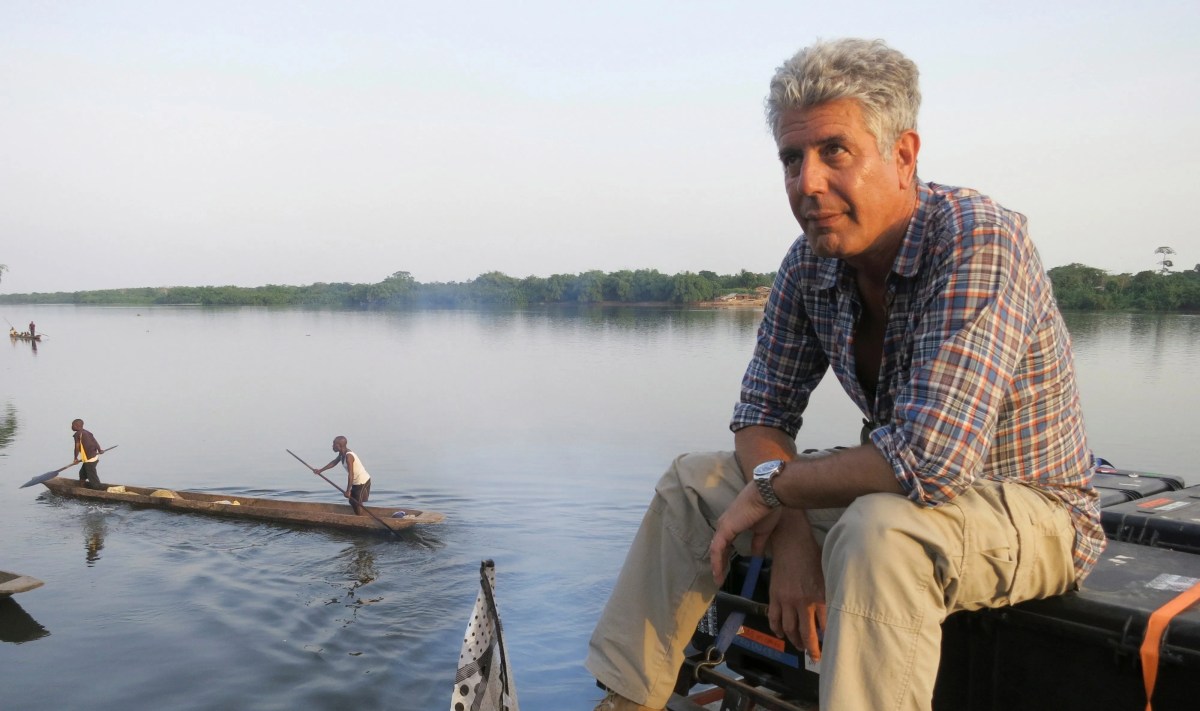
Anatomy of a Scene – Bourdain’s ‘Parts Unknown’ in Congo and NYC Contrast

“One of Anthony Bourdain’s ‘Parts Unknown’ episodes in the Congo has one of the show’s best scenes where it has a vivid description of Bourdain gazing over New York City from his high-rise apartment in the closing moments, set up against the backdrop of his first and only foray to the Democratic Republic of Congo.”

If you had to pick opposites in the world, you couldn’t do much worse to contrast the journey through the thick Congolese jungles and down the Congo River with the urban sprawl of New York City. One of Anthony Bourdain’s ‘Parts Unknown’ episodes in the Congo has one of the show’s best scenes where it has a vivid description of Bourdain gazing over New York City from his high-rise apartment in the closing moments, set up against the backdrop of his first and only foray to the Democratic Republic of Congo.

There are multiple themes to take away from the significance of Bourdain’s perilous journey in the Congo throughout the episode and with the contrasting solitude and isolation he likely had felt back in his NYC apartment after such a harrowing trip. There is a burden that he must have felt in witnessing such a contrast between the Congo and New York City that leaves the contrasting scenes up for our interpretation as fans of his ‘Parts Unknown’ show. How easy it can be to feel lonely amongst millions of people after traveling to such a distinct place, the burden of making it through a perilous journey and putting your life on the line, and how traveling to such extreme places can change your sense of place in a complicated and often troubling world.

Before his passing in 2018, Anthony Bourdain was the preeminent travel host for over 15 years and his last show, Parts Unknown, from 2013-2018 was the deepest dive in his own mission of uncovering people’s stories through food and culture. In terms of looking at human nature and the human condition, few shows, if any, were better than Parts Unknown. More than anything, many of the Parts Unknown episodes had Bourdain providing needed historical context regarding the complex and difficult history of the country or place he would be visiting. This was especially the case during the Congo episode where he spends part of the episode looking at the colonial exploitation, civil conflict, and poverty that has gripped the country both before and after it became the nation state known as the Democratic Republic of the Congo today.

Bourdain was a huge fan of the Joseph Conrad book, ‘Heart of Darkness’ and makes it known in the episode of how became obsessed with the Congo and the Congo River without trivializing the country or its people. His approach is sincere, and he looks to paint an accurate picture of what the Congo is like, why he sought to demystify and humanize the place, and how it was both similar and different to Conrad’s interpretation of it.

“When all is said and done, I wanted to go to the Congo, and I did.” Bourdain knew that this would be one of his most difficult journeys, but he also wanted to pay homage to Conrad’s novel by following a similar exploration to the authors with a boat trip down the Congo river. However, this kind of journey as shown in the episode was not simply a leisurely trip down the river without witnessing the history, culture, or food of the Congolese. Bourdain and his film crew interacted with different villagers, aid workers, and other locals to hear their stories despite how difficult the journey had been especially losing power on the boat and being surrounded by mosquitoes and other insects at one point.

It takes a toll on a person to look at the dark history of a place’s past as well as its uncertain present and not be affected by it. Bourdain has a visible weariness and introspection upon the conclusion of the journey given how hearing about the history of violence, dealing with the security issues involved, the lack of infrastructure to make the journey work, and to hear about the sheer resilience and fortitude of the Congolese people under extremely difficult circumstances.

The hardest part for Bourdain in my view maybe wasn’t the actual trip down the Congo river with all the bureaucracy, bribery, and lack of infrastructure involved to make it finally happen. I think the final scene of this Parts Unknown episode sums up the ‘lost’ feeling and the isolation to have witnessed all that and come back to a New York City that is abundant, thriving yet inequal, and with a completely different set of circumstances than one would encounter in the Congo. There’s ‘culture shock’ and then there is experiencing a bit of a totally different reality that few Americans and fewer New Yorkers would ever see for themselves. This contrast in realities and the stark scene transition from leaving the Congo River to being back at his high-rise apartment in Manhattan is perhaps the greatest scene ever shot for Parts Unknown or in any of his travel shows.

To break down this excellent scene and contrast further, Bourdain is in one of the world’s most crowded cities, but he is alone and isolated in his apartment like being isolated from most people’s lived experiences of the world, which pales in comparison to his own having had been to over 100 countries in his travels. He is filmed sitting behind his apartment windows, which acts as a barrier between Anthony and the rest of the world, seeing everything for himself but finding it difficult to connect with his immediate surroundings in NYC after witnessing such a contrasting reality in the Congo.

I think this final scene of the Congo episode really encapsulates Bourdain’s struggle as a travel host and writer to search for meaning and purpose in a world that often feels indifferent or alienates the struggles of other people who live in a different place or country. Bourdain’s gaze through the window symbolizes the distance between the world he witnessed and the world he felt disconnected from. It reflected the existential tension that marked his life: the constant search for meaning, tempered by the knowledge that some things, no matter how deeply we travel, remain elusive.

In his life, Antony Bourdain likely felt a sense of solitude and isolation having witnessed the worst of humanity at times, which could be hard to relate to other people or even travelers who had not been to the same places. He was brave, kind, and let other people to tell their stories without judgment but it must have been lonely especially after a return from the Congo and returning home where he may have felt the most alone rather than out on the road with others in his crew or amongst people he had met. There is a loneliness in the familiar as any traveler can attest and the novelty of new places, people, and experiences make the routine feel mundane and trite. Bourdain’s entire journey, in this case, from the Congo back to his home in New York, shows that it can be hard to come full circle after visiting one of the least known places in the world.

The final shot of Anthony Bourdain in his New York City apartment, looking out over the vast, bustling city, yet consumed by solitude, serves as a poignant culmination of his journey as a seasoned traveler. After traveling the world, exploring the darkest corners of humanity in places like the Congo, Bourdain returns home, not with answers, but with a profound sense of isolation. The Congo episode, with its harrowing depictions of suffering and resilience, reflects the complexity of human nature that Bourdain grappled with throughout his career. The contrast between the vibrant, chaotic cityscape of NYC and Bourdain’s contemplative stillness in his apartment alone emphasizes a universal paradox: despite all the human connections made in the world, the traveler often finds themselves confronted with a loneliness that cannot be filled as a result.

Bourdain’s Parts Unknown was not merely about exploring food and culture, but it was also an exploration of the man himself. His travels were a quest for greater understanding, but they also unearthed the difficult truth that knowing the world does not necessarily mean knowing oneself at the same time. In the end, Bourdain’s legacy lies in the raw, honest portrayal of this duality, the external world and the internal battles that shape who we are. His life story continues to remind us that, no matter where we go or how much we learn, we all face the same fundamental challenge in life: to find a true connection in a world that often seems vast, indifferent, and overwhelming.

Thoughts on ‘Roadrunner’

“If there’s any word in the English language that would sum up the life of Anthony Bourdain, a ‘Roadrunner’ would be quite fitting to remember the man by.”

If there’s any word in the English language that would sum up the life of Anthony Bourdain, a ‘Roadrunner’ would be quite fitting to remember the man by. He was also a husband, father, friend, chef, writer, television host, and a cultural ambassador who made the world his oyster after many years as a cook in hot, windowless, stressful New York City kitchens. For some people, travel is a birthright that they have from a young age but for Anthony Bourdain, it was an unexpected gift at middle age after writing the excellent ‘Kitchen Confidential’ book highlighting his years in the underbelly of those same kitchens, which became a New York Times bestseller, and helped lead him into fame, stardom, and notoriety.

Bourdain’s life would never be the same as he was offered other book deals, his first television contract for the show, ‘A Cook’s Tour’, and started to be recognized around the world from Tokyo to Los Angeles. While his life as a newly minted TV host traveling worldwide, tasting different cuisines, meeting different peoples, he opened the world to those of us who only knew what they had read, learned about in school, or heard from others. Those of us who watched his shows learned about the world through the medium of television, but it was Anthony’s narration, his willingness to listen and empathize with whom he shared a meal that made him stand out from others in the travel show business. Bourdain never sugarcoated things and didn’t mince words about what he saw in his travels especially as the focus became less on food and more on culture, politics, and the trajectory of humanity itself. All this time though, watching his shows and reading his books, we knew more about the man’s reflections on the world and then how the world reflected on him.

The shock of his loss still hurts those who were fans of his works over three years later, I included, among the millions of people who were touched by his words, his spirit, and his lust for life. It is hard even now to reconcile the fact that the man who appeared to have had it all still suffered and that there was no outreach, gesture, or love shown that could have prevented his tragic suicide. Feelings of anger, disbelief, regret, and sadness come to mind when you think of how anyone, especially Anthony Bourdain, could decide to let go of life itself especially when it had enveloped him in such a warm embrace especially after his 2nd life of fame, success, and travel had gone on for almost two decades.

What ‘Roadrunner’, the film documentary on Anthony Bourdain’s life tries to answer is not the ‘why?’ of his death but the ‘how?’ of his illustrious life and how it changed, evolved, shifted, swinged on its ups and downs, which the documentary is successful at achieving. Rather than the director, Morgan Neville, attempt to get all of the answers on an unknowable concept such as what makes a person decide to take their own life, which left his friends, family, and fans devastated and unable to make sense of it either, the ‘Roadrunner’ documentary looks at how his life was, which people changed Anthony for better or worse, how he changed as a person, and how did travel affect him over almost 18 years. As a fan of Anthony’s written and television work, you learn a lot about the world through him, but I never got a full sense of who the man was as a person and I’m sure others can relate to this feeling.

Although he gave his all in his craft and in his vision, he rarely liked to be the center of attention in any room and was a shy, slightly self-deprecating, yet also a kind and generous man that would give more to others than would receive himself in return, and who never seemed fully quite comfortable with the fame, success, and notoriety his works produced. Those who remember him in the documentary talk about how he would always reach out to them to see how they are doing and to be a real people-pleaser but not ask for much in return or would find it difficult to confide in others with problems that may have been affecting him, personal or otherwise. While the film does a great job of capturing what it was like for Bourdain as he went from a line cook to a chef to an author to a television host to a cultural icon, we don’t really get to see much about his personal life beyond bits and snippets of details.

The viewer knows Bourdain came from a stable childhood, summers spent in France, loving parents, and a younger brother who he got along with well. However, you can sense from the documentary that he never grasped what most people would want from a ‘normal life.’ Bourdain was a creative soul who was curious by nature, inquisitive, had a taste for linguistics, and had a big imagination given his literary and musical tastes. He was not a man as Mark Twain would rail against as “vegetating in one corner of the planet” for their whole lives. Once he had the opportunity to do so financially and professionally, he seized it and took full advantage of the gifts that he had been given from a young age.

What was missing from the documentary sadly is Bourdain’s own reflections beyond his travels and perhaps the family he built from scratch. We do not hear much about what his childhood was like, how he got introduced to drugs such as heroin, how did he succumb to his addiction to it, and what how his two marriages and past girlfriends affected his outlook on love and life. During the documentary, we are perhaps best informed about who Anthony was as a cook, as a traveler, as a friend, who he was as a father, but it is hard to know who we were behind closed doors when the cameras were not rolling.

There are some aspects of his personality that you can glean from the documentary such as his addictive habits whether it would be using heroin, drinking alcohol, smoking cigarettes, learning Brazilian Jiu Jitsu, or wanting to hold on to his relationships even perhaps their natural end date. For better or worse, as the film portrays, Bourdain loved experiencing novelty and new things which led him to his legendary status as a globetrotter, but it also could backfire in terms of giving too much of himself to people without getting as much in return. It seemed from ‘Roadrunner’ that Bourdain would seek to please others before pleasing himself and that could have led to some deeper dissatisfaction with life. It can be hard to feel as if you’re giving more than receiving and I do believe that does play a role in depression.

You can also infer from ‘Roadrunner’ that Anthony’s romantic views on life, on love and on travel did not always meet reality. He could be very demanding in his professional career and rude or dismissive of his long-time camera crew and production team. It’s shown that he could make rash decisions about hiring and firing of personnel as well as set very high expectations for his television show, which could not always be met by those who worked with him. It’s also true that in his last romantic relationship with Ms. Argento, he would let his personal desires to please her or work with a famous director like Mr. Feng that led to him putting his crew’s creative input on the back burner. When he expressed his desire to quit traveling a few years before his death, his production team encouraged him to do it if he felt it was time to do so and they wouldn’t stop him, but it was as if Bourdain needed someone to validate his decisions to go through with them.

‘Roadrunner’ succeeds in telling the story of one of our young century’s great explorers and cultural ambassadors. In 2021, there are still some gaps in our knowledge of who Anthony Bourdain was and how he felt about his life. Sadly, we will never know the full story because of his tragic death by suicide and we can only infer on how such a bright life could be extinguished too soon when he had so much more to give to the world, to his family, and to his friends. Unfortunately, not all men make it to a ripe old age to be surrounded by those who matter most to them.

Names like Hemingway, London, and now Bourdain died at middle-aged by in their lives accomplished or saw or did as much as five men combined who lived longer than them. It is not the years in your life that matter but the life in your years and Anthony Bourdain made the most of his life as few could or will do again. Even more than three years after his death, he is sorely missed, and the world is not as well off without him and his impact. From the Congo to Iran to Antarctica to Libya, he was not afraid or reticent of sharing a meal with those who were different than him even when he had nothing personally in common with them.

I hope that the ‘Roadrunner’ documentary becomes part of Anthony Bourdain’s legacy and inspires both young and old people to see the world as it is and to hopefully mold it little by little through travels and meals to change the world bit by bit into the world that we would like it to be. That would be a fine way to honor his legacy and to make the world a little less unknown.

___________________________________________

If you or someone you know is having suicidal thoughts, call the National Suicide Prevention Lifeline at 1-800-273-8255 or contact the Crisis Text Line by texting HOME to 741741.

Book Recommendations – Volume III

After a five-month break, I’m back with another edition of “Book Recommendations.” I’ve had some free time on my hands lately which has allowed me to read these really great books. I would like to share my latest selections with my visitors and hope that you will check these books out for yourself.

Note: I have also posted the links to these books so you can check them out on Amazon.com. You simply need to click on the books’ images below in order to be re-directed to the Amazon page of the book itself. Enjoy.

1.) And Then All Hell Broke Loose: Two Decades In The Middle East by Richard Engel, Chief Foreign Correspondent for NBC News

As someone who has studied the Middle East region extensively in college and has made a few trips to the region (Turkey, Israel, Jordan), I continue to enjoy learning about this tumultuous part of the world despite its rough past and present.

This book by Richard Engel is excellent because it comes from someone who understands the complexities and historical background of the region. He is also a great correspondent and storyteller who weaves his own history of working in the Middle East alongside the tumultuous events over the past two decades, which have fundamentally transformed the region.

Mr. Engel has been a foreign correspondent in the Middle East for over twenty years now. In this book, he clearly displays his vast knowledge of its’ history, culture, societies, and the troubles that continue to plague the region. Engel is fluent in Arabic, Italian, and Spanish. He has worked for NBC News and other major news organizations for over two decades. He re-tells his firsthand experiences and stories of starting out as a freelance journalist for the Agence France-Presse in the late 1990’s during the time of Mubarak’s Egypt. He goes on to discuss his experiences of working and living in Iraq during the collapse of Saddam’s regime and the subsequent U.S. occupation of Iraq.

In addition, Mr. Engel has also spent a lot of time covering the fall of Muammar Gaddafi in Libya and the recent civil war in Syria. Richard Engel has also endured some trauma during his career as he was captured and kidnapped by ISIS in late 2012. For the readers of his book, we get personal insight into the hellish situations he has been drawn into through his accounts of witnessing the deaths and injuries of many of his journalist colleagues over the past twenty years. This book is fundamentally a more personal story as he recounts how his 20 years of covering the Middle East had affected his marriage, his friendships, and his mental state.

What I like most about this book is that Mr. Engel gives you the historical background and the straight facts of what happened in the region and why it happened. You can tell that he was both physically and emotionally affected by the wars and insurgencies that he bravely covered for the U.S. media. More than anything else, it is a well-written account of what it means to be a journalist in a very difficult region of the world for journalists. Richard Engel doesn’t preach about what should have happened or what could have been different in terms of the politics but he simply relays his past experiences for those of us who want a more personal, firsthand account of what it is like to cover the Middle East.

2.) Kitchen Confidential: Adventures in the Cultural Underbelly by Anthony Bourdain

A world-renowned traveler, famous television show host, coolest American alive over 50 years of age. You can also add best selling-author to this list as if it wasn’t long enough. These are just a few of the titles that Mr. Bourdain has earned over the course of his life. However, most people forget that he was a very successful chef in New York City and elsewhere during the 1980’s and 1990’s. He is especially known for being the executive chef at the famed restaurant of ‘Les Halles’ in Manhattan, NY.

Due to his years in the kitchen, Kitchen Confidential is an in-depth, intriguing look into the actual process of how the food we eat in restaurants ends up on our plates. You may not feel very hungry after reading this book due to the expose on some food industry practices that could be considered unsatisfactory in terms of health regulations. I know now that I won’t ever order fish or any other seafood from a restaurant if it’s a Monday.

This book is an unfiltered look into life as a cook and Bourdain hilariously delves into stories from his past and the characters he encounters in the various kitchens he’s worked in. He discusses how he worked alongside drug dealers, degenerates, thieves, loose cannons, etc. in the kitchen but that didn’t detract from the excellent chefs that they made themselves out to be. If anything, Bourdain argues, their eccentricities and attention to details help make these people into great cooks.

Kitchen Confidential is also useful in that Bourdain gives tips and advice to his readers on how to cook and prepare food better. His advice ranges from what kind of knives are best to which simple gadgets make the most difference in having a decent kitchen to cook in. If you like his travel shows and his antics as a TV host, you will most certainly enjoy this book.

3.) Connectography: Mapping The Future of Global Civilization by Parag Khanna

The race to win the 21st century will not be a race between militaries, or of competing arms but of overall connectivity. Mr. Khanna argues that whichever country becomes the most connected to the global supply chains of trade, finance, technology, infrastructure, etc. will stand to benefit most in our current globalized world. A geopolitical strategist, consultant, and world traveler, Mr. Khanna displays his in-depth knowledge of international affairs and geopolitics from his past travels and from his extensive research.

From Ukraine to the UAE and from China to Nigeria, Mr. Khanna details how national borders are no match for the global supply chains that are increasingly emerging. Physical boundaries of geography are becoming less important than the priorities of developing high-speed rail lines, building intercontinental pipelines, expanding the World Wide Web, along with increasing energy outputs and resource trading among many different nations.

While some prominent figures in politics are advocating for resurgent nationalism and wall-building, Mr. Khanna understands that this perspective is detrimental in a world which is becoming more fundamentally connected. In the 21st century, countries and continents need each other now more than ever. With ten trillion dollars and growing being spent per year on infrastructure, transportation, energy, and communications, this trend is likely to continue unabated.

Among the notable ideas in this great book that Mr. Khanna highlights are the emerging North American Union with related maps in the book showing how the United States, Canada, and Mexico are becoming more interdependent. China is also connecting itself to many of its neighbors in Eurasia through gas, oil pipelines and freight rail networks.

In Connectography, Mr. Khanna gives us an in-depth perspective on the world’s growing interdependence and how its’ affecting our everyday lives. While there are numerous challenges to this worldwide trend, which are also highlighted in the book, Mr. Khanna strikes on a final note of optimism. Even with the difficulties and struggles of climate change, terrorism, civil wars, etc., only a more inclusive, connected global society can meet these challenges head on and succeed together.