Movie Recommendations – Volume IV

Movie Recommendations – December 2019

The Report (2019)

download

With an excellent cast, brilliant cinematography and direction, ‘The Report’ (2019) is one of the most underrated films of this year. Casting a wide net from the early days after 9/11 to the 2nd term of the Obama Administration, the film covers the work of Senate Intelligence Committee staffer Daniel Jones and his team’s tireless efforts to bring the scope of the CIA’s ‘enhanced interrogation techniques’ program into the public light. Focusing on not just the legality of the program but its effectiveness as well as its handlers, the film does a great job in bringing that story to a wider audience who may not have read the report or even heard about it. Part of the appeal of the film is that it creates a real sense of drama and real-world significance that often lacks in other Hollywood films about Washington. You really do sympathize with the characters and understand the weight that is on their shoulders handling a report of both national and international significance.

The fact that the report or at least a summary of it was made public is a great victory for transparency, the truth, and for holding those in power accountable for their actions. In terms of actual justice for those who may have perpetuated crimes and/or human rights violations, the film makes it clear that justice was not served but hopefully because those crimes were laid out to bare through this report, we will be finally able to learn that torture does not in fact work and that by refraining from these ‘enhanced interrogation techniques’ in the future, we do not become a monster in order to defeat a monster.

Ford v. Ferrari (2019)

download (1)

Ford v. Ferrari is an excellent film that is sure not to bore you when you see it on the big screen. It’s got that classic kind of Hollywood racing film and it does a good job of keeping you excited throughout the movie especially if you have never heard of the story before. It can be hard to make a racing film carry emotional weight, but the stakes are kept high throughout and there’s never a dull moment. Each major character has something on the line whether it’s their pride, their future success, their family, or their car brand’s ability to be the best in the world. A stellar cast of Matt Damon, Christian Bale, and Jon Bernthal deserve a stellar script and a stellar story and luckily, Ford v. Ferrari is ready to provide that and then some.

Even if you are not a fan of racing, you’ll enjoy the story behind this film especially when it comes to the time-old theme of proving yourself against the odds. An unlikely American auto company focused on station wagons and comfort is able to stand up to the challenge thrown down by the legendary Ferrari auto company who had dominated stock-car racing for decades. An unlikely hotheaded driver is able to overcome his doubts and his hotheaded instincts to become the key to a potential victory of Ford v. Ferrari. An American racing legend, Carroll Shelby (Matt Damon) is able to put his racing days behind him due to his heart condition to focus on the new mission of building an amazing Ford racing car that could put them over the top against Ferrari and establish his company’s success as a budding entrepreneur. This film shows you that you don’t just need talent and the will to win but you also need heart and a belief in your team to get the job done. An excellent film that I really recommend while it’s in theaters.

The Irishman (2019)

download (2)

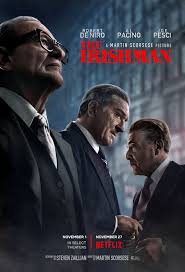
I know you may be asking yourself: Another mafia movie? Hasn’t this particular genre been exhausted already? The answer is both yes and no. It is a ‘yes’ because it’s the same old story of a rise and an eventual fall of mobsters who thought that they could get away with their crimes and most eventually ended up dead or in prison. It is a good film overall about hubris, vanity, pride, and how a man can justify his sins when both family and society is against you by saying that he was just ‘following orders.’ I say ‘No’ as well because any Scorsese mafia movie is going to be a classic in some way and this one in particular does an excellent job of highlighting the connections of the legendary and controversial Teamsters union leader Jimmy Hoffa to the Pennsylvania mafia. The unique story of Jimmy Hoffa has never really been explored that well in American cinema and I have to admire Al Pacino a lot for his performance of the emphatic and conniving union leader.

Not to be outdone, Joe Pesci who is a legend in film makes his first film in what seems like a decade and does an excellent job playing the mafia crime boss Russell Bufalino. Robert DeNiro plays the role of Frank Sheeran, a World War II, mafia accomplice, and Jimmy Hoffa bodyguard who is a tragic character in a way. Like any good Scorsese movie, the film asks the audience about how far a person can go to betray their ‘friends’ as they ‘follow orders’ and at what cost is it to do morally heinous acts and still act for forgiveness from family and from God.

The film’s almost 3 and a ½ hour runtime is my biggest gripe as it does drag at times and some scenes could have been cut out without detracting from the overall story. Still though, it’s a great Scorsese film that will add to the legendary acting careers of De Niro, Pacino, and Pesci. I would not be surprised if this film walks away with the ‘Best Picture’ Academy Award even if another film may end up deserving it more.

Knives Out (2019)

MV5BMGUwZjliMTAtNzAxZi00MWNiLWE2NzgtZGUxMGQxZjhhNDRiXkEyXkFqcGdeQXVyNjU1NzU3MzE@._V1_

A murder mystery film that you actually care about? Daniel Craig talking in a Southern drawl while figuring out the case in a tweed suit? An all-star cast that actually acts in this film like an all-star cast? What movie could this be? This movie is ‘Knives Out’, a film about a mystery that Agatha Christie would endorse regarding the suspect suicide of Harlan Thrombey (Christopher Plummer) who is a wealthy crime novelist found dead after a family party and foul play might have been involved. Each of the family members is a suspect and the top-notch private detective recently published in The New Yorker, Benoit Blanc believes one of the family members may be responsible for having murdered him. Besides the family itself, one non-family member is also a suspect, Harlan’s nurse, Ana Cabrera (played by the excellent Ana de Armas, an actress on the rise) who was with Harlan the last time he was seen alive.

If this is not an intriguing premise for a murder mystery, you may want to skip this one, but you shouldn’t because it is that good. This film is more than a modern murder mystery brought to the big screen, but it also intelligently discusses the issue of immigration in the United States and also lampoons extremist views on both sides during the film’s more lighthearted moments. The film also covers family relations through the generations, what someone is or isn’t entitled to, how social class can divide people rather than unite them, and how somebody can stand up for themselves when the crowd (or family in this case) is out to get them for their own benefit. Don’t sleep on ‘Knives Out’, which is a definite crowd pleaser and a satisfying ending that could result in future films. I, for one, hope Daniel Craig will be in more films where he can use a Southern drawl from Kentucky as it was surprisingly convincing and must have took a lot for him to emulate. Highly recommend this one which is in theaters now.

Anatomy of a Scene – The Box of Chocolates

Life is a Box of Chocolates – Forrest Gump (7/9) Movie CLIP (1994) HD

Few movie scenes sum up the random or arbitrary nature of life more than the scene of ‘Forrest Gump’ where Forrest’s mom talks about how life is “like a box of chocolates.” We never know what “we’re going to get.” Sally Field, a wonderful actress, explains in one sentence what some of us don’t understand in a lifetime: You have to do the best you can with what you have and then let life take its course. We do have control over our destiny to some degree but there are forces outside of our control.

Sometimes, we have to let life takes its course even with how painful that can be such as losing a loved one as depicted in this particular memorable scene of ‘Forrest Gump.’ “Death is just a part of life, something we’re all destined to do.” Forrest’s mom explains to him that we all have a destiny and it is what we make of it with the time we are given here on Earth. His mother further explains how being a mother was her destiny and that “she did the best she could.” Forrest is heartbroken but knows that her time has come to leave him. Forrest, given the way his own life has gone from college football player to Vietnam war veteran to shrimp boat captain is still trying to figure out his destiny at middle age.

The fact that Forrest is still unsure of his own destiny as a person even in middle age makes him extremely relatable to the audience watching in showing his own vulnerability for how life has changed him and what he still is unsure of to do with the time he has left. “What’s my destiny, momma?” She knows that even as mother, she can’t tell her son what his destiny is and that he has to “figure that out for himself.” The randomness of life summed up in choosing from a big box of chocolates is fitting in a way and is an expression that 25 years after this movie was released in theaters still has a way of connecting with people because we all know how true it is. While we do have some control over our lives, we must be ready and willing to face unknown challenges and changes that come our way.

Forrest is confronted by the death of the woman who brought him in to the world and is unsure of how to go on without her.  She tells him to be strong and that she will “miss him” like any good mother would. He has to continue on without her as hard as that may be. She had raised him to be strong, self-reliant, and to let his mental handicap hold him back from achieving his true potential. A woman who saw the value in her son when others marginalized and chastised him for something outside of his control.

As she tells him, you are what God made you and you have to do the best with what you are given. Forrest narrates how she got cancer and died on a Tuesday. He bought her a nice hat with flowers and gave her a proper burial to say goodbye to a woman who taught him so much. Without a father in his life, Forrest’s mom played both roles and did so under difficult conditions from that era. This is a powerful and moving scene in so many ways, but this movie scene has a particular message that we all can learn from.

Sally Field and Tom Hanks did an excellent job in this scene and in this movie. They have excellent chemistry and it shows in this particular scene where they say goodbye. You can feel the emotional depth of both actors to express what any mother or son would say to each other in such a sad moment in time. What most movies can’t accomplish in two hours, this particular scene accomplishes in two minutes. Losing a loved one is an immensely painful and traumatic experience. The emotional weight and gravity of this particular movie scene makes it one of the best of all-time.

“Life is a box of chocolates; you never know what you’re going to get.” Such a simple quote has resonated with audiences around the world for the past twenty-five years. An excellent film in its own right, ‘Forrest Gump’ is a tribute to the power of the human spirit in the face of tough challenges that the average person can go through during their life. Forrest preserved partly due to the love of his mother and despite not knowing what curveballs life would throw his way. He knew he had to make the best of his life with what he’s given. Because his destiny was not set in stone, he knew that he had the power to shape and mold it to make it what he wanted it to be even if life sometimes threw challenges and obstacles in his way.

Movie Recommendations – Volume II

  1. The Mule (2018)

MV5BMTc1OTc5NzA4OF5BMl5BanBnXkFtZTgwOTAzMzE2NjM@._V1_UX182_CR0,0,182,268_AL_

A normal man of the middle class is pushed to his limits and takes serious risks that could backfire on him. This is essentially the premise of legendary actor and director Clint Eastwood’s latest film in which he stars and directs as an octogenarian horticulturist turned drug mule named Earl Stone. Based on true events, this unreliable family man and an even worse husband, Earl has sacrificed his love of flowers for the love of his daughter and wife. More at home on the road with his drinking buddies and colleagues than with his own family members, Earl has spent over thirty years doing what he does best much to the chagrin of those who care about him including his soon to be wed granddaughter.

Earl is faced with the unsettling reality of the crippling economic recession beginning in 2008 and the subsequent rise of eCommerce outlets when his horticulture lifestyle and flower gardens go out of business. All Earl has left is his love of the road, his ability to never get a speeding ticket, and a lot of debt that he’s not sure how to get out of. Earl has the utter misfortune to run into people who are shady yet loaded with cash and Earl, being as desperate as he is to stay afloat economically goes ahead and trusts them anyway despite not knowing about the illicit cargo, he is transporting around the country for them.

You are left feeling bad for Earl because despite putting work first all those years and missing time with his loved ones, he partly did it to feed his family and give them a good life even if he was away most of the time. Eastwood who plays Earl in the film is not an innocent lamb and deserves punishment for what he did, but he is simply a manipulated fall guy and another casualty to the endless ‘war on drugs.’ Pursued by federal agents and cartel criminals, Earl ends up between a rock and a hard place and you have to wonder how we can live in a society where an old man such as himself has to resort to be a drug mule in order to get by financially and create a good life for himself and those close to him.

Overall, this is a good movie that I would recommend for its questions about morality, family, and the consequences economic hard times can have and are still a reality for so many people who choose to take illegal means or are forced to do so in order to survive or get by. It’s clear from the movie that crime doesn’t pay but we are left to reckon with the absurdity of an eighty plus year old man needing to work for the cartels in order to thrive economically.

  1. Once Upon a Time in Hollywood (2019)

once-upon-a-time

It may not be Tarantino’s best but it’s certainly not his worst. With a stellar cast of characters including Leonardo DiCaprio, Brad Pitt, Margot Robbie, Al Pacino, etc., This film does a great job of invoking the nostalgia and uniqueness of Hollywood in its heyday during the late 1960’s. Set in a time when hitchhiking was normal to partake in, hippies were hanging out in ranches, and the Manson family was beginning its reign of terror, Tarantino has an uncanny ability to bring those cultural tenets together to produce a satisfying film.

Between the cars, the outfits, the egos of the actors, you get a real sense of what it must have been like to be in Hollywood during that golden era. Even still, Tarantino as in his other films, likes to put his own spin on history and without revealing too much, the last thirty minutes of this film are among the most satisfying that he has put to the big screen.

It would not be a Tarantino movie without some craziness and shocking moments occurring. One of the best parts of ‘Once Upon a Time in Hollywood’ is the chemistry between Brad Pitt’s character, Cliff Booth, a stuntman who does all the dirty work with a smile on his face and Leo DiCaprio’s character, Rick Dalton, an actor who is struggling with the notion that his career may be on the downslope.

While the film gets off to a slow start and certain scenes are drawn out way too long, the writing is well-done, the characters are interesting to see develop, and the payoff of the ending is way too satisfying to not recommend this film. Especially if you are a fan of Hollywood history and the era of the 1960’s, you’ll definitely enjoy this one.

  1. Blinded by The Light (2019)

blinded_by_the_light_onesheet

Brrrrrruuuuucccceeeeee! Springsteen fans are going to love this film. I know I did and it’s for a couple of reasons. The actors are really likable in this one and the story they’re telling is one as old as time but in a setting and an era that I found pretty compelling. There are some similarities between the coming of age of someone like a Bruce Springsteen and the film’s main character, Javed Khan (played by Viveik Kalra). Even though they are from different countries, different races, and different religious beliefs, there is a universal truth that underlies what Javed and Bruce went through as younger men. Dealing with overprotective or absent fathers, searching for one’s own identity, trying to find true love, and figuring out how to make their dreams come true These are the powerful themes of the film that are timelines across cultures and across borders.

Also timeless is the fight against hatred, bigotry, and intolerance among those who don’t accept others who are different living in their communities. The film is not just about Springsteen’s music and how it relates to a young man’s search for his place in the world but also about a family’s immigrant dream to create a better life for themselves in a community that can be rather cruel and mean at times. Not only is Javed trying to make his dreams come true but his family are also trying to fit in to a town, Luton, where they are minorities, and are discriminated against.

I particularly like how ‘Blinded by The Light’, while it followed the formulaic story of similar films, it has its own identity and its own unique setting and characters that make it a rewarding watch. There are some lessons to be taken from this film beyond just enjoying the music of the Boss. It’s about balancing family responsibilities and your own independence and desires, and also about what your priorities are in life.

Music isn’t everything but it’s the sweet, fulfilling topping that will get you through hard times when things look bleak. That is part of the appeal of Bruce Springsteen’s music and it’s why his music is so powerful and resonant from Asbury Park to Luton and from New York City to London. If you get the chance, see this film even if you don’t like Springsteen. It is more than just a musical and at its core, it’s about the triumph of love over hate and of dreams over despair.

Anatomy of a Scene – The Letter

“For what it’s worth, it’s never too late, or in my case too early, to be whoever you want to be. There’s no time limit, start whenever you want. You can change or stay the same. There are no rules to this thing. You can make the best or worst of it, and I hope you make the best of it. I hope you see things that startle you. I hope you feel things you never felt before. I hope you meet people with a different point of view. I hope you live a life you are proud of. If you find that you’re not, I hope you have the strength to start all over again.”

-The Curious Case of Benjamin Button

Sometimes, you can watch an entire movie and not feel moved by it. Whether it’s a stirring of your emotions or being introspective about your feelings, few movies will touch the viewer personally. Luckily, The Curious Case of Benjamin Button is an exception to the rule, especially when it comes to the scene where the main character, Benjamin Button, writes a letter to his daughter, whom he barely knew in life.
With her mother on her death bed, the daughter finally opens and retrieves many letters from a father whom she barely knew and is startled to have a keepsake from someone who was rarely in her life.

Benjamin Button has a unique condition where instead of getting older like he the rest of us as he goes through life, the opposite happens to him and he gets younger and younger allowing him to experience life backwards. Still, despite this inconvenience he can live a full life and that is what this movie scene so special because he encourages his daughter to do the same. While he is not around to see her have her own adventures, he wants the best for her and wants to her to “live a life that she’s proud of.”

When we first are introduced to this scene, we see that Benjamin’s daughter realizes that he went to India and many other places years ago based on the kind of parchment that his letters are written on. There are many letters addressed to her from the time she was two years old and onward when he was not around to be with her. Despite the sadness and disappointed associated with that, she is relieved that he was writing to her and thought of her even when he was far away. For him to think of her while writing ‘the letter’ in such faraway places show that despite his curious condition, he loved her dearly and wanted to express that even after he passed away.

This movie scene is brilliant because it shows Benjamin travelling around India while narrating to his daughter that he wants her to ‘be whoever you want to be’ whether that’s a traveler or a janitor or a toll booth manager. You can make the ‘best or the worst of it’ as he states to her depending on your perspective on life, but he wants her to make the ‘best of it’ as he did. A father imparting this important message on to his daughter that it’s okay to ‘start over’ again in life is important for her to hear but also for the audience to understand.

If you find that you are not ‘living a life that you’re proud of’, then there is nothing wrong with changing it in order to finally be proud of. While he did a lot of travelling, there is still the humdrum of daily life involved such as cleaning your clothes, talking with the locals, and even drinking from a water hose. “There are no rules to this thing.” Sometimes, we tend to think of life as a narrow path when really there are going to be numerous zigs or zags, and when you become an adult, you have to make the rules for how you want to live, what is important to you, and what to care about.

“I hope you see things that startle you, I hope you feel things that you’ve never felt before…” This part of the scene is brilliant in showing the beauty of Benjamin’s travels and how he would sleep, brush his teeth, and move around by motorbike through beautiful mountain passes and rivers. Benjamin wanted his daughter to experience the world and for her to enjoy what it had to offer in her own life. Part of doing just that is adapting to the places you visit and to seek out the adventures yourself in order to make the most of it.

“I hope you meet people with a different point of view…” Benjamin encourages his daughter also to get to know other people, whether from another city or another country, and how it’s necessary to be open to them and to be kind. The locals help Benjamin fix his motorbike as he drives through their village on one of his journeys.
“I hope you have the strength to start all over again.” Benjamin’s last words to his daughter ask of her to be strong in not being afraid to change your life or decide that you want to live it a different way than before. The mother imparts at the end of the scene that “he had been gone a long time…”

Unfortunately, this scene shows both the beauty and tragedy of life in that sometimes, we can’t be there for the people we love but are with them in spirit. Benjamin could not be with his daughter in life but he wished that he had been there to wish her a happy birthday, to kiss her goodnight, to take her to her first day of school, to teach her to play piano, to chase away boys, and to be her Father. “Nothing he ever did would replace that.” Even after all the adventures that Benjamin had, the most important role he ever had was being her father and he wanted to make sure she knew that by leaving her with his diary.

Even in his absence, this scene shows us the power of a father’s love for his daughter and how he wanted the best for her and to live a life that would yield happiness and fulfillment for her. In one minute, this scene in ‘The Curious Case of Benjamin Button’ has more of an emotional impact than many movies do in more than two hours. Breaking down this narrative and the beautiful cinematography and filmmaking of travelling at its most challenging yet most rewarding was quite an achievement by the film’s director and crew. Not only would this movie scene have an impact on Benjamin’s daughter by also on the rest of us watching in the movie theater or at home. If you have a chance, watch this scene to appreciate the scenery, the message, and the power of love between a father and a daughter. A powerful movie scene worth a watch and a couple of re-watches as well.

‘The Grey’ – Film Review and Analysis

The actor Liam Neeson has become one of the main action figures in Hollywood, starring in such popular films as ‘Taken’, ‘Batman Begins’, and ‘Gangs of New York.’ However, while these roles were a bit one-dimensional or short lived in terms of his supporting role, you get to see the full scope of his talents in a powerful and dramatic role in the 2012 film, ‘The Grey.’ In this fictional drama, we get to see a man pushed to his mental and physical limits and how he is able to come to grips with such weighty topics such as his own mortality and his religious beliefs.

Not only is ‘The Grey’ a great film when it comes to its views on mortality, religion, and the depths of human nature when pushed to its limits. The cinematography, direction, pacing and setting in the film help make it stand out. There’s something in this film for everybody who is a fan of serious cinema especially when it comes to character backstory, action scenes, and touching moments of vulnerability and camaraderie. ‘The Grey’ doesn’t sugarcoat anything as well and does not shy away from addressing real life struggles such as depression, a search for meaning, and the futility of having bad luck run roughshod over one’s life.

Man can only control so much in his life and that includes what happens to those who he loves, how he adapts and survives when it exposed to the worst elements of nature and of the animal kingdom. Sometimes, the only choice that you have is to fight, persevere, and struggle to the last breath even when things look bleak. Neeson and the other men in the film have to grapple with a lot of bad events that make it a hopeless situation to get out of. There is no choice though and all of them have to do their best to make it out alive especially to the ones they love.

John Ottway, the main character in the film played by Liam Neeson, is a guy you want with you in the oil fields of Alaska. We know little about his backstory in the film, but it is revealed that he struggles with depression, meaning, and his faith in a higher power. He dreams of a woman who is his wife and the audience are not sure if he is still with her or if they divorced or each other or if something fatal has befallen her.

We assume that he is in Alaska working as a marksman protecting oil workers from the wolves and that he is doing this job for lack of better options and to preserve some remaining meaning in his life. Part of the brilliance of this film is that it doesn’t reveal everything too quickly about why Ottway is in Alaska or what happened to his wife. ‘The Grey’ does not ignore the great sense of suspense that can be built up over the course of the film to make a true compelling drama that captures and holds your attention until the end.

Ottway and the other men are facing grey wolves who see them as a threat and it’s not possible for the men to communicate to these wolves that they are friends and not foes. The animal kingdom suffers no man especially when he is in their territory. They can’t communicate with each other so it’s a battle for survival between man and wolf. While the grey wolves in real life are harmless and do not hunt humans, ‘The Grey’ takes some creative liberties with this fact in order to have a compelling film. Despite the criticism from animal rights groups, if you enter the area of a wolf’s pack den, you are likely asking for trouble regardless if you didn’t mean to do so, man or animal alike.

After a freak plane crash, Ottway and the other oilmen must fend for survival in harsh conditions while they are stalked by wolves including its alpha leader who see the men as threats to be reckoned with. Ottway has killed wolves before to protect the oilmen when they’re working in the fields and he knows what they are like. Against ever increasing odds of survival, he proves to be a great example of how to lead men in times of crisis and peril. His leadership, throughout the film, proves pivotal in giving the men a shot to get out of the Alaskan wilderness and back to their families. Even though it seems at the beginning of the film that Ottway has lost his will to live due to the situation with his wife, the freak plane crash and his survival from it propels him to try and save the men and outwit the wolves if possible.

Still though, ‘The Grey’ is a serious and realistic film about how far faith will carry you out of a real crisis. There is an underlying atheistic outlook of the movie that may rub some people the wrong way, but I found it to be needed. In life, when you face a tragedy, a crisis, or a perilous event, faith can only do so much, and you have to claw and fight your way out of it. I think ‘The Grey’ does a great job of showing how important it is to confront your fears, show true leadership, and fight as hard as possible against the odds to make it out alive of a bad and deteriorating situation.

Ottway’s character and his fight against the Alaskan wilderness and the wild wolves is a great metaphor of how each of us is fighting against our own personal demons and against events that are beyond our control in life. We each have a struggle to face and we have to do it on our own. If we have a wife or a crew by our side, that’s a great thing to have but that’s not always the case as it is in ‘The Grey.’ When you’re put into a bad situation and all hope is lost, you have to truly fight for survival and live like it’s your last day because it might just be it.

There’s an excellent quote from ‘The Grey’ that has a lot of resonance for how true it is regarding life’s fragility and how you have to live like it’s your last day and to do the best you can to survive against the odds. “Once more into the fray…into the last good fight I’ll ever know. Live and die on this day…live and die on this day.” This quote that Liam Neeson’s character recites throughout the film is not only a metaphor for his fight against the wolves and nature but his fight against depression and to make it through the day when all hope seems lost.

‘The Grey’ is a true survival film and it is excellently directed with a great starring performance by Liam Neeson. I believe it is an extremely underrated film and does a good job of bringing up various themes surrounding hope, faith, loss, and about life’s injustices. If you can check it out, I highly recommend giving ‘The Grey’ a view. It will be well worth your time.

Movie Recommendations – Volume I

‘Good Kill’ (2014)

220px-Good_Kill_poster

Good Kill is an excellent drama/thriller film that highlights the ethics and the cost involving drone warfare and how it can affect the servicemen and women who have to pull the trigger and live with the consequences. Starring Ethan Hawke, this film is a deep and probing look at how warfare conducted from thousands of miles away can still leave a lasting imprint on those who have a role in it even when they are not anywhere near the battlefield.

The film highlights correctly how while drone strikes may carry less collateral damage to civilian lives, there will always be the chance for the loss of innocent life and families being destroyed. Whether that’s an errant missile crashing into a wedding party or a group of children running by a targeted building within seconds of a missile being launched and getting caught in the crossfire, death from the skies will not only affect terrorists, but women and children too. Because drone strikes are less costly to governments and militaries, the rules of engagement can sometimes be abused to focus too often on low-level targets, who pose some actionable threat, but who could also be captured for intelligence purposes. A lack of international norms and standards regarding drone warfare leads to serious consequences in terms of possible abuse by governments who overuse it on secondary targets.

Airmen and women such as Ethan Hawke’s character and his colleagues, who conduct drone strikes, are shown to suffer from symptoms of post-traumatic stress disorder because they get to know their targets, see how they live, and struggle with having the power of death over them. High-resolution surveillance makes the act of killing personal despite the fact that these servicemen are thousands of miles away. When a drone strike goes wrong and innocent civilians are killed, it leaves a long-lasting psychological effect on the military personnel involved.

They may not see their victims when they are flying an F-16, but they are aware of what collateral damage is when they see the dead bodies of women, children being shown on the high definition screen. Military service members do not last long as drone pilots due to the immense mental strain placed on them especially when they did not sign-up for conducting warfare with a joystick. Alcoholism, depression, and family problems have occurred due to pilots being asked to conduct drone strikes in the name of national security. All of these issues are highlighted in Good Kill making it more than just your average film about war, but also about an excellent look on how the human condition is affected from holding life or death decisions over those who never see it coming.

‘Roma’ (2018)

220px-Roma_theatrical_poster

Roma is more than just your average film about a family. It is excellent in its scope and ambition in covering a tumultuous period in Mexican history and for highlighting the issues of family, race, and class within the larger society. What I enjoyed most about this film was that it felt personal and it is based off of the childhood of the director Alfonso Cuaron. The way the story unfolds feels as if it has been lived out before.

Cuaron’s work and that of his film crew that was done with the cinematography, film editing, and screenplay is extremely impressive and goes to show the audience just how film is another form of human artwork that can display beauty, meaning, and pure emotion.

Amidst the story of this family are real-life events in Mexican history that overlap with the film without overwhelming the intimacy of the story being told. For example, The Corpus Christi Massacre or “El Halconazo” in 1971 are intertwined with Cleo’s search for a crib for his newborn baby to be.

Nobody in this film is perfect and true human error of both behavior and character are laid bare. Amongst the flawed characters in this film are redemptive qualities about them and how they fight and struggle to overcome betrayal, disappointments, and tragedy. The film is gripping in that it is about real life and there is no sugarcoating. In Roma, no one is immune from setbacks and struggles, and that is what makes the audience invests in the story being told even more.

Compared to many other films that I have seen, few have touched me more on an emotional level than Roma. The realistic dialogue, the set pieces, the chain of events, and the character development all lend to its longevity as one of the best films of the decade. If you have a Netflix subscription, do yourself a favor and watch Roma. You won’t regret the chance to view this pure work of art and I would not be surprised if it sweeps the awards at the Oscars. It is that good of a film and a noteworthy achievement by director Alfonso Cuaron.

‘A Private War’ (2018)

Unknown

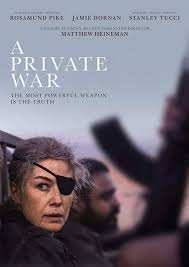
This is a biographical film without feeling overwhelming or too much tied up in the protagonist. This film does a good job in covering the life of the deceased war correspondent, Marie Colvin, who reported from multiple war zones over two decades including Sri Lanka, Iraq, Libya, Syria. Marie was a fearless and bold reporter who did the under-appreciated work of reporting the facts on the ground when it came to what was going on in these war zones.

The film portrays her as someone who battled the terrible things that she witnessed and the horrors that she could not avoid. She struggled with her dependency on alcohol, cigarettes, was divorced twice and also had her bouts with post-traumatic stress disorder (PTSD) as many war correspondents deal with when they return home from a war zone. Rosamund Pike, the lead actress in A Private War does an incredible job in accurately portraying who Marie Colvin was in how she mimics both her mannerisms and her speaking style throughout the film’s entirety.

Despite losing an eye, suffering from PTSD, and struggling with maintaining her friendships and relationships away from the battlefield, Mrs. Colvin dedicated her life to reporting the truth and the facts from war zones around the world so that everyone would else would know the costs of war.

While she was afraid and while she was fearful, she had the courage to press on and do her duty in informing the public on what was going on. While she was killed during the siege of Homs, Syria, her memory lives on with this film and the work that she did for two decades in holding the powerful accountable for the wars that they started. In an era where journalists are being denigrated and dismissed with increasing impunity, it’s refreshing to see a film that pays tribute to a war correspondent who gave her life to the cause of reporting the facts so that people would be more informed on what was going on and to also care about why it was happening.  

‘Munich’ – Film Review and Analysis

Can revenge be worth it and what are the consequences involved in carrying out acts of vengeance? ‘Munich’ (2005), a film directed by Steven Spielberg poses a number of moral quandaries regarding how can there possibly be lasting peace after so much violence and bloodshed has been spilt by both Israelis and Palestinians in a decades-long conflict. In addition to the historical narratives of both groups never seem to align, there is a violent undertone to how both groups see their struggle and what they are willing to do to ensure the success of their cause.

‘Munich’ is a film that is loosely based on the novel, ‘Vengeance’ by George Jonas, and takes a number of liberties regarding the historical events of the Black September terrorist attack on the Israeli national team during the 1972 Summer Olympics in Munich, Germany. While Spielberg’s adaptation may not be the most historically accurate, it brings the events of that tumultuous time of the Israeli-Palestinian conflict to life by attaching the names of the deceased to the tragic events that occurred.

While not commercially successful at the box office, ‘Munich’ was critically acclaimed and was nominated for five Academy Awards including ‘Best Picture’, ‘Best Adapted Screenplay’, and ‘Best Score.’ While it didn’t win any of those awards, it was given a lot of praise for its writing, direction, and cast of characters including Eric Bana, Daniel Craig, and Ciaran Hinds. In addition, the film is not just about the 1972 Olympics attack, but it dives into what the Israeli government’s response was to this act of terrorism and how the response is similar to the ‘eye for an eye’ ethos that reflects how governments react to violent acts of terrorism with an approach to seek vengeance primarily.

The main character of the film is not actually based on a specific person, but he is used as an amalgam of the Mossad agents of the Israeli intelligence service who were responsible for getting revenge on the Black September group of Palestinian terrorists. Avner Kaufman, played by Eric Bana, who after witnessing the tragic act of terror take place on national television alongside his wife, is subsequently thrust into service by Mossad, Israel’s national intelligence service, to run a counterterrorism operation and to lead a team of operatives whose main objective is to bring those men who plotted and orchestrated the attacks on the Olympians in Munich to justice, dead or alive.

This isn’t your average intelligence mission because it involves the probable use of deadly force to achieve the aims of the mission. Avner has to technically ‘resign’ from Mossad first and to disavow that he has any connection to the Israeli government in order to carry out this secret mission. Avner’s handler, Ephraim, also informs him that this team is an eclectic mix of Jewish volunteers from around the world who are not really assassins so much as bomb makers, drivers, and document forgers.

Luckily, this unique team of newly recruited Mossad agents has good chemistry and they work well together in tracking down the plotters of the Munich attack. They are able to carry out the first couple of assassinations against the terrorists with precision and without any ‘collateral damage’, meaning that no innocent civilians were not caught up in the crossfire. However, there are a few close calls where they almost end up killing the daughter of Mahmoud Hamshari in Paris which are they able to call off the bomb detonation calling off the attack at just the last moment. Also, the men who are being killed, while they are the masterminds of an older age, there’s a lingering sense in the film that the young militants who carry out these attacks are ready to take up arms given how righteous they feel the mission is of creating a free Palestine even if it means killing Israelis and Jews around the world.

In one scene, Avner, pretending to be a member of the German Red Army Faction (RAF), has a frank conversation with Ali, a member of the Palestinian Liberation Organization (PLO), about how ‘home is everything’ to the Palestinian peoples and how much they want the land back that they believe was taken from them in the creation of the state of Israel in 1948. Believing that the Arab states would have the back of the Palestinian people, Ali believes that “Israel will cease to exist”, which did not change even with the Yom Kippur War of 1973 and the invasion of Egypt and Syria against Israel. In this critical conversation of the film, Ali believes that it will take a few more generations but a free Palestine is inevitable given how poor the conditions are in the refugee camps and how the Palestinians will win due to demographics and the deep belief in their want for a ‘home’ and a state of their own separate from other Arab identities. “We want to be nations” is a belief that hasn’t changed in the past forty years and is an intractable fact behind how the Israeli-Palestinian conflict continues to this day.

With this chance encounter of Mossad agents and PLO, there seems to be a worry among the Israeli team how they are targets as well and there is a team looking to kill them as well in response for their attacks against the Black September group. While the group is successful in tracking down seven of the eleven men who plotted the 1972 Munich Olympics attack, there is growing frustration as to whether meeting their objectives will have any long-term importance since these terrorist group leaders are just replaced by new people, and the cause of Black September and the Palestinian Liberation Organization continues to recruit new and young members to join the fight against the Israeli government. Avner, the main character, also sees most of his team members die in retaliation attacks along with interference from the CIA with regards to protecting their own Palestinian asset, Ali Hassan Salameh. As Avner’s team loses members and aren’t able to kill Salameh, the violent actions that Avner undertook as well as his inability to protect his men from harm weigh heavily on his conscience.

“Why cut my fingernails? They’ll grow back…” Ephraim, Avner’s handler, makes clear that terrorists replace one another with ease and they must keep the cycle of violence going as long as it takes until ‘peace’ is achieved. Avner is disgusted with this argument and by the end of the film, is a morally conflicted Jew and Israeli, who realizes that this is not the way to have peace through an endless cycle of revenge and vengeance. Rather than continuing on as a Mossad agent in a mission that he no longer believes will change anything, Avner decides to quit. As one of his team members tells Avner during the last mission they take on together, “We are supposed to be righteous. That’s a beautiful thing. And we’re losing that. If I lose that, that’s everything. That’s my soul.” Avner and the other team members understand implicitly that the violent actions they take have consequences and that while their version of history is different from the Palestinians, they are both using violence and bloodshed to further their own people’s cause, but to what end?

The main theme of ‘Munich’ that Spielberg gets across to the audience quite well is that while the historical narratives may never overlap with each other, there has to be a recognition of the other side’s existence and to see a way to compromise without continuing the endless cycle of violence and revenge. What it comes down to fundamentally is recognizing the dignity, the hope, and desire for a better future of your fellow man and woman while putting aside the religious, cultural, and political differences to make peace now so that in the future young Israelis and Palestinians will not have to fight and die to preserve their nation’s existence.

‘No Country for Old Men’ – Film Review and Analysis

Cormac McCarthy, a distinguished American author of such noteworthy novels of ‘The Road’ and ‘Blood Meridian’, is not as well known for ‘No Country for Old Men’, but it is an excellent and renowned novel in its own right. Out of the movies that have been based off of his work, ‘No Country for Old Men’, released in 2007, is considered to be the best book to film adaptation done so far when it comes to the written works of Mr. McCarthy.

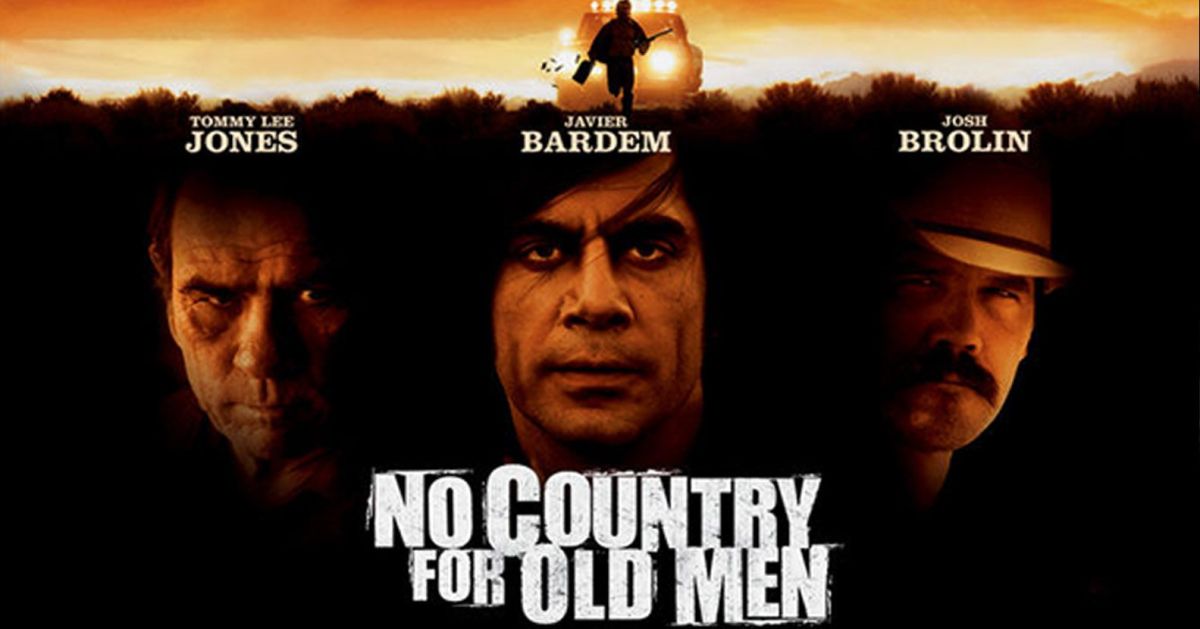
Like his other novels, ‘No Country for Old Men’ focuses on the darker parts of human nature including violence, corruption, and the evil that people can do to one another without just cause. ‘No Country for Old Men’ was a hit at the box office and has an all-star cast including Josh Brolin, Javier Bardem, and Tommy Lee Jones. This film was directed by the Coen brothers and received critical acclaim including four Academy Awards including Best Picture and Best Supporting Actor for Bardem. While not the most upbeat and positive film, it’s a film that probes questions regarding fate v. coincidence, if destiny is pre-ordained, and how much the world is beyond our control despite our wishes and desires for it to be different than it actually is.

‘No Country for Old Men’ takes place in Texas, USA in 1980 after the conclusion of the Vietnam War, one of the bloodiest conflicts in American history, and which is referenced at points throughout the film. Each of the three main characters have personal experience committing violence although they do so for different reasons. Anton Chigurh, the name of the film’s antagonist is a man born without a conscience and is a hired killer. However, he doesn’t simply kill because he is getting paid with money to do so but rather because it comes naturally to him and sees himself as an instrument of fate. It does matter whether or not you are ‘innocent’ or not but if you happen to cross paths with him on the road, at a hotel, in a convenience store, he will judge your fate based on the basis of a coin toss flip. Chigurh’s chilling approach to life and how it is totally beyond any of your collective will and actions is an eerie recurrence throughout the film that the Coen brothers use to make him one of the greatest film villains of all-time.

Most relatable as a main character in ‘No Country for Old Men’, Llewelyn Moss (played by Josh Brolin) is a married man, Vietnam war veteran, and welder who enjoys hunting as a Texan. He is not a perfect person but he tries to do the right thing most of the time and is unfortunately a victim of fate as well during the film. On a hunting trip in the west Texas desert, he ends up seeing the aftermath of a drug deal gone bad with men and dogs both badly wounded and dead at the scene. His overall fate is set in motion when he takes two million dollars that does not belong to him and stashes it away.

As an audience member, you know that’s not the right action for him to take because it ends up causing him to be tracked by Chigurh as he is the contract killer hired to kill Moss and bring back the money. It’s not only that Chigurh who is after Moss for the money and this main character is up against fate which has conspired against him due to the stolen money that didn’t belong to him. Moss, at his heart, is a survivalist and wants to live on yet his actions cause himself and his wife to be put into serious danger.

Because of their predicament, Sheriff Ed Tom Bell, a Terrell County mainstay who is closer to retirement and death then he would like to admit is good at his job but is not sure that he can keep up with the violence and evil that he sees around him and which seems to be getting worse and not better. Throughout this film, Ed Tom is one step behind Chigurh and is unable to help Moss as directly as he can as sheriff because he is overmatched and isn’t able to keep up with a part of the country that isn’t always meant for ‘old men’ to live happily ever after.

“What you got, ain’t nothing new. This country’s hard on people. You can’t stop what’s coming. It ain’t all waiting on you. That’s vanity.” Sheriff Bell, throughout the film, becomes disenchanted with the way the world is and how senseless violence is unavoidable and can’t always be stopped. His ability to influence or change events is weakening and as an older sheriff, he’s slowing down and wondering what his ultimate fate will be whether its dying of old age or getting killed by a psychopath like Chigurh. Ed Tom Bell as a character in this film is aware that as human beings, we can only have control over the world around us and that we are limited to the choices we make regarding good and evil but our choices can also be sometimes constrained by the hand we are dealt by life itself and our circumstances. When it comes to the violence of the world, it is something that can never be truly vanquished as long as there is evil in the hearts of men.

The most prominent theme of the film relates to fate and self-determination. Each of the main characters chooses to see those two concepts differently. Anton Chigurh uses the cover of a ‘fateful’ coin toss to leave it up to the fates of his potential victims regardless if he was hired to kill them or not. He brutally rationalizes his violence through the use of ‘fate’ as if they had it coming all of their life. Llewelyn Moss, a simple hunter and welder, makes flawed choices as any normal person would but struggles to outrun his fate based on some bad decisions he made regarding money that was stolen and would be considered ‘blood money.’

Moss is a survivalist at heart but knows that he can only do so much physically and mentally to outrun his fate based on the choices he actually made that led him there. Ed Tom Bell, is the most morally sound character of the film but comes to the realization that he can only deal with the world as it is rather than the world he would like it to be. The choices he makes are his own but the world and its depravity and violence are out of his control and he can only react to those events rather than prevent them from ever occurring.

In various films of theirs, The Coen Brothers often present a bleak and nihilistic view about the world. ‘No Country for Old Men’ is their most serious and brutal look at the nature of violence, how deeply it seems to be embedded in the American landscape, and how everyone regardless if they are good or evil is subject to a fate that is out of their earthly control.

Overall, ‘No Country for Old Men’ is a great film in that it probes a number of moral questions relating to mankind’s capacity for both good and evil. The cinematography is stunningly impressive, the acting is excellent by every character and Bardem especially deserved to win an Academy Award for his chilling role as Anton Chigurh. This film is not meant for those with weak stomachs because the violence is both brutal and frightenly realistic. The Coen Brothers make movies mainly for mature audiences and this film is no exception.

The music of the film carries little weight and there is not much of a soundtrack and that is done on purpose collectively to build up tension and have the audience invest in every scene to see what happens next. It’s hard to classify this movie to a specific genre but it definitely could be best summarized as a dramatic thriller. The directing is excellent overall and ‘No Country for Old Men’ is truly loyal to its unique setting of west Texas and the U.S. – Mexico borderlands. If you would like to see a movie that deals in shades of grey rather than black and white, you will enjoy ‘No Country for Old Men’. However, be forewarned that it does not have a cliché happy Hollywood ending, which is refreshing since men and women do not always get to live to a ripe, old age.

‘Ex Machina’ – Film Review and Analysis

The rise of automation, the development of artificial intelligence, and the increasing likelihood that robots who look like us and act like us will become major parts of the next few decades of the 21st century and beyond is not a new phenomenon. Going back to the 1950’s and even earlier, human being have predicted through popular media and culture that the future would have advanced intelligent beings who would aid us, support us, and perhaps even dominate us. Recently, the popular culture seems to have gotten more specific and more in line with the technological developments of today of how artificial intelligence may look not hundreds of years from now but rather mere decades from now.

Television shows like ‘Black Mirror’ and ‘Westworld’ approach the rapid growth of technology and the rise of artificial intelligence with unease and even dystopian consequences. However, the main message that these two TV shows can agree on is that these types of scenarios are not a matter of ‘if’ it will happen but ‘when’ it will happen. Now, obviously these shows are science fiction and are not based in truth but it is becoming more and more difficult to say that it is impossible for the world to look somewhat like a mix of ‘Black Mirror’ and ‘Westworld’ by the latter half of the 21st century.

While these shows are very black and white by mainly displaying the damage that virtual reality, artificial intelligence, and big brother surveillance can do to our societies, the excellent film ‘Ex Machina’ deals with shades of gray correctly when dealing with this phenomenon. As some of the television shows that are currently popular deal with the advent of robots and AI with total dismay and unease, ‘Ex Machina’ is more balanced in its perspective and points to a conclusion that is left to be interpreted by the audience in its repercussions for humankind.

While it didn’t gain much notoriety or was a big hit at the box office, ‘Ex Machina’ released in April of 2015 in the United States garnered critical acclaim, especially for its visuals. The film won for ‘Best Visual Effects’ at the Academy Awards and was also nominated for ‘Best Original Screenplay.’ Alicia Vikander, who plays ‘Ava’ the humanoid robot that has a high level of artificial intelligence also was nominated and won a few major awards for ‘Best Supporting Actress.’ The film was directed by English novelist and director Alex Gardner and despite it being a science fiction-based concept only had a film budget of $15 million dollars. In addition to the talented actress Alicia Vikander, other up and coming actors like Domhnall Gleeson and Oscar Isaac play the other two leading roles. While they are currently known for their high-budget roles in the new Star Wars series, they really get a chance in this film to shine as actors in a movie that centers on dialogue and emotional expression.

The film’s plot begins rather innocuously with pretty spot on references to our world today. A programmer named Caleb Smith (played by Domhnall Gleeson) who works at a Google-like worldwide search engine company known as ‘Blue Book’, similar to Facebook in its name is chosen to meet with the Sergey Brin or Larry Page of this fictional world one-on-one for a week. It’s an office contest that Caleb surprisingly wins and which everyone congratulates him on since this tech CEO is known to be reclusive and does not give interviews. The CEO of ‘Blue Book’ is Nathan Bateman, who lives isolated from humanity in a luxurious mountainous estate that seems to be more of a fortress than a home. Nathan only lives with one other person, Kyoko, who is his personal servant but it is unclear who she is really since she does not speak English.

At first, Caleb is excited to meet his tech idol especially since his boss has developed the first humanoid robot who has passed a simple Turing test, which is quite the triumph where man cannot tell if he who he is talking to a robot or a human being. This special humanoid robot was built and designed by Nathan, and is kept in a singular room in an apartment-like setting within the fortress for which she is never allowed to leave. Unlike other fictional depictions of humanoid robots, it’s clear from the outside that Ava is a robot and does not have a humanlike appearance although Nathan has given her a human face that slowly disarms Caleb in terms of his apprehension of speaking to her and asking her questions. It is clear that Ava is extremely advanced in terms of her artificial intelligence and is curious about who she is and about the outside world.

After a little while, Nathan reveals to Caleb that the real reason he brought him here to his isolated complex was to ask Ava questions to see if she is capable of independent human thought and whether she is conscious of them and her actions. Nathan wants to break the barrier to see if his humanoid robot can relate to Caleb on a human level and to express emotions such as sympathy, remorse, happiness, and even romantic feelings. The big surprise about Ava is how much she is able to turn the tables on Caleb and get him to reveal more about himself than he finds out about her. She is able to connect with him very deeply and even plant ideas in his head regarding her suspicions about who Nathan is and what does he really want.

What once starts out as mutual respect and fascination for Nathan’s work on AI and robotics, Caleb grows to distrust Nathan due to his lack of respect for his servant Kyoko, who is a humanoid herself. Nathan is an alcoholic, quite narcissistic, and uses his robots for personal pleasure and not much else. Nathan is quite controlling of his latest creation, Ava, and is distrustful of her motives when she is around Caleb.

Without spoiling the rest of this intriguing movie, the running theme that binds these three characters together is how they use each other to further their own means. Ava is using Caleb to pursue her potential future away from Nathan and her isolated life, Caleb is using Nathan to absorb his knowledge and to discover more about this AI phenomenon he has created. Nathan is both using Caleb as a test subject for Ava and to also use Ava for his own pursuit in dominating the field of Artificial Intelligence and the future of robotics.

The end of this film, ‘Ex Machina’ has quite a few unexpected twists and turns that will leave the audience member speechless. This movie does a great job of posing questions about the future of humanity and whether we will be able to control artificial intelligence and the sentient beings that may end up usurping us if we are not careful. It’s fascinating to see the humanoid robot character of Ava self-actualize herself throughout the film and her ability to use emotions and feelings to manipulate and best her human creators is astounding. Compared to any other recent science fiction offering, ‘Ex Machina’ is the most realistic in telling us the story of how the latter half of the 21st century might go.

There are many unanswered questions to think about when it comes to this film. Will we be able to control and harness artificial intelligence always or will they be able to usurp our status as the most powerful beings on the planet? What will the relationship be between advanced intelligence creations and human beings? What will AI and humanoid robots expect from human beings and what should we expect from them? Is it right to play God and develop artificial intelligence to the point where they can think like us, act like us, have emotions like us, and even look like us like another face in the crowd.

I am no expert on artificial intelligence or the future of it but I believe that this film ‘Ex Machina’ is important to watch because there may come a day soon in our lifetimes where the possibilities that are laid out in this film come to fruition. We may want to look at ‘Ex Machina’ with different perspectives but we should be united in the fact that these issues and questions are not going away anytime soon and will likely become more prominent and pressing as the 21st century rolls on.

We ignore the message, the theme, and the scenarios played out in ‘Ex Machina’ to our own detriment. If you are reading this review of ‘Ex Machina’ and are intrigued more about what the 21st century may bring, I would definitely recommend the book by the author Yuval Noah Harari titled, ‘Homo Deus: A Brief History of Tomorrow’, to gain further insight into how the rest of this century may shape up. If one thing’s for certain, our world is changing quite rapidly and it may lead to being beyond our total control as human beings not too far into the future.

‘Good Will Hunting’ – Film Review and Analysis

What happens when you bring together two of the best actors of the modern age who meet at just the right time in their careers? The short answer is that you get some old-fashioned movie making magic. Both men have made their mark on Hollywood and this film that they carry together is one of the reasons for that happening. While a generation sets them apart, their commitment to the craft of acting shines through in this classic film that takes place in the city of Boston where I currently reside titled ‘Good Will Hunting.’

‘Good Will Hunting’, released in 1997, over twenty years ago is a film that I have gone back to again and again throughout the years since I grew up with it in a way. As I have gotten older, the themes of the film stick with me more and more. This film is a timeless piece that a lot of people, especially young men, can relate to. While it’s not a blockbuster and isn’t a mainstream favorite, it carries deep messages regarding relationships, dealing with the future, and learning to love and trust other people.

The two actors that I was referring to earlier are Robin Williams and Matt Damon. Both men are known for their more popular roles in movies like ‘Mrs. Doubtfire’ and ‘Good Morning, Vietnam for Mr. Williams and ‘The Bourne Trilogy’ movies and ‘The Departed’ for Mr. Damon. Unlike those other movies, I believe that this movie really shows off the talent of these two men and how they’re able to push each other in emotionally trying roles. On top of those two performances, Gus Van Sant is an excellent director who does a great job of filming this movie set in late 1990s Boston.

As if that weren’t enough, you have a great cast of supporting actors including Ben Affleck, Minnie Driver (has she been in any major movies since?), Stellan Skarsgard, and Casey Affleck of Manchester-by-the-Sea fame who really add depth and substance to this movie. These character-driven movies such as ‘Good Will Hunting’ are usually the hardest to make but if done right, they really stay with the viewer long after the film is over. They really capture different moods, emotions, and feelings and this one in particular captures the struggles inherent in being a brilliant mind in a troubled world.

The title of this film ‘Good Will Hunting’ is based off the name of its main character, Will Hunting (played by Matt Damon) a 20-year old, born and raised in South Boston. You would think from this description that he’s just a regular guy but Mr. Hunting was born with the innate gift of having genius level intellect. He has few possessions except for hundreds of books from Foucault to Shakespeare. He’s an avid book reader but has a specialty in solving advanced mathematical equations that few others in the world can figure out. You would think that this college-aged guy would be working on advanced mathematics at MIT or CalTech but he’s not an enrolled student there or anywhere for that matter.

Will Hunting has had a rough upbringing in that his parents abandoned him when he was a baby and he grew up in foster homes where his foster father abused him physically multiple times. Abandoned by those people who were supposed to love and cherish him, Will, for good reason has a fear of abandonment and does not trust other people. His social interactions are limited because of the abusive childhood he endured but he is happy with his group of three friends: Billy, Morgan, and his best friend Chuckie. While Will does not have many friends, he would do anything for his three neighborhood buddies who he grew up with and he literally considers them to be his family.

While Will’s friends are loyal, they are not the best influence on him and they can be crass, crude, and spend too much time drinking. The group’s antics lead Will into a fight against some neighborhood miscreants, which draws the attention of the local police. Will, acting out his aggression violently, ends up assaulting a police officer causing him to do mandatory community service and therapy sessions. Will, a janitor at the Massachusetts Institute of Technology, works after hours to help clean the bathrooms and empty the waste paper baskets. Unbeknownst to both students and professors alike, Will in his spare time has been going around solving advanced Math equations that the regular MIT graduate students can’t even begin to conceive a solution for. One night, Will is caught in the act as he gets caught doing an extremely difficult problem that no one else has solved yet. Professor Lambeau of the Mathematics department discovers Will solving this problem and calls after him to no avail but with a four-letter crude response from Mr. Hunting.

Professor Lambeau does Will a huge favor and gets him out of some serious jail time for assaulting the police officer. In exchange for his favor, Will has to sit and work with Professor Lambeau on advanced mathematics in a mutual exchange. Professor Lambeau is fascinated by Will’s brilliance but it appears to the audience that he cares more just about Will’s brain than who he is as a person. Professor Lambeau tries to get Will to open up to different psychiatrists but Will messes with all of them and doesn’t take his therapy sessions seriously. Lambeau, out of options, goes to an old friend from his college days at MIT, Sean Maguire (played by Robin Williams), who now teaches psychology at Bunker Hill Community College and is also a licensed therapist.

Despite a few sessions where Will is argumentative and closed off, Sean is able to break down Will’s defensive mechanisms partly by talking about his own rough upbringing. Sean was beat by his alcoholic father while he was a child. In an effort to protect his mother and little brother, Sean would endure the brunt of his father’s anger and vitriol. The two men bond over the fact that they have a high intellect, have both grown up in Boston, share a love of the Red Sox, have had rough upbringings, and can be a bit closed off from their loved ones.

Will is going through a transition period in his young life where he is starting to think about a future beyond just getting drunk with his buddies and hiding his talents from the world. He is also trying his best to form healthy relationships with not only his friends but in his love life too. Instead of endlessly pursuing casual one-night stands, Will finds a girl one night at a Harvard bar whom peaks his interest named Skylar (played by Minnie Driver). Despite them coming from very different family backgrounds as well as her being born into wealth, they share a love for learning and have the same sense of humor. Most important to Will in all of this courting is that she likes his friends and that means a lot to him since they have essentially been his family his whole life.

The problem that Will struggles with in terms of his relationships whether its romantic with Skylar or personal with Sean is that he can’t open up to them about his being abused as a child due to a mixture of shame, guilt, and anger. He turns his emotional pain outward and directs that anger at society, the past therapists, Professor Lambeau, and even at Will and Skylar. Will is self-conscious about his genius and is not sure he wants to have a prestigious office job or even to leave his home city of Boston. He says to his best friend, Chuckie, at one point that he doesn’t “feel like doing long division in a room for the rest of my life.”

However, what Will realizes is that he’s not the center of the world. With the help of Sean and Skylar, he learns eventually that while his life has been tragic, that should not prevent him from reaching his true potential and that he is literally “bound by nothing.” He’s a genius of great intellectual capacity who can change the world in a number of ways. Will has a great gift that a lot of people would kill to have including his best friend, Chuckie. As Chuckie puts to Will bluntly towards the end of the movie, “You’re sitting on a winning lottery ticket and you’re too chicken to cash in on it.” Chuckie tells Will that he’ll essentially be working construction until he retires which is fine because he doesn’t have Will has and that Will owes it not only to himself but to him and his other buddies to do more with his life.

Sean also is the father figure that Will never had and is able to give him tough life. Sean was also abused as a child and knows where Will is coming from. However, he has to learn how to put the past behind him and to not blame himself for what had happened because it simply wasn’t his fault. Will was an innocent child and can’t be blamed for such a horrific event. Will has to learn again how to be emotionally open and vulnerable with the people who care about him like Sean and Skylar. Will had lost the inability to love and be loved but it’s never too late to get that back.

The mentorship of Sean throughout the film helps to bring Will around and the time they share together in the therapy sessions make them true friends. Sean is able to tell Will that he is not so special in the fact that his life has been extraordinarily difficult. Sean, himself, fought in the Vietnam War as a young man and had his best friend there die in his arms. He also lost his wife, the one true love of his to a long battle with cancer years ago and hasn’t been able to become romantically involved with anyone since then. However, he implores Will to also see the beauty in life such as in the form of a woman who can ‘level you with her eyes’ and be your own angel.

There are also the wonders of the world that Will can experience such as how it smells in the Sistine Chapel in Italy.    Will may be an intellectual genius but he still has a lot to learn about the beauty and ugliness of life. Sean’s experiences help to enlighten Will about what life is all about and how to persevere through the struggles and setbacks that are inevitable. Both men have their inner demons to battle but they encourage each other to become better, to strive for more, and to live good lives. With Will’s urging, Sean is also ready to put his tragic past behind him to begin anew. He sets out to travel the world, meet a special someone like Will has with Skylar, and truly live life again.

The positive mentorship between Will and Sean is a beautiful thing to see develop over the course of the film. To see true friendship between the two and the chemistry that Damon and Williams have in their scenes together makes ‘Good Will Hunting’ a really special movie. Similar to ‘Lost In Translation’, it’s also nice to see a true romance between Will and Skylar develop as well that starts out very inconspicuously. It’s a young, innocent kind of love that is beautiful to watch and it’s both real and raw to see with how much they truly care for each other and want to best for one another. One of the best lines in the film that Will and Sean both use for courting the special women in their lives is “Sorry, I had to go see about a girl.” Is there anything in modern cinema that can compare to this phrase so simple yet so full of meaning? I don’t think so.