Unlocking More Freedom By Escaping The Hamster Wheel

“I am hopeful that everyone reading this article can find a way to escape at some point in the sense that you keep pursuing a life that is freer, more fulfilling, and less constricted than what is expected of you rather than what you are wishing for.”

Life can feel a lot like a ‘hamster wheel’ the older you get. The responsibilities, bills, obligations, and societal expectations can pile up without you even noticing at first. The hustle and bustle of life can keep us trapped without a way out. I am hopeful that everyone reading this article can find a way to escape at some point in the sense that you keep pursuing a life that is freer, more fulfilling, and less constricted than what is expected of you rather than what you are wishing for.

It is easy to settle into the steady job, the steady paycheck, the comfort of the ‘daily grind’ despite the dislike of it that a lot of us feel about it. It’s called a ‘grind’ for a reason and while there’s nothing wrong with steady work, paying your bills, and handling your responsibilities like an adult, but it’s about not questioning or working towards a different path that may make you get more out of life and what it has to offer you. You should not resign yourself to a life of constantly chasing something that you don’t even want or what doesn’t make you fulfilled. You should consider the ‘hamster wheel’ as a temporary station and not your permanent status in life.

Society often encourages each of us to take the ‘safe route’ and to ‘climb the ladder’ without thinking about if it’s really fulfilling or giving you the purpose and satisfaction we yearn for as human beings. It’s a cycle of working, earning, spending and saving, and while that’s fine if that’s your choice, I do believe there is more to life than that and you have to try to figure out which path is the right one for you off the wheel.

You may want to get off the proverbial ‘hamster wheel’ if you have a feeling of monotony and boredom each day, there’s a lack of passion or purpose in what you’re doing, and if you’re not earning or having the kind of success you envisioned in your current role in whatever work you are currently doing. Time slips away faster and faster as you age, and you really got to ask yourself more and more is if it’s worth my time and effort. If you’ve aged five years and your goals are still not in reach or if the job or vocation you chosen isn’t doing it for you anymore, you need to have some internal reflection on whether your life is heading in the right direction.

Productivity and achievement can be fulfilling at first but if you find the work to be repetitive, listless, or without any growth, it will often lead to burnout and a lack of overall fulfillment. If you are feeling that days are becoming more listless, directionless, or without any purpose, you may need to adjust your career, your lifestyle, or even your values to decide if where you’re heading is where you want to end up being. If that involves refocusing your priorities to less possessions or less spending or a change in your home location, you may need to shake things up a bit to see if you can get more out of life than you’ve been getting.

I am a fan of routines but if that routine, daily or otherwise, is sucking the life out of you, then you need to change up your routine or lifestyle in a big way. Living freely means not just breaking free of an unfulfilling routine but also creating space for deeper relationships, more creativity in what you do, activities that contribute to personal growth, and diversifying your identity outside of your work and more towards experiences and living more outside of the grind.

If you can’t escape the ‘hamster wheel’, I completely understand but you can still create a more intentional approach to your life. You can still prioritize those things that give you greater satisfaction and meaning including balancing out work, leisure time, and personal development without sacrificing each of these life aspects. Other strategies involve being less materialistic and being minimalistic with your possessions, setting boundaries with people at work and at home, practicing mindfulness in your decision making, and exploring different careers and lifestyles that serve you and not someone else. Those practical steps can help you break free a bit more and help you reclaim control over your life.

Meaningful change takes time and having more personal freedom involves making gradual shifts to where you live, who you work with, how you spend your time, what you prioritize, and how you live your life each day. You don’t need to quit your job today, sell your house, and move to a different city or country, but you can try to make some changes in your life to improve your freedom and choice as much as possible.

Living outside the ‘hamster wheel’ can bring a greater sense of peace, clarity, and contentedness that will allow you to enjoy your time more, bolster your relationships, and allow you to have more experiences that you want to have. Think less of what other think of your life and prioritize a life where you are constrained less about what others think of you and focus more on creating your own joy, happiness, and connections with other people as much as possible. Getting off the hamster wheel fully will not be easy but if you can’t get off now, try to slow down, take measure of what’s working and what isn’t, and make meaningful changes to enjoy life before that spinning wheel comes to an end.

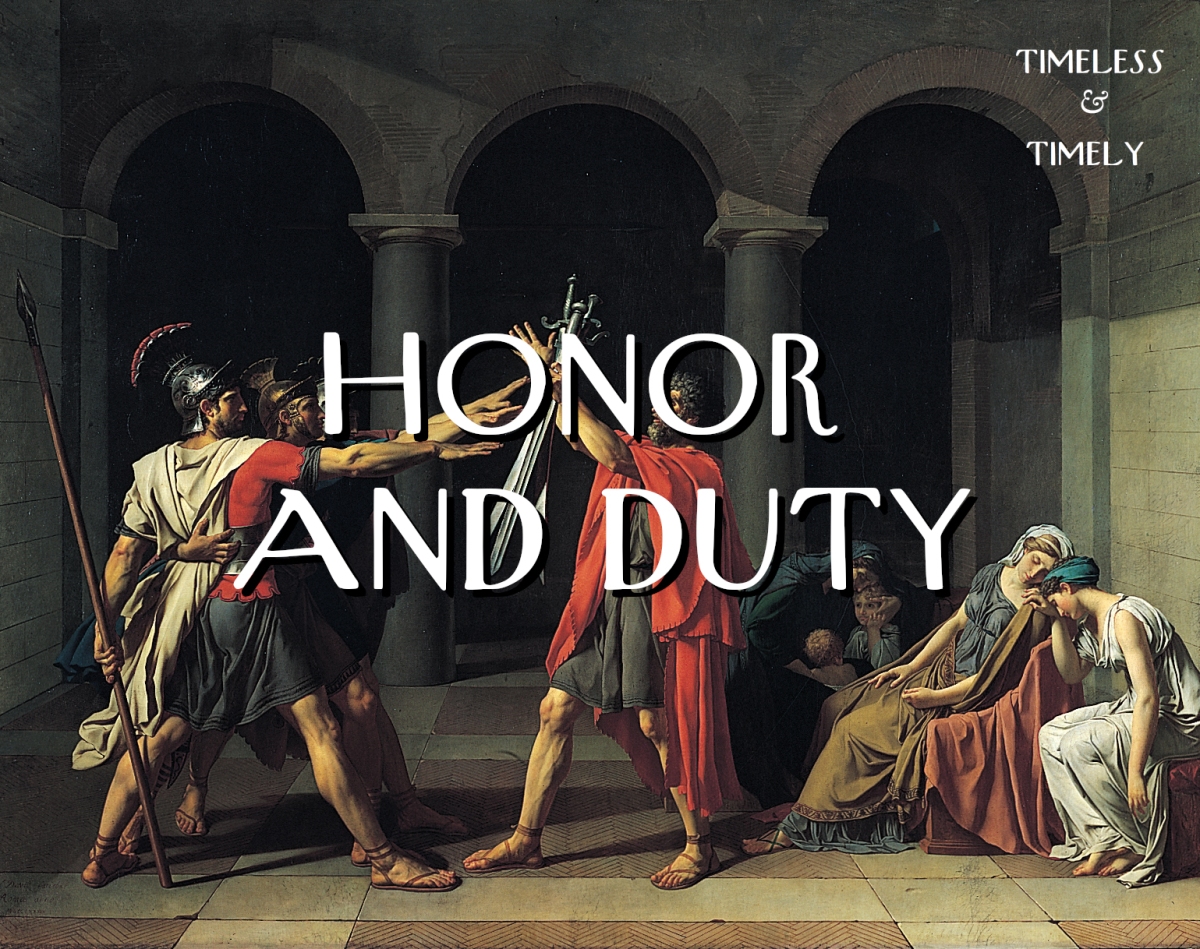
On Duty and Honor

“Two concepts that are not discussed very often today in our culture, but for which go hand in hand to have a purposeful life are duty and honor.”

Two concepts that are not discussed very often today in our culture, but for which go hand in hand to have a purposeful life are duty and honor. Duty is the obligation, either moral or legal, to uphold your responsibilities and to take upon tasks and actions when called upon. Duties are be thrust upon you such as being part of jury or registering to be eligible for military service but also done voluntarily such as keeping your community clean by picking up trash, giving money to a charity, being part of the local school board or town forum.

There are many variations on duty, but what they all have in common is to think of more than just yourself and to be responsible to those people around you. We are duty-bound by law in many such cases, but we are also duty-bound by morals and values that are passed on from generation to generation.

Being dutiful is conscientiously being able to know what your duties in life are, pursue them vigorously, and to conduct them in a moral manner. Duties may not be easy or fun to fulfill, but we have them in place so that society can function at a higher level. If no one was duty-bound to others, selfishness, greed, and egocentric behavior would replace it, which would cause the larger community and society to collapse over time. Lack of duties breeds this kind of behavior whether they are mandatory or not. If everyone is out for themselves and not able to look after others or think of their behavior’s effect on other people, it would create what we know to be as a ‘dog eat dog’ world.

When you fulfill your duties, legally bound or morally footed, you uphold the basic contract as a citizen and as a human being, to help improve your community and the society to some degree. If everyone fulfills their duties, trust, confidence, and belief in each other will be much more assured. If nobody does what is required or expected of them, nothing substantive can get done. The more duties we fulfill and the more we look out for another rather than ourselves, the better off we are to be when we commit to these obligations.

Duties can be granted and often must be enforced to be fulfilled but if we each uphold the duties we are given and see each other as all being on the same page, other duties that we voluntarily take on can be added on if we see that the system is working, and people are putting in their fair share. If a few individuals, especially if they leaders or representatives of their community, are found to be neglectful of their duties, and especially lied about fulfilling such duties, it can easily cascade to where the average person sees this and will unfortunately not find the duties they have been given as being as necessary to commit to if they see those who put them into place or have mandated them do not fulfill them as well.

Regardless of where you find yourself in the overall society, a leader, a citizen, a representative, a voter, etc., we are all held to the same duties and obligations that we commit ourselves to by law or by morality. If we all uphold those duties through acts of good faith and completing tasks that are insured to us, the better off everyone will be.

However, if duties are neglected, discouraged, or done away with even if they are mandated, the whole society will suffer as a result due to a loss of trust, faith, or belief in what upholds this basic sense of equality that we have to be beholden to the same duties as everyone else is regardless of age, sex, race, religion, ethnicity, etc. Now, it is commendable to do your duty, but it is even better to do so with honor.

Being honorable or conducting oneself with honor is taking the duties you are given to uphold or the tasks that come with such duties is to perform such duties with integrity, accountability, and trustworthiness. It is one thing to do your duty and it is another thing to do your duty well.

You can think of someone who is elected to be a representative of a community, town, city, or nation who will use the position for egotistical purposes and to twiddle the time away while doing nothing of honor to make sure the people who elected him or her will benefit as a result. They have been given the honor of representing their community or a nation and have squandered it by neglecting the privilege of having such a position to do good on behalf of others. There is no honor in that even if they are technically fulfilling the duty of public service.

Duties can be bestowed on soldiers, politicians, community leaders, public figures of influence, religious clergy, teachers, etc. and they can perform them because they have been trained or are seen as qualified to fulfill them. However, the question arises is if they are doing their duties with honor? Some will only do the bare minimum and will only think of themselves while having their position of power or influence wrapped up. Others will use their newfound duties to abuse their position for financial or social gain and lie to say that they did not do anything dishonorable to begin with.

Luckily, there will be those people in positions of status who will conduct themselves honorably and seek to uphold that trust bestowed upon them by being transparent, accountable, and forthright. A good leader or example of someone who conducts themselves with honor is that they do not only do their duties as expected of them, but they also seek out those in a similar position or authority who are not doing their duties. They will not only conduct themselves with honor intact but make sure they are holding others in their position accountable and to find out if their honor is there.

If not, that person of authority or influence would work to ensure that the individual without honor even while having done their duties albeit in a lackluster manner are held to account. To uphold that trust across a society where we all must do our duties and to do so with honor, those without honor should lose their given duties when it is found that they are not holding themselves to that standard. When we each hold ourselves to an honorable standard by doing the duties bestowed upon us to the best of our abilities, then the larger community or society will benefit as a result.

Without duties, there is no honor to be had. If duties are being done without honor, no functioning society will result. It is important to understand how much these two concepts feed off each other. One cannot exist without the other and if one concept is neglected, the other will suffer as a result. We all must commit the duties and obligations bestowed upon us whether by law or by creed, but duties must also be performed to high standards, both morally and ethically. Performing one’s duties without honor cannot work and nor can having honor without upholding one’s duties.  

A Sense of Balance

“When the show talks about balance, it is not just about karate in terms of making sure you are able to work to anticipate your own movements as well as those of your own opponent but to be sure to not be balancing too much where your life suffers from imbalance.”

Recently, I have been watching the ‘Cobra Kai’ series on Netflix and while I was never really a huge fan of the Karate Kid movie series, I have really taken a liking to this TV series featuring the same characters with some new ones over 35 years later. There are a lot of great things about this particular popular series such as the 80s music and influence, the acting, the fight choreography among other positives that make you root for each character for different reasons. However, my favorite thing about the series is the life lesson that is not only applicable to the martial art of Karate but to someone’s life in general.

Without spoiling too much about the show, Mr. Miyagi’s philosophy of living life with a sense of balance is applicable not only to his protégé student, Daniel LaRusso, but also to the audience who is watching the show. When the show talks about balance, it is not just about karate in terms of making sure you are able to work to anticipate your own movements as well as those of your own opponent but to be sure to not be balancing too much where your life suffers from imbalance.

Imbalance can cause you to slip, fall, and end up in a fishpond as what happens to Daniel in the movie and to some of the characters for whom he teaches. When you balance on a plank or board, you have to balance your body but beyond karate as in regular life, you have to balance your mind in order to succeed in life. It’s important to be able to not lose sight of what is important in your life to what is trivial at best. When you don’t have balance, you can quickly lose sight of what’s important and what should not take up both your time and your mental capacity.

In the movie and the show too, Daniel, the protagonist of Karate Kid and a teacher in Cobra Kai, struggles to balance his responsibilities as an adult. He has a loving wife and two great kids but finds his life is out of balance. He loves Karate and misses Mr. Miyagi, his sensei or teacher, so when the show begins, his life is somewhat out of balance, which takes time for him to realize. He has a really successful car dealership business with multiple locations but even then, he uses Karate metaphors as a way of expressing how much he misses the martial art he had been practicing for years. In a way, while his life is successful on the surface, he has placed too much weight on his family and personal success but had forgotten the nurturing, passionate side of who he is as a person.

This sense of balance can be missing as it was for Daniel when we put too much weight on professional and personal success but forget what makes us passionate about life and to devote some time out of our busy lives to focus on that passion even if it doesn’t make us money. When it comes to balancing out responsibilities, duties, and habits, you should make time for each part of one’s life but not too much where one responsibility crowds out the rest.

With Daniel as an example, he has to balance it out, so he does not overwhelm himself with one part of his life when he is being pulled in three directions. He has to keep his marriage romantic and show love to his children while not neglecting his role as a business owner and making sure his customers are satisfied. If he spends too much time at work, he still has to be a present father and a loving husband, so he has to be extra cognizant of how much time he is spending on each responsibility.

When you add his love of Karate in the show to the mix, it makes that ‘sense of balance’ much harder to achieve. However, the love of Karate and spending time on his passion makes him as happy, if not more so, than when he is at his job or when he is with family. If you in your life find a passion that great where you want to mentor or help others develop that passion, you should try to add that to your life and do your best to maintain balance.

Karate, like life itself is about maintaining balance and anticipating what your opponent or what life will throw at you next. Part of having a sense of balance is to predict what is to come and adjusting your duties and responsibilities in terms of time spent on those commitments.

For example, if Daniel has a big meeting at work, hypothetically, when it comes to car sales, he may need someone to fill in at the Karate dojo for him such as a top student so that his business does not suffer. If he has to do so, he can move his training hours for the dojo to nights or weekends but that may conflict with his family obligations so maybe he has to ask his wife first to make sure he is spending enough time with them when he’s not managing the car dealership. He also has to be sure to not spend too many hours at the dealership so as to miss breakfast or dinner with his children who may be in school all day.

A good way Daniel can balance his love of Karate with his love of family and work is to incorporate an element of Karate in his work and with his family. He can add a line like ‘kicking the competition’ to his company logo or giving away Bonsai trees to customers who buy cars from them. He can also involve his wife in his dojo by showing her around the training center he set up for his students. Daniel can also encourage his children to join him and to show them how to use Karate in their lives when they are not busy with school.

Similar to Daniel in ‘Cobra Kai’ and ‘Karate Kid’, we must continue to maintain that sense of balance in our lives and to keep adjusting the balance when we become too top heavy in one part of our life which can crowd out our other responsibilities. Be sure to not lose your passion or your family or your livelihoods in the process but see first how much time and effort you can devote to each commitment you make to yourself.

Rather than totally give up something you love or are passionate about, try to do better with time management first, see if it really conflicts with your other daily or weekly tasks, and then determine if it brings enough joy in your life before getting rid of it to improve your internal balance. Balance is not just about time management but it’s also about being aware of other people’s feelings and emotions. You have to anticipate how they’ll react to what you choose to focus on. If you spend too much time at work, you should be aware of how your wife may feel about it. If you are working on a passion too much, your family may feel neglected. If you are focusing on family too much and your work suffers, you have to improve your concentration in order to be able to provide for them.

Balance involves analyzing how your life is going and being self-aware enough to know if change is needed in it. If you do nothing, your life balance is likely to suffer. When you can instead manage your time better, seek out input from others, and figure out what priorities come first, your life balance will be that much better, and your level of happiness will likely increase as a result.