America Off Track – Why It Needs a Nationwide High-Speed Rail Network

“In an age where it’s hard to agree about anything, I do think having nationwide high-speed rail as the rule rather than the exception is something most Americans would support if given a choice of whether to fund it.”

Introduction: Connectivity Beyond Broadband and Rocket Ships

Connectivity in the modern age is more than high speed broadband or rocket ships that can go to the Moon or Mars, it can be as simple as connecting major towns and cities together. It is a simply an economic win-win when you think about having high speed rail being as common as any kind of subway, commuter rail, or streetcar. It is an economic investment that pays for itself over time and is a great way to support local to national economies. It is the exact kind of rail that I believe America is lacking outside my home region of the Northeast and which continues to be neglected despite the benefits far outweighing the costs. In an age where it’s hard to agree about anything, I do think having nationwide high-speed rail as the rule rather than the exception is something most Americans would support if given a choice of whether to fund it.

From Railroad Pioneers to Going Off the Rails

Long ago, the United States was the leader in rail across the board especially when the transcontinental railroad was first established connecting the continental nation together from east to west in the late 1860s. Fast forward to the mid-20th century, America decisively turned away from rail and embraced cars and planes as symbols of modernity and freedom. The construction of the Interstate Highway System in the 1950s, along with generous federal subsidies for aviation, made driving and flying faster, cheaper, and more convenient than taking the train. As families moved to the new and sprawling suburbs, car ownership exploded, and passenger rail ridership collapsed.

Meanwhile, freight railroads, struggling with shrinking margins, often abandoned or neglected passenger services. Amtrak’s creation in 1971 was a last-ditch effort to save intercity rail travel, but chronic underfunding, outdated equipment, and lack of political will left it unable to compete with well-funded highways and airports. This shift cemented a car-and-plane culture in the United States, relegating trains to a niche role in the American transportation landscape rather than the preferred mode of transportation. Unfortunately, today, it continues to be a disappointing national story as trains and train speeds here are some of the slowest, most infrequent, and bordering on dysfunctional in the modern era.

There are a whole host of factors and finger pointing to go around in terms of how we got to where we are as a nation in 2025 from NIMBYism to the airline and auto lobbies to cost overruns that drain support for any of these high-speed rail projects. However, I’d like to focus first on where America stands now compared to other developed nations and how far the U.S. needs to go to catch up to other nations who have surpassed us in this key area of development.

China Leads, Europe Excels

China is currently the world leader in high-speed rail with the biggest network of high-speed trains on Earth with top speeds clocking in at around 220 miles per hour (350 kilometers an hour). If you look at any map of Chinese high-speed rail, all major cities are connected to each other by a train and often for one day, multiple trains serve each city at different times a day making it a better option than flying within the country. Many more cities in China are connected by high-speed rail than American cities and the trains are much faster by comparison.

Unfortunately, this is not only the case in China but in also much of the European Union. France, Germany, Spain, and Italy all have high speed rail networks that are extensive, fast, and reliable, whose coverage far exceeds the U.S. when you do an overlay of their networks compared to the regional networks in the U.S. or per capita in terms of access despite the size difference. Other major players in high-speed rail include Japan, South Korea, Indonesia, with Thailand, Vietnam, and India looking to start building their ‘bullet’ trains in the 2020s. Even developing nations in Africa such as Morocco have invested in having their own high-speed rail with Morocco’s Al-Boraq line between Casablanca and Tangier having opened in 2018, which is the first high speed train in Africa (approx. 180 miles per hour / 300 kilometers per hour) and not likely to be the last.

High-Speed Rail: A 21st Century Economic Engine

As we get close to being well into the second half of the 2020s-decade, high speed rail investment makes more sense and not less sense. It is a win-win to me economically when you can create jobs in construction, project management, and other related industries. As more economies pivot to clean energy, I find that high speed rail is a more efficient, less polluting form of travel that is also extremely safe and reliable if run well. Regional and local economies can flourish more especially when high speed rail comes to their communities’ bringing tourists and possibly new businesses to set up shop there.

Business travel can expand as well when you don’t have the options of only relying on renting a car, taking a bus, or flying on a plane to get to a conference or a meeting in another city in the same day. Cutting carbon emissions is a goal almost universally shared in 2025 so a keyway to do it is embracing forms of travel that are better for the environment such as high-speed rail. Multiple studies in Europe show that every dollar or euro spent on high-speed rail returns multiple dollars in long-term economic gains. The overall return on investment speaks for itself and that’s why more than ever, nationwide high-speed rail efforts should become a national priority.

America’s Missed Opportunities in High Speed Rail

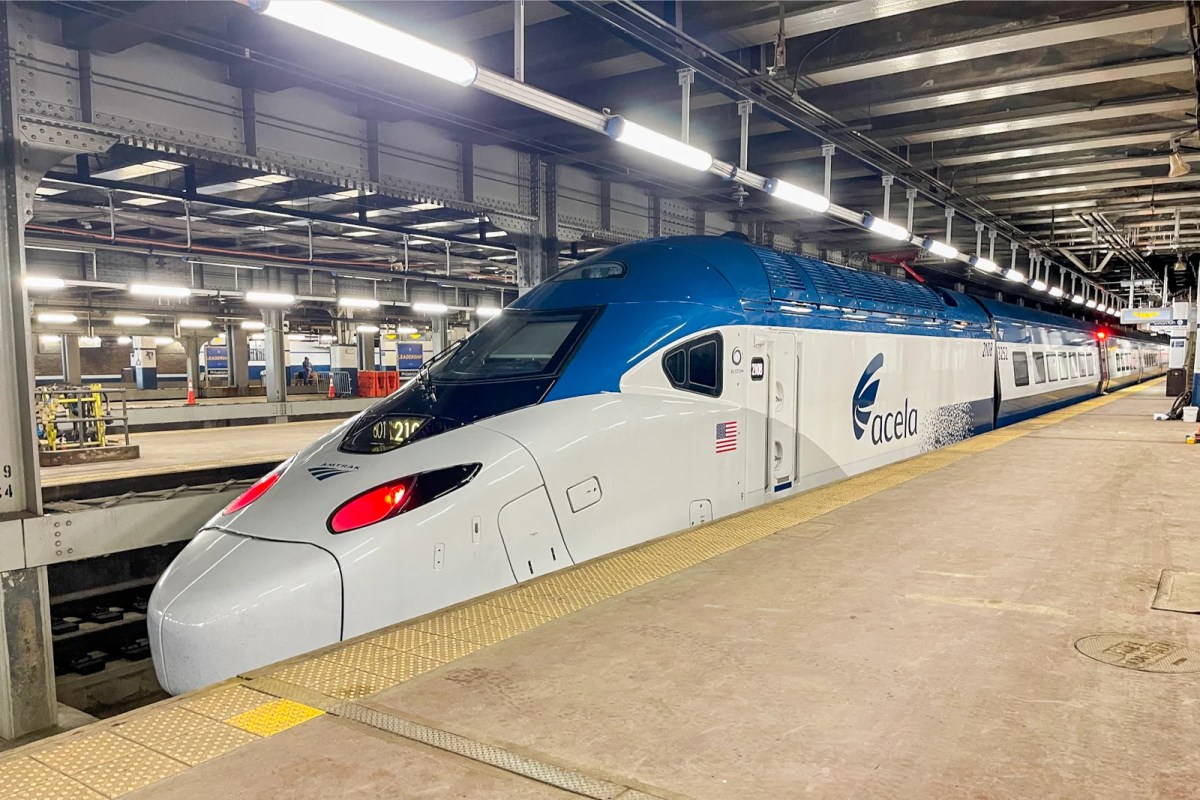
My love for the Northeast’s Amtrak lines as someone who rides multiple times a year, especially the Acela and Northeast Regional, comes from knowing how liberating it feels to speed past gridlocked highways and soul-crushing airport security. However, I would like to be clear in that what we have in the Northeast United States is the exception, not the rule. The rest of the nation is left with woefully inadequate or non-existent passenger rail options, especially no high-speed rail train options.

California’s notorious and still unfinished high-speed rail project, originally envisioned to connect Los Angeles and San Francisco in under three hours, has become a cautionary tale of political infighting, spiraling costs, and endless delays, now more than fifteen years since voters approved it, the line remains incomplete as of this writing. Texas’ proposed Dallas-to-Houston bullet train, based on Japan’s Shinkansen technology, has been mired in lawsuits and land disputes, while Florida’s once-promising plan for a Tampa-Orlando-Miami high-speed corridor was killed by politics despite federal funding being on the table. These failures aren’t just isolated missteps; they’re a systemic reflection of America’s inability to plan, fund, and execute transformative infrastructure projects in the 21st century.

A Vision of a More Connected America

Imagine for me now a future United States where a high school student in Indianapolis could visit Washington, D.C. on a field trip by getting there in 4-5 hours, or where a business traveler could commute between Atlanta and Charlotte in 90 minutes, turning what’s now a grueling four-hour drive into a swift and productive journey. France’s TGV system, which I have been lucky enough to ride from Bordeaux to Paris has long proven that high-speed rail is profitable and competitive with air travel for distances up to 600 miles, drawing millions of passengers who might otherwise fly or drive in that country.

China’s network, the world’s largest as mentioned earlier, has shrunk travel times dramatically: for example, the 819-mile Beijing–Shanghai route, once a ten-hour slog by conventional train, now takes just four and a half hours. A similar Chicago–New York high-speed line, roughly the same distance, could cut today’s fourteen-hour Amtrak ride by more than two-thirds if it were ever developed and invested in.

The creation and development of a nationwide rail grid could connect major population centers such as Houston, Dallas, Austin, Chicago, Detroit, Miami, Atlanta, Denver, and Los Angeles with frequent, fast trains. This would wholeheartedly reshape the American economy as we know it and foster new hubs of innovation, tourism, and opportunity in cities both large and mid-sized, and if smaller cities can be added to a more local line with more stops, that’s a positive as well.

Overcoming America’s High Speed Rail Barriers

There’s no denying the hurdles that exist and will continue to slow the development of a nationwide high speed network: federal and state governments have rarely aligned on rail priorities; outdated regulations, such as the Federal Railroad Administration’s archaic crash standards, make it difficult to adopt off-the-shelf European or Asian trainsets; and NIMBYism often turns local communities into fierce opponents of new rail lines.

However, none of these obstacles are insurmountable if America learns from the examples set by other nations. Spain’s national AVE system, for instance, was built with robust public support and clear national commitment, resulting in more than 2,000 miles of high-speed track in a country with less than a seventh of America’s population. Japan’s initial Shinkansen line was completed in just five years, transforming travel patterns permanently, and this is despite being a mountainous island nation where political gridlock can also occur.

America could adopt federal legislation to streamline permitting, incentivize public-private partnerships, and dedicate a long-term funding mechanism like the Highway Trust Fund to ensure reliable and consistent investment. Beyond these present technicalities, it will take real leadership willing to communicate to the American voter that high-speed rail is not a luxury for a developed nation, but a real necessity for economic growth, energy security, and national competitiveness in the 21st century.

Conclusion: It’s Time to Board the Train of Real Progress

I am writing this article on an Amtrak Northeast regional train to Washington, DC ironically but not intentionally because as someone who treasures the unique sense of freedom and connection offered by train travel in the Northeast United States, I believe deeply that every American deserves the same opportunity. This should be the case whether they live in Houston, Detroit, or Los Angeles. We have the financial resources, the technology, and the know-how; what we lack is the political resolve to make high-speed rail a reality nationwide.

Our tax dollars should be able to build systems that make our daily lives better, and there are few investments more transformative than modern, fast, reliable trains that knit together our cities and regions. High-speed rail would give Americans more options, less stress, and cleaner air, while restoring our global reputation as a nation of builders and innovators. It’s time for the United States to leave the station of outdated thinking, board the train of progress, and embrace a future where high-speed rail is not the rare exception, but the expectation for every American traveler.

Note: The views expressed in this article are entirely my own and do not reflect the opinion(s) of any outside organization, firm, or entity.

Works Cited / Endnotes (MLA)

  1. “China’s High-Speed Rail Development.” China Railway Corporation, 2023, www.china-railway.com.cn/en/high-speed-rail/.
  2. “TGV: The French High-Speed Train.” SNCF, 2024, www.sncf.com/en/trains/tgv.
  3. International Union of Railways (UIC). “High-Speed Rail in Europe: A Competitive Advantage.” UIC Publications, 2023, uic.org/IMG/pdf/high-speed-rail-in-europe.pdf.
  4. “Al Boraq, Africa’s First High-Speed Train.” Office National des Chemins de Fer (ONCF), 2019, www.oncf.ma/en/Projects/High-Speed-AlBoraq.
  5. Hurst, Dana. “Morocco Opens First High-Speed Rail Line in Africa.” BBC News, 15 Nov. 2018, www.bbc.com/news/world-africa-46227056.
  6. California High-Speed Rail Authority. “Project Update Report to the Legislature.” CHSRA, March 2024, www.hsr.ca.gov/docs/about/legislative_reports/2024_Project_Update_Report.pdf.
  7. Swarts, Jonathan. “Texas’ Bullet Train Faces Legal, Financial Roadblocks.” Texas Tribune, 20 Apr. 2024, www.texastribune.org/2024/04/20/texas-high-speed-train-lawsuits/.
  8. United States Government Accountability Office (GAO). “Intercity Passenger Rail: Amtrak’s Challenges in Implementing High-Speed Rail.” GAO-21-480, Sept. 2021, www.gao.gov/assets/gao-21-480.pdf.
  9. International Energy Agency. “The Future of Rail: Opportunities for Energy and the Environment.” IEA, 2019, www.iea.org/reports/the-future-of-rail.
  10. European Commission. “White Paper on Transport: Roadmap to a Single European Transport Area.” Publications Office of the European Union, 2011, ec.europa.eu/transport/themes/strategies/2011_white_paper_en.
  11. Pew Research Center. “Most Americans Support Investments in Infrastructure, Including Public Transit.” 15 June 2021, www.pewresearch.org/2021/06/15/public-views-on-infrastructure/.
  12. American Public Transportation Association (APTA). “Economic Impact of High-Speed Rail.” APTA Reports, 2022, www.apta.com/research-technical-resources/research-reports/economic-impact-of-high-speed-rail/.


Gross Domestic Product v. Gross National Happiness

“Most of us know what Gross Domestic Product (GDP) is having learned it at some point in high school or in college. The total value of all finished goods, products, and services produced within a country’s borders over a specific time period such as a quarter (three months) or a year. Economists commonly use GDP as a model for economic health when it comes to an individual country.”

Most of us know what Gross Domestic Product (GDP) is having learned it at some point in high school or in college. The total value of all finished goods, products, and services produced within a country’s borders over a specific time period such as a quarter (three months) or a year. Economists commonly use GDP as a model for economic health when it comes to an individual country. If GDP grows positively or increases over time, then generally you could assume that the economy is doing well or is at least maintaining its equilibrium. However, when the GDP of a country is declining or has been stagnant for multiple years, economists are likely to assume there is a problem of some sort.

There are economic terms related to Gross Domestic Product as a recession (two straight quarters of negative GDP growth) leading to an economy to contract rather than grow. We also know of an economic depression where an economy contracts for years and is often associated with double-digit negative growth and/or high unemployment, inflation rates. What is less talked about is how do we measure the health and well-being of citizens within a country’s borders.

What other measurement besides GDP could measure a country on a national scale? While GDP measures the economic health, the actually mental health of a country’s citizens has been measured by a little-known survey conducted by the small land-locked, mountainous country of Bhutan, which is a Buddhist kingdom that is located at the eastern part of the Himalaya mountains. This national survey is given out only every five years to the citizens of Bhutan, of which there are only 750,000 people living in the small country. Instead of a simple 0 to 10 survey on if you are happy on a scale, the survey is quite comprehensive in its questions.

The government of Bhutan asks over 300 questions in the survey and can take multiple hours to complete. Questions are compensated a day’s working wage to answer the questions and it strives to measure all forms of human capital and not just the economic capital measured by GDP. The survey has nine different domains, 33 social indicators, and hundreds of variables. The categories of the survey include education, health, culture, time use, psychological well-being, community development, environmental practices, and overall living standards. This GNH survey has become a cornerstone of Bhutan’s presence on the world stage and has gained notoriety since it was introduced in 1998 as a form of alternative human development.

About 8,000 households in Bhutan answer the survey every five years, which is conducted by the Centre for Bhutan Studies and GNH research. Questions can range from being general about prayer and/or meditation habits to being specific about if you ‘trust your neighbors’ to if you ‘fight with your family at all.’ The measuring of the country’s happiness began in 1972 when the fourth king of Bhutan, Jigme Singye Wangchuck, declared that the “Gross National Happiness is more important than gross domestic product” for the country.

Bhutan has seen numerous changes over almost fifty years since the movement towards measuring GNH began. The same king helped ensure a parliamentary democracy was established in 2008 with the constitution and political reforms putting him in a more ceremonial role. Bhutan has strived to actually use the survey to help improve certain aspects of the lives of its citizens such as having free education, health care, and getting electricity at no extra cost. Bhutan’s new democracy is messy like any young democracy would be, but Bhutan is known for attracting increased numbers of tourists before the COVID-19 pandemic began and for being largely self-sufficient in terms of food production and for being a peaceful, inwardly looking nation.

The concept of Gross National Happiness is related to the country’s prominent religion of Buddhism with the focus on being content with less, not being so concerned with materialism or economic gains, and to be calm, cool, and collected when facing life’s many challenges. Seeking harmony with one’s friends, family, and neighbors is also another key part of the GNH survey. Bhutan is a beautiful, land-locked country, which has provided its citizens with a number of basic needs such as education, health care, and peaceful relations with its neighbors with having a smaller GDP than many other nations.

The paradox of a country such as Bhutan is that it may be the only country to internally measure happiness in some formal way, but it still ranks in the median in terms of national happiness by outside surveys. Norway was ranked 1st by the United Nation in its 2020 World Happiness Report, which had a different format and questioning style than Bhutan’s, but for which is a relatively new kind of survey that Bhutan’s GNH survey helped to inspire. While Norway topped the list, Bhutan ranked 97th out of the 153 nations surveyed, which may not inspire much confidence, but the country does face ongoing challenges especially with its GDP.

Bhutan ranks as a ‘least developed’ country by the United Nations and is dealing with the effects of climate change, high income inequality, increasing youth unemployment, and an uncertain energy future due to the effects of environmental degradation. Bhutan’s GDP is only $2.2 billion and while material wealth and economic growth are not integral to the GNH survey, it likely has a role to play in affecting the happiness of its citizens.

The 2015 GNH Survey by Bhutan reported that “91.2% of people reported experiencing happiness, and 43.4% of people said that they are deeply happy.” From my reading of the survey, Bhutan is committed to improving the happiness of its people by having such an insightful and detailed survey and while their national happiness has room for improvement, they have taken that crucial first step to actually evaluating if its citizens are happy or not, which is quite unique when compared to other nations around the world.

The first step to solving the problem is realizing there is one. If a country focuses only on GDP as a measure not only for economic health but for the health of their citizens in other ways, then they are making a false dichotomy. Economies are naturally going to rise and fall in growth rates but the same can be said of people’s own happiness over time. The key is to first be aware of how happy people are by having a comprehensive yet accessible way to measure that elusive emotion as best as you can. Bhutan is a model for not seeing only its Gross Domestic Product as a sign of national progress.

Any nation can be wealthy and still be extremely unhappy and a nation can be poor but still be happy. The same could be also for a poor nation being unhappy as a rich nation being very happy. The key to 21st century economics will be to figure out how to find that balance between economic success and people’s happiness. You can have the average citizen make a lot of money and be considered a ‘success’ but what if the schools in their town are lousy, the health care is too expensive and of low quality, and the community is distrustful of one another.

Bhutan has taken the initiative as a country for seeing happiness as being an important part of a nation’s well-being, which can be measured in various ways. While their GDP is very small, they recognize that economic growth is not simply everything that a country should be known for. If you have a certain amount of money in the economy, where are you putting the national product towards? How will you know how to spend the money gained from your citizens through taxes without knowing what their grievances are and what they unhappy with?

Having Gross National Happiness be part of a country’s consciousness involves asking difficult yet necessary questions from the population on different aspects of their lives. Bhutan has taken that crucial step towards asking their citizens what they are happy with, what they are not happy with, and what could be improved in their lives. When you have that necessary information coming in, the government can then take steps to allocate the tax money and other revenue they have available to put it towards where its’ needed most. If government services need to be improved, they’ll know from their citizenry that it’s a priority. If living standards need to be improved such as providing more housing, better food, or less pollution, they will have that awareness from knowing more from the GNH data that they are receiving.

Lastly, a government like Bhutan’s can work closely with the parliament, civil servants, non-governmental organizations, and civil society leaders to take the survey’s results and work together on a common set of facts and figures to start to improve the country in needed areas where people are unhappy about. If other governments can learn from Bhutan when it comes to Gross National Happiness, it’s that it can be measured from your citizens in a comprehensive way and that each government can learn from its citizens how their people’s lives can be improved and in what ways beyond just how much money their people are producing each year.

Sources:

https://www.npr.org/sections/parallels/2018/02/12/584481047/the-birthplace-of-gross-national-happiness-is-growing-a-bit-cynical

https://www.grossnationalhappiness.com

https://www.happiness-report.s3.amazonaws.com/2020/WHR20.pdf

Interconnected

interconnected
“Will humanity become more or less interconnected during the 21st century?”

When the 21st Century is over and becomes apart of the history books, it will be known as the first truly interconnected, interdependent, and entangled era of human history. Compared to past eras, borders are more open, long-distance travel is common place due to modern aviation, and global commerce is more free than it ever has been. Globalization as a phenomenon has been made possible not just through open borders and advances in aviation but also due to the wonders of the Internet.

While many human beings can not physically cross borders or take modes of transport to other countries, the Internet has helped to minimize that gap of connection by allowing people from around the world to connect virtually at an increasing frequency. As the technology continues to improve and advance, the Internet has made our planet interconnected on a scale once considered unthinkable a generation ago.

I woke up one morning in New York, had my breakfast and juice, and then was able to log-in to Skype and chat with my good friend who is living in Beirut, Lebanon about his work there and how he has adjusted to living in the Mediterranean metropolis. After that, I sat down to have lunch and finished some homework for a 1:30 PM Spanish lesson with my teacher who is originally from Mexico but currently lives in Italy. Somehow, we were able to make the six-hour time difference work between me in New York and her in Italy. Before the day was over, I had two more Skype and Google Hangout based English lessons with my students from countries like Saudi Arabia and South Korea. Satisfied with my day of both teaching and learning, I settled the rest of my affairs and went down to the kitchen to prepare my dinner for the evening.

None of these lessons or exchanges of information would be possible between persons of different countries and backgrounds without the invention of the Internet. Too often, the average person either takes for granted the capabilities that allow us to stay connected on a worldwide scale or doesn’t take advantage of using this technology to bolster their abilities personally or professionally.

Professionally, as an ESL teacher, the fact that I have been able to use the Internet and web applications such as Skype, Google+, etc. to connect with numerous students from around the world virtually has been a real treat for me. Sometimes, my students with whom I’m working with online do not have the means or ability to work with a native English speaker / teacher in person in their own city or country. Those of us language teachers who commit time out of our lives to help others learn our native languages should be commended for making this a possibility. It is truly enjoyable for me to work with those students online from different countries who will share with me interesting tidbits about their cultures and societies.

Personally, I have been able to stay in touch and meet up again with friends of mine from different regions of the world thanks to staying connected through social media websites like Facebook, CouchSurfing, Twitter, etc. The Internet has allowed me to stay connected with international friends, both new and old, thanks to the rise of social media and its applications. It is funny to think that only fifty to hundred years ago, or even before the advent of the Internet, twenty years ago, the best that you could do is send a handwritten letter by mail or make an expensive call to any location overseas. Now, such communication to an international location is often very cheap or even free of charge depending on which application you decide to use.

While the advent of globalization has its positives and negatives, which are often debated and discussed endlessly, I believe that one net positive from globalization has been how the Internet and the “world wide web” has made humanity interconnected. This one trend of “Interconnectedness” for the 21st century is one that isn’t going to reverse course anytime soon and is going to be hard pressed to find itself limited in total amount of users or overall global popularity.

According to the World Bank’s recent report titled “World Development Report 2016: Digital Dividends”, the number of people worldwide who have access to the Internet has tripled from about 1 billion people in 2006 to about 3.5 billion people in 2016. This recent development is an extraordinary occurrence. This means that over 40% of humanity now has some type of access to the Internet which has become increasingly possible due to rise of mobile technology and the spread of 3G and 4G cellular networks.

As more and more people connect to digital markets of e-commerce, become new entrepreneurs and start to create their own small businesses, this will also allow more students to connect and learn with me here in New York and other teachers around the world to learn English or another foreign language. The possibilities of eventually having everyone connected to the Internet would be truly endless. It could lift millions more people out of poverty and create new economic opportunities where there were none before.

Some of the big questions to be answered in the coming decades is how do we as a global community work together to connect the remaining 60% of humanity to the Internet? How do we work together as governments, NGOs, and individuals to give people the means virtually to benefit economically and personally from the advent of the Internet? These are not easy questions to answer let alone solve. However, if humanity is to continue advancing and developing into the future, we must continue to become more interconnected to each other. That is a fundamental truth of the 21st century for which we all must be aware of.

Sources:

1.)  http://www.theguardian.com/technology/2016/jan/13/internet-not-conquered-digital-divide-rich-poor-world-bank-report

2.) http://www.worldbank.org/en/publication/wdr2016

Made In America?

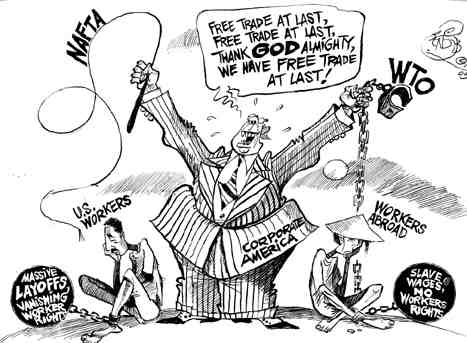
free-trade-cartoon

Have you ever noticed this small yet important detail when you’re out at the store buying a consumer good whether it’s a pair of pants, a carpet, or some brand new shoes? For those of you who are confused right now, there’s a tag attached to the item indicating that the final product was “Made in …..” which indicates the origin of the country the good has come from. I doubt that most people notice this small detail when they’re out shopping and it’s probably not their biggest concern.

However, I do believe it’s very important as consumers to know where our goods and services are coming from and to what sort of quality they are made. It’s also important to ask the question of these companies who make these consumer products, both foreign and domestic, how well are they treating their employees and what do they pay them for their hard work? Do they receive good health benefits and vacation time? Are the working conditions in their factories and shops safe and hospitable?

I have noticed that most of the clothing, household items, and electronic products that I have bought were not made in the United States. I am not against wearing or buying consumer goods that were created and manufactured in other countries. However, I do worry that we are relying too heavily on these foreign-made products in our daily lives instead of having some of these same goods made in the U.S.A., which could improve the lives of many people looking for decent-paying jobs. Many abandoned and dilapidated factories, plants, and mills could be re-opened again if we change the way we look at free trade.

According to the official and most recent numbers on United States International Trade Data, there was a sizable overall trade deficit in goods and services of $43.9 billion dollars in October of 2015. Since ‘The Great Recession of 2007-2008’, the trade balance has not changed greatly in terms of lowering the overall deficit. Over the past five years alone, the monthly trade deficit has ranged from $40 to $65 billion. There has been very little sign of this trade imbalance being decreasingly significantly or being entirely eliminated recently. This means that the U.S. is importing a much larger quantity of goods than we are exporting overseas. While some people would argue that this is not a big deal, I would say that in order to grow the economy at a higher output and decrease unemployment further, increasing our exports overseas with the stamp “Made in America” should be a higher priority especially with the upcoming presidential election.

With the decline in American manufacturing, the U.S. has increasingly looked to its trading partners overseas to fill the void that has been created. Due to free-trade agreements such as NAFTA and the recent passing of the Trans-Pacific Partnership, many American companies and jobs have moved overseas causing the trade deficit to increase over the past generation. This has led to many good-paying middle class jobs with health and other benefits to disappear. There has also been a steady decline in the Unions and their total membership and influence within the U.S.

Examples of the shift towards the growing importation of manufactured goods and products that used to be made in here at home can be found in companies such as Wal-Mart and Apple. These iconic companies that were created by Americans such as Steve Jobs and Sam Walton have changed significantly like many others since their early days. They have become multi-national in nature and have expanded their facilities and operations to multiple countries around the world. Even though their company headquarters are in Silicon Valley and in the heartland of Arkansas, these companies are not taxed like other U.S. companies and carry out their manufacturing and production of goods from overseas suppliers.

American workers are known to be more expensive to train and hire than those workers found in countries such as China, Vietnam, and Cambodia. That’s an unfortunate truth that has led many companies to take the easy way out by calculating how much they would save due to the fact that foreign labor is cheaper. For these firms, there is little to no need to worry about strict labor laws that don’t exist outside the U.S. and other parts of the Western world. For example, huge multi-national companies such as Apple have used subsidiary companies like the ‘Foxconn Technology Group’ for years in order to manufacture their iPhones and other high-tech products. There have been many investigative reports done by The New York Times and other news outlets about the harsh working conditions, poor salary, long hours, and reported suicides and riots occurring at these plants in China.

In a lot of developing countries, the taxes associated with doing business are much cheaper which allows a lot of big manufacturing firms to operate there more freely. Even though multinational companies have to pay U.S. taxes on the profits that they earn from products that they make and sell in other countries, Apple and others can avoid paying these taxes by re-investing their profits made from outside the U.S. on overseas factories, stores, warehouses, etc. Because of that, they won’t have to pay the higher taxes. It’s a significant loophole that hasn’t been closed yet and allows U.S. companies to store billions in profits overseas. “Apple is not alone in this strategy. U.S. companies have $2.1 trillion in foreign profit stashed overseas, according to Capital Economics.”

Once the multi-national companies decide to move their manufacturing and production operations overseas, it’s very difficult to bring them back to the U.S. Competitors like China have the infrastructure and a vast amount of workers willing to work in the factors for these supplier companies. It is the responsibility of companies like Apple to break their agreements with manufacturing giants like Foxconn if they ever decided to move their production operations back to the U.S. However, Apple would have to invest in billions of dollars to build these new factories and pay these workers a fair wage with benefits. This proposition is entirely unlikely to occur in the near future for Apple, Wal-Mart, GE, and others to move their manufacturing back to the U.S. due to the higher taxes, the higher costs of the workers and their desire to make the most profits that they can secure.

Free trade is a complicated subject but I decided to write about this issue because I think as consumers, we should know where our money is going. I am guilty like many other Americans in supporting these popular multi-national companies who have gotten away with sketchy business practices and who have shied away from creating jobs here in the U.S. However, it’s never too late to be informed about where your clothes, your cars, and your electronics come from. Do your research and be informed about these issues.

Globalization and free trade have lifted millions of people out of poverty and allowed many countries to boost their economies but it’s also led to a higher amount of competition, the stagnation of wages, and many environmental concerns. I am not a protectionist and I believe that some free trade is good. However, it’s more important than ever that we support fair trade and business practices from these companies. Workers around the world should be treated fairly with good wages, good health and vacation benefits, and they shouldn’t be taken advantage of whether they are located in Saigon or Detroit.

We have free trade with other countries so that we can exchange goods and services with them to better our economies and our peoples. Lets’ not create a situation where we are importing more goods than we should be at the expense of the American worker and taxpayer. These companies need to be held accountable for what they do both here in the U.S. and overseas.

I would encourage everyone reading this entry to think about where your goods and products come from. If you have the chance and opportunity to do so, I would argue that you should try to buy from the U.S. companies making the goods and services right here in America. I am not against buying foreign goods either but we have to know whether these large companies out there are playing by the rules and are not being exploitative.

By ‘Buying American’, it’s good to show those small businesses and firms that we still support them and that we want them to succeed. If you would like to support buying American-made goods and products, check out this website: http://madeinusachallenge.com/ (Made In America – Master List)

Sources