English Corner – Present Perfect Tense

While not the most widely used or well-known grammar tense in the English language, the ‘perfect’ tense does come up every now and then in either your writing, speaking, or listening skills. It’s important to understand both the usage of the ‘perfect tense’ as well as the forming of this grammar tense. We’ll begin this series of the ‘perfect tense’ with its’ usage and formation in the present. In the next two posts, we’ll then dive into the past and future forms and uses of the ‘perfect tense.’ When you get the basic grammar tenses down as I have gone over in past ‘English Corner’ posts, you can move onto more challenging and specifically used tenses such as the ‘perfect tense.’

It may be surprising to teach this right off the bat but the present perfect tense helps to create a link between the past and the present. In a present perfect sentence, you are going to be describing an action or an event that has happened before but it isn’t certain whether that action or event is ongoing. When you use the present perfect tense, you are going to want to focus on the result or conclusion of an action rather than if it’s still continuing or not.

There are five main circumstances in which you can use the present perfect tense. You can do so when discussing an action or situation, which began in the past and has continued into the present. You can talk about an action that was undertaken during a period of time and that has not yet been finished. You could also discuss a repeated action or event that occurred over an unspecified amount of time between the past up until now.

You can also insert the word ‘just’ into your sentence to indicate that an action or event was completed very recently in the past to emphasize how close it was to the present. Lastly, you can describe an action or event that simply took place and was completed without mentioning the time or date at all. If you want to be more detailed about asking why, when, where, what, how, who, etc., you’re going to want to focus on using the simple past tense instead so as to not to confuse these two distinct tenses. In order to get a better idea of these five different uses for the present perfect tense, here are some examples to remember.

Actions Started In The Past that Continue Into The Present

Examples:

  • We haven’t lived in our house for years.
  • He has worked in the high school for decades.
  • Have you played the guitar since you were a teenager?

The Time Period Hasn’t Been Completed Yet

Examples:

  • I have traveled very far this week.
  • They have danced a lot tonight.
  • It has snowed a little bit this winter.

Repeated Actions Between The Past and Now (Unknown Period)

Examples:

  • We have seen The Terminator three times.
  • I have been on that roller coaster ride multiple times.
  • She has visited her parents occasionally.

Completed Actions In The Very Recent Past – ‘Just’

Examples:

  • Have you just eaten dinner?
  • I have just finished my thesis.
  • Has he just left the ballpark?

The Timing of the Action is Not Known or Not Important

Examples:

  • Have you been to Washington DC?
  • Somebody has eaten my lunch.
  • You have studied many foreign languages.

Ultimately, it’s important to remember that additional words like ‘just’, ‘since’, ‘for’, and ‘still’ may pop up every now and then in your present perfect tense sentences depending upon which of the five uses you are utilizing this specific grammar tense for.

When it comes to forming the present perfect tense, there is an actual formula towards creating the right form that each English learner should be aware of. There are two elements to the present perfect tense. The first is the right form of the auxiliary verb represented by the verb to have in the present tense. The second element is represented by using the past participle of the main verb with the base verb + ed. For some examples, the past participle of these regular verbs could be danced, finished, worked, etc. The two elements will also go together when the base verb is irregular regardless of the circumstances.

Positive Form – Example

  1. He has traveled to Japan.

(Subject + verb ‘to have’ + past participle)

Negative Form – Example

  1. She has not traveled to Brazil.

(Subject + verb ‘to have + not’ + past participle)

Question Form – Example

  1. Have they traveled to Colombia?

(Verb ‘to have’ + subject + past participle)

Negative Question Form – Example

  1. Hasn’t he traveled to Japan?

(Verb ‘to have + not’ + subject + past participle)

To finish off this entry on the ‘present perfect’ tense, I’d like to leave my readers with an additional example of how to use a simple verb and express that word in the positive, negative, and question forms by using the present perfect tense. You can use these examples to help yourself when it comes time for you as the student to use this particular grammar tense in your everyday speaking and writing activities as an English language student.

As always, if you have any questions or comments about my ‘English Corner’ posts, please do let me know. Next time, I’ll be covering the ‘past perfect’ grammar tense, which is quite similar to the ‘present perfect’ tense but with a few differences to highlight. In the meantime, keep studying hard and do check out my previous ‘English Corner’ posts on my website.

To Run – Present Perfect Tense

Positive Form

  1. I have ran
  2. You have ran
  3. He, She, It has ran
  4. We have ran
  5. You have ran
  6. They have ran

Negative Form

  1. I haven’t ran
  2. You haven’t ran
  3. He, She, It hasn’t ran
  4. We haven’t ran
  5. You haven’t ran
  6. They haven’t ran

Question Form

  1. Have I run?
  2. Have you run?
  3. Has he, she, it ran?
  4. Have we run?
  5. Have you run?
  6. Have they run?

Note: It’s important to remember that the verb ‘to run’ goes from ran to run when it comes to the question form of the ‘present perfect’ tense. Otherwise, in the positive and negative forms of this grammar tense, you will use ‘ran’ instead to describe this particular verb in the ‘present perfect.’ This is a helpful tip to remember for readers if you happen to be confused by this change.

English Corner – Interjections

What is an Interjection? You may reading the title of this blog post and appear to be slightly confused. The concept may sound familiar to you but it’s possible that you may have forgotten the meaning of the word since you left high school English. If you’re learning English as a non-native speaker, you may be even more befuddled. Luckily, if you keep reading on, you’ll discover that ‘Interjections’ are more common than we think they are and play a huge role in English literature. There are also a number of examples when it comes to what are interjections and where they are used in a sentence. If your curiosity has been piqued, keep reading on to find out more about this underrated and underused form of speech.

To answer the question that I posed in the opening paragraph, an Interjection is considered to be one of the eight parts of speech along with nouns, verbs, pronouns, adjectives, adverbs, prepositions, and conjunctions. While interjections are unnecessary to be placed in most sentences and are considered to be the least important part of speech, you can still use it quite effectively to grab the reader’s attention especially when you’re writing a short story or novel.

You need nouns, verbs, and even adjectives to make a complete sentence that makes grammatical sense but you do not an interjection to make that happen. However, to convey the depths of emotion within a sentence, interjections are an important part of speech that must be used in those cases. You can express either emotions or feelings with interjections but they are not as grammatically important as other parts of speech. If you plan on using interjections in academic or professional forms of writing, I would not recommend doing that. Instead, interjections would be perfect for more artistic or creative forms of writing that allow you as the author to express your emotions or feelings to the readers.

When it comes to the placing of interjections within a sentence itself, there are a couple of options for you to consider. It is quite common to put an interjection like “Wow!” or “Oh no!” with an exclamation at the beginning of a sentence to signal that it is a strong emotion.

Examples:

Oh no! I forgot to do my homework last night!”

Wow! That was an exciting football match!”

Interjections don’t solely need to be at the beginning of a sentence but can also be found in the middle or at the end of a sentence. Emotions and feelings can be conveyed in any part of a sentence as long as it makes sense within the story or article you’re writing.

Example: So, it’s going to rain today, huh?

In this case, the interjection here is “huh?” which comes at the end of the sentence to express disappointment or bewilderment that it’s going to rain. When you use ‘huh’ as an interjection in English, it mainly conveys confusion rather than excitement or wonder, which would allow you to place an exclamation point after a different interjection (!) such as wow!

As for an interjection that can go in the middle of a sentence, let’s look at this example below.

Example: “According to what you just told me, my gosh, that’s the most intelligent argument you have ever made.”

You do not need an exclamation point in this case but you should understand that the author of this quote is expressing his sentiment that what the other person just said was very smart and insightful.

Last but not least, interjections can even be their own sentences on their own especially when they are followed by an exclamation mark (!) or a question mark (?). Even though, interjections are very short in length at only one or two words, with the emotion or feeling they convey, it can be its own sentence. The complete thought has already been expressed in terms of the emotion that the narrator or character is feeling. In this rare case, you do not need either a subject or an action to make a complete sentence. Some examples of an interjection making up an entire stand-alone sentence would be “Wow!” “Huh?”, or “Oh gosh!”

If you aren’t clear what interjections are at this point, let me give you some more common examples to help you out.

Examples: Hah, Boo, Ew, Dang, Darn, Gosh, Oh, Oh No, Ouch, Shoot, Uh-Oh, Ugh, Yikes.

There are over hundreds of examples of interjections that you can look up to start using in your own stories or articles. These examples above are just a few of the most commonly used ones that you’ll see in the English language. When it comes to interjections being used within larger sentences, there are some examples that I can show you to improve your comprehension.

Examples:

Yowza! That was a close call with those hooligans.

Hurray! We won the baseball league championship.

It was a great celebration, my goodness, you missed out on it.

Oh no! I forgot to do my Science project that was due today.

Boo! The creepy ghost scared my friends and I away from the haunted house.

Remember, it’s important to know when and where these interjections should be used. Academic and formal forms of writing should have no place for interjections because you are trying to convey facts and relevant information rather than emotions and feelings. However, when it comes to artistic or creative forms of writing, you can use as many interjections as you want.

While interjections are considered to be an unpopular and relatively unknown form of speech, they are actually used quite frequently and are very popular when you think about it. During those times when you are texting back and forth with your friends or you need to write a captivating fictional story, interjections play a large role in the English language and shouldn’t be overlooked.

English Corner – Future Progressive Tense

Similar to the ‘Simple Future Tense’ that was written about in last month’s edition of the ‘English Corner’, it is only natural that we continue with the other form of the Future tense in English known as the Continuous Future tense or the Future Progressive tense. This grammatical tense is the last of the major verb forms that appears often in the English language and it is quite important to master each of the Past, Present, and Future grammatical tenses before moving on to other grammatical topics, which I will proceed with next month. There are a number of similarities between the Simple Future tense and the Future Progressive tense so it’s important to take them into account when you start to use them in either your speaking or writing activities.

Compared to the Simple Future tense, there is a major distinction between it and the Future Progressive tense that should be recognized by the learner. The Future Progressive tense is more specific than the Simple Future tense in that this grammatical tense refers to an event or a thing that will occur at a specific point in the future and is certain in its’ happening at a given time or date.

The Simple Future tense is most often used when it comes to possibilities and probabilities that could occur in the future rather than certain events or things that will definitely transpire. For the latter principle, you’re going to want to use the Future Progressive Tense as much as you can. Now that we know when to use this particular grammar form, we should learn about its’ structure especially when it comes to its’ positive, negative, and question forms.

When it comes to the structure of the Future Progressive tense, you’re going to want to put the subject at the beginning of the sentence regardless if you’re beginning with I, You, We, They, etc. The auxiliary verbs of ‘will’ and ‘be’ should follow after the subject and then to finish off the sentence, you will need to put down a main verb in the present participle form with the base form of the word + ing and then the ‘action’ part of the sentence should come at the very end to complete the structure. It’s important to note that this structure should only apply to the positive form of the Future Progressive tense as the questions and negative form of this grammar tense is a little bit different.

Examples: Positive

  1. I will be going to the Mall tomorrow to do some shopping for my sister.
  2. You will be dancing a lot tonight when we go to the rock concert.
  3. We will be meeting you and your family in the hotel lobby tonight at 8 PM for the cocktail hour and reception.

When you want to use the negative form of the Future Progressive tense with the correct structure, it’s quite simple to do. In between the will and be, the two auxiliary verbs of this grammatical tense, you would need to put the word ‘not’ in between these two words in order to make the structure of the sentence negative in its’ meaning. Also, if you want to turn the Future Progressive tense structure into the question form, you need to exchange the placing of the ‘subject’ at the beginning of the sentence for the auxiliary verb of ‘will’ and have these two parts switch places. Please look at the examples below to get a better sense of how to create the negative and question forms of the Future Progressive tense.

Examples: Negative

  1. I will not be going to the play tonight because I have to study for an exam.
  2. He will not be attending the graduation ceremony because he did not pass all of his classes this semester.
  3. She will not be performing in the Broadway musical because she broke her leg during a rehearsal.

Examples: Question

  1. Will you be joining all of us for dinner tonight?
  2. Will they be marching in the Memorial Day parade tomorrow?
  3. Will we be studying tonight for the important exam on Wednesday?

It’s important to note that certain verbs such as ‘shall’ can be substituted for ‘will’ as an auxiliary verb when it comes to the Future Progressive tense and be used in its’ place. ‘Shall’ and ‘will’ have the same meaning and express the same certainty when it comes to an event or a thing that will definitely take place in the future at a certain time and date.

Examples: Shall

  1. I shall be going to work tomorrow at 9 AM.
  2. I shall be completing the website design project by noon today.

As mentioned in the previous blog post on the ‘Simple Future Tense’, it is quite common to contract the form of ‘I will’ to be ‘I’ll’ and still be grammatically correct with your sentence. If you want to make a contraction in the negative form, you should turn ‘I will not’ into ‘I won’t’ to make sense in your sentence structure.

Contractions: Positive

I will –> I’ll

You will –> You’ll

They will –> They’ll

He will –> He’ll

She will –> She’ll

Contractions: Sentence Examples

  1. They’ll be going to visit Italy in July this summer.
  2. I’ll be hearing from the manager about the job offer next week.
  3. He won’t be marrying his fiancé because he’s not in love with her.
  4. We won’t be traveling to Europe because we don’t have the money.

Before I finish up this post on the ‘Future Progressive Tense’, I would like to remind my readers that the most important distinction between the ‘Simple Future Tense’ and this one is that the Future Progressive Tense refers to a specific timeframe in the future and is very particular in its’ timeline. Since we are using ‘will’ or ‘shall’, you’re going to want to give the reader or listener a specific time or date in the future in which you will be doing the action so that they know when to expect it to be started or completed.

The future action will be ongoing but the reader or listener in question will have a better idea on when the action will be completed as well. Since this is the Future Progressive tense, there must be a specific time and date when the action will be in the process of completion. I will be leaving you with some examples so that you’ll have a better idea of how to use this important grammatical tense. Good luck and please let me know if you have any questions or comments about this particular subject.

Examples: Actions

  1. We will be playing paintball tomorrow morning at 10 AM.
  2. He will be taking the Chemistry exam next Wednesday evening at 8 PM.
  3. They will be playing each other in an important football match starting at 5 PM this Saturday.

English Corner – Simple Future Tense

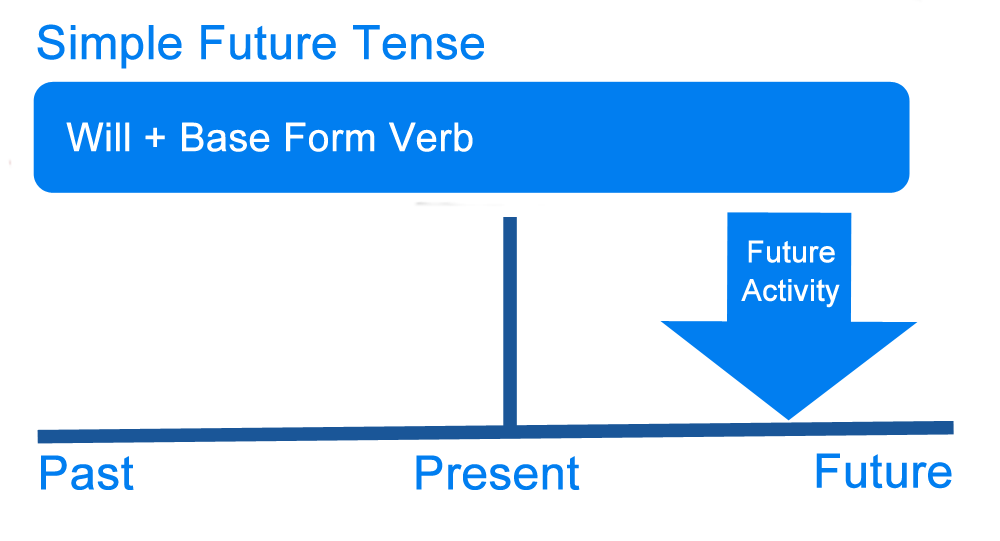
In the past couple of editions of the ‘English Corner’, we’ve gone from the past to the present in terms of understanding and using the grammar structures that encompass these lengths of time. Now, we’re going to take our knowledge of English grammar into the future by going over and analyzing the ‘Simple Future’ tense. If you have a good basis of understanding when it comes to the past tense and the present tense, you should have no trouble with the future tense, especially the ‘simple’ version of the tense to start out with.

In order to master the simple future tense, we need to use the word ‘will’ and implement that word into the correct order of the sentence. This is why the simple future tense is sometimes known as the ‘will tense’ instead due to the importance of this particular word. In order to create the correct form of the simple future tense, we need to get the structure down without any problems.

As always in the English language, we are going to want to start our sentence even in the simple future tense with the ‘subject’ at the beginning whether it is ‘I, You, They, We, He / She, It, etc. After the subject comes the auxiliary verb first which in this case you are going to put the future indicator ‘will’ right after the subject. Once you have the subject and the auxiliary verb set up, you can then put the main verb after that to fill out the third part of the sentence. Lastly, you’re going to finish the sentence with the action taking place and the object that is being referred to. Overall, the structure of a ‘simple future’ tense sentence should be ‘subject + auxiliary verb + main verb + action (object).

Here are a few examples to consider:

  • I will go to the store today.
  • He will do his homework before tomorrow.
  • We will attend the theater musical later tonight.
  • They will finish the job as necessary.
  • She will study mathematics for her test tomorrow.

Sometimes, you’re going to want to make the simple future tense from its’ usual, positive form into the negative form which isn’t that much different except for one important difference. In order to make this grammar tense negative, you’re going to want to put the word ‘not’ between the auxiliary verb, which is the word ‘will’ and the main verb, which could be any number of verbs to express what you would like to be doing in the future.

If you want to go ahead and put the simple future tense into the question form, you’re going to want to exchange the usual placement of the subject for the auxiliary verb and switch them around with each other. In order to get a better understanding of the negative and question forms of the simple future tense, let us take a look at some examples that I have listed below:

Negative

  • I will not go to the store tomorrow.
  • He will not beg to keep his job.
  • You will not get a promotion unfortunately.

Questions

  • Will you do your homework please?
  • Will she go out with you to the dance this weekend?
  • Will we win the match if we practice hard today?

Another thing to be aware of when it comes to the simple future tense is that you don’t need to use ‘will’ in the auxiliary verb part of the sentence all of the time. To express the future, you can exchange ‘will’ for ‘shall’ in order to get your point across.

Examples

  • I shall not waver from this decision that I must make tomorrow.
  • I shall work my hardest to ace this job interview on Wednesday.

Beyond just writing correctly in the simple future tense, when it comes to the spoken form, you can be much more informal with your choice of words. If you’re speaking to someone about the future, you’re going to want to contract both the subject and the auxiliary verb. You should push them together to become one word with the help of a well-placed apostrophe. You don’t have to speak or write in the contracted form but you can do so if you’re being informal and don’t feel the need to sound everything out for the other person or for the audience.

Examples

I will –> I’ll

I’ll be sure to call you back after I’m done cooking.

You’ll need more time to study tonight since your exam is tomorrow.

In addition to contracting the positive form, you can also contract the negative form of ‘will’ with a slight difference in its’ wording. Instead of ‘will’ being contracted into ‘I’ll’, it becomes something else entirely.

Examples

I will –> I won’t

We won’t stop the strike until our demands are met.

They won’t stop playing their awful music in the house next door.

Now that we have the structure of the simple present tense down to a science, let’s focus on the ways in which we can use this grammar form to the best of our ability.

More often than not, the main reason we choose to use the simple future tense is because we have no plans or obligations ahead of us so we can choose to do things spontaneously instead without putting much thought into it. Sometimes, as human beings, we do things without much planning so using ‘will’ in a sentence to express a spontaneous action is quite useful. The decision that you make or the action that you take can occur right away or within a short notice.

Examples

  • I’ll bring you a drink.
  • We will go see the new Star Wars movie tonight.
  • They will leave after dessert is served.

It should be kept in mind that there are a few known exceptions where ‘will’ is actually the main verb in a sentence and the auxiliary verb is another word that can take its’ place to express a future action to take place. The primary example of this exception is the word ‘think’, which can exchange places with ‘will’ to become the auxiliary verb and to express what the subject may do in the future with regards to their plans or obligations.

Examples

  • I think I’ll buy a bike later today.
  • We think they’ll do the right thing and return the money.
  • She doesn’t think that you are guilty.

Another main use of the simple future tense is to try and predict the future. While these predictions aren’t foolproof and could end up being wrong, we try to be as certain as possible before using ‘will’ in a sentence to prove its’ inevitability. As human beings, we are prone to make mistakes but we try to predict the future as if it is set in stone.

Examples

  • It will snow heavily tomorrow.
  • He said the Yankees will win the World Series this season.
  • We will be victorious in the spelling bee next week.

Lastly, without changing the structure of the simple future tense, you can add the verb ‘to be’ after the important auxiliary verb ‘will’ to create some additional sentences with the same grammatical form. It is not necessary to use ‘be’ in a sentence with ‘will’ but it can help you to create additional examples such as the ones below.

Examples

  • I will be waiting for you outside the doctor’s office when you finish.
  • Will we be meeting at the ice skating rink at 8 PM?
  • They won’t be able to come tonight to dinner, should we reschedule?

Oftentimes, you can use ‘going to’, the present progressive (continuous) tense to express what plans or actions you have for the future. However, for now and for the next edition of ‘English Corner’, we are going to continue to focus on how to use ‘will’ to express the future including its’ continuous form, which we will review next month. Until then, keep studying your English and please let me know if you have any questions or comments!

English Corner – Past Progressive Tense

Now that we have covered both the Simple Past Tense and the Present Progressive tense in the past few months, we will be able to move forward with our summary and analysis of this month’s ‘English Corner’ focusing on the underrated yet important ‘Past Progressive Tense.’ If you want to express your sentiments or observations in English regarding something that was happening in the past as a continuous action or movement with no clear end date, you’re going to want to utilize the past progressive tense in order to make the grammar of your sentence work properly.

While not as popular as the simple past tense, it’s an important concept to grasp in order to fully understand the past tense as a whole. Both the simple and progressive forms of the past tense tend to overlap quite a bit, sometimes in the same sentence or paragraph, making it necessary to know when and where to use both or either grammar tense to talk about actions and happenings in the past. Compared to most grammar tenses that you will learn in the course of your English studies, the past progressive tense tends to be one of the simplest and easiest to grasp.

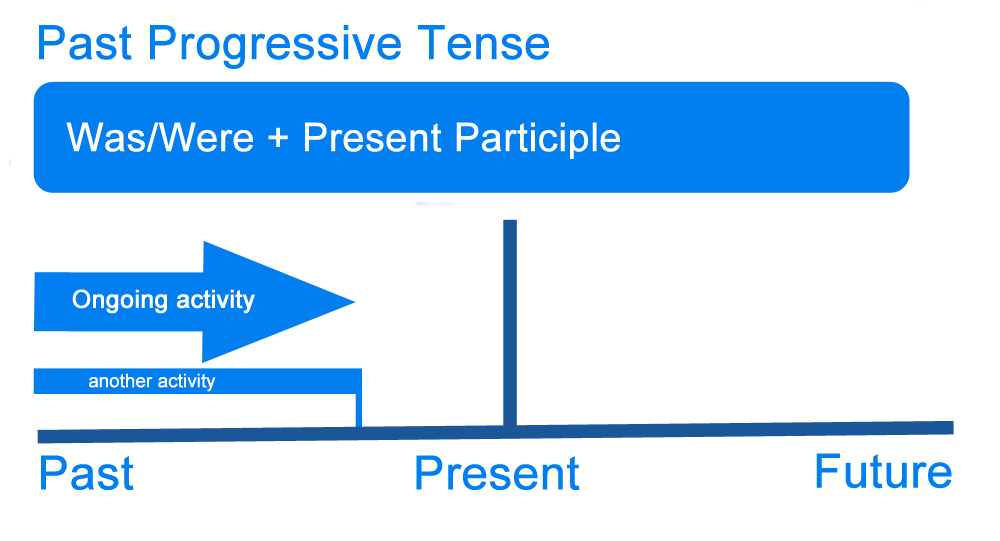
To form the ‘past progressive’ tense is quite simple and is very similar to the present progressive tense in how the structure works. In order to make this grammar tense function, you need to put the ‘to be’ verb in the past tense. There are two different ways for accomplishing this method. If it is a singular action that was occurring, you’re going to use the word ‘was’ before the main verb if you’re referring to one person or thing. However, if it is a plural action being described, you’re going to use the word ‘were’ before the main verb if you’re referring to more than one person or thing.

The actual main verb is going to be in its’ present progressive form with –ing being added to the end of each verb after ‘was’ or ‘were’ that will make it a past progressive tense sentence. It is very important that you follow this structure, otherwise, your sentence won’t make much grammatical sense and you’ll need to re-order the structure in order for your sentence to be understood by the reader. Don’t stress about it if you don’t get the concept at first.

Here are some examples with the basic form of the past progressive tense using ‘was’ or ‘were’:

  • I was riding on the train when lightning struck the tracks nearby.
  • We were going to go to the movies on Saturday night but you canceled on me.
  • They were talking about us at the lunch table today as we walked by.
  • He was not doing the job like his boss wanted him to do it.

If you are thinking of making the past progressive tense negative, all you need to do is to put the word ‘not’ between the ‘to be’ verb in the past form and the actual action that was taking place at the time. If you’re struggling with forming a sentence by using the past progressive tense, you should look to these examples in order to help you in the future as an English student.

When it comes to the past progressive tense, you are often describing an action or an occurrence that is happening within a limited time frame while something else in the past was going on at the same time. When you write a sentence in the past progressive tense, you should be aware that most sentences with this grammar tense would be describing two actions in the past and not just one action. Here are some examples of past progressive sentences where two actions are being described simultaneously:

1) John lost his wallet while he was dancing salsa at the club.

2) Jane found her keys while she was watching her favorite television show.

3) We ate a lot of tapas dishes while the bands were playing Spanish music at the restaurant.

As you can see, it is quite easy to form the past progressive tense in a sentence if you are able to describe two actions occurring within the same timeframe. The major difference between the simple past tense and the past progressive tense that any student of English grammar should be aware is the fact that the simple past tense describes a completed action from the past while the past progressive tense describes an incomplete action from the past that is still playing out. If you’re still confused, here are some examples that highlight the difference between the simple past tense and the past progressive tense:

  • I slept throughout the night while the rain was coming down heavily. (Simple past tense and Past progressive tense)
  • I drank too much juice yesterday, which made me sick. (Simple past tense)
  • He was dancing all night long to the wonderful music of Michael Jackson. (Past progressive tense)

As highlighted in the examples above, the simple past tense and the past progressive tenses can be used together in the same sentence without any problems. However, it is possible to use them in separate sentences as well, which will make the sentence a lot simple to create. Be aware that the word ‘while’ is a way to connect a sentence together that uses the two forms of the past tense together in a seamless manner.

Lastly, it’s important to note that the subjects ‘I, He, She, It’ should be used with the singular word ‘was’, which is the past form of ‘to be’ before describing the past action that was happening. For the subjects of the past progressive tense which are ‘You, We, They’ should be used in conjunction with the plural word ‘were’, which is the past form of ‘to be’ before describing the past actions that were happening. Here are a few examples to clarify the difference between ‘was’ and ‘were’ in the past progressive tense:

Singular: I was playing, He was playing, She was playing, It was playing.

Plural: You were playing, They were playing, We were playing.

Overall, the past progressive tense is a lot simpler and straightforward when compared to other grammar tenses such as the simple past tense. As long as you remember the rules, study the examples, and practice writing sentences using this verb form on your own, you should be just fine. As always, if you have any questions or comments, please leave a comment for me and I would be happy to answer them for you. Good luck and look out for next month’s English corner!


English Corner – Simple Past Tense

For this edition of ‘English Corner’, we’re going into the past to figure out and understand the ‘Simple Past Tense.’ In order to successfully master the English language, you need to be able to use the simple past tense correctly. Whether it’s talking about what you did yesterday or last week or even five years ago, the structure and formation of the simple past tense should not be overlooked. As we discussed previously with the simple present tense and the present progressive tense, having a good grasp of these basic grammar forms will help you to get better in English really quickly.

In this blog post, I’ll go over when and how we should use the simple past tense and you will be able to see a few examples of how to put this grammar tense into action. If you have any questions or comments, please leave them for me below the article, as I am happy to help anyone out who needs additional assistance with the simple past tense. After going through this grammar tense for this post, be on the lookout for the next edition of ‘English Corner’ when we go over the past progressive tense.

If you have heard about the ‘preterite tense’ but don’t know about the ‘simple past tense’, then you can be at ease knowing that they are one in the same. While there are different forms of the past tense, the ‘simple past tense’ has become the most commonly used form and is quite easy to master if you are able to understand and apply the structures and the different ways you can use the grammar tense in a sentence.

When it comes to creating the simple past tense, the structure is quite simple. There are three types of sentences that you can form with the simple past tense: positive, negative, and questions. For positive sentences, you’ll put the ‘subject’ first and then add the ‘main verb’, which will be in the simple past tense. For negative sentences, you put the subject first and then an auxiliary verb with the verb ‘to do’, put into the past tense, which becomes ‘did’ followed by the word ‘not’ afterwards to indicate the negation in the sentence. The last part of the ‘negative’ sentence with simple past is the ‘main verb’ so the structure should be ‘subject’ + ‘auxiliary verb and ‘not’ + ‘main verb’ to complete the sentence fully. The question form of the ‘simple past tense’ is very similar to the negative form but there’s one exception that makes them different from each other.

The ‘auxiliary verb’ comes first before the ‘subject’ and then after the subject comes the ‘main verb’ and the ‘object’, which completes the sentence’s overall purpose. Positive sentences for the simple past tense do not have any auxiliary verbs as the negative and question sentences do reply upon. The verb ‘to do’ is the most important one when it comes to forming the simple past sentence regardless if its’ a positive, negative, or question form of the grammar tense. Lastly, the negative sentences you create must have the ‘not’ word after the auxiliary verb and before the main verb in order for it to make grammatical sense.

Examples

Positive Sentences:

I did go to the mall last weekend. (to go)

         I did play with my friends at the park yesterday. (to play)

Negative Sentences:

I did not think you were polite at the lecture on Monday. (to think)

I did not believe you when you said the stock market crashed. (to believe)

Question Sentences:

Did you do your homework last night? (to do)

Did you tell her you were late for class? (to tell)

When it comes to the verb ‘to be’, there is a different structure for the simple past tense that the average ESL student should be made aware of. In order to put ‘to be’ in the past tense form, it’s either going to become ‘was’ or ‘were’ depending upon what subject is being used at the beginning of the sentence. For the positive form of the was/were usage of ‘to be’ in the past tense, you start with I/He/She/It (subjects) and then the verb, which in this case for singular subjects would be was, followed by the object of the sentence.

For sentences with subject plurals like We/They/You, you are going to change ‘to be’ from was to were to reflect the change followed by the action / object again. For the negative form, you’re just going to add ‘not’ between the main verb and the object at the end of the sentence. ‘Was or were’ are going to be placed at the beginning of a question sentence followed by the subject and the actions that are involved in the sentence.

Examples

Positive Sentences:

He was here yesterday evening at the dinner table. (to be)

         You were in Istanbul last weekend for a friend’s birthday. (to be)

Negative Sentences:

I was not at the park last night because I had work to do. (to be)

They were not at the party because they were not invited. (to be)

Question Sentences:

Was she nice to her date last Thursday night? (to be)

Were you happy with how you did on the Spanish exam? (to be)

Compared to the verb ‘to do’ in the simple past tense, ‘to be’ has no auxiliary verbs at all even for the question and negative forms of the verb tense. However, it is the same in that ‘not’ always comes after the main verb for a negative sentence. The subject also becomes the past tense form of the verb ‘to be’ while the main verb moves to the middle of the sentence and is actually the subject words such as he / she / they, etc.

If you simply would like to use the past simple tense with most of the verbs you’ll be using in your sentences, you will add the letter ‘d’ or ‘-ed’ to the end of the verb in order for it to make sense grammatically. There are a couple of examples we should take a look at it when it comes to forming the simple past tense of the verb with ‘d’ or ‘ed.’

Examples

  1. After school, he walked home in the rain.
  2. He danced really well with his date at the senior prom.
  3. She planned to go to Europe this summer but she couldn’t save up enough money.
  4. Because his mother was sick, he baked a chocolate cake.
  5. We went to the movies after we ate at a Mexican restaurant.

It’s important to note that there may be some irregular verbs that are formed differently when it comes to the simple past tense. For example, ‘go’ in the simple present tense will become ‘went’ when it comes to being grammatically correct in the simple past tense. Another verb like ‘eat’ will become ‘ate’ and ‘drink’ will also change slightly to become ‘drank.’ While most of the verbs only need a ‘d’ or an ‘ed’ to be properly simple past, there are a few irregular verbs that should be memorized for the fact that they are exceptions to the rule when it comes to going from present to past in terms of how the word is written and pronounced.

Now that we know how to use the structure of the simple past tense, you’ll also want to be aware of what kinds of uses do we have for this particular grammar tense. The main purpose of the simple past tense is to talk about the past meaning that we want to shed light about a thing, an action, or a situation that happened in the past. These events can be as recent in the past as in they happened last night or they can be events that occurred long ago such as discussing a sports championship that happened over a decade ago.

Examples

  1. I played my violin last night for my parents and brother. (short time ago)
  2. I had a great time living in Istanbul, Turkey back in 2015. (long time ago)

When we use the simple past tense, you cannot refer to events or actions that are happening currently in the present or are slated to happen anytime in the future. The simple past tense only focuses on those events and actions that were completed sometime in the past. It simply doesn’t matter if the event was finished ten years ago or ten seconds ago. The fact is that it’s still in the past and the sentence structure should reflect the grammatical tense that fits the place and time.

Lastly, it should be noted that the books you’ve read or the movies you seen who occur in the past are mainly going to use the simple past tense. The present perfect and simple present tense may be used in stories or movies as well but you’re going to want to pay attention and listen to the sentences with the simple past tense because they are going to be the most common.

If you want to practice your simple past tense after reading this article, I recommend listening to songs, reading books, watching movies that take place in the past. Besides speaking or writing about the past, participating in the active listening and / or reading about events or moments in the past will help to take your English language skills to the next level. I hope you enjoyed this ‘English Corner’ post and please leave a comment if you have any questions, queries, or comments.

Book Recommendations – Volume IV

Wintertime is often the best time to settle down with a cup of hot coffee / tea and open up a new book or fire up your Kindle to catch up on some reading. When it’s cold and snowy out, there is no better way to pass the time than to sit down with a good book in order to learn something new or to be entertained by a particular story. If you’re looking for some good recommendations, here are three books that I have read recently that I think avid readers would enjoy especially if you like non-fiction material. If you happen to read any of these three recommendations, please let me know what you thought of these books in the comments section below.

markmansonbook

1.) The Subtle Art of Not Giving A F*ck by Mark Manson is a current New York Times bestseller and is not your typical self-development book. I have been following Mark’s writings for a couple of years now and I hold him in high regard. He has helped change my life for the better with his unconventional life advice and his second book is a great read. Contrary to some self-help books that advertise a philosophy of feeling good all the time and always being positive, Mark instead advocates for a more balanced approach to life. It’s important to embrace the negatives and setbacks in life because you’ll be a stronger and a more mature person for it.

It’s a common truth that not everything will go well in life so it’s better to make due with that than to have a ‘pie in the sky’ attitude all of the time. Mark asks the reader to think about the fact that going through negative experiences is actually a positive experience and can teach us a lot about ourselves. Having solely positive experiences without any adversity or setbacks is itself a negative experience as well because you didn’t struggle and fight for it, which means that it wasn’t that much of a big deal in retrospect. Learning from our past mistakes and our failures is just as important, if not more so, as having massive success according to Mark’s thesis.

The title of the book itself, The Subtle Art of Not Giving a F*ck, doesn’t imply that we as human beings shouldn’t care about anything going on in our lives but rather that we should be more selective about the things that we can truly control and have some input in. You shouldn’t give a f*ck about everything, only the things that matter the most to you and that truly impact your life in some way. Overall, this book is a really thoughtful perspective on living one’s life in a mature and thoughtful manner and has some really practical advice for any demographic of reader.

lightsoutbook

2.) Lights Out: A Cyberattack, A Nation Unprepared, Surviving the Aftermath by Ted Koppel is a well-researched, thought out look about the cyber security challenges facing the United States especially when it comes to the national energy grid that makes it possible for Americans to live a 21st century lifestyle. I remember watching Ted Koppel on ABC’s Nightline when I was a child and he always impressed me with his ability to look at a story he was reporting on from all angles and do a thorough job with interviewing different people involved with the issue. This book written by Mr. Koppel is no exception. Mr. Koppel does great investigative reporting on what is being done and what isn’t being done to prevent such a cyber attack from happening.

With the increasing amount of focus being put on cyber security as it affects different businesses, individuals, and governments, this book is a must-read as it considers the areas in which we are most vulnerable to attack. Mr. Koppel looks at how we can address the current gaps in cyber security such as when it comes to our different energy grids across the United States and what should be done about it in order to prevent an attack from happening in the near future. Mr. Koppel interviews a wide variety of people involved with cyber security from the Secretary of Homeland Security to leaders of the Mormon church in Salt Lake City to ‘preppers’ across the U.S. who make it a lifestyle habit of preparing themselves and their families with emergency supplies and goods in case a cyber attack happens and the electric grid goes down.

The frightening possibility of a regional and national blackout happening in the United States is discussed in detail as to what would be the consequences and how long it would take for the electric grid to go back online. The current picture isn’t very rosy and a lot of work needs to be done according to Mr. Koppel. Hopefully, the policy makers and leaders of government take notice of this book as it is both a warning and a call to action for those people in power to do more about this situation and to help protect against such a potential disastrous scenario.

hillbillyelegybook

3.) Hillbilly Elegy: A Memoir of a Family and Culture in Crisis by J.D. Vance was one of the most important books of 2016 for its’ insight into a part of the United States that rarely gets much in-depth coverage. This book is a mix of a personal memoir of Mr. Vance’s life who is a native of the hills of Kentucky and who grew up in southern Ohio and also a retrospective on the economic and social conditions that are affecting Appalachia to this day. Mr. Vance goes into great detail about the struggles of the white, working class, both self-inflicted and those wounds placed on them by economic decline and societal decay that’s out of their control. It’s a community that doesn’t get much fanfare but who still have a political impact as showcased in the recent 2016 election.

Even with a troubled family that both uplifts him and casts him down, Mr. Vance through his hard-work and intellect makes it out of Appalachia and was a member of the Marine corps, a law school graduate and now a successful writer. However, it could be argued that he is the exception and not the norm when it comes to the current state of Appalachian communities. Upward mobility can be hard to believe in for today’s America with stories like Mr. Vance’s becoming less and less common. For this course to reverse itself, economic vitality has to come back to forgotten regions like the Rust Belt and Appalachia. The current social malaise and dispirited communities may be able to improve if the local economy were to improve for families like the Vance’s.

You root for the people of Appalachia highlighted in this memoir who have been dealt a bad hand in life but still try to make the best of things and want to help their family members achieve the American dream, even if it appears out of reach to most. One such example that sticks in my mind from this book is ‘Mamaw’, Mr. Vance’s grandmother and one of the few steady and pragmatic influences in his life that helped make him who he is today. To change a community and a society, it starts with the family but it doesn’t end there. Families in these communities need a future and they need prospects, both educational and job-wise. Let’s see if this book has an impact as well on the policymakers, think tanks, and government leaders. It’s a must-read and I highly recommend it.


An Urban Transformation

img_2039
“The kids were cheering me on.”

I had the pleasure recently of visiting Comuna 13, a neighborhood in Medellin that has had a difficult history with gang violence and the illegal drug trade but which is showing signs of both progress and renewal. Due to the investments made by both the local and city government, Comuna 13 has become a hotbed for beautiful street art and graffiti murals, which has attracted many local artists to make a positive mark on this community. Many of these artists are from Medellin and grew up in the neighborhoods of Comuna 13. Rather than discuss the past of Comuna 13, I would rather talk about why this particular community is poised to have a brighter future.

Beyond just the new street art and the graffiti murals that you can find around Comuna 13 are the relatively new escalators that connect the San Javier metro station to the communities located in the hills surrounding this transportation hub. These escalators make it a lot easier for both students and workers to gain easier access to the rest of the Medellin metropolitan area and are an easy way to get from point A to point B. The escalators are free to use for all people including the tourists who come to visit this part of the city.

While the escalators are not so numerous, it is possible that more of them will be added to other parts of the city in the future if I were to haphazard a guess. Medellin can set an example to other urban cities on how to connect neighborhoods efficiently with the use of escalators, especially those with sloping hills and steep mountains within the city limits. For the elderly and children as well, these escalators can be quite useful in helping them get around the neighborhood without too much trouble.

If you don’t feel like taking the escalators, there are concrete staircases adjacent to the new escalators so you can choose which way you want to go up or go down. The escalators are weatherproof as well which is quite genius when you think about. On your way to the metro, the overhang, which is a bright, fluorescent orange color, will protect you fully from the elements such as rain, snow, hail, etc. It only takes about five to ten minutes to get from the top of the escalators to the bottom of the escalators so if you’re in a rush, you won’t have to go through too many escalators to get to your final destination.

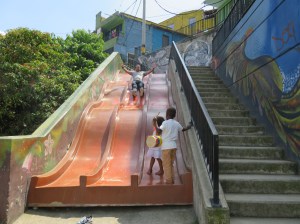
The city government of Medellin and local police has done a great job in my opinion with regards to keeping this part of Comuna 13 safe and secure. I noticed during my visit that locals and volunteers are instrumental in helping to keep the area around the escalators clean and orderly. There are park benches and small parks nearby to encourage community get-togethers as well as the fact that there is a big slide where the local children can use to slide up and down to have some fun in the neighborhood. Being the kid at heart that I am, I partook in one of the slides because it is pretty enjoyable and you do go down at a pretty fast speed.

Beyond just the new escalators, the cool slides, and the park benches, there are also now a few library parks, which are free for members of the community to enjoy, explore, and learn. In addition to being places for education, the libraries are great meeting places for the community and can strengthen neighborhood ties. You can also hold cultural, recreational, and educational activities such as group English classes or a family birthday party. Books in these libraries are free to borrow and use.

Everyone can use them regardless of their age, educational level or social status. The mind is a terrible thing to waste and because of the twelve library parks in Comuna 13 and other parts of Medellin, city residents here have a real chance to learn new things and satisfy their curiosity. One particular volunteer group that I’m interested in learning about is called ‘Stairway to English’, which provides free English classes with native speakers to members of the Comuna 13 community.

My visit to Comuna 13 left quite an impact on me. I did go through an organized tour this time, which I do recommend to people visiting this webpage. It was really useful to learn about the history, background, and the progress being made for this part of Medellin. Medellin is quite a large city and it can be easy to get caught up in only staying within your own neighborhood and to not see other parts of the city. Personally, I do hope that other escalator projects in urban areas will become popular in Colombia and other parts of the world.

Human beings are increasingly becoming more urban with over 70% of the world’s population projected to be living in cities by mid-century. This puts the onus on local, city, and national governments to adapt to this reality and try to make life easier and better for the millions of people who call a city their home. Other cities should take note of the social progress being made in Comuna 13 and I can only hope that more and more residents of Medellin will be able to improve their lives in different ways because of urban projects like building library parks or constructing escalator routes.

If you’re in Medellin sometime and you’re curious to check out the positive urban transformation that is ongoing in Comuna 13 and other parts of the city, I would recommend using Comuna 13 Tours, which has a very knowledgeable, kind, and helpful staff members who are bilingual and want to share their city with foreigners out of the goodness in their heart. This is not an official endorsement and I don’t get paid or receive any benefits from mentioning this tour on my website.

I’m doing it because I really enjoyed the experience I had recently with them and I think other visitors who come to Medellin should do the same based off my positive experience using this tour group. Perhaps, most importantly of all, you’ll meet a few locals during your tour and you can see how hospitable, kind, and open they are in Comuna 13. My only advice is to be careful about your photo taking, and to be respectful of both the tour guide and the locals who are kind enough to take some time out of their day to share with you. I look forward to visiting Comuna 13 again someday and I hope to use that giant slide again too.

For more information: http://www.comuna13tours.com/

English Corner – Present Progressive Tense

present_progressive_tense
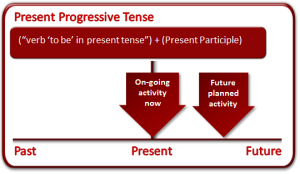
“If you’re not sure where the Present Progressive Tense fits into the timeline, I have a useful chart for you to study.”

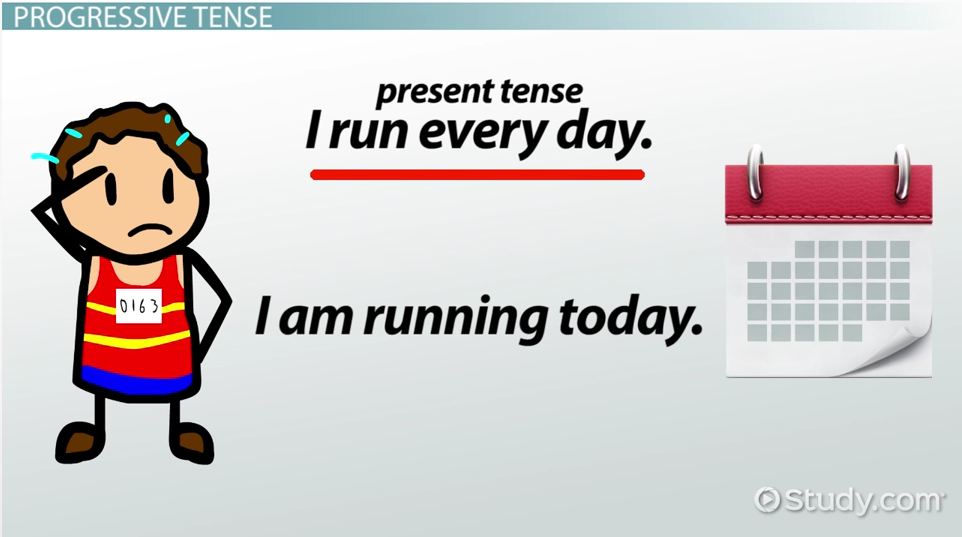
As a student of the English language, once you’re able to understand and use the ‘Simple Present Tense’ with proficiency and are ready to move on to the next grammar step, it would be wise to start learning about the ‘Present Progressive Tense.’ This particular grammar tense can help you to describe a number of different topics and can be used in a variety of ways. By studying the examples listed in this blog post and knowing when to apply the present progressive tense, you’ll be able to advance and get better in your study of English grammar rules.

The ‘Present Tense’ is divided into two kinds: the ‘Simple’ present tense and the ‘Continuous’ or ‘Progressive’ present tense. In order to fully understand the present tense grammar form, it’s important to understand both the ‘simple’ and ‘progressive’ aspects to this concept. Please follow along and read through this blog post if you’re a student of English grammar and want to better understand the ‘Present Progressive Tense.’ We will start by looking at a couple of examples regarding how this grammar tense is supposed to be structured. I would recommend that you copy these particular examples so you have some idea on how to use the present progressive tense in a sentence.

Examples

  1. I am going to the store today.
  2. We are planning on coming to your wedding tonight.
  3. What are you doing for dinner later this evening?

For the actual structure of the Present Progressive tense, it’s a little bit different when compared to the Simple Present tense. It’s necessary to begin the sentence with the ‘subject’ word whether it is “I, You, We, They, He / She, etc.” and you can also use the question form as well with “What, When, Where, Why, etc.” at the beginning of a sentence. The auxiliary verb, which is supposed to be conjugated in the Simple Present tense would come next and is modified depending upon which ‘subject’ word is used at the beginning of the sentence.

The auxiliary verb “to be” is the most popular form when it comes to the present tense so it is meant to be used often when it comes to creating the sentence. When you conjugate “to be” in the simple present form, you’ll end up with “is, are, am, etc.” depending upon the subject word. The auxiliary verb is always followed by the main verb, which is supposed to be displayed in present participle form. When we mention the present participle form, it basically involves the verb such as “do” and adding an “ing” to the end of the verb.

For negative sentences, the form of the present progressive sentence is a little bit different compared to regular sentences. It’s necessary to put the word ‘not’ in between the auxiliary verb and the main verb in order for the sentence to make grammatical sense.

Examples

  1. I am not dancing at the ball tonight.
  2. You are not playing basketball tomorrow.

If you’re thinking about making a question sentence with the present progressive tense, there’s a clear step that you need to take in order to make it work. The ‘subject’ at the beginning of the sentence must be exchanged for the ‘auxiliary verb’ due to a necessary change in the structure of the sentence in order to make the question work.

Examples

  1. Am I doing the right thing?
  2. Are you playing the piano for the recital?

As you can see, the ‘am’ which is the auxiliary verb comes at the beginning of the sentence this time and the ‘I’ word comes after and becomes secondary in terms of its’ placement. The positive and negative forms of the present progressive tense are quite similar to each other with the only difference being that the ‘not’ is added into the structure of the sentence in order to create that difference but the actual structure of the present progressive tense does not change at all. When it comes to the question form however, there is a change in the actual structure of the present progressive tense with the fact that the ‘subject’ and the ‘auxiliary verb’ essentially change places in order to form the actual question.

Now that we know the structure of the present progressive tense in its’ main forms of usage, how do we know when to put this grammatical tense into action? Well, it’s quite simple actually. There are some fundamental principles that guide the use of the present progressive tense in formal sentences. The present progressive tense can describe actions that are happening in real time and are continuing into the near future.

These could be actions or occurrences that are happening right now and have not been finished yet. These are actions that are in progress and have not reached the completion stage yet. This is why we add the –ing to our verbs to indicate that the action is ongoing and hasn’t reached an end yet.

Examples

  1. The wheels are spinning.
  2. The tables are turning.
  3. The guns are firing.

In addition to those actions that are occurring right now, there are also actions that have no set time frame or completion date yet but are ongoing and will require some time to finish. This is the most popular use for the –ing form and there are a lot of examples that can be construed from it.

Examples

  1. John is taking Salsa lessons.
  2. Martha is learning how to cook.
  3. Bob is starting a new job.

Despite being known as the ‘present progressive’ tense, this grammatical tense can also be used to describe actions or habits that will be occurring in the near future. In order to make this work though, you must add a word to indicate that something will happen in the future. Some examples of these words include ‘tonight, tomorrow, next week, this weekend, two days from now, etc. Usually, you are describing something that has been planned out to occur in the future with a specific date or timeframe in mind. People are long-term planners and thus, we are able to talk about actions that we will take in the future having made the plans ahead of time.

Examples

  1. I am going to attend university next August.
  2. I am planning to go to Mexico this winter.
  3. We are thinking about having our honeymoon in Hawaii next month.

The plan has already been set in motion and that’s why you’re discussing what you’re going to be doing but at a future time and place. It’s vital to remember that the present progressive tense does not exist without adding -ing to any verb regardless of which verb it is. The present progressive tense may not be the most popular grammatical tense but it is extremely important to practice, create examples, and master it both in its’ written form and its’ spoken form. Before you can go on to the ‘past’ and ‘future’ grammatical tenses, I believe that it’s necessary to have a good handle on the present progressive tense first before moving on to something else. Keep my explanations and examples in mind and look out for another ‘English Corner’ coming to you all soon.

English Corner – Simple Present Tense

wordle1
“Hobbies, routines, and daily habits are key actions that are described by the simple present tense.”

If you’re a student of the English language, chances are good that you’re familiar with the ‘Present Tense’ grammar form. In order to form basic sentences in your writing or to make yourself understood verbally when speaking to a native speaker, it’s important to learn the ‘Present Tense’ especially before moving on to the ‘Past’ and ‘Future’ tenses which is slightly more advanced and complicated to master.

The ‘Present Tense’ is divided into two forms: the ‘Simple’ present tense and the ‘Continuous’ or ‘Progressive’ present tense. In order to fully understand the present tense grammar form, it’s important to understand both the ‘simple’ and ‘continuous’ aspects to this concept. Please follow along and read through this blog post if you’re a student of English grammar and want to better understand the ‘Simple Present Tense.’ For next month’s edition of English Corner, we will focus on the ‘Present Continuous Tense’ and how that grammar tense is formed correctly.

The Simple Present tense is regarded as being the easiest to learn and most vital tense to master in order to the basics of English grammar down. For example, the simple present tense uses verbs like “to be” and changes the form into singular or plural depending on if you are referring to one more person or more.

For Example:

  • He is on his way to the store to pick up some fruits and vegetables.
  • They are at the ballpark tonight to watch the baseball game.

We can see from these examples how the verb “to be” is put into the simple present tense using the word ‘is’ or ‘are’ depending on if the subject of the sentence is singular or plural. For the subject ‘He’, the corresponding simple present tense form of “to be” would be is which is singular. For the subject ‘They’, the corresponding simple present tense form of “to be” would be are which is plural. With the subject word ‘I’ which is singular, we will use the word am which is singular but is different from the word ‘is’ which is used for ‘he’, ‘she’, or ‘it.’ The subject words of ‘they’, ‘you’ or ‘we’ would be used for the word ‘are’ as mentioned before.

The structure of the present simple tense is quite easy to form correctly when compared to other English tenses. You simply need to put the subject and the main verb together to form the basis of a sentence. This goes for positive sentences which don’t have a negative connotation or which form the basis of a question.

For Example:

1) I do like to swim with my friends at the lake.

The subject for this sentence is the word ‘I’ and the verb form is ‘do’ and it is possible sometimes to follow one verb with another verb or two verbs, as is the case with this sentence. ‘Do’ and ‘like’ can be together as well as ‘to swim’ and then to finish off the sentence with ‘my friends’ who are the objects and ‘at the lake’ which is the location along with a prepositional phrase.

The first verb in a sentence when there are other verbs after is known as the auxiliary verb, which comes before the main verb(s). Once again, it’s important to note that ‘I do’ can change form into becoming ‘He does’ or ‘She does.’ It is a common rule that the verb must be modified to change depending on which subject word in English is being used.

If you need to make a simple present sentence negative, it’s important to add the word ‘not’ after the auxiliary verb of ‘to do.’

For Example:

1) I do not like to dance because the basic moves are hard for me.

2) He does not want to go to work because he does not like his boss.

Regardless of the subject word being ‘I’ or ‘He’, there will always be a ‘not’ after the auxiliary verb. You can have multiple verbs being used in a simple present sentence as well. There is no limit to the amount as long as the sentence makes grammatical sense to the audience.

In order to form a question using the simple present tense, the order of the sentence needs to change slightly in order to reflect this shift. Instead of the ‘subject word’ leading off the sentence, the auxiliary verb of ‘to do’ must be at the beginning. You can either put ‘do’ or ‘does’ at the beginning of a simple present tense sentence. After that, you can place the subject word whether it is ‘I’ or ‘you’ right after the auxiliary verb. In this case, after the auxiliary verb and the subject comes the main verb and then finally the object which is wrapped up with a question mark to finish the sentence.

For Example:

1) Do you like to go skiing?

2) Does he know who you are?

It’s important to remember that the positive form of a simple present tense sentence doesn’t have an auxiliary verb in it while there is one in both the negative and the question form of the sentence. With the main verb for the positive form, it’s important to add an ‘s’ to the end of the word especially if it’s a third-person subject like ‘it’, ‘he’ or ‘she’ in order to make the sentence grammatically correct.

For Example:

  • He likes to dance salsa on Saturday night.
  • She knows that it’s important to study for the Chemistry exam.

When it comes to the negative and question forms of the simple present tense, certain rules must be observed. The auxiliary verb form must be used in both cases and also needs to be conjugated. The main verb form does not change and often comes in its’ normal form which is ‘to ____’. For negative sentences, the word not must come between the auxiliary verb and the main verb for the sentence to be coherent. Lastly, The auxiliary verb has to come at the beginning of a question sentence while the subject comes afterwards which is a reversal of what you would see in a positive or negative form of the simple present tense.

In terms of using the simple present tense correctly, it’s best usage comes in terms of describing general times and situations. Action verbs like ‘to do’, ‘to eat’, ‘to work’, ‘to dance’, and ‘to swim’, etc. are apart of the simple present tense umbrella of usage. This grammar tense is instrumental in describing a statement, which is always true as well as describing actions, which are continuous, habitual, or come from a routine. The simple present tense is most often associated with the verb ‘to be’ which can describe whom somebody is, what they do, where are they going, and why they are unique. The simple present tense can describe those actions, which happen in all forms of time whether it is the past, present, and future.

Out of all English grammar forms, the ‘Simple Present’ tense forms the base of a simple sentence. For any Basic English language student out there, it’s a necessity to master this concept before moving on to other forms of the present tense. After successfully understanding the methodology and the usage behind the simple present tense, an English learner will be ready to move on to the next challenge: The ‘Present Continuous’ tense.