

Trust Is The Foundation

“Trust is the bedrock that glues our society together. It is the foundation for which our relationships are built on.”

Without trust, there can be nothing. Trust is the bedrock that glues our society together. It is the foundation for which our relationships are built on. Once that bedrock is ruptured, it can never fully heal again. This is why we place such a high value on it because it can be hard to find or even replicate whether in business or in work or in our lives in general. We learn from a young age the value of keeping our word, being accountable for our actions, and being part of a team or a whole.

If we cannot make a promise, we shouldn’t keep it. We learn not to overpromise, undersell, or to bite off more than we can chew in what we can be relied upon for. Whether it is a secret between friends, a business deal that should remain private, or our duty to uphold a certain standard in our professional lives, the ideal of trust is at the center of how we are expected to act and behave. Trust can be earned over time and can take months, years, or even decades to build on it but while it is hard to gain trust initially, it can last a very long time with repeated adherence.

However, once the trust is broken between people or groups or societies, it can never truly be fully healed again as it once was. While verbal trust is a key part of our lives, we often go above and beyond to string together the bonds of trust more deeply. We shake hands to formalize a deal, sign the terms and conditions of an agreement, have legal papers, lawyers, and the ‘fine print’ drawn up, so the trust given and received is as clear as day. There are multiple ways to establish trust with each other but there are just as many ways that trust can be broken too if you are not careful.

It is not just our work lives or business success that depends on the trust established within them but also our personal relationships. If you are not seen as trustworthy but those people who are closest to you, it is likely that will extend outwards to other kinds of relationships in your life. It is vital to maintain your trustworthiness across the board regardless of how fleeting the ties to the other person or group are. While our relationships, business dealings, and professional ties will all begin and come to an end, our reputation precedes us throughout our lives, and it is important to keep your trustworthiness intact as you navigate the years and decades of who you meet and who you establish connections with.

Trust is not only about keeping your word or telling the truth to someone else or acting in an honest matter, but it is also about not promising something that you can’t deliver on or embellishing or making up falsehoods to earn the other person’s trust. You may think you are able to take an action or provide something or to promise a result but if you cannot guarantee it 100%, it’s best to pull back and let that person or group know that it is not entirely possible. How often have you heard that expression, “don’t make a promise that you know you can’t keep.”

It’s not only about breaking a promise that shatters trust but also trying at something that you said would happen and guaranteeing its success without being realistic about the odds or about if you could deliver the intended result without error, delay, or setbacks. You not only have to be honest with other people to establish trust but also honest with yourself and what you can and what you cannot do for them.

Our own ego can sometimes hurt our own trustworthiness because we are biased in believing we can do more or be more or accomplish more than what we can do when we make a promise. It can be difficult to reign back our promises to others and to pull back our own ego when it comes to what we are capable of. However, it is necessary to keep our trust alive with the other group or person with whom you are dealing with. I believe it is better to hurt our own ego when it comes to being realistic about the promises or the actions, we can accomplish rather than to lie or to embellish or to delay the unrealistic promises that were made, which hurts that trust or even breaks it completely. When the trust is broken, the other person won’t think you’re honest or reliable or even a good person so that is why trust itself is the foundation for which any kind of relationship is built upon.

Trust being the foundation of an individual’s relationships is key, but it also portends to our society and our world. Shared values, beliefs, and rules are built on trust in that if you will follow them and obey them so will everyone else living in that society. If that trust is broken in the sense that there are rules for me and you, but not for them, then that trust in one another starts to erode. Basic civility, courteousness, respect for laws and rules, and overall trust builds society up and when promises are broken, when double standards are common, and when one party or group holds unfair advantages over another group, without any kind of recourse or change made to make the society fairer, then the society will suffer as a result.

It is no accident that more productive and successful societies and countries function at a higher level, and it comes down a high level of trust between its citizens regardless of age, gender, race, socioeconomic background, etc. When trust is shared by all to play by the rules and do the right thing for each other, then that society and/or country will flourish as a result. How can a society establish strong economic ties, pass new laws that are enforced for all, and foster a strong education system that works for all? if it is not built on that fundamental trust that we are to look out for one another rather than to take advantage of one another instead.

If you can read this article knowing that your trust for your fellow man or woman is high and that they can rely on you as you would rely on them, then you’re in good shape where you are with the trust of your society. However, if your trust in your fellow man or woman is waning and you are skeptical of other people’s intentions often, well, then unfortunately, your society has a lot of work to do to rebuild and strengthen that fundamental trust. You should be part of that change by helping to build up the trust in one another again where you are at rather than to keep poking holes in the foundation or to tear it down completely. The choice is yours to make.
On Duty and Honor

“Two concepts that are not discussed very often today in our culture, but for which go hand in hand to have a purposeful life are duty and honor.”

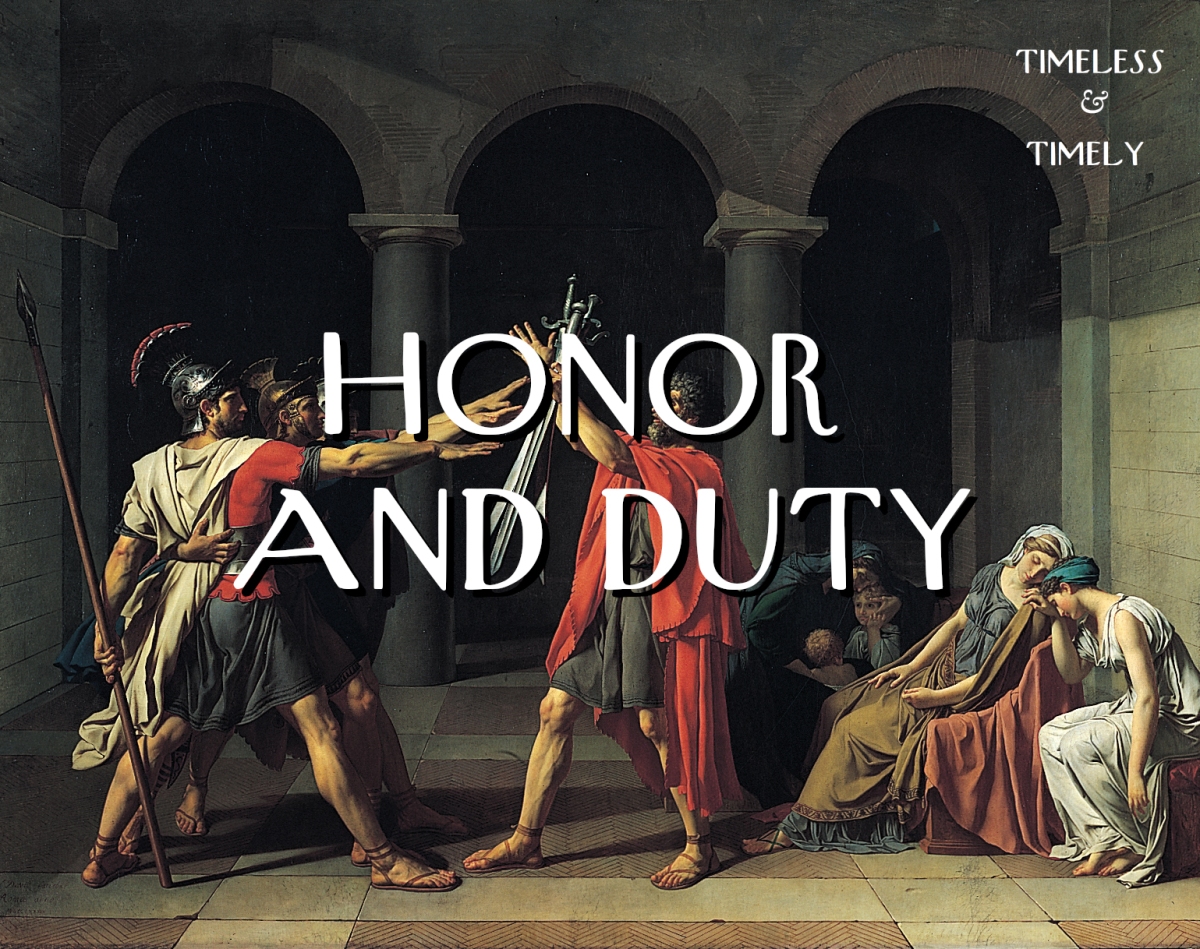
Two concepts that are not discussed very often today in our culture, but for which go hand in hand to have a purposeful life are duty and honor. Duty is the obligation, either moral or legal, to uphold your responsibilities and to take upon tasks and actions when called upon. Duties are be thrust upon you such as being part of jury or registering to be eligible for military service but also done voluntarily such as keeping your community clean by picking up trash, giving money to a charity, being part of the local school board or town forum.

There are many variations on duty, but what they all have in common is to think of more than just yourself and to be responsible to those people around you. We are duty-bound by law in many such cases, but we are also duty-bound by morals and values that are passed on from generation to generation.

Being dutiful is conscientiously being able to know what your duties in life are, pursue them vigorously, and to conduct them in a moral manner. Duties may not be easy or fun to fulfill, but we have them in place so that society can function at a higher level. If no one was duty-bound to others, selfishness, greed, and egocentric behavior would replace it, which would cause the larger community and society to collapse over time. Lack of duties breeds this kind of behavior whether they are mandatory or not. If everyone is out for themselves and not able to look after others or think of their behavior’s effect on other people, it would create what we know to be as a ‘dog eat dog’ world.

When you fulfill your duties, legally bound or morally footed, you uphold the basic contract as a citizen and as a human being, to help improve your community and the society to some degree. If everyone fulfills their duties, trust, confidence, and belief in each other will be much more assured. If nobody does what is required or expected of them, nothing substantive can get done. The more duties we fulfill and the more we look out for another rather than ourselves, the better off we are to be when we commit to these obligations.

Duties can be granted and often must be enforced to be fulfilled but if we each uphold the duties we are given and see each other as all being on the same page, other duties that we voluntarily take on can be added on if we see that the system is working, and people are putting in their fair share. If a few individuals, especially if they leaders or representatives of their community, are found to be neglectful of their duties, and especially lied about fulfilling such duties, it can easily cascade to where the average person sees this and will unfortunately not find the duties they have been given as being as necessary to commit to if they see those who put them into place or have mandated them do not fulfill them as well.

Regardless of where you find yourself in the overall society, a leader, a citizen, a representative, a voter, etc., we are all held to the same duties and obligations that we commit ourselves to by law or by morality. If we all uphold those duties through acts of good faith and completing tasks that are insured to us, the better off everyone will be.

However, if duties are neglected, discouraged, or done away with even if they are mandated, the whole society will suffer as a result due to a loss of trust, faith, or belief in what upholds this basic sense of equality that we have to be beholden to the same duties as everyone else is regardless of age, sex, race, religion, ethnicity, etc. Now, it is commendable to do your duty, but it is even better to do so with honor.

Being honorable or conducting oneself with honor is taking the duties you are given to uphold or the tasks that come with such duties is to perform such duties with integrity, accountability, and trustworthiness. It is one thing to do your duty and it is another thing to do your duty well.

You can think of someone who is elected to be a representative of a community, town, city, or nation who will use the position for egotistical purposes and to twiddle the time away while doing nothing of honor to make sure the people who elected him or her will benefit as a result. They have been given the honor of representing their community or a nation and have squandered it by neglecting the privilege of having such a position to do good on behalf of others. There is no honor in that even if they are technically fulfilling the duty of public service.

Duties can be bestowed on soldiers, politicians, community leaders, public figures of influence, religious clergy, teachers, etc. and they can perform them because they have been trained or are seen as qualified to fulfill them. However, the question arises is if they are doing their duties with honor? Some will only do the bare minimum and will only think of themselves while having their position of power or influence wrapped up. Others will use their newfound duties to abuse their position for financial or social gain and lie to say that they did not do anything dishonorable to begin with.

Luckily, there will be those people in positions of status who will conduct themselves honorably and seek to uphold that trust bestowed upon them by being transparent, accountable, and forthright. A good leader or example of someone who conducts themselves with honor is that they do not only do their duties as expected of them, but they also seek out those in a similar position or authority who are not doing their duties. They will not only conduct themselves with honor intact but make sure they are holding others in their position accountable and to find out if their honor is there.

If not, that person of authority or influence would work to ensure that the individual without honor even while having done their duties albeit in a lackluster manner are held to account. To uphold that trust across a society where we all must do our duties and to do so with honor, those without honor should lose their given duties when it is found that they are not holding themselves to that standard. When we each hold ourselves to an honorable standard by doing the duties bestowed upon us to the best of our abilities, then the larger community or society will benefit as a result.

Without duties, there is no honor to be had. If duties are being done without honor, no functioning society will result. It is important to understand how much these two concepts feed off each other. One cannot exist without the other and if one concept is neglected, the other will suffer as a result. We all must commit the duties and obligations bestowed upon us whether by law or by creed, but duties must also be performed to high standards, both morally and ethically. Performing one’s duties without honor cannot work and nor can having honor without upholding one’s duties.  

The Power of Saying ‘No’

“As much as we like to say ‘yes’, it’s important to know that saying ‘no’ is just as important and even just as powerful.”

There is nothing wrong with saying ‘No’ to someone else. Saying ‘No’ has a negative connotation but it can be worth its weight as much as saying ‘Yes.’ There is a main reason why we have both ‘Yes’ and ‘No’ in English language vocabulary. There are times in our life when we can say ‘yes’ but we also have to moderate our impulse to say, ‘yes’ to things, people, and other commitments by balancing it out with the ‘no’s.’ As much as we like to say ‘yes’, it’s important to know that saying ‘no’ is just as important and even just as powerful.

When it comes to saying ‘no’, you do not want to overdo it either but it’s best to moderate your ‘no’s and to pick when and where to use that word. As you get older in life, the ‘no’ should be more often and the key hump to get over is to have any shame or remorse for saying ‘no.’ Psychologically, it’s much easier to say, ‘yes’ than it is to say ‘no’, but I would argue the ‘no’ needed to happen rather than a false ‘yes.’ Often, a truthful ‘no’ will be much better for you and other people than a fake ‘yes’, which could do much more harm. People don’t like to hear ‘no’s’ but rather than to embellish people with false yes’s, you must be firm with them and make the ‘no’ part of your vocabulary with them, even if they are friends or family of yours.

While others would not like to hear ‘no’, it is best not to lead them on when you’re not interested in anything related to business to doing favors to getting into a relationship. Honesty is part of the power of saying ‘no’ and if that person truly values you, they won’t be bothered by hearing the ‘no.’ A good litmus test for knowing how much someone cares about you is their reaction when you are bound to tell them ‘no’ at some point for one reason or another. If they give you a hard time in giving them a sincere ‘no’, it may be best to not be around them as much. The person(s) you say ‘no’ to, even if they are family or friends, should be mature and responsible enough to take the ‘no’ well and to understand that the ‘no’ itself is not a reflection of them as people but what they may be asking or telling you to do. If you disagree, have reservations about, don’t find it appealing, or don’t have time for it, it is best to say ‘no.’

When you tell other people ‘no’, you should always be firm but also do be as gentle as possible. It does not have to lead into a confrontation or an argument either. A good ‘no’ can be followed up with ‘that’s the way I feel’ or ‘sorry but it’s not possible, or ‘that is not something I’m interested in.’ Saying ‘no’ should never be seen as being disrespectful, rude, or condescending because it does not need to be as such. If you want to still be on good terms with someone like a friend or family, you can express your regret or disappointment on having to say ‘no’ depending on the ask or request. You don’t have to do that, but it can soften the blow, which may be important in salvaging the relationship or friendship for the long-term. In that relation to the other person or people, if the ‘yes’s outweigh the ‘no’s, the ‘no’ won’t be as big of a deal too. They should balance each other out but it is good to mix them up in order to have no ‘no’s at all or too many ‘yes’s back to back.

Most importantly, having the power to say ‘no’ not just every now and then but whenever you feel like it is crucial. You should not feel nervous or anxious about saying ‘no’ and to be ready to do so at any time. As we get older, we must be prepared to say ‘no’ more and more often. Time is limited as well as the chance to foster relationships, friendships, or job / business opportunities. If something does not sound that appealing to you at first, it’s best to have a firm ‘no’ for it rather to waste either your time or your money.

It’s likely in life that you’ll regret the ‘no’s you didn’t say rather than the ones that you did say ‘no’ too. There are plenty of charlatans, liars, scammers, fakers, and crooks out there and you need to be ready to say ‘no’ to them. Instead of saying ‘yes’ too many times, be more comfortable in saying ‘no’ especially if your heart, mind, or body are not into the idea. Unless you are enthusiastic or thrilled by the idea, thing, or even the person, a preemptive ‘no’ will make you better off in the long run. There is a power in saying ‘yes’ but there is also an equal if not more important power of saying ‘no’ especially if you are worried about losing precious time or valuable money or other resources.

Most of all, you should do your best to think deeply or weigh the ‘yes or no’ decisions as much as possible. Lose the impulse to give either a ‘yes’ or ‘no’ quickly unless you do not have the time or place to think it through first. Not controlling your impulses when it comes to saying ‘yes’ or ‘no’ can cost you both in the short-term or in the long-run. Be sure to have the power to say ‘no’ but remember to think it through carefully first before giving the ‘no’ to someone or something. Also, as I mentioned before, please be sure to phrase the ‘no’ in a polite or respectful manner. It’s not so much that you said ‘no’ at all but if you do it in the wrong way or with the wrong tone, you may risk losing that person or thing you care about forever.