If you are looking for a mainstay of most living languages, you should look no further than the concept of the ‘Idiom.’ The Idiom is the closest thing that humans have in terms of a universal connector among the diversity inherent in all forms of spoken language. The most important thing to understand about the idiom is that you are not supposed to take them literally but you are still supposed to take them seriously. There’s a deeper, implied meaning beyond any idiom regardless of the language it’s spoken in. This is especially the case in the English language where there are hundreds, if not thousands of idioms that can be used for any matter or circumstance.
Idioms can be extremely diverse in their range and can refer to any amount of unique subjects or topics. Idioms can also be used very locally, regionally, or nationally depending upon the language and the culture it comes from. A dialect, jargon, or accent can also lend to the idioms used by a certain group of people who share common interests and/or beliefs. Idioms can be used in reference to business, politics, science, art, music, and other parts of daily life.
It can be tough to decipher which idioms are the most used in the English language but there are a few of them that stand out in terms of their popularity and their different ways of usage. Most people who speak English are likely to be familiar with these idioms below or have used them themselves.
Examples
Don’t count your chickens before they hatch.
Meaning: Don’t get ahead of yourself before things are accomplished.
Have a chip of my shoulder.
Meaning: You’re bothered or annoyed by something that won’t go away.
Don’t jump to conclusions.
Meaning: While not taking this statement literally, you shouldn’t pass judgment on someone or something before you receive all of the facts.
A dime a dozen.
Meaning: Very common, easily found anywhere and everywhere.
An ace in the hole.
Meaning: A secret advantage or a benefit that no one else knows about and is going to be used soon against an opponent or adversary.
Sentences
The science project isn’t finished yet because we still have to build the volcano. Don’t count your chickens before they hatch.
I don’t like critics doubting my basketball skills. They really give me a chip on my shoulder.
We don’t know whether or not he’s telling the truth about his new invention, Let’s not jump to conclusions.
These Amazon ‘Alexa’ AI devices are a dime a dozen. You can find them everywhere and they are really popular.
I have Matt Ryan as my starting Quarterback in Fantasy Football this weekend. He’s my ace in the hole.
Idioms can refer to someone’s actions and the consequences of those actions highlighted in example idioms such as ‘Pay the piper’ and ‘Rub somebody the wrong way.’ Idioms can refer to people in general when you say that they are ‘sick as a dog’ or ‘six feet underground.’ Lastly, colors in English can often become part of idioms themselves such as when you describe somebody as feeling upset or depressed as having ‘the blues.’ You know that the person isn’t actually ‘blue’ in their color but rather they have ‘the blues’, which is referred to as when somebody isn’t feeling well. There is a whole musical genre that is devoted to this kind of mellow music called the ‘Blues.’ ‘Out of the blue’ is another example of a color kind of idiom that refers to something happening when you least expect it to.
It can be very difficult to get the hang of idioms especially if your proficiency level is at a low level. First, you need to be able to conjugate verbs, have a good grasp on the vocabulary by knowing a lot of different words, and then you need to be able to understand the meaning behind the idioms and use them with other native speakers in the right way. The idioms being used depends upon the region, the culture, and the social group you find yourself in. That is why there are such a sheer variety of idioms that can be used in any given situation regardless of the language that the idiom falls under. Idioms cut across language and cultural barriers and can have similar meanings to each other depending upon the situation.
The best way in which to comprehend and start using English idioms is to talk with native speakers who will use them throughout a conversation even if they don’t realize it at times. The more conversations you have with English speakers, the more idioms you will pick up on and remember. They will most likely want to help you out so do not be afraid to ask questions if you don’t understand the meaning of the idiom or why it’s being used in a certain sentence.
Before you start using idioms yourself, you want to be absolutely clear that you’re using the idiom within the right context for the right meaning. It can be a bit embarrassing if you tell your American friend who is starring in a Broadway play that you want him to ‘jump the gun’ instead of to ‘break a leg.’ Idioms take time to understand, use, and master but they are an important part of learning any language, including English.
______________________________________________
If you have liked what I have written in this ‘English Corner’ post, and you are interested in improving your English language skills whether its’ with speaking, writing, or just boosting your knowledge of grammar, I would be happy to help you reach your language learning goals. Check out Learn English With Ben to book a private lesson with me today!
Using the ‘imperative’ is similar to using the bare infinitive and has the same form as the singular or plural ‘you’ when it comes to forming it. The imperative clause is used for many reasons and is flexible in terms of its’ usage. Some of the reasons for using the imperative include when you want to tell somebody else to do something, giving them advice, making suggestions, creating requests, enforcing commands, or handing out orders and/or instructions. This means that you can tell people do things or to not do things and you are usually not referring to anyone in particular when you give out these imperatives.
There is no specific subject indicated when it comes to the imperative form of sentences. It’s rather about addressing who is listening to you whether it’s one listener or multiple listeners, and the speaker is addressing a general subject rather than a specific subject. The base form of the verb in its’ present form is usually the most common way to create an imperative sentence. You can make the imperative as direct as possible or make it more indirect as to not hurt someone’s feelings, which will make him or her less likely to do something for you.
Let us take a look at some of the reasons why we use the imperatives as mentioned earlier as well as cite some specific examples when it comes to the reasons being used.
To give advice or suggestions
Examples:
-Go to the gym three times a week to lose weight.
-Eat fruits and vegetables daily to stay healthy.
To give directions or instructions
Examples:
-Turn right at the street corner and walk 400 meters to the store.
-Cut the tomatoes into small pieces and add them to the guacamole.
To give orders or commands
Examples:
-Fire the missiles!
-Shoot the ball!
-Be silent now!
To give warnings
Examples:
-Put your cell phone on to airplane mode.
-Wear your seatbelt.
To make polite requests
Examples:
-Please eat your peas and carrots, Karen.
-Be quiet during the movie please.
To offer invitations
Examples:
-Join us for the birthday party, John.
-Come with him to the dance tonight.
It’s important to not refer to the subject as ‘you’ regardless if your imperative is singular or plural in its nature. Instead, it would be better to refer to the specific individual by their name or be more general than that by omitting the subject totally from the sentence.
If you really want your ‘imperative’ to stand out, it would be best to add the word ‘do’ to the beginning of your command, request, or instruction. The word ‘do’ really adds emphasis to your imperative and helps to create a sense of urgency that is not easily replicated with other word substitutes. The word ‘do’ has a powerful meaning in the English language that makes it an important part of mastering imperatives. Here are a few examples that uses ‘do’ in an imperative sentence effectively:
Examples:
Do be kind and gentle to your grandmother.
Do the right thing and help that old lady carry her groceries home.
Do finish your exam on time!
Having been able to use the word ‘do’ in an imperative sentence in the ‘positive’ form, you should also be able to use ‘do’ in its’ negative form. In order to use ‘do’ negatively, you need to add the word ‘not’ right after ‘do’ to create ‘do not’ as the beginning of the imperative sentence. You can also combine ‘do not’ together to create ‘don’t’ to create an even more powerful and emphatic command or request. Here are some examples that you can use with ‘do not’ or ‘don’t’ to create imperative sentences.
Examples:
Do not smoke inside the restaurant.
Don’t give alcohol to underage minors.
Don’t loiter in front of the grocery store.
An important thing to remember when it comes to using imperatives correctly is not to use them if you’re addressing your employer, a family member or relative, or a police officer / authority figure. Imperatives are very direct and you can come off as being harsh or rude in English if you don’t understand when and where to use this type of sentence.
It’s necessary to know who you’re talking with and how well you know them before you start to give out a formal request, a dire command, or a stern warning. Hopefully, with this edition of ‘English Corner’, you’ll know a lot more about ‘imperatives’ and how to form and use them correctly in polite conversation.
There is a fact that you eventually have to come to terms with as a language learner such as myself: there are going to be certain words in foreign languages that have no direct translation to the English language. The art of translation is an imperfect one, which means that you need to be comfortable doing your best to come up with an adequate description of a foreign word even if there is no direct translation available.
The beauty of studying a foreign language is being able to use one word that is able to sum up a number of different emotions and feelings that are tied together. While there are singular phrases and/or words in the English language that have no equivalent in other languages, the same could be said for the Portuguese word of ‘Saudade.’
According to Dictionary.com, Saudade means “a feeling of longing, melancholy, or nostalgia that is supposedly characteristic of the Portuguese or Brazilian temperament.” As you can see from the English definition that I have written about above, there are a great number of different words in English that you could use to describe saudade in Portuguese. While there are multiple words in the English language that could be translated to have the same meaning as saudade, however, in its’ culture and in the overall context, there is only one saudade in its’ original language of Portuguese.
While I have never been to Brazil or to Portugal, I have recently begun to study the Portuguese language in earnest. I now believe that is a really powerful language in terms of communicating both emotions and feelings. Portuguese is a romance language like Spanish, and I have found that the way I communicate in either of these two romance languages is much different than how I communicate in my mother tongue of English. I think that there is a huge variety of ways for which you can express your emotions and feelings in romance languages such as Spanish or Portuguese, and you can be more expressive in those ways when compared to the English language.
I first learned about saudade not from my Portuguese language studies but rather from when I was watching a recent episode of Anthony Bourdain’s show, “Parts Unknown”, when he is visiting Porto, Portugal. There’s a beautiful scene in that episode where Mr. Bourdain is listening to an older woman singing a melodic song in Portuguese about how she has experienced saudade in her past, and how she mourns for a lost lover.
It goes to show you how any human being can relate to that exact feeling even if each individual language has a different way of stating what that feeling is. If you think about saudade in English when it comes to musical expression, the first thing that comes to my mind is the ‘blues.’ You can say that someone has the ‘blues’ and is feeling upset or bummed out about life. However, the ‘blues’ is also a form of expressive music in English similar to how singers and musicians can express saudade in Portuguese musical styles.
I have come to love the word, saudade, because regardless of the fact that it comes from a different language, everyone around the world can relate to it in terms of what it means. Everyone experiences saudade whether they realize it or not. Saudade is longing for someone or something that you’re nostalgic for from your past but which you’re unable to have with you in the present. It’s a deep yearning to go back in time to experience those positive, happy moments that put a smile on our face. It’s a very human thing to want to dive back into your memories and make them real again because one day, that’s all that we’re truly left with.
Whether it’s a long lost lover, a memorable trip, or a fun night out with your close friends, saudade can represent any one of those unique, happy memories. The older a person gets, the more they’re likely to experience saudade because it’s only natural to want the people or things back in your life that were once present and real. While our memories can be happy and joyous, they can also be painful and sad. If you’re yearning for a family member who passed away or a lover who you parted ways with, you’re going to be having saudade. In order to go through saudade, you need to experience life in all of its’ ups and downs. You need to feel things, have experiences, go off to new places, be part of events, etc. in order to make those memories happen whether they end up being beautiful or ugly. That is saudade at its’ core.
Millions of love poems and songs have been written about saudade, whether these feelings and emotions were described in the original Portuguese or other languages such as English, Spanish, etc. While we are happy to have had those experiences, met those people, and done those things, we are also sad because we know those occurrences are in the past and may never come to us again in our lives. Saudade is a very strong emotion and one that we all experience at least once.
When it comes to saudade, it’s important to remember that it’s still necessary to move on emotionally to focus on the present and the future. While it’s nice to reminisce about past memories and experiences, you don’t want to do it so often that you’re handicapping yourself from thinking about what’s next to come in your life, and what your future holds. Like many things in life, there’s a balance to be struck between the past, the present, and the future. Saudade is a powerful and potent feeling but you should not let it consume you.
If you decide to learn more about what saudade is, you should invest in studying the Portuguese language. When it comes to using ‘saudade’ in European Portuguese, it would look something like, “Tenho saudades tuas.” A sentence with ‘saudade’ in Brazilian Portuguese would look a little bit different but very similar to the European structure and form. “Tenho saudades de você”, which translates in English literally as “I have saudade of you” or if you are using the better, more figurative translation of this sentence; Either “I miss you” or “I have feelings for you” would work best in this context.
When it comes to other countries’ languages, there are words that come close to describing what saudade is. Whether its’ the ‘blues’ in America, ‘Sehnsucht’ in Germany, or ‘Tizita’ in Ethiopia, many cultures around the world have their own form of saudade in their respective languages. Saudade seems to be a cultural centerpiece in both Brazil and Portugal with there even being a specific day devoted to the word in Brazil that takes places every year on January 30th.
The fact that this word ‘saudade’ can have figurative translations to other similar words in different languages, and cultures in other parts of the world should show us how interconnected the world really is. There is universality in the human experience that transcends language, culture, and national boundaries. We all feel joy, pain, sorrow, anger, and happiness.
Considering that many languages across the world have a word such as the Portuguese ‘saudade’ to represent the ups and downs of life is a testament to how there is more that should unite us than divide us as human beings. Whether it’s a young Portuguese sailor missing his homeland on the initial journey to the new world, or an elderly man thinking about a lifetime of memories in the local park while feeding the birds as time passes by, saudade is saudade.
We’re going back to the future for this edition of ‘English Corner.’ The ‘future perfect tense’ is our last main form of the perfect tense. The future form of the perfect tense is the most specific in terms of its’ usage and formation. While not the most important grammar tense to learn, if you want to be able to describe actions in the future that have already been completed, it’s necessary to have a good working knowledge of the ‘future perfect tense’ and to be able to use it proficiently. First, let’s take a look at its’ formation and usage before looking at some examples of the future perfect tense in action.
The future perfect tense is a very specific grammatical tense and is only used in a few situations. The 1st situation in which it is used is to describe how long an action will take until some point and time in the future, regardless if its’ near or far from the present time. The 2nd situation is when it’s used to describe at what time or point will a specific action be finished in the future.
Often times, the future perfect tense is used in conjunction with the present simple tense in order to form a grammatically accurate sentence. It’s important to note that when using the future perfect tense, you should have a good knowledge of how to utilize days, weeks, months, years, and other time-related vocabulary in order to be successful in making these kinds of sentences.
Let’s take a look at some examples of the future perfect tense utilizing the simple present tense + the word ‘for’ to describe the length of time in which a specific action is being taken.
Examples
When we finish our group project, it will have taken us three weeks total.
At five o’clock, I will have worked in this office for eight hours straight.
A good ‘future perfect’ sentence should include a future indicative word, which deals with a period of time such as ‘by.’ This is imperative because you can then describe an action being done by a certain time in the future but being more specific with using ‘by’ to hold yourself or other subjects to a general deadline whether it’s on an hourly, daily, weekly timetable.
Examples
By the time I’m 30 years old, I will have completed my Masters’ degree.
By next Tuesday, Your boss will have needed you to finish your environmental report for the office.
In addition, it should also be pointed out that the future perfect tense is formed with a combination of the simple future tense with verbs like ‘to be’. In the future perfect tense, ‘to be’ becomes ‘will be’ combined along with the past participle in the regular form (verb + -ed) to go after the verb being used to complete the sentence.
Here are some other examples when the future perfect tense is being used in the positive form:
Examples
Jane will have cooked dinner by 7 PM tonight.
We will have left the stadium before the lightning storm comes.
By Christmas time, parents will have bought presents for their children.
If you would like to shorten the word ‘will’ and combine it with the subject phrase, you can do so quite easily. All you have to do is change ‘will’ to ‘ll’ and put the subject word (I, we) together with ‘ll and then make the future perfect sentence as you normally would.
Examples
I’ll have studied the English grammar tenses for many months before taking the TOEFL exam.
They’ll have left China by the time you arrive in Japan.
In order to make the future perfect tense ‘negative’ in its formation, you simply need to put the word ‘not’ in between the future indicative word of ‘will’ and the verb ‘to have’, and then the past participle would follow afterwards towards the end of the sentence. You can also make the negative form of the future perfect tense contracted by combining ‘will’ and ‘not’ together to form ‘won’t.’ It’s all a matter of preference but if you’re choosing to use this grammatical tense in formal settings, you should err on the side of caution and use ‘will not’ instead of ‘won’t.’
Examples
I will not have surprised her at the birthday party because she already knew about it ahead of time.
She won’t have helped me out with my paper because she’s been busy doing other things.
It will not have stopped snowing by the time I leave my meeting at 9 PM.
When you have to put the future perfect tense into the question form, you simply need to place the word ‘will’ before the subject word especially if you’re focusing on simple yes or no questions. English learners should not hesitate to use the future perfect tense with ‘Wh-‘ based questions because that is acceptable in its’ formation and usage as well.
Examples (Yes or No – Questions)
Will I have improved my test scores by next semester?
Will it have snowed in New Hampshire by December?
Will you have told the truth to the Grand Jury for the next trial?
Examples (Wh – Questions)
Why will he have got married to Luisa before this Fall?
When will she have been in Colombia for two months?
How will you have met your girlfriend by tonight?
During those times when we think about ourselves, other people and the actions that we take in the future, we need to be able to understand, use, and master the future perfect tense. While these actions may be completed, we need to have some insight into what circumstances did these actions occur especially when it comes to time and place. To project ourselves into the future, we need the future perfect tense to make that happen.
The future perfect tense can make us reflect upon an action or an event that will be completed sometime into the future and beyond the present, but it’s not certain as to when that will happen. Using time expressions are a necessity with the future perfect tense, so make sure that you practice a lot so you can be able to merge these two grammatical concepts together to form functional and unique sentences.
Now that we’ve gone over the present perfect tense with the last post, let’s go back into the past. I’m going to cover the how, when, and why’s of when we use the past perfect tense and how to do so with the correct form and usage. While not the most well know or often used grammatical tense, by improving your knowledge and understanding of the ‘past perfect tense’, you’ll be able to take your English proficiency to new heights. Remember this blog post in the future because it may help you for years to come.
The past perfect tense goes deeper than other past tenses in that you’re going to be referring to two separate yet interrelated events that occurred at some point in the past but at different times and places. The past perfect tense, like other past tenses, refers to an action, event, or thing that took place at a time earlier than now or in the present. The past perfect tense goes further in that it connects two events in the past and ties them together because they are somehow interrelated to some degree. This grammar tense refers to one past event happening before the other event and it’s usually clear which event happened first and which event happened second.
When it comes to the past perfect tense, the first event will be mentioned at the beginning of the sentence and then the second event will be mentioned towards the end of the same sentence and is noted as having happened after the first event.
Examples
Alex had gone out to eat dinner when his phone rang suddenly.
When they had arrived to the birthday party, the cake was already being eaten.
She was already exhausted at 10 o’clock that night because she had studied for the Chemistry exam all day.
You had finished the 5K race when I was just getting started.
Forming the past perfect tense for usage in sentences is quite simple. There is always going to be two parts to forming this particular grammar tense that you should be aware of. Firstly, you’re going to use the verb ‘to have’ in the past tense form, which would change into the word had. Right after the word ‘had’, you’re going to add the past participle of the main verb to be used in the heart of the sentence.
As listed in the examples above, the ‘had + past participle’ combination should come one right after the other to form the past perfect grammar tense. You can use verbs like started, studied, finished, danced, etc. to go along with the past tense form of ‘to have.’ There are only some slight changes to be made to the past perfect tense when it comes to the negative or question form of this grammatical tense. I’ll also use another example of the ‘positive’ form of the past perfect tense to compare the three versions together.
Example – Positive
I had realized my mistake in the equation but it was too late to change.
Example – Negative
John hadn’t thought that it was a big deal to skip the gym this week.
Example – Question
Had they worked hard enough to earn the Nobel Peace Prize? (+)
Hadn’t you sung before with the city choir before tonight’s performance? (-)
It’s quite common when it comes to the negative form of the ‘past perfect tense’ to contract ‘had not’ into ‘hadn’t’ to express it. It’s not obligatory to contract the negative form of the verb ‘to have’ but it’s quite common to use especially if the sentence is informal in nature. In the negative question form of the ‘past perfect tense’, you can also be free to contract the ‘to have’ verb if you feel that it is necessary although it is not mandatory to do.
The word ‘had’, positive or negative form, will always go at the beginning of the sentence if it is in the form of a question for the past perfect tense. While that’s a lot to keep in mind, if you follow the examples listed above for positive, negative, and question form, you’ll be able to catch on quickly in terms of the structure and usage of the past perfect tense.
The last thing to keep in mind is that similar to the ‘present perfect tense’, the past perfect tense also makes usage of the word ‘just’ to describe events that ‘just’ happened in the past recently and could be used to relate to another event in the same sentence.
Examples
I just had put on some coffee when my friend arrived to the house.
The airplane had just departed when I came to the airport gate.
The past perfect tense can be used under a specific circumstance and it can be quite valuable to master when describing multiple events that occurred recently. When it comes to a historical timeline to study or errands that your close friend ran during the day that he wants to tell you about, a working knowledge of the past perfect tense in English could help you in a number of ways. By understanding the structure, the forms, and the usage of this grammatical tense, you should be able to pick it up yourself to be used in polite conversation or for your next story.
Getting better at a foreign language or achieving an advanced level of proficiency in one is not an easy task. I’m not going to sugarcoat it. Regardless of which language you’re focusing on, it can months or even years to get the hang of it. Depending upon how much hard work and effort you put in, you are going to likely improve quicker and remain committed to the process of becoming bilingual or multilingual. Certain people are going to pick up language(s) quicker because they may have a natural talent for it or because they truly enjoy learning the subject and find it easy to excel in.
However, even if you’re not naturally gifted or don’t pick it up quickly, you can still get ahead and make gains in the language through a number of ways. As someone who has studied foreign languages for over half of my life and has also taught English as a Second Language for a few years now, I have a pretty good idea at what separates those students who are going to succeed in their language studies and those students who are likely to fail.
Even though, you may want to be fluently writing in Japanese or speaking to friends in Spanish, you have to put the work in even if language learning happens to come easy to you. It won’t happen overnight but the process can be sped up if you want to boost your ability to learn with a few key steps that I will highlight in the rest of this post. Take these five steps that I will flesh out to heart because it could mean the difference between you being at an advanced level in a year rather than being stuck at the intermediate stage. You don’t have to do all of my five recommended steps to make language gains quickly but it’s definitely recommended to try our at least one or two of them for your own personal benefit as a student of foreign languages.
Be Consistent
While not the most noteworthy recommendation, some language learners forget to put the work in on a consistent basis. If you happen to work five hours on one day specifically on learning a language, that sounds great on paper but if you happen to neglect the six other days of the week, then you’re not really going to make any progress. This is partly why if you study a foreign language in a school or at a university, you’re going to usually have classes four or five days a week so that it stays fresh in your mind. One or two hours per night five or six days a week will go a long way for you and your learning language goals.
Being consistent and responsible in your hours of study will pay off much greater dividends than cramming all of your language studies into one night for a bunch of hours. It’s likely that your brain and memory will be so overwhelmed by all of that information if you cram it into one night that you won’t be able to remember anything you learned by the next week or month. When it comes to any academic subject including foreign languages, you should listen to wise words of a popular phrase that I remember from my high school days: “It’s better to study smart, then it is to study hard.” Don’t overwhelm yourself, stay committed to a language study schedule, and remember to take one day off instead of five or six days off to retain the vocabulary, grammar, phrases, etc. that you have been learning.
Use Both Online and Offline Resources
We live in an amazing time and I would argue that it’s easier than ever to learn a foreign language if you’re willing to do your research, both online and offline. When it comes to online resources, there is almost a limitless amount of information that you can discover dealing with the study of a foreign language. Whether it’s grammar, vocabulary, listening, writing activities, etc. you’re likely to find what you need in order to study and improve if you make the effort to research carefully. In addition to that, it’s easier now than ever to do a language exchange with a native speaker through the medium of an online platform such as Skype, Google Hangouts, etc. You can also use a website like Meetup.com to find a social group to meet up, hang out, and practice your target language with if you happen to live in a big city or large town.
Beyond just online resources, you can network in person by offering to have coffee for an hour with a native speaker of the language you’re learning and if you haven’t had success with Meetup, you can enroll in language classes for a fee at either a foreign language center, community college, or at a local university of note. It’s much easier to make language gains when you live in a big city and have a good amount of money to spare for some formal classes. However, not everybody in the world has that luxury, which leads me to my next step.
Invest in a Private Tutor / Teacher
As mentioned before, not everybody can live in a big city or have the ability to pay for classes at a university or a language center. However, if you can make the more affordable investment of getting a private tutor, it will save you some money and you will be able to practice directly, one-on-one with a native speaker and teacher of the target language.
Usually, a private tutor or teacher who you meet with face to face in person is going to be a bit more expensive than an online tutor. If you prefer to be physically present with your tutor to make it easier for you to learn and clarify the content that you’re absorbing, you may prefer to shell out the extra money for them to meet you at a café or to make a house call to your home and apartment.
However, if you are on a budget, don’t have access to a native speaker of the language you’re learning in your current location because you’re in a small town, don’t live near a foreign language center, etc. you should consider getting an online tutor or teacher. Even though you won’t be physically in the same room as your tutor, you’ll still be able to learn new material, go through lessons together, speak in the target language, and be able to complete homework and classwork to improve your fluency. Online tutors also tend to be less expensive as an investment when compared to real life tutors or to enroll in group classes.
You have to consider how much time you have to devote to the foreign language you’re learning and what your budget is. The cheapest and least expensive option is to have a free exchange of languages if you have a friend or colleague who wants to improve at your language in exchange for them teaching you their language. If you are particularly interested in learning a foreign language online, you should check out platforms like Verbling or Italki.
Immerse Yourself (Books, Music, Movies, TV)
Another great way to boost your foreign language abilities is by seeking out opportunities outside of the classroom or textbook to brush up on your knowledge. Through a variety of media that is available both online and offline, you can spend an hour or two each day going through books, music (songs), movies, TV shows, etc. to listen and absorb the language you’re learning. For example, when you’re reading a book in a foreign language, you can highlight the words that you do not know and find out the meaning with a dictionary. You can also look up news articles online and take the time to translate the sentences and paragraphs from the foreign language into your own language.
You can immerse yourself more deeply into the culture behind the language you’re learning by being exposed to the songs and dances whose lyrics you’ll be able to study and analyze. In addition, you can pick up a lot of a language when you watch a popular TV Show, Movie, or other program. You can not only pick up a lot of a foreign language by spending some time listening to the language and interacting with it but also by observing the host culture(s), and finding out more about the individual expressions and phrases that also make this language you’re studying unique in its’ own ways.
Move Overseas
To save the best and most important step for last, if you want to immerse yourself fully and take your foreign language studies to the next level, you’re going to want to move overseas for a period of time for some intense study of the language. You can watch a lot of movies, you can take a lot of classes, and you can study five or six nights out of the week, but moving to a country where they speak the language you’re learning as a fact of life will challenge your language skills and abilities as never before and put you to the test. Out of the five steps that I mentioned, this one will be the most beneficial to your language studies and also make the biggest impact on your life. I cannot recommend it enough for you as the student to go overseas for as long as you need to improve your language skills and improve as much as you can.
Even if you can only make it overseas for a cultural / language study exchange program for a month or two, you should take advantage of an opportunity like that. Also, if you happen to be in university and have the chance to study abroad for a semester or even a year, you should really do it especially if you’re committed to mastering the foreign language you’ve chosen. Foreign language learning doesn’t have to end even after you have earned your diploma.
You can continue to make trips to those countries where the language is the official one into the future. Other options include taking a gap year off from work or school to devote yourself to language study while you’re traveling around the world. If you are TEFL certified and want to learn a foreign language at the same time, you can move overseas to teach your language to students while receiving lessons from a teacher in that country as well as being immersed in the culture at the same time. There are tons of options out there so if you want to boost your language skills as much as possible, moving overseas for a long period of time could be a great chance for you.
There is no ‘magic bullet’ that will guarantee you perfect, almost native-like fluency in a foreign language. It’s a goal that takes a lifetime to master and even then you’ll still make mistakes and may retain your accent while speaking the language. Learning a foreign language is a lifetime project and is a skill that has to be consistently studied and improved upon.
It’s a common fact that the younger a person is when they start a foreign language, the better off they’ll be. If you start learning Chinese at five years old, you’ll be at a clear advantage when compared to somebody who is first starting a language at twenty years old. The younger a learner is when it comes to a foreign language, the more vocabulary and grammar they’ll be able to retain.
However, it’s important to not be discouraged about this fact even if you’re starting a foreign language in your 20’s and 30’s. With hard work and determination, you can still make a lot of progress especially if you follow these five steps. You can boost your level quicker than usual if you consider implementing these useful steps in your weekly or daily routine.
It’s also a positive that after you learn your first foreign language well, it’s likely to be easier for you when it comes to getting a high proficiency for your 2nd, 3rd, or 4th foreign language. Anything worth doing in life does not come easy so you have to decide how much the study of languages means to you personally. However, with the five steps that I have outlined in detail for you as the reader, you will be able to learn the language well, improve quickly, and reach your goals as a student to develop this crucial skill for the 21st century.
If you liked this article of mine and you are looking to improve your English language skills, please consider the option of having me as your private tutor. You can find out more information about this opportunity at https://benjweinberg.com/learn-english-with-me/. Whether it’s a lesson through Verbling, Italki, or another platform, I’d be happy to work with any English language student from around the world in their quest to achieve an advanced proficiency in my mother tongue. Good luck!
While not the most widely used or well-known grammar tense in the English language, the ‘perfect’ tense does come up every now and then in either your writing, speaking, or listening skills. It’s important to understand both the usage of the ‘perfect tense’ as well as the forming of this grammar tense. We’ll begin this series of the ‘perfect tense’ with its’ usage and formation in the present. In the next two posts, we’ll then dive into the past and future forms and uses of the ‘perfect tense.’ When you get the basic grammar tenses down as I have gone over in past ‘English Corner’ posts, you can move onto more challenging and specifically used tenses such as the ‘perfect tense.’
It may be surprising to teach this right off the bat but the present perfect tense helps to create a link between the past and the present. In a present perfect sentence, you are going to be describing an action or an event that has happened before but it isn’t certain whether that action or event is ongoing. When you use the present perfect tense, you are going to want to focus on the result or conclusion of an action rather than if it’s still continuing or not.
There are five main circumstances in which you can use the present perfect tense. You can do so when discussing an action or situation, which began in the past and has continued into the present. You can talk about an action that was undertaken during a period of time and that has not yet been finished. You could also discuss a repeated action or event that occurred over an unspecified amount of time between the past up until now.
You can also insert the word ‘just’ into your sentence to indicate that an action or event was completed very recently in the past to emphasize how close it was to the present. Lastly, you can describe an action or event that simply took place and was completed without mentioning the time or date at all. If you want to be more detailed about asking why, when, where, what, how, who, etc., you’re going to want to focus on using the simple past tense instead so as to not to confuse these two distinct tenses. In order to get a better idea of these five different uses for the present perfect tense, here are some examples to remember.
Actions Started In The Past that Continue Into The Present
Examples:
We haven’t lived in our house for years.
He has worked in the high school for decades.
Have you played the guitar since you were a teenager?
The Time Period Hasn’t Been Completed Yet
Examples:
I have traveled very far this week.
They have danced a lot tonight.
It has snowed a little bit this winter.
Repeated Actions Between The Past and Now (Unknown Period)
Examples:
We have seen The Terminator three times.
I have been on that roller coaster ride multiple times.
She has visited her parents occasionally.
Completed Actions In The Very Recent Past – ‘Just’
Examples:
Have you just eaten dinner?
I have just finished my thesis.
Has he just left the ballpark?
The Timing of the Action is Not Known or Not Important
Examples:
Have you been to Washington DC?
Somebody has eaten my lunch.
You have studied many foreign languages.
Ultimately, it’s important to remember that additional words like ‘just’, ‘since’, ‘for’, and ‘still’ may pop up every now and then in your present perfect tense sentences depending upon which of the five uses you are utilizing this specific grammar tense for.
When it comes to forming the present perfect tense, there is an actual formula towards creating the right form that each English learner should be aware of. There are two elements to the present perfect tense. The first is the right form of the auxiliary verb represented by the verb to have in the present tense. The second element is represented by using the past participle of the main verb with the base verb + ed. For some examples, the past participle of these regular verbs could be danced, finished, worked, etc. The two elements will also go together when the base verb is irregular regardless of the circumstances.
Positive Form – Example
He has traveled to Japan.
(Subject + verb ‘to have’ + past participle)
Negative Form – Example
She has not traveled to Brazil.
(Subject + verb ‘to have + not’ + past participle)
Question Form – Example
Have they traveled to Colombia?
(Verb ‘to have’ + subject + past participle)
Negative Question Form – Example
Hasn’t he traveled to Japan?
(Verb ‘to have + not’ + subject + past participle)
To finish off this entry on the ‘present perfect’ tense, I’d like to leave my readers with an additional example of how to use a simple verb and express that word in the positive, negative, and question forms by using the present perfect tense. You can use these examples to help yourself when it comes time for you as the student to use this particular grammar tense in your everyday speaking and writing activities as an English language student.
As always, if you have any questions or comments about my ‘English Corner’ posts, please do let me know. Next time, I’ll be covering the ‘past perfect’ grammar tense, which is quite similar to the ‘present perfect’ tense but with a few differences to highlight. In the meantime, keep studying hard and do check out my previous ‘English Corner’ posts on my website.
To Run – Present Perfect Tense
Positive Form
I have ran
You have ran
He, She, It has ran
We have ran
You have ran
They have ran
Negative Form
I haven’t ran
You haven’t ran
He, She, It hasn’t ran
We haven’t ran
You haven’t ran
They haven’t ran
Question Form
Have I run?
Have you run?
Has he, she, it ran?
Have we run?
Have you run?
Have they run?
Note: It’s important to remember that the verb ‘to run’ goes from ran to run when it comes to the question form of the ‘present perfect’ tense. Otherwise, in the positive and negative forms of this grammar tense, you will use ‘ran’ instead to describe this particular verb in the ‘present perfect.’ This is a helpful tip to remember for readers if you happen to be confused by this change.
Similar to the ‘Simple Future Tense’ that was written about in last month’s edition of the ‘English Corner’, it is only natural that we continue with the other form of the Future tense in English known as the Continuous Future tense or the Future Progressive tense. This grammatical tense is the last of the major verb forms that appears often in the English language and it is quite important to master each of the Past, Present, and Future grammatical tenses before moving on to other grammatical topics, which I will proceed with next month. There are a number of similarities between the Simple Future tense and the Future Progressive tense so it’s important to take them into account when you start to use them in either your speaking or writing activities.
Compared to the Simple Future tense, there is a major distinction between it and the Future Progressive tense that should be recognized by the learner. The Future Progressive tense is more specific than the Simple Future tense in that this grammatical tense refers to an event or a thing that will occur at a specific point in the future and is certain in its’ happening at a given time or date.
The Simple Future tense is most often used when it comes to possibilities and probabilities that could occur in the future rather than certain events or things that will definitely transpire. For the latter principle, you’re going to want to use the Future Progressive Tense as much as you can. Now that we know when to use this particular grammar form, we should learn about its’ structure especially when it comes to its’ positive, negative, and question forms.
When it comes to the structure of the Future Progressive tense, you’re going to want to put the subject at the beginning of the sentence regardless if you’re beginning with I, You, We, They, etc. The auxiliary verbs of ‘will’ and ‘be’ should follow after the subject and then to finish off the sentence, you will need to put down a main verb in the present participle form with the base form of the word + ing and then the ‘action’ part of the sentence should come at the very end to complete the structure. It’s important to note that this structure should only apply to the positive form of the Future Progressive tense as the questions and negative form of this grammar tense is a little bit different.
Examples: Positive
I will be going to the Mall tomorrow to do some shopping for my sister.
You will be dancing a lot tonight when we go to the rock concert.
We will be meeting you and your family in the hotel lobby tonight at 8 PM for the cocktail hour and reception.
When you want to use the negative form of the Future Progressive tense with the correct structure, it’s quite simple to do. In between the will and be, the two auxiliary verbs of this grammatical tense, you would need to put the word ‘not’ in between these two words in order to make the structure of the sentence negative in its’ meaning. Also, if you want to turn the Future Progressive tense structure into the question form, you need to exchange the placing of the ‘subject’ at the beginning of the sentence for the auxiliary verb of ‘will’ and have these two parts switch places. Please look at the examples below to get a better sense of how to create the negative and question forms of the Future Progressive tense.
Examples: Negative
I will not be going to the play tonight because I have to study for an exam.
He will not be attending the graduation ceremony because he did not pass all of his classes this semester.
She will not be performing in the Broadway musical because she broke her leg during a rehearsal.
Examples: Question
Will you be joining all of us for dinner tonight?
Will they be marching in the Memorial Day parade tomorrow?
Will we be studying tonight for the important exam on Wednesday?
It’s important to note that certain verbs such as ‘shall’ can be substituted for ‘will’ as an auxiliary verb when it comes to the Future Progressive tense and be used in its’ place. ‘Shall’ and ‘will’ have the same meaning and express the same certainty when it comes to an event or a thing that will definitely take place in the future at a certain time and date.
Examples: Shall
I shall be going to work tomorrow at 9 AM.
I shall be completing the website design project by noon today.
As mentioned in the previous blog post on the ‘Simple Future Tense’, it is quite common to contract the form of ‘I will’ to be ‘I’ll’ and still be grammatically correct with your sentence. If you want to make a contraction in the negative form, you should turn ‘I will not’ into ‘I won’t’ to make sense in your sentence structure.
Contractions: Positive
I will –> I’ll
You will –> You’ll
They will –> They’ll
He will –> He’ll
She will –> She’ll
Contractions: Sentence Examples
They’ll be going to visit Italy in July this summer.
I’ll be hearing from the manager about the job offer next week.
He won’t be marrying his fiancé because he’s not in love with her.
We won’t be traveling to Europe because we don’t have the money.
Before I finish up this post on the ‘Future Progressive Tense’, I would like to remind my readers that the most important distinction between the ‘Simple Future Tense’ and this one is that the Future Progressive Tense refers to a specific timeframe in the future and is very particular in its’ timeline. Since we are using ‘will’ or ‘shall’, you’re going to want to give the reader or listener a specific time or date in the future in which you will be doing the action so that they know when to expect it to be started or completed.
The future action will be ongoing but the reader or listener in question will have a better idea on when the action will be completed as well. Since this is the Future Progressive tense, there must be a specific time and date when the action will be in the process of completion. I will be leaving you with some examples so that you’ll have a better idea of how to use this important grammatical tense. Good luck and please let me know if you have any questions or comments about this particular subject.
Examples: Actions
We will be playing paintball tomorrow morning at 10 AM.
He will be taking the Chemistry exam next Wednesday evening at 8 PM.
They will be playing each other in an important football match starting at 5 PM this Saturday.
In the past couple of editions of the ‘English Corner’, we’ve gone from the past to the present in terms of understanding and using the grammar structures that encompass these lengths of time. Now, we’re going to take our knowledge of English grammar into the future by going over and analyzing the ‘Simple Future’ tense. If you have a good basis of understanding when it comes to the past tense and the present tense, you should have no trouble with the future tense, especially the ‘simple’ version of the tense to start out with.
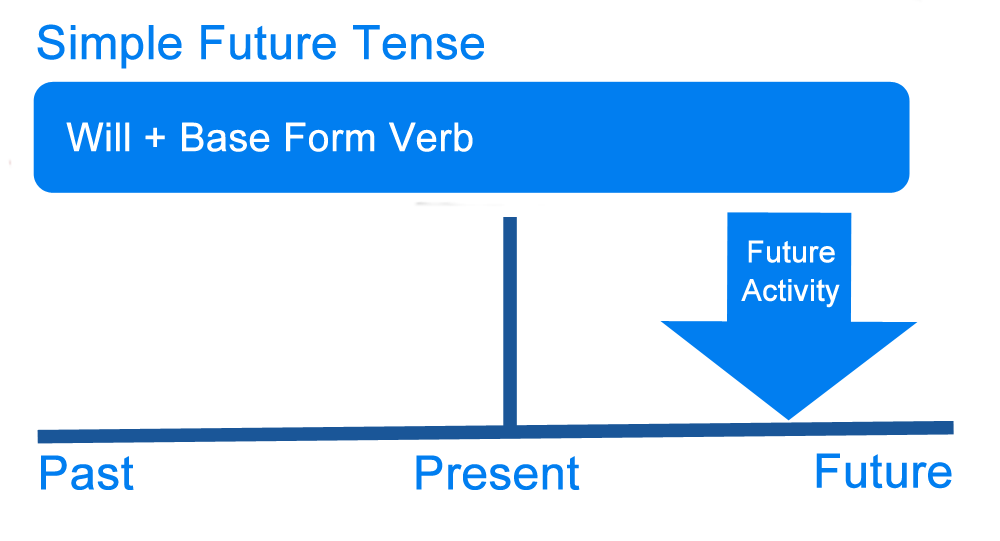
In order to master the simple future tense, we need to use the word ‘will’ and implement that word into the correct order of the sentence. This is why the simple future tense is sometimes known as the ‘will tense’ instead due to the importance of this particular word. In order to create the correct form of the simple future tense, we need to get the structure down without any problems.
As always in the English language, we are going to want to start our sentence even in the simple future tense with the ‘subject’ at the beginning whether it is ‘I, You, They, We, He / She, It, etc. After the subject comes the auxiliary verb first which in this case you are going to put the future indicator ‘will’ right after the subject. Once you have the subject and the auxiliary verb set up, you can then put the main verb after that to fill out the third part of the sentence. Lastly, you’re going to finish the sentence with the action taking place and the object that is being referred to. Overall, the structure of a ‘simple future’ tense sentence should be ‘subject + auxiliary verb + main verb + action (object).
Here are a few examples to consider:
I will go to the store today.
He will do his homework before tomorrow.
We will attend the theater musical later tonight.
They will finish the job as necessary.
She will study mathematics for her test tomorrow.
Sometimes, you’re going to want to make the simple future tense from its’ usual, positive form into the negative form which isn’t that much different except for one important difference. In order to make this grammar tense negative, you’re going to want to put the word ‘not’ between the auxiliary verb, which is the word ‘will’ and the main verb, which could be any number of verbs to express what you would like to be doing in the future.
If you want to go ahead and put the simple future tense into the question form, you’re going to want to exchange the usual placement of the subject for the auxiliary verb and switch them around with each other. In order to get a better understanding of the negative and question forms of the simple future tense, let us take a look at some examples that I have listed below:
Negative
I will not go to the store tomorrow.
He will not beg to keep his job.
You will not get a promotion unfortunately.
Questions
Will you do your homework please?
Will she go out with you to the dance this weekend?
Will we win the match if we practice hard today?
Another thing to be aware of when it comes to the simple future tense is that you don’t need to use ‘will’ in the auxiliary verb part of the sentence all of the time. To express the future, you can exchange ‘will’ for ‘shall’ in order to get your point across.
Examples
I shall not waver from this decision that I must make tomorrow.
I shall work my hardest to ace this job interview on Wednesday.
Beyond just writing correctly in the simple future tense, when it comes to the spoken form, you can be much more informal with your choice of words. If you’re speaking to someone about the future, you’re going to want to contract both the subject and the auxiliary verb. You should push them together to become one word with the help of a well-placed apostrophe. You don’t have to speak or write in the contracted form but you can do so if you’re being informal and don’t feel the need to sound everything out for the other person or for the audience.
Examples
I will –> I’ll
I’ll be sure to call you back after I’m done cooking.
You’ll need more time to study tonight since your exam is tomorrow.
In addition to contracting the positive form, you can also contract the negative form of ‘will’ with a slight difference in its’ wording. Instead of ‘will’ being contracted into ‘I’ll’, it becomes something else entirely.
Examples
I will –> I won’t
We won’t stop the strike until our demands are met.
They won’t stop playing their awful music in the house next door.
Now that we have the structure of the simple present tense down to a science, let’s focus on the ways in which we can use this grammar form to the best of our ability.
More often than not, the main reason we choose to use the simple future tense is because we have no plans or obligations ahead of us so we can choose to do things spontaneously instead without putting much thought into it. Sometimes, as human beings, we do things without much planning so using ‘will’ in a sentence to express a spontaneous action is quite useful. The decision that you make or the action that you take can occur right away or within a short notice.
Examples
I’ll bring you a drink.
We will go see the new Star Wars movie tonight.
They will leave after dessert is served.
It should be kept in mind that there are a few known exceptions where ‘will’ is actually the main verb in a sentence and the auxiliary verb is another word that can take its’ place to express a future action to take place. The primary example of this exception is the word ‘think’, which can exchange places with ‘will’ to become the auxiliary verb and to express what the subject may do in the future with regards to their plans or obligations.
Examples
I think I’ll buy a bike later today.
We think they’ll do the right thing and return the money.
She doesn’t think that you are guilty.
Another main use of the simple future tense is to try and predict the future. While these predictions aren’t foolproof and could end up being wrong, we try to be as certain as possible before using ‘will’ in a sentence to prove its’ inevitability. As human beings, we are prone to make mistakes but we try to predict the future as if it is set in stone.
Examples
It will snow heavily tomorrow.
He said the Yankees will win the World Series this season.
We will be victorious in the spelling bee next week.
Lastly, without changing the structure of the simple future tense, you can add the verb ‘to be’ after the important auxiliary verb ‘will’ to create some additional sentences with the same grammatical form. It is not necessary to use ‘be’ in a sentence with ‘will’ but it can help you to create additional examples such as the ones below.
Examples
I will be waiting for you outside the doctor’s office when you finish.
Will we be meeting at the ice skating rink at 8 PM?
They won’t be able to come tonight to dinner, should we reschedule?
Oftentimes, you can use ‘going to’, the present progressive (continuous) tense to express what plans or actions you have for the future. However, for now and for the next edition of ‘English Corner’, we are going to continue to focus on how to use ‘will’ to express the future including its’ continuous form, which we will review next month. Until then, keep studying your English and please let me know if you have any questions or comments!
Now that we have covered both the Simple Past Tense and the Present Progressive tense in the past few months, we will be able to move forward with our summary and analysis of this month’s ‘English Corner’ focusing on the underrated yet important ‘Past Progressive Tense.’ If you want to express your sentiments or observations in English regarding something that was happening in the past as a continuous action or movement with no clear end date, you’re going to want to utilize the past progressive tense in order to make the grammar of your sentence work properly.
While not as popular as the simple past tense, it’s an important concept to grasp in order to fully understand the past tense as a whole. Both the simple and progressive forms of the past tense tend to overlap quite a bit, sometimes in the same sentence or paragraph, making it necessary to know when and where to use both or either grammar tense to talk about actions and happenings in the past. Compared to most grammar tenses that you will learn in the course of your English studies, the past progressive tense tends to be one of the simplest and easiest to grasp.
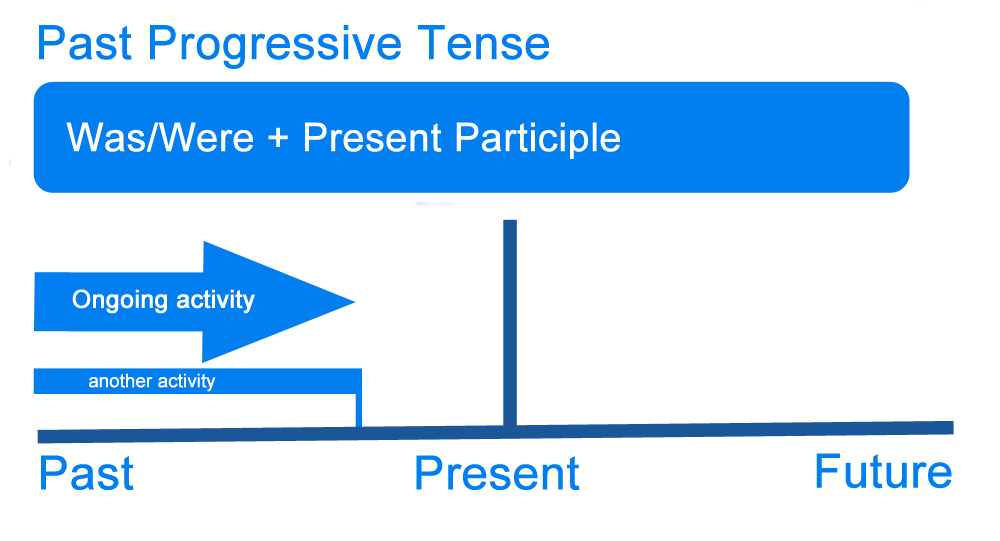
To form the ‘past progressive’ tense is quite simple and is very similar to the present progressive tense in how the structure works. In order to make this grammar tense function, you need to put the ‘to be’ verb in the past tense. There are two different ways for accomplishing this method. If it is a singular action that was occurring, you’re going to use the word ‘was’ before the main verb if you’re referring to one person or thing. However, if it is a plural action being described, you’re going to use the word ‘were’ before the main verb if you’re referring to more than one person or thing.
The actual main verb is going to be in its’ present progressive form with –ing being added to the end of each verb after ‘was’ or ‘were’ that will make it a past progressive tense sentence. It is very important that you follow this structure, otherwise, your sentence won’t make much grammatical sense and you’ll need to re-order the structure in order for your sentence to be understood by the reader. Don’t stress about it if you don’t get the concept at first.
Here are some examples with the basic form of the past progressive tense using ‘was’ or ‘were’:
I was riding on the train when lightning struck the tracks nearby.
We were going to go to the movies on Saturday night but you canceled on me.
They were talking about us at the lunch table today as we walked by.
He was not doing the job like his boss wanted him to do it.
If you are thinking of making the past progressive tense negative, all you need to do is to put the word ‘not’ between the ‘to be’ verb in the past form and the actual action that was taking place at the time. If you’re struggling with forming a sentence by using the past progressive tense, you should look to these examples in order to help you in the future as an English student.
When it comes to the past progressive tense, you are often describing an action or an occurrence that is happening within a limited time frame while something else in the past was going on at the same time. When you write a sentence in the past progressive tense, you should be aware that most sentences with this grammar tense would be describing two actions in the past and not just one action. Here are some examples of past progressive sentences where two actions are being described simultaneously:
1) John lost his wallet while he was dancing salsa at the club.
2) Jane found her keys while she was watching her favorite television show.
3) We ate a lot of tapas dishes while the bands were playing Spanish music at the restaurant.
As you can see, it is quite easy to form the past progressive tense in a sentence if you are able to describe two actions occurring within the same timeframe. The major difference between the simple past tense and the past progressive tense that any student of English grammar should be aware is the fact that the simple past tense describes a completed action from the past while the past progressive tense describes an incomplete action from the past that is still playing out. If you’re still confused, here are some examples that highlight the difference between the simple past tense and the past progressive tense:
I slept throughout the night while the rain was coming down heavily. (Simple past tense and Past progressive tense)
I drank too much juice yesterday, which made me sick. (Simple past tense)
He was dancing all night long to the wonderful music of Michael Jackson. (Past progressive tense)
As highlighted in the examples above, the simple past tense and the past progressive tenses can be used together in the same sentence without any problems. However, it is possible to use them in separate sentences as well, which will make the sentence a lot simple to create. Be aware that the word ‘while’ is a way to connect a sentence together that uses the two forms of the past tense together in a seamless manner.
Lastly, it’s important to note that the subjects ‘I, He, She, It’ should be used with the singular word ‘was’, which is the past form of ‘to be’ before describing the past action that was happening. For the subjects of the past progressive tense which are ‘You, We, They’ should be used in conjunction with the plural word ‘were’, which is the past form of ‘to be’ before describing the past actions that were happening. Here are a few examples to clarify the difference between ‘was’ and ‘were’ in the past progressive tense:
Singular: I was playing, He was playing, She was playing, It was playing.
Plural: You were playing, They were playing, We were playing.
Overall, the past progressive tense is a lot simpler and straightforward when compared to other grammar tenses such as the simple past tense. As long as you remember the rules, study the examples, and practice writing sentences using this verb form on your own, you should be just fine. As always, if you have any questions or comments, please leave a comment for me and I would be happy to answer them for you. Good luck and look out for next month’s English corner!