Be Wary of Bread and Circuses

“There’s nothing wrong with distractions and wanting to enjoy an event, a spectacle, or indulge a bit but in the times that we’re living in, it’s important to realize that focusing only on ‘bread and circuses’ is something we can no longer afford to do.”

Who doesn’t enjoy sports or entertainment or both? People since the dawn of time have enjoyed being entertained or have been spectators or participants in games, sports, or other spectacles. At best, it is a thrilling adrenaline rush to be part of it to the roar of hundreds or thousands of people. At worse, it is a pleasant distraction from the humdrum of our daily life and our routines. There’s nothing wrong with distractions and wanting to enjoy an event, a spectacle, or indulge a bit but in the times that we’re living in, it’s important to realize that focusing only on ‘bread and circuses’ is something we can no longer afford to do.

The concept and phrasing of “bread and circuses or in Latin known as, “panem et circenses”, comes from the Roman Empire and belongs to the Roman poet Juvenal. Juvenal criticized how the Roman leadership would use free food such as bread and grant entertainment such as the gladiator events and other spectacles of the coliseum to distract the citizenry from societal and economic decay. While the Roman empire declined and fell as all empires do, today, in our modern world, we have major sporting events such as the FIFA World Cup and the NFL Super Bowl. Reality Television shows remain quite popular, and the media spends hours on celebrity scandals and gossip rather than focus on systemic issues affecting each of us daily.

Why is this an issue today as it was almost 200 years ago? I would argue that we are living through an era of upheaval including political instability, economic inequality, the effects of climate change, and the rise of authoritarianism. Distraction such as ‘bread and circuses’ help to keep people distracted from these ongoing issues and is a powerful tool to be utilized by those holding power. While sports and entertainment can be healthy outlets, it does not go well for a society when it is all-consuming, and people are overly reliant on it each day for fulfillment or pleasure. An active citizenry must remain focused on issues that affect them and their families as if they are paying attention and are engaged, positive change is more likely to occur as a result.

Political leaders can use major sporting events to help push their agendas forward as the times surrounding such events are the easiest to enact policies that are controversial but in which public attention is directed elsewhere. Politicians and leaders can also engage in controversies surrounding sporting events and how it related to ‘culture wars’ and ‘celebrity feuds’ to divert from ongoing political scandals or economic problems. Major sporting events are also used to stir national pride in a country and can be used to distract from real issues that the country is facing as well.

Sports and entertainment are big money for corporations and for wealthy individuals. Sports can reflect ongoing economic inequalities especially when multimillion-dollar commercials are paid for by a company rather than in investing in their own workforce’s compensation. Money spent in the billions of dollars each year on sports betting, gambling, or on tickets could have been funneled towards programs focusing on social well-being in health care, education, or infrastructure.

Celebrities and athletes should be compensated well for the work they do but there is an issue when ordinary workers who help make events, games, and other spectacles run smoothly are not paid a living wage. Thousands of workers are making decent pay, but it pales in comparison to what the ‘stars’ are making especially when they are the one preparing their food, keeping them safe with security measures, and helping stock the shelves and sell the merchandise.

There is also the ongoing debate in society about taxpayer money funding massive students and events that are not benefiting the surrounding community or the city itself. A lot of that money gets funneled to corporations in the ‘naming rights’ and to the ‘billionaires’ who see their net worth grow up as the sports franchise becomes more valuable over the years. A society where income inequality is high and is rising will be reflected in sports and entertainment as well. While there are some economic benefits to be made by the average person in these industries, a large sum of the gains to go to the wealthiest owners, players, and stars while the wealth does not ‘trickle down’ much, if at all.

While some of these issues do get coverage in the media although increasingly sparingly, I would argue that general news media, especially in recent years, has become sensationalistic and has focused on ‘click bait’ content rather than on serious investigative journalism. News outlets have prioritized celebrity feuds, sports gossip, and other trivial controversies that pale in comparison in terms of importance compared to real issues going on with the wider society. Viral content gets more clicks and eyeballs, especially on social media, and that’s where the focus has turned especially in recent years. Too much information at one time also presents most people from being able to decipher of what’s real vs. what’s fake and what to pay attention to because ‘information overload’ makes it hard to pinpoint what is likely to affect them the most and is worth paying attention to.

Similarly to the issues I’ve mentioned that ‘bread and circuses’ distract from each day, one issue that is the most immediate and wide scale in terms of ongoing effects is the accelerating climate crisis. Major sports and entertainment events all have an environmental cost and leave a sizable carbon footprint. When you tally up, the travel emissions, energy consumption because of the game or event, and the waste involved from having thousands of people in attendance, communities who support the events or games must deal with the aftermath, including both the financial and environmental costs.

While these massive events like the Super Bowl, the FIFA World Cup, and the Olympics due to pledge to be more sustainable and environmentally friendly, many companies do not end up footing the bill for the carbon emitted or the energy used. They can do so because the companies help sponsor the events and contribute enough money to them, so they aren’t as liable to help with the environmental aftereffects. Looking at two recent examples with the 2016 Rio Olympics and the 2022 FIFA World Cup in Qarar, these two events led to increased carbon emissions (FIFA) and environmental aftereffects. (Olympics)

While I am supportive of sports and entertainment and have been a fan of both, I still recognize the need to tone it back these days because excessive consumption of either will not help our society and our world be better. Sports and reality TV may seem as important as real issues, but they are not and never will be. People must stay engaged in what’s going on in their community, their country, and their world. As consumers of news, we also have the individual and collective power to choose which news outlets we give our time and our money to as well. If frivolities and ‘bread and circuses’ is all a news organization is offering, then it’s not a real news organization to begin with.

 Advocating for solutions to real issues, being a reliable voter, and volunteering in your community consistently can help keep the ‘bread and circuses’ to a more tolerable level. We all want to experience gratification and rewards in our lives and sports, or entertainment do both in providing that kind of dopamine hit but it’s a cheap one, and it’s not something we do ourselves. Political activism, working for social change, and developing our problem-solving abilities is real gratification in whatever issue you want to work on in our world. It’s not as instant and far from being easy but improving anything in society will take effort, discomfort, patience, and a lot of perseverance. Make sure you advocate for what you care about because celebrities and sports figures may not do the same, if at all.

You should stay focused on what’s important in the news, be civically engaged and encourage others in your life to do so. Remember to balance your consumption of entertainment and sports along with awareness of the issues and problems affecting you, your families, and your communities. Watching the Super Bowl is fine and I just did so recently as I have most years of my life, but if we continue to ignore political scandals, economic problems, and societal injustices, there won’t be much to celebrate in our society beyond that one day of the calendar year, where two teams of millionaires play a game that you can’t even be part of or even afford to go to.


Ben Folds Live at The Kennedy Center

Ben Folds performing live in concert at the Kennedy Center in Washington, DC, USA in the Fall of 2023.

Camera: iPhone 12

Location: The Kennedy Center; Washington, District of Columbia, United States

The 2023 Mubadala Citi Open

The 2023 Mubadala Citi Open in Washington, DC for Men’s and Women’s Tennis

Camera: iPhone 12

Location: Washington, District of Columbia

Capitals and Wizards in 2023

Capitals and Wizards in 2023

Camera: iPhone 12

Location: Capital One Arena; Washington, District of Columbia, USA

Nighttime at Nationals Park

Camera: iPhone 12

Location: Nationals Park; Washington, District of Columbia, USA

A Holiday Lights Show

Camera: iPhone 12

Location: Jones Beach, New York, USA

Anatomy of a Scene – Miracle Ceasefire

How we as humanity cling to hope is our investment into the future that better and brighter days are ahead as long as we persevere, push forward, and leave our world a little bit better for the next generation. ‘Children of Men’ is great because it poses the answer to the question of how does humanity hope for a future when no babies are being born?

The world without hearing children’s voices, laughter, and even cries can be a dark and hopeless place. That central message of the now classic movie ‘Children of Men’ (2006) has stayed with me especially in the current times of a pandemic that we are living in. How we as humanity cling to hope is our investment into the future that better and brighter days are ahead as long as we persevere, push forward, and leave our world a little bit better for the next generation. ‘Children of Men’ is great because it poses the answer to the question of how does humanity hope for a future when no babies are being born?

When you think deeply about it, humanity is restored generation after generation thanks to our youth, their ideas, their drive, their desire to not repeat the mistakes of the past and to learn from history. When you take humanity’s future away, what is there left to fight and live for? It is a powerful premise and one for which I am glad Director Alfonso Cuaron decided to focus on. His movie does not pull any punches and shows humanity at its worst when women are no longer able to have children.

Without children, playgrounds and swing sets remain empty. Refugees and immigrants are persecuted and forced into detention camps, suicide pills are common place, environmental degradation is the norm rather than an obscenity, and violent factions fight it out with the government in a post-apocalyptic United Kingdom where suicide bombings are an increasingly common occurrence as Theo (Clive Owen) discovers when he is almost the victim of one in one of the earliest scenes. Perhaps the most frightening part of the whole movie is that no one has figured out why women can’t have babies anymore and the novel that the film is based on is also clear when it shies away from saying why men can’t help in the reproduction process anymore.

In ‘Children of Men’, no child has been born for 18 years and it can be hard to retain hope after that long that things will change. The world is in a downward spiral and things get worse as the youngest person alive, Diego, is killed by an angry crowd. Theo takes solace in the fact that he has a good job at the government ministry and has a funny friend who goes by the name Jasper. Still, you can tell that Theo has lost faith in humanity especially after the death of his infant son due to a flu pandemic and his estranged relationship with Julian, his wife. However, when Julian tells Theo about Kee, a pregnant African woman, who may be carrying the first baby in almost two decades, everything changes, and Theo finds his purpose again to live and to fight for a tomorrow. Theo dedicates himself to protecting Kee and her future baby and wants to get her to safety, which means getting her to the Human Project, a group of the world’s best scientists discussing how best to make humans fertile again.

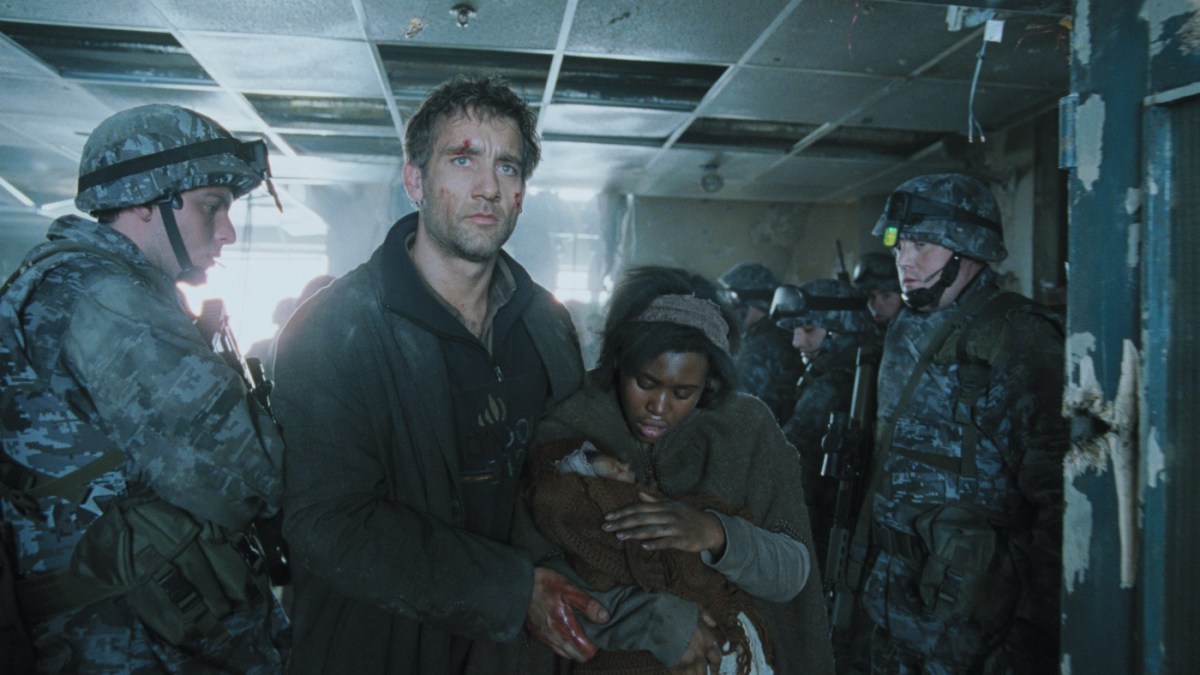
Theo’s journey with Kee involves getting her out of a refugee camp, escaping men who want to keep Kee’s baby for political purposes and who are also armed combatants, and avoiding fascist police forces who intend to get in their way. To escape the escalating urban violence around them as both the government and rebels fight it out in bombed out Bexhill, Theo and Kee take shelter in a refugee settlement in a former apartment building. The three of them come close to being killed and the baby’s cries echo throughout the building much to the stunned shock, joy, and awe it inspires among the refugees, the rebel forces, and the government troops.

The way the cinematographer follows Kee’s baby and Kee around in a wide tracking shot is absolutely beautiful making it one of the most memorable scenes in cinema history. “How is she?”, Theo asks Kee. “Annoyed.” Kee replies. A refugee woman reaches out her hand to touch the baby and another woman sings a sweet song in her native language. Prayers and aspirations are given to the baby as Theo and Kee walk through the crowd. The rebel soldiers acknowledge the baby as they get away from the advancing troops behind them. The government’s military soldiers are in absolute shock as one soldiers’ yell at his army unit: “Ceasefire! Ceasefire!” All of them stop shooting at once and look upon Kee’s baby in disbelief, many of them never having seen a human child before in person.

To see the armed men in tanks and heavy weapons and their technological mastery stop, think, and realize how humanity and its future must be preserved and let free without being in danger. Not much can stop a war from continuing but a baby’s cries can most certainly pause it for a few minutes as this brilliant scene exemplifies. An immediate symbol of hope for humanity and its possible redemption is realized in its newest addition and it is a wonderful allegory to how despite our differences, any human around the world will stop to comfort, aid, and protect for a baby as we would do for our own children or grandchildren or even nieces and nephews.

Those men who don’t see the baby continue to fire at each other in the distance but any soldier, man, or woman who hears the baby crying lowers their weapon, pays their respect, and let Theo and Kee have safe passage as they represent a glimpse of hope finally for humanity’s future rather than its eventual extinction. Some of the soldiers pray to their God and others peer in to get a look at the baby with their own eyes but all are silent and in disbelief thinking that finally there might be hope again.

After a minute or two of calm and as Kee and Theo are about to get away, a rocket RPG hits the government soldiers and the men ignore the baby again and get back to fighting the rebel forces in the building that Kee and Theo just left. To me, that is a tragic symbol of how once we have something out of sight and out of mind, we go back to fighting each other instead of uniting around a common cause. As that RPG fires, I think to myself watching this scene how somebody always has to ruin it for everybody else. Unfortunately, Kee’s baby does not lead right away to world peace and a cessation of arms. However, it is enough time for the two of them to escape and have a fighting chance of reaching the Human Project.

A baby’s cries are more powerful and everlasting than any weapon, any political cause, and any division between humanity. While human nature cannot be totally pacified by children and babies being born, it allows us to fight for better days and for a future freer of pain, sorrow, and tragedy.

I hope that when you watch this scene, you’ll realize that even in our current age when fertility is not extinct and is not a present issue that we are still fighting to preserve hope for the next generation and generations to come. Whether it is preventing pandemics, stemming the worst effects of climate change, or preventing nuclear war between nations, we all have a responsibility to be stewards like Theo in protecting the babies of the future against any manmade harm that could befall them due to our own neglect and ignorance.

Please do watch this ‘Miracle Ceasefire’ scene and the rest of ‘Children of Men’ when you have the chance. It is an excellent film to see and this scene may be the best one of the entire film. Hope and redemption are only as strong as our ability to have a better future.

Anatomy of a Scene – The Dream

“In his 30+ years as a police officer, he means well but he has noticed an increasingly brutal fact that is inescapable. The world has become more unforgiving, violent, and it is hard for him to make an impact whereas at the beginning of his career, he sought to make it a better place.”

Tommy Lee Jones is an elderly police officer overmatched in the excellent ‘No Country for Old Men’ (2017). He is overmatched for a number of reasons including not being able to keep up with the actions of violent men who show no compassion or no remorse. Throughout the film, he is always just a step behind the sociopathic Anton Chigurh and fails to either apprehend him or to prevent him from killing innocent people. In his 30+ years as a police officer, he means well but he has noticed an increasingly brutal fact that is inescapable. The world has become more unforgiving, violent, and it is hard for him to make an impact whereas at the beginning of his career, he sought to make it a better place.

Ed Tom Bell is your average protagonist who means well, wants to do right in his work, and believes he can do good but finds himself overmatched and overwhelmed by what he is asked to do. When he thinks of his future, he wonders what is left for him and if retirement will bring him peace or have him think back on what could be.


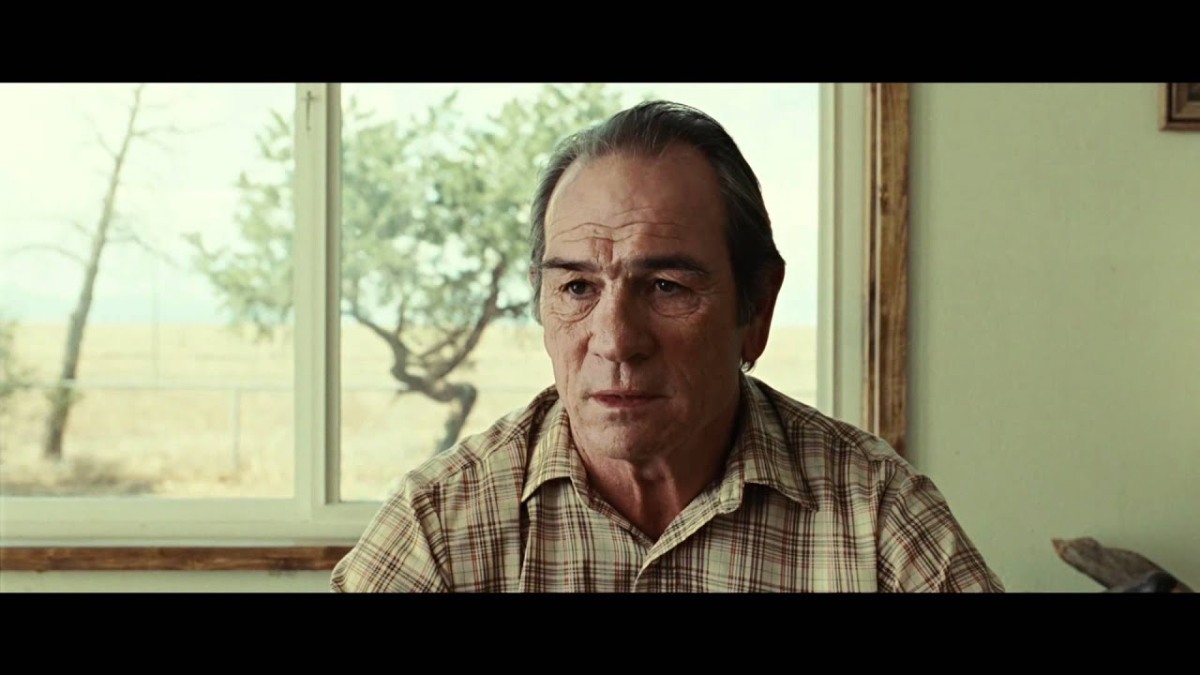
The dream scene begins with Ed Tom, now retiring, looking out of his window at his farm’s seemingly barren landscape with a sole tree to his left through the window behind him. A man of seemingly few hobbies and fewer words, he thinks about his day ahead and thinks about the possibility of riding around on his horse. Not too enthused about it, he also asks his wife if he should help around the house. Seemingly because he is less than skilled at this work, his wife believes it’s better that “he not.” He asks if his wife will join him riding but she is still working and a member of society actively.

Resigned to his fate as a retiree instead of being an active police officer, he reflects to his wife that he’s had dreams and he wants to share them. She says that he has time for them now and that she’ll be polite while he remembers them. He goes ahead and states that there were ‘two dreams’, they were ‘peculiar’ and both of them involved his father who has long passed away. Ed Tom is an older man than his father ever was indicating his father passed away at a younger age that of which Ed Tom will live to be longer.

The first dream is almost like a flash as most of our dreams tend to be with the details muddled and hard to recall. Ed Tom only states that he meets up with his young father in town and he leaves him some money perhaps as a way of his father being there for him even if he wasn’t present physically in his life. Similar to losing his father early in life, Ed Tom believes he lost his money in the dream as well leaving him without help as his father’s early death may have inadvertently done.

The second dream is much more imaginative and involve Ed Tom and his father living in ‘older times’ perhaps when the West was not settled and was lawless. He is no longer a police officer maintaining law and order but rather a horse rider having adventures with his father as he wishes they perhaps would have had time for had he lived longer.

This second dream is much more vivid as Ed Tom recalls how it is cold, they are going through a mountain pass together. They ride together in the snow among the mountains of the night until his father rides past him with no explanation and his blanket wrapped tight against him. This is confusing to Ed Tom at first knowing how hard it is to be without his father who he loves and must face the cold world without him as if he has been abandoned again. Though he may have lost his father, Ed Tom recalls how his father was carrying ahead a fire and a horn of a golden moon color, which gave him comfort despite the fact that he was not with him riding together.

“He was going on ahead, fixing to make a fire.” Ed Tom believes his father in the dream is out there doing this noble act in the middle of all the dark and cold, which is brutal to handle. “I knew whenever I got there, he’d be there…then I woke up.” The hope that Ed Tom haves is that his father even though it seems like he abandoned him as the son is that he really is instead looking out for him and paving the road ahead with light so he would not abandon his hope.

He believes that his father even though he may not be there with him wants him to keep going ahead and to meet him eventually instead of becoming deterred. He paves the way for his son to chase the flame of his absence and to resolve to not let the dark encapsulate him fully. Ed Tom’s expression about the dream is one of resigned sadness that his father is no longer around but also one of lingering strength to believe his death was not in vain and that he will reunite with him one day. His father, like him later, use their lives to keep the flame and the light moving forward even when surrounded by the darkest aspects of human nature.

Like any dream scene in a movie, this one has a deeper meaning behind it related to one man’s grief involving the loss of not only his livelihood but of his hope for a brighter future for humanity. Having seen the horrors that people inflict on one another, he may be resigned to that fact but he also believes his father would have wanted him to keep the flame ‘alive’ and to keep carrying it forward throughout his life even if things looked bleak. His death did not stop Ed Tom from keeping the flame moving in his own life and to carrying it forward in the hopes that he would bring it to his father someday when they would eventually be reunited in another lifetime or in another dream that seemed real.

Movie Recommendations – Volume IV

Movie Recommendations – December 2019

The Report (2019)

download

With an excellent cast, brilliant cinematography and direction, ‘The Report’ (2019) is one of the most underrated films of this year. Casting a wide net from the early days after 9/11 to the 2nd term of the Obama Administration, the film covers the work of Senate Intelligence Committee staffer Daniel Jones and his team’s tireless efforts to bring the scope of the CIA’s ‘enhanced interrogation techniques’ program into the public light. Focusing on not just the legality of the program but its effectiveness as well as its handlers, the film does a great job in bringing that story to a wider audience who may not have read the report or even heard about it. Part of the appeal of the film is that it creates a real sense of drama and real-world significance that often lacks in other Hollywood films about Washington. You really do sympathize with the characters and understand the weight that is on their shoulders handling a report of both national and international significance.

The fact that the report or at least a summary of it was made public is a great victory for transparency, the truth, and for holding those in power accountable for their actions. In terms of actual justice for those who may have perpetuated crimes and/or human rights violations, the film makes it clear that justice was not served but hopefully because those crimes were laid out to bare through this report, we will be finally able to learn that torture does not in fact work and that by refraining from these ‘enhanced interrogation techniques’ in the future, we do not become a monster in order to defeat a monster.

Ford v. Ferrari (2019)

download (1)

Ford v. Ferrari is an excellent film that is sure not to bore you when you see it on the big screen. It’s got that classic kind of Hollywood racing film and it does a good job of keeping you excited throughout the movie especially if you have never heard of the story before. It can be hard to make a racing film carry emotional weight, but the stakes are kept high throughout and there’s never a dull moment. Each major character has something on the line whether it’s their pride, their future success, their family, or their car brand’s ability to be the best in the world. A stellar cast of Matt Damon, Christian Bale, and Jon Bernthal deserve a stellar script and a stellar story and luckily, Ford v. Ferrari is ready to provide that and then some.

Even if you are not a fan of racing, you’ll enjoy the story behind this film especially when it comes to the time-old theme of proving yourself against the odds. An unlikely American auto company focused on station wagons and comfort is able to stand up to the challenge thrown down by the legendary Ferrari auto company who had dominated stock-car racing for decades. An unlikely hotheaded driver is able to overcome his doubts and his hotheaded instincts to become the key to a potential victory of Ford v. Ferrari. An American racing legend, Carroll Shelby (Matt Damon) is able to put his racing days behind him due to his heart condition to focus on the new mission of building an amazing Ford racing car that could put them over the top against Ferrari and establish his company’s success as a budding entrepreneur. This film shows you that you don’t just need talent and the will to win but you also need heart and a belief in your team to get the job done. An excellent film that I really recommend while it’s in theaters.

The Irishman (2019)

download (2)

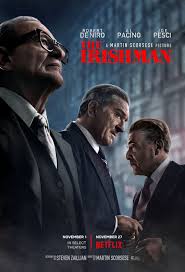
I know you may be asking yourself: Another mafia movie? Hasn’t this particular genre been exhausted already? The answer is both yes and no. It is a ‘yes’ because it’s the same old story of a rise and an eventual fall of mobsters who thought that they could get away with their crimes and most eventually ended up dead or in prison. It is a good film overall about hubris, vanity, pride, and how a man can justify his sins when both family and society is against you by saying that he was just ‘following orders.’ I say ‘No’ as well because any Scorsese mafia movie is going to be a classic in some way and this one in particular does an excellent job of highlighting the connections of the legendary and controversial Teamsters union leader Jimmy Hoffa to the Pennsylvania mafia. The unique story of Jimmy Hoffa has never really been explored that well in American cinema and I have to admire Al Pacino a lot for his performance of the emphatic and conniving union leader.

Not to be outdone, Joe Pesci who is a legend in film makes his first film in what seems like a decade and does an excellent job playing the mafia crime boss Russell Bufalino. Robert DeNiro plays the role of Frank Sheeran, a World War II, mafia accomplice, and Jimmy Hoffa bodyguard who is a tragic character in a way. Like any good Scorsese movie, the film asks the audience about how far a person can go to betray their ‘friends’ as they ‘follow orders’ and at what cost is it to do morally heinous acts and still act for forgiveness from family and from God.

The film’s almost 3 and a ½ hour runtime is my biggest gripe as it does drag at times and some scenes could have been cut out without detracting from the overall story. Still though, it’s a great Scorsese film that will add to the legendary acting careers of De Niro, Pacino, and Pesci. I would not be surprised if this film walks away with the ‘Best Picture’ Academy Award even if another film may end up deserving it more.

Knives Out (2019)

MV5BMGUwZjliMTAtNzAxZi00MWNiLWE2NzgtZGUxMGQxZjhhNDRiXkEyXkFqcGdeQXVyNjU1NzU3MzE@._V1_

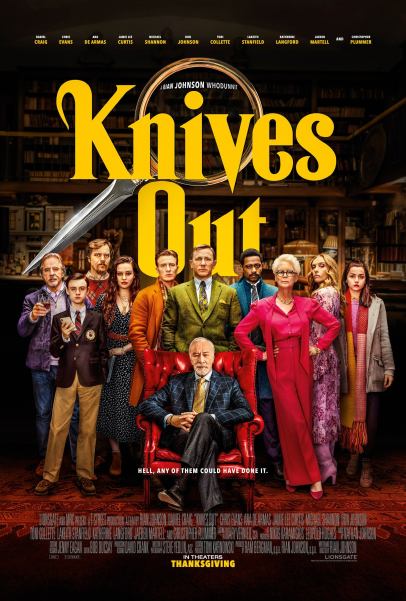
A murder mystery film that you actually care about? Daniel Craig talking in a Southern drawl while figuring out the case in a tweed suit? An all-star cast that actually acts in this film like an all-star cast? What movie could this be? This movie is ‘Knives Out’, a film about a mystery that Agatha Christie would endorse regarding the suspect suicide of Harlan Thrombey (Christopher Plummer) who is a wealthy crime novelist found dead after a family party and foul play might have been involved. Each of the family members is a suspect and the top-notch private detective recently published in The New Yorker, Benoit Blanc believes one of the family members may be responsible for having murdered him. Besides the family itself, one non-family member is also a suspect, Harlan’s nurse, Ana Cabrera (played by the excellent Ana de Armas, an actress on the rise) who was with Harlan the last time he was seen alive.

If this is not an intriguing premise for a murder mystery, you may want to skip this one, but you shouldn’t because it is that good. This film is more than a modern murder mystery brought to the big screen, but it also intelligently discusses the issue of immigration in the United States and also lampoons extremist views on both sides during the film’s more lighthearted moments. The film also covers family relations through the generations, what someone is or isn’t entitled to, how social class can divide people rather than unite them, and how somebody can stand up for themselves when the crowd (or family in this case) is out to get them for their own benefit. Don’t sleep on ‘Knives Out’, which is a definite crowd pleaser and a satisfying ending that could result in future films. I, for one, hope Daniel Craig will be in more films where he can use a Southern drawl from Kentucky as it was surprisingly convincing and must have took a lot for him to emulate. Highly recommend this one which is in theaters now.

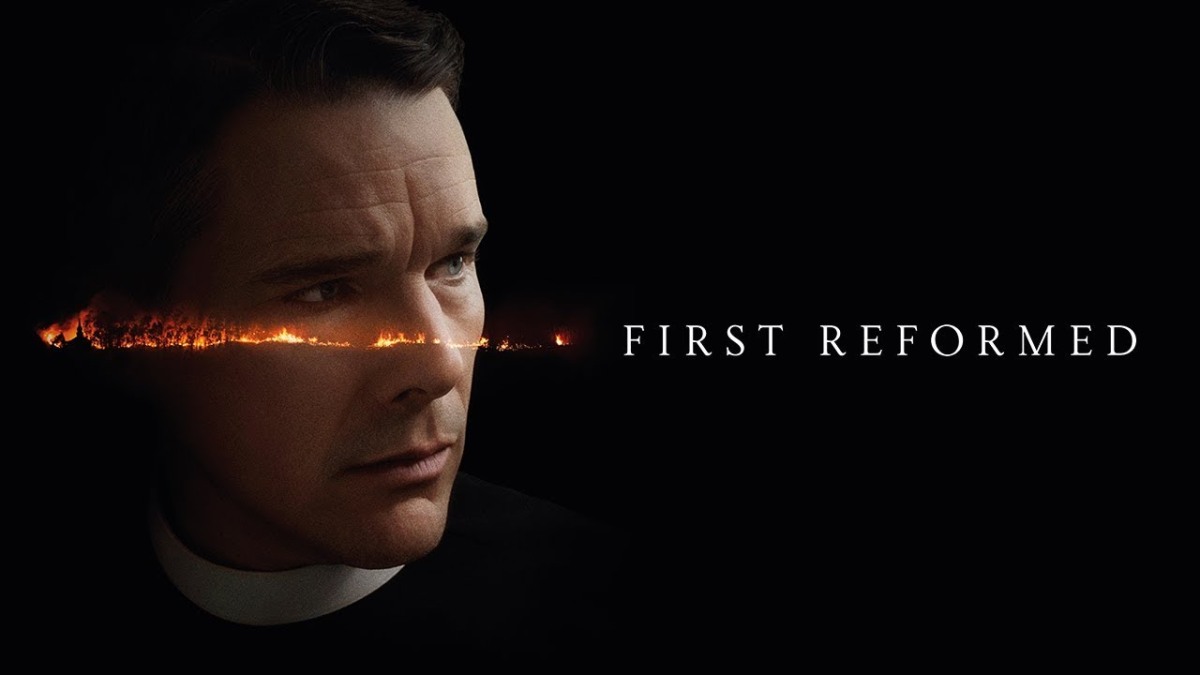
‘First Reformed’ – Film Review and Analysis

Man’s struggle with God can almost be as endearing yet painful as his struggle against man. If there is one way to sum up the excellent film, ‘First Reformed’, that would be it. First Reformed (2017) focuses on the environment, one’s faith, and the struggle to find hope when things seem rather bleak. “Can God forgive us for what we’ve done to the world?”, a troubled environmental activist asks Pastor Ernst Toller and the Pastor replies to his congregant, “Who can know the mind of God?”

While this movie did not receive any Oscar awards, the acting by Ethan Hawke (Pastor Ernst Toller) and also by Amanda Seyfried (Mary) is excellent as well as the cinematography, the adapted screenplay by Director Paul Schrader which helps this film earn its critical acclaim and some Independent Spirit award nominations as well as one Academy Award nomination. I still believe Mr. Hawke was snubbed from getting an Oscar nomination since this film’s performance was one of the best he has ever done and deserved more praise. In many of his films, I find him to be one of the best actors of his generation and able to produce genuine emotion regardless of the situation his character finds himself in.

In ‘First Reformed’, Reverend Ernst Toller (Ethan Hawke) finds himself faced with difficult questions surrounding his faith, morality, the environment in 2017, and what lies ahead in the future for humanity. These are weighty questions for anyone to deal with let alone a pillar of a community like Toller finds himself to be in Snowbridge, New York as the head pastor for the colonial era First Reformed church that dates back to the time of British colonization and the underground railroad movement later on.

This historical church is seen to be losing its membership and interest and Pastor Toller has to resort to touristic gimmicks and a small gift shop to help make ends meet to keep the church going. There is a noticeable parallel to the decline of Christianity in terms of active members of the Christian church in the United States so a fictional movie such as this one has some real-life parallels that seem plausible. The crisis of faith in churches in certain communities has a coinciding similarity with Toller’s own faith in God and in himself. He is an alcoholic struggling to find meaning and purpose in his life at the beginning of the film.

While making the church more touristy, he has also made the church more spiritual as well instead of its Calvinist origins. He sticks more to sermons than to scriptures and has enlisted the financial backing and ownership of an evangelical megachurch in nearby Albany, New York, which is likely to take over the church in the near future much to Toller’s apprehension. As we go through the film, we peel back the curtain on who this pastor is and like any of us, he has his own personal flaws and past sins but has also suffered for them and wishes to make amends in some way.

We find out that Pastor Toller lost his son, Joseph, recently while serving in the Iraq War and feels guilt for having told him to enlist having come from a military background himself as a chaplain. During that difficult time, he committed adultery and started drinking but also found his faith again to then become a pastor at First Reformed after going through grieving his son’s loss. However, a chance encounter with one of his congregants and his wife puts his faith in God and humanity to the ultimate test.

Mary, a devout congregant and believer in God and her skeptical husband, Michael, a stern environmentalist and becoming increasingly radical meet with Pastor Toller separately in their house. Mary has concerns about Michael’s well-being and tells the Pastor they expect to have a child soon. Michael is sincerely struggling with the fact that he will be a father soon when the world’s ecosystems are steadily collapsing, sea levels are rising, and the effects of global climate change are to be felt beginning in the next few decades. For any of us watching this pivotal scene including Pastor Toller himself, there are no easy answers from God or from man either regarding the future of humanity. Ernest finds it difficult to comfort Michael but asks to keep seeing him and to look out for Mary and the unborn child.

This particular scene leads to the rest of the film’s deeper dive into the effects of capitalism and greed on the environment as well as the relationship between big industry and religious institutions. Pastor Toller’s awakening from meeting with Mary and Michael leads him to questioning why the environmental situation is so dire, who is responsible for it, what can be done to stop it, and how far should measures be taken. Because the Pastor has no easy answers for Michael, he starts looking for them and is obviously dismayed by what he finds out regarding the local environmental situation in his community and how greed, industry, and the lack of stewardship for his community have led humanity down towards an unsustainable path.

Without spoiling the film, The Pastor struggles with what he can do as one individual to counteract the forces aligned against good stewardship of the planet and what a person can do to draw attention to the problem. Not only is there a crisis of faith in God but in each other and what is being done to the only planet we have ever known. The Pastor, with certain health issues related to alcoholism, is reconciling with the fact that he is mortal and what kind of impact he wants to leave behind.

He is comforted by the fact that Mary is still a believer in the future and wants to have a child even with the future of the planet looking relatively bleak. Pastor Toller knows however that he has the responsibility now to hold those accountable for their actions whether it’s the Evangelical church, a big industrialist doing environmental damage, or even himself when he strays from helping those in his congregation who need it the most.

‘First Reformed’ poses a lot of weighty questions and it is an extremely timely film in terms of its messages and themes. It is bleak because it has to be and raises a lot of issues that we have neglected regarding the environment and now we may be finding that time to make a difference in this escalating problem is running out. ‘First Reformed’ asks us how an ordinary man of faith yet a pillar of the community so respond to those in his congregation who are in despair regarding environmental damage and destruction.

How far should he go and how radical should he be to get people to listen and understand what is being done? Can love and faith overcome the desire to do harm and take revenge against those who have sinned against the planet? Like any good film, there are no easy answers and the director does not condone or condemn the thoughts or possible actions that Pastor Toller weights leading up to the climax of the last scene.

What this film does an excellent job of is warning its viewers about the consequences of greed, ignorance, lack of stewardship, valuing profits over the health and well-being of people, and the unholy alliance of organized religion and big industries. There are numerous fingers to point at regarding the worsening state of climate change going on in the world currently but perhaps those who watch this excellent film will realize that the finger should be pointed at ourselves first about the damage being done. Perhaps that kind of introspective thinking is what it will take for massive external action to occur and for the worst of the consequences to be avoided.