The Producer vs. Consumer Mindset

We are all consumers but not all of us are producers. This dichotomy between producing vs. consuming has become especially relevant in the 21st century when levels of consumption are at historic levels. When you think about it, being able to consume in different parts of life has never been easier or faster. You can stream vast amounts of music, download movies within minutes, and have food delivered to you at the click of a button. These days, you don’t even have to leave your house or apartment to consume food, books, music, movies, etc. Everything has become more widely available to the average person and that also includes education.

The Internet and other forms of technology have made it easier than ever to consume but despite that fact, is that all we should be doing? Aren’t we met to do more than to order food online, surf Amazon.com for the latest book, or listen to multiple Pink Floyd albums for hours thanks to Spotify? I believe that recently we have strayed too much to being only consumers without realizing that what is most fulfilling is to produce something of value. There should be a balance between consuming and producing and it’s best to strive for a mix of producing and consuming in your life with the former being more of a priority. Consuming is easy but it’s been shown to not be fulfilling and the utility of consumption decreases consistently the more you do it.

While consuming is incredibly easy and requires little to no effort, producing is the exact opposite. Producing something of worth or of value takes some or a lot of effort and the results are not immediate. To be a producer, you need to be determined, patient, put your skills to the test, and be able to think outside the box. Even though producing may not be the most fun or most enjoyable thing to do, it’s really what we as human beings are meant to do and what also gives us the most satisfaction.

If you think about it, our ancient ancestors had to produce or create in order to stay alive and sustain themselves. Back in those times, you had to catch a fish, spear a buffalo, or even a build a hut or you would not last very long. Simply put, our intrinsic value as people is based off of what we can contribute to our friends, families, communities, and the greater society. Now, this does not imply that you have to be producing something of value for others all of the time in order to be considered valuable. You don’t have to produce something for the sake of it or just to impress someone. You should find something to produce for yourself because you’ll build up some self-confidence as well as create more skills and abilities for yourself. You should choose to produce over consume yet you must figure out on your own what you would like to contribute whether that’s writing a blog, creating a piece of music, making an invention, or starting a business.

Why do we choose to produce? It reflects our innate sense of purpose and wanting to leave an imprint on the world regardless of how small or big it may be. There’s a true sense of satisfaction that you get from creating something out of nothing. Our ideas and our thoughts when they are put into actions can create a massive ripple effect that can change our lives if we do big things. The richest companies in the world such as Amazon, Google, and Facebook started out as simple ideas in the minds of their founders but they became real through actions and deeds after starting out just as words.

A producer takes their thoughts and ideas and turns them into something real. For each person, what they would like to produce is going to be different but the simple act of deciding to produce something instead of consuming all of the time is a beautiful thing in its own right. You can start out small by producing a poem, a painting, a piece of music, and then once you successfully create those things, you can aim bigger and better for producing things like a screenplay, a novel, a film, a multi-million-dollar business, etc. If you do not know what to produce but would like to start somewhere, think of which skills and abilities you currently have and make a list of what interests and hobbies you have as well. It’s also best to realize that producing something of value takes serious hard work and effort. It is not an instantaneous event and takes months and sometimes years depending on how big the thing is you’re producing.

Once you get the first thing you produce out of the way, you’ll start to realize how useful, fun, and innovative it can be to be a producer instead of a consumer. As mentioned before, there’s an innate sense of satisfaction out of crafting something from nothing as well as the fact that you used either your mind or your body or both to make it happen. Happiness, I would argue, does not come from consuming the things of this world but rather producing things to bring into the world that weren’t in existence before.

Depending on what you produce, you’ll also be helping people with what you make whether it’s a house that a family will live, a business that will hire employees, or a bridge that will connect town and city together. Also, the thing that you produce will last beyond your life here on Earth and can even transcend time if it is that impactful. Beyond the creation and production, what you’ll be creating is a legacy that you’ll be remembered for. Could you say the same for someone who doesn’t produce anything at all and just consumes? That person won’t be remembered for anything because they will not have left a legacy of producing for themselves, their family, and humanity while they were around. Consumers may benefit in the short run but not in the long run.

Our lives can both be about consuming and producing but think about what would be a better use of your time. Is it binging Netflix for multiple hours or creating a garden to grow fresh vegetables? Is it about playing video games or coming up with ideas for a new novel? Is it better to eat ice cream from Ben and Jerry’s or to make it from scratch? Depending on what answers you gave for these questions, you will be better off as a consumer or a producer.

Everybody has different priorities with what they value in their free time. If you find that you’re producing enough in your day to day work, keep doing that. However, if you find that you’re consuming all the time and not really producing beyond what you’re paid to do, you may want to reconsider how you spend your time. Giving yourself a chance to do more, write more, build more, play more, etc. is likely to be much more satisfying for you and give you a sense of fulfillment and even happiness that can’t be found in Netflix, Spotify, or UberEats. By being a producer, you’re creating value for the world and you’re building your skills, abilities, and knowledge at a time when you can do more than ever if you’re willing to educate yourself and put those traits and turn them into conceivable actions.

I’ll leave you with the idea of compiling a list of your day-to-day activities, map out the amount of time you spend on consuming or producing. If you’re consuming for hours on end and you feel listless, demoralized, or sad, you can turn it around by starting to take those free hours of your time and turning it into something productive. Producing is simply harder and more intensive than being a simple consumer. However, the return of investment on your time put into producing something far outweighs any benefit(s) you would receive from consuming a video game, an order of take-out, or a pop album.

Start from scratch and do your best to take the skills and abilities you have and turn out something totally original that only you and you alone came up with. The books you’ve read, the movies you’ve watched, the music you’ve listened to, the classes you’ve enrolled in, the people you’ve met; that kind of consumption isn’t inherently bad but you should take the time you spent consuming other people’s products and using that knowledge to create your own product. Your own novel, your own play, your own symphony, your own business, or your own recipe: these are all ways that you can find fulfillment and meaning as a producer in this life. You won’t have forever to do both producing and consuming so why not choose producing because you may find that you’re not only good at it but you like it just that much more than being a consumer.

English Corner – Fun with Adverbs

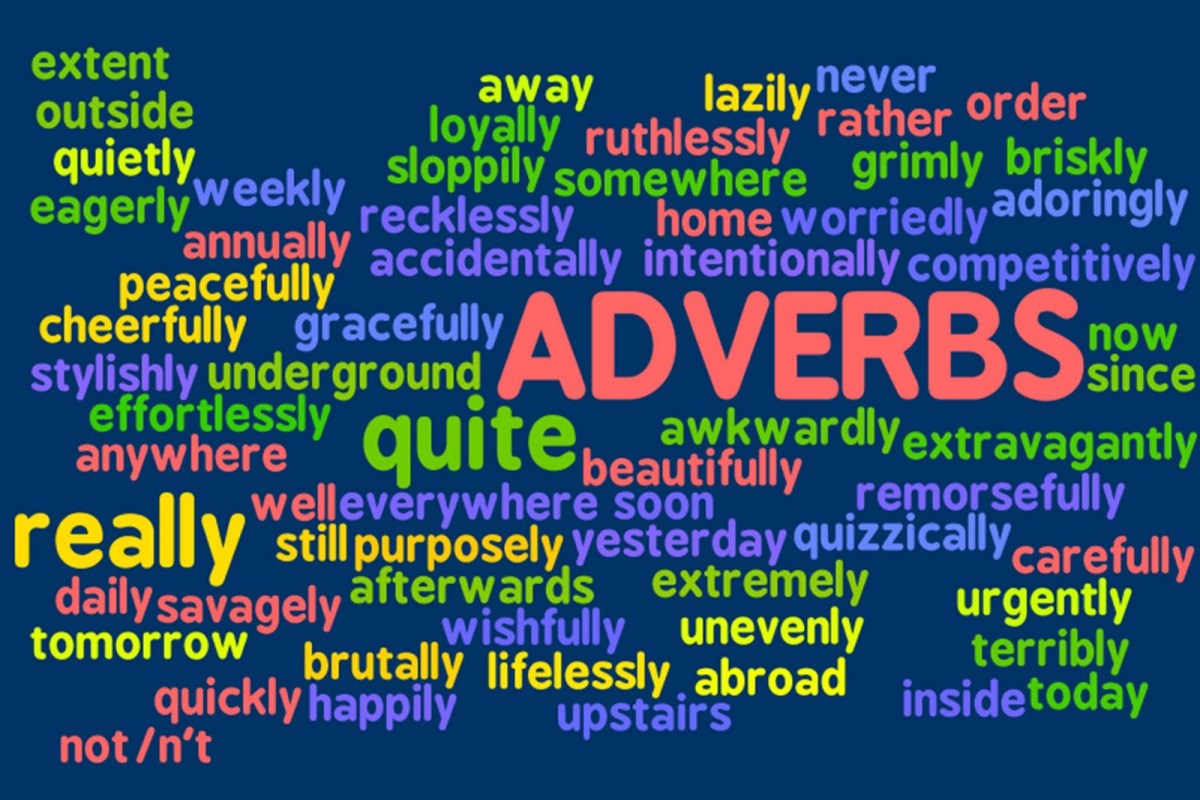
In a previous ‘English Corner’ post, we covered the topic of ‘conjunctive adverbs‘ and also briefly touched upon ‘adverbs’ in the articles on ‘basic parts of speech‘ but now I would like to go much more in depth to talk about adverbs and why they should matter to the English learner. To put it quite simply, Adverbs are a basic part of speech in English that add clarity to your written and spoken sentences. Adverbs are used to modify, change, or quantify an adjective, verb, or another adverb in the same sentence or group of words.

Without adverbs, sentences in English wouldn’t have the same zest and flair that they do with this basic part of speech being used correctly. Adverbs can draw relations between places, people, times, causes, degrees, etc. While Adverbs are not the most popular form of basic speech, you cannot be well-versed in understanding English grammar without having a formal knowledge of what adverbs are, how they are used, and what kind of examples need them within the sentences you create. Please use this article on ‘adverbs’ to improve not only your understanding of the English language but also your ability to write, speak, and use it freely. 

Traditionally considered to be a single part of speech, adverbs perform a wide variety of functions, which makes it difficult to treat them as a single, unified category. Adverbs normally carry out these functions by answering questions such as:

  • When? She always arrives early.
  • How? He drives carefully.
  • Where? They go everywhere
  • In what way? She eats slowly.
  • To what extent? It is terribly

These examples help bring light to the fact that they are all adverbial functions and may be accomplished by using adverbial clauses and adverbial phrases as well as by adverbs that are singular as well. There are many rules for using adverbs, and these rules often depend upon which type of adverb you are using. Remember these basics as expressed in the examples above, and using adverbs to make sentences more meaningful, and expressive will be easier for you.

  • Adverbs can always be used to modify verbs. Notice that the second of these two sentences is much more interesting simply because it contains an adverb:
    • The dog ran. (You can picture a dog running, but you don’t really know much more about the setting.)
    • The dog ran excitedly. (You can picture a dog running, wagging its tail, panting happily, and looking glad to see its owner. You can paint a much more interesting picture in your head when you know how or why the dog is running.)
  • Adverbs are often formed by adding the letters “-ly” to the end of adjectives. This little tidbit of information makes it very easy to identify adverbs in many sentences. There are many exceptions to this rule; everywhere, nowhere, and upstairs are a few examples where an –ly isn’t apart of the adverb itself.
  • An adverb can be used to modify an adjective and intensify the meaning it conveys.
    • Examples: He plays tennis well. (He knows how to play tennis and sometimes he wins.)
    • He plays tennis extremely well. (He knows how to play tennis so well that he wins often.)

As you read the following adverb examples listed below, you’ll notice how these useful words modify other words and phrases by providing information about the place, time, manner, certainty, frequency, or other circumstances of activity denoted by the verbs or verb phrases in the sentences.

There are many different words that function as adverbs. The following list is broken down into different categories, which list adverbs by their function. After reading, you will be able to think of additional adverbs to add to your own list – after all, there are thousands of adverbs that appear in the English language.                   

The vast majority of adverbs out there end in “-ly”. This makes it very easy to spot the adverbs in most sentences so please be on the lookout for that as you discover this basic part of speech in more detail.

Abruptly

Boldly

Carefully

Deliberately

Excitedly

Financially

Horribly

Mildly

Naughtily

Openly

Poorly

Quickly

Sadly

Terribly

Willingly

Yearly

Some adverbs tell us where the action happened. These are known as adverbs of place.

Everywhere

Here

Inside

There

Underground

Upstairs

Certain adverbs let us know when or how often the action happened. These are known as adverbs of time and adverbs of frequency.

After

Always

Before

Later

Now

Today

Yesterday

Many adverbs tell us the extent of the action.

Almost

Enough

So

Too

Quite

Rather

Very

Some adverbs are used as what’s known as intensifiers.

Absolutely

Certainly

Completely

Heartily

Really

Certain adverbs called adverbs of manner tell us about the way in which something was done.

Briskly

Cheerfully

Expectantly

Randomly

Willingly

___________________

Now that you are more familiar with what ‘adverbs’ are, have seen a good amount of examples of how they are used, as well as been shown a list of the most popularly used ones, you should be better able to use adverbs correctly in written or spoken sentences. Please be sure to study the definition of an adverb, the different ways it can be used, and the list of words that are adverbs themselves. If you do not apply the information that you learn about adverbs such as in this article, you won’t be able to improve your English grammar as much as possible. Good luck and remember to have some fun with adverbs!

‘No Country for Old Men’ – Film Review and Analysis

Cormac McCarthy, a distinguished American author of such noteworthy novels of ‘The Road’ and ‘Blood Meridian’, is not as well known for ‘No Country for Old Men’, but it is an excellent and renowned novel in its own right. Out of the movies that have been based off of his work, ‘No Country for Old Men’, released in 2007, is considered to be the best book to film adaptation done so far when it comes to the written works of Mr. McCarthy.

Like his other novels, ‘No Country for Old Men’ focuses on the darker parts of human nature including violence, corruption, and the evil that people can do to one another without just cause. ‘No Country for Old Men’ was a hit at the box office and has an all-star cast including Josh Brolin, Javier Bardem, and Tommy Lee Jones. This film was directed by the Coen brothers and received critical acclaim including four Academy Awards including Best Picture and Best Supporting Actor for Bardem. While not the most upbeat and positive film, it’s a film that probes questions regarding fate v. coincidence, if destiny is pre-ordained, and how much the world is beyond our control despite our wishes and desires for it to be different than it actually is.

‘No Country for Old Men’ takes place in Texas, USA in 1980 after the conclusion of the Vietnam War, one of the bloodiest conflicts in American history, and which is referenced at points throughout the film. Each of the three main characters have personal experience committing violence although they do so for different reasons. Anton Chigurh, the name of the film’s antagonist is a man born without a conscience and is a hired killer. However, he doesn’t simply kill because he is getting paid with money to do so but rather because it comes naturally to him and sees himself as an instrument of fate. It does matter whether or not you are ‘innocent’ or not but if you happen to cross paths with him on the road, at a hotel, in a convenience store, he will judge your fate based on the basis of a coin toss flip. Chigurh’s chilling approach to life and how it is totally beyond any of your collective will and actions is an eerie recurrence throughout the film that the Coen brothers use to make him one of the greatest film villains of all-time.

Most relatable as a main character in ‘No Country for Old Men’, Llewelyn Moss (played by Josh Brolin) is a married man, Vietnam war veteran, and welder who enjoys hunting as a Texan. He is not a perfect person but he tries to do the right thing most of the time and is unfortunately a victim of fate as well during the film. On a hunting trip in the west Texas desert, he ends up seeing the aftermath of a drug deal gone bad with men and dogs both badly wounded and dead at the scene. His overall fate is set in motion when he takes two million dollars that does not belong to him and stashes it away.

As an audience member, you know that’s not the right action for him to take because it ends up causing him to be tracked by Chigurh as he is the contract killer hired to kill Moss and bring back the money. It’s not only that Chigurh who is after Moss for the money and this main character is up against fate which has conspired against him due to the stolen money that didn’t belong to him. Moss, at his heart, is a survivalist and wants to live on yet his actions cause himself and his wife to be put into serious danger.

Because of their predicament, Sheriff Ed Tom Bell, a Terrell County mainstay who is closer to retirement and death then he would like to admit is good at his job but is not sure that he can keep up with the violence and evil that he sees around him and which seems to be getting worse and not better. Throughout this film, Ed Tom is one step behind Chigurh and is unable to help Moss as directly as he can as sheriff because he is overmatched and isn’t able to keep up with a part of the country that isn’t always meant for ‘old men’ to live happily ever after.

“What you got, ain’t nothing new. This country’s hard on people. You can’t stop what’s coming. It ain’t all waiting on you. That’s vanity.” Sheriff Bell, throughout the film, becomes disenchanted with the way the world is and how senseless violence is unavoidable and can’t always be stopped. His ability to influence or change events is weakening and as an older sheriff, he’s slowing down and wondering what his ultimate fate will be whether its dying of old age or getting killed by a psychopath like Chigurh. Ed Tom Bell as a character in this film is aware that as human beings, we can only have control over the world around us and that we are limited to the choices we make regarding good and evil but our choices can also be sometimes constrained by the hand we are dealt by life itself and our circumstances. When it comes to the violence of the world, it is something that can never be truly vanquished as long as there is evil in the hearts of men.

The most prominent theme of the film relates to fate and self-determination. Each of the main characters chooses to see those two concepts differently. Anton Chigurh uses the cover of a ‘fateful’ coin toss to leave it up to the fates of his potential victims regardless if he was hired to kill them or not. He brutally rationalizes his violence through the use of ‘fate’ as if they had it coming all of their life. Llewelyn Moss, a simple hunter and welder, makes flawed choices as any normal person would but struggles to outrun his fate based on some bad decisions he made regarding money that was stolen and would be considered ‘blood money.’

Moss is a survivalist at heart but knows that he can only do so much physically and mentally to outrun his fate based on the choices he actually made that led him there. Ed Tom Bell, is the most morally sound character of the film but comes to the realization that he can only deal with the world as it is rather than the world he would like it to be. The choices he makes are his own but the world and its depravity and violence are out of his control and he can only react to those events rather than prevent them from ever occurring.

In various films of theirs, The Coen Brothers often present a bleak and nihilistic view about the world. ‘No Country for Old Men’ is their most serious and brutal look at the nature of violence, how deeply it seems to be embedded in the American landscape, and how everyone regardless if they are good or evil is subject to a fate that is out of their earthly control.

Overall, ‘No Country for Old Men’ is a great film in that it probes a number of moral questions relating to mankind’s capacity for both good and evil. The cinematography is stunningly impressive, the acting is excellent by every character and Bardem especially deserved to win an Academy Award for his chilling role as Anton Chigurh. This film is not meant for those with weak stomachs because the violence is both brutal and frightenly realistic. The Coen Brothers make movies mainly for mature audiences and this film is no exception.

The music of the film carries little weight and there is not much of a soundtrack and that is done on purpose collectively to build up tension and have the audience invest in every scene to see what happens next. It’s hard to classify this movie to a specific genre but it definitely could be best summarized as a dramatic thriller. The directing is excellent overall and ‘No Country for Old Men’ is truly loyal to its unique setting of west Texas and the U.S. – Mexico borderlands. If you would like to see a movie that deals in shades of grey rather than black and white, you will enjoy ‘No Country for Old Men’. However, be forewarned that it does not have a cliché happy Hollywood ending, which is refreshing since men and women do not always get to live to a ripe, old age.

The Why of Standards

How do we define standards? What exactly do they mean to our society and the world as a whole? See, the thing about standards is that if they are not observed by everyone to some degree than what would be the point of having them in the first place. Having standards when it comes to behavior, dress, professionalism, ethics, etc. helps society to function and for people to live productive and healthy lives. Without having standards or not being beholden to anyone else will create a society of winner-take-all or every man or every woman for themselves, which is not only counterproductive but also self-destructive in the long run.

As defined by Dictionary.com, A ‘standard’ is defined as “something considered by an authority or by general consent as a basis of comparison; or an approved model.” It’s a general definition but you can see that creating a standard requires the consent of the society at large. Standards can be difficult or easy to enforce depending on how popular they are but the total absence of standards in different areas of life should be fought against as much as possible. Everybody has different standards but the key to keep in mind is whether a lack of standards or a complete abandonment of standards is making the local community or overall society worse off as a result.

We don’t think about it but basic standards helps create laws, rules, and regulations that keep society running well. When there are no standards in anything whether its’ with business, politics, dress, the environment, etc. then every individual man, woman, and child will suffer in some regard as a result. Another thing to keep in mind is that a lack of standards or standards that are burdensome and counterproductive also cause harm to us as well.

Standards change over time but there are certain ideals and beliefs that I think should stand the test of time. By this I mean that basic manners and politeness should always be observed, presenting yourself well in your outer dress and appearance depending on the setting is crucial, and that you add with basic integrity, decency, and honesty when doing business or leading as a member of your community. Standards over time for these particular areas should not change and should even become stronger so that the next generations do not forget how to act, behave, and be good.

Standards can be relaxed in a number of areas or they can be hardened in other areas depending upon the mood and whims of the larger society but those areas I listed above should be consistent and not be trifled with. When basic manners, integrity, and matters of presenting become optional rather than mandatory, it’s likely that the entire society will feel the ill effects of such an absence of standards rather quickly. Fundamentally, systemic societal issues such as corruption, violence, and poverty, which while they have a wide range of causes are still related to an absence of moral and behavioral standards.

In a free society, standards can most definitely change and be adapted to fit to the times but it has to be with the approval of the majority of those people in that society. Leaving standards to the whims of a few leaders can be cumbersome and even negligent especially if they themselves due not match the standards for which they should follow based on their leadership roles. Standards are best when they are created, managed, and enforced in a democratic fashion and where the majority of people in that society are able to follow those standards.

While we are all individuals, we are all still apart of a collective society and we have to sometimes sacrifice our personal standards when we come up against those standards of the larger society even when we may fundamentally disagree with them. No standard is perfect but if the society has collectively agreed upon those standards, then all of the people must abide by them to the best of their ability. If the standards are to be changed, that should be done over time with the consent of the majority. Even if we don’t like the standards, if no one agrees to them, then they are not standards anymore and society could suffer as a result.

If you don’t like the absence of certain standards or believe that they are too burdensome on you or people that you know, then you need to make the effort and put in the work to change these standards. If you don’t like with how someone is behaving, then you need to make an informed argument as to how that person should behave in a more polite and decent manner. If you see some form of corruption and certain political leaders are letting it slide, then you need to take some responsibility in holding yourself first to a higher standard and then calling out that corruption to get others behind you so that the corruption may end in the future.

Individuals have power in a society with standards but they will fundamentally have less power in a society where there are weak standards or none at all. That is also the case where one sole individual can set standards for everyone else without so much as a protest from others, which is also dangerous and detrimental to society as a whole.

While standards such as for behavior, dress, professionalism, ethics, etc. may not always be popular to uphold, these standards form the backbone of the collective society. With the absence of any sort of standards comes at the behest of laws, rules, regulations, and principles as well. Standards form the base for a civilized society and in their absence; there is no way that a society of individuals can function at all.

When you read this article, think about your own standards and how they came to be in your thinking. Also, think about how important they are to you. Lastly, think about the current standards of your society and how long it took for them to be formed and implemented as well as how important they also are regardless if you agree with their being in existence or not. Standards are not meant to be popular all the time but they are meant to ensure codes of conduct in various manners of life.

The sheer absence of standards leads to an anarchy of sorts that would render polite society meaningless and turn individuals against each other in a collective free-for-all. Understanding the why of standards will make you more likely to improve and better your own existing ones.

English Corner – All About Adjectives

We have previously covered ‘adjectives’ to an extent in a previous blog post entry on the ‘eight basic parts of speech’ for which ‘adjectives is one of them. However, I believe that it is crucial to go into much more detail about what adjectives are and how they can be used in different ways in the English language.

The main definition for a ‘adjective’ is a word that is used to describe a noun or give a noun or a pronoun a more specific meaning. There are hundreds of adjectives in the English language making the possible combinations and uses of them almost infinite. The process of an adjective describing a word is modifying it to become more descriptive. Adjectives answer important questions about the details of a sentence such as: What kind?, Which one?, How many?, How much?

Let’s start out with some general examples of how adjectives can be used within sentences to help give pronouns and nouns more specific and descriptive meanings.

Examples:

The newlyweds live in a beautiful house.

John is a kind and caring teenager.

Tina is a sweet and respectful girl.

The high school students are quiet when they listen to the teacher.

From the general examples of ‘adjectives’ that I have listed above, in the bolded words, you can see a pattern take place in that these words are describing nouns like ‘house, teenager, girl, teacher’, and they always come before the nouns. These nouns as they are well documented are people, place(s), and thing(s). As you can see, while the adjective(s) come before a noun, they also come after verbs such as ‘is, are, live,’ etc. as shown in the examples above. Verbs don’t always come before adjectives but that’s usually the case in a normal sentence.

Here are a few more examples showing how the average verb will come before an adjective in a sentence:

  • Your car is blue. (to be)
  • The sky appeared to be cloudy. (to appear)
  • His face looked tired. (to look)

Adjectives can also modify pronouns as well within a sentence and you can use two adjectives together in the same sentence back-to-back without any issues. Here are some examples I have listed below with adjectives – pronouns together in a sentence as well as the use of two or more adjectives in the same sentence:

  • They were such a nice couple.
  • It is really a beautiful day out.
  • He truly acts like a mature individual.

From these pronouns – adjectives examples above, you can see that they are often subject words such as (they, it, he) and they come at the beginning of the sentence. The adjectives themselves (nice, beautiful, mature) will come towards the end of the sentence after the pronoun but before the noun they modify if there is one to be changed.

  • The cookie is both black and white.
  • He was a dangerous, demented person.
  • LeBron James is a kind, caring athlete.

You don’t only need to use one or two adjectives in your sentences as you can use three or more if you really would like to make your writing as descriptive as possible. Knowing how and when to use adjectives is the key to becoming a better English writer and making your writing more appealing to your audience. By being able to know the vocabulary and how to use adjectives correctly in your sentences, your English will be more readable and also more entertaining to your readers. It will take time but it’s good to establish the basics of adjectives now in order to build upon your knowledge of this topic later on.

When it comes to how to form ‘adjectives’, they will usually come with endings to the words that stand out to you. Examples of adjective word endings include –able, -ible, -ish, -like, -ful, -less, -ous, and –y. Adjectives don’t always end in those word endings but it’s important to be aware of the many cases in which they do end like that.

Examples: Thinkable, Possible, Childish, Adultlike, Thoughtful, Faithless, Courageous, Hungry.

There are hundreds of examples for adjectives that end with these letters but it’s key for you, the reader, to draw the connections by looking at the structure of the adjective and seeing if there’s a –y or –ish ending before you write it for your sentence.

Lastly, a lot of adjectives are comparative or superlative in nature so you have to be aware of how to form those words as well because they will come up a lot in written or spoken form.

Comparative: more or less + adjective and -er

Superlative: most or least + adjective, adjective and –est

Adjective: Tall

1st Comparative Example: Taller

1st Superlative Example: Tallest

Adjective: Dangerous

2nd Comparative Example: More Dangerous, Less Dangerous

2nd Superlative Example: Most Dangerous, Least Dangerous

Hopefully, this blog post on adjectives has helped you, the reader, in terms of what they are, how they are placed within a sentence, how many of them can be used, and how to use them for comparative purposes. You have also seen possible word endings for most adjectives to give you a good hint as to when they are actually adjectives and not just nouns or verbs. Once you have this fundamental basic part of speech down, you’ll be able to tackle harder and more complex (adjective) English grammar topics.

Yankees v. Red Sox

Phy5T0ofQlubh5ocN8%%fgMAEbD%dQR46Mg3ss+433bQ7BmwwvK0QjajHwVVAeBwEAtinCajQcTFSxS2YZCtP75wN80x8GDmRb2se2y+9c0pkwQdK5SAfrRT2%klVxOOaRkgtq8mXsSOSeOtQNKwOHhyyA4eoWlISfQge5j73XRbC%iAC7mMRePJT6azW0G2IVQRRQHnx87XcfTEqdrIfEaocJxg

CameraiPhone 8

Location: Fenway Park; Boston, Massachusetts, United States

Book Recommendations – Volume VIII

As always, the summer season is an excellent time to be catching up on personal reading. One of my favorite activities during the summer is to lie out in the park or at the beach and dive into some books that have piqued my interest. Whether you are a fiction fan or a non-fiction fan, there are a lot of excellent books out there to keep you occupied. My three choices for reading this summer deal with non-fiction topics yet I hope they peak your interest as well even if you are a fiction fan.

1.) “Homo Deus: A Brief History of Tomorrow” by Yuval Noah Harari

Click Me!

The follow-up to Harari’s first book, ‘Sapiens: A Brief History of Humankind’ dives into the promise, the challenges, and the problems facing humanity as we go through the 21st century and beyond. ‘Homo Deus: A Brief History of Tomorrow’ looks at how human beings got to this point in our collective history and how we will need to come up with new solutions whether political, economic, or social to adapt to this current age of rapid technological and climatic change. Clearly, this book deals with more speculation on the part of Harari as he lays out a number of possibilities that could come about in this century and beyond, rather than solely focusing on past human history as ‘Sapiens’ did.

Harari devotes a large part of the book to the fact at how much progress has been made across humankind in terms of eradicating disease, famine, and also how war has been limited in a time of relative peace and prosperity. The question that Harari poses is what will humanity focus its efforts on now that we have been able to get past in large part major sources of human suffering in the form of disease, famine, and war. Mr. Harari makes the argument that humanity will focus a lot of its collective effort on artificial intelligence, genetic engineering, machine learning, etc.

The goal particularly of the rich and wealthy will be to conquer death and achieve immortality through various means that the author goes more into detail about. However, how will social harmony be insured as artificial intelligence, robotics, and machine learning wipe out a large percentage of human jobs over the next few decades? Will the rights of the individual be maintained when a large part of the population no longer are able to find work or where they can receive adequate educational training for the jobs of tomorrow?

Harari is a sociologist so the details of the actual engineering and technology that would need to occur to make this shift happen is lacking in the book. However, he poses urgent questions for policymakers, economists, and other leaders as to what will happen when ‘big data’ algorithms know us and our desires better than they ever have. How will the meaning of ‘work, leisure, and relationships’ change as artificial intelligence continues to advance? Increasingly, Mr. Harari concludes that humans and machines will complement each other in various ways whether its in education, technology, the workplace, etc. and there can be nothing done to avoid this shift from happening in our lifetimes. What remains to be seen is how human societies react to a future where people must adapt to these technological changes to survive, prosper and how man and machine will act as they merge together beyond what was considered possible just a century ago.

2.) “Us v. Them: The Failure of Globalism” by Ian Bremmer

Click Me!

Ian Bremmer, a notable political scientist has written a new book on the populist resurgence in the United States and around the world. He tackles the failure of ‘globalism’ as an ideology and how unfortunately it doesn’t look like we will all be able to live and thrive in a truly borderless world without political, economic, and social differences getting in the way. The fear of the ‘other’ and the tendency for human beings to organize themselves in separate tribes whether it’s the form of nations, races, and religions takes precedence even today as the reaction to globalism.

Mr. Bremmer makes the argument that ‘globalism’ and ‘globalization’ are separate in their meanings as ‘globalism’ as a term is primarily political in nature while ‘globalization’ is primarily economic. Globalization will continue to expand and thrive because its’ practical for nations to engage in trade and finance at the international level to boost and grow their national economies. As long as it is economically advantageous for nations to trade and do business with each other, globalization will continue to be a mainstay in economic relations.

‘Globalism’ however has received a backlash from the rise of political populism primarily in the Western world (the U.S., the U.K.) but also in Eastern Europe (Hungary, Poland), and also in developing nations like India, Mexico, Turkey, etc. Issues of mass migration, cultural shifts in nations, growing income inequality have led populations to look towards protectionism and ‘strongmen-lite’ politicians to address these systemic issues. In my opinion, Bremmer correctly argues that while the world is collectively doing well in terms of economic growth and the subsequent rise in living standards, there is still a serious political recession going on with far left and far right politicians gaining stream in terms of popularity.

‘Us v. Them’ reflect the growing unease and anxiety that a lot of people have regarding ‘globalism.’ Besides the cosmopolitan populations that live in the major cities of the world and who have benefited from the cross-cultural exchange of peoples, trade, finance, etc., there are many others who feel threatened by the ‘other’ and how their country and culture may be changing as a result. Mr. Bremmer sees the happening of Brexit, the election of Trump, and the rise of strongmen around the world as a reaction to ‘globalism’, and how there are drawbacks in that many people feel left behind by their political and economic elites who enacted these policies without their support. ‘Us v. Them’ is something that has occurred throughout human history and to myself, it goes back to our fundamental nature of our willingness to divide ourselves into separate tribes and to look upon the ‘other’ with suspicion and fear.

According to Mr. Bremmer, political populism is not likely to go away anytime soon and the rise of automation, an increase in artificial intelligence, the weakening of the middle class in both the developed and developing world are likely to put continued pressure on weakening political institutions who may or may not be agile and forward-thinking enough to come up with satisfactory solutions to these 21st century issues.

3.) “Notes on a Foreign Country: An American Abroad in a Post-American World” by Suzy Hansen

Click Me!

‘Notes on a Foreign Country: An American Abroad in a Post-American World’ by Suzy Hansen is a refreshing take on the way American foreign policy decisions have affected the U.S.’s relationships with certain countries such as Iran, Greece, Afghanistan, Turkey, Egypt, and specifically the people who feel that they have been negatively affected by those decisions. The average American is likely to be unaware of how large of a role the country has played beyond its borders and how some of those decisions have left deep, festering wounds in the people of those countries who were directly affected and still haven’t forgotten.

Ms. Hansen who came from a personal background similar to mine has lived in Turkey for over ten years and has traveled to the Middle Eastern countries such as Iran and Egypt looking for the perspectives of those citizens in regards to how America changed their countries, mainly for the worse. Her personal background growing up was very insular and she went to travel and live overseas in order to see her country differently.

From reading this book, it was refreshing to see Ms. Hansen do her research about the countries she was living in and visiting as well as interviewing many people in those countries to hear their stories and their perspectives. I believe that her book does a great job of enlightening Americans about negative foreign policy decisions made in the past that our country may not like to remember but is still forefront in many other countries’ perspective of the United States.

As Hansen left home and lived overseas, her innocence and that of America is stripped away because it’s a harsh truth to face yet it is one that we must all face is that America has not always done good in the world and there have been negative effects of past U.S. foreign policy decisions that heavily resonate with those peoples to this day. The key aspect of this mix of journalism and personal memoir makes this book stand out as a referendum on America’s role in the world, and how its likely to decline in the future. While our impact may lessen on our nations in the future, Hansen sees that as a possible good occurrence do the damage that has already been done.

My main critiques of this book is that while Ms. Hansen diagnoses that issues with U.S. foreign policy, I do wish there was an addition to the book where the author discusses how America can better its foreign relations in the future and to move forward positively with the countries she has become familiar with. However, to be fair, that would take a whole another book to diagnose how U.S. foreign policy should move forward. Also, I believe that this book was a bit too negative in its perspective on America and it could have been more balanced in its overall viewpoint. Ms. Hansen’s book pulls no punches and is a clear-eyed look on the blindspots of American exceptionalism and how our values have not always been well received beyond our borders.

Radiohead @ TD Garden

IMG_0908IMG_0910IMG_0895IMG_0885IMG_0840IMG_0872IMG_0852IMG_0846IMG_0862IMG_0879IMG_0868IMG_0855

Camera: iPhone 8

Location: Boston, Massachusetts, United States

Gloucester

IMG_3198IMG_3199IMG_3201IMG_3202IMG_3204IMG_3206IMG_3209IMG_3214IMG_3218IMG_3220IMG_3224IMG_3226IMG_3229IMG_3234IMG_3238

CameraCanon PowerShot SX710 HS 

LocationGloucester, Massachusetts, United States

English Corner – Gerunds

In order to facilitate your grammar studies, it’s important to not overlook certain topics that are integral to boosting your knowledge of English grammar. ‘Gerunds’ is one of those key topics to really get a handle on and master because it will come up again and again in both your speaking and writing. While not the most complex topic, being able to understand the rules behind gerunds and memorizing them will put you ahead of other learners. ‘Gerunds’ is a topic that needs to be put into use over and over in order to be used proficiently.

The main thing to keep in mind with gerunds is not to overcomplicate what they are and what they are used for. Gerunds are simple verbs that end in –ing and that never changes regardless of which tense they are used in. –Ing can be added to verbs that are used in the present, past, and future tenses. Gerunds can also be utilized at the beginning, middle, and ending of sentences. These verbs + -ing are extremely versatile in their usage and it’s important to be aware of where they can be placed within sentences.

The key thing to keep in mind with a gerund word is that it used more like a noun than a verb or an adjective. Most students don’t remember that a verb that ends in –ing can also function as a present participle which is different than a gerund. Gerunds are not the same as present participles and the main difference between them is quite easy to remember. Gerunds are primarily used as more of a noun than a verb or adjective whereas present participles function more as exact verbs. Here are a few examples below as to how ‘gerunds’ are used as nouns in a regular sentence:

  1. I like dancing on a Saturday night.
  2. Playing video games is really fun.
  3. Singing in the rain is an underrated activity.

Gerunds have to be thought of nouns in verb form essentially. If you notice from the above examples, ‘gerund’ words can be used as the subject or object of a sentence. They can be placed at the beginning of the sentence to become the main subject or they can be the object of the sentence when the gerund comes after the main subject and the main verb as well.

While gerunds can mainly function as nouns, they can also be used as adjectives when they are right next to each other in the sentence structure.

  1. It was a night of ceaseless partying that went until the morning light.
  2. The careful building of the Statue of Liberty was a great French achievement.

It is important to note that you can often use gerunds after many different kinds of prepositions during a normal sentence. Gerunds often act as a substitute for noun words that you could be used right after prepositions. If you’re only using the base verb without the gerund (-ing), it won’t be grammatically correct. Here are a few examples of how to use the gerund after a few different prepositions:

  1. I will make breakfast before going into work today.
  2. Please do wash your hands after making dinner for our guests.
  3. We are used to driving on the right here in the United States.

It’s important to keep in mind that the gerund immediately follows each preposition directly after the preposition word is used in the sentence. There are dozens of prepositions used in the English language so it is important to keep in mind when to use the gerund after any kind of preposition comes up in a sentence.

Lastly, ‘gerunds’ can be used in a passive voice kind of sentence under multiple circumstances. In these kinds of cases, the gerund word would often come at the end of the sentence to reflect the action taking place. Here are a few examples of how you can use gerunds in a passive voice kind of sentence:

  1. I have three pairs of pants that need washing.
  2. The water cooler at my workplace needs replenishing.
  3. Your shirts are outside the house on the clothesline drying.

Please note that in sentences #1 and #2 from my examples that the main verb ‘need’ is used right before each gerund word. Without the main verb of ‘need’, it becomes much more difficult to express the action that is occurring at the end of the sentence.

Whatever use you find for the gerund, remember that the gerund comes up very often in both spoken and written English. You can use the gerund for multiple purposes including for nouns, adjectives, prepositions, passive voice, etc. The key thing to take away is that gerunds are very flexible in terms of their placement within a sentence. They can also be combined with various parts of speech to make your writing flow better and have more details. While gerunds are easy to form with ‘verb + -ing’, using them within the right context and in the right format is something that requires patience, practice, and repetition.