English Corner – Prepositions

The ‘English Corner’ will be a new blog post series from me with a new post every month to help English language learners to better understand the vocabulary, grammar, and syntax in order to better develop their own proficiency. I have over two years of experience of teaching the English language to non-native speakers, both online and in person. I hope to use these posts to help you, the reader, improve your understanding of English, and also develop your fluency.

If you have any questions about this ‘English Corner’ post, please leave a comment and I will answer them to the best of my ability. Any constructive feedback is appreciated and I hope that this will become a popular series of posts within my website. If you enjoy my ‘English Corner’ series, you can also request private English lessons with me through the WordPress message system.

One of the biggest struggles that new learners of the English language will encounter during their studies is mastering the grammatical concept of the ‘Preposition.’ The most common issue that a lot of my ESL students have come across is how to better understand and memorize the grammar rules of the ‘Preposition.’

It’s nearly impossible to memorize all of the ‘Prepositions’ and their specific uses in English. I find that it’s best to examine certain examples where the individual preposition is being used in the sentence and for what context does it most apply fittingly. It’s important to remember that a preposition is considered to be a part-of-speech that comes before a noun type of phrase and connects it to another part of the sentence. The name of ‘Preposition’ can be broken down into pre-position which gives us a good hint that this part-of-speech needs to be placed before the noun. There are different types of noun phrases such as the noun phrase (the short boy), the noun (meat), the pronoun (us), and the ‘gerund or before the verb in –ing form’ (dancing).

The most common prepositions are on, in, to, for, with, by, and. There are numerous other prepositions and for a full list of them, I highly recommend going to this link: https://www.englishclub.com/grammar/prepositions-list.htm

There are three types of relationships that the preposition has with the rest of the sentence. They are relationships in time, in space, and of a certain method.

For some examples of prepositions in these three different relationships, let’s look at the following sentences:

  • The soccer ball is on the floor. (relationship in space)

Note: The physical location of the soccer ball is located on the floor. ‘On’ is a good example of a preposition that is used to demonstrate the relationship in space between itself and the noun.

  • You will meet him in October to discuss the business deal. (relationship in time)

Note: When it comes to date / time / place, a preposition like in is perfect for highlighting the relationship of time when it comes to a noun like ‘October.’ For months, days, weeks, and other words for time, it’s important to use the correct preposition to express this relationship.

  • I sent the wedding invite to you by postal mail. (relationship of method)

Note: When describing a method with a preposition, using by is the most popular and the most useful. Whether its’ mailing a package, or writing a reply to your boss, this kind of preposition will come in handy especially when it comes to connecting the gerund (verb + ing) to the part of speech.

There are several kinds of relationships that are expressed with the help of prepositions but the most common relate to space, time, and method.

Prepositions can either be one word (after, in, by, etc.) or a couple of words, which makes them more complex in their overall nature. (according to, despite that, because of, etc.)

Prepositions will usually come in the middle of a sentence to connect two parts of a whole sentence. However, there are exceptions and sometimes they will appear at the beginning or end of a sentence.

Examples:

Which person did you talk to?

To which person did you talk?

____________________________________________

Another important distinction between prepositions is related to whether they involve place or time.

Prepositions of place describe the relation of an object or thing to another object or thing in terms of space.

This chart below provided by http://www.englishclub.com explains this phenomenon along with a list of corresponding prepositions of place:
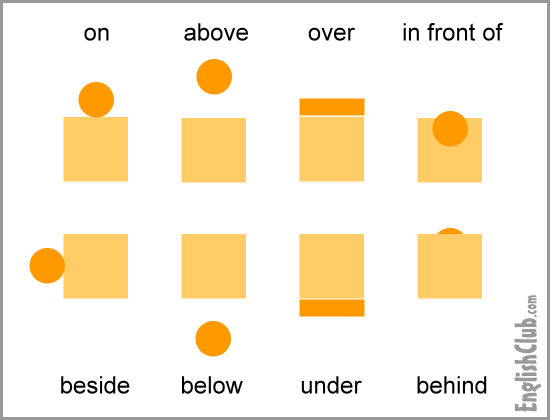
prepositions-of-place

Here are some example sentences for preposition of place:

  • My dinner plate is on the table.
  • The boy hid under his bed.
  • He stood in front of the door.
  • The bird flew above the crowd.
  • He looked over his assembled troops on the battlefield.

Prepositions of time usually involve prepositions like at, in, on, by, etc. We use at to describe a specific time or date. We use in to highlight months, years, decades, and long periods of time. The last preposition of on is the most specific and deals with days of the week, and dates in time. By is the least common preposition of time but can be used to express important due dates when it comes to days and weeks.

Here are some example sentences for preposition of time:

  • I have a salsa class at 8 pm tonight.
  • In September, I started my new job.
  • We ended our job strike on Tuesday because our demands were met.
  • You need to finish this project by next week.
  • We will be back from our vacation by Friday night at 11 PM.

This chart below from http://www.englishlearnsite.com is very useful in giving us more examples on how to use these prepositions of time in the correct manner without getting frustrated.
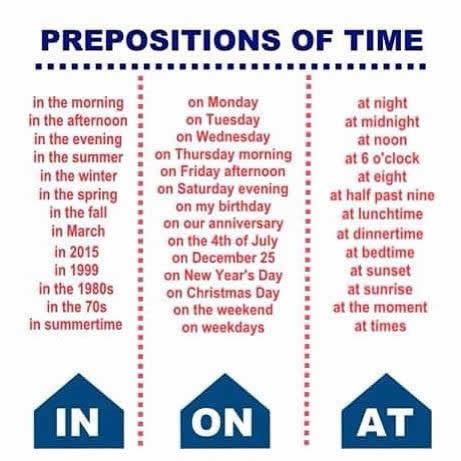
prepositions-of-time

Prepositions are an important grammatical concept to master in order to become fluent in the English language. I hope this first ‘English Corner’ session was helpful to you as a reader of my website. Remember that a preposition is always followed by a noun, and never by a verb. Prepositions usually appear in the middle of a sentence but sometimes at the beginning or end too. Placing your prepositions before the ‘noun’ and after the subject/verb will help you greatly with regards to your English grammar.

I hope you enjoyed this first edition of ‘English Corner’ and I look forward to sharing another topic with all of my visitors again soon.

A Future To Believe In

It is very rare in American politics these days to have a candidate running for high office who is sincere, genuine, and committed to his principles and ideals. A candidate who will not bow to the special interests, who will look out for all citizens and not just the wealthy few, and who has the ideas to make the United States a more fair, equal, and prosperous country. Because of these reasons, I am supporting  Bernie Sanders’ candidacy for President and why I will be voting for him in the upcoming Democratic primary in New York on April 19th.

While there is no such thing as the “perfect Presidential candidate”, Senator Bernie Sanders is the best choice not only for the Democratic Party but for the nation as a whole. He has served not only as a U.S. Senator for Vermont, but also as a member of the U.S. House of Representatives, and the Mayor of Burlington before that. For over thirty years, Senator Sanders has been a faithful and dutiful public servant. Over the course of his political career, he has always been a staunch defender for the rights of working class people, the middle class, and the poor.

From a young age of 22 when he was apart of the historic ‘March on Washington for Jobs and Freedom’ along with Dr. King and other civil rights leaders, he has continuously fought for equality of opportunity and greater freedom for minorities, women, and the LGBT community. What is also notable to mention from his past was his willingness to participate in an anti-segregation protest in Chicago in 1963. Because he stood up for his beliefs, he ended up being arrested and was taken away by the police for living up to those principles of fairness, justice, and equality.

Mr. Sanders has made his Presidential campaign “of the people, by the people, and for the people.” He refuses to take money from SuperPACs unlike his Democratic and Republican rivals. He also does not accept donations from big corporations and the millionaires, billionaires of the country. He wishes to nominate Supreme Court justices who will attempt to overturn the disastrous Citizens United decision, which allowed large corporations the ability to donate huge sums of money to their favored candidates for elected office. I applaud his commitment to making his campaign about the individual supporters, donors rather than about corporate sponsorship and special interest contributions. More so than any other Presidential candidate in recent history, he has shown a commitment to running a national campaign that’s fueled and powered by the average voter.

In addition, I believe in his policy proposals for a national minimum wage of $15 per hour, a Medicare-for-all policy that would ensure universal health care for all U.S. citizens, and to reduce the incarceration rate significantly over time to end the unfortunate distinction of being the country that has the biggest prison population in the world. Over the past few weeks since I returned from Colombia, it has been a pleasure for me to knock on doors, make phone calls, and to volunteer for his campaign at the Washington Square Park rally on April 13th.

About 30,000 people attended one of the largest rallies of the 2016 election season at Washington Square Park this past Wednesday night to see Senator Bernie Sanders speak about his vision for America. As a volunteer at the event, I helped with crowd control by keeping the huge lines orderly and moving cordially. The atmosphere was filled with excitement and anticipation. The mood of the people attending the rally was happy and even joyous at times. It was a cold evening in lower Manhattan but you could feel the energy and the passion people felt about this particular campaign. In addition to Senator Sanders’ rousing one-hour stump speech, notable celebrities, public officials and figures also lent their voices during the massive rally. The most notable names were Tim Robbins, Spike Lee, Rosario Dawson, and Shailene Woodley.

I enjoyed the rally immensely and I was lucky enough to be close to the stage after a hectic day of volunteering and keeping order among the large crowds of people waiting in line. I shook Senator Sanders’ hand after the end of his speech and wished him well in Tuesday’s New York primary. It was an exciting moment for me and I was glad to be apart of such a large and historic campaign event. I can only hope that this rally will lead to a large turnout and a successful result at the polling places across New York State in just a few days from now.

While I usually avoid writing blog posts about politics, I have to make an exception in this case because I feel strongly about Bernie Sanders’ candidacy and believe that he is the best choice not only for the Democrats but for the country too. Similar to Candidate Obama in 2008, Candidate Sanders has created a lot of enthusiasm, held huge rallies, and has earned support from diverse groups of voters due to his campaign’s message and consistency.

Time will tell if his candidacy will be successful enough to be nominated as the Democratic Party’s standard-bearer and to continue on to the 2016 general election against the Republican nominee. However, so far, he has shocked all of his doubters and made it further than anyone would have originally thought possible. Despite what may happen in Tuesday’s New York primary and beyond, I know that I will continue to “Feel The Bern.”

______________________________________

Disclaimer: The views and opinions expressed in this blog post represent solely my own and do not reflect or represent those of any outside party, organization, company, or group. Thank you.


A Wealth of Knowledge

knowledge-translation-and-exchange1
“The sharing and exchange of knowledge is easier now than it has ever been in human history.”

There has been no other time in human history than in today’s era where the average person with access to the Internet can seemingly have unlimited amounts of information available to him or her. When you truly think about the magnitude of it, untold amounts of data are being created every day. According to IBM, “The current estimate is 2.5 quintillion bytes of data per day and over 90% of the data in the world today has been created in the past two years alone.”

A common response nowadays from both family and friends when I ask a question to them about a random query is not a straight-forward answer but rather an off-handed suggestion to “Google it.” Living in this era of ‘Big Data’ can be quite overwhelming to the average person but one could also look into it as an opportunity to gain knowledge and further ones’ understanding on a limitless amount of subjects with the simple click of a mouse. The Internet is an amalgamation of thousands of libraries of Alexandria at the beck and call of one’s fingertips.

Compared to past ages when information and knowledge was more exclusive and harder to come by, today’s era allows everyone with an Internet connection to search and find information to their heart’s content. Instead of going to a library to find what you need on a subject, websites like Google, Wikipedia, and other online encyclopedias have largely replaced the main role of the physical library. I remember when I was younger and in my high school days having to seek out certain books in order to write a research paper or complete a book report.

However, now more than ever, you can easily find the sources of information you need online in order to facilitate your research and evidence. While I love libraries and hope that they never go out of style, the reality is that online encyclopedias and eBooks are largely replacing their original purpose. In order for libraries to stay relevant, they need to start incorporating computers, free Wi-Fi, and technical classes in order to remain useful.

From the 18th to the 20th centuries, universities and colleges across America were the standard bearers and purveyors of higher education. Originally for the elite, wealthy, and well connected, those students who were able to get accepted and afford undergraduate and graduate studies believed that they would have an advantage in the job market and in achieving the American Dream. More recently, as colleges and universities have become more inclusive than exclusive, tuition prices have inversely risen as well.

While higher education has become accessible to more and more young Americans, it also has become more expensive especially over the past decade. These events have led to an ongoing debate as to whether college is really worth the price tag and whether the average student gains anything from earning a four-year degree. With student loan debt at an all-time high of $1.3 trillion in 2015 in the United States and tuition rates at both public and private universities continuing to rise, people are beginning to look for alternatives to the current higher education system.

Over the past decade, there has been a drastic proliferation of massive open online courses (MOOCs) provided by both private companies and traditional universities. At a much lower price and sometimes free, people from all over the world can sign-up for these courses and partake in lectures, tests, quizzes, and papers as if they were actual enrolled undergraduate and graduate students at the physical form of the university. As the credentials and certifications bestowed upon these courses continue to increase and become more widely accepted, we may begin to see ‘the end of college’ as we know it.

Examples like Khan Academy, edX, Coursera, Udacity, etc. and other MOOCs have leveled the playing field. Tech entrepreneurs from Silicon Valley have allowed students from all over the world to access unlimited online courses to further their academic knowledge at a lower price. With the subsequent rise in online university programs for undergraduates and graduates, the physical college experience of dormitories, lecture halls, football stadiums, etc. may become less appealing to students as tuition prices continue to increase. While the social and networking benefits of college life are numerous, they may not be enough to compete with this era of free information that we are living in.

Compared to past decades, we’re living in a time when access to the Internet is at an all-time high and is increasingly rapidly due to the rise of mobile technology. Traditional havens of knowledge such as the library or the public university will have to adapt to stay relevant in this unlimited information age. In a worldwide job market that is evolving rapidly and where the average child today will work in an industry not yet created, the free exchange of knowledge must continue to spread through the worldwide web.

Countless others and I have benefited from taking online coding courses on ‘Codeacademy’ to learning new languages on ‘Duolingo.’ As MOOCs and online universities continue to develop their courses and credentials, we may begin to see an era where the average person can earn a degree or two without breaking the bank. MOOCs are cheaper, less time intensive, and can adapt more easily to the rapidly changing employment market.

A well-educated population is now more possible now than ever with the wealth of knowledge and information that is available. That fact is evident but it also is up to the individual to be willing to search for that information and actually apply it. Instead of getting frustrated with people asking me to ‘Google’ the answer, I find that it’s worth the hassle because it’s often true that I will find the answers I’m looking for and in greater detail than if I were to ask a friend or family member for a quick description. That’s the power of the Internet. That’s the wealth of knowledge that we are able to take advantage of.

Sources

Sites Mentioned

Staging and Arrival in Barranquilla

IMG_0136

The day has finally come and I have made it safely to Colombia. It has been an extremely eventful week so far and I am very happy to be apart of the CII-8 volunteer trainee group as apart of the U.S. Peace Corps. Everyone in my cohort has been extremely friendly and helpful so far and I look forward to training with them over the next three months so that we can be sworn in as official Volunteers serving in Colombia. It’s a real pleasure for me to meet all of the great people from around the United States who have committed themselves to the Peace Corps for the next 27 months.

The only bad part of this trip so far was the rather tedious and stressful flight from New York to Miami on American Airlines which provides much better international service than domestic service. I arrived in Miami on Monday afternoon after a tumultuous morning but I was happy to be reunited with a good friend of mine from college who showed me around the Miami Beach area.

The anticipation and excitement had caused me to lose sleep over these past few days and that built up to a crescendo when I arrived to the hotel on Tuesday morning for ‘Staging’ with the other volunteers-to-be. After a long day of orientation, icebreakers, and getting to know my fellow invitees to Peace Corps Colombia, I capped off the ‘Staging’ event by going to an excellent Cuban restaurant called “La Rosa” which I would recommend to anyone reading this blog. Fantastic food and a great atmosphere.

Finally, the moment had arrived yesterday when we gathered our many bags and backpacks and headed off together to the Miami Airport. After checking-in, going through security, and arriving at the gate, we were on our way to Colombia. Compared to my usual flights overseas, this was extremely easy to handle as it was only a 3-hour flight and the service, hospitality is much improved for an international trip from American Airlines thankfully.

Since arriving, the other invitees and I have been extremely busy with meetings, paperwork, and briefings designed to help ease our transition into life in Colombia. This is necessary for us to all take part in because this weekend, we will be moving out to small pueblos outside of Barranquilla to begin our three months of technical and language training before we can be sworn-in as official volunteers.

I am extremely grateful and pleased with the support of all of the staff and the current Peace Corps volunteers. Those currently serving have been a great resource to us in answering our questions and helping us out. I was especially pleased with how enthusiastically and warmly we were greeted at the airport by the current staff and volunteers here in Colombia.

Barranquilla seems like a very nice city from what I’ve seen so far and reminds me a lot of Miami although much more humid and down-to-earth. Thankfully, there is a very nice wind breeze coming in from the Caribbean Sea to the north of us so the hot weather is much more bearable during this month although this is likely to change in the Spring. This will only be a short-stay here in the city before we meet our Colombian host families for the next three months.

Lastly, I am excited to begin my training to become an official Volunteer and am committed to my mission and goals here in Colombia. It’s been a long journey to get to this point but I am ready for the work to begin and I am very happy to be here.

A New Adventure Awaits

peace_corps
U.S. Peace Corps in Colombia – I’m excited to serve and ready for this journey to begin.

In just one week from now, I will begin my training to become a Volunteer for the United States Peace Corps in Colombia starting in mid-January of 2016. For my three months of training, I will be living in a town called Santo Tomas, which is about 45 minutes outside of Barranquilla. For my work and living situation, after I’m sworn in as a Peace Corps Volunteer, I will be located in a site close to the Atlantic Coast of Colombia close to the cities of either Barranquilla, Santa Marta, or Cartagena. The school where I will be teaching and the community that I will be living in has not been announced yet due to the fact that I haven’t completed my training yet.

This will not be my first time living overseas for an extended period of time. Previously, I lived in Istanbul, Turkey last year as an ESL teacher at a private high school. I also studied for a semester at Bogazici University in Istanbul as well when I was in college. My first overseas living experience occurred when I was 16 years old in Costa Rica where I studied Spanish for a summer there in a language homestay program. I have become quite comfortable with adjusting to a new lifestyle and territory by now. However, it still may take me a few months to adapt to the new culture and hot climate.

My family and my friends have been very supportive of my decision over the past year and a half to pursue service in the U.S. Peace Corps. It’s not easy to be away from your family and friends for a long period of time but they all know about the good work that I will be doing in Colombia. They understand the importance of volunteering and serving. I would not be where I am today without the support of my father, mother, and my brother especially. They have been great to me throughout the whole application and selection process.

My main project while serving in Colombia will be developing, and improving upon the ‘Teaching English for Livelihoods’ program. I hope to work with local Colombian teachers to advance the English curriculum and materials that they are using to teach the students. I believe that with hard work and effort, we can make real progress in creating an effective way of teaching English and improving the English proficiency levels of the Colombian students. I also would like to expand upon tutoring and after-school programs related to English learning and making sure that the students see learning English as fun and useful to them.

I look forward to being apart of a new school and a new community. I am excited to explore my surroundings and to learn about the Colombian culture and their customs. I will be very happy to work with my Colombian colleagues as well at the school and hope that I can make a real difference in improving the English level of the students that I hope to help during my service. I want to immerse myself in becoming fluent in Spanish, learning the local dances, and tasting the Colombian cuisine as well.

My motivation to join Peace Corps was because of a number of different factors. I had a desire to volunteer and serve a purpose greater than myself. I felt that I could contribute a lot to the Peace Corps’ Education sector given my previous background and experiences as an ESL teacher. I wanted to explore a new country and a new culture as well. Spanish was the first foreign language that I learned as well so I hope to use this exciting opportunity to become fluent and to connect more easily with the locals in my community. It was also important to me to volunteer and contribute to the wider world in some way. I hope I can be an example to other Americans who want to be part of something bigger than themselves but are not sure where to begin.

When I leave Colombia, I want to leave behind a school and community that is better off than it was before I arrived. My main goal is to help the local teachers to develop an effective English language curriculum that will last for many years after I depart them. I hope to foster better relations between Americans and Colombians through my actions and my relationships that I hope to build between our two peoples.

I wish to help as many students as possible with their English language skills whether its through tutoring, after-school programs, etc. so that they can become bilingual and have a brighter future. Above all else, I would like to make new, lasting friendships and to be considered an honorary member of their community by the time I leave.

I leave in less than a week and I’m excited to begin and complete my training over the next three months. All I have left is the final packing of my bags and I’m off to Miami for the staging event!

There will be a change of focus for my blog from this point forward as I will focus on writing about my experiences and adventures living in Colombia. I hope to write about the cuisine, customs, culture, and food of my adopted country for the next 27 months. I hope that you will follow me on this exciting journey. Thank you very much for your continuing viewership and support. (Muchas Gracias y Saludos para todos! Vamonos!)

The Ripple Effect

chocolates-forrest-gump-1814922-397-264
Which chocolate will you decide to choose?

Throughout the course of our lives, actions and events occur that we don’t see coming or have little control over. While these small events and actions seem unimportant at the time, their results continue to spread and manifest in changing things about yourself, and your path in life. This is known as the ‘Ripple Effect’, and is often overlooked by certain people who refuse to recognize that actions have consequences and what we say or do now has lasting effects on who we will become in the future.

The most famous example signifying the ‘Ripple Effect’ is when drops of water or other objects, fall into a larger pool of water causing ‘ripples’ to manifest themselves while affecting the initial state and changing its physical makeup. Similar in overall meaning to the ‘Ripple Effect’ is the ‘Butterfly Effect’ and also the ‘Domino Effect’ often cited in sociological terminology.

The older you get, the more you realize that certain things in life are going to be outside your control. Some people refuse to recognize this fact and try to direct and manage everything in life to prevent any surprises, twists, or turns that will come your way. However, this approach is a recipe for disaster because it is a fact that we cannot control everything that happens to us and that it is pointless to try to do so.

I don’t want to turn this into a “Predestination v. Free Will” debate because that is too black and white for a world that has a lot of grey matter. If you had asked me about the concepts ‘Free Will’, ‘Destiny’, and ‘Fate’ when I was ten years younger, I would have said that I have complete control over my life and that my destiny is totally in my hands. At my current age and the older I get, I believe that it is a intertwining mix of destiny and your own will that sees you through both the highs and lows of life.

From my own personal experiences, especially as I enter my mid-20’s, there have been many unexpected occurrences that have changed my life in different ways which would have been unimaginable to me in the past. I never would have thought that I would become an ESL teacher, move overseas and travel to different countries, and change my career path for the time being. There are cities that I have visited, cool experiences that I have had, and lessons that I have learned about life that would not have had happened had I stayed in the same town, kept my first job after college, and not gone out of my way to meet new people, make new friends.

It’s occurred to me now more than ever that we should not plan for everything in the future because the future is not up to us and life can throw unexpected curveballs when we least expect it. Instead of ‘cursing our fate’ and ‘falling into gloom and doom’ about the things we cannot control: (job security, natural disasters, deaths of family and friends), we should make an effort to change what we can control to benefit out lives: (relationships, where we live, and our physical and mental health.)

‘Free Will’ for human beings is limited as is ‘Pre-Destination.’ I would like to believe that I have some control over my life and the direction(s) it can take. However, I cannot change anything about my past and I am limited in what I can do about my future. Do not feel totally helpless about your future because you still have the power of decision-making, reasoning, and foresight, which can help you with your personal and professional goals.

It’s much easier to be angry at the world and to curse about the wrongs that have been committed against you but it won’t do much to make you feel better or to improve your future. Instead of feeling powerless, take charge and do your best with what you have now. Make every day a chance to improve yourself in some way so that your future will be a little bit brighter than before.

Never give up, and if challenges and set-backs come your way, meet them head-on and have the resolve to face them given your previous experiences in life. As was once said famously by the character, Forrest’s mother, in the critically acclaimed film, Forrest Gump, “Life is like a box of chocolates, Forrest, you never know what you’re going to get.” Even if you get a bad chocolate every now and then, there will still be plenty more to choose from.