Book Recommendations – Volume VIII

As always, the summer season is an excellent time to be catching up on personal reading. One of my favorite activities during the summer is to lie out in the park or at the beach and dive into some books that have piqued my interest. Whether you are a fiction fan or a non-fiction fan, there are a lot of excellent books out there to keep you occupied. My three choices for reading this summer deal with non-fiction topics yet I hope they peak your interest as well even if you are a fiction fan.

1.) “Homo Deus: A Brief History of Tomorrow” by Yuval Noah Harari

Click Me!

The follow-up to Harari’s first book, ‘Sapiens: A Brief History of Humankind’ dives into the promise, the challenges, and the problems facing humanity as we go through the 21st century and beyond. ‘Homo Deus: A Brief History of Tomorrow’ looks at how human beings got to this point in our collective history and how we will need to come up with new solutions whether political, economic, or social to adapt to this current age of rapid technological and climatic change. Clearly, this book deals with more speculation on the part of Harari as he lays out a number of possibilities that could come about in this century and beyond, rather than solely focusing on past human history as ‘Sapiens’ did.

Harari devotes a large part of the book to the fact at how much progress has been made across humankind in terms of eradicating disease, famine, and also how war has been limited in a time of relative peace and prosperity. The question that Harari poses is what will humanity focus its efforts on now that we have been able to get past in large part major sources of human suffering in the form of disease, famine, and war. Mr. Harari makes the argument that humanity will focus a lot of its collective effort on artificial intelligence, genetic engineering, machine learning, etc.

The goal particularly of the rich and wealthy will be to conquer death and achieve immortality through various means that the author goes more into detail about. However, how will social harmony be insured as artificial intelligence, robotics, and machine learning wipe out a large percentage of human jobs over the next few decades? Will the rights of the individual be maintained when a large part of the population no longer are able to find work or where they can receive adequate educational training for the jobs of tomorrow?

Harari is a sociologist so the details of the actual engineering and technology that would need to occur to make this shift happen is lacking in the book. However, he poses urgent questions for policymakers, economists, and other leaders as to what will happen when ‘big data’ algorithms know us and our desires better than they ever have. How will the meaning of ‘work, leisure, and relationships’ change as artificial intelligence continues to advance? Increasingly, Mr. Harari concludes that humans and machines will complement each other in various ways whether its in education, technology, the workplace, etc. and there can be nothing done to avoid this shift from happening in our lifetimes. What remains to be seen is how human societies react to a future where people must adapt to these technological changes to survive, prosper and how man and machine will act as they merge together beyond what was considered possible just a century ago.

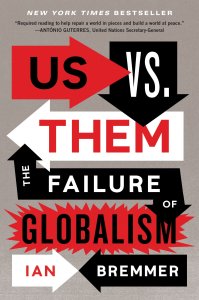
2.) “Us v. Them: The Failure of Globalism” by Ian Bremmer
Click Me!

Ian Bremmer, a notable political scientist has written a new book on the populist resurgence in the United States and around the world. He tackles the failure of ‘globalism’ as an ideology and how unfortunately it doesn’t look like we will all be able to live and thrive in a truly borderless world without political, economic, and social differences getting in the way. The fear of the ‘other’ and the tendency for human beings to organize themselves in separate tribes whether it’s the form of nations, races, and religions takes precedence even today as the reaction to globalism.

Mr. Bremmer makes the argument that ‘globalism’ and ‘globalization’ are separate in their meanings as ‘globalism’ as a term is primarily political in nature while ‘globalization’ is primarily economic. Globalization will continue to expand and thrive because its’ practical for nations to engage in trade and finance at the international level to boost and grow their national economies. As long as it is economically advantageous for nations to trade and do business with each other, globalization will continue to be a mainstay in economic relations.

‘Globalism’ however has received a backlash from the rise of political populism primarily in the Western world (the U.S., the U.K.) but also in Eastern Europe (Hungary, Poland), and also in developing nations like India, Mexico, Turkey, etc. Issues of mass migration, cultural shifts in nations, growing income inequality have led populations to look towards protectionism and ‘strongmen-lite’ politicians to address these systemic issues. In my opinion, Bremmer correctly argues that while the world is collectively doing well in terms of economic growth and the subsequent rise in living standards, there is still a serious political recession going on with far left and far right politicians gaining stream in terms of popularity.

‘Us v. Them’ reflect the growing unease and anxiety that a lot of people have regarding ‘globalism.’ Besides the cosmopolitan populations that live in the major cities of the world and who have benefited from the cross-cultural exchange of peoples, trade, finance, etc., there are many others who feel threatened by the ‘other’ and how their country and culture may be changing as a result. Mr. Bremmer sees the happening of Brexit, the election of Trump, and the rise of strongmen around the world as a reaction to ‘globalism’, and how there are drawbacks in that many people feel left behind by their political and economic elites who enacted these policies without their support. ‘Us v. Them’ is something that has occurred throughout human history and to myself, it goes back to our fundamental nature of our willingness to divide ourselves into separate tribes and to look upon the ‘other’ with suspicion and fear.

According to Mr. Bremmer, political populism is not likely to go away anytime soon and the rise of automation, an increase in artificial intelligence, the weakening of the middle class in both the developed and developing world are likely to put continued pressure on weakening political institutions who may or may not be agile and forward-thinking enough to come up with satisfactory solutions to these 21st century issues.

3.) “Notes on a Foreign Country: An American Abroad in a Post-American World” by Suzy Hansen

Click Me!

‘Notes on a Foreign Country: An American Abroad in a Post-American World’ by Suzy Hansen is a refreshing take on the way American foreign policy decisions have affected the U.S.’s relationships with certain countries such as Iran, Greece, Afghanistan, Turkey, Egypt, and specifically the people who feel that they have been negatively affected by those decisions. The average American is likely to be unaware of how large of a role the country has played beyond its borders and how some of those decisions have left deep, festering wounds in the people of those countries who were directly affected and still haven’t forgotten.

Ms. Hansen who came from a personal background similar to mine has lived in Turkey for over ten years and has traveled to the Middle Eastern countries such as Iran and Egypt looking for the perspectives of those citizens in regards to how America changed their countries, mainly for the worse. Her personal background growing up was very insular and she went to travel and live overseas in order to see her country differently.

From reading this book, it was refreshing to see Ms. Hansen do her research about the countries she was living in and visiting as well as interviewing many people in those countries to hear their stories and their perspectives. I believe that her book does a great job of enlightening Americans about negative foreign policy decisions made in the past that our country may not like to remember but is still forefront in many other countries’ perspective of the United States.

As Hansen left home and lived overseas, her innocence and that of America is stripped away because it’s a harsh truth to face yet it is one that we must all face is that America has not always done good in the world and there have been negative effects of past U.S. foreign policy decisions that heavily resonate with those peoples to this day. The key aspect of this mix of journalism and personal memoir makes this book stand out as a referendum on America’s role in the world, and how its likely to decline in the future. While our impact may lessen on our nations in the future, Hansen sees that as a possible good occurrence do the damage that has already been done.

My main critiques of this book is that while Ms. Hansen diagnoses that issues with U.S. foreign policy, I do wish there was an addition to the book where the author discusses how America can better its foreign relations in the future and to move forward positively with the countries she has become familiar with. However, to be fair, that would take a whole another book to diagnose how U.S. foreign policy should move forward. Also, I believe that this book was a bit too negative in its perspective on America and it could have been more balanced in its overall viewpoint. Ms. Hansen’s book pulls no punches and is a clear-eyed look on the blindspots of American exceptionalism and how our values have not always been well received beyond our borders.
English Corner – Direct and Indirect Speech

One of the biggest challenges that the average English learner can face is not being able to interpret or understand the difference between direct and indirect speech. In order to really understand how they are formed and used, we first need to define these two terms and what they are supposed to represent.

Let us start first with what ‘direct speech’ is. Direct speech simply repeats or quotes the exact words that were spoken word for word without any hesitation. If you need to use direct speech in writing, in English, we use quotation marks (““) to highlight the words that the person spoke so as to not to give false representation. Direct speech in writing always goes within the two quotation marks so that there is no confusion as to who said what words. For direct speech, you can highlight what was said in the present but also what was said in the past. I have listed a few examples below that could be used both in the spoken and written contexts.

Examples

  1. Jimmy says that, “We will need to come home early tonight for dinner.”
  2. Katherine shouted, “There’s a bee in my hat! Help!”
  3. My mom asked me earlier, “What time will you be home? I said to her, “I don’t know yet, mom.”

It is important to keep in mind that direct speech can refer to both the past and the present which is a key difference from indirect speech as I will go on to discuss further.

Indirect speech, also known as reported speech, often discusses what was said or what was written about in the past and may not always be 100% in its accuracy so that is important to keep in mind. The words are often used in the past tense and there are different verbs used for indirect speech such as ‘say, tell, ask, hear, see.’ The word ‘that’ also comes in handy in sentences that use indirect speech and commas are not used as frequently as they are when it comes to direct speech.

Examples

  1. Janet said, “I spoke to him earlier. “ (Direct)                                                                      Janet said that she had spoken to him earlier. (Indirect)
  1. The principal stated to the class, “He will not accept bullying in this school.” (Direct)                                                                                                                                      The principal stated to the class that he will not accept bullying in this school. (Indirect)
  1. They told him that he would never receive a work promotion. (Indirect)
  2. We told the children yesterday that it was time for them to go to bed. (Indirect)

As you can see from a few of these examples, the word ‘that’ is a key part of differentiating indirect speech from direct speech. It is also common to see indirect speech or reported speech not using commas as well. If you weren’t actually there with the person who said those words or had heard it from someone else afterwards, you need to use indirect speech because it wouldn’t be right to quote someone when you weren’t actually there to hear them.

You don’t always have to use ‘that’ to make it indirect speech. However, you never really want to use commas in sentences with reported speech. Lastly, as mentioned before, indirect speech always refers to the past tense whereas direct speech can reflect the present as well since you can quote people’s words in real time as you’re there listening to them speak. That distinction is key to understanding one of the differences between direct and indirect speech because there are a few of them to be aware of.

There are certain verbs for the act of speaking in English that are going to come up in direct and especially indirect speech. You’ll want to use the verb ‘to say’ in a sentence where there is no indirect object. You can use the verb ‘to tell’ when you know who it is the person is talking to in the sentence and can verify who they are. When it comes to communicating with other people, the verbs ‘to speak’ and ‘to talk’ come in handy for both direct and indirect speech.

It’s important to note that the future tense cannot be used for direct speech since you would be basing those quotes or words on your own speculation rather than what you are hearing the person say or would have heard what the person said. Direct speech is for present and past tense while indirect speech is used for the past tense only.

While the tenses are either present or past tense when it comes to the direct speech or indirect speech verbs of ‘talk, speak, say, tell’, etc., it is important to keep in mind that the quoted parts of the sentence referencing the speaker can refer to the past, present, and the future. The direct and indirect speech verbs maintain their present or past tense format while the rest of the verbs can be past, present, or future tense depending upon the context. I have listed a few examples below to make this bit of information more easily digestible.

Examples

  1. Alice said, “She will go to the farmers market tomorrow to get some vegetables.” (Direct)
  2. I heard Alice say that she will go to the farmers market tomorrow to get some vegetables. (Indirect)
  3. Murphy says to the other teachers, “I don’t understand why my students didn’t pay attention in class yesterday. (Direct)
  4. The Math teacher told us how Mr. Murphy didn’t understand why his students weren’t paying attention in class yesterday. (Indirect)

Another thing to keep in mind when it comes to indirect or reported speech are that modal verbs such as could, might, must, should, etc. do not change their actual form at all.

Examples

  • They explained to us that this tax bill could have negative consequences for the middle class.
  • We were told earlier that there might be consequences if we don’t finish all of the assigned homework by the end of the semester.

While there are many small differences between direct and indirect speech in English, the main thing to take away from this blog post is that how to phrase and quote speech is really important and must involve practice and effort. Being able to write stories or quote dialogue correctly are integral skills in the English language that can only come from being able to understand and use both direct and indirect speech. If you have any questions or comments, please let me know and best of luck in using this article to further your English language goals!

English Corner – Prepositions of Time

In other blog entries, we covered the general topic of ‘prepositions’ and then we broke it down even further by highlighting certain ‘prepositions of place.’ For this post, I am going to focus on the other half of prepositions which can be categorized as ‘prepositions of time.’ If you are able to master both prepositions of place and prepositions of time as an English student, you are going to do very well in terms of writing complete sentences that make grammatical sense and also improve your conversational skills. There are many prepositions of time similarly to how many prepositions of place there are but I am going to focus on the ones that will come up the most during your studies of this important grammatical topic.

I am going to focus on the five most popular prepositions of time starting with the three main ones known as ‘in, on, at’ which are also used as prepositions of place in different ways. As prepositions of time, ‘in, on, at’ are used in various ways and have different intended uses.

For example, the preposition ‘in’ can be used for describing months, seasons, years, decades, centuries, longer periods of time such as millennia as well.

Months – in March, in October

Seasons – in the Summer, in the Winter

Years – in 1991, in 2018

Decades – in the 2000s, in the 1960s

Centuries – in the 21st century

Unspecified Periods of Time – in the past, in the future

Below I have listed some example sentences where the preposition ‘in’ is being used in various ways associated with describing time.

  • My birthday is in October.
  • It is the hottest time of the year here in the summer.
  • In the 1960s, John F. Kennedy was President of the United States.

As you can see, the preposition of time ‘in’ can be used towards in the middle of the sentence but also at the beginning of a sentence as its first word especially when describing a decade.

When it comes to the preposition ‘on’, it can also be used in a number of ways. ‘On’ is specifically used for describing days of the weeks, part(s) of the day, specific dates, and special days such as anniversaries, birthdays, weddings, etc.

Days of the week – on Monday, on Saturday

Specific part(s) of the day – on Sunday afternoon, on Tuesday night

Specific date(s) – on December 31st, on April 1st

Special days – on our anniversary, on my birthday, on the wedding day

Here are some examples below of how the preposition ‘on’ can be used correctly according to its various usages related to the descriptions above:

  • On Friday evenings, I like to go to the movies with my girlfriend.
  • We went to the baseball game together on my birthday.
  • April Fools day is known to be on April 1st.

‘On’ can be used in various parts of the overall sentence and is not solely restricted to the beginning or end of a regular sentence. It’s important to note that ‘on’ is a preposition that is more specific in its purposes when compared to the preposition ‘in’ when it is used for time.

Next, we have the last preposition of time which could be considered one of the three musketeers of prepositions. ‘At’ has a variety of uses and is known for being the most specific of the three main prepositions of time. ‘At’ can be mainly used for describing times on the clock, festivals, holidays, and more general times of the day or night.

Times on the clock – at 5:30, at 4:15

Festivals / Holidays – at Christmas, at Thanksgiving

General times of the day – at night, at lunchtime

Listed below are some key examples to draw from when it comes to being able to use the preposition ‘at’ in the right context and with the right usage:

  • Chris gets out of his soccer practice at 5:00.
  • We get together as a family at Christmas time.
  • The couple likes to go out and dance Salsa at night.

Two additional prepositions of time to be aware of as an English student are ‘for’ and ‘during.’

‘For’ is a more specific preposition of time that is used to describe a length of time where an action or event is taking place. You use ‘for’ to discuss how long something or someone will be going on for with whatever kind of action that they are doing. Here are some examples to make it easier for you reading this post to master this preposition of time.

  • The volleyball tournament lasted for four hours total because there were so many teams competing.
  • The music festival lasted for three days and three nights since there were a lot of bands playing.

The 2nd additional preposition to be aware of is ‘during’ which is used as a preposition to discuss when something happens during a certain timeframe. It’s more general in terms of the timeframe when compared to ‘for’ but it can discuss an action that happened in the morning, in the afternoon, in the evening or in the night. Here are some examples to help you with this very specific preposition of time:

  • The blizzard happened during the night and school was closed as a result.
  • During the summer drought, farmers had to conserve their use of water for their agriculture and cattle.

As you can see from these examples, ‘during’ is a more general preposition of time when compared to ‘for’ which discusses a specific timeframe in hours, days, or weeks.

Unfortunately, there are more than five prepositions of time but I believe from my experience that ‘in, at, on, for, during’ are the most common prepositions for this kind of usage. In addition, if you wish to know all of them, there are also other prepositions of time such as since, ago, before, past, to, from, until, by.’ I may have another blog post focused on these prepositions but the most important ones to know to get by in describing time accurately in the English language are in, on, at, for, during.

 Good luck with the prepositions of time and please leave a comment if you have any questions about this grammar topic.

English Corner – Conjunctive Adverbs

Today’s English grammar topic is one that is often overlooked but can really help you become more advanced in using the language if you know how to do so correctly and by following the rules behind it. What I am referring to are ‘conjunctive adverbs’ which can help improve your sentences in terms of the meaning and to explain further about each independent clause within the sentence.

Conjunctive adverbs are words that are used to join two or more independent clauses into one sentence. A conjunctive adverb can help you to create a shorter sentence that still contains the necessary details to be complete. When you use a conjunctive adverb in a sentence, it’s necessary to follow the main rule otherwise it won’t work out.

The main rule for the placement of a conjunctive adverb is to put a semicolon (;) before it and a comma (,) after it. There are very few exceptions to this rule and without observing it, the sentence structure will suffer as a result. 

Example

  • We have many different sizes of this shirt; however, it comes in only one color.

Some examples of conjunctive adverbs are: accordingly, also, besides, consequently, finally, however, indeed, instead, likewise, meanwhile, moreover, nevertheless, next, otherwise, still, therefore, then, etc.

More Examples

  • The due date for the midterm paper has passed; therefore, I could not submit mine on time.
  • There are many history books; however, some of them may not be accurate.
  • It rained hard; moreover, lightning flashed, and thunder boomed.
  • The tired baby fell asleep; then, the doorbell rang, waking her up.
  • The law does not permit drinking and driving anytime; otherwise, there would be many more car accidents.

Conjunctive adverbs look like coordinating conjunctions (and, but, or, so, for, yet, nor); however, they are not as strong as coordinating conjunctions and they are punctuated differently. Compared to coordinating conjunctions in particular, there are many more words out there that can function as conjunctive adverbs. There are a lot less coordinating or subordinating junctions out there when compared to the amount of adverbs that can be used for conjunctive purposes. 

A conjunctive adverb is also used in a single main clause. In this case, only a comma (,) is used to separate the conjunctive adverb from the rest of the sentence. There’s no semicolon (;) in the case of these examples so it’s important to remember that you don’t always need a comma and a semicolon together in between your conjunctive adverb.

  • I woke up very late this morning. Nevertheless, I wasn’t late to school.
  • She didn’t take a bus to work today. Instead, she took the commuter train.
  • Jack wants a toy car for his birthday. Meanwhile, Jill wants a dollhouse for her birthday.
  • They returned home. Likewise, I went home after the party.

List of the Most Popular Conjunctive Adverbs

  • accordingly
  • additionally
  • also
  • anyway
  • besides
  • certainly
  • comparatively
  • consequently
  • conversely
  • elsewhere
  • equally
  • finally
  • further
  • furthermore
  • hence
  • henceforth
  • however
  • in addition
  • in comparison
  • in contrast
  • incidentally
  • indeed
  • instead
  • likewise
  • meanwhile
  • moreover
  • namely
  • nevertheless
  • next
  • nonetheless
  • now
  • otherwise
  • rather
  • similarly
  • still
  • subsequently
  • then
  • thereafter
  • therefore
  • thus
  • undoubtedly
  • yet

Overall, there are dozens of conjunctive adverbs that can be used in the English language but the ones I’ve listed above are definitely the most common. The job of an adverb is not to always connect two main clauses but it can happen so it’s important to be aware of how and when the ‘conjunctive adverb’ can be used in a sentence.

We do sometimes used adverbs to connect ideas together. In addition, conjunctive adverbs are supposed to connect words, phrases, and clauses together in order to create great sentences that flow really well and have a deeper meaning. By using conjunctive adverbs well, you can provide smooth transitions in a sentence from one independent clause to another one. The conjunctive adverb has a really important purpose within English grammar and I hope this blog post will help you, the reader, to use it to better your writing skills and reading comprehension. 

English Corner – Possessive Nouns

Being able to discuss ownership in English over a person, place, or thing is quite key when it comes to developing your grammar proficiency. In order to do that, you must be able to understand, use, and master possessive nouns. The function of possessive nouns is to essentially demonstrate ownership or some similar relationship over something else. Plural nouns indicate more than one person, place or thing. Listed below is a key hint about how to create the possessive noun as well as the five key rules that you can utilize in order to figure out if there is ownership of an object or not.

When you’re unsure of how to find the ‘possessive noun’ you have to look for the Apostrophe! Possessive nouns typically include an apostrophe!

Examples:

  • Jennifer’s imagination ran wild as she pictured the horrible car accident.
  • The kitten’s toy is a stuffed mouse, which she plays with every day.

You should be able to think of the apostrophe mark as a ‘hook’ reaching out to take possession of the object or person involved. Without the little hook or hand grabbing onto the ‘s’ or the next word, the noun is in its’ plural form simply but not actually possessive of anything or anyone.

In addition to looking out for the apostrophe to indicate that the noun is possessive, there are five major grammar rules for possessive nouns to understand and use.

Grammar Rules for Possessive Nouns

There are five basic grammar rules that cover the majority of times where writers encounter possessive nouns.

Rule #1: Making singular nouns possessive

You must add an apostrophe (‘) + s to most singular nouns and to plural nouns that do not end in the letter -s.

You’ll use this rule the most, so pay particular attention to it. English has some words that are plural but do not add the letter ‘s’. Words like children, sheep, women and men are examples of some plural words that do not end with an ‘s.’ These plural words are treated as if they were singular words when making the noun possessive.

Examples:

  • Singular nouns: kitten’s toy, Joe’s car, MLB’s ruling
  • Plurals not ending in s: women’s dresses, sheep’s pasture, children’s toys

Rule #2: Making plural nouns possessive

Add an apostrophe only to plural nouns that already end in the letter -s. You don’t need to add an extra ‘s’ to plural nouns that already end with the letter ‘s’. You only need to put the apostrophe onto the end of the word to indicate that the plural noun is now a plural possessive noun as well.

Examples:

  • Companies’ workers
  • Horses’ stalls
  • Countries’ armies

Rule #3: Making hyphenated nouns and compound nouns plural

Compound words can be tricky for the average grammar student. However, you’ll need to add the apostrophe (‘) + ‘s’ to the end of the compound word or the last word in a hyphenated noun.

Examples:

  • My father-in-law’s recipe for meatloaf is my husband’s favorite.
  • The United States Post Office’s stamps are available for purchase in rolls or packets.

Rule #4: Indicating possession when two nouns are joined together

You may be writing about two people or two places, or two things that share possession of an object. If two nouns share ownership of the object or the person in question, indicate the possession of that noun only once, and on the second noun itself. Add the apostrophe (‘) + ‘s’ to the second noun only.

Examples:

  • Jack and Jill’s pail of water is a common nursery rhyme.
  • Abbot and Costello’s comedy skit “Who’s On First” is a classic comedy sketch.

Rule #5: Indicating possession when the two nouns are joined, yet ownership remains separate

This is the trickiest rule of them all, but luckily you’ll only need to use this rule infrequently. When two nouns indicate ownership, but the ownership is separate, each noun gets the apostrophe (‘) + ‘s’. The written examples below may help you to understand exactly what this rule means.

Examples:

  • Lucy’s and Ricky’s dressing rooms were painted pink and blue.

Explanation – (Each person owns his or her own dressing room, and they are different rooms).

  • President Obama’s and Secretary Clinton’s educations are outstanding.

Explanation – (Each government official owns his or her education, but they attained separate educations).

Possessive nouns is a tricky grammar topic but by understanding the need to use the apostrophe in the correct place and studying the rules surrounding its’ usage, you’ll be going in the right direction. Nouns can be singular, plural, compound, hyphenated, etc. so that is why you must be aware that the formation of the possessive will change depending upon how the noun is formed.

These rules, examples, and explanations for possessive nouns will help you develop your English grammar proficiency especially for this particular topic. However, you as the student must take the time to create your own sentences, study these examples and review this blog post in order to master the subject of possessive nouns.

Isabella’s Museum

IMG_2927IMG_2930IMG_2936IMG_2937IMG_2940IMG_2942IMG_2946IMG_2949IMG_2951fullsizeoutput_7b9IMG_2960IMG_2964IMG_2967IMG_2968IMG_2971

CameraCanon PowerShot SX710 HS

Location: Isabella Gardner Stewart Museum; Boston, Massachusetts

A Lifetime of Learning

Contrary to popular belief, one’s education does not stop when you finish high school, college, or even graduate school. While formal education is often necessary and useful especially for skilled and professional fields, it is not the end all be all for actual learning. Even if you have been through 12 – 18 years of formal schooling, that doesn’t mean that you should stop learning. If anything, you may have the time, the money, and the ability now to study and learn about subjects that you never had the chance to before. Learning doesn’t stop in your teens or in your 20’s. It’s a lifelong process and you should never want to stop learning.

In a previous article titled, “A Wealth of Knowledge”, I highlighted a number of ways and places where you can continue to learn new things to broaden your horizons and expand your interests. As I mentioned previously, we are currently living in a time where knowledge is seemingly infinite, more affordable, and easier to access than ever. While information, data, and subject matter is limitless in the ways that it can be obtained and analyzed, the ways in which you can stand out as a learner is in how much time you devote to the learning process and how dedicated you are to absorbing this knowledge.

Whether it’s coding, learning a language, or developing financial literacy, the amount of effort you put into it will decide how much you get out of it. Even if you’re just learning a new skill or subject as an interest or hobby, it will help you to stand out from the crowd. If you use part of your free time to develop yourself by learning a new skill or trade, it is guaranteed to help you both personally and professionally. There are also different types of learning so if you happen to decide to revisit subjects you forgot about from high school like algebra, physics or chemistry, you may be doing your brain a favor. If you’re not so much into math and science but enjoy the written word much more, perhaps you would be better suited for strengthening your reading, writing, and editing skills. You may want to start your own blog like I did, or become a freelance editor to make extra money, but you are using your personal interests to further your learning to make yourself well rounded.

Reading a new book each month, learning a language for one hour each day, or doing a daily crossword puzzle takes both discipline and effort. A lifetime of learning is not for everyone because it takes some characteristics that some people aren’t capable of implementing. You have to set goals when you’re learning outside of a university or a class setting. Only you will be accountable for your actions and how far you go when it comes to your outside the box learning experiences. It can be difficult to learn new things when you don’t have a teacher or professor looking over your shoulder but you’ll develop more self-confidence, maturity, and intellectual depth by being able to learn and study on your own.

When it comes to learning by yourself, in addition to no one holding your hand through the process, don’t expect others to recognize the work or effort you put in to it. You should be learning for yourself and not for the approval of other people. If you’re expecting recognition just for reading a lot or creating your first website, the world doesn’t work like that. Being confident in your abilities, proud of your efforts, and seeing the fruits of your labor change the world in some way is the icing on the proverbial cake when it comes to taking the initiative to learn.

To make the excuse that you don’t have time or you’re too old or it’s going to be too hard are not good enough. There’s a popular expression that you never know until you try. How can you know that you’re going to fail if you haven’t even tried yet? Don’t limit yourself based on your educational background as well because you may find that you were bad at mathematics but ended up becoming a great coder when you gave it a shot. If you find that you don’t like what you’re learning or that you’ve made little progress over the period of at least a few months of serious effort and hard work, then it may be a good idea to do something else.

You should always be learning something, especially when it’s something new. Letting your creative and intellectual juices stagnate is not good for either the mind or the body in my opinion. Even if learning new things may become more difficult as you get older, it’s still not impossible and it would be good for your mental dexterity. Do not let pressure from your friends and your family prevent you from learning. If they love and care about you, they’ll support your thirst for knowledge. Reading a book, learning a foreign language, or playing an instrument are activities that we should always be encouraging in people regardless of their age and background.

Learning new skills has many mental benefits especially for the brain. ‘Myelin’, the white matter that makes up a good portion of our cerebral nervous system becomes denser when we learn new skills allowing us to improve our performance when it comes to processing new information. In addition to your brain chemistry seeing a boost, the more you learn, the more neural pathways are formed in the brain allowing the electrical impulses to fire off quicker than ever making it continually easier to learn new things. It’s a positive feedback loop for your brain when you learn on a consistent and unyielding basis.

Existing knowledge that you’ve compiled is also more easily retained because you’ll be making connections between the new information you’re learning and the old information that you remember clearly. Having more knowledge and more learning experiences is proven to make you a more interesting person as well. Being able to discuss a wide variety of books or have a detailed conversation with another person in a foreign language are great ways to form deeper connections with people and to boost your self-esteem.

If you’re bored and don’t have much of a challenge in your life, then try something new! Putting yourself to the test with learning a new skill is perhaps the most rewarding thing you can do in your life. In this hyper-technological age, adapting to change is a key trait that you’ll need to take on in order to succeed both personally and professionally. Adapting to the times often means learning new skills so if you embrace this process, you won’t be as afraid of change and you will be better able to meet those challenges.

As mentioned before, your brain is full of muscles that need to be exercised like any other part of the body. You don’t want one of your most important organs to atrophy and stagnate. A good way to prevent the onset of dementia and Alzheimer’s is to keep learning throughout your life to make those degenerative, painful diseases less of a possibility. Learning is contagious so if you have a friend or a family member who seems bored by life or wanting to pursue something new, give them a few suggestions and see what they do with them. Practicing a new language or joining a book club are examples of ideal social activities that are focused around these new learning experiences. A lifetime of learning can truly do a world of good.

SourcePreventing Alzheimer’s Disease

English Corner – ‘Will’ and ‘Going To’

The phrases ‘will’ and ‘going to’ are very commonly used to express oneself in the future tense. It’s important however to know the difference in how they are used and under what circumstances should they be applied.

If you’re making a quick decision about something or someone, you’re going to use ‘will’ instead of the alternative of ‘going to.’ Also if you’re offering to help or assist someone, then you would use ‘will’ as well. When it comes to making a promise or a threat, ‘will’ is what you should be using before the verb. Lastly, ‘will’ is also used when you want to refuse a gesture or a gift from somebody. The five instances of making a quick decision, offering something, making a promise and/or threat, and refusing a gesture or a gift will all use ‘will’ when it comes to the future tense.

Examples:

1.) I will buy you dinner tomorrow night.

2.) He will help you get out of the car.

3.) She will promise us to watch the dog while we go out to brunch.

4.) If they don’t stop marching, we will shut down the bridge to stop them.

5.) They won’t help us if we are not willing to cooperate with them.

When it comes to using ‘going to’, the circumstances of usage are not as frequent when compared to using ‘will’ for the future tense. When ‘going to’ is placed in a sentence, it’s often for discussing a prior plan that you have confirmed with friends, family, or other people in your life and is a definitive plan. When something is likely to happen and the result is inevitable based on the current evidence, you would also use ‘going to’ to describe the outcome. The last instance where you would use ‘going to’ over ‘will’ is when something imminent is about to happen and there’s not much time left until it occurs such as an event.

Examples: 

1.) I’m going out dancing with my best friends tonight at the Salsa club in Havana.

2.) New England is likely going to win this football game. They’re up by 21 points at halftime.

3.) The race is going to start immediately after the gun fires in the air.

The one instance where ‘will’ and ‘going to’ overlap with each other in terms of usage deals with making predictions that are likely to happen in the future. In this regard, both ‘going to’ and ‘will’ are equal and both create the same kind of meaning in the sentence.

Example:

1.) I think it’s going to rain tomorrow evening in Seattle.

2.) I think it will rain tomorrow evening in Seattle.

As you can see in this example above, there is no discernible difference between these two sentences in terms of meaning even though they use ‘going to’ or ‘will’ interchangeably without any issues. If a student of the English language is to master the future tense in grammar, he or she will need to know the differences and similarities between the phrases ‘will’ and ‘going to.’ They can be applied in a number of different ways so it’s important to study the examples above and also think about their reasons for being used in the future tense.

English Corner – Introduction to Modals

There are many different kinds of modals to study but in this ‘English Corner’ blog post, we’re going to start out with an introduction dealing with the modals of ability. Modals of ability are the most common and the most important to master firstly. Modals are verbs usually and the ones that I am going to be focused on in this article are can, could, be able to, may, might.

Modal verbs act as auxiliary verbs in your average sentence and can express different ideas. These ideas include expressing one’s ability, one’s possibility, and sometimes necessity. Modal verbs often have more than one meaning and can be significant in a variety of ways. A simple form of a verb always follows a modal verb in a regular sentence as well.

Example:

  • Ben can do his homework.

The modal verb ‘can’ is followed by the simple form of the verb ‘to do’ followed by the object part, which refers to his homework.

An Introduction to Modals can be broken down into three separate parts: modals for ability, modals for possibility, and modals for permission. Each type of modals is unique in their own way but they each help to express oneself in some form or another.

For ‘Modals of Ability’, you can express your own ability or that of someone else by using the words ‘can, be able to, could’ in order to highlight your ability to do something.

Present Ability: I can speak three languages.

Negative Form: I cannot read this book.

Past Ability: Jack could play on the swings when he was a child but not anymore.

Negative Past Ability: Jane couldn’t go to the dance last night because she was sick.

In any regular sentence, the verb after the modal ‘can, could, be able to’ is always in the simple form and always follows the auxiliary (modal) verb. It’s important to note that the simple verb after the modal verb never changes either.

Examples:

-Ben can doing his homework. X

-Ben can to do his homework. X

-Ben can did his homework. X

All of these examples listed above give us the understanding we need to see that the simple form of the verb such as ‘to do’ never changes from its’ original intention. ‘Ben can do his homework’ is the only correct answer in this case.

In order to turn the ability modal into a question, it’s also quite easy to do. The form of the sentence should look like ‘modal verb + subject + main verb + object…? For any of the ability modals whether it’s can, could, etc., you can use them in the form of a question.

Examples:

  1. Can she play the flute?
  2. Could you go to the store to pick up some fruit?
  3. Are you able to do your homework tonight?

‘Able to’ is an exception in that as a modal of ability verb, the structure of the question form looks like: ‘to be’ + subject + able to + main verb + object…?’

For Modals of Possibility, it’s important to understand how to express ‘possibility’ in a sentence through showing what’s possible and what’s not possible for someone or something. The modals of possibility include ‘may, might, and could’ now and in the future. All of these three modals have the same meaning and can be used interchangeably regardless of the type of sentence.

Examples:

  • I might be late to the business meeting tomorrow.
  • You may want to re-take the exam next year.
  • You could get into college if you study harder.

Possibility cannot be expressed for the past but only for the present and the future when it comes to grammar.

For ‘Modals of Permission’, you can express ways to ask for or to give permission in a regular sentence. In order to create this modal sentence, we need to use the modals of ‘may, could, and can’, which are also apart of permission and ability modals. Permission modals are very polite and formal so it’s important to know how to write and verbally use them correctly in a sentence.

Examples:

  • May I go to the bathroom please?
  • Could I borrow your lawnmower today?
  • Can he have the last piece of chocolate cake?

For the main verb that comes after the subject and before the modal verb, it’s always going to be in its’ regular, simple form which never changes. When it comes to modals of permission, it’s important to remember that using ‘may’ especially at the beginning of the sentence is the most formal of the three options. Also, if someone were to answer you to grant that permission so you can go to the bathroom or to use your lawnmower, you can answer with:

-Yes, you may or No, you may not.

There’s also the possible positive or negative response to the modal question with ‘Yes, you can’ or ‘No, you can’t.’

While not the most popular grammar topic, there are many kinds of modals and knowing some of them especially those modals concerning permission, ability, and possibility is key to improving your English proficiency. This article is simply an introduction to modals and in the coming weeks and months; I hope to highlight other types of modals that are likely to come up in your grammar studies. “You can do it!”


English Corner – Personal Pronouns

When you begin to learn the English language and specifically English grammar, it is very important to be able to address people whether it’s a man, a woman, or a collective group of people. You won’t be able to become personal with people unless you understand and know about personal pronouns.

The good news is that learning about personal pronouns is quite easy and doesn’t take much time compared to other grammar topics. Personal pronouns can be divided into two separate categories: subject pronouns and object pronouns. It’s important to recall that we use pronouns in place of a full noun. Pronoun words tend to be shorter than regular nouns in terms of syllables and length too.

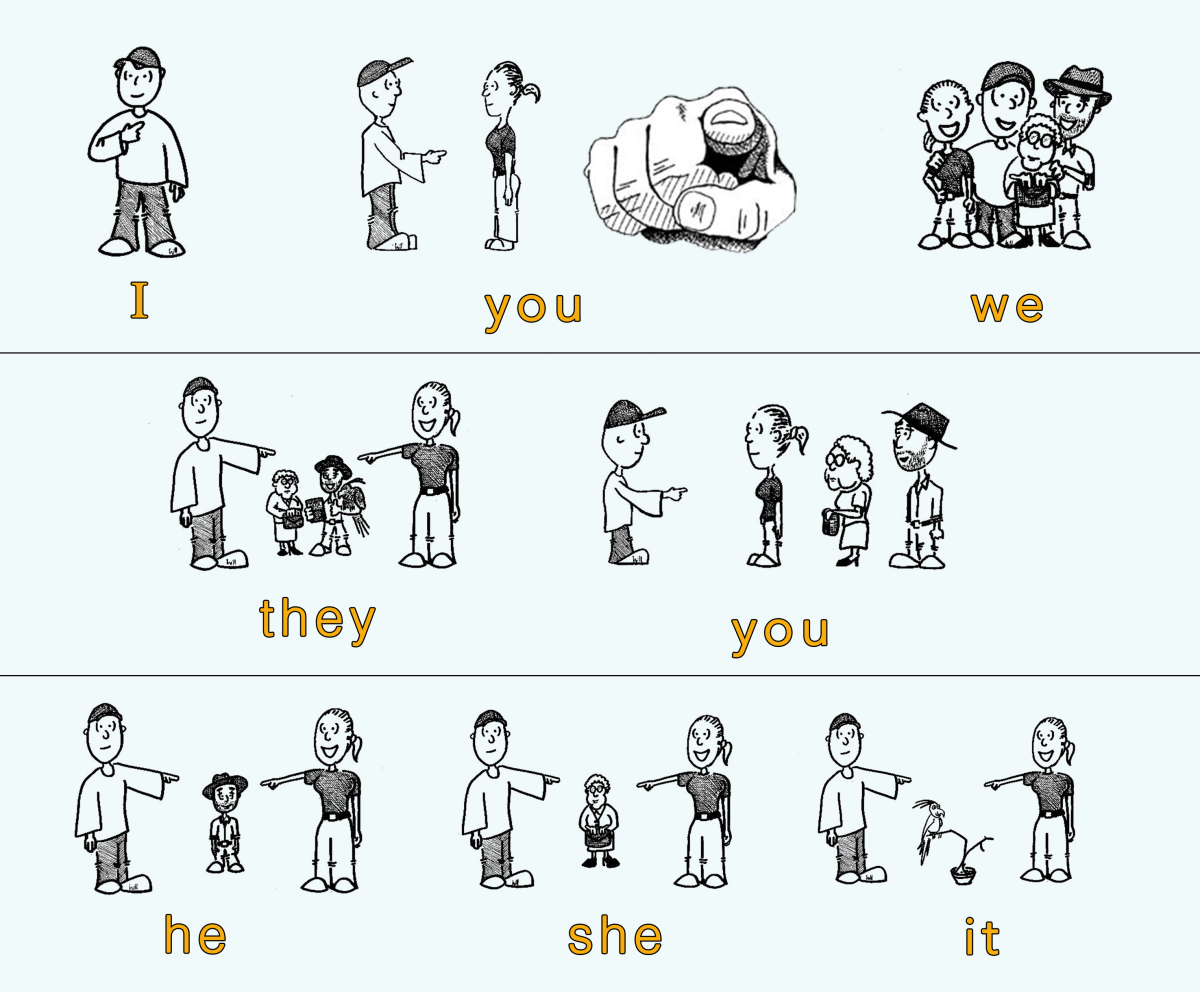
The subject pronouns are as follows in the list below:

I         (Singular)

You   (Plural)

He     (Singular)

She     (Singular)

It         (Singular)

We      (Plural)

They   (Plural)

These subject pronouns are personal and apply to both singular and plural subjects. The singular subject pronouns are ‘I, he, she, it’ while the plural subject pronouns are ‘you, we, they.’ Regardless if you are using the present, past, or future tense of the verb form, the singular pronouns stay singular and the plural pronouns stay plural.

The object pronouns are as follows in the list below:

Me    (Singular)

You   (Plural)

Him   (Singular)

Her   (Singular)

It       (Singular)

Us     (Plural)

Them (Plural)

These object pronouns are also to be used for personal reasons and apply to both singular and plural subjects. The singular object pronouns are ‘me, him, her, it’ while the plural subject pronouns are ‘you, us, them.’ Regardless if you are using the present, past, or future tense of the verb form, the singular pronouns stay singular and the plural pronouns stay plural when it comes to objects. If you study both the subject and object pronouns consistently, you’ll be able to tell which words are singular and which words are plural.

It’s important to remember that in the English language, gendered nouns are not as prominently used compared to other languages such as Spanish or Italian. However, he / him is always used to refer to a man or boy while she / her is used to refer to a woman or girl. ‘It’ is often used to refer to a non-human entity such as an animal (whose gender is unknown) or an object like a desk.

Another key thing to keep in mind is that ‘you’ is a singular pronoun in terms of it referring to just one person, thing, or object. However, ‘you’ goes along with the plural form of a verb such as ‘to be’ making it more of a plural pronoun. For example, instead of putting ‘you’ and ‘is’ (to be) together, you would instead put ‘you’ and ‘are’ (to be) together, which is the plural form of the verb and not the singular form.

‘You is smart’ is a sentence that is not grammatically correct in English while ‘You are smart’ is correct instead. I like to call this English rule of personal pronouns the ‘You’ exception. Similar to ‘I, He, She, It’, ‘You’ is singular in its’ meaning yet it can be used with the plural form of the verb ‘to be’ instead of the singular form. Due to this exception, ‘You’ should be grouped more with ‘We, They’, which are both plural subject pronouns rather than with the former singular subject pronouns.

Here are some examples to show you how the singular and plural subject pronouns can be formed in complete yet simple sentences:

Subject Pronouns (Singular)

  1. I am doing okay.
  2. He is feeling good.
  3. She is playing tennis.
  4. It is raining outside.

Subject Pronouns (Plural)

  1. You are being mean.
  2. They are going to the movies.
  3. We are hungry for dinner.

From the examples above, you can see that the singular subject pronouns go with the ‘am, is’ form of the verb ‘to be’ in the simple present tense while the plural subject pronouns all use the ‘are’ form of the verb ‘to be.’ By following the examples above, you’ll have a better understanding of how to use the subject pronouns correctly in order to be personal in English.

One of the main differences between the subject and object pronouns is that the ‘subject’ pronouns begin the sentence while the ‘object’ pronouns often come at the end of the sentence. The English language follows a structure of ‘subject – verb – object’ and that is a formula of a basic sentence that rarely changes. The singular ‘object’ pronouns are words like ‘me, him, her, it’ while the plural ‘object’ pronouns are words like ‘you, us, them.’ As mentioned before, the word ‘you’ falls into the plural category with object pronouns like it does for the subject pronouns.

Here are some examples to show you how the singular and plural object pronouns can be formed in complete yet simple sentences:

Object Pronouns (Singular)

  1. The horse jumped over me.
  2. Think about him.
  3. Sing loudly with her.
  4. They did it.

Object Pronouns (Plural)

  1. I like
  2. The reservation is for us.
  3. We were here before

Without being able to address anyone or anything properly, your English will not advance that much. If you want to be comfortable forming sentences either verbally or in the written form, you must study and master the personal pronouns to the best of your ability.

———————

If you’re looking to improve your English through private lessons with me on a one-to-one basis please check out my ‘Learn English with Ben‘ page here: https://benjweinberg.com/learn-english-with-ben/

You can also check out my ‘English Grammar’ courses on Teachable.com here: https://benjweinberg.com/my-grammar-courses/