
English Corner – Using Words of Encouragement

A letter, essay, e-mail or other written form of encouragement in English serves the following purposes:

-An expression of approval and support.

-An act of giving hope or support to someone.

We use encouraging words in the English language for helping someone out especially when they are not doing well. We want to encourage each and every person to keep on doing their best.

Some Examples:

-Do not give up faith.

-Do not be discouraged.

-Do not lose hope as there will many more opportunities again.

-It has been a great incentive to get a bonus for my extra sales and I hope that this continues.

-I am confident that our Sales / Marketing team will have no trouble accepting this challenge.

-I am confident that you will make an excellent host.

-Your hard work and determination are greatly valued.

Ten Main Expressions of Encouragement to Use in Your Speaking and Writing

-You’re coming along nicely.

-Keep up the good work.

-That’s good effort on your part.

-You are showing real improvement.

-You’re on the right track.

-Keep going and do not give up.

-Come on, you can do it

-Give it your best shot

-What have you got to lose?

-If at first you don’t succeed, then you must try, try again.

Some Phrases to inspire people.

(You wouldn’t use these phrases often in regular conversation, but when you are writing speeches or creating motivational essays, they sound very inspirational.)

  • Always follow your dreams.
  • You should reach for the stars.
  • Do the impossible.
  • Believe in yourself.
  • The sky is the limit.

How To Use These Encouraging Phrases In English:

Phrases to use when someone hasn’t started yet.

(You can say these phrases to someone who is trying to figure out whether or not to do something that seems difficult or risky.)

1. Give it a shot.

Example: Your friend has never asked a girl out for coffee before. You offer to introduce him to your friend since she is single.

2. Go for it.

Example: One of your colleagues at work is looking for a raise and is thinking of asking his boss for one. You encourage him to do so.

3. Why not do it?

Example: Your wife asks you if she should enroll in a cooking class on the weekends. You tell her why not do it and see what happens.

4. It’s worth a shot.

Example: Your brother wants to try out for the Varsity basketball team at his high school but is not sure if he should do it. You tell him that it is worth a shot.

5. What are you waiting for?

Example: You are waiting for your friend to go down the waterslide and have some fun. You ask him ‘what are you waiting for?’

6. What do you have to lose?

Example: Your brother asks you whether or not he should take his girlfriend on a nice vacation to Italy this Summer. You tell him, “What do you have to lose?”

7. You might as well.

Example: Your professor asks you to see her after class to do some extra work so you can understand the class material better. “You might as well” to get a better grade.

8. Just do it.

Example: The famous Nike slogan but whenever you are put to the challenge physically or mentally, you say to yourself or others, “Just do it.”

Phrases to use when someone is already doing well.

(You can “encourage” someone to continue doing what they are already doing.)

1. There you go!

Example: You hit a home run to tie the baseball game and your teammates cheer you on.

2. Keep up the good work.

Example: You get an ‘A’ on your history exam and your professor commends you for your good work.

3. Keep it up.

Example: You are running in a Track and Field race and you have one lap to go. Your coach urges you to finish strong.

4. Good job!

Example: You improve your Grade Point Average (GPA) by a few percentage points and your parents want to congratulate you.

5. I’m so proud of you!

Example: You tell your grandmother about you getting in to your dream college and she exclaims how proud of you she is.

Phrases to use when someone is having trouble.

(These phrases are ways to tell someone to keep doing something even when it is difficult.)

1. Hang in there.

Example: Even though you have to hike for another hour, you need to ‘hang in there.’

2. Don’t give up.

Example: Life can be difficult but you need to persevere through its challenges by not giving up.

3. Keep pushing.

Example: Even though the weights you are lifting are very heavy, keep pushing and get them done.

4. Keep fighting.

Example: You have three rounds left to fight against the heavyweight champion of the world.

5. Stay Strong.

Example: I know losing a pet is very sad and difficult but you have to stay strong for your siblings.

6. Never give up. Never give in.

Example: Even when you have schoolwork, a job, and a mortgage to pay, don’t give up or give in.

7. Never say ‘die’.

Example: Anything is possible in life so there is a chance that your dreams can come true.

8. Come on! You can do it!

Example: When you have 500 meters left to swim and you’re in first place. You have the ability to win the race.

Phrases to use when someone is facing a hard decision.

(These phrases are ways to tell someone to keep trying)

1. I will support you either way.

Example: If you choose not to go to college and join the Army instead, I will support you either way.

2. I’m behind you 100%.

Example: Your family should be behind you 100% as long as you are working hard to better yourself.

3. It’s your call.

Example: I’m not sure where to go out tonight, sweetheart, ‘it’s your call.’

As you can see, there are numerous examples in English of this kind of supportive language. Words and phrases of encouragement play a key role in showing the person(s) or people that you care about them and that you want them to succeed. If you have a friend, family member, or a work colleague who is a native English speaker and you want to encourage them to improve, get better, or to do their best, you’ll want to use some of these examples listed above.

There’s not much that can make a person’s day more than receiving some encouragement so they can face their challenges head on and succeed in their goals. This list of vocabulary words and phrases will help you do just that as an English learner in both your speaking and writing abilities. In the English language, there are dozens if not hundreds of these vocabulary words but if you are able to put them to good use, you’ll be seen as being more proficient in the language. You will also be better able to connect emotionally with people and gain a few new friends through your kind words and actions.

If you would like to improve your English skills especially with regards to your grammar and vocabulary, check out my English grammar course offerings on Teachable:

https://english-from-a-to-z.teachable.com/ 

English Corner – Five English Mistakes That Can Be Easily Fixed

New students of the English language are destined to make mistakes when practicing their skills and abilities in building up their proficiency. There’s nothing wrong with making mistakes but I’d like to share the five most common mistakes that are easily fixable given my experience in teaching English as a Second Language. Instead of letting these mistakes continue unabated, it’s important for teachers such as myself to correct our students right away so as to not let these small mistakes become bad habits. When you have a small error, usually grammatical in nature, it’s necessary for the teacher to use his or her expertise to correct the student right away and show them the difference between the right approach and the wrong approach to the mistake.

You should always be correcting the student politely and then showing them where exactly did they go wrong, and how they can avoid the same mistake again. Hopefully, English as a foreign language student will be able to avoid some of these five mistakes but I would say that it is quite likely that they will commit one or two of these five errors. Luckily, these mistakes are easy to fix and once you do, the student can move on to more intermediate and advanced challenges.

            1.) Neglecting both indefinite and definite articles: Some non-native speakers of English have a bad habit of leaving out the ‘a’, ‘the’, or ‘an’ at the beginning of their sentences. They may state their sentence as being “Economy performed very well.” While it’s easy to understand the sentiment of the sentence and the meaning will come across to the native speaker, it won’t be grammatically correct. It’s always necessary to put a definite article like ‘the’ before the word ‘economy’ in order for it to sound like a sentence that a native speaker would put together. “The economy performed very well,” should be the sentence that the foreign learner of English must use to be grammatically correct and fully understood.

This is an easy mistake to correct but if left unchecked, the non-native speaker will forget many times to add ‘a’, ‘an’, or ‘the’ at the beginning of their spoken or written sentences. For ESL teachers, this is a key mistake that students will make especially from language backgrounds where ‘definite and indefinite articles’ are not used. Another example of an indefinite article not being used is a sentence like “I have cat.” While we know that person has a cat, there is the key ‘a’ word missing to make it grammatically correct. The student should then be correct for the sentence to be “I have a cat.” While these are not major mistakes, by showing your students the correct structure, you will be doing them a big favor and helping them to become better English learners.

            2.) Mixing up singular and plural noun usage: Another slight mistake that ESL students make as beginners is to mix up singular and plural nouns. Knowing when and when not to use the ‘s’ at the end of nouns is key to having a grammatically correct sentence. It should be made clear that the letter ‘s’ should only be added to the end of a noun when there are more than one item, place, or thing being referenced. The key difference from one example would be ‘You eat one cookie’ and then ‘You eat two cookies’, with ‘s’ only being added to the noun ‘cookie’ when there is more than one being referenced.

You can also use ‘many, a few, a lot of’ before the noun ‘cookies.’ Countable and uncountable nouns go hand in hand with singular and plural nouns as grammatical concepts. ‘Countable’ nouns are usually plural meaning referencing more than one in number while ‘Uncountable’ nouns are usually singular in nature and can’t reference multiple persons, places, and things. Being able to use singular and plural nouns in written and/or spoken sentences is key because it will come up very often. If you make a small mistake with this concept of mixing up their usage, it should be corrected as soon as possible in order to not become another bad habit.

            3.) Forgetting to use prepositions and conjunctions: Before you can speak and write with some authority, you will need to study, use, and memorize the correct prepositions and conjunctions. Oftentimes, ESL students can forget the need for prepositions, conjunctions in a regular sentence but that will mean your sentence won’t be grammatically correct. A sentence like this one as an example would not work without prepositions or conjunctions. “He left me didn’t return I was not afraid I knew he would be back.” There are four prepositions and conjunctions missing from that example sentence and it can still work as a sentence, but it is fundamentally incomplete and would raise some eyebrows from native English speakers.

These are small errors but would hurt your ability to be understood or seen as an intermediate or advanced English learner. In order to change this example for the better, we need to make the sentence have both prepositions and conjunctions. “He left me and didn’t return but I was not afraid because I knew he would be back.” These two grammatical functions add a lot of substance to your sentence and makes it flow that much better. If you leave these conjunctions and prepositions out of your sentences, it will hurt your proficiency and you won’t be able to correct these particular mistakes.

            4.) Changing the order of the sentence from (Subject – Verb – Object): Spoken and written sentences in English have a strict order in terms of formation like any other language. While other languages could be ‘subject – object – verb’ or ‘verb – subject – object’ in official syntax, English, as a language, follows the strict format of ‘subject – verb – object’ at all times especially if you’re looking to form a complete sentence. You can form sentences in English in another order and you may be understood by a native speaker, but it won’t be grammatically correct, and you will be creating yet another bad habit that can be easily corrected. Every language has a basic structure and it needs to be observed at all times. You can’t cut around the edges in terms of the sentence structure or it will stand out as a huge error.

Basic sentence order should be memorized when you are first studying a foreign language and that includes English. A wrong sentence in terms of basic order would look like this as an example: “Store goes to the he.” You have the ‘object’ at the beginning which is wrong, the verb in the middle which is correct, yet the subject is at the end of this example sentence when it should be at the beginning. The sentence order is completely wrong here, but it is easily fixable in the following manner: “He goes to the store.” SVO or ‘Subject – Verb – Order’ is a clear and concise grammar rule that is fundamental in order to master the basic sentence structure instrumental in creating good sentences. A basic mistake like changing the order of a sentence form unnecessarily can be fixed quite easily. subject (he), verb (goes to), and object (the store). You just have to switch the order around a bit if it is incorrect and then you’ll be ready to move on to the next sentence while keeping the right order.

            5.) Capitalizing the wrong words in a sentence: Let’s remember that correct capitalization can be quite easy to do but it remains as a difficulty for many English as a second language students to master due to how, when, and where to capitalize words. It’s not a huge mistake so students may commit the error thinking that it’s not a big deal, yet correct capitalization can set you apart in terms of your writing proficiency from other learners. To neglect the basic rules of capitalization sets you up for bigger and more costly grammar mistakes. If you are able to take care of the basics and capitalize words throughout the sentence, then you’ll be well on your way to becoming a great English learner. An example of poor capitalization in a sentence would be as follows: “i Went to the grand canyon and it was Fun.” There are a few errors here that should stand out to you and are easily fixable, but a few students may choose to not revise the errors and leave the sentence wrongly capitalized. The key fixes are easy to implement for this sentence and would like the following revised sentence: “I went to the Grand Canyon, and it was fun.”

The changes I made include ‘I’ as capitalized, ‘went’ as not being capitalized, ‘Grand Canyon’ as being capitalized, and ‘fun’ as not being capitalized. In keeping with the basic rules of capitalization, proper nouns (Grand Canyon) should be capitalized, as well as the first word in any sentence, ‘I’ in this case, and to recall that ‘went’ as a verb should not be capitalized along with an adjective such as ‘fun’ when it comes at the end of the sentence. Conjunctions, or a preposition such as ‘and’ should also never be capitalized in a regular sentence.

Taking the time to take care of capitalization errors will put you ahead and establish your English language proficiency as improving by fixing your mistakes. If you have the time to write, speak, and use the English language, you should also use that time to revise, fix, and correct your errors to become a better student and a better learner.

———————————————————

If you are interested in taking a private English lesson, check out my teachers page here where you can learn with me in a one-on-one hour session: Learn English with Ben

Lastly, please check out my Udemy courses on ‘Beginner Grammar’, ‘Intermediate Grammar’, and ‘Advanced Grammar’ here: My Udemy Courses

English Corner – Introduction to Action Verbs

When you are first getting the basic structure of English sentences, it’s important to base those same sentences around key verbs in the language that we use every day. Knowing what action verbs are as well as when and where to use them is key to becoming better at the beginning stages of your English language studies. In this blog post, we will cover what an action verb is, what it does, and we will cover numerous examples in the past and present tenses in order for students to understand how to use these ‘action verb’s and apply them to regular sentences.

I recommend taking these examples and studying them on your own by copying them or saying them out loud depending on if you are working on your speaking or writing. You can also have a friend, or a family member help you understand what these ‘action verbs’ mean by listening to the context of the sentences and how these different ‘action verbs’ are used. Please remember to memorize this type of English vocabulary because ‘action verbs’ are perhaps the most commonly used in English and will come up quite frequently in both the written and spoken form. Do your best to read through this article and then on your own time or in the comments section, please feel free to give a few examples of sentences that use ‘action verbs’ to complete them.

An action verb is a verb that expresses physical or mental action.

The action verb tells us what the subject of our clause or sentence is doing-physically or mentally.

Examples of Action Verbs:

To find an action verb:

1) Find the word in the sentence that is something someone or something can do.

2) Remember that the action can be physical or mental.

Examples of action verbs: think, smell, love, do, act, run, swim

Examples of action verbs in a sentence:

Maria walked to school.

‘Walked’ tells us what Maria was doing physically. (Past Tense)

Louie thought about the math problem.

‘Thought’ tells us what Louie was doing mentally. (Past Tense)

Below are some more examples of sentences that contain action verbs:

The action verbs are italicized.

1) Sam and Dave ride the bus to school each morning.

2) Jordan wants a horse for her birthday.

3) Isaac reads a chapter in his book each night.

4) Do you think it will rain today?

5) I believe that fairies, monsters, and unicorns are real.

6) Will you help me with my Math homework?

7) Please call your mom, Teresa.

8) The chicken strutted across the road without any fear.

————————————————————-

1) Are you doing your homework today?

2) McGregor and Mayweather will be fighting in the boxing match tomorrow.

3) She is singing a cover of a famous song by Ella Fitzgerald.

4) I’m smelling the flowers and their scent is divine.

5) She is acting in the top musical on Broadway these days.

6) Are you thinking what I’m thinking?

7) We are dancing to the beat of the Salsa music.

—————————————————————

Lastly, as you can see from the numerous examples I have provided, there are dozens of ‘action verbs’ in English but the ones I would like you to focus on primarily are the few that come up most frequently. From my experience as both an English as a Second Language teacher and a student of other languages, ‘action verbs’ like ‘run, go, swim, jump, walk, play, dance, sing’ are all vocabulary words that you should memorize first. Once you have those ‘action verbs’ under your belt, you will be able to move on to more complicated and longer ‘action verbs’ such as ‘think, strut, believe, smell, etc.’ In order to gain an advantage in getting better with English vocabulary, make sure to focus your efforts on ‘action verbs’ first before moving on to other vocabulary topics. 

‘Governing The World: The History of an Idea’ – Book Review

Governing the World: The History of an Idea by Mark Mazower is an illuminating and insightful history regarding the shaky yet continuous rise of internationalism that began with the Concert of Vienna in 1815. Mazower’s look at the emergence of global governance continues up until the wake of the Eurozone crisis with regards to the present needs of reforming the European Union in the wake of unpopular austerity measures and burdensome bureaucratic regulations from Brussels.

His book addresses ‘globalization’ different from previous books I’ve read in the past with regards to focus on ‘ideas’ themselves and the rise and fall of those ideas throughout the 19th and 20th centuries led by primarily politicians and philosophers such as Kant, Metternich, Mazzini, Marx, Lenin, Bentham, Wilson, the Roosevelts, etc. among many others who were driven in defining what the international system should look, act, and be like.

A consistent theme of this history of ideas and institutions from 1815 to about 2012 was how instrumental the ‘Great Powers’ in each era were in setting up the foundation of the international system whether it was the ‘Concert of Europe’, the ‘League of Nations’, or the ‘United Nations.’ In the wake of the Napoleonic Wars and World Wars I, II, the leading powers desired to create a ‘balance of power’ among the great nations yet whose actions could be backed up by a single hegemon such as the U.K., U.S. to set the rules and boost the institutions they founded. Mazower is clear in that the history of global governance evolved originally from the heart of Europe and then spread across the Atlantic as the title of global hegemon shifted from the U.K. to the U.S. with the emergence of Wilsonianism and the ‘fourteen points’ in the 1910s.

Whereas the origins of internationalism started out with a gentlemen’s agreement among the Great Powers of Europe to refrain from conquering each other in unending, bloody wars over territory based on religious and political aims, this shift has now ended up only two hundred years later encompassing the entire world over with 193-member states being represented from the People’s Republic of China to Tuvalu.

While the United Nations could be seen by some observers as a success story in terms of its inclusive nature and the ability for nations from around the world to have a voice regarding international issues, there are problems still today that plague the UN and its sister agencies and bodies. Whether it was how the ‘Responsibility to Protect’ doctrine could be implemented in different conflicts around the world with UN peacekeeping forces or the controversial over-usage of vetoes by the five permanent members of the Security Council to control the debate about their national self-interests, global governance increasingly mirrors national governance in being quite messy and imperfect.

Real questions remained in 2012 when this book was published and more so today regarding the vitality of the United Nations especially given the fact that the United States is responsible for 22 percent of the overall budget of the UN. In the 2nd half of the book, Mazower focuses on the differing approaches of various U.S. administrations towards the UN and how fundamentally the U.S. government, mostly during Republican administrations, were acting out of self-interest and would often go out of the way to create competing international bodies to marginalize the UN such as the IMF, the World Bank, and most recently the WTO. Often times, the U.S. has bypassed, ignored, threatened, and left UN bodies and have held themselves to a standard above those given to other member states which has caused a backlash among not only allies but also developing countries (see: International Court of Justice and U.S. nationals being exempted from its jurisdiction).

Similarly to how the League of Nations through the guise of British and French leadership failed to hold imperial ambitions in check between the World Wars, U.S. disengagement and disenchantment with the U.N. increasingly from the 1970s onwards and the rise of other ambitious states such as China, India, Brazil, etc. signals that there may be a shift towards a multipolar world where there is no true hegemon leading to more of a systemic anarchy within the international system in the near future.

By the end of Governing the World, Mazower sees serious needs for reform in not just the United Nations but also in the European Union, another leading international institution created during this period. Western-led international institutions are in real danger of losing relevancy, argues Mazower, due to a number of overlapping factors including rising political apathy, catering too heavily towards financial elites, and being unable to meet the lofty goals that they set for themselves. I didn’t even mention a resurgence in nationalism and populism around the world from Brazil to the Philippines, but you get the picture, right?

Much to the chagrin of internationalists, Mazower argues that the nation-state still remains the primary way for the average citizen around the world to receive or pay into ‘public goods’ so their attention will largely remain focused on what their President or Prime Minister is doing and not the UN Secretary-General or IMF Director. There are numerous challenges that face the international system currently and it remains to be seen whether the UN and numerous other bodies are ready to be able to tackle income inequality, climate change, financial crises, the threat of global pandemics in the rest of this tumultuous 21st century.

Overall, I thought it was refreshing to see his attention on the ‘Concert of Europe’ in Vienna and how he started this event as a jumping off point where leading powers would try to use regional and later international cooperation to prevent conflicts from emerging among nation-states. The lack of support given to bodies of ‘International Law’ remains as a consistent theme throughout this book and while ‘arbitration’ between nations was popular, it lost relevancy and hasn’t gained it back since.

Seeing ‘globalization’ through the ideas of influential thinkers from Immanuel Kant to Karl Marx to Henry Kissinger really paints a wholistic picture on how nation-states were driven by different belief and value systems. The clash between nations especially in the 20th century can be seen through the ideological lens (ex: Capitalism v. Communism). While I really enjoyed Mazower’s conclusion, I thought it could have been expanded upon a bit further especially with regards to the rise of private foundations, i.e. the Clintons, the Gates and other NGOs, and how that has affected larger institutional institutions which are now not as well funded. On that note, the chapters titled, “The Empire of Law” and “Science the Unifier” could have been shortened or condensed into one chapter. It took away from the timeline narrative of the book and didn’t relate well to the political history unfolding during the two centuries.

If you are looking for an interesting, comprehensive, yet digestible read regarding the tumultuous development of the international system over the past two centuries, then you will want to take a chance at reading Mr. Mazower’s Governing The World: The History of an Idea. The one question that we are left at the end of this over 400-page book is what will the international system look like for the rest of the 21st century? We shall have to wait to find out but there are numerous challenges and obstacles ahead.

English Corner – Countable and Uncountable Nouns

It’s important to distinguish between countable and uncountable nouns in English because their usage is different in regard to both the determiners and the verbs. Countable and Uncountable nouns are grammatical topics that are likely to come up again and again in your studies so it’s important to know the main differences between them. If you are looking to improve your usage of numbers and to know how to use them to refer to person(s), place(s), and things(s), which are one or more in amount, then you will need to have a good grasp of countable and uncountable nouns.

Compared to many other grammar topics, countable and uncountable nouns are among the easiest to master but they are also the easiest ones to make careless mistakes about. By not paying enough attention to these basic rules, you will put yourself at risk of not referring to them correctly in either a direct or indirect manner. Please be sure to use the examples below to better your understanding and to also write out your own example sentences as well to get more practice. With enough effort, you’ll be able to tell the difference between the significance of one cow and five pencils. Most nouns are countable but there are a few exceptions which are not countable which you will find out more about in the rest of this ‘English Corner’ blog post.

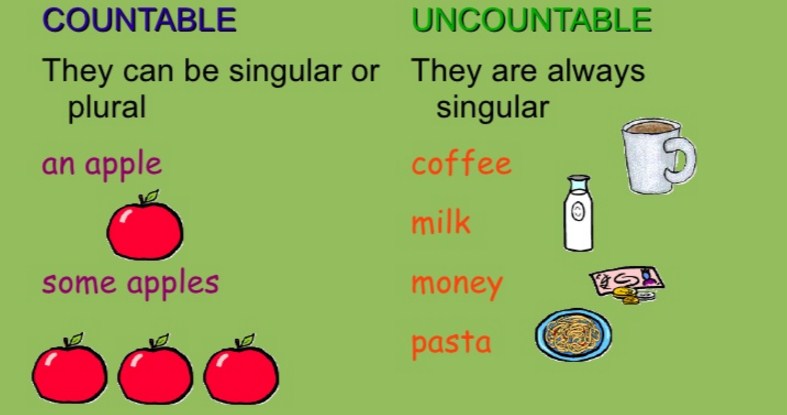
Countable nouns are for things we can count using numbers. They have a singular and a plural form. The singular form can use the determiner “a” or “an”. If you want to ask about the quantity of a countable noun, you ask “How many _______?” combined with the plural countable noun.

Singular: One cat, one woman, one job, one store, one idea.

Plural: Two cats, three women, four jobs, five stores, six ideas.

She has three dogs. I own a house. I would like two books please. How many friends do you have?

Examples of Uncountable Nouns: tea, sugar, water, air, rice, knowledge, beauty

We cannot use a/an with these nouns. To express a quantity of an uncountable noun, use a word or expression like some, a lot of, much, a bit of, a great deal of, or else use an exact measurement like a cup of, a bag of, 1kg of, 1L of, a handful of, a pinch of, an hour of, a day of. If you want to ask about the quantity of an uncountable noun, you ask “How much?”

-There has been a lot of research into the causes of this disease.

-He gave me a great deal of advice before my interview.

-Can you give me some information about uncountable nouns?

-He did not have much sugar left.

-Measure 1 cup of water, 300g of flour, and 1 teaspoon of salt.

-How much rice do you want?

Exceptions to the Rule of Countable v. Uncountable

Some nouns are countable in other languages but uncountable in English. They must follow the rules for uncountable nouns.

The most common ones are:
accommodation, advice, baggage, behavior, bread, furniture, information, luggage, news, progress, traffic

  • I would like to give you some advice.
  • How much bread should I bring?
  • I didn’t make much progress today.
  • This looks like a lot of trouble to me.
  • We did an hour of work yesterday.

Be careful with the noun hair, which is normally uncountable in English, so it is not used in the plural form. However, It can be countable only when referring to certain examples such as the individual hairs on someone’s head.

Examples:

1) Did you wash your hair last night?

2) Your dad is getting some grey hairs on his beard.

As shown in the multiple amount of examples, Countable nouns can be singular or plural although they mostly are plural in usage. This is in contrast with uncountable nouns which are only singular in their nature and can never be plural. This is an important grammatical distinction which will help you to understand the main difference between these two types of nouns. Do your best to study these examples, create your own sentences, and know why countable nouns are singular and plural while uncountable nouns are only singular. Whether it’s one potato or a hundred potatoes, you have to be able to count both.

English Corner – The Passive Voice

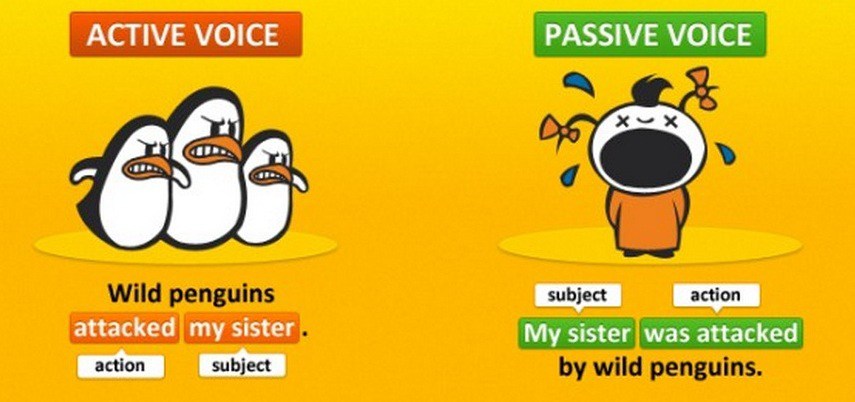
The passive voice occurs when you make the object of an action into the subject of a sentence. This is because of whoever or whatever is performing the action is not the grammatical subject of the sentence. Take a look at this passive rephrasing of a familiar joke in the English language:

Why was the road crossed by the chicken?

Who is doing the action in this sentence? The chicken is the one doing the action in this sentence, but the chicken is not in the spot where you would expect the grammatical subject to be. Instead, the road is the grammatical subject.

The more familiar phrasing (why did the chicken cross the road?) puts the actor in the subject position, the position of doing something—the chicken (the actor/doer) crosses the road (the object). We use active verbs to represent that “doing,” whether it be crossing roads, proposing ideas, making arguments, or invading houses (more on that shortly).

Once you know what to look for, the passive voice is easy to spot. Look for a form of “to be” (is, are, am, was, were, has been, have been, had been, will be, will have been, being) followed by a past participle. (The past participle is a form of the verb that typically, but not always, ends in “-ed.” Some exceptions to the “-ed” rule are words like “paid” (not “payed”) and “driven.” (not “drived”).

Here’s a sure-fire formula for identifying the passive voice:

Form of “to be” + past participle = passive voice

For example:

The metropolis has been destroyed by the dragon’s fire blasts.

When her house was invaded, Penelope had to think of ways to delay her auction.

Not every sentence that contains a form of “have” or “be” is passive!

Let’s briefly look at how to change passive voice sentences into active ones. You can usually just switch the word order, making the actor and subject one by putting the actor up front:

The metropolis has been destroyed by the dragon’s fire blasts.

The passive sentence, when converted into an active sentence:

The dragon destroyed the metropolis with his fire blasts.

When her house was invaded, Penelope had to think of ways to delay her auction.

This passive sentence, when it is converted into an active sentence:

After robbers invaded her house, Penelope had to think of ways to delay her auction.

To repeat, the key to identifying the passive voice is to look for both the form of “to be” and the past participle, which usually, but not always, ends in “-ed.”

Sometimes, the passive voice is the best choice. Here are a few instances when the passive voice is quite useful:

1. To emphasize an object. Take a look at this example:

60 Senate votes are required to pass the bill.

This passive sentence emphasizes the number of votes required. An active version of the sentence (“The bill requires 60 votes to pass”) would put the emphasis on the bill, which may be less dramatic.

2. To de-emphasize an unknown subject/actor. Consider this example:

Over 120 different contaminants have been dumped into the river.

If you don’t know who the actor is—in this case, if you don’t actually know who dumped all of those contaminants in the river—then you may need to write in the passive voice. Please remember though, if you do know the actor, and if the clarity and meaning of your writing would benefit from indicating him/her/it/them, then use the active voice.

Also, please consider the third example which is listed below:

3. If your readers don’t need to know who’s responsible for the action.

Here’s where your choice can be difficult; some sentences are less clear than others. Try to put yourself in the reader’s position to anticipate how he or she will react to the way you have phrased your thoughts. Here are two examples:

(passive) Baby Sophia was delivered at 3:30 a.m. yesterday.

(active) Dr. Susan Jones delivered baby Sophia at 3:30 a.m. yesterday.

The first sentence might be more appropriate in a birth announcement sent to the family and friends—they are not likely to know Dr. Jones and are much more interested in the “object” (the baby) than in the actor (the doctor). A hospital report of yesterday’s events might be more likely to focus on Dr. Jones’ role in delivering the baby.

Active and Passive Voice Examples – Different Grammar Tenses

Simple Present TenseTwice a month, Brian cleans his apartment. (Active)

Twice a month, the apartment is cleaned by Brian. (Passive)

Simple Past Tense – John fixed the doorknob. (Active)

The doorknob was fixed by John. (Passive)

Simple Future Tense / will – He will finish his job by 5 PM today. (Active)

The job will be finished by 5 PM today. (Passive)

Simple Future Tense / going toJackie is going to cook dinner tonight. (Active)

Dinner is going to be cooked by Jackie tonight. (Passive)

Present Progressive TenseAs of now, Corey is creating a Science project. (Active)

As of now, the science project is being created by Corey. (Passive)

Past Progressive TenseThe detective was working on the mystery murder case when his partner picked up another clue. (Active)

The mystery murder case was being worked on by the detective when his partner picked up another clue. (Passive)

Future Progressive Tense (will)

At 10:00 PM tonight, HBO will be airing the new Vice special. (Active)

At 10:00 PM tonight, the new Vice special will be airing on HBO. (Passive)

I hope that this ‘English Corner’ blog post has made clear when to use the passive voice and under which circumstances can its usage best be applied. As an English language learner, you’ll need to be comfortable with using both the passive voice and the active voice in order to become a better English writer and speaker. Please use the examples given to better your understanding of this English topic as well as how the active and passive voices are set up in the past, the present, and the future tenses. 

English Corner – The Active Voice

Every writer has a voice but it’s important to be able to distinguish which is the correct voice to use depending upon the context. There are two main voices in English writing to be aware of: the active voice and the passive voice. In this ‘English Corner’ blog post, we will be focusing specifically on how to use the active voice in your writing, which means that the subject of the sentence is actually creating the action and not the other way around.

The ‘active voice’ adds more impact to your writing, which is why most writers use the active voice instead of the passive voice. Overall, I would argue that the active voice is more important than the passive voice yet you should know how to use both effectively as an English writer.

Active Voice Usage

Sentences written in an active voice flow better and are easier to understand. When you use the active voice, the emphasis is on the subject of the sentence, which is doing the action itself. This makes the sentence straightforward and concise. Examples are:

  • I really love this TV show.
  • Gorillas live in the jungle. 

Sentences that use a passive voice are often harder to understand. Passive voice can make a sentence awkward and vague. The emphasis of the sentence changes to the receiver of the action. Some examples are:

  • This TV show is loved by me.
  • The jungle is where the gorillas live.

Passive sentences usually have more words than active ones, which is one reason why the reader has to work harder to get the meaning of the sentence, and the sentence structure can seem disorderly. If you have a composition that is too difficult to understand, you may be able to change some passive sentences to active ones. Two examples are:

  • The electoral ballots were counted by the volunteers. (passive)
    The volunteers counted the electoral ballots. (active)
  • The flowers were stepped on by the dog. (passive)
    The dog stepped on the flowers. (active)

Active Voice Adds Impact to Your Writing

The active voice adds substantial impact to your sentence; however, you may sometimes want to use the passive voice to lessen the impact of your sentence.

  • Sometimes the active voice is used to deliberately obscure who is responsible for an action, like if a politician said, “Mistakes were made” or “Shots were fired.”
  • Businesses may use the passive voice to lessen their impact like “Your service will be shut off” which is passive, rather than “We are going to shut off your service.” which is active.
  • In crime reports, a policeman would write, “the bank was robbed” because he does not know who actually robbed the bank.
  • In a mystery novel, you may want to place the emphasis on what was taken, like “the jewels were taken” rather than focus on the unknown person who took them.

In most English sentences with an action verb, the subject performs the action denoted by the verb. These examples show that the subject is doing the verb’s action:

The boy must have eaten all of the hot dogs.

            The boy (subject) is doing the eating (verb).

Jennifer mailed him the love letter.

            Jennifer (subject) is doing the mailing (verb).

Colorful iguanas live in the Amazon rainforest.

            Iguanas (subject) are doing the living (verb).

Because the subject does or “acts upon” the verb in such sentences, the sentences are said to be in the active voice. As you go through an individual essay, article, or paper, please be sure to check that you are primarily using the active voice. The passive voice definitely has its place but if you are especially trying to be persuasive, make a congruent argument, or back up your hypothesis, then you should mainly be using the active voice in those types of writing. 

If you find that the ‘subject’ of your sentence is clearly not at the beginning and your action / object is taking its place, then your sentence is not an active one by a passive one instead. The active voice always places the subject within the first word or two at the beginning of the sentence so that the reader will be well aware of who is committing the action. Please keep in mind how to use the active voice in terms of the sentence structure, what the examples show above, and in which types of writing the active voice is mainly used. If you would like to take your English writing to the next level, you must first know what the active voice is and in a later ‘English Corner’ post, the passive voice will be discussed in terms of its usage and some examples.

Lastly, think of the ‘active voice’ and the ‘passive voice’ as the Yin and the Yang of English writing. Both have their separate and unique uses but you can’t only have one in your writing. You must be able to know how to use both because there cannot be one without the other. 

English Corner – Fun with Adverbs

In a previous ‘English Corner’ post, we covered the topic of ‘conjunctive adverbs‘ and also briefly touched upon ‘adverbs’ in the articles on ‘basic parts of speech‘ but now I would like to go much more in depth to talk about adverbs and why they should matter to the English learner. To put it quite simply, Adverbs are a basic part of speech in English that add clarity to your written and spoken sentences. Adverbs are used to modify, change, or quantify an adjective, verb, or another adverb in the same sentence or group of words.

Without adverbs, sentences in English wouldn’t have the same zest and flair that they do with this basic part of speech being used correctly. Adverbs can draw relations between places, people, times, causes, degrees, etc. While Adverbs are not the most popular form of basic speech, you cannot be well-versed in understanding English grammar without having a formal knowledge of what adverbs are, how they are used, and what kind of examples need them within the sentences you create. Please use this article on ‘adverbs’ to improve not only your understanding of the English language but also your ability to write, speak, and use it freely. 

Traditionally considered to be a single part of speech, adverbs perform a wide variety of functions, which makes it difficult to treat them as a single, unified category. Adverbs normally carry out these functions by answering questions such as:

  • When? She always arrives early.
  • How? He drives carefully.
  • Where? They go everywhere
  • In what way? She eats slowly.
  • To what extent? It is terribly

These examples help bring light to the fact that they are all adverbial functions and may be accomplished by using adverbial clauses and adverbial phrases as well as by adverbs that are singular as well. There are many rules for using adverbs, and these rules often depend upon which type of adverb you are using. Remember these basics as expressed in the examples above, and using adverbs to make sentences more meaningful, and expressive will be easier for you.

  • Adverbs can always be used to modify verbs. Notice that the second of these two sentences is much more interesting simply because it contains an adverb:
    • The dog ran. (You can picture a dog running, but you don’t really know much more about the setting.)
    • The dog ran excitedly. (You can picture a dog running, wagging its tail, panting happily, and looking glad to see its owner. You can paint a much more interesting picture in your head when you know how or why the dog is running.)
  • Adverbs are often formed by adding the letters “-ly” to the end of adjectives. This little tidbit of information makes it very easy to identify adverbs in many sentences. There are many exceptions to this rule; everywhere, nowhere, and upstairs are a few examples where an –ly isn’t apart of the adverb itself.
  • An adverb can be used to modify an adjective and intensify the meaning it conveys.
    • Examples: He plays tennis well. (He knows how to play tennis and sometimes he wins.)
    • He plays tennis extremely well. (He knows how to play tennis so well that he wins often.)

As you read the following adverb examples listed below, you’ll notice how these useful words modify other words and phrases by providing information about the place, time, manner, certainty, frequency, or other circumstances of activity denoted by the verbs or verb phrases in the sentences.

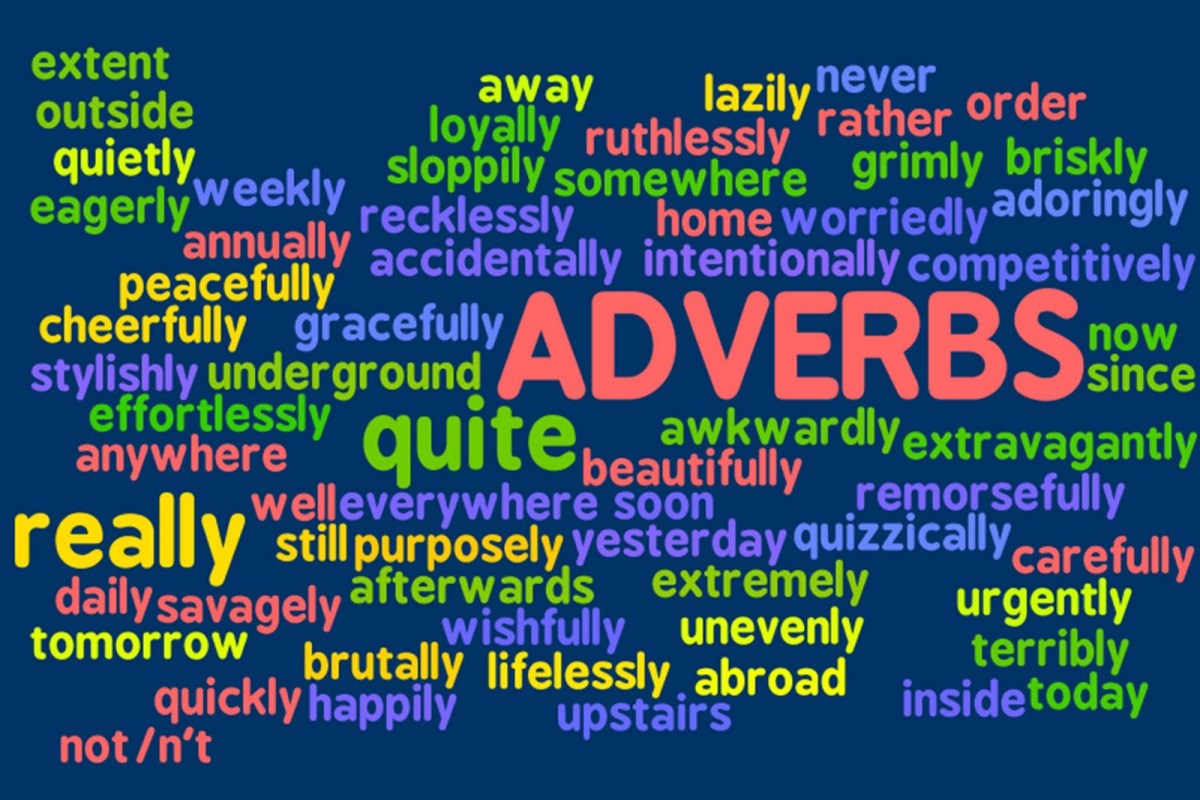
There are many different words that function as adverbs. The following list is broken down into different categories, which list adverbs by their function. After reading, you will be able to think of additional adverbs to add to your own list – after all, there are thousands of adverbs that appear in the English language.                   

The vast majority of adverbs out there end in “-ly”. This makes it very easy to spot the adverbs in most sentences so please be on the lookout for that as you discover this basic part of speech in more detail.

Abruptly

Boldly

Carefully

Deliberately

Excitedly

Financially

Horribly

Mildly

Naughtily

Openly

Poorly

Quickly

Sadly

Terribly

Willingly

Yearly

Some adverbs tell us where the action happened. These are known as adverbs of place.

Everywhere

Here

Inside

There

Underground

Upstairs

Certain adverbs let us know when or how often the action happened. These are known as adverbs of time and adverbs of frequency.

After

Always

Before

Later

Now

Today

Yesterday

Many adverbs tell us the extent of the action.

Almost

Enough

So

Too

Quite

Rather

Very

Some adverbs are used as what’s known as intensifiers.

Absolutely

Certainly

Completely

Heartily

Really

Certain adverbs called adverbs of manner tell us about the way in which something was done.

Briskly

Cheerfully

Expectantly

Randomly

Willingly

___________________

Now that you are more familiar with what ‘adverbs’ are, have seen a good amount of examples of how they are used, as well as been shown a list of the most popularly used ones, you should be better able to use adverbs correctly in written or spoken sentences. Please be sure to study the definition of an adverb, the different ways it can be used, and the list of words that are adverbs themselves. If you do not apply the information that you learn about adverbs such as in this article, you won’t be able to improve your English grammar as much as possible. Good luck and remember to have some fun with adverbs!

English Corner – All About Adjectives

We have previously covered ‘adjectives’ to an extent in a previous blog post entry on the ‘eight basic parts of speech’ for which ‘adjectives is one of them. However, I believe that it is crucial to go into much more detail about what adjectives are and how they can be used in different ways in the English language.

The main definition for a ‘adjective’ is a word that is used to describe a noun or give a noun or a pronoun a more specific meaning. There are hundreds of adjectives in the English language making the possible combinations and uses of them almost infinite. The process of an adjective describing a word is modifying it to become more descriptive. Adjectives answer important questions about the details of a sentence such as: What kind?, Which one?, How many?, How much?

Let’s start out with some general examples of how adjectives can be used within sentences to help give pronouns and nouns more specific and descriptive meanings.

Examples:

The newlyweds live in a beautiful house.

John is a kind and caring teenager.

Tina is a sweet and respectful girl.

The high school students are quiet when they listen to the teacher.

From the general examples of ‘adjectives’ that I have listed above, in the bolded words, you can see a pattern take place in that these words are describing nouns like ‘house, teenager, girl, teacher’, and they always come before the nouns. These nouns as they are well documented are people, place(s), and thing(s). As you can see, while the adjective(s) come before a noun, they also come after verbs such as ‘is, are, live,’ etc. as shown in the examples above. Verbs don’t always come before adjectives but that’s usually the case in a normal sentence.

Here are a few more examples showing how the average verb will come before an adjective in a sentence:

  • Your car is blue. (to be)
  • The sky appeared to be cloudy. (to appear)
  • His face looked tired. (to look)

Adjectives can also modify pronouns as well within a sentence and you can use two adjectives together in the same sentence back-to-back without any issues. Here are some examples I have listed below with adjectives – pronouns together in a sentence as well as the use of two or more adjectives in the same sentence:

  • They were such a nice couple.
  • It is really a beautiful day out.
  • He truly acts like a mature individual.

From these pronouns – adjectives examples above, you can see that they are often subject words such as (they, it, he) and they come at the beginning of the sentence. The adjectives themselves (nice, beautiful, mature) will come towards the end of the sentence after the pronoun but before the noun they modify if there is one to be changed.

  • The cookie is both black and white.
  • He was a dangerous, demented person.
  • LeBron James is a kind, caring athlete.

You don’t only need to use one or two adjectives in your sentences as you can use three or more if you really would like to make your writing as descriptive as possible. Knowing how and when to use adjectives is the key to becoming a better English writer and making your writing more appealing to your audience. By being able to know the vocabulary and how to use adjectives correctly in your sentences, your English will be more readable and also more entertaining to your readers. It will take time but it’s good to establish the basics of adjectives now in order to build upon your knowledge of this topic later on.

When it comes to how to form ‘adjectives’, they will usually come with endings to the words that stand out to you. Examples of adjective word endings include –able, -ible, -ish, -like, -ful, -less, -ous, and –y. Adjectives don’t always end in those word endings but it’s important to be aware of the many cases in which they do end like that.

Examples: Thinkable, Possible, Childish, Adultlike, Thoughtful, Faithless, Courageous, Hungry.

There are hundreds of examples for adjectives that end with these letters but it’s key for you, the reader, to draw the connections by looking at the structure of the adjective and seeing if there’s a –y or –ish ending before you write it for your sentence.

Lastly, a lot of adjectives are comparative or superlative in nature so you have to be aware of how to form those words as well because they will come up a lot in written or spoken form.

Comparative: more or less + adjective and -er

Superlative: most or least + adjective, adjective and –est

Adjective: Tall

1st Comparative Example: Taller

1st Superlative Example: Tallest

Adjective: Dangerous

2nd Comparative Example: More Dangerous, Less Dangerous

2nd Superlative Example: Most Dangerous, Least Dangerous

Hopefully, this blog post on adjectives has helped you, the reader, in terms of what they are, how they are placed within a sentence, how many of them can be used, and how to use them for comparative purposes. You have also seen possible word endings for most adjectives to give you a good hint as to when they are actually adjectives and not just nouns or verbs. Once you have this fundamental basic part of speech down, you’ll be able to tackle harder and more complex (adjective) English grammar topics.

English Corner – Writing a Good Essay

In order to become an excellent English writer, it’s very important to have the structure in place if you want to write a good essay. Firstly, you are going to want to make sure that you start with a beginning paragraph known as the ‘introduction.’ With the introduction paragraph, you’re going to set the tone in terms of telling the audience what the topic of your essay is along with some supporting sentences discussing the topic(s) that are going to be covered later in the body paragraph(s). Your introduction paragraph should be between 3 to 4 sentences total and you should also have a thesis sentence laying out the main purpose of your essay and what you hope to get across to the audience. 

After completing the introduction, you should make sure to have a body paragraph or a few body paragraphs next where you can discuss the main topic in more detail depending upon how many paragraphs you need to express your point of view or opinion. 

For example, if you’re discussing the weighty topic of climate change, you’ll need a couple of paragraphs in the body section of the essay to discuss why it’s an issue, what can be done about it, and how should people work together to reduce the effects of climate change. For this particular example, you’re going to want to have three body paragraphs total which should be between 4 – 6 sentences total. In these body paragraph(s), you need to make sure you’re giving examples, statistics, or evidence to support the claims and/or ideas that you brought up in your introduction paragraph. The body paragraph(s) are the meat of your essay or article so make sure that it’s convincing, detailed, and engaging to your audience. 

Lastly, you will need to finish up your essay or article with a ‘conclusion’ or concluding paragraph. The conclusion is similar to the introduction in that it is only going to be 3 – 4 sentences total. For this paragraph, you are going to sum up the main points or arguments again that you want the readers of the essay to take from what you wrote. You’ll want to restate your thesis from the beginning paragraph and make sure to leave your reader wanting more information about the topic that you just addressed. It’s important that you follow the introduction + body paragraph(s) + conclusion structure in order to have a truly great essay. The structure and formatting of an essay is really important so you have to make sure that it becomes a personal habit for yourself whenever you’re writing in English. 

An overlooked part to writing a good essay is the fact that you’ll need to back up your main ideas with real examples. These examples can be more scientific or research-based in nature or they can be based off of your own personal experiences and background depending on what kind of essay you are writing. If it is an academic, scientific, or evidence-based essay, you’ll need to use outside sources that are legitimate and directly related to the main ideas you’re reiterating in each paragraph. 

For an academic essay or paper, you should not be using your own opinions or personal experiences to count as doing research. When it comes to this kind of writing, you need to find research that is evidence-based, that has been backed up by more than one source, and is able to be cited in either the footnotes or the endnotes of your essay. The examples needed for this kind of essay should be not your own but rather those of other authors in your field who came to a similar kind of conclusion based on their research. You can use their quotations to cite the work that they’ve done and use their findings to supplement your ideas while adding validity to your essay’s argument. 

When it comes to a persuasive or opinionated essay, you won’t have to do as much scientific or academic research, but you’ll still have to use your own experiences and personal background to add to your essay. Also, there should sometimes be an added effect in these essays where you can use the experiences of other people to back up your main ideas and thesis statements. Your own background and experiences could be useful in developing one body paragraph but another body paragraph or two could be supplemented by those experiences of other people whether they are historical figures or friends and family of yours. 

Your research and outside examples should always be cited in the correct manner whether that is a quotation, a footnote, an endnote, etc. There are many different citation styles that can be used for various types of essays but do choose the one that feels most comfortable for you to implement successfully. Whether its Chicago / Turabian style being used for Business and History writing, MLA (Modern Language Association) style being used for the Humanities, or APA (American Psychological Association) style being used for Education and the Sciences, please choose one of the above citation styles that would fit best for your essay. 

The main point to keep in mind is to always cite your research / findings in some way if it is not your own. You should always be careful in avoiding plagiarism or taking from another person’s work without carefully citing their examples. Depending on the type of essay you are writing, you may also be able to use your own experiences, research, and background to make your writing stand out more to the audience. Without any evidence, examples, or research to support your thesis statement and/or main ideas, your essay won’t nearly be as complete or as appealing to the reader.

It’s necessary to re-state the fact that in order for an essay to be truly complete, the basic structure of an essay needs to be in place in order for the reader to get the most out of it. There is no substitution in the English form of writing for the introduction + body paragraph(s) + conclusion format.

However, once you have the essay structure down, it’s important to be able to brainstorm the main idea of each paragraph followed up two or three key supporting ideas for that paragraph using evidence and/or examples to back up your main idea. Whether it is a research article, an argumentative essay, or a persuasive essay, it’s key to remember that each paragraph especially the introduction and the body paragraph(s) should highlight the main idea and the supporting ideas. When it comes to the conclusion paragraph, you are basically going to re-state the main idea that you introduced in the opening paragraph while citing your supporting ideas once more to leave the reader with. 

The introduction paragraph is used to ‘introduce’ your main idea followed by a brief tidbit about what your supporting ideas are going to entail. Depending upon how many body paragraph(s) you have planned, each supporting idea should be expanded upon in a separate body paragraph where the research and the evidence are cited through facts and details given. In the body paragraph(s), you can rehash what your main idea is but you should not give it too much of your attention. Listed below, I have detailed how the structure of each paragraph should play out along with an example of what a main idea would be along with three supporting ideas for an example essay topic. 

IntroductionTell the audience what the main idea of the essay is along with an introduction to each of the three supporting ideas to be highlighted in the body paragraphs.

BodyParagraph #1 – Supporting Idea #1 with Main Idea briefly discussed (evidence / research needed)

           Paragraph #2 – Supporting Idea #2 with Main Idea briefly discussed (evidence / research needed)

           Paragraph #3 – Supporting Idea #3 with Main Idea briefly discussed (evidence / research needed)

Conclusion: Re-state the main idea of your essay while discussing briefly your supporting ideas and why they should matter to the audience. No more evidence or research should be introduced into the concluding paragraph.

Example Essay Topic

Main Idea: There is too much plastic in the oceans.

Supporting Idea #1Many sea mammals have been harmed or even killed by the plastic in the oceans.

Supporting Idea #2The plastic in the oceans is contaminating our food and even our de-salinization of water efforts.

Supporting Idea #3The plastic is disrupting our oceanic ecosystems and causing coral reefs to be permanently damaged. 

Whatever essay topic you choose to focus on, remember to make sure that you clearly have a main idea and at least two or even three supporting ideas to make the essay flow better whether it is persuasive, academic, or research-based in nature. Writing a good essay is not an easy task but if you’re willing to create an outline with your main and supporting ideas written down, you’ll be off to a good start.

Additionally, good punctuation and grammar will help your essay flow better allowing the reader to easily understand and grasp the ideas you are writing about. As the saying goes, ‘practice makes perfect’ so make sure to practice writing about different topics often and to use peer reviewing and proofreading to fix your mistakes and learn from them.