

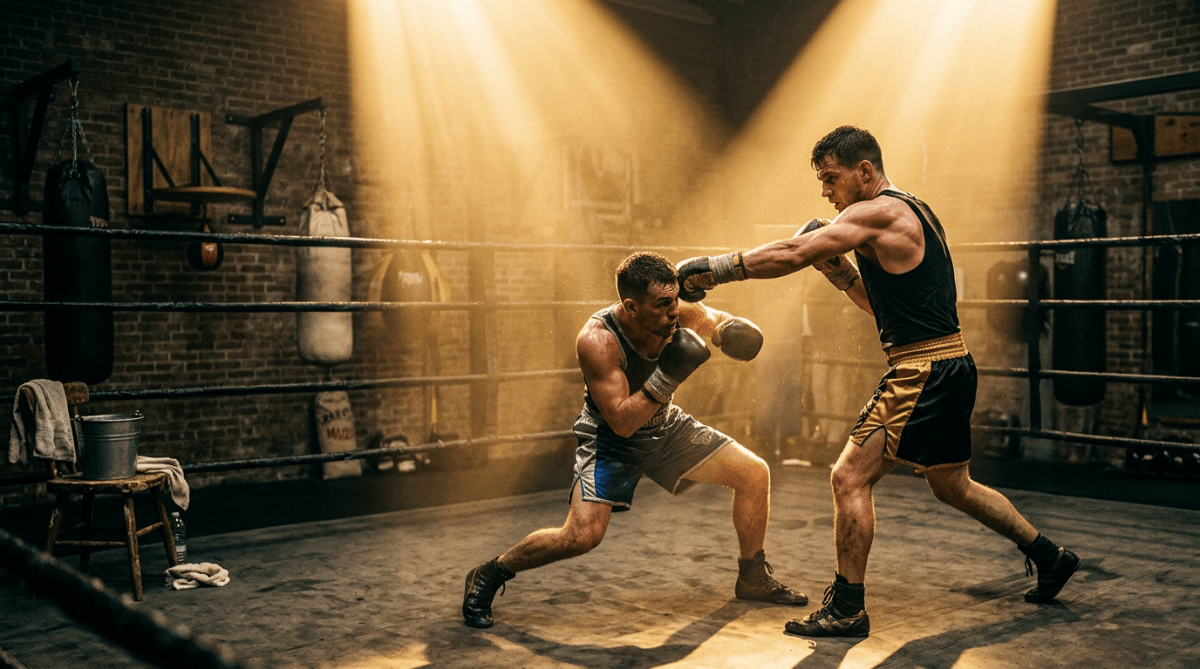
Slip, Counter, Repeat – What Boxing Taught Me About Surviving Real Life

“Life, like the sport of boxing, isn’t about taking punishment, it’s about learning from your mistakes, moving to avoid future errors, reading what the next move(s) could be thrown at you, and responding with precision when you make your counters.”

I remember the first time when my trainer told me to stop blocking punches and start slipping and dodging them instead; it rewires your brain to not just try to absorb the punishment but to dodge and counter it with the same enthusiasm. Life, like the sport of boxing, isn’t about taking punishment, it’s about learning from your mistakes, moving to avoid future errors, reading what the next move(s) could be thrown at you, and responding with precision when you make your counters.

You’re not always going to win the fight like you’re not going to always win in life, but if you know to slip, dodge, and counter, you’ll lose less and learn from your mistakes to be better not just at boxing but in life itself. For myself, you can learn more from boxing than you can from a traditional classroom and there’s a lot of justified metaphors for how this unique sport translates over to how to win in life.

Most setbacks in boxing aren’t knockout punches, they’re jabs. They are meant to measure you, test your resolve, and see how you react to them. A jab is like the difference between a crisis and a probe, meant to read what’s being thrown at you. Like overacting to an unfortunate event in life, you don’t want to overreact to a jab in a sparring session or a fight. You don’t want to waste precious mental and physical energy worrying too much about the jab when you should be focused on what could come after it. Burning bridges, making decisions from panic in life will cost you more in the long run instead of pausing, thinking it through, and coming up with your counter. Not every jab deserves a full combination back from you; but you should be sizing up your opponent (life) and figuring out what the next move is going to look like.

The slip, in boxing, isn’t a retreat, its intelligent non-contact, you keep your feet planted and you move your head to avoid the damage. When you apply that approach to life, it’s about knowing which arguments, which jobs, and which people to let pass by cleanly. If you don’t slip and you think you can dodge very blow when you’re flat footed, you’re going to get hit and take shots that you could have avoided making you worse off than before. Don’t let your ego stand in the way of protecting yourself and know that you’re saving yourself for the long struggle in the ring and outside of it, if you know how to slip a punch. This is a very underrated skill of not engaging everything that comes at you or wants a piece of you. You shouldn’t be engaging in contact or giving a response to everything headed your way; something, it’s best to slip it.

In boxing, the counter punch is thrown at the same moment your opponent overextends themselves and life works the exact same way. When you face adversary or a challenge, life should open to you as the moment of disruption can create an equal opportunity as a result. When you counterpunch an opponent in the ring, you’re meeting the moment and taking advantage of an opportunity even while you’re putting yourself at risk. When you counterpunch in practice outside of the ring, you are changing careers, rerouting plans, pivoting to new skills, turning obstacles into reaffirming moments and repositioning yourself for future success. Timing matters though so make sure that when you throw your counter it comes at the right time because if you do it too early or too late, it’s not going to land cleanly and is going to look more like a wild swing out of desperation.

Any boxer will tell you that footwork is pivotal to mastering even before the fight starts and positioning yourself well could end up making the difference. Champions don’t improvise their way through fights; they control the ring before the first punch lands and are always moving their feet to be in the best position possible. In life, you have got to build skills, relationships, and options for yourself even during the calm periods so you’re not scrambling to make progress when things get hard or when you need immediate success. Good footwork is about optionality and always having somewhere to move to or from and not backing yourself into a counter. Being light on your feet, agile, and not getting caught flatfooted by comfort, complacency, or cockiness will help you win the fight and in your life.

When someone or something seems impenetrable, you have got to shift your attack and rethink your approach. You must be able to play the long game when you can’t get through your opponent’s guard. You must be persistent, shift your strategy, and choose different pressure points to wear down your opponent. Slow, consistent pressure will win over dramatic gestures or do the same thing repeatedly to expect a different result. Boxing and life both require mental discipline by delaying your own gratification and using sustained effort to get the wins that you are seeking. If your opponent is blocking one approach, you have got to go for a different strategy and try to find a weakness or opening elsewhere. Shift your approach when it calls for it and don’t keep trying without mixing it up to get the success you are fighting for.

You will get hit. You will get bruised. You are going to fail. The question is whether you’re falling forever or rolling with the punches. ‘Rolling with the punches’ is known as the physical technique of being able to deal with getting hit and absorbing blows with some difficulty without catastrophizing the effect of getting hit to prevent you from fighting back. Resilience in the ring and outside of it is about knowing when you can take the hit and keep moving forward and you must get back to the center after it by reset, breathe, drink some water, find your focus and your range again, and stay in the fight. Only throw in the towel when you know the hit has changed the fight and you’re not continuing out of sheer stubbornness. Sometimes, you know you’ve lost the fight when you’ve taken too many hits and it’s better to call it quits to fight another day than to lose everything in that one night.

Even the greatest fighters in boxing don’t go the three-minute rounds alone; they have someone cutting the swelling during rounds, giving timely advice, and cheering you on from your corner. We need coaches in boxing just like we need mentors, honest friends, and trusted advisors who tell you what’s happening rather than what you want to hear from them. Be wary of having a ‘yes man’ in your corner in the ring or in your life. A corner that is not truthful with you and only hypes you up will get you knocked out because they fail to take account of your weaknesses as well as your strengths. You got to build your corner up wisely over the years and have good people you can rely on who will tell you the truth, support you through thick and thin, and know when the fight is over to save you from yourself sometimes.

Any good boxer knows how to make some adjustments in the middle of fight and to change their game plan when it comes to their opponent. The fighter who can’t adapt gets figured out by round four and usually doesn’t win the match. It can be hard to invest in something you’ve put days, weeks, months, or even years into developing but you need to have the discipline to abandon a pursuit, strategy, or plan even after investing heavily into it. When we think of a sunk cost in boxing, the mistake is like throwing a hundred punches the same way even when they aren’t landing in each round and that strategy is costing you to lose the fight. Be prepared to constantly pivot as you would in the real world whether it’s professionally, personally, or geographically because doing the same thing again and expecting a different result is lunacy and it shows up both in boxing and in your life.

You don’t train to be a boxer to avoid any difficulty that you’ll face, you train to be someone who can handle it when it arrives, and that also goes for any facet of your life. You dodge and counter not just as well-known tactic in boxing but as a mindset for your entire life. You don’t dodge and then not counter, any action deserves a response, but it must be measured, appropriately, and done patiently. You should always be moving forward but with the wisdom that sometimes, you’re going to have dodge a punch like you would dodge a toxic person, a bad boss, an unfortunate upbringing, and be able to counter by moving towards a result and a life that you can be proud of.

As someone who enjoys boxing, I’m always thinking about how I’m going to slip the next punch and what counter I can set up as a result to move forward in the contest. Think about this for yourself: what ‘punch’ are you slipping right now in your life, and what counter are you setting up? Life, like boxing, can be difficult sometimes, but if you can slip, dodge, and counter, you’ll be able to handle any adversity, meet any challenge head on, and be successful in whatever you put your mind and body to.

Adaptability Is Both Our Greatest Strength And Weakness

“To be, feel, or act the same or to be resistant to change can hurt us in an ever-changing society where we are constantly at the mercy of forces that are beyond our control.”

Being adaptable is largely thought of as a good characteristic and for which you are usually commended for. We try our best to be adaptable to the challenges and opportunities that life throws at us as best as we can. To be, feel, or act the same or to be resistant to change can hurt us in an ever-changing society where we are constantly at the mercy of forces that are beyond our control.

When you can adjust to new conditions or changes, there is usually positive reinforcement from others who also are adaptable to the changes or conditions at the same time. My concern is that while adaptability has helped us thrive in different eras as a species, it has at the same time been a weakness of ours in adapting to norms or behaviors that harm our collective progress.

Adaptability is both our biggest strength and our biggest weakness in that it both allows us to change conditions and norms for the better, but also it can make things worse when we backslide into previous harmful attitudes, values, and beliefs that can make a comeback. Being adaptable has helped humanity survive different tumultuous eras since the early days when we were foraging for basic sustenance and shelter to survive.

The act of adaptation goes back to what makes us innately human, at our core, even when we get used to adapting to less-than-ideal conditions or changes that revert progress we’ve made rather than embracing further progress to our benefit. While change does not always equal to progress, my concern is that when we are adaptable to any kind of change, both positive and negative, without thinking of the consequences of such constant adaptability, we remain at risk for going backwards and worsening our quality of life.

To give a few examples of when adaptability is a strength of ours as a species, I would refer to our ever-increasing desire to assimilate, tolerate, and promote diversity, inclusion, and equity in our world. This social inclusion and desire for equal rights has been an adaptation that is rather recent when you consider how far humanity has come from the centuries and millennia of mistreatment, discrimination, slavery, and wars that were fought to keep the horrible status quo of how we treat each other.

Our ability to adapt to making sure that this previous status quo was no longer acceptable and repugnant in terms of previous attitudes has led to greater tolerance, acceptance, and more diversity throughout the world. Yes, there are still challenges to our adaptability in this important area but to say that we haven’t made progress in this area of life would be a falsehood. Being able to adapt successfully to these societal changes has by and large been a positive development in my lifetime and beforehand earlier on in the 20th century. While there has been negative resistance to this kind of adaptability, I’ve found there has been most people accepting these changes that have gone on and while the struggle continues, this strength of humanity to seek greater equality and inclusion has been a net positive of our adaptability mechanism.

In addition to that previous point, the expansion of social and economic rights to more and more people throughout the world have led to greater political and civil rights as a result. They have been tied to each other and have been a positive step in the right direction. There is greater representation politically and economically for more diverse populations than ever before and while progress still needs to be made, the status quo has been upended by our adaptability in this area to these kinds of societal changes.

While adaptability is our greatest strength, it can also be our greatest weakness ironically, and this has been shown in different areas of life where there has been a reversal of progress recently or too much comfort shown with a lack of progress. I’ll point to two different areas where there been a reluctant yet steady adaptability towards the climate crisis and for democratic backsliding across the world. Where there is significant resistance in both areas, we are running out of time in preventing these new ‘norms’ from taking hold. It’s common knowledge that our planet’s climate is changing with disastrous consequences for livability for more and more people in different worlds.

Longer-lasting heat waves, disastrous storms with greater frequency, and unyielding glacial icecap melting threaten to become the rule of our life on this planet rather than the exception. From my perspective, we have become complacent to these changes and are looking to adapt rather than to work harder to change course. From our political leaders to our civil society, we are looking more and more like we are giving up rather than trying harder to reverse the negative changes set to befall us around the world.

Our ability to adapt to a warming world highlight how while we can adapt to negative changes, many of us will still suffer as a result and some won’t survive this kind of adaptation. Rather than seek to change the status quo in climate action, I believe that we are seeking to adapt to the changes that will befall us despite the harm it will do to the planet and our place in it rather than do our best to collectively try to resist such a negative adaptation.

Related to this regretful kind of adaptability, our political leadership worldwide has failed to martial the resources and the willpower necessary to combat climate change as quickly and as effectively as needed. Instead of championing solutions and working across societies to solve the climate crisis, there has been instead of focus on centralizing power, holding on to political office, and reversing previous norms and values of democratic rule to a forthright shift towards autocratic or dictatorial rule. I think this is a negative adaptation that more and more countries are seemingly getting used to as previous norms, values, and equality under the law are being undermined. It is not too late to reverse the damage done while the power of the vote and the right to assemble and protest is still allowed but that is not a given.

As much as we had to adapt to democratic rule centuries ago, it’s been shown that when there is no fight to keep those norms and values alive, we can just as slide backwards to the days when kings, tyrants, and demagogues ruled by force and decree across broad swaths of the world. Democratic norms and values are not universal values these days but our adaptions to them have largely further greater equality, inclusion, and prosperity than the opposite of autocratic rule. If we get used to the unraveling of previous norms that had served us well as a society to a previous time where we adapted to autocratic norms and rule by the few over the many, then we are in for a rough period of adaptation which will not serve us as well.

Adaptability has largely served humanity well since our early days of foraging and hunter-gathering. It is an innate trait that we must make whatever conditions we live in work well enough for us. Being able to adapt can both help us but also harm us depending on what we are adapting to. Let’s continue to set a higher standard individually and collectively to what we tolerate and adapt to and what we will not adapt to. We still have a choice in what we get used to and for what we do not accept and let’s hope we always will but right now, our adaptability is leading us on a crash course where instead of choosing to adapt to our surroundings, we will be forced to do so and will have to do so as a result without having had the choice in previous eras.

The Value of Self-Awareness

“Having self-awareness shows that you also have the right personal values that will make it easier for you to get ahead in life in terms of your character.”

Self-awareness is a key character trait that will improve your relationships with others and also improve your relationship with yourself. Having self-awareness shows that you also have the right personal values that will make it easier for you to get ahead in life in terms of your character. Achieving self-awareness takes a number of traits to embody such as showing wisdom by working to understand yourself and your own actions. You have to understand how your actions affect others, both positively and negatively, and to also take responsibility for those actions in both cases.

Beyond wisdom, you have to be honest about what you are capable of and what you need help with including your abilities at work or at school. You want to be able to keep your ego in check and to know your own limits but to be able to work on pushing those limits. This is also a key part of having self-awareness. There are key differences between being confident and being cocky and a self-aware person knows the differences between the two traits. You should show confidence but know how that confidence is coming across to others and to be open to receive feedback even when it can be critical at times.

A confident person knows their strengths but also knows their weaknesses and will make those traits aware so that others know what you can do and what you cannot do. Being aware of those strengths and weaknesses will make you humbler and more open to learn from others. Admitting to others that you have weaknesses and that you have strengths openly will garner respect and help from people who will know that you are not perfect and that you always have things to work on to be better and to do better.

Humility and self-awareness go hand in hand too. Being self-aware means owning up to your failures and shortcomings and not blaming others for them. Taking responsibility for yourself and your actions is a key part of being self-aware. You applaud and recognize other people and do not take all of the credit yourself, which is what happens most often in life that you cannot take sole credit for an accomplishment, but with which is achieved through the mentorship and support of others. Showing humility and being humble are key parts of being self-aware and having that personality trait be made known to others through your actions and your words.

A self-aware person can exercise wisdom, be honest, show confidence without being cocky, and displaying humble actions and words to get others to support you and be a friend to you. Arrogance, dismissiveness, immaturity, and dishonesty all show a lack of self-awareness and I would argue that not being straightforward and direct with people will often hurt you in the long run because they will not know where you stand. Being able to self-reflect and look inward to what you did and why you did it will help you to become more self-aware in retrospect even if you do not practice self-awareness in the moment. Ideally, you would like to be self-aware at all times but if you are not self-aware at the present moment, at the least, you should try to be self-aware about the past for better or for worse.

Self-awareness and self-reflection go hand in hand so you must be able to so some self-reflection in order to be fully self-aware. Actions speak louder than words, so you need to make sure that the actions you take offer some space for some self-reflection afterwards. It’s critical that you know how to practice self-awareness in your actions, and I would like to give a few examples below.

Self-awareness in practice means also knowing how to apologize and being aware of your actions when they have caused harm or anguish. If you do not say ‘sorry’ or give an apology, it means you have a lack of self-awareness and other people may not want to be around you knowing that you do not take accountability for your actions. On the other hand, you do not want to react with anger or other strong emotions in order to get what you want. Remaining calm, cool, and collected is much needed as well when dealing with others. You should not ever be insulting them when they give you some feedback that you may not want to hear but it’s in your best interest to take it into consideration.

As mentioned earlier, you should not pretend to be a know-it-all and you should be self-aware to know the limits of your knowledge as well as your skillset. In life, you should not be afraid to reach out to others for advice, counsel, mentorship, or for them to teach you things whether that is a new language, a job skill, or a sport. You will never be the expert on everything, and it is not wise to pretend you know everything as that will cause other people to see that you are arrogant and too egotistical.

Being honest and direct with others should be done politely and tactfully. It is better for others to know where you stand than for them to be guessing where your head and heart are at a lot of the time. The feedback that you give should be genuine and the feedback that you receive from others should be taken into consideration even if you don’t agree with it. Being defensive, attacking the person who criticized you, or getting too emotional about it will look bad in the eyes of others and hurt your ability to work with other people.

A self-aware person knows where and when they need help, how they can become a better person, or always striving to be as empathetic as possible. You should want to put others in your shoes and vice versa to be emotionally in tune with other people (related to having a high level of emotional intelligence). Above all else, you want to stay true to yourself, to your family and friends, as well as knowing what your core values and principles are in life. You should always put yourself on the path to succeed while not stepping over anyone to get there.

Being self-aware will make you an emotionally healthier person, allow you to form healthier relationships, and also be able to form better friendships at work, at school, or elsewhere. You want to value other people and not ignore how they feel but to recognize their emotions and understand where they are coming from without dismissing their views outright. Self-awareness is not an innate trait in the sense that we all have it equally. It has to be worked on, fostered, and built up over our lives.

You need to be consistently aware of your behavior, your emotions, and how they play off on other people. It comes down to having respect for others, being humble in your demeanor and your abilities, and also knowing how to behave responsibly and without letting your emotions control how you act all the time without regulating them. Self-awareness is a really important personal trait and has so much value that you must be willing to work on it day-in and day-out to become a better human being.