“Don’t Look Back In Anger”, A Lyric and Life Lesson

“Don’t look back in anger, I heard you say.” Few lyrics from the 1990s have aged as gracefully as this one has from Oasis. It’s more than just a line from the Oasis anthem sung brilliantly by lead singer Noel Gallagher, it’s a mantra and a life lesson disguised as a rock chorus, and a call to stop letting yesterday’s pain and sorrow weigh down tomorrow’s joy.”

“Don’t look back in anger, I heard you say.” Few lyrics from the 1990s have aged as gracefully as this one has from Oasis. It’s more than just a line from the Oasis anthem sung brilliantly by lead singer Noel Gallagher, it’s a mantra and a life lesson disguised as a rock chorus, and a call to stop letting yesterday’s pain and sorrow weigh down tomorrow’s joy.

When Noel Gallagher wrote “Don’t Look Back in Anger,” it was meant as a stadium singalong, but the phrase itself has outlived its Britpop origins from the 1990s. It’s been sung at concerts, football matches, and even vigils, most notably after the tragic Manchester Arena bombing in 2017. In moments of grief or frustration or malaise, people cling to words that help them move forward, and this one delivers in just five simple words that we all can relate to.

Beyond popular cultural and music history, what does this lyric mean for the way we live our lives? For anyone who’s been mistreated, overlooked, or hurt by other people, whether at work, in love, or by life in general, intentionally or unintentionally, it’s a reminder not to stay stuck in bitterness because of how you have been wronged. Because anger or being angry forever, if you let it, will make a home in your chest and eat away at your peace of mind.

Life isn’t always fair; we all know that fact from a young age. You might work hard only to have a work colleague promoted over you who didn’t deserve it. You might trust someone like a friend who lets you down or lies about you to other people. You might pour yourself into a relationship that ends with betrayal. The gut reaction in these moments is anger and honestly, it’s justified. Anger is the body’s alarm system, telling us something wrong has happened to you.

The problem is what happens next and, in the days, months, and years that follow the event. Anger is useful for a moment, and we should be allowed to feel that emotion rather than bottle it up entirely, but corrosive over time. It tempts you to replay every slight, to act out, to rehearse every insult, and cling to grudges like they’ll somehow make the scales of justice even. Anger keeps you bound to the people and situations you want freedom from and to be free of mentally.

That’s why this song lyric hits so hard. “Don’t look back in anger” doesn’t mean “forget what happened.” It means instead to don’t let your gaze stay fixed on the wreckage. You’ve got to keep walking and moving forward, because the road ahead is always longer than the one behind.

Forgiveness is one of the most misunderstood concepts out there in life. People often think it means excusing someone’s behavior or giving them another chance to hurt you again. This is not true at all. Forgiveness is less about them and more about you, it’s a decision to release your grip on your anger so you can move forward in life and to move your emotions on from that person.

Think of it this way metaphorically: carrying anger is like holding a burning coal. Yes, it’s hot, and yes, it proves you were hurt. But the longer you clutch it, the more damage it does to you, not to the person who wronged you, but to you alone. To not look back in anger doesn’t mean inviting mistreatment to happen again. Boundaries are still vital and it’s best to get away from the person(s) who wronged you in the first place. You can forgive someone and still choose never to deal with them again. The difference is whether you carry that heavy emotional baggage with you on the road forward while not ever letting it go.

How do you live the lyric you might ask? Here are a few ways to start doing so today:

  1. Reflect, then release: Acknowledge what happened to you and how it made you feel. Then, consciously decide to stop replaying it. Journaling or talking it out can help you.
  2. Redirect your energy: Instead of fueling resentment, pour that fire into something constructive like playing music, writing, going traveling, or even doing physical exercise.
  3. Build stronger boundaries: Forgiveness doesn’t mean letting people walk all over you. Learn from the mistreatment you received and protect yourself from it in the future.
  4. Practice self-compassion: Often, the hardest person to forgive is yourself. Don’t beat yourself up for trusting, caring, or trying with that person who wronged you. Recognize that those qualities are strengths, not weaknesses and to not give up on trusting others entirely.

What makes this song lyric timeless and still relevant in 2025, especially as Oasis is touring the world again and playing this song each time, is its dual simplicity and power. Everyone has something they regret or someone they resent from their past. Everyone carries scars from unfair treatment whether from work, from family, or from supposed ‘friends.’ However, “Don’t look back in anger” doesn’t ask for perfection, it asks for direction in going forward and leaving the anger behind.

Even three decades later since Noel Gallagher first put this famous song lyric down on scratch paper, it’s still sung loudly at concerts because it feels good to let it all out. Belting the words is cathartic as I did recently on a warm summer night in New Jersey but living them is transformative. In a world where negativity and hate spreads faster than hope and kindness, this song lyric reminds us to choose the harder, better path: release over revenge, peace over poison.

There’s no sugarcoating it: forgiveness isn’t easy. Sometimes it feels impossible to do. If you’ve ever carried anger long enough like I have in my past, you know how exhausting it is to hold on to. Anger narrows your world; forgiveness widens it again. The lyric, then, becomes less of a suggestion and more of a survival strategy. “Don’t look back in anger” because the future needs you to be free, not bitter and burnt out. “Don’t look back in anger” because life is too short to let someone else’s behavior dictate your happiness. “Don’t look back in anger” because joy requires space in your heart, and anger takes up too much of it and corrodes it slowly.

“Don’t look back in anger, I heard you say.” It’s a simple song lyric, yes, but it’s also timeless advice, true therapy, and a way of living well. Life will hand you plenty of reasons to grow bitter at yourself and at other people, but it will also hand you a thousand opportunities to move forward with forgiveness in your heart.

You can’t change what happened to you and who did it to you. You can’t undo the mistreatment or rewrite the past. Instead, you can decide not to be imprisoned by your anger. You can decide to keep walking, keep building, keep loving, and keep moving forward. In the end, that’s the only way to win. The next time you feel anger weighing you down because of someone or something, ask yourself this question: what would it feel like to finally set it down? You just might find the answer in a song you’ve been singing for years.
Anatomy of a Scene – Bourdain’s ‘Parts Unknown’ in Congo and NYC Contrast

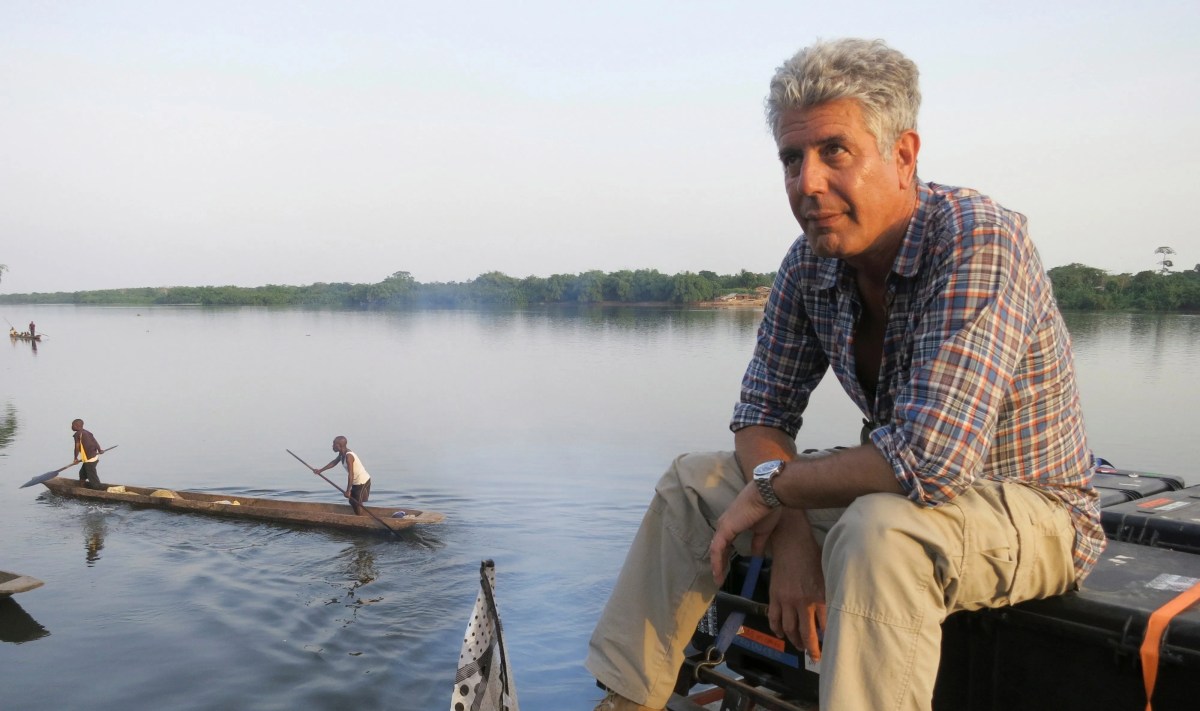
“One of Anthony Bourdain’s ‘Parts Unknown’ episodes in the Congo has one of the show’s best scenes where it has a vivid description of Bourdain gazing over New York City from his high-rise apartment in the closing moments, set up against the backdrop of his first and only foray to the Democratic Republic of Congo.”

If you had to pick opposites in the world, you couldn’t do much worse to contrast the journey through the thick Congolese jungles and down the Congo River with the urban sprawl of New York City. One of Anthony Bourdain’s ‘Parts Unknown’ episodes in the Congo has one of the show’s best scenes where it has a vivid description of Bourdain gazing over New York City from his high-rise apartment in the closing moments, set up against the backdrop of his first and only foray to the Democratic Republic of Congo.

There are multiple themes to take away from the significance of Bourdain’s perilous journey in the Congo throughout the episode and with the contrasting solitude and isolation he likely had felt back in his NYC apartment after such a harrowing trip. There is a burden that he must have felt in witnessing such a contrast between the Congo and New York City that leaves the contrasting scenes up for our interpretation as fans of his ‘Parts Unknown’ show. How easy it can be to feel lonely amongst millions of people after traveling to such a distinct place, the burden of making it through a perilous journey and putting your life on the line, and how traveling to such extreme places can change your sense of place in a complicated and often troubling world.

Before his passing in 2018, Anthony Bourdain was the preeminent travel host for over 15 years and his last show, Parts Unknown, from 2013-2018 was the deepest dive in his own mission of uncovering people’s stories through food and culture. In terms of looking at human nature and the human condition, few shows, if any, were better than Parts Unknown. More than anything, many of the Parts Unknown episodes had Bourdain providing needed historical context regarding the complex and difficult history of the country or place he would be visiting. This was especially the case during the Congo episode where he spends part of the episode looking at the colonial exploitation, civil conflict, and poverty that has gripped the country both before and after it became the nation state known as the Democratic Republic of the Congo today.

Bourdain was a huge fan of the Joseph Conrad book, ‘Heart of Darkness’ and makes it known in the episode of how became obsessed with the Congo and the Congo River without trivializing the country or its people. His approach is sincere, and he looks to paint an accurate picture of what the Congo is like, why he sought to demystify and humanize the place, and how it was both similar and different to Conrad’s interpretation of it.

“When all is said and done, I wanted to go to the Congo, and I did.” Bourdain knew that this would be one of his most difficult journeys, but he also wanted to pay homage to Conrad’s novel by following a similar exploration to the authors with a boat trip down the Congo river. However, this kind of journey as shown in the episode was not simply a leisurely trip down the river without witnessing the history, culture, or food of the Congolese. Bourdain and his film crew interacted with different villagers, aid workers, and other locals to hear their stories despite how difficult the journey had been especially losing power on the boat and being surrounded by mosquitoes and other insects at one point.

It takes a toll on a person to look at the dark history of a place’s past as well as its uncertain present and not be affected by it. Bourdain has a visible weariness and introspection upon the conclusion of the journey given how hearing about the history of violence, dealing with the security issues involved, the lack of infrastructure to make the journey work, and to hear about the sheer resilience and fortitude of the Congolese people under extremely difficult circumstances.

The hardest part for Bourdain in my view maybe wasn’t the actual trip down the Congo river with all the bureaucracy, bribery, and lack of infrastructure involved to make it finally happen. I think the final scene of this Parts Unknown episode sums up the ‘lost’ feeling and the isolation to have witnessed all that and come back to a New York City that is abundant, thriving yet inequal, and with a completely different set of circumstances than one would encounter in the Congo. There’s ‘culture shock’ and then there is experiencing a bit of a totally different reality that few Americans and fewer New Yorkers would ever see for themselves. This contrast in realities and the stark scene transition from leaving the Congo River to being back at his high-rise apartment in Manhattan is perhaps the greatest scene ever shot for Parts Unknown or in any of his travel shows.

To break down this excellent scene and contrast further, Bourdain is in one of the world’s most crowded cities, but he is alone and isolated in his apartment like being isolated from most people’s lived experiences of the world, which pales in comparison to his own having had been to over 100 countries in his travels. He is filmed sitting behind his apartment windows, which acts as a barrier between Anthony and the rest of the world, seeing everything for himself but finding it difficult to connect with his immediate surroundings in NYC after witnessing such a contrasting reality in the Congo.

I think this final scene of the Congo episode really encapsulates Bourdain’s struggle as a travel host and writer to search for meaning and purpose in a world that often feels indifferent or alienates the struggles of other people who live in a different place or country. Bourdain’s gaze through the window symbolizes the distance between the world he witnessed and the world he felt disconnected from. It reflected the existential tension that marked his life: the constant search for meaning, tempered by the knowledge that some things, no matter how deeply we travel, remain elusive.

In his life, Antony Bourdain likely felt a sense of solitude and isolation having witnessed the worst of humanity at times, which could be hard to relate to other people or even travelers who had not been to the same places. He was brave, kind, and let other people to tell their stories without judgment but it must have been lonely especially after a return from the Congo and returning home where he may have felt the most alone rather than out on the road with others in his crew or amongst people he had met. There is a loneliness in the familiar as any traveler can attest and the novelty of new places, people, and experiences make the routine feel mundane and trite. Bourdain’s entire journey, in this case, from the Congo back to his home in New York, shows that it can be hard to come full circle after visiting one of the least known places in the world.

The final shot of Anthony Bourdain in his New York City apartment, looking out over the vast, bustling city, yet consumed by solitude, serves as a poignant culmination of his journey as a seasoned traveler. After traveling the world, exploring the darkest corners of humanity in places like the Congo, Bourdain returns home, not with answers, but with a profound sense of isolation. The Congo episode, with its harrowing depictions of suffering and resilience, reflects the complexity of human nature that Bourdain grappled with throughout his career. The contrast between the vibrant, chaotic cityscape of NYC and Bourdain’s contemplative stillness in his apartment alone emphasizes a universal paradox: despite all the human connections made in the world, the traveler often finds themselves confronted with a loneliness that cannot be filled as a result.

Bourdain’s Parts Unknown was not merely about exploring food and culture, but it was also an exploration of the man himself. His travels were a quest for greater understanding, but they also unearthed the difficult truth that knowing the world does not necessarily mean knowing oneself at the same time. In the end, Bourdain’s legacy lies in the raw, honest portrayal of this duality, the external world and the internal battles that shape who we are. His life story continues to remind us that, no matter where we go or how much we learn, we all face the same fundamental challenge in life: to find a true connection in a world that often seems vast, indifferent, and overwhelming.

On Territory and Hierarchy

“It’s not just being rewarded financially but there are also the noted past benefits such as being the first to eat at a meal or having livestock awarded to you for leading the tribe or group.”

When you rise in the hierarchy of any company, firm, or organization, you are likely to be rewarded for it subsequently. It’s not just being rewarded financially but there are also the noted past benefits such as being the first to eat at a meal or having livestock awarded to you for leading the tribe or group. The leader, if he or she does a good job, gets first dibs on what they would like as a result whereas if it’s money, food, or what I think is the most common today as it was in the past: land or space.

In my view, there is a direct correlation between rising in the hierarchy and having more space or territory allotted to you. This kind of correlation has really stood the test of time when you think about the era of feudalism when there would be lords over the land and forts or castles would be built to maintain that territory, even if it was contested by outsiders. When you think of the rise of empires from the Ottoman to the French to the British whose kings, queens, emperors, or sultans who would make their royal palaces and compounds as elegant, grand, and massive as they could.

Even your modern-day Presidents and other heads of state live more lavishly than 99% of their population and while they may command a modest salary, they still hold the keys to a massive home and office where they have people waiting on them to make sure any of their needs are taken care of. Because of the way hierarchies are set up, the people who have the most power tend to get the most benefits in terms of taking up space and territory because of the office or title or family legacy that they hold.

While it would make sense that in a capitalist society, you must ensure lopsided rewards and benefits to those people entrusted with political or other forms of power. When you think of your average CEO or company owner, they tend to on average also take up more territory or have more space than your average person. As your status rises so does the amount of acreage or square meters you would like to claim as your own. While there are exceptions, popular culture encourages the acquisition of power and status to correlate with not only acquiring financial wealth but territorial wealth too.

You can even see this in terms of who gets the most space in the c-suite or in the average office. While the average worker may have to work in a cubicle or share a space with others at a lower level of hierarchy in their organization or company, the management or higher-level executive will often have the corner office or their own floor depending on the place of work. It is easy to see where your status in the working world is just by seeing who is taking up the most space even when the impact you or your colleague have on the firm, company, organization, may be different in terms of actual value provided.

The societal drive to get that corner office, or to get a bigger home, or to have a piece of land to call your own is an innate part of what keeps our drive to boost our economic means in life. Taking up territory and holding it is such an innate part of our caveman-like nature that even if we may have come out of the caves into homes, palaces, and offices, we still strive to show off to others where we are in the hierarchy by showing how much space we take up compared to the other guy.

While there’s nothing wrong with staking your claim, working hard for what you earn, and claiming that corner office or hectare of land as your own, it does not mean that you’ll automatically be happy or fulfilled. It’s likely you’ll be satisfied, happy, or content with how far you’ve come and how hard you had to work for your spot in the hierarchy, but it does not guarantee you long-term happiness or fulfillment. When you think about it, while you can get an office or a home or a castle to yourself, it can cause a tendency to isolate yourself, to think you know better than anyone, and worst of all, to lose a kind of empathy for what your co-workers, your compatriots, or your community is going through.

You may be able to stock more resources, live more lavishly, and show off to others, but it won’t fill our most basic need as human beings, and that is to connect with one another on a deeper level. You may have family or close friends but the higher you are up in the hierarchy, the tendency is there to ignore others’ advice, or to start thinking you’re better than other people even when you may not know what to do or what the answer is, and it may prevent you from being touch with other people are going through who are going through a tough time in life.

The more we seek to rise in a hierarchy, whatever it may be, the more likely it is to lead to isolation, loneliness, and even unhappiness if we use the territory that we have to shut the door on interacting with others around us or who work with us. It is tempting to let our success and our status get to our heads, but it can lead to increased narcissism, apathy toward what got you there in the first place, and an ego that can run out of control if it’s not checked by others.

When you think about a successful leader or executive, they let others tell them when they are wrong or show humility when they don’t know the answer. Instead of isolating themselves entirely, they make sure those people who helped them share in the success and are treated well. They share their space with others instead of hoarding it for themselves. They go out in the community to find out how they can help as a leader with more resources and knowledge. Instead of becoming a hermit with a lot of territory but no one around to help, a good leader will let people in to give advice, counsel, and to back down when he or she knows when they are wrong.

It’s the reason why dictators, kleptocrats, and monarchs can be so out of touch with their compatriots and why the CEO who has his own floor and never leaves his mansion are not long for staying in power. They neglect having people around them to be part of their apparatus and to tell them when the decisions they make should be rethought. It is also because when a leader hoards all the wealth, territory, or resources for him or herself and their family or close friends, people who are worse off tend to notice, can congregate, and organize together, and an overthrow of that leader is just around the corner.

A good leader makes sure that he does not hoard more than he needs to succeed in his role and that he or she relinquishes their title so a successor can rise whatever the vocation to share in the continued success of the company, organization, or firm. There’s nothing wrong with letting your rise in hierarchy allow you to acquire more land, territory, or money, but to hoard it all or to do nothing to let others improve their own lot in life to make sure they have the same shot at success is a recipe for disaster. You cannot take land with you after you’re gone so the priority should be on making sure you are a good leader first and also someone who uses their status to assist others, to make wise decisions, and to help give other people in their community or country a leg up so they can have enough territory to live a good life and share their own success with their family and friends.

Kindness Always Matters

“One of those things is the effort taken to be kind. It does not take much to do and while it can be difficult to be kind all the time, it doesn’t cost anything, and the effort is always worth it.”

There are a few things in life that are non-negotiable. One of those things is the effort taken to be kind. It does not take much to do and while it can be difficult to be kind all the time, it doesn’t cost anything, and the effort is always worth it. Some of the issues that we experience in our world is due to a lack of kindness in our daily interactions. If more people tried to be kind towards one another, I could guarantee that a lot of conflict, irritation, and resentment would go away.

Someone who is always kind to anyone regardless of who they are or what they can or cannot do for the person will stand out even more. The smallest gestures can make all the difference in another person’s day or week. As the popular saying goes, “It costs nothing to be kind.” I would add on to that saying but highlighting that, “It costs nothing to be kind, but it means everything to be kind.” When you do kind gestures and use kind words, not only will it reflect well on you, but it will also endear you to the people around you.

When we are living in a day and age of rapid technological, social, and political change, it is even more important to stay true to the morals and values that make people trust, believe, and have faith in one another. Showing kindness and being a kind person helps make the world a little bit better in a measurable way. I have written before about the ripple effect and how your kind gesture is likely to lead to another kind gesture from the person you impact. I’ll give an example to highlight just exactly what I mean.

We open and close doors multiple times a day and usually we are in a public place when we must do this. It takes approximately three to five seconds to hold the door open for the next person. You may not think it’s a kind gesture, but I would like you to imagine that the person behind you has a bag or two bags in their hand. Maybe, they also have their dog with them, or they are on a cell phone call. Thus, when you put it like that, the simple gesture of opening the door for them so they don’t have to use their arms if they’re full or if they’re busy with another urgent task can make all the difference.

You will have to exert a little bit of physical effort to hold that door open to a complete stranger but think about if they automatically would not hold the door open for you when you are in need. It would not feel that good to you if you were the person occupied with other items or tasks and the person before you did not hold the door open for you when you need that. When it comes to kindness, we do have to think about being in someone else’s shoes and how a lack of kindness can make our day worse and not better.

I do believe that when you do a kind gesture for someone, they will likely then reciprocate by following that learned behavior. It’s similar to what we do when we are children, and someone offers us a piece of gum, or a candy and we do that to someone else as we learn that “sharing is caring.” You can have that kind of impact each day by holding the door open for someone reminding them that they themselves can do that same small act of kindness for the next time when the opportunity presents itself.

In the Post-COVID era where we were instructed to stay away from each other to prevent the pandemic from spreading, I think it’s not even more important to get back to looking out for each other in the opposite way by looking out for one another even more after a hard period of isolation, distress, and uncertainty. The world remains in a tumultuous and difficult period still but now we have the chance to make life a little easier by being kind because it is the right thing to do as we are taught since we are children.

Whether it is holding that proverbial door open or asking how someone is really doing and hearing them out if they are not doing well, or remembering to check in with friends and family from time to time and asking if they need help with anything, especially if you have elder family members in need. We truly show our humanity when we look out for one another, and it is the singular characteristic for which we will be remembered for or not remembered for when we are gone from this Earth.

While we would like to think we were remembered for having a prestigious job or for all the things we did for our own personal gain or benefit, or for what kind of impact we had in the world, which are not bad things to be remembered for, I do think it is better to be remembered as a kind person firstly. I believe it is best for others who will remember you to focus most on if you were the kind of person who endeared himself or herself to others in a selfless manner without expectation of a return for having done so.

You can bet that if you are a kind person, people who will remember you when you’re gone will focus on that quality more than anything else. If you have ignored being kind to others or have not focused on it as a character trait, it is never too late to instill more kindness to people in your life. Every effort matters and kindness always matters. If you can change your ways to a better person, being a kind person is a trait that will always be remembered long after you’re gone. Remember that people are struggling out there and the simplest kind gesture of asking how a person is doing, opening the door for someone else, and checking in on people to help them if they are in need is the greatest gift to share in this world.

On Duty and Honor

“Two concepts that are not discussed very often today in our culture, but for which go hand in hand to have a purposeful life are duty and honor.”

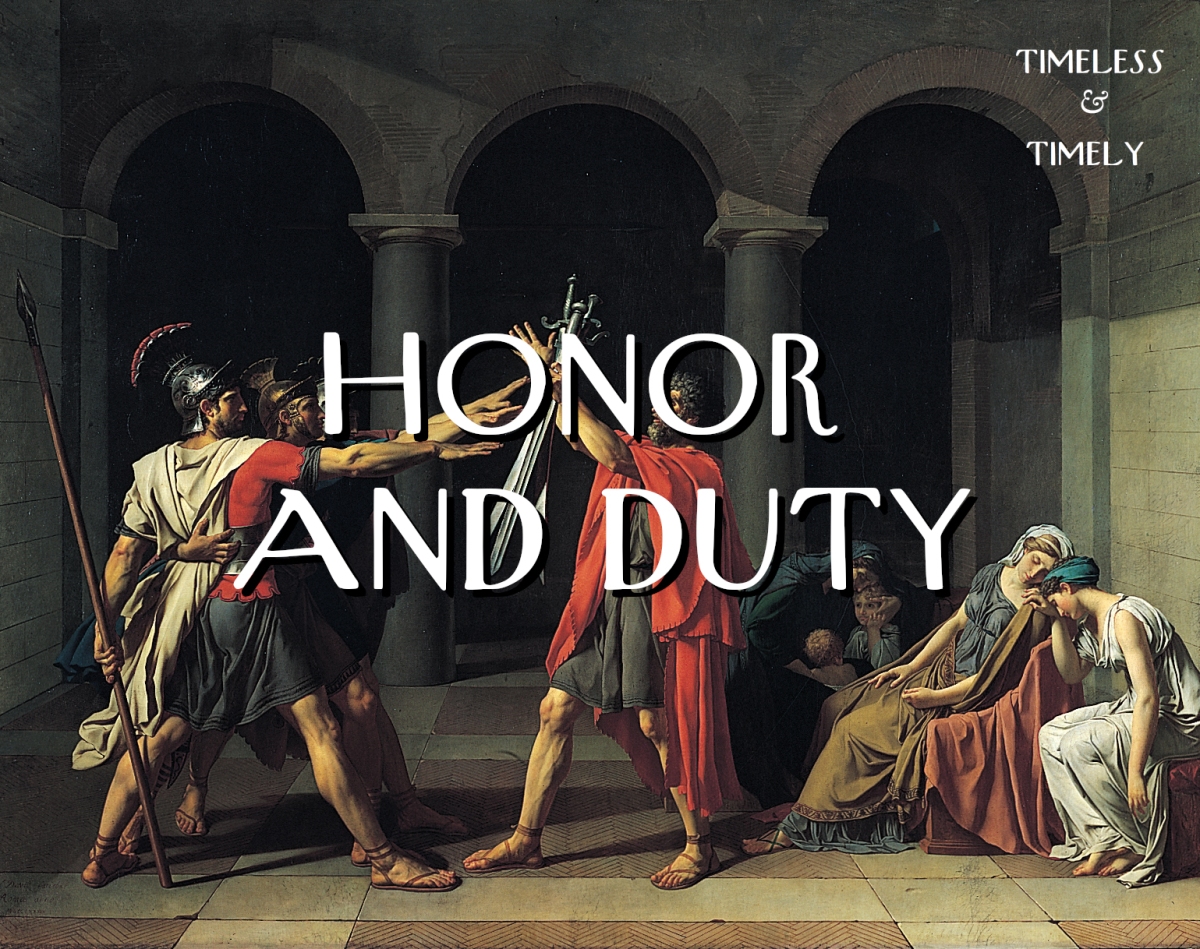
Two concepts that are not discussed very often today in our culture, but for which go hand in hand to have a purposeful life are duty and honor. Duty is the obligation, either moral or legal, to uphold your responsibilities and to take upon tasks and actions when called upon. Duties are be thrust upon you such as being part of jury or registering to be eligible for military service but also done voluntarily such as keeping your community clean by picking up trash, giving money to a charity, being part of the local school board or town forum.

There are many variations on duty, but what they all have in common is to think of more than just yourself and to be responsible to those people around you. We are duty-bound by law in many such cases, but we are also duty-bound by morals and values that are passed on from generation to generation.

Being dutiful is conscientiously being able to know what your duties in life are, pursue them vigorously, and to conduct them in a moral manner. Duties may not be easy or fun to fulfill, but we have them in place so that society can function at a higher level. If no one was duty-bound to others, selfishness, greed, and egocentric behavior would replace it, which would cause the larger community and society to collapse over time. Lack of duties breeds this kind of behavior whether they are mandatory or not. If everyone is out for themselves and not able to look after others or think of their behavior’s effect on other people, it would create what we know to be as a ‘dog eat dog’ world.

When you fulfill your duties, legally bound or morally footed, you uphold the basic contract as a citizen and as a human being, to help improve your community and the society to some degree. If everyone fulfills their duties, trust, confidence, and belief in each other will be much more assured. If nobody does what is required or expected of them, nothing substantive can get done. The more duties we fulfill and the more we look out for another rather than ourselves, the better off we are to be when we commit to these obligations.

Duties can be granted and often must be enforced to be fulfilled but if we each uphold the duties we are given and see each other as all being on the same page, other duties that we voluntarily take on can be added on if we see that the system is working, and people are putting in their fair share. If a few individuals, especially if they leaders or representatives of their community, are found to be neglectful of their duties, and especially lied about fulfilling such duties, it can easily cascade to where the average person sees this and will unfortunately not find the duties they have been given as being as necessary to commit to if they see those who put them into place or have mandated them do not fulfill them as well.

Regardless of where you find yourself in the overall society, a leader, a citizen, a representative, a voter, etc., we are all held to the same duties and obligations that we commit ourselves to by law or by morality. If we all uphold those duties through acts of good faith and completing tasks that are insured to us, the better off everyone will be.

However, if duties are neglected, discouraged, or done away with even if they are mandated, the whole society will suffer as a result due to a loss of trust, faith, or belief in what upholds this basic sense of equality that we have to be beholden to the same duties as everyone else is regardless of age, sex, race, religion, ethnicity, etc. Now, it is commendable to do your duty, but it is even better to do so with honor.

Being honorable or conducting oneself with honor is taking the duties you are given to uphold or the tasks that come with such duties is to perform such duties with integrity, accountability, and trustworthiness. It is one thing to do your duty and it is another thing to do your duty well.

You can think of someone who is elected to be a representative of a community, town, city, or nation who will use the position for egotistical purposes and to twiddle the time away while doing nothing of honor to make sure the people who elected him or her will benefit as a result. They have been given the honor of representing their community or a nation and have squandered it by neglecting the privilege of having such a position to do good on behalf of others. There is no honor in that even if they are technically fulfilling the duty of public service.

Duties can be bestowed on soldiers, politicians, community leaders, public figures of influence, religious clergy, teachers, etc. and they can perform them because they have been trained or are seen as qualified to fulfill them. However, the question arises is if they are doing their duties with honor? Some will only do the bare minimum and will only think of themselves while having their position of power or influence wrapped up. Others will use their newfound duties to abuse their position for financial or social gain and lie to say that they did not do anything dishonorable to begin with.

Luckily, there will be those people in positions of status who will conduct themselves honorably and seek to uphold that trust bestowed upon them by being transparent, accountable, and forthright. A good leader or example of someone who conducts themselves with honor is that they do not only do their duties as expected of them, but they also seek out those in a similar position or authority who are not doing their duties. They will not only conduct themselves with honor intact but make sure they are holding others in their position accountable and to find out if their honor is there.

If not, that person of authority or influence would work to ensure that the individual without honor even while having done their duties albeit in a lackluster manner are held to account. To uphold that trust across a society where we all must do our duties and to do so with honor, those without honor should lose their given duties when it is found that they are not holding themselves to that standard. When we each hold ourselves to an honorable standard by doing the duties bestowed upon us to the best of our abilities, then the larger community or society will benefit as a result.

Without duties, there is no honor to be had. If duties are being done without honor, no functioning society will result. It is important to understand how much these two concepts feed off each other. One cannot exist without the other and if one concept is neglected, the other will suffer as a result. We all must commit the duties and obligations bestowed upon us whether by law or by creed, but duties must also be performed to high standards, both morally and ethically. Performing one’s duties without honor cannot work and nor can having honor without upholding one’s duties.  

The Yearning for Nostalgia

“Whether it is an escape through our popular culture, a preference to revisit the past than to explore what may come in an unknown future, or to enjoy simply what we have been accustomed to, the power of nostalgia should not be underestimated.”

What is it about nostalgia that stirs such powerful emotions in us all? Why do we insist on revisiting, remaking, and reconstructing the past? This innate yearning that is part of being human, I would argue, is a part of gaining back some comfort and familiarity in an increasingly unfamiliar and complex world. Whether it is an escape through our popular culture, a preference to revisit the past than to explore what may come in an unknown future, or to enjoy simply what we have been accustomed to, the power of nostalgia should not be underestimated.

As the new year begins, looking at the popular culture, which reflects trends in our overall society, this yearning for nostalgia has only gotten more prominent in the recent years, especially with the continuing of the COVID-19 pandemic. There are multiple examples in pop culture where nostalgia is the rule rather than the exception. One example would include video games where remakes, sequels, and remastered games from the Halo series to Assassin’s Creed to Call of Duty are still the most popular even after being decades long in terms of their original creation.

Another example would be television shows where one of the most popular series released recently is ‘Cobra Kai’ whose origins come from the Karate Kid movies of the 1980s, but for which has had a rebirth with the same actors almost four decades later but also with new characters who compliment the original story. Other popular shows involve those from the ‘Star Wars’ and ‘Marvel’ series whose revitalizations include the bounty hunter Boba Fett (also from the 1980s as a character) and popularly known comic book heroes including ‘Loki’, ‘Captain America’, and ‘Hawkeye.’ While these comic book heroes may be new to some viewers, they also date back in their creation back to the 1990s or even earlier allowing their fans to indulge in their own nostalgia in seeing these comic book heroes come to the small screen.

I haven’t even mentioned the plethora of movies from ‘Licorice Pizza’ (1970s), ‘The Power of the Dog’ (1920s Western), ‘The Matrix: Resurrections’ (1990s-2000s), released just in the past few months who pay homage to the past from settings we are familiar with or at least recognize. While there are films and TV series that do focus on mankind’s possible future(s), such as ‘Station Eleven’ on HBOMax or ‘The Expanse’ on Amazon Prime, most popular media today focuses on either adapted stories or at least remakes of stories with slight changes or new ideas related to the same characters to keep its popularity going.

In 2022, nostalgia sells the best, which is why new Halo video games, new Spider-Man movies, and new Game of Thrones books still rule the day in terms of our popular media consumption. Now, that does not mean that our appetite for new and original ideas in our popular culture are going extinct, but you can tell that we live in an age of rampant nostalgia, which is the norm rather than taking a chance or a risk on a new story or new ideas.

I believe that this resurgent nostalgia does have its positives to give people some familiarity with what they already know from their own past and for which they have experience in liking already. In addition, it can take more time to warm up to a new story, a new idea, or a new experience when it’s easier to go with something or someone you already know. Stories can change or adapt or get better sometimes over times and just because we are familiar with a character, or a series does not mean that it automatically gets boring after a certain point.

However, it is much easier to rely on nostalgia rather than to forge a new path. In anything in life and not just popular culture, it’s not as challenging to look back on what we’ve done, where we’ve been, or what we’ve experienced than to go forward, challenge oneself, and try new things. The impulse to be comfortable with what’s familiar rather than the unknown is a powerful force and an impulse that can be hard to overcome without pushing yourself. Nostalgia does not create lasting comfort though usually and it can be rather stale to rely on reliving things, experiences, or places rather than to look forward to unknown occurrences in the future.

Sequels, remakes, reshoots, adapted materials are harder to make better than the originals and they also do not break any new ground. Whether it is film, music, art, books, or in general, it may be easier to rely on nostalgia for creation but if it does not work out, it can be harder to bounce back from that failure. If you do something original or unique instead, it will stand out much more currently, and while you may polarize people who have gotten so used to nostalgia everywhere, you can be more wildly successful in your endeavor potentially and create a new cultural touchstone.

One great example from this past year that generated not only a cultural touchstone, but a worldwide phenomenon from Seoul to London to New York was the Netflix original series, ‘Squid Game.’ While the popular show contained elements from other TV series from the past, it had its own flair to it with unique set design, memorable characters, and a compelling and timely plot. It was the #1 TV series on the global streaming platform for over a month or so and generated important conversations in the public sphere regarding capitalism, income inequality, and debt servicing. The creators of the series took a big gamble, and they could have failed but they put their heart and soul into this unique show, and it paid off in more ways than one.

‘Squid Game’ and other original programming are a lesson for us all to not let our imaginations be stymied by what’s familiar and already known. Even in an uncertain world being continually upended by a pandemic and the effects of climate change, people want to be challenged to discover what’s new and what’s important. There is room in this world for both what’s new and what’s nostalgic. I think our problems begin in society when we only crave what’s comfortable or only what’s nostalgic to us. If we only choose to focus on what we already know, we won’t be able to face what’s new or on the horizon for us. It is not good to dwell only on what’s past and to rehash forever and ever what we already like rather than not trying to discover what we may like or embrace in the future that can help us learn more about the world around us.

What We Need vs. What We Want

Understanding that you must be able to divide up the two categories fairly and also be able to balance them healthily with our seemingly limitless desires at times is key to being a fully formed individual.

A key part of adulthood is being able to know the differences between knowing ‘what we want’ vs. knowing ‘what we need.’ Understanding that you must be able to divide up the two categories fairly and also be able to balance them healthily with our seemingly limitless desires at times is key to being a fully formed individual. As children, we are taught to temper our desires to manageable levels and to remember to not be selfish especially when it conflicts with the needs of others.

We are flawed as humans in that we often let our wants overtake our immediate needs and that we cannot distinguish the two in terms of actual importance. I may want a new suit but if I only have so much money, do I really need it? Am I being selfish by buying a suit when I already have a perfectly good one at you? These questions are especially important to pose when you have limited money or time to contribute towards either your needs or wants. What we focus on each day shows us if we care more about ‘needs’ or ‘wants.’

It has to be non-negotiable in your own life how your needs come first and will always come first. Your wants have to be considered in terms of whether you actually need them and how much they will actually add that much to your life. When it comes to your wants, you should not only be thinking about their utility in the short-term but also in the long-term. Will you be that much better off not just a day later, a week later, or a year later when you satisfy those wants? A short-term want will be fleeting and may end up not even be worth it whereas a long-term want like starting a business, getting your degree, or moving overseas are often worthwhile investments and satisfactory wants that will put you ahead in your life. If you do want to fulfill your wants, they should be in the interest of you moving forward, learning new things, and developing your interests.

Short-term wants are good every now and then like a new bicycle, a nice meal out with friends, or a trip to a day spa, but the gratification will be short-term, and you can’t rely on those wants to fulfill you in the long-term. Long-term wants are harder to achieve but they often have higher levels of satisfaction. These wants aren’t automatically given to you and you have to work for them but it’s often worth the effort more so than just things being handed to you automatically. Your wants have to be kept in moderation too because if you let your wants overwhelm your needs, you may be left with less than you had before. An adult keeps their wants in check and prioritizes their needs first to make sure that their life is headed in the right direction. Long-term gains have to always take priority over short-term gratification, which may give you happiness but won’t give you fulfillment in the long run.

Your needs in daily life should always come first in terms of securing them. Whether it is water to drink, clean air to breathe, food to eat, and a roof over your head; they are all part of the equation to keep you in good spirits and in good health. Do not let your wants take away from your immediate needs because when it comes down to it, your wants may come and go but your needs are your needs and that never really changes. Abraham Maslow’s ‘hierarchy of needs’ was pretty much on the money in terms of distinguishing what are most urgent needs are and beyond that, what could be considered wants. We have the physical needs of eating, drinking, sleeping, maintaining homeostasis (not too warm or too cold) but beyond that, we start to go into the wants territory of seeking out self-actualization as well as having a steady purpose in life.

We all need human connection along with friends and family who care about us but that is not given to everybody and that kind of need is something that you have to work for and what you have to ‘want’ in a way. We all need safety and security to carry out our lives but that is something that we have to work towards to and that is not guaranteed when we are born. What we need may not been given to us like friends and family or the security of a place we live in and we may have to take action to turn those needs into a reality by wanting them badly enough.

In Maslow’s ‘Hierarchy of Needs’, our basic needs must be taken care of first as the pyramid shows us but then you have our psychological needs such as love, relationships, friendships, and feelings of accomplishment and goal-setting. As you go up the pyramid, you get into the ‘self-fulfillment’ needs category of achieving our potential, reaching our set goals, and becoming the best version of ourselves through self-actualization. This category is tricky, but we may feel that we need to be fulfilled that way; how hard are you willing to work to achieve that and how much do you really want to achieve it?

I would argue that our basic needs of food, drink, shelter, warmth, etc. are real needs but our psychological or self-fulfillment needs are different in that while each of us need them in our life, they are really ‘wants’ that you have to earn and to work for. Our basic needs are not given to us either, but they are of such urgency that we will do almost anything to have them guaranteed and it often subsumes our other ‘needs’ like love, friendship, or career goals.

What we need to live is our number one priority. Everything after that is supplementary in life. What we want Is important but it’s clear that our wants are endless at times and we need to prioritize with our limited time and/or money what matters to us most to achieve or to have. Being able to prioritize while understanding this internal battle is key to being a fully formed individual capable of holding our wants at bay while getting our needs taken care of.

Lastly, it is important to distinguish between short-term needs and long-term needs. Short-term needs should always take priority over long-term needs, but you can work towards both at the same time. You can hunt for food and still have companionship with a loved one at the same time. You can watch your vegetables grow while you’re studying for your next course exam or replying to emails. However, if your immediate needs are unmet or neglected, your long-term needs will have to take a backseat because they are just not as critical as what short-term needs are in terms of daily occurrence. You need to eat and drink water a lot more than you need to see your family and friends as an adult. I’m sure you would love to see them every day but it’s more likely you would see them once a week or a month or maybe less if you’re really busy.

Your immediate needs can be balanced with long-term needs, however, if you can’t cook for yourself, make money to support yourself, or be able to clean and take care of yourself physically, not many or very few of your long-term needs can be met after. As an adult, you need to take care of the daily details before you can reach your lifelong dreams and goals. What we need vs. what we want is a constant battle taking place in our mind. If we don’t pay attention to how to win this battle by trusting in our innate knowledge of what we are capable of doing to achieve them one by one and what are healthy priorities to focus on, you won’t be able to get very far in life with either your needs or your wants.

Anatomy of a Scene – Miracle Ceasefire

How we as humanity cling to hope is our investment into the future that better and brighter days are ahead as long as we persevere, push forward, and leave our world a little bit better for the next generation. ‘Children of Men’ is great because it poses the answer to the question of how does humanity hope for a future when no babies are being born?

The world without hearing children’s voices, laughter, and even cries can be a dark and hopeless place. That central message of the now classic movie ‘Children of Men’ (2006) has stayed with me especially in the current times of a pandemic that we are living in. How we as humanity cling to hope is our investment into the future that better and brighter days are ahead as long as we persevere, push forward, and leave our world a little bit better for the next generation. ‘Children of Men’ is great because it poses the answer to the question of how does humanity hope for a future when no babies are being born?

When you think deeply about it, humanity is restored generation after generation thanks to our youth, their ideas, their drive, their desire to not repeat the mistakes of the past and to learn from history. When you take humanity’s future away, what is there left to fight and live for? It is a powerful premise and one for which I am glad Director Alfonso Cuaron decided to focus on. His movie does not pull any punches and shows humanity at its worst when women are no longer able to have children.

Without children, playgrounds and swing sets remain empty. Refugees and immigrants are persecuted and forced into detention camps, suicide pills are common place, environmental degradation is the norm rather than an obscenity, and violent factions fight it out with the government in a post-apocalyptic United Kingdom where suicide bombings are an increasingly common occurrence as Theo (Clive Owen) discovers when he is almost the victim of one in one of the earliest scenes. Perhaps the most frightening part of the whole movie is that no one has figured out why women can’t have babies anymore and the novel that the film is based on is also clear when it shies away from saying why men can’t help in the reproduction process anymore.

In ‘Children of Men’, no child has been born for 18 years and it can be hard to retain hope after that long that things will change. The world is in a downward spiral and things get worse as the youngest person alive, Diego, is killed by an angry crowd. Theo takes solace in the fact that he has a good job at the government ministry and has a funny friend who goes by the name Jasper. Still, you can tell that Theo has lost faith in humanity especially after the death of his infant son due to a flu pandemic and his estranged relationship with Julian, his wife. However, when Julian tells Theo about Kee, a pregnant African woman, who may be carrying the first baby in almost two decades, everything changes, and Theo finds his purpose again to live and to fight for a tomorrow. Theo dedicates himself to protecting Kee and her future baby and wants to get her to safety, which means getting her to the Human Project, a group of the world’s best scientists discussing how best to make humans fertile again.

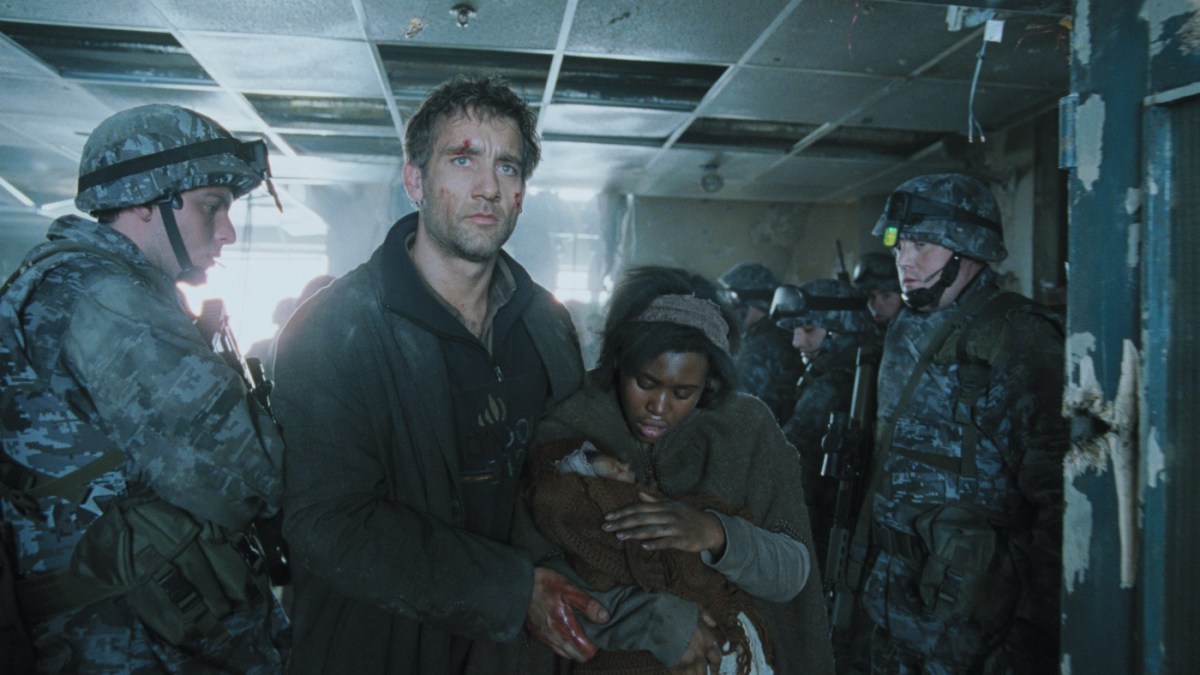
Theo’s journey with Kee involves getting her out of a refugee camp, escaping men who want to keep Kee’s baby for political purposes and who are also armed combatants, and avoiding fascist police forces who intend to get in their way. To escape the escalating urban violence around them as both the government and rebels fight it out in bombed out Bexhill, Theo and Kee take shelter in a refugee settlement in a former apartment building. The three of them come close to being killed and the baby’s cries echo throughout the building much to the stunned shock, joy, and awe it inspires among the refugees, the rebel forces, and the government troops.

The way the cinematographer follows Kee’s baby and Kee around in a wide tracking shot is absolutely beautiful making it one of the most memorable scenes in cinema history. “How is she?”, Theo asks Kee. “Annoyed.” Kee replies. A refugee woman reaches out her hand to touch the baby and another woman sings a sweet song in her native language. Prayers and aspirations are given to the baby as Theo and Kee walk through the crowd. The rebel soldiers acknowledge the baby as they get away from the advancing troops behind them. The government’s military soldiers are in absolute shock as one soldiers’ yell at his army unit: “Ceasefire! Ceasefire!” All of them stop shooting at once and look upon Kee’s baby in disbelief, many of them never having seen a human child before in person.

To see the armed men in tanks and heavy weapons and their technological mastery stop, think, and realize how humanity and its future must be preserved and let free without being in danger. Not much can stop a war from continuing but a baby’s cries can most certainly pause it for a few minutes as this brilliant scene exemplifies. An immediate symbol of hope for humanity and its possible redemption is realized in its newest addition and it is a wonderful allegory to how despite our differences, any human around the world will stop to comfort, aid, and protect for a baby as we would do for our own children or grandchildren or even nieces and nephews.

Those men who don’t see the baby continue to fire at each other in the distance but any soldier, man, or woman who hears the baby crying lowers their weapon, pays their respect, and let Theo and Kee have safe passage as they represent a glimpse of hope finally for humanity’s future rather than its eventual extinction. Some of the soldiers pray to their God and others peer in to get a look at the baby with their own eyes but all are silent and in disbelief thinking that finally there might be hope again.

After a minute or two of calm and as Kee and Theo are about to get away, a rocket RPG hits the government soldiers and the men ignore the baby again and get back to fighting the rebel forces in the building that Kee and Theo just left. To me, that is a tragic symbol of how once we have something out of sight and out of mind, we go back to fighting each other instead of uniting around a common cause. As that RPG fires, I think to myself watching this scene how somebody always has to ruin it for everybody else. Unfortunately, Kee’s baby does not lead right away to world peace and a cessation of arms. However, it is enough time for the two of them to escape and have a fighting chance of reaching the Human Project.

A baby’s cries are more powerful and everlasting than any weapon, any political cause, and any division between humanity. While human nature cannot be totally pacified by children and babies being born, it allows us to fight for better days and for a future freer of pain, sorrow, and tragedy.

I hope that when you watch this scene, you’ll realize that even in our current age when fertility is not extinct and is not a present issue that we are still fighting to preserve hope for the next generation and generations to come. Whether it is preventing pandemics, stemming the worst effects of climate change, or preventing nuclear war between nations, we all have a responsibility to be stewards like Theo in protecting the babies of the future against any manmade harm that could befall them due to our own neglect and ignorance.

Please do watch this ‘Miracle Ceasefire’ scene and the rest of ‘Children of Men’ when you have the chance. It is an excellent film to see and this scene may be the best one of the entire film. Hope and redemption are only as strong as our ability to have a better future.

‘The Edge’ – Film Review and Analysis

“Whether it was ‘The Revenant’ with Leonardo DiCaprio or ‘The Grey’ with Liam Neeson, these films highlight man’s struggle to overcome the elements, the animals, and even his own demons. Many of these ‘man v. nature’ films focus on one main lead and a small cast of supporting characters but most of the film’s runtime is about the sole main character. ‘The Edge’ is different.”

I have always really liked Man vs. Nature type of films. Even though they have similar premises and conclusions, it really is a raw kind of film that grips you and leaves you wondering what you would do in a similar kind of situation. Whether it was ‘The Revenant’ with Leonardo DiCaprio or ‘The Grey’ with Liam Neeson, these films highlight man’s struggle to overcome the elements, the animals, and even his own demons. Many of these ‘man v. nature’ films focus on one main lead and a small cast of supporting characters but most of the film’s runtime is about the sole main character. ‘The Edge’ is different.

In ‘The Edge’ (1997), this survival film does something else by highlighting two men who have different intentions and different backgrounds. One is a wealthy man named Charles Morse (played by Anthony Hopkins) and the other is a photography presumably who take pictures of models and is very much a person of the city who is not used to nature or wildlife. Bob Green (played by Alec Baldwin) has ulterior motives in mind but comes off as affable and friendly enough in giving Charles a gift for his birthday in the form of a hunting knife. Charles is accompanied by his beautiful wife, a model named Mickey, who Bob takes pictures of as well as Bob’s assistant, Stephen, who is also new to being in wildlife. The small group are joined by a few friends in a cabin in the Canadian wilderness to celebrate Charles’s birthday.

From the beginning of this film, you can tell that Charles is more comfortable with his intellectual pursuits than with his friends. He loves Mickey, his wife, but he understands that he is more interested in books than in people. Charles is particular obsessed with a survival book / guide that he is reading and is fascinated by the natural surroundings that he has brought the group to and the people who hunt there for bears and other wildlife.

Charles’s fondness for nature and of survival are to come in handy later on in the film and is an excellent use of foreshadowing when things go haywire later on. During this birthday celebration, the viewer can also tell that Bob while he is kind to Charles is envious of him, his life, his money, and his wife. He openly flirts with Mickey and kisses her platonically. Charles can sense this animosity and is wary of Bob’s intentions.

Part of the reason why they all have come up to the Canadian wilderness besides Charles’s birthday is to find, interview, and take photographs of a famous Alaskan Indian hunter. During their flight, as Bob and Charles make small talk, Charles blurts out of the blue to him: “How do you plan to kill me?”. Before Bob has a chance to respond, a flock of birds come out of nowhere and strike the plane’s engines and its windshield killing the pilot and causing a downward crash.

The plane crash lands in the lake and all three men (Bob, Charles, and Stephen) are all shook up but survive the crash. The pilot does not but the men quickly realize they may be stranded for a while. Charles, given his survival skills knowledge, takes charge and encourages the other two men not to panic and to learn from him. Using his encyclopedic knowledge from his memory, he is able to make a compass to plot their course forward, make a small fire, and also give them advice about how to proceed.

Charles is not perfect in his survival skills and he almost gets swallowed up by a river rapid that almost carries him away until Bob pulls him out. For most of the film, it is unclear to the viewer how the two men really feel about each other. Their survival and getting out of the wild takes first priority. This becomes even more pressing when they wander into the territory of a giant Kodiak bear who is a real ‘manhunter’ as Charles calls him.

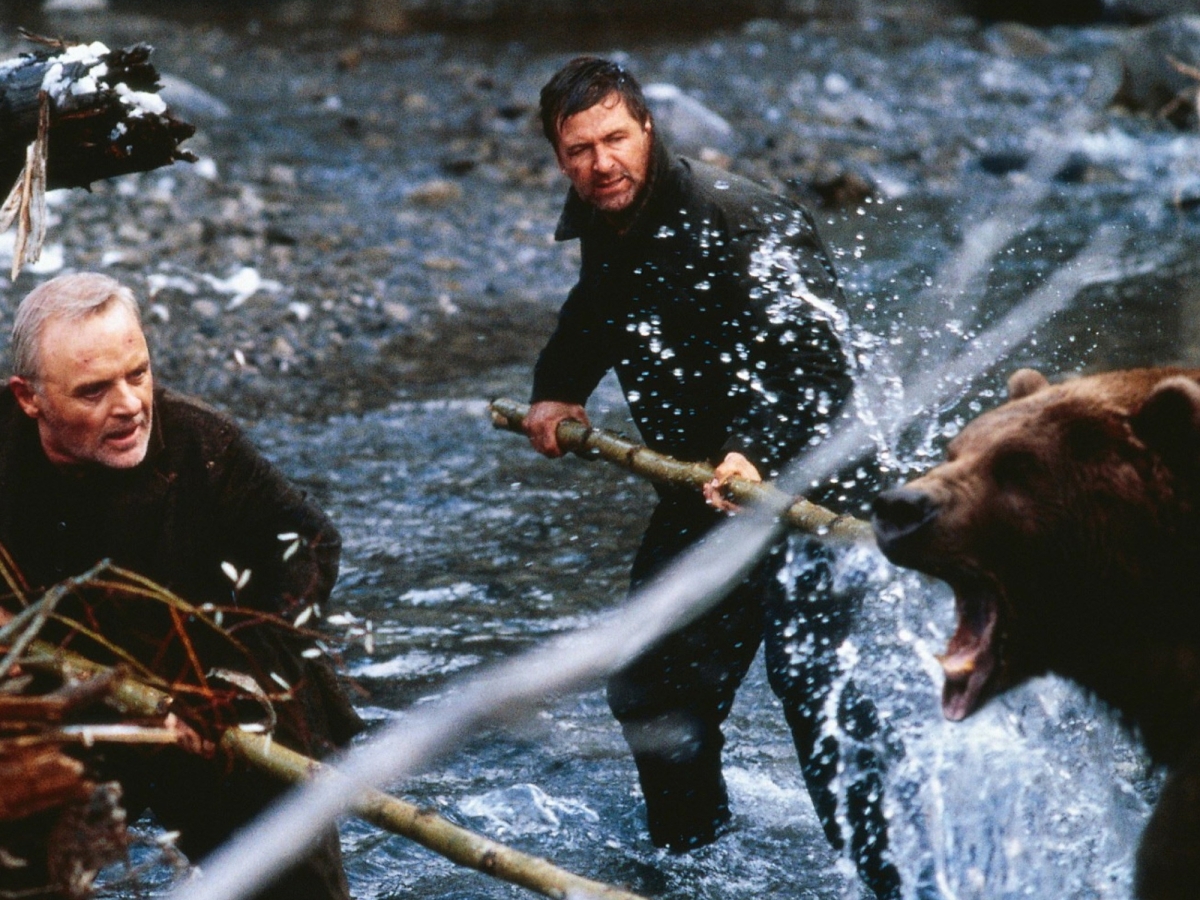
Stephen injures himself while climbing and Bob mistakenly hangs up the blood-soaked clothes of Stephen later on at night around the fire drawing the bear to him. This costly mistake leads to the Kodiak bear tracing their scent and finding them. Instead of burying the clothes, Bob lets them hang above their campsite causing Stephen to be attacked and brutally killed by the bear. Bob and Charles barely escape and realize that if they want to survive this ordeal, they must band together to trick the bear and then kill him.

Food is also a concern for both men as they haven’t eaten anything since they crashed and will starve to death if they don’t kill the bear. This is another instance where Charles comes in handy as he is able to distract the bear while Bob goads the bear into falling into their trap. By working together as a team and using a hidden spear to impale the bear, Bob and Charles are able to kill the bear together even when they both end up wounded from the encounter.

This is a small victory in the long road to survival for both men as they are able to eat well, don bear skins, and even find a cabin where they can get supplies. However, this is not the end of their animosity or wariness of each other. Man’s most fatal enemy is not nature or animals but often his fellow man and that comes into play.

While Charles is a smart and dedicated man to have achieved his wealth and success, he may have been naïve to who Bob is and what his wife Mickey was doing with him. Bob is not a survivalist and relies on Charles to survive but with the bear vanquished and having reached a cabin with some ability to reside there for some time, does Bob need Charles anymore and will his wife Mickey miss him if he didn’t come back?

The viewer has a lot to absorb and while I don’t want to spoil the film’s ending, ‘The Edge’ is not just about survivalism, but the edge of our tolerance of one another or our shared cooperation when a woman or money or prestige comes between people. Both men are not perfect, and they gain more when they cooperate rather than try to kill one another. Bob has the negative traits of hubris, envy, and short-sightedness. He is not able to survive the woods without Charles but wonders how much he truly needs him now that they have conquered the bear. He also covets Bob’s wife and wonders if he could murder Charles and get away with it by making it look like an accident.

Charles is an avid survivalist but may be naïve about the people around him. He also knows that Mickey and Bob and other people may take advantage of him and he may not know if they truly love him for him or if it is for his wealth and influence. While Bob is a personable, fun, and outgoing, Charles is an introvert with a love for knowledge and learning. They are opposite personalities, which is why they clash at times during this film.

While being in a precarious, life-threatening situation can bring the best out of people, it can also bring the worst out of the people, which is why ‘The Edge’ is a great film. Survival films like it do not just focus on the brutal realm of the wilderness where our creature comforts and our money cannot protect us, but they can also focus on man’s cruelty to man as well as our ability to work together too. ‘The Edge’ does a good job of pointing out how we can rise to the occasion when our survival counts on it but also shows us how dark human nature can be when we feel compelled to act out of jealousy, rage, and deceit.

‘The Edge’ is a great and underrated film, which I do highly recommend. The vistas of the Canadian wilderness are brilliant shown through the cinematography. The Kodiak bear, which was played by a real bear, named Bart, does a great job of showing how terrifying and powerful a giant bear can be when it is attacking you. Anthony Hopkins and Alec Baldwin are respectively some of the best actors of their generations and they do a great job of highlighting the unique personalities of their characters. You really believe the scenarios that they could find themselves in having been stranded in the wilderness for weeks. It is a believable kind of film from being able to make a fire, to finding fish in the river, to being attacked by a bear, to climbing and hiking day after day in unknown territory.

‘The Edge’ is overall a very compelling and realistic film. It does a great job of blending elements of ‘man vs. nature’, ‘man vs. animal’, and most importantly ‘man vs. man’, which is an element missing from our survival films. I would be lying if watching ‘The Edge’ didn’t make me want to buy my own survivalist guide to learn about how to survive in the wild for days or weeks. A terrifying plane crash, a boat whose engine doesn’t start, or a car engine that goes dead is enough to make anyone panic.

I believe it is important to prepare like Charles did for that kind of horrible situation and not to panic or dwell with shame. As Charles says at the beginning of the film, “Those who get lost in the woods often die of shame because they were ashamed that it happened to them.” This is an important quote of his to keep in mind. When the chips are down, you have to use your knowledge, resources, and will to survive whatever the circumstances. The best time to start preparing for that kind of occurrence is now.

Anatomy of a Scene – The Dream

“In his 30+ years as a police officer, he means well but he has noticed an increasingly brutal fact that is inescapable. The world has become more unforgiving, violent, and it is hard for him to make an impact whereas at the beginning of his career, he sought to make it a better place.”

Tommy Lee Jones is an elderly police officer overmatched in the excellent ‘No Country for Old Men’ (2017). He is overmatched for a number of reasons including not being able to keep up with the actions of violent men who show no compassion or no remorse. Throughout the film, he is always just a step behind the sociopathic Anton Chigurh and fails to either apprehend him or to prevent him from killing innocent people. In his 30+ years as a police officer, he means well but he has noticed an increasingly brutal fact that is inescapable. The world has become more unforgiving, violent, and it is hard for him to make an impact whereas at the beginning of his career, he sought to make it a better place.

Ed Tom Bell is your average protagonist who means well, wants to do right in his work, and believes he can do good but finds himself overmatched and overwhelmed by what he is asked to do. When he thinks of his future, he wonders what is left for him and if retirement will bring him peace or have him think back on what could be.

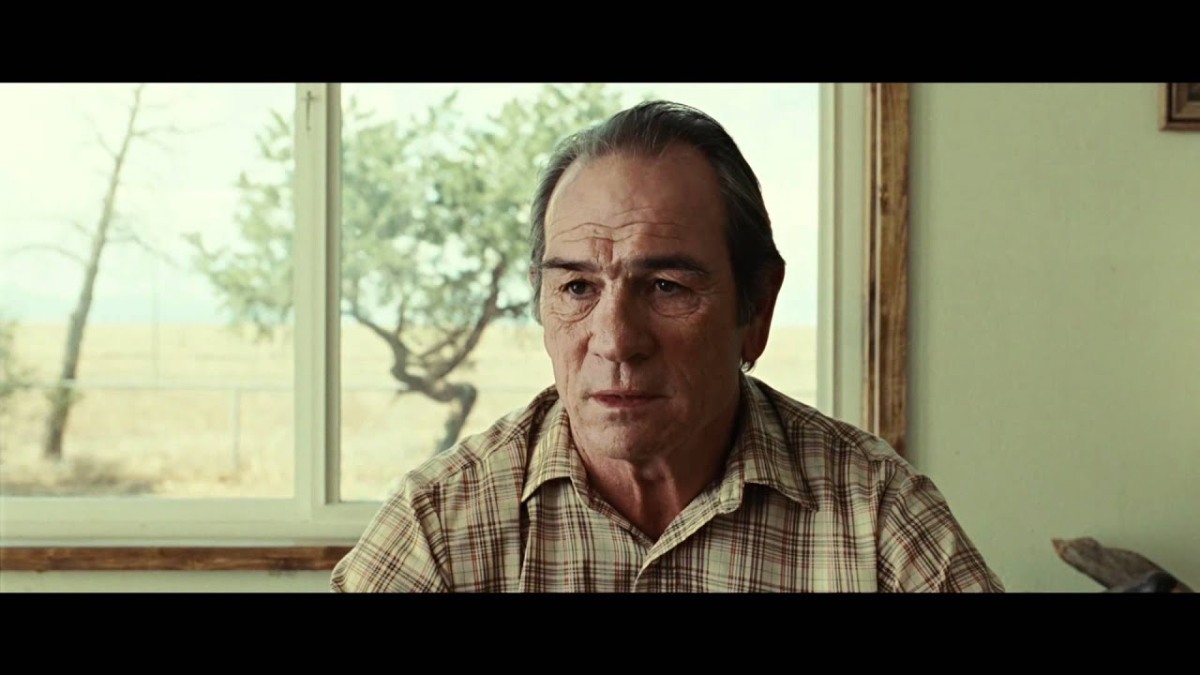
The dream scene begins with Ed Tom, now retiring, looking out of his window at his farm’s seemingly barren landscape with a sole tree to his left through the window behind him. A man of seemingly few hobbies and fewer words, he thinks about his day ahead and thinks about the possibility of riding around on his horse. Not too enthused about it, he also asks his wife if he should help around the house. Seemingly because he is less than skilled at this work, his wife believes it’s better that “he not.” He asks if his wife will join him riding but she is still working and a member of society actively.

Resigned to his fate as a retiree instead of being an active police officer, he reflects to his wife that he’s had dreams and he wants to share them. She says that he has time for them now and that she’ll be polite while he remembers them. He goes ahead and states that there were ‘two dreams’, they were ‘peculiar’ and both of them involved his father who has long passed away. Ed Tom is an older man than his father ever was indicating his father passed away at a younger age that of which Ed Tom will live to be longer.

The first dream is almost like a flash as most of our dreams tend to be with the details muddled and hard to recall. Ed Tom only states that he meets up with his young father in town and he leaves him some money perhaps as a way of his father being there for him even if he wasn’t present physically in his life. Similar to losing his father early in life, Ed Tom believes he lost his money in the dream as well leaving him without help as his father’s early death may have inadvertently done.

The second dream is much more imaginative and involve Ed Tom and his father living in ‘older times’ perhaps when the West was not settled and was lawless. He is no longer a police officer maintaining law and order but rather a horse rider having adventures with his father as he wishes they perhaps would have had time for had he lived longer.

This second dream is much more vivid as Ed Tom recalls how it is cold, they are going through a mountain pass together. They ride together in the snow among the mountains of the night until his father rides past him with no explanation and his blanket wrapped tight against him. This is confusing to Ed Tom at first knowing how hard it is to be without his father who he loves and must face the cold world without him as if he has been abandoned again. Though he may have lost his father, Ed Tom recalls how his father was carrying ahead a fire and a horn of a golden moon color, which gave him comfort despite the fact that he was not with him riding together.

“He was going on ahead, fixing to make a fire.” Ed Tom believes his father in the dream is out there doing this noble act in the middle of all the dark and cold, which is brutal to handle. “I knew whenever I got there, he’d be there…then I woke up.” The hope that Ed Tom haves is that his father even though it seems like he abandoned him as the son is that he really is instead looking out for him and paving the road ahead with light so he would not abandon his hope.

He believes that his father even though he may not be there with him wants him to keep going ahead and to meet him eventually instead of becoming deterred. He paves the way for his son to chase the flame of his absence and to resolve to not let the dark encapsulate him fully. Ed Tom’s expression about the dream is one of resigned sadness that his father is no longer around but also one of lingering strength to believe his death was not in vain and that he will reunite with him one day. His father, like him later, use their lives to keep the flame and the light moving forward even when surrounded by the darkest aspects of human nature.

Like any dream scene in a movie, this one has a deeper meaning behind it related to one man’s grief involving the loss of not only his livelihood but of his hope for a brighter future for humanity. Having seen the horrors that people inflict on one another, he may be resigned to that fact but he also believes his father would have wanted him to keep the flame ‘alive’ and to keep carrying it forward throughout his life even if things looked bleak. His death did not stop Ed Tom from keeping the flame moving in his own life and to carrying it forward in the hopes that he would bring it to his father someday when they would eventually be reunited in another lifetime or in another dream that seemed real.