‘Training Day’ – Film Review and Analysis

‘Training Day’ is the kind of movie that highlights two people who somehow cross paths as they are on opposite sides of morality. The men are shown to be both flawed in their own ways but still have a direct impact on each other as they spend more time together. Throughout this film, both men are trying to outwit each other in the hopes that they’ll come out on top. Because of this gamesmanship, this is no simple training day but rather a series of events that end up changing both of their lives for better and for worse.

The two main characters, one of them who could be considered a youthful idealist, is trying to better his community and his city by enforcing the law by the book. The other man has been around the block and knows about the grittiness of the job more so than his impressionable, younger rookie partner. He is a pessimist who discards the idealism that he likely brought with him when he originally joined the police force. He has abused his power as a law enforcement agent, is looking to maintain his authority and grow his wealth through intimidation and threats.

“It takes a wolf to catch a wolf” is a powerful quote from ‘Training Day’ that shows that in order to bring somebody down, you have to act and imitate who they are. The problem with this attitude is that sometimes you end up becoming your own worst enemy. However, to simply be a sheep is leading yourself to the slaughter as well especially when you’re dealing with the criminal underworld.

In order to survive as a detective, both men know that you need to be confident in yourself, steadfast in your beliefs, and willing to confront ‘the wolves’ out there if you want to catch one. It could be argued that the protagonist of this film starts out as a sheep and ends up becoming a wolf in order to catch the antagonist, a true wolf who has caught the wolves for many years. This kind of symbolism embedded within ‘Training Day’ makes it a classic film worthy of repeated viewings.

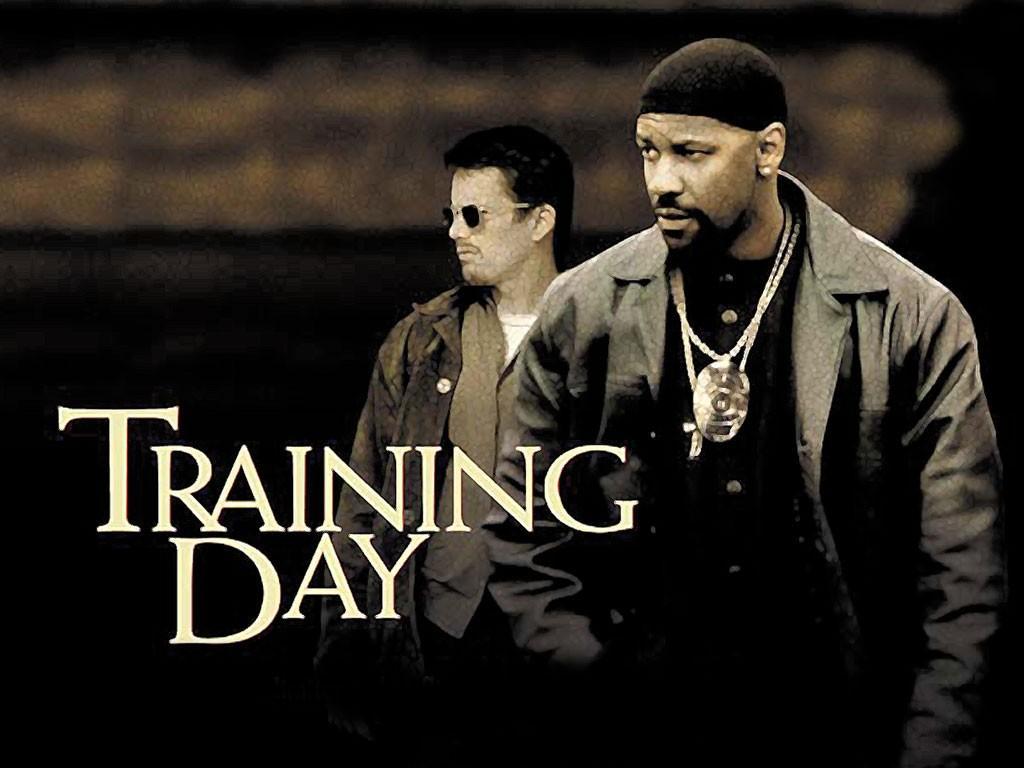
‘Training Day’, released in 2001 is a crime drama / thriller directed by Antoine Fuqua which follows two LAPD detectives who patrol and fight crime in gang-heavy neighborhoods. The film stars Denzel Washington as Alonzo Harris, a veteran detective and police officer who prefers wearing street clothes over a formal uniform and a badge. Ethan Hawke, who plays Jake Hoyt, a new detective and Alonso’s new partner who is entrusted in learning from Alonzo on his first day of detective training.

This film has earned excellent reviews over the years and is considered one of the best movies of the 2000’s. It achieved critical acclaim and success in theaters as Denzel Washington earned a Best Actor award for his role as Alonzo Harris. Truly, one of the best parts of the film is Washington’s acting and how he brings the corrupt yet smooth talking cop character to life. Det. Harris is a classic villain who ranks as one of the best antagonists in film history for his duplicity to others and displaying his indefatigable charisma while doing it.

From the opening scene of the movie, you can tell that Jake Hoyt is out of his league when it comes to matching up against Alonzo Harris. Unfortunately, not much of Alonso or Jake’s backstory is given in the film as well as how they came to become partners together. However, you can see early they are both polar opposites of each other in terms of their ideals, morals, and overall character. Jake is a young guy who’s trying to make his mark as a police officer and trying to do everything by the book as instructed by his superiors at the academy.

He is idealistic, fair-minded, and perhaps a bit naïve to the murky shades of gray that make up the world. Meanwhile, the audience can tell that Alonso has been on the wrong side of the streets for a while and has become purely jaded by his work as a narcotics detective. Instead of serving and protecting the people in his community and city, he cares only about his image, the reach of his authority, and the ability to make illegal money without compromising his career. What once was left of the idealism and the drive to do good by becoming a police officer has long been washed away. You could argue that Jake is a sheep while Alonso is a wolf who is going to prey on him.

The ultimate goal of Alonso is to bend Jake to his will by manipulating his moral code and his willingness to stay clean as a police officer. While Jake starts out the film as being a bit reticent, gullible, and naïve to what Alonso is doing to him, he is able to change over the course of the film to fight for his future, his career, and his life. The transformation of Jake Hoyt from a ‘sheep’ to a ‘wolf’ able to stand up to Alonso is one of the greatest displays of character development in film.

The great drama of ‘Training Day’ is to see both men push each other to the limits both mentally and physically to see who will be left standing after the training day and night is over. While Alonso lost his soul and is trying to corrupt those around him, Det. Jake Hoyt needs to harness his strengths, moral fiber, and intelligence to best Alonso at his own game.

At first, Alonso seems like an ideal partner to be with if you are in the police force. However, Jake and the audience find out that he is anti-social, manipulative, and willing to take what he wants without remorse. The challenge throughout the film for Jake is how does he change into a ‘wolf’ without losing his own moral code. Complicating matters for Detective Hoyt is the fact that Alonso isn’t the only corrupt police officer to deal with and that it goes to higher levels in both local and state government who know what Alonso is up to.

While some officials turn a blind eye to Alonso’s money-grabbing, wrongful beatings and killings, and others in the police force actually join in on it, Jake takes a moral stand and wants to bring Alonso to justice. However, we find out that Alonso is in fact his own worst enemy and the bad karma that he’s acquired over his years of corrupt wheeling and dealing will come back to haunt him.

Everyone’s luck eventually runs out and Alonso finds himself on the wrong end of a bad gambling streak with organized crime. For all of his manipulation, wrongdoing, and anti-social behavior, its’ Alonso’s desire for control over others including Jake that leads himself to ruin. To the opposite, Jake becomes a stronger person and a more effective police officer as the film progresses. He stops two men on the street from physically abusing a high school girl, which pays off for him later after he faces another near fatal betrayal from Alonso.

The concept of karma plays out for Jake, as he is able to resist the corrupting influence of Alonso and remain on the right side of the law by doing his job even under great personal pressure. Instead of letting the power and authority entrusted in him get to his head, Jake is able to become not just a better police officer than Alonso by the end of the film but a better human being.

While Alonso wasn’t always a corrupt cop, ‘Training Day’ makes you wonder what could have happened to this man to turn him into what he was originally fighting against. Overall, this movie is a morality tale of two men who have different intentions when it comes to being a police officer, which puts them at odds with each other. Their impression of the other man continually changes as they learn more about who exactly is the ‘sheep’ and who is the ‘wolf’ as their training day plays out.

English Corner – Demonstratives

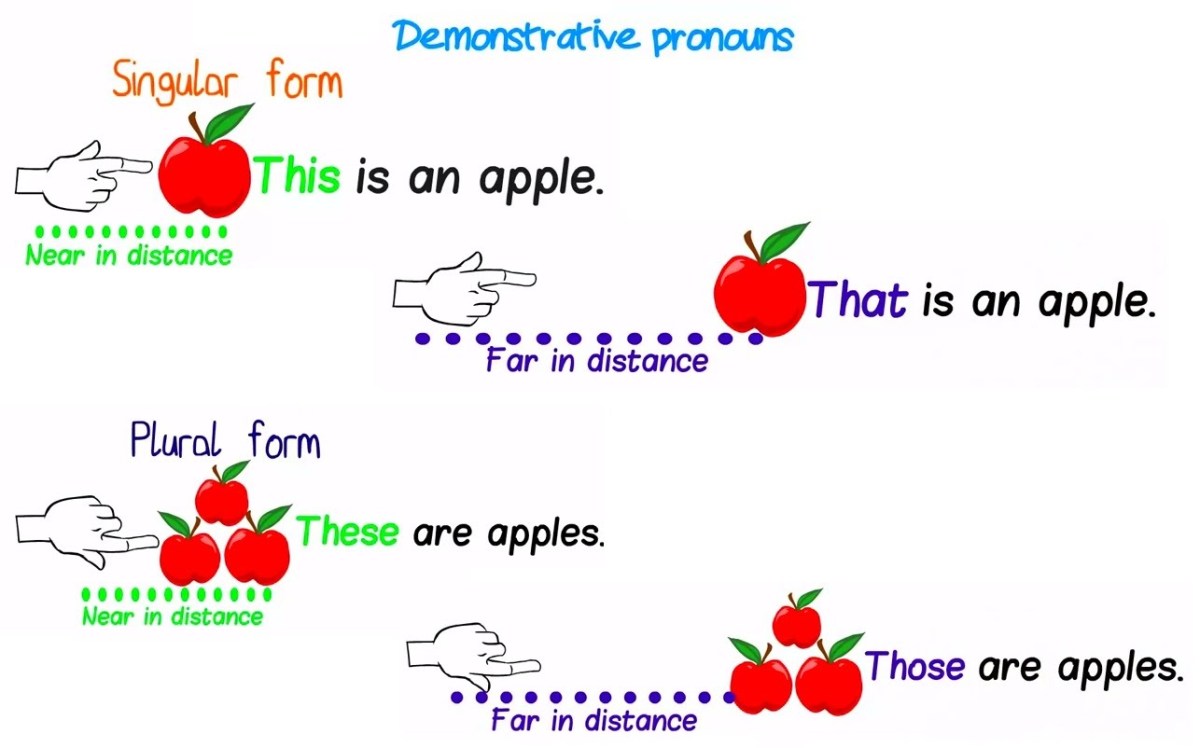
When it comes to discussing one’s distance from objects, things, or other people, it’s necessary to master the grammatical concept of demonstratives. To describe the physical distance of something or someone to another is a key aspect of demonstratives. Depending if the speaker is near or far from the other object, person, place or thing, the demonstrative will change to reflect that change in closeness.

A key aspect of demonstratives to remember is that they can either be adverbs or pronouns for both singular and plural nouns. You can use demonstratives as well to describe both countable and uncountable nouns. In addition, when it comes to discussing actual events, you would use ‘near’ forms of the demonstrative to refer to the present while ‘far’ forms of the demonstrative would refer to the past.

For the demonstrative adverbs, the word ‘here’ refers to the subject who is close by and near to the object, thing, or person. For the opposite, the adverb ‘there’ refers to the subject that is far away from the object, thing, or person.

Here are some examples of demonstrative adverbs for near / far usage:

  • I am here at the police station.
  • They are here for the Science exam.
  • She was there for the graduation ceremony.
  • We will be there at 9 o’clock.

Based on these examples, it’s important to remember that the adverb ‘here’ for near situations should be used in the present tense whereas for far situations, ‘there’ is heavily used and often with either the past or future tenses.

As mentioned before, if you are near to an object, thing, or person and you’re looking to use a demonstrative pronoun, you’ll want to use the words of ‘this’ or ‘these’ depending upon if its’ with a singular, uncountable noun or with plural, countable nouns. The demonstrative ‘this’ or ‘that’ would be used with singular and uncountable nouns while ‘these’ or ‘those’ would be used with plural and countable nouns.

Here are some examples of how ‘this’ and ‘these’ would be used in sentences to describe objects, things, or people that are close in distance to the subject:

  • This cup is for my tea.
  • Is this your jacket?
  • Where have you been traveling to these days?
  • These bananas are delicious.
  • This is my friend, Dan.

As you can see from these examples, these objects or things are close to the subject rather than far away in distance. You can also see how the demonstrative ‘this’ is used for singular nouns while the pronoun ‘these’ are being used with plural nouns.

If the opposite occurs and you or another subject in your sentence is far away in distance from another, person, place or thing, you’re going to want to use the demonstratives ‘that’ or ‘those.’

Here are some examples of how ‘that’ and ‘those’ would be used in sentences to describe objects, things, or people that are far in distance to the subject:

  • What are those men doing over there?
  • That book in my shelf was really enjoyable.
  • That printer has a paper jam that needs to be fixed.
  • Those boys are heading off to play in the park.
  • Those tires are flat. They need air.

It’s clear from those examples above that those objects or things are considered to be far away from the subject of the sentence. You can also see how the demonstrative ‘that’ is used for singular nouns while the pronoun ‘those’ are being used with plural nouns.

When it comes to placing a demonstrative like ‘that’, ‘this’, ‘these’, ‘those’ in a sentence, you should remember that those pronouns can be placed before the noun or adjective that modifies the noun even if there is more than one noun in the same sentence.

Examples:

  • Those hungry people need to eat soon.
  • These tired citizens are waiting long hours in the unemployment line.

Another way to use the demonstrative is that it can be placed before any number by itself when the noun is understood within the context of a larger paragraph.

Examples:

  • These four need to be fixed.
  • That one gave me some trouble.

Sometimes, a demonstrative pronoun or adverb can be used by itself in a sentence without a noun even being present after the demonstrative. The noun can be understood from the context of a previous sentence or larger paragraph making the demonstrative clear the only necessary subject to have.

Examples:

  • This was not very fair to me.
  • That is really cool.
  • Those were really interesting.
  • What was the issue with these?

As with many other grammatical concepts in English, there are some rules and circumstances that have to be remembered in order to develop both spoken and written fluency. In order to become comfortable with demonstratives, study the examples, create sentences of your own, and re-read this article to remember the rules of usage.

A Study in Contrasts – the Medellin Metro and the Boston T

I’ve used a lot of different metropolitan transit systems in cities I’ve either visited or lived in. From Istanbul to Berlin to Washington, DC, it’s fascinating to see how different cultures and countries treat their metro systems. Some cities emphasize the ability to eat and drink at established vendors right next to the platform, while others emphasize the ability to know exactly when the next train will be arriving with real-time updates. In a way, these metro systems are a microcosm of a country’s culture. Unbeknownst to most travelers, you can learn a lot about a city and a country as a whole based on how they approach their public transportation. Each metro system I’ve used has had their own kind of flair to them whether it’s the London Underground’s cleanliness, New York Subway’s 24-hour service, and Istanbul’s kind food merchants.

Out of all the metro systems I’ve rode on, there are currently two in the world that stand out to me in their approach to customer service. While most systems rarely have attendants to help people enter or leave the train, the two cities that are the exception to this rule are Boston and Medellin. These two transit systems actually have attendants working on behalf of the transportation authority to help passengers to use the metro effectively but with different approaches. For example, the way Boston does its’ customer service would be more hands-off while in Medellin it is much more hands on.

This difference in culture may play into the fact that the Boston T system has been in operation since 1897 and the locals are pretty adept at navigating the transit system considering its’ more than a century old. When it comes to Medellin, the metro system there began in 1995, which is a little over twenty years old. Medellin currently has the only urban train network in Colombia. Still though, you could draw the conclusion that the way the customer service of these two transit systems functions is reflective of the overall culture. In the U.S., we tend to be more individualistic especially when it comes to our urban transportation. When I lived in Medellin, I was enamored with how collective the metro system was when compared to where I’m currently living. In Boston, it’s much more about every man or woman for himself or herself as they try to navigate the system regardless of whether you’re a long-time local or a first-time visitor.

For Medellin, the aspect of their metro system that stood out most to me was the number of attendants who would help riders enter the train platform, instruct users on how to board and exit the trains, and how to refill and use their metro cards. Instead of just one or two attendants there on behalf of the transportation authority, there were usually up to a dozen workers assisting customers at each station. It was really nice for me to see the attention to detail that the metro system had in terms of assisting passengers to use the system effectively. This approach was crucial especially during a busy rush hour when there would be thousands of passengers wanting to enter and exit the train station.

Having a dedicated group of workers on hand to help smooth things over and make sure passengers were respecting each other and the transit system was a really impressive thing to witness. It doesn’t hurt that the entire Medellin metro system is well kept and has no littering, little rats running around etc. at any of its’ dozens of train stations. Compared to other cities, Medellin does a great job with its’ communal approach to the metro system. One of the catchphrases of their advertising is to ‘Vive La Cultura de Metro’, which basically translates to living the metro culture by respecting others and keeping the system clean.

Other cities could benefit from replicating the effective customer service, the emphasis on cleanliness, and the easy access to information that the Medellin Metro provides. Like any other transit system in a major city, it still does get quite congested during rush hour, and it can be hard to get on the train during peak hours due to lack of trains available. I know this from my own past experiences of having to fight to get on the train at 6 AM some mornings when I was a teacher there.

When it comes to the Boston T system, it’s the oldest in the United States and doesn’t take much time to get acclimated to. However, compared to the New York or Washington, DC transit systems, there is some customer service and assistance given. However, when you compare Boston to Medellin in this regard, it’s really no contest. While there are usually one or two attendants from the transit authority present, they don’t really actively help passengers. Sometimes, you can see a transit worker more interested in a smartphone game than to see if anyone needs help or has a question. Instead of being on the train platform to help riders get on and get off the train without issue, they usually just stand by the entrance to the station making sure everybody pays their fare.

Coming from where I was living in Medellin before I moved to Boston, this was a bit of a culture shock to me. It’s nice to have one or two more customer service attendants around to ask questions but I wish there were more attendants on the platform handling crowd control and enforcing the unwritten rules of getting on or leaving the train especially during rush hour. Also, compared to the dozen workers at any train station platform in Medellin, a city like Boston should have a few more people helping out compared to one or two workers per station.

Perhaps this cultural contrast is due to the fact that metro systems in the United States are much more individualistic in nature and the fact that public transit has been part of cities’ makeup for decades especially in the Northeast. I’m guessing that the majority of Bostonians would prefer to be left alone during the morning and evening commute rather than have hands-on help from transit service officials especially at a station platform. However, it might make everyone’s day a bit better and smoother if there were workers actively helping to assist people to refill their transit cards, making sure the rush hour commute goes smoothly, and aiding travelers to the city with directions.

When you travel to different countries, it is tempting to compare and contrast approaches to daily life. In any city, the transit system is an extension of the culture and I find it interesting to see the similarities and differences between countries in how they run their metro systems. It’s good to see how other cities and other countries do things because you’re able to see within your own culture what could be better or more improved. However, what may suit your own tastes may not suit others as much, even your own countrymen.

Train systems like whole cultures tend to be more individualistic or communal. What one city may lack in efficiency, they can make up for it in customer service. I believe it’s best to shoot for improvement in all areas to create a better travel experience. Having the trains run on time, being treated fairly by attendants, and enjoying clean, safe rides are keys for any metro system to achieve. Hopefully as more and more people travel and see the world, we can better see what ways we can improve our own cities and countries by seeing how others do it themselves.

English Corner – More Fun with Modals

In the last ‘English Corner’ post, I focused on introducing the topic of modals by beginning with ‘modals of ability.’ As I mentioned previously, there are different types of modals in the English language. We have already covered the modals of ability and permission so now this article will concentrate on those modals that deal with making suggestions, having obligations, seeking advice, going through with a decision, and getting an invitation. The modal verbs of must, shall, should, will, would are going to be highlighted in this article in terms of when to use them in sentences and how those sentences are to be structured.

For making suggestions, the modal verb of ‘shall’ can be used to offer up something to someone or to give advice to them. You can also use this auxiliary verb in the future tense if you plan on doing some action decisively. The modal ‘shall’ can be used both in the positive for and also be posed as a question.

Examples:

1) Shall I pick you up from your house at 8 pm tonight?

2) I shall travel to Morocco and Brazil in 2018.

Once again, it should be noted that ‘shall’ like other modals is to be used as an auxiliary verb in the sentence and often goes before the main verb like ‘travel’ or ‘pick up.’

When it comes to giving out advice or seeking it from somebody else, the modal verb of ‘should’ will come in handy for English learners. You can use ‘should’ at both the beginning of a sentence if it’s in the question form and towards the middle of the sentence after the subject word if you’re using it in the positive form. Should can also be used negatively when you change the word to ‘shouldn’t’ to express that modal in its’ negative form.

Examples:

1.) You should go to the doctor since you have a high fever.

2.) Should we wait for the presentation to end before leaving here?

3.) They shouldn’t have been rude to the doctor yesterday.

When you have an obligation that you simply can’t get out of or a duty to fulfill that cannot be delayed, the modal verb of ‘must’ is key to put in your sentences. Similar to other modal verbs, it is auxiliary and comes before the main verb in the sentence structure. You can also use ‘must’ in the form of a question as well.

Examples:

1.) He must do his homework by tomorrow.

2.) Must I bear this burden alone?

When it comes to making a firm decision to be carried out in the future, choosing the modal word of ‘will’ is a good choice. It is a definite verb that can be used as a question, a positive and a negative. To create the negative form, you simply have to change ‘will’ to ‘won’t’ after conjugating ‘will’ and ‘not’ together to form ‘won’t. When you use ‘will’, you’re not just making a decision but you’re also making a promise to someone that you shouldn’t break.

Examples:

  1. I will play football with you guys this weekend.
  2. Won’t you join us for dinner tonight?
  3. She will be so tired from the party that she won’t be able to study later.

As shown above in the third example, you can use both the positive and negative form of the modal ‘will’ in the same sentence, and the same modal can be used more than once in the same sentence too.

For the last modal ‘would’, you are going to want to use this one when it comes to seeking permission, giving a request, or extending an invitation to somebody. There are a couple of different uses for this last main modal verb but it’s important to keep in mind that it can be used in all forms including positive, negative, and question. As with the other modals, it is an auxiliary verb that will always come before the main verb in the sentence.

Examples:

  1. Would you join me at the birthday party Friday night?
  2. I would like to go home now if that is fine with you.
  3. We wouldn’t climb Mount Everest because it is so dangerous.

The modal verbs of must, shall, should, will, would are focused on the future tense and are very strong in terms of making suggestions or going through with a decision. In total, you now have a basis of understanding the nine main modal verbs. There are others in the English language but these nine words ‘can, could, may, might, must, shall, should, will, would’ come up the most and are the most important to master.

‘Children of Men’ – Film Review and Analysis

What would happen to our world if women were no longer able to have babies? How would human society, nations, and the globe as a whole react to such a consequential event to humanity? A dystopian take on the state of a world without children is the focus of the 2006 critically acclaimed film titled, ‘Children of Men’, directed by Alfonso Cuaron. This film stars Clive Owen, Julianne Moore, Michael Caine, and Chiwetel Ejiofor in its leading roles. The film is based off of a novel of the same name, ‘Children of Men’, which was written by author P.D. James in 1992.

The screenplay and the story have both been adapted from the novel but the striking visuals and the memorable cinematography make it fit for the big screen treatment. Despite a limited release and low profit earnings when it first came out, Children of Men has stayed in the public consciousness due to its timely socio-political themes on immigration, the environment, terrorism, and political violence. With the election of Donald Trump as U.S. President and the unlikely occurrence of Brexit, the message and themes of the film have turned out to be quite relevant. Although this film is set in the United Kingdom in the future year of 2027, despite the non-issue with the infertility of women, the issues that humanity is dealing with in 2017 are tied directly to different issues that the film brings up in its’ plotline.

Theo Faron, a civil servant for the British government and former activist, seems to have given up his fight for a better future. With humanity on the brink of extinction and with most of the countries’ governments having collapsed, there doesn’t seem to be any hope left. As one of the characters, Miriam, explains to Theo in the film, “As the sound of the playgrounds faded, despair set in. Very odd, what happens in a world without children’s voices.” Theo and his ex-wife, Julian, estranged for years after the death of their infant child, Dylan, are reunited due to a refugee named Kee. Julian and the Fishes, an anti-government and pro-refugee group involved in an uprising, would like to take Kee to the Human Project.

She is known to be the only woman in the world who is pregnant with the world’s first child in eighteen years, and is very valuable. However, things are not as they seem with the Fishes and their motives for helping Kee. Theo, in this film, is a lone character who promises to help Julian to bring Kee to the Human Project to ensure the future of humanity against all odds. Instead of using Kee as a political prop to help their cause against the government, Theo decides to help her escape from the Fishes, bring her to the British coast, and protect the future of humanity. Along the way, the viewer of the film sees the consequences of a world without babies. Where once there was no hope, Theo gains his sense of purpose and faith again as he hopes to redeem himself by getting Kee to safety and away from both the British government and the Fishes group.

Starting from the opening scene where the main character, Theo, is taken aback from a suicide bomb blast in the heart of London after just having left the café where the attack happened, you get a sense of what you’re in for with this movie. There’s a sense of hopelessness, dread, and despair as the audience is thrust into the focus of the movie as it’s made clear that the youngest person on Earth was eighteen years old meaning that something seriously has gone wrong to make that a reality. Although it’s never directly addressed in the movie, a few of the characters speculate that the reasons women can’t have babies anymore vary from environmental degradation to genetic experiments to too much pollution / radiation. The reason for women’s infertility is never addressed but the film makes it clear that the world is without hope because of the fact that there are no children to carry on the future of the human race.

Humanity faces certain extinction and the United Kingdom where the film’s setting is, instead of maintaining its’ parliamentary form of democracy has regressed into a totalitarian police state. Because it is one of the few surviving nations left on Earth, the country has developed a strict anti-immigration and anti-refugee policy. Any refugees or immigrants from outside the U.K. are rounded up and sent to detention camps, which have very poor and inhospitable conditions. The situation is so dire that the Fishes, labeled as a terrorist group, are fighting a guerrilla war campaign against the government to fight for immigrant rights.

The Fishes, with Julian, Theo’s ex-wife as their leader seem like the good guys but they have nefarious intentions in mind when it comes to the righteousness of their cause especially after they discover the first pregnant woman, Kee, in eighteen years. Throughout the movie, Theo is shown to be caught in the middle between the tyrannical government and the nefarious freedom fighter groups who are both trying to get hold of Kee for their own political gain.

The Human Project, believed to be a group of the world’s leading scientists, are thought to be the best people to help Kee with the baby and to perhaps study why she out of all the women on the planet was able to give birth to a child. Theo, having seemingly lost all hope and reason for living after the death of his baby, Dylan, believes again in the cause of getting Kee to be in the safe hands of the Human Project and to keep her from falling into the hands of either the Fishes group or the government. One of the main themes in this film is Theo’s regaining of hope and his quest for redemption after losing his only son years ago with his ex-wife, Julian.

The director, Alfonso Cuaron, does a great job of setting the scene of a dystopian future where humanity has lost all hope. A pill that allows people to commit suicide peacefully called ‘Quietus’ is mass advertised, terrorist attacks are an almost daily occurrence, and the immigrants, refugees who come to Britain are kept in detention camps separate from the rest of the population because the borders of the country have been closed down. In a plot and setting so dark, the only light to hold on to is Kee and her newborn to be. In a particular moving moment, Kee decides to name her baby girl after Theo’s deceased child, Dylan, showing just how much she really cares for the man who is getting her to the Human Project. It’s no coincidence that Kee herself is a refugee from a West African nation where the first humans emerged.

One of the best scenes in the film occurs when Kee, Theo, and the newborn baby are trying to leave a bombed out building where the rebels and the government are fighting each other in an urban war. The only thing that stops the bombs from falling and the bullets from firing are the sounds of a newborn baby echoing throughout the building and the street. This particular scene is a reminder of how special the sounds of a children’s cries are to the vitality of the world and how without them, it’s likely that humanity would descend into a downward spiral of chaos and violence. When all of the soldiers stopped for a few minutes to stop fighting, they realized that there was still hope in the world and that life can continue. It’s a very special scene for a special movie.

In addition to great directing, and great acting, Children of Men has some of the best cinematography of any movie in modern history. The single tracking shots, and there are quite a few throughout the film are ridiculously well done and help the viewer feel the tension and suspense in every scene. The soundtrack, the setting, and the messages of the film are extremely powerful and relevant to today’s world. I believe the director does a great job of asking the audience about how susceptible we are to either the rule of a totalitarian government or to the whims of absolutist extremist groups when societal collapse is imminent.

When there are no children or future generations, what is there worth fighting for? How also do we prevent ourselves from scapegoating other groups when things go bad? Maybe the issue is not infertility per say but rather climate change, the rise of artificial intelligence, or war between nations, how do we prevent ourselves from losing hope when things look bleak? The film, Children of Men, makes the argument that we should never lose hope especially in dire times. The future must be protected however especially as shown by the role the character, Theo, plays in helping Kee in her quest to meet members of The Human Project.

Ironically, there have been news stories out about the precipitous drop in men’s sperm counts over the past forty years in countries such as the United States. While this may not lead to total infertility, researchers labeled it as a cause for concern due to the overall trend of less fertility in men. In addition, birth rates are down below replacement level rates in multiple Western countries causing concern among scientists. Similar to the theories laid out in ‘Children of Men’, it is unclear why male infertility may be on the rise but it may be due to a number of factors, both environmental and otherwise. Where as Children of Men focused on women being infertile and not being able to have babies, the possibility of men being infertile in the future should be a cause for concern. (Source: http://www.newsweek.com/2017/09/22/male-infertility-crisis-experts-663074.html)

It is difficult to see why Children of Men did not win any of the Academy awards that it was nominated for. It’s an excellent, thought-provoking film that raises questions to the audience that are difficult to answer. If you have the chance to rent or buy this movie, please do so because it is widely regarded as one of the best movies of the 21st century.

English Corner – Introduction to Modals

There are many different kinds of modals to study but in this ‘English Corner’ blog post, we’re going to start out with an introduction dealing with the modals of ability. Modals of ability are the most common and the most important to master firstly. Modals are verbs usually and the ones that I am going to be focused on in this article are can, could, be able to, may, might.

Modal verbs act as auxiliary verbs in your average sentence and can express different ideas. These ideas include expressing one’s ability, one’s possibility, and sometimes necessity. Modal verbs often have more than one meaning and can be significant in a variety of ways. A simple form of a verb always follows a modal verb in a regular sentence as well.

Example:

  • Ben can do his homework.

The modal verb ‘can’ is followed by the simple form of the verb ‘to do’ followed by the object part, which refers to his homework.

An Introduction to Modals can be broken down into three separate parts: modals for ability, modals for possibility, and modals for permission. Each type of modals is unique in their own way but they each help to express oneself in some form or another.

For ‘Modals of Ability’, you can express your own ability or that of someone else by using the words ‘can, be able to, could’ in order to highlight your ability to do something.

Present Ability: I can speak three languages.

Negative Form: I cannot read this book.

Past Ability: Jack could play on the swings when he was a child but not anymore.

Negative Past Ability: Jane couldn’t go to the dance last night because she was sick.

In any regular sentence, the verb after the modal ‘can, could, be able to’ is always in the simple form and always follows the auxiliary (modal) verb. It’s important to note that the simple verb after the modal verb never changes either.

Examples:

-Ben can doing his homework. X

-Ben can to do his homework. X

-Ben can did his homework. X

All of these examples listed above give us the understanding we need to see that the simple form of the verb such as ‘to do’ never changes from its’ original intention. ‘Ben can do his homework’ is the only correct answer in this case.

In order to turn the ability modal into a question, it’s also quite easy to do. The form of the sentence should look like ‘modal verb + subject + main verb + object…? For any of the ability modals whether it’s can, could, etc., you can use them in the form of a question.

Examples:

  1. Can she play the flute?
  2. Could you go to the store to pick up some fruit?
  3. Are you able to do your homework tonight?

‘Able to’ is an exception in that as a modal of ability verb, the structure of the question form looks like: ‘to be’ + subject + able to + main verb + object…?’

For Modals of Possibility, it’s important to understand how to express ‘possibility’ in a sentence through showing what’s possible and what’s not possible for someone or something. The modals of possibility include ‘may, might, and could’ now and in the future. All of these three modals have the same meaning and can be used interchangeably regardless of the type of sentence.

Examples:

  • I might be late to the business meeting tomorrow.
  • You may want to re-take the exam next year.
  • You could get into college if you study harder.

Possibility cannot be expressed for the past but only for the present and the future when it comes to grammar.

For ‘Modals of Permission’, you can express ways to ask for or to give permission in a regular sentence. In order to create this modal sentence, we need to use the modals of ‘may, could, and can’, which are also apart of permission and ability modals. Permission modals are very polite and formal so it’s important to know how to write and verbally use them correctly in a sentence.

Examples:

  • May I go to the bathroom please?
  • Could I borrow your lawnmower today?
  • Can he have the last piece of chocolate cake?

For the main verb that comes after the subject and before the modal verb, it’s always going to be in its’ regular, simple form which never changes. When it comes to modals of permission, it’s important to remember that using ‘may’ especially at the beginning of the sentence is the most formal of the three options. Also, if someone were to answer you to grant that permission so you can go to the bathroom or to use your lawnmower, you can answer with:

-Yes, you may or No, you may not.

There’s also the possible positive or negative response to the modal question with ‘Yes, you can’ or ‘No, you can’t.’

While not the most popular grammar topic, there are many kinds of modals and knowing some of them especially those modals concerning permission, ability, and possibility is key to improving your English proficiency. This article is simply an introduction to modals and in the coming weeks and months; I hope to highlight other types of modals that are likely to come up in your grammar studies. “You can do it!”


Book Recommendations – Volume VI

As we go into the month of December, the winds start to blow, the snow starts to fall, and the cold begins to set in, it’s no better a time during the year to crack open a book to catch up on some reading. The three books I’ve read at this time and am highlighting in this ‘Book Recommendations’ post focus on current events. I tend to stay away from politics but these books do a good job of reflecting upon the political moment we are living in here in the United States.

All three of these books come from authors who have a wealth of life experiences and are considered to be experts in what they do. If you’re not into non-fiction books, you may want to skip these ones but if you want to understand more about the United States in 2017, you should give each of these books a honest read.

edwardluce

1. The Retreat of Western Liberalism by Edward G. Luce is an excellent take on the current state of liberal democracy in Western countries. Due to growing income inequality, the failure of institutions to handle complex issues involving immigration, health care, infrastructure, etc. causes more and more citizens to doubt the benefits of the current democratic system. Luce pulls no punches and does a good job summarizing the pressing problems that ail the United States and Western Europe.

While not the cause of these problems that have been building up for decades, Donald Trump, Brexit, and the rise of far-right parties throughout Europe are symptoms of a virus that is weakening the fundamentals of liberalism. For every action, there is a reaction and the negligence shown by political and economic elites in the Western world has caused there to be a backlash against our system of governance. Luce believes that there has been a lot of doing away with the principles that made democracy work for the past couple of centuries. In the 21st century, the current political system has not adapted to technological, economic, and social changes that have occurred at a quickening pace. Unless more attention is paid to those men and women not succeeding in today’s globalized economy, there will continue to be political dysfunction within the democratic system.

Unless the Western countries can guarantee that political liberties and freedoms can go hand in hand with an economic system that works for the many and not the few, the status quo will not last. Mr. Luce is not hesitant in using the rise of authoritarianism in countries such as Russia, Turkey, and the Philippines to draw a distinct parallel as to an alternative form of government that is becoming more prominent. The Western system used to be an example of good governance to the rest of the world but is that still the case today?

tribe

2. Tribe by Sebastian Junger deals more with modern psychology than modern politics but you can gain a lot of insight into what drives us as human beings from reading this book. Mr. Junger is a war correspondent that has covered the front lines for over a decade in America’s wars in Afghanistan and Iraq. From his experiences, he was able to form the hypothesis that there are certain living conditions that bring out the best of us. When a person is surrounded by the members of the same ‘tribe’, usually about 20-30 people, who he or she has something in common with and for whom survival is not guaranteed but fought for every day, that goes back to our early days on the planet as hunter-gatherers.

Mr. Junger makes excellent points throughout the book that we started out thousands of years ago as a communal society moving from place to place and relying on each other to survive against the elements and against other creatures. He argues consistently that we may do best when we work with each other instead of against each other for a common goal or purpose. The alienation, individualism, and me-first culture in modern Western societies is out of line with our evolutionary history and may be the cause of the mental illnesses and anxieties that have been shown to be on the rise. Combat veterans who come home from war often miss the bonds of brotherhood that were formed from fighting for the guy or girl on the left or the right of you. They often miss the bonds created during battle that are impossible to recreate after re-entry into modern society.

The author uses an example from early American history when some English settlers would leave the colonial towns to join the Indian society, which was exactly like the tribal lifestyle, and the reverse would never be the same. There were no Indians who would leave their tribe to join the English settlers in their more modern colony set-up. In tribal communities where everybody has a say and where everybody has a role to play, it’s easy to make the argument that there would be less stress, less anxiety, and more purpose for those apart of it. Mr. Junger also brings up the example of Great Britain’s citizens during World War II and how only adversity would bring that modern society together.

A lot of Britons felt more patriotic and more cooperative each other during the war than compared to before and after the war. Adversity, struggle, and the fight for survival can be more meaningful to people than the safe and sanitized existences that make up the modern West. The time spent living through natural disasters like earthquakes or hurricanes can stir up people’s memories more than the average vacation or wedding. Tribe is an excellent, must-read book that pulls different elements of history, anthropology, and sociology to make a compelling argument that the average person should think deeply about.

fantasyland

3. Fantasyland: How America Went Haywire – A 500-Year History by Kurt Andersen is not your average American history book. Mr. Andersen spends about 500 pages summing up 500 years of American history through the lens of what’s fantasy and what’s real. Fantastical thinking, Andersen argues, has been apart of American culture since the first pilgrims arrived on Plymouth Rock in Massachusetts. In order to understand what’s going on in the America of 2017, he does a good job of bringing out examples from past centuries to explain how we got to this unique point in our history.

The ‘fake news’, ‘alternative facts’, and other fantastical phrases that have become part of the national dialect are not outlandish in the sense that they have always been apart of the national character. Citing examples such as the extremes of Puritan beliefs, the Salem witch trials, P.T. Barnum and show business, the anything-goes ‘cultural revolution’ of the 1960’s, the spread of Hollywood and celebrity culture, etc., each century in America has brought about new fantasies to become part of the national fabric.

The individualistic nature of American culture has led to dreamers, believers, and magical thinkers being indulged rather than the other way around as done in other countries. The idea that you can be whom you want and believe what you want in America has become a national rallying cry, especially in recent decades. Our belief in the stuff of fantasy (ghosts, extraterrestrials, is the Earth flat?) has made America an international outlier among the industrialized nations.

Mr. Andersen argues that with the rise of Donald Trump and the excessive polarization along cultural and political fault lines that we may have hit a point of no return. The lines of fantasy and reality are becoming increasingly blurred whereas in our past, fantasy and reality were competing ideas in American society but never overtook each other to reign supreme. An amazing and timely non-fiction book that is an easy page-turner, Fantasyland is a must-read in 2017 and will help you understand how we Americans ended up here over the span of centuries.

English Corner – Personal Pronouns

When you begin to learn the English language and specifically English grammar, it is very important to be able to address people whether it’s a man, a woman, or a collective group of people. You won’t be able to become personal with people unless you understand and know about personal pronouns.

The good news is that learning about personal pronouns is quite easy and doesn’t take much time compared to other grammar topics. Personal pronouns can be divided into two separate categories: subject pronouns and object pronouns. It’s important to recall that we use pronouns in place of a full noun. Pronoun words tend to be shorter than regular nouns in terms of syllables and length too.

The subject pronouns are as follows in the list below:

I         (Singular)

You   (Plural)

He     (Singular)

She     (Singular)

It         (Singular)

We      (Plural)

They   (Plural)

These subject pronouns are personal and apply to both singular and plural subjects. The singular subject pronouns are ‘I, he, she, it’ while the plural subject pronouns are ‘you, we, they.’ Regardless if you are using the present, past, or future tense of the verb form, the singular pronouns stay singular and the plural pronouns stay plural.

The object pronouns are as follows in the list below:

Me    (Singular)

You   (Plural)

Him   (Singular)

Her   (Singular)

It       (Singular)

Us     (Plural)

Them (Plural)

These object pronouns are also to be used for personal reasons and apply to both singular and plural subjects. The singular object pronouns are ‘me, him, her, it’ while the plural subject pronouns are ‘you, us, them.’ Regardless if you are using the present, past, or future tense of the verb form, the singular pronouns stay singular and the plural pronouns stay plural when it comes to objects. If you study both the subject and object pronouns consistently, you’ll be able to tell which words are singular and which words are plural.

It’s important to remember that in the English language, gendered nouns are not as prominently used compared to other languages such as Spanish or Italian. However, he / him is always used to refer to a man or boy while she / her is used to refer to a woman or girl. ‘It’ is often used to refer to a non-human entity such as an animal (whose gender is unknown) or an object like a desk.

Another key thing to keep in mind is that ‘you’ is a singular pronoun in terms of it referring to just one person, thing, or object. However, ‘you’ goes along with the plural form of a verb such as ‘to be’ making it more of a plural pronoun. For example, instead of putting ‘you’ and ‘is’ (to be) together, you would instead put ‘you’ and ‘are’ (to be) together, which is the plural form of the verb and not the singular form.

‘You is smart’ is a sentence that is not grammatically correct in English while ‘You are smart’ is correct instead. I like to call this English rule of personal pronouns the ‘You’ exception. Similar to ‘I, He, She, It’, ‘You’ is singular in its’ meaning yet it can be used with the plural form of the verb ‘to be’ instead of the singular form. Due to this exception, ‘You’ should be grouped more with ‘We, They’, which are both plural subject pronouns rather than with the former singular subject pronouns.

Here are some examples to show you how the singular and plural subject pronouns can be formed in complete yet simple sentences:

Subject Pronouns (Singular)

  1. I am doing okay.
  2. He is feeling good.
  3. She is playing tennis.
  4. It is raining outside.

Subject Pronouns (Plural)

  1. You are being mean.
  2. They are going to the movies.
  3. We are hungry for dinner.

From the examples above, you can see that the singular subject pronouns go with the ‘am, is’ form of the verb ‘to be’ in the simple present tense while the plural subject pronouns all use the ‘are’ form of the verb ‘to be.’ By following the examples above, you’ll have a better understanding of how to use the subject pronouns correctly in order to be personal in English.

One of the main differences between the subject and object pronouns is that the ‘subject’ pronouns begin the sentence while the ‘object’ pronouns often come at the end of the sentence. The English language follows a structure of ‘subject – verb – object’ and that is a formula of a basic sentence that rarely changes. The singular ‘object’ pronouns are words like ‘me, him, her, it’ while the plural ‘object’ pronouns are words like ‘you, us, them.’ As mentioned before, the word ‘you’ falls into the plural category with object pronouns like it does for the subject pronouns.

Here are some examples to show you how the singular and plural object pronouns can be formed in complete yet simple sentences:

Object Pronouns (Singular)

  1. The horse jumped over me.
  2. Think about him.
  3. Sing loudly with her.
  4. They did it.

Object Pronouns (Plural)

  1. I like
  2. The reservation is for us.
  3. We were here before

Without being able to address anyone or anything properly, your English will not advance that much. If you want to be comfortable forming sentences either verbally or in the written form, you must study and master the personal pronouns to the best of your ability.

———————

If you’re looking to improve your English through private lessons with me on a one-to-one basis please check out my ‘Learn English with Ben‘ page here: https://benjweinberg.com/learn-english-with-ben/

You can also check out my ‘English Grammar’ courses on Teachable.com here: https://benjweinberg.com/my-grammar-courses/

The Power of Mentorship

Since the days of ancient Greece, the concept of mentoring or mentorship has been apart of human recordkeeping and history. The naming of the word itself ‘mentor’ is said to have come from Homer’s ‘Odyssey’ where the main character, Odysseus, while getting ready to leave for his famous voyage, decided to leave his infant son behind. Because he didn’t want to leave his son alone considering how long his ‘odyssey’ could be, His infant son, Telemachos, was left in the care and companionship of Odysseus’s friend named ‘Mentor.’ From this allegorical story from Homer, we get a sense of how longstanding the idea of mentorship has been around and why it has lasted throughout the centuries.

Why exactly is mentorship so powerful? Well, there are a number of reasons why it can be such a helpful and important part of a person’s success. People very rarely can do everything by themselves and to have the ability to seek out someone who gives them both their time and expertise without asking for anything in exchange is what makes having a mentor so powerful. Now, not everybody starts out being the best mentor. It’s a skill like any other skill that takes time to develop. It’s also impossible to mentor somebody in every aspect of his or her life.

It would be better to focus on an area where you think you can be a good mentor and lend help to another person. For example, if you’re good at writing and consider yourself to be a writer, you should want to mentor someone else who’s aspiring to be a writer and not someone who wants to become a mechanical engineer. Your mentoring has to line up with the mentee’s aspirations and what they hope to do in the future. Mentorship doesn’t only have to be professional advice but it can also involve be personal advice as well. Mentorship can range from how to learn a new skill set in order to make more money to being able to manage your personal relationships better.

Before mentorship can begin though, a level of trust has to be built up over time between the mentor and the mentee. When you’ve taken upon the role of the mentor, it’s important to make sure that you think that the mentee can be successful and that they can put in the work and effort to reach their goals. If somebody is mentoring you, it’s important to make sure that you know them well already, you respect them, and you find that they have good expertise and knowledge in the field or area that you need mentoring in.

A mentor doesn’t have to be a boss or a co-worker. It could also be a friend or family member who you have a close relationship to and is able to give you sound advice based off of their personal and/or professional experiences. When it comes to mentorship, it has to be a consistent and long-standing relationship between two people. The mentor and the mentee should be meeting on a weekly, bi-weekly, or monthly basis together in order to make actual real and sustained progress on both their short-term and long-term goals. If you’re only meeting with a mentor once every month or every three months, it’s not going to work out and you’ll be lucky to make any lasting progress. If mentorship is done right, the mentee will see themselves go far in the area, skillset, or field that they’re focusing on especially if the mentor is giving out real, practical advice that they themselves have proven to work.

For mentorship to be successful, it’s important that this kind of relationship between two people be a two-way street and not just a one-sided affair. The mentee should not be getting 100% of the benefits out of the mentorship because respect and appreciation has to be paid from the mentee to the mentor. Time, as we all know, is quite valuable and for a mentor to be giving his time freely to the mentee especially on a weekly or monthly basis is a very selfless thing to be doing. While the mentor should not expect anything in return right away, a healthy mentorship would involve the mentee taking it upon himself to show his appreciation and thanks through small gestures. It could be buying your mentor a gift for the holidays or buying them a ticket to a baseball game or a concert but it’s important to show that you care about the mentorship and that you realize it’s nice to give back every now and then.

If you’ve built up a strong personal friendship with your mentor, it would be nice for the mentee to spend time with the mentor outside of their formal meetings / sit-downs, etc. For example, if you two have shared interests outside of business, you can go out together for dinner, or do an activity together. Mentorships don’t have to be strictly business all of the time and the best mentorships are when both parties like each other and would consider themselves to be good friends. One of the key powers of mentorship is its’ sustainability and longevity when it’s done right. A fruitful mentorship of months and even years can definitely change the course of a person’s life. While not the easiest thing in life to take upon oneself, being a mentor to someone is one of the most rewarding things a person can do and it’s an easy way to make the world a bit better than before.

Unfortunately, true mentorship today isn’t as prevalent as it used to be and is a far cry from what it was like just a generation or two ago. Most people today do not have a mentor in their lives to help them who can they rely on for good advice without paying money. If you’re able to be a mentor to someone who needs your help or advice, it is something that should be seriously considered especially if that person has a lot of potential. Mentorships shouldn’t always be thought of in terms of the mentor being older the mentee in terms of age.

That’s a fallacy in that there are ways in which older people can learn from younger people especially in this current digital age of technology. The power of mentorships lies in the inherent decency of one person helping another person to get ahead in life in any way that they can. The mentee can then take the advice to heart and work hard to improve themselves in professional and/or personal ways. The mentee should show gratitude and appreciation to the mentor because having a good mentor who is generous with his time is not easy to find these days. While mentorships and apprenticeships were more common a generation or two ago, they are exceedingly rare nowadays. If you’re able to have a good mentor in your life, remember to be grateful for it and pay it back in the future by mentoring another person who is growing through the same struggles and setbacks that you once conquered yourself.

If there were more active mentoring going on between people, not only would their own individual lives improve over time but also that of the local community and society as a whole. When more and more folks are willing to give back to others in their community and help them out consistently, that helps out the society in general. The power of mentorship is also a reminder that we’re all in this together and we should try to spur on success of others rather than kick them down a notch. You’ll feel happier and more engaged in the world to when you give mentorship a shot so I encourage those of you reading this article to go out there, think about why mentorship is important, and figure out if that is a calling that you personally would like to take upon in the future in an effort to help other people help themselves.

English Corner – Prepositions of Place

In this ‘English Corner’ blog post, we are going to go deeper into the topic of prepositions, which we have covered previously but I want to highlight the specific ‘prepositions of place’ that are a large part of this expansive grammatical topic. The thing to keep in mind when reading this article is to focus mainly on the examples listed below to see how, when, and why these preposition words such as ‘at, on, and in’ are used. There are different reasons that are given when it comes to each of the ‘preposition of place’ words and how they end up being used in a sentence. Later on, I will highlight the ‘prepositions of time’ and how they are utilized when compared to the ‘prepositions of place.’

When it comes to ‘prepositions of place’, the main point of this type of prepositions is to show where something or someone is located, usually in a physical sense. The three major words that are ‘prepositions of place’ are ‘at, in, and on’, which also come up the most frequently in terms of usage. ‘At’ is used in a very specific manner in terms of being referred to for a specific location, place, or position.

Here are some examples where we can use ‘at’ as a ‘preposition of place’ in the right way:

  1. I was at Jonathan’s birthday party last night.
  2. We lived together at 8 Drury Lane for two years.
  3. They danced with each other for the first time at the Senior Prom.

When you use the prepositional word ‘on’, the meaning and usage for it is a little bit different than ‘at.’ For ‘on’, you’re going to use it to indicate the position of an object, thing, or person on a horizontal or vertical surface such as a desk, table, floor, etc.

Here are some examples of how we can the preposition ‘on’ in a sentence:

  1. The boy is playing on the playground.
  2. The basketball was bouncing on the court surface.
  3. I put my cowboy hat on the kitchen table.

Similarly to ‘at’, ‘on’ can also be used for positioning when it comes to streets, roads, and avenues.

Example: I used to live on Beacon Street.

The last major ‘preposition of place’ would have to be ‘in’ which is quite frequent in its’ usage. In terms of its’ meaning, the preposition ‘in’ is used for something or someone that is enclosed or surrounded.

Here are some examples of how we can use the preposition ‘in’ in a sentence:

  1. The check is in the mail.
  2. The letters are in the mailbox.
  3. She is in the high-speed train going home from work.

In addition to discussing enclosed or closed off places and spaces, the preposition ‘in’ can also refer to a position within a general area such as a town, city, country, region, country, continent, etc.

Example: I used to live in Istanbul, Turkey but now I live in London, England.

It’s important that the average English learner be made aware that there are many more prepositions of place besides the main ones, which are ‘at, in, on.’ There are many other prepositions of place words, and it would be an exhaustive list to go over the meaning and usage of each one. However, it would be better to highlight another couple of preposition of place words that come up frequently but not as often as ‘in, on, at.’ The other ‘preposition of place’ words would be after, among, behind, between, in front of, next to, beside, by, over, above, under, below, and beneath. Here are some examples of sentences that use these other preposition of place that were just mentioned above:

  1. The dog jumped over the wheelbarrow.
  2. He was hanging out by the pool on his off day from work.
  3. She checked under her bed to see if her pet gerbil was there.

There are dozens of examples that could be made with prepositions of place. However, it’s best to focus mainly on the particular prepositions of place such as ‘at, on, in’ and to understand clearly when, why, and how we use them correctly. While a sub-topic within ‘prepositions’, knowing what prepositions of place are and how to use them correctly in the grammatical sense will help you to become a better English learner and student.

———————

If you’re looking to improve your English through private lessons with me on a one-to-one basis please check out my ‘Learn English with Ben‘ page here: https://benjweinberg.com/learn-english-with-ben/

You can also check out my ‘English Grammar’ courses on Teachable.com here: https://benjweinberg.com/my-grammar-courses/