English Corner – The Keys to Public Speaking

It can be difficult to speak in front of another person when you are not so sure of your English abilities. You’re probably comfortable when you talk to your family or your friends but you struggle to practice your English skills in front of random strangers. You’re fine on the phone with your best friend and may have no problem talking to them one-on-one. You might even be comfortable speaking in front of a class to practice a dialogue that your teacher prepared for you.

However, what about when it comes to speaking in English in front of a large group? Public speaking makes most people uncomfortable or nervous even when they are talking in their native language. Fortunately, there are some things you can do to make it easier especially when it is your first time talking in front of strangers or an audience where you do not know anyone. The next time you have to do a presentation or make a speech, try these techniques and see if they help you. The more you practice your English in front of people who don’t know you, the more you’ll be able to gain self-confidence and get better at speaking even if you happen to make a few mistakes.

Choose a Topic You Know Well: Think about your background and experiences. Who are you? and what do you know a lot about? When you speak to a group for the first time, you have to be yourself. Don’t try to talk about something you know little about. Also, remember to not try to be someone you’re not. If you love sports, for example, do a presentation on your favorite baseball team and why you like them so much. You could also discuss what sport is your favorite to play and how it is played.

In order to grab the audience’s attention, remember to include personal stories from your own life and use a conversational tone as you would with a friend or a family member. Your audience wants to hear about your knowledge and expertise but they also want to get to know the real you along with how you were able to become the person you are today.

Practice and Practice Again: After you plan your formal presentation, it’s time to practice your English. If you do not want to practice it in front of friends or family, at least try to practice in front of a mirror or in front of your pet if you have one. You should use a clock or an alarm so that you know how long your presentation will take. Then, do your whole presentation out loud without stopping, even if you catch yourself making a few grammatical errors.

It is absolutely necessary that you follow through with your presentation even if you are not perfect at it during your practice runs. Also, please be sure to practice with the equipment you plan to use such as a laptop or projector. You may also need to practice with a microphone so you can know if you need to be louder or if you need to tone down your voice a bit for the future presentation. Practice more than once and when you have put that fear behind you, remember to practice in front of a friend or family member if possible. They might be able to give you some helpful advice about your tone, grammar, subject matter, etc. They will be your best critic because they know how your English is in spoken form.

Use Eye Contact and Gestures: Words are only one way that we communicate during a spoken presentation. You can also connect with your audience through your body language. First, always make eye contact with someone in the audience. Remember to look directly at different people in the audience so that they feel that you are talking to them personally. Second, use natural movement with your body and use gestures to get your points across. You do not have to wave your hands and arms around ecstatically but it is good to move them around to emphasize a certain part of your speech that you feel is uniquely important. Walking around the stage or platform a little can make you look less nervous and also gives you an air of confidence. On top of all that, being able to use your hands while you talk can also be helpful for your presentation.

Never Say “You’re Sorry”: Finally, don’t ever apologize for being nervous during a presentation, especially when English is not your native language. The audience probably doesn’t know or realize how nervous you are, and they are more interested in hearing about your topic for which you are an expert in. Also, if you don’t know the answer to a question, it’s alright to admit that you don’t know it and to move on to the next one. You don’t have to say you’re sorry. However, it’s great if you can explain to that audience member that the question is not something you know about. When you can do this in a polite manner, you will be able to move on to the next question without offending the audience you’re talking to.

Do Your Best: Nobody’s perfect at public speaking even if their native language is English. You may make a few mistakes but the audience will respect and admire you for giving it your best and presenting to them about a worthwhile topic. As the old saying goes, “Rome wasn’t built in a day” and neither will the perfection of your public speaking skills. The main things to take out of your public speaking experience are to develop your grammar, diction, vocabulary, and overall cadence. Putting yourself out there is hard to do but you will be a better English speaker for it and after having gone through these experiences, you will have more confidence and better communication skills. Whether you are pitching your new business, explaining your scientific discovery, or examining the witness at a trial, good public speaking is absolutely key to your professional development.

Crave Discomfort

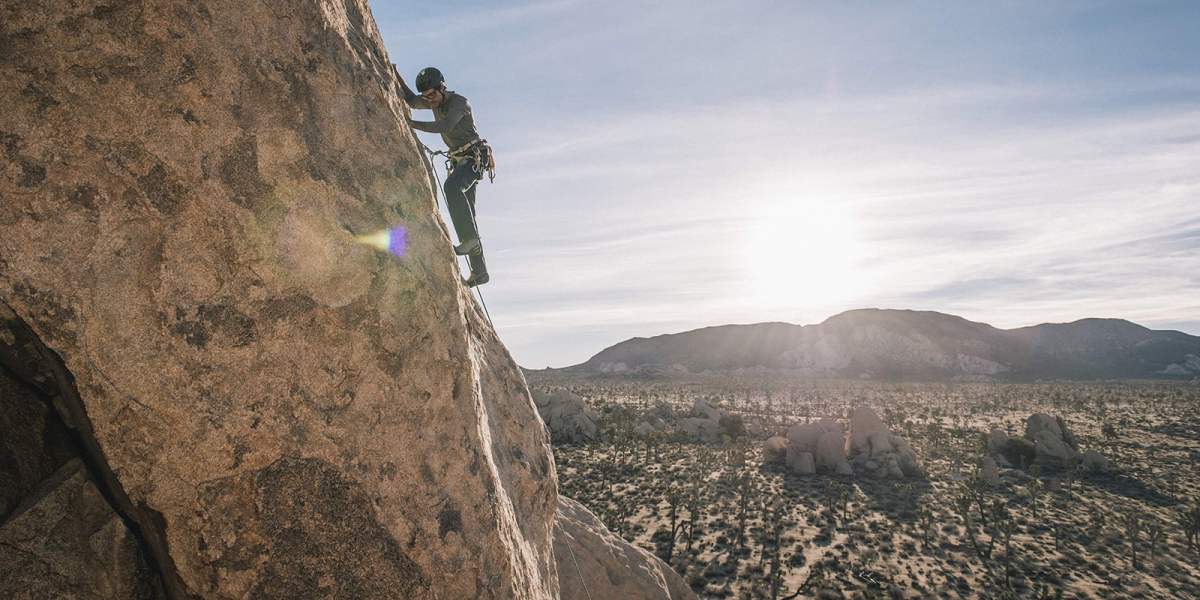
The mountain looks intimidating. You’re chilled to the bone as you make the final ascent. You didn’t think you were prepared for this moment but you wanted to push yourself to the physical limit. You made this hike not because it was easy but because it was hard. In order to understand your mentality and physicality better, you had to put yourself to the test.

There’s no other way to know what you are capable of than to test yourself and to do it often. It does not matter if you are cold, you are tired, you are hungry, you are sweaty, or you are sleepy, there are times in life when you must simply crave discomfort because you know deep down that you will be more fulfilled from pushing yourself than from having played it safe.

Imagine being on the side of that same mountain and you are rock climbing to get your way to the top. Each move that you make must be analyzed quickly so you don’t make a mistake. It’s likely that you will have a harness or some kind of restraint to catch you if you fall but that’s not always the case. You’re under a large amount of emotional stress and personal discomfort but you feel invigorated when you successfully climb or hike your way to the top. You’ll never regret those times when you put yourself out of your comfort zone especially when you are able to push yourself past those previously held limits that you thought you had.

There is no such thing as a challenge-free life. Putting yourself out there is going to be uncomfortable and you are going to be vulnerable. However, you may find that you will be the most fulfilled emotionally and physically when you challenge yourself. Discomfort as a concept may seem unappealing but it is in those moments or those times of discomfort where we advance the most.

Having the means of comfort may give short-term happiness but it is definitely unlikely to lead to long-term fulfillment. The only way to achieve satisfaction or fulfillment is to acclimate yourself to dealing with discomfort and being able to overcome it again and again. Being able to handle uncertainty will set you apart from other people and give you a level of maturity that will make you a stronger and more resilient person.

Discomfort does not only show up in the form of physical challenges but also in the realm of mental obstacles. Keeping your mind active by putting it to the test will improve you in numerous ways. Whether it’s reading a 400-page book, writing a research paper, or studying a foreign language, these mental challenges will definitely cause some discomfort and that’s a good thing. These personal projects will be very uncomfortable at first, but you will notice results when you stick with them, little bit by bit, and you’ll realize that the discomfort was worth it because of how far you have advanced with your mental development.

Living a life of ease and pleasure is not going to lead you to be the best person that you can become. Only by overcoming obstacles and meeting challenges will you be able to develop yourself fully. It’s good to kick back every now and then to relax and enjoy life yet that kind of pleasure is temporary. True personal growth lies in craving discomfort in whatever form it may yield the highest rewards for you. Whether it’s running a marathon or climbing a mountain to reach new physical capabilities or to writing a thesis paper for your doctorate or solving a complex physics equation, both our body and our mind need these challenges.

If you are ever feeling lethargic or lost, you should evaluate whether or not you are challenging yourself enough. Giving yourself personal goals to work towards will make you uncomfortable but you will also be able to greater fulfillment and longer lasting happiness. Being able to put yourself out there, use your physical and/or mental abilities, and logically think through and solve problems will get you out of your self-imposed funk.

Having a deeper purpose in life that is fulfilling and meaningful is necessary for everyone to pursue. Everybody will struggle at first to find out what exactly they were meant to do. Instead of doing nothing about it, I think it is best to try out different things that are uncomfortable to find out which challenges make you feel the most engaged and willing to overcome. Doing a bunch of different things to keep yourself active is better than to do nothing at all. Time is limited so it’s best to challenge yourself in a variety of ways first before you settle on the one or two major challenges in life that you want to succeed at.

Craving that discomfort is a necessary part of this part of self-development. Failure is possible and you may not ultimately succeed. However, if you fail, you will learn from having tried your hand at it and you will be the better person for it. Once you try at something, even without ultimate success, you know that you have the ability to take on challenges and eventually you’ll meet them without unease and with greater confidence. It is far better to have failed one hundred times and to have succeeded on your 101st try, then to have failed only once and then give up entirely without trying again.

Many people today shy away from being uncomfortable at all, even for a minute, but this is much to their detriment. Being in discomfort and going through painful times is part of being human. Without experiencing that pain and that discomfort, you won’t be able to become a stronger person. The person who has been through several trials by fire is the person you want around in times of discomfort and distress. You don’t want to be around a person who only indulges in pleasures and shies away from any pain.

Having physical toughness and mental fortitude to meet challenges head on are traits that you should want to make part of yourself for the rest of your life. Putting your fear and your doubts aside to climb that mountain, write that book, learn that language, or solve that Math problem will give you an advantage over others who deny themselves discomfort. You have to want to engage in the discomforts in life because in today’s day and age, it is easier than ever to avoid discomfort. Those who pursue discomfort will be rewarded long after the challenge(s) you set for yourself have been overcome.

Mind Your Surroundings

In an era of nearly unlimited distractions, the best way to make yourself stand out is to mind your surroundings. Ironically, this should not be that hard to do yet so many people struggle today with keeping their eyes and ears clear of distractions. One of the main reasons for this phenomenon is the fact that technology has rendered us with the ability to avert the need to use our eyes actively in sizing up our environment by focusing instead on flashy advertisements, fluorescent smartphones, and glittering video board. Our eyes are being constantly assaulted by so many visual cues from inanimate objects that we have an increasing amount of trouble focusing on what’s real and what’s in front of us. Not only are our eyes being affected by this distracted kind of living but our ears as well. If you want to see the extent of this, go to any street corner, subway / bus stop, or any public park, instead of listening to nature with the sound of birds chirping and leaves falling, we instead close ourselves off from the natural world with our earphones, headphones, and even earplugs.

Now I’m as guilty as listening to loud music through my earphones and also focusing on my smartphone or a cheesy advertisement as much as the next person, however, I try to be as self-aware as possible in limiting the amount of time I devote my eyesight to screens and my hearing to artificial sounds. What I worry about and what I would encourage you, dear reader, to do is to know the time(s) and the place(s) to put the distractions away for good and to focus on the world around you. You may not think it is important now until something unfortunate or unseemly happens to you because you were not in touch with the immediate environment. Anything can happen in a split second and if you are not prepared for that to occur, especially in public, you may end up regretting your decision to look at your phone or to listen to music when you should have put the ear-pods away. ‘Mind your surroundings’ is a simple wish I have for everyone especially when you are not at home or in a private domicile. When you are in an unfamiliar environment, you have to be much more aware of your surroundings than you would otherwise because it could even mean the difference between life and death.

Unfortunately, it’s become well documented especially in recent years with the rise of mobile technology how a few folks have met an early end to their lives because they simply were not paying enough attention to their environment. These terrible accidents and freak of nature incidents could be avoided if people put down their phones, their headphones, and their smart watches to listen and look carefully at where they were going. Unless you have an important call, are lost in an unfamiliar area, or have to look at you watch for the time, it can wait. Minding your surroundings is especially true in public places. You need to be watching out for where you are going, or it could cost you. This is especially true when you are not familiar with the local environment or may not speak the language if you are traveling to a new country. Being able to hear the sound of cars / buses going by, of what pedestrians are doing or saying, and to orient yourself to find out which neighborhood or part of town you’re in, this is absolutely critical to do, and you do not need modern technology in order to do this.

While it’s definitely true that most people have good intentions, this is not always the case. Do not let yourself become an easy target especially when it would only take a few precautionary steps to keep yourself aware of your environment. Multiple people have died from texting while driving, looking at their smartphone as they crossed a busy intersection, or have fallen off a cliff from a ‘selfie’ gone wrong. While we live in an era of technological abundance, let us not also live in a time that is bereft of common sense. You owe it not only to yourself but to your friends and your family to make wise decisions in terms of managing your interactions with the immediate environment. The steps you can take are quite simple, but they take serious discipline which may not be easy.

A few tips that I personally think would make a big difference involve some measure of personal responsibility but are really not that strenuous in terms of total effort. Sitting yourself in a restaurant facing the entrance and exit of a restaurant is key if something unfortunate were to happen or if you would like to have a good idea of what’s going on throughout the place, especially if you’re seated further into the room than right by the entrance. I find this tip to be really underrated when you are with close friends or family members who you want to look out for when they are sitting across from you and facing away from the entrance and/or exit.

Another tip of mine is to put your phone on airplane mode or simply turn it off when you are on the go. If you are walking for a little while, driving in a car (all the time!), or are involved in an activity, which requires serious concentration, you should not tempt yourself to be on your phone, smartwatch, etc. because it may lead to deadly consequences if you are not careful. A public service campaign that I fully support is titled, “It can wait”, which shows how 99% of texts or phone calls can wait a half an hour or even more when you’re busy doing other actions such as driving. Having the discipline to use a hands-free method or to contact the person(s) before you operate a vehicle or other machinery is common sense and saves lives.

Above all, the advice of ‘mind your surroundings’ is also appropriate in terms of being able to assess your environment quickly and accurately. You cannot do this if you are listening to music, texting, or have your eyes peeled to the ground. Maintain your awareness, be vigilant, and be sure to maintain eye contact that is dead ahead. You may not think that these tips are important now, but you do not want to regret being distracted if it comes to backfiring on you in the future. Whether you are at a movie theater, the beach, in your car, hiking a mountain, kayaking in the lake, you need to be able to be aware of who and what is around you at all times. If you’re lying in bed or relaxing on the couch, then I would say it’s not bad to let your guard down. However, in public, especially when you’re traveling to a new area, city, country, etc., you need to put the distractions away, mind your surroundings, and pay careful attention to what is going on around you. Unfortunately, this needs to be said in today’s world where every minute, our senses are absorbed all of the time especially in urban environments.

Nobody’s perfect but you really have to adapt yourself to the various locales that you put yourself into. A seasoned traveler, explorer, or observer can tell you that being aware and mindful is a key trait to have that will keep you moving forward. Please do your best to follow some of the tips I have laid out and some of the cautions that I have listed. Keep the texting, calling, and Tweeting to a minimum when you’re on the go and you should be fine. Always mind your surroundings to the best of your ability.

Are You a Wolf or a Sheep?

We often like to think of ourselves as ‘introverts’ and extroverts’ in terms of our social makeup in how we act socially and how we get along with others. However, I like to think of another spectrum for which deserves some thought and introspection. Both of these classifications are not anything new, but I would like to put my own personal spin on what they represent, the good and the bad characteristics, and how these two personality types interact with other people.

I fundamentally believe that any person could be classified as having both character types with the extremes representing one or the other. I’d like you as the reader to figure out by the end of this article whether you are a wolf or a sheep? How did you come to that conclusion? and are you happy with this classification or wanting to resolve to change yourself?

When you first think of a ‘wolf’, you may think of the animal itself and how it can be dangerous, unpredictable, and fast. However, a wolf can also be thought of as cunning, loyal, and a team player. The wolf is not afraid to go it alone, sometimes for months at a time, while he or she is also comfortable with the pack where there is strength in numbers. The wolf can survive both on its own and in a group. The wolf adds value to the group but is able to self-sustain itself when it needs to.

If you see yourself as a ‘wolf’ kind of person, you take other people’s opinions into consideration, but you are not afraid to strike it out on your own. You don’t go along with the herd or the group all of the time when they are not of the same opinion or going in the same direction as you. You are an independent, reliable, and courageous person who is not afraid to go it alone even when it doesn’t please your tribe. At its extreme, being a ‘wolf’ can lead you to be a loner and cause you pain as you are no longer able to rely on your wolf pack for help or assistance. You may shun others with your actions and your opinions much to your detriment. A ‘wolf’ knows how to push his or herself to the limits, but it may bite off more than it can chew.

In a world where it is difficult and sometimes detrimental to go against the pack, a ‘wolf’ can decide to do so in an effort to sustain itself against the odds. Being a wolf is risky, but it has greater highs and lower lows. The risk is higher but so are the rewards. The wolf prides itself on being able to integrate into a community if necessary but it solely does not need it to survive like other animals. Any person can be a ‘wolf’, but it depends how far they push themselves physically and mentally, and how far they are willing to stray from the pack. A wolf can handle being a loner, being unpopular, and being cast out if it means keeping its morals, goals, and ambitions ahead of itself.

In contrast to the hard-headed yet cunning wolf, the ‘sheep’ is more timid, cautious, and relies on its flock for everything from where to eat, how to look, and where to go. The ‘sheep’ is unable to voice a contrasting opinion or forge another direction because as an animal, it would be largely left defenseless from predators, including a pack of wolves, if it is not careful.

The ‘sheep’ goes along with all of the other sheep in the flock not because he or she wants to but because he or she needs to. As an animal and a personality type, it puts the group’s needs above its own much to its detriment and making it weaker in the process. A sheep is not a risk-taker and is more about the collective group than being its own individual. While the life of a sheep may be comfortable and cozy, it is likely not to push itself to the limits and find out what he or she is truly capable of. Sometimes, it’s necessary to act, be, and think independently and a sheep is not able to do any of these things. A person can be a ‘sheep’ when they are not able to go against the group to develop themselves and to gain inner confidence. While it’s good to be in the flock or to be part of the pack, to do so all of the time much to your personal detriment is neither productive nor desirable. While sheep and wolves may be together, only the former has to do so some of the time while wolves have a choice to be on their own independent of the pack.

After thinking about these two personality types through the guise of these animals, it is my belief that any person can fit on the spectrum from the huddled sheep to the running wolf. Both personality types like ‘introverted’ and ‘extroverted’ have their innate positives and negatives. However, you have to decide for yourself when it is best to act like the ‘sheep’ or to be the ‘wolf’. There are those people out there who want to be 100% wolf or 100% sheep but you may not have this end up being a good decision for yourself. Life is about balance and you have to decide whether it’s best at times to be the ‘wolf’ and when it’s time to act like the ‘sheep.’ I find that to be 100% like each animal’s characteristics can lead to alienation, disenchantment, and outright dissatisfaction.

There are times in life where you have to be independent of others, believing in your goals when no one else does, and having opinions that the group does not share leading to positive ostracism. You have to be the ‘wolf’ when these times happen because you will be better off for it and be a more enlightened person as a result. Also, there are times when you have work with others well as a constructive team and put your beliefs and opinions on the back-burner when you can’t achieve and do things on your own.

‘Sheep’ rely upon strength in numbers and being part of a strong community that can support and back each other up when being independent could lead to isolation, despondency, and even death. Being independent v. being part of the group is a constant struggle in one’s life and you have to decide for yourself when it’s best to strike it out on your own or to be part of a larger group (family, friends, colleagues, schoolmates), etc. in order to get ahead.

You should ask yourself after reading these two descriptions of these popularly known animals whether your own personality and characteristics are more in line with the ‘wolf’ or with the ‘sheep.’ There’s nothing wrong with having a mix of both or being aligned with one or the other, but you have to do some introspection to decide whether you are a wolf or a sheep. A person with no defined personality traits that they are aware of is too easily manipulated and too easily controlled. Please be sure to always think, act, and do for yourself but to also respect your tribe and your group if they are supportive of you, your goals, and your beliefs. Now, “Are you a wolf or a sheep?” Decide for yourself.

“Get Action”

“Get action. Do things; be sane; don’t fritter away your time; create, act, take a place wherever you are and be somebody; get action.”

Theodore Roosevelt, the 26th President of the United States, was unlike many of the men who came before him or who came after him who served as President. He was a truly unique individual in how much he was able to do during his life. While Roosevelt only lived to the age of 60 years old, looking at how much he was able to accomplish and what he was able to do with his life, you could easily make the argument that he lived the lives of five men put together. To put it simply, he was a man of action regardless of how strenuous and difficult that action may be.

When you look at Teddy Roosevelt, he wasn’t just President of the United States which is a massive accomplishment in its own right, but he was also Vice President, Governor of New York, Assistant Secretary of the U.S. Navy, Leader of the Rough Riders during the Spanish-American war, and a Harvard College graduate. On top of all of that, he was a noteworthy explorer who spent over two years in the Amazonian basin of Brazil, a hunter who herded cattle out in the Dakotas, and a historian who wrote several books including a military history titled, ‘The Naval History of 1812.’ On top of everything that he did, while he was boisterous and a bit cocky to a fault, he backed up his words with actions, and he did his best to maintain his integrity in everything that he did. Roosevelt was not a man who cut corners or looked for shortcuts. Once he committed himself to something, he made sure to give it his best effort.

While Teddy Roosevelt was a member of a wealthy family from Oyster Bay, New York, he struggled with adversity throughout his life. He had severe bouts of asthma and would suffer from attacks that were debilitating. Instead of staying still and not exerting himself, he found that being active, physically and mentally, would actually help to minimize his asthma and improve his spirits. Roosevelt was not a man who would go about and pity for himself ever.

He was home-schooled, naturally curious about the world, and self-educated himself in a number of subjects including taxidermy, geography, French, German, history, etc. Roosevelt to make himself physically stronger would take it upon himself to learn boxing and then rowing in his desire to keep himself fit and active. Roosevelt lost his father at a young age, which was an almost unbearable loss for him, but he used his father as an example of who he should strive to be in life in terms of his father’s morals, career, and his overall character. Also, when he was only 22 years old, Theodore Roosevelt lost both his mother and his first wife within a few hours of each other.

Losing your mother and wife in such a terrible manner would break a lesser man but while Roosevelt grieved in a manner that was natural, he knew that he must go on and that he must live up to the memory of those family members who passed before him. Theodore was not one to sit around and grieve forever but a man who desired to make the most of his life and commit himself to action. Even when he was almost assassinated in 1912 when he was campaigning for the Presidency a second time, he would read his speech and refused medical attention for over ninety minutes before seeking assistance with a bullet lodged in his chest.

What lessons can we draw in our own lives from the energetic and boisterous life of Theodore Roosevelt? There are many lessons to draw upon but the most important one that can just be summed up in two words is to “get action.” Roosevelt believed that man is most content in the pursuit of action whether its’ in the form of academia, physical exertion, public service, and military duty. Roosevelt’s life was made up of numerous actions that fit his various interests and he committed himself to these actions over a long period of time. When we read about Teddy, we admire how much he was able to accomplish and how possibly he could have done of all that. My take on it is that Roosevelt made the most of his time and committed himself to pursuits instead of lazing about and being distracted by idle pleasures.

How many of us can say that we would be able to do ½ or 1/5 of what Theodore Roosevelt was able to do during his life? Not many. In this day and age of Netflix, smartphone, video games, and virtual reality, it’s easier now than ever to not get action but to be lazy. You have to put blinders on and prevent yourself from being distracted from the technologies of today. While Roosevelt may have had a harder time accomplishing everything he did in the early 20th century compared to what he may have done in the early 21st century, his core personality, his priorities, and his spirit would not have changed. Roosevelt’s life is a testament to the power of taking actions in various pursuits and to push both your body and your mind to the limit.

He did not let his setbacks, failures, and limitations hold him back from becoming the great man that we recognize him as being today. He fundamentally knew that he was at his happiest and his most vibrant when he was putting himself to work. His hobbies, interests, and his professional career were his number one priority and he still managed to re-marry, raise six children, and explore the world from Brazil to Egypt. Did he have a leg up in life due to his family name and his wealthy background? Yes, you could argue that fact, but he made the most of the deck of cards he was dealt but still had the common decency and integrity to commit himself to public service and helping out his countrymen and women as well.

Roosevelt could have enjoyed his wealth, spent opulently on material goods and hedonistic pursuits, and sat back for the rest of his days but he was not that kind of man. Not only was he aware that he had one life to live but he knew fundamentally that every day counts and that every day matters. Luckily, he used his mental and physical prowess in the service of others whether that was in the United States Army, the Governorship of New York, or Office of President of the United States. Theodore Roosevelt put his energies and his time into productive matters and was able to do amazing things in his life. If Roosevelt were to give anybody a piece of advice today, it would be to simply ‘get action.’ Without action, there is stagnation and with stagnation, there is no future. Even if you are not successful in your actions, don’t ever be so discouraged that you do not try again or try something new.

Whether it was reading, writing, making speeches, hunting, traveling, Roosevelt was a man who embodied the human spirit when it is fully unleashed. He made the most out of this thing we call ‘life.’ If you are feeling down in the dumps and aren’t sure what to do next, just ‘do something.’ By doing something and sticking to it as a routine, you’ll get better at it and it may take you places in life that you never thought was possible to begin with. Taking any kind of action in your day to day life is the natural and healthy thing to do. Sitting in bed, lazing around, letting your mind and body wither away is no way to go through life.

When you commit yourself to getting out in the world in whatever way appeals to you, you move forward as a person and you develop yourself in various ways. You’ll fail, you may get hurt, and you will learn a lesson or two but at least you got yourself out into the arena as Theodore Roosevelt did. ‘Get Action’ are two words that can make a world of difference in one’s life. Make sure you make the most of the time for which you have been given.

English Corner – The Passive Voice

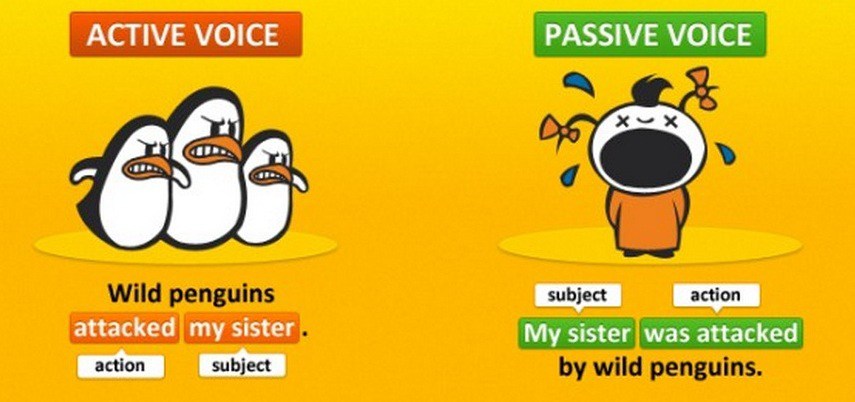
The passive voice occurs when you make the object of an action into the subject of a sentence. This is because of whoever or whatever is performing the action is not the grammatical subject of the sentence. Take a look at this passive rephrasing of a familiar joke in the English language:

Why was the road crossed by the chicken?

Who is doing the action in this sentence? The chicken is the one doing the action in this sentence, but the chicken is not in the spot where you would expect the grammatical subject to be. Instead, the road is the grammatical subject.

The more familiar phrasing (why did the chicken cross the road?) puts the actor in the subject position, the position of doing something—the chicken (the actor/doer) crosses the road (the object). We use active verbs to represent that “doing,” whether it be crossing roads, proposing ideas, making arguments, or invading houses (more on that shortly).

Once you know what to look for, the passive voice is easy to spot. Look for a form of “to be” (is, are, am, was, were, has been, have been, had been, will be, will have been, being) followed by a past participle. (The past participle is a form of the verb that typically, but not always, ends in “-ed.” Some exceptions to the “-ed” rule are words like “paid” (not “payed”) and “driven.” (not “drived”).

Here’s a sure-fire formula for identifying the passive voice:

Form of “to be” + past participle = passive voice

For example:

The metropolis has been destroyed by the dragon’s fire blasts.

When her house was invaded, Penelope had to think of ways to delay her auction.

Not every sentence that contains a form of “have” or “be” is passive!

Let’s briefly look at how to change passive voice sentences into active ones. You can usually just switch the word order, making the actor and subject one by putting the actor up front:

The metropolis has been destroyed by the dragon’s fire blasts.

The passive sentence, when converted into an active sentence:

The dragon destroyed the metropolis with his fire blasts.

When her house was invaded, Penelope had to think of ways to delay her auction.

This passive sentence, when it is converted into an active sentence:

After robbers invaded her house, Penelope had to think of ways to delay her auction.

To repeat, the key to identifying the passive voice is to look for both the form of “to be” and the past participle, which usually, but not always, ends in “-ed.”

Sometimes, the passive voice is the best choice. Here are a few instances when the passive voice is quite useful:

1. To emphasize an object. Take a look at this example:

60 Senate votes are required to pass the bill.

This passive sentence emphasizes the number of votes required. An active version of the sentence (“The bill requires 60 votes to pass”) would put the emphasis on the bill, which may be less dramatic.

2. To de-emphasize an unknown subject/actor. Consider this example:

Over 120 different contaminants have been dumped into the river.

If you don’t know who the actor is—in this case, if you don’t actually know who dumped all of those contaminants in the river—then you may need to write in the passive voice. Please remember though, if you do know the actor, and if the clarity and meaning of your writing would benefit from indicating him/her/it/them, then use the active voice.

Also, please consider the third example which is listed below:

3. If your readers don’t need to know who’s responsible for the action.

Here’s where your choice can be difficult; some sentences are less clear than others. Try to put yourself in the reader’s position to anticipate how he or she will react to the way you have phrased your thoughts. Here are two examples:

(passive) Baby Sophia was delivered at 3:30 a.m. yesterday.

(active) Dr. Susan Jones delivered baby Sophia at 3:30 a.m. yesterday.

The first sentence might be more appropriate in a birth announcement sent to the family and friends—they are not likely to know Dr. Jones and are much more interested in the “object” (the baby) than in the actor (the doctor). A hospital report of yesterday’s events might be more likely to focus on Dr. Jones’ role in delivering the baby.

Active and Passive Voice Examples – Different Grammar Tenses

Simple Present TenseTwice a month, Brian cleans his apartment. (Active)

Twice a month, the apartment is cleaned by Brian. (Passive)

Simple Past Tense – John fixed the doorknob. (Active)

The doorknob was fixed by John. (Passive)

Simple Future Tense / will – He will finish his job by 5 PM today. (Active)

The job will be finished by 5 PM today. (Passive)

Simple Future Tense / going toJackie is going to cook dinner tonight. (Active)

Dinner is going to be cooked by Jackie tonight. (Passive)

Present Progressive TenseAs of now, Corey is creating a Science project. (Active)

As of now, the science project is being created by Corey. (Passive)

Past Progressive TenseThe detective was working on the mystery murder case when his partner picked up another clue. (Active)

The mystery murder case was being worked on by the detective when his partner picked up another clue. (Passive)

Future Progressive Tense (will)

At 10:00 PM tonight, HBO will be airing the new Vice special. (Active)

At 10:00 PM tonight, the new Vice special will be airing on HBO. (Passive)

I hope that this ‘English Corner’ blog post has made clear when to use the passive voice and under which circumstances can its usage best be applied. As an English language learner, you’ll need to be comfortable with using both the passive voice and the active voice in order to become a better English writer and speaker. Please use the examples given to better your understanding of this English topic as well as how the active and passive voices are set up in the past, the present, and the future tenses. 

English Corner – The Rules of Capitalization

Understanding the rules of capitalization is a key part of taking your English grammar understanding to a very advanced level. If you are able to know when, where, and how to capitalize letters and words correctly, you will definitely be ahead of most other English learners.

Some people may tell you that there are far more than just the main ten rules of capitalization in English, which may in fact be true. Other folks may say that there are only three rules of capitalization, and they may also be correct. However, The truth is that, depending on how you organize the rules, the rules of capitalization may be many or few based on how narrow or broad your definition of these rules are.

Most of the things we capitalize in English are what we refer to as ‘proper nouns.’ They are the names of specific and unique things.

  • If you are talking about one specific mountain (Mt. Fuji), state (Idaho) or street (Atlantic Avenue), use a capital letter for every word in the name.
  • However, when you are talking about a common thing of which there are many of them- like a mountain, a state or a street – you don’t have to use a capital letter for those words.

It’s important to remember as well that Capital letters are not used for articles (a, an, the) or for prepositions (of, on, for, in, to, with, etc.).

The Ten Main Rules

  1. Names or titles of people

This one may seem obvious, but there’s also a catch. Of course, you capitalize the first letters of a person’s first, middle and last names (John Quincy Adams), but you also capitalize suffixes (Jr., the Great, Princess of Power, etc.) and titles.

Titles can be as simple as Mr., Mrs. or Dr., but they also apply to situations wherein you address a person by his or her position as though it’s their first name. For example, when we talk about President Lincoln, we are using his role as though it were a part of his name. We don’t always capitalize the word president. Indeed, we could say, “During the Civil War, President Lincoln was the president of the United States.”

Another way to look at capitalizing job titles is to look at the position of the job title in the sentence in reference to the person’s name.

  • You should capitalize the title when it comes immediately before or after someone’s name.
  • You don’t have to capitalize the job title if it comes after the word “the.”

For example:  “Dr. Rogers was the Cardiac Surgeon.” “The cardiac surgeon allowed me to come into the room and observe the patient.”

  1. Names of mountains, mountain ranges, hills and volcanoes

Again, we’re talking about specific places. The word ‘hill’ is not a proper noun, but Bunker Hill is because it’s the name of one specific hill. Use a capital letter to begin each word in the name of a mountain (Mt. Olympus), mountain range (the Appalachians), hill (San Juan Hill) or volcano (Mt. Vesuvius).

  1. Names of bodies of water (rivers, lakes, oceans, seas, streams and creeks)

From here, it gets pretty easy. The same rules that apply to mountain names also apply to water names. A river is just a river, but the Mississippi River is a proper noun and must be capitalized, just like Lake Erie, the Indian Ocean and the Dead Sea.

  1. Names of buildings, monuments, bridges and tunnels

Man-made structures also often have names. The White House, The Eiffel Tower, The Statue of Liberty, The Golden Gate Bridge and The Lincoln Tunnel are a few good examples.

  1. Street names

It’s necessary to capitalize both the actual name part of the name (Capital) and the road part of the name (Boulevard); both are necessary for forming the entire name of the street (Capital Boulevard).

  1. Schools, colleges and universities

All of the words in the name of the educational institution should be capitalized. For example, Harvard University, Wilkesboro Elementary School, Cape Fear Community College.

  1. Political divisions (continents, regions, countries, states, counties, cities and towns)

As is the case with regions of a country, the divisions may not always be political, but you get the idea. When you refer to New England, the Midwest, the Pacific Northwest or the South as a region (as opposed to a compass direction), you capitalize it. Also, continents (South America), countries (Belgium), states (Wisconsin), counties (Prince William County), cities (London) and towns (Lizard Lick) get capitalized.

  1. Titles of books, movies, magazines, newspapers, articles, songs, plays and works of art

This one’s a little tricky when ‘and,’ articles or prepositions are involved. If ‘the’ is the first word in the given name of a work, it must be capitalized (The Washington PostThe Glass Menagerie). If ‘a’ or ‘an’ is the first word, it too is capitalized (A Few Good Men), and if a preposition leads the way, you guessed it: Capitalized (Of Mice and Men). However, if any of these words come in the middle of the title, it is not capitalized.

  1. The first letter in a sentence

The last two rules are easy. Always capitalize the first letter of a sentence. If the sentence is a quotation within a larger sentence, capitalize it, but only if it’s a complete sentence. If it’s merely a phrase that fits neatly into the larger sentence, it does not require capitalization. Study the following two examples for clarification:

  • The waiter said, “My manager will be here shortly,” but he never came.
  • The waiter told us that his manager would “be here shortly,” but he never came.
  1. The pronoun ‘I’

It’s only necessary to capitalize other pronouns when they begin a sentence, but ‘I’ is always capitalized.

Remembering the Rules

How can you possibly remember all these rules? Well, first of all, you should ask yourself three questions:

  • Is this the first letter in a sentence? If the answer is yes, capitalize.
  • Is this the pronoun I? If yes, capitalize.
  • Am I using a name that someone gave to this thing or person? If yes, capitalize.

And if you want to remember all the specific categories, try memorizing one of the following sentences.

  • “For Bob Barker, the price is wrong sometimes,” Adam says.
  • Susan Sarandon bought my wife fancy toilet paper in Boston.

The first letter of each word stands for a category:

  • F– First letter in a sentence
  • B– Buildings (and other man-made structures)
  • B– Borders (of regions, states, countries, etc.)
  • T– Titles
  • P– People
  • I– I
  • S– Schools
  • W– Water
  • M– Mountains
  • S– Streets

Other Examples of Capitalization

First Word of a Sentence

The cat is sleeping in my bedroom.

Where did I put that book?

Hey! It’s great to see you! How have you been?

Names and Personal Pronouns

My favorite author is Jonathan Franzen.

Tom and Diane met at Jill’s house.

Have you met my dog, Barry?

The First Word of a Full Quote

Mario asked, “What is everyone doing this weekend?”

Stacy answered, “My sister and I are going to the theme park.”

Days, Months, and Holidays

I hate Mondays!

Harry’s birthday is in July.

Oh no! I forgot about Mother’s Day!

Words in Formal Titles

Lord of Rings is better than A Song of Ice and Fire.

The first movie of the series is Harry Potter and the Sorcerer’s Stone.

Cities, Countries, Nationalities, and Languages

English is made up of many languages, including Latin, German, and French.

My mother is Italian, and my father is German.

The capital of Ethiopia is Addis Ababa.

Time Periods and Events

Most of the World War I veterans have now passed away.

In the Middle Ages, poor hygiene was partly responsible for the spreading of the black death.

High school history students often enjoy studying the social changes that took place during the Roaring Twenties in the United States.

In this article, it is not just the ten main rules of capitalization that we have to be aware of. There are many other additional rules where you can use capitalization on a consistent basis. The examples shown above should help you, the reader, to understand when and where these words can be capitalized and to notice a pattern in terms of how these rules can be applied. 

Overall, capitalization is a very tricky topic to fully master but if you know the rules and you know when not to capitalize at all just for definite / indefinite articles along with prepositions, you will be well on your way to having a handle on this advanced grammar topic. It’s important to not be overwhelmed by all of the rules out there including the additional ones that were highlighted here. Starting off with the ten main rules of capitalization is a sufficient enough starting point to focus on. With Capitalization, you do not want to bite off more than you can chew and while the ‘additional rules’ of this grammar topic are important, it’s best to focus on the main rules such as geographic features, names of people / titles, the first letter in any sentence, etc. Good luck!

The Producer vs. Consumer Mindset

We are all consumers but not all of us are producers. This dichotomy between producing vs. consuming has become especially relevant in the 21st century when levels of consumption are at historic levels. When you think about it, being able to consume in different parts of life has never been easier or faster. You can stream vast amounts of music, download movies within minutes, and have food delivered to you at the click of a button. These days, you don’t even have to leave your house or apartment to consume food, books, music, movies, etc. Everything has become more widely available to the average person and that also includes education.

The Internet and other forms of technology have made it easier than ever to consume but despite that fact, is that all we should be doing? Aren’t we met to do more than to order food online, surf Amazon.com for the latest book, or listen to multiple Pink Floyd albums for hours thanks to Spotify? I believe that recently we have strayed too much to being only consumers without realizing that what is most fulfilling is to produce something of value. There should be a balance between consuming and producing and it’s best to strive for a mix of producing and consuming in your life with the former being more of a priority. Consuming is easy but it’s been shown to not be fulfilling and the utility of consumption decreases consistently the more you do it.

While consuming is incredibly easy and requires little to no effort, producing is the exact opposite. Producing something of worth or of value takes some or a lot of effort and the results are not immediate. To be a producer, you need to be determined, patient, put your skills to the test, and be able to think outside the box. Even though producing may not be the most fun or most enjoyable thing to do, it’s really what we as human beings are meant to do and what also gives us the most satisfaction.

If you think about it, our ancient ancestors had to produce or create in order to stay alive and sustain themselves. Back in those times, you had to catch a fish, spear a buffalo, or even a build a hut or you would not last very long. Simply put, our intrinsic value as people is based off of what we can contribute to our friends, families, communities, and the greater society. Now, this does not imply that you have to be producing something of value for others all of the time in order to be considered valuable. You don’t have to produce something for the sake of it or just to impress someone. You should find something to produce for yourself because you’ll build up some self-confidence as well as create more skills and abilities for yourself. You should choose to produce over consume yet you must figure out on your own what you would like to contribute whether that’s writing a blog, creating a piece of music, making an invention, or starting a business.

Why do we choose to produce? It reflects our innate sense of purpose and wanting to leave an imprint on the world regardless of how small or big it may be. There’s a true sense of satisfaction that you get from creating something out of nothing. Our ideas and our thoughts when they are put into actions can create a massive ripple effect that can change our lives if we do big things. The richest companies in the world such as Amazon, Google, and Facebook started out as simple ideas in the minds of their founders but they became real through actions and deeds after starting out just as words.

A producer takes their thoughts and ideas and turns them into something real. For each person, what they would like to produce is going to be different but the simple act of deciding to produce something instead of consuming all of the time is a beautiful thing in its own right. You can start out small by producing a poem, a painting, a piece of music, and then once you successfully create those things, you can aim bigger and better for producing things like a screenplay, a novel, a film, a multi-million-dollar business, etc. If you do not know what to produce but would like to start somewhere, think of which skills and abilities you currently have and make a list of what interests and hobbies you have as well. It’s also best to realize that producing something of value takes serious hard work and effort. It is not an instantaneous event and takes months and sometimes years depending on how big the thing is you’re producing.

Once you get the first thing you produce out of the way, you’ll start to realize how useful, fun, and innovative it can be to be a producer instead of a consumer. As mentioned before, there’s an innate sense of satisfaction out of crafting something from nothing as well as the fact that you used either your mind or your body or both to make it happen. Happiness, I would argue, does not come from consuming the things of this world but rather producing things to bring into the world that weren’t in existence before.

Depending on what you produce, you’ll also be helping people with what you make whether it’s a house that a family will live, a business that will hire employees, or a bridge that will connect town and city together. Also, the thing that you produce will last beyond your life here on Earth and can even transcend time if it is that impactful. Beyond the creation and production, what you’ll be creating is a legacy that you’ll be remembered for. Could you say the same for someone who doesn’t produce anything at all and just consumes? That person won’t be remembered for anything because they will not have left a legacy of producing for themselves, their family, and humanity while they were around. Consumers may benefit in the short run but not in the long run.

Our lives can both be about consuming and producing but think about what would be a better use of your time. Is it binging Netflix for multiple hours or creating a garden to grow fresh vegetables? Is it about playing video games or coming up with ideas for a new novel? Is it better to eat ice cream from Ben and Jerry’s or to make it from scratch? Depending on what answers you gave for these questions, you will be better off as a consumer or a producer.

Everybody has different priorities with what they value in their free time. If you find that you’re producing enough in your day to day work, keep doing that. However, if you find that you’re consuming all the time and not really producing beyond what you’re paid to do, you may want to reconsider how you spend your time. Giving yourself a chance to do more, write more, build more, play more, etc. is likely to be much more satisfying for you and give you a sense of fulfillment and even happiness that can’t be found in Netflix, Spotify, or UberEats. By being a producer, you’re creating value for the world and you’re building your skills, abilities, and knowledge at a time when you can do more than ever if you’re willing to educate yourself and put those traits and turn them into conceivable actions.

I’ll leave you with the idea of compiling a list of your day-to-day activities, map out the amount of time you spend on consuming or producing. If you’re consuming for hours on end and you feel listless, demoralized, or sad, you can turn it around by starting to take those free hours of your time and turning it into something productive. Producing is simply harder and more intensive than being a simple consumer. However, the return of investment on your time put into producing something far outweighs any benefit(s) you would receive from consuming a video game, an order of take-out, or a pop album.

Start from scratch and do your best to take the skills and abilities you have and turn out something totally original that only you and you alone came up with. The books you’ve read, the movies you’ve watched, the music you’ve listened to, the classes you’ve enrolled in, the people you’ve met; that kind of consumption isn’t inherently bad but you should take the time you spent consuming other people’s products and using that knowledge to create your own product. Your own novel, your own play, your own symphony, your own business, or your own recipe: these are all ways that you can find fulfillment and meaning as a producer in this life. You won’t have forever to do both producing and consuming so why not choose producing because you may find that you’re not only good at it but you like it just that much more than being a consumer.

English Corner – Prepositions of Time

In other blog entries, we covered the general topic of ‘prepositions’ and then we broke it down even further by highlighting certain ‘prepositions of place.’ For this post, I am going to focus on the other half of prepositions which can be categorized as ‘prepositions of time.’ If you are able to master both prepositions of place and prepositions of time as an English student, you are going to do very well in terms of writing complete sentences that make grammatical sense and also improve your conversational skills. There are many prepositions of time similarly to how many prepositions of place there are but I am going to focus on the ones that will come up the most during your studies of this important grammatical topic.

I am going to focus on the five most popular prepositions of time starting with the three main ones known as ‘in, on, at’ which are also used as prepositions of place in different ways. As prepositions of time, ‘in, on, at’ are used in various ways and have different intended uses.

For example, the preposition ‘in’ can be used for describing months, seasons, years, decades, centuries, longer periods of time such as millennia as well.

Months – in March, in October

Seasons – in the Summer, in the Winter

Years – in 1991, in 2018

Decades – in the 2000s, in the 1960s

Centuries – in the 21st century

Unspecified Periods of Time – in the past, in the future

Below I have listed some example sentences where the preposition ‘in’ is being used in various ways associated with describing time.

  • My birthday is in October.
  • It is the hottest time of the year here in the summer.
  • In the 1960s, John F. Kennedy was President of the United States.

As you can see, the preposition of time ‘in’ can be used towards in the middle of the sentence but also at the beginning of a sentence as its first word especially when describing a decade.

When it comes to the preposition ‘on’, it can also be used in a number of ways. ‘On’ is specifically used for describing days of the weeks, part(s) of the day, specific dates, and special days such as anniversaries, birthdays, weddings, etc.

Days of the week – on Monday, on Saturday

Specific part(s) of the day – on Sunday afternoon, on Tuesday night

Specific date(s) – on December 31st, on April 1st

Special days – on our anniversary, on my birthday, on the wedding day

Here are some examples below of how the preposition ‘on’ can be used correctly according to its various usages related to the descriptions above:

  • On Friday evenings, I like to go to the movies with my girlfriend.
  • We went to the baseball game together on my birthday.
  • April Fools day is known to be on April 1st.

‘On’ can be used in various parts of the overall sentence and is not solely restricted to the beginning or end of a regular sentence. It’s important to note that ‘on’ is a preposition that is more specific in its purposes when compared to the preposition ‘in’ when it is used for time.

Next, we have the last preposition of time which could be considered one of the three musketeers of prepositions. ‘At’ has a variety of uses and is known for being the most specific of the three main prepositions of time. ‘At’ can be mainly used for describing times on the clock, festivals, holidays, and more general times of the day or night.

Times on the clock – at 5:30, at 4:15

Festivals / Holidays – at Christmas, at Thanksgiving

General times of the day – at night, at lunchtime

Listed below are some key examples to draw from when it comes to being able to use the preposition ‘at’ in the right context and with the right usage:

  • Chris gets out of his soccer practice at 5:00.
  • We get together as a family at Christmas time.
  • The couple likes to go out and dance Salsa at night.

Two additional prepositions of time to be aware of as an English student are ‘for’ and ‘during.’

‘For’ is a more specific preposition of time that is used to describe a length of time where an action or event is taking place. You use ‘for’ to discuss how long something or someone will be going on for with whatever kind of action that they are doing. Here are some examples to make it easier for you reading this post to master this preposition of time.

  • The volleyball tournament lasted for four hours total because there were so many teams competing.
  • The music festival lasted for three days and three nights since there were a lot of bands playing.

The 2nd additional preposition to be aware of is ‘during’ which is used as a preposition to discuss when something happens during a certain timeframe. It’s more general in terms of the timeframe when compared to ‘for’ but it can discuss an action that happened in the morning, in the afternoon, in the evening or in the night. Here are some examples to help you with this very specific preposition of time:

  • The blizzard happened during the night and school was closed as a result.
  • During the summer drought, farmers had to conserve their use of water for their agriculture and cattle.

As you can see from these examples, ‘during’ is a more general preposition of time when compared to ‘for’ which discusses a specific timeframe in hours, days, or weeks.

Unfortunately, there are more than five prepositions of time but I believe from my experience that ‘in, at, on, for, during’ are the most common prepositions for this kind of usage. In addition, if you wish to know all of them, there are also other prepositions of time such as since, ago, before, past, to, from, until, by.’ I may have another blog post focused on these prepositions but the most important ones to know to get by in describing time accurately in the English language are in, on, at, for, during.

 Good luck with the prepositions of time and please leave a comment if you have any questions about this grammar topic.

‘Good Will Hunting’ – Film Review and Analysis

What happens when you bring together two of the best actors of the modern age who meet at just the right time in their careers? The short answer is that you get some old-fashioned movie making magic. Both men have made their mark on Hollywood and this film that they carry together is one of the reasons for that happening. While a generation sets them apart, their commitment to the craft of acting shines through in this classic film that takes place in the city of Boston where I currently reside titled ‘Good Will Hunting.’

‘Good Will Hunting’, released in 1997, over twenty years ago is a film that I have gone back to again and again throughout the years since I grew up with it in a way. As I have gotten older, the themes of the film stick with me more and more. This film is a timeless piece that a lot of people, especially young men, can relate to. While it’s not a blockbuster and isn’t a mainstream favorite, it carries deep messages regarding relationships, dealing with the future, and learning to love and trust other people.

The two actors that I was referring to earlier are Robin Williams and Matt Damon. Both men are known for their more popular roles in movies like ‘Mrs. Doubtfire’ and ‘Good Morning, Vietnam for Mr. Williams and ‘The Bourne Trilogy’ movies and ‘The Departed’ for Mr. Damon. Unlike those other movies, I believe that this movie really shows off the talent of these two men and how they’re able to push each other in emotionally trying roles. On top of those two performances, Gus Van Sant is an excellent director who does a great job of filming this movie set in late 1990s Boston.

As if that weren’t enough, you have a great cast of supporting actors including Ben Affleck, Minnie Driver (has she been in any major movies since?), Stellan Skarsgard, and Casey Affleck of Manchester-by-the-Sea fame who really add depth and substance to this movie. These character-driven movies such as ‘Good Will Hunting’ are usually the hardest to make but if done right, they really stay with the viewer long after the film is over. They really capture different moods, emotions, and feelings and this one in particular captures the struggles inherent in being a brilliant mind in a troubled world.

The title of this film ‘Good Will Hunting’ is based off the name of its main character, Will Hunting (played by Matt Damon) a 20-year old, born and raised in South Boston. You would think from this description that he’s just a regular guy but Mr. Hunting was born with the innate gift of having genius level intellect. He has few possessions except for hundreds of books from Foucault to Shakespeare. He’s an avid book reader but has a specialty in solving advanced mathematical equations that few others in the world can figure out. You would think that this college-aged guy would be working on advanced mathematics at MIT or CalTech but he’s not an enrolled student there or anywhere for that matter.

Will Hunting has had a rough upbringing in that his parents abandoned him when he was a baby and he grew up in foster homes where his foster father abused him physically multiple times. Abandoned by those people who were supposed to love and cherish him, Will, for good reason has a fear of abandonment and does not trust other people. His social interactions are limited because of the abusive childhood he endured but he is happy with his group of three friends: Billy, Morgan, and his best friend Chuckie. While Will does not have many friends, he would do anything for his three neighborhood buddies who he grew up with and he literally considers them to be his family.

While Will’s friends are loyal, they are not the best influence on him and they can be crass, crude, and spend too much time drinking. The group’s antics lead Will into a fight against some neighborhood miscreants, which draws the attention of the local police. Will, acting out his aggression violently, ends up assaulting a police officer causing him to do mandatory community service and therapy sessions. Will, a janitor at the Massachusetts Institute of Technology, works after hours to help clean the bathrooms and empty the waste paper baskets. Unbeknownst to both students and professors alike, Will in his spare time has been going around solving advanced Math equations that the regular MIT graduate students can’t even begin to conceive a solution for. One night, Will is caught in the act as he gets caught doing an extremely difficult problem that no one else has solved yet. Professor Lambeau of the Mathematics department discovers Will solving this problem and calls after him to no avail but with a four-letter crude response from Mr. Hunting.

Professor Lambeau does Will a huge favor and gets him out of some serious jail time for assaulting the police officer. In exchange for his favor, Will has to sit and work with Professor Lambeau on advanced mathematics in a mutual exchange. Professor Lambeau is fascinated by Will’s brilliance but it appears to the audience that he cares more just about Will’s brain than who he is as a person. Professor Lambeau tries to get Will to open up to different psychiatrists but Will messes with all of them and doesn’t take his therapy sessions seriously. Lambeau, out of options, goes to an old friend from his college days at MIT, Sean Maguire (played by Robin Williams), who now teaches psychology at Bunker Hill Community College and is also a licensed therapist.

Despite a few sessions where Will is argumentative and closed off, Sean is able to break down Will’s defensive mechanisms partly by talking about his own rough upbringing. Sean was beat by his alcoholic father while he was a child. In an effort to protect his mother and little brother, Sean would endure the brunt of his father’s anger and vitriol. The two men bond over the fact that they have a high intellect, have both grown up in Boston, share a love of the Red Sox, have had rough upbringings, and can be a bit closed off from their loved ones.

Will is going through a transition period in his young life where he is starting to think about a future beyond just getting drunk with his buddies and hiding his talents from the world. He is also trying his best to form healthy relationships with not only his friends but in his love life too. Instead of endlessly pursuing casual one-night stands, Will finds a girl one night at a Harvard bar whom peaks his interest named Skylar (played by Minnie Driver). Despite them coming from very different family backgrounds as well as her being born into wealth, they share a love for learning and have the same sense of humor. Most important to Will in all of this courting is that she likes his friends and that means a lot to him since they have essentially been his family his whole life.

The problem that Will struggles with in terms of his relationships whether its romantic with Skylar or personal with Sean is that he can’t open up to them about his being abused as a child due to a mixture of shame, guilt, and anger. He turns his emotional pain outward and directs that anger at society, the past therapists, Professor Lambeau, and even at Will and Skylar. Will is self-conscious about his genius and is not sure he wants to have a prestigious office job or even to leave his home city of Boston. He says to his best friend, Chuckie, at one point that he doesn’t “feel like doing long division in a room for the rest of my life.”

However, what Will realizes is that he’s not the center of the world. With the help of Sean and Skylar, he learns eventually that while his life has been tragic, that should not prevent him from reaching his true potential and that he is literally “bound by nothing.” He’s a genius of great intellectual capacity who can change the world in a number of ways. Will has a great gift that a lot of people would kill to have including his best friend, Chuckie. As Chuckie puts to Will bluntly towards the end of the movie, “You’re sitting on a winning lottery ticket and you’re too chicken to cash in on it.” Chuckie tells Will that he’ll essentially be working construction until he retires which is fine because he doesn’t have Will has and that Will owes it not only to himself but to him and his other buddies to do more with his life.

Sean also is the father figure that Will never had and is able to give him tough life. Sean was also abused as a child and knows where Will is coming from. However, he has to learn how to put the past behind him and to not blame himself for what had happened because it simply wasn’t his fault. Will was an innocent child and can’t be blamed for such a horrific event. Will has to learn again how to be emotionally open and vulnerable with the people who care about him like Sean and Skylar. Will had lost the inability to love and be loved but it’s never too late to get that back.

The mentorship of Sean throughout the film helps to bring Will around and the time they share together in the therapy sessions make them true friends. Sean is able to tell Will that he is not so special in the fact that his life has been extraordinarily difficult. Sean, himself, fought in the Vietnam War as a young man and had his best friend there die in his arms. He also lost his wife, the one true love of his to a long battle with cancer years ago and hasn’t been able to become romantically involved with anyone since then. However, he implores Will to also see the beauty in life such as in the form of a woman who can ‘level you with her eyes’ and be your own angel.

There are also the wonders of the world that Will can experience such as how it smells in the Sistine Chapel in Italy.    Will may be an intellectual genius but he still has a lot to learn about the beauty and ugliness of life. Sean’s experiences help to enlighten Will about what life is all about and how to persevere through the struggles and setbacks that are inevitable. Both men have their inner demons to battle but they encourage each other to become better, to strive for more, and to live good lives. With Will’s urging, Sean is also ready to put his tragic past behind him to begin anew. He sets out to travel the world, meet a special someone like Will has with Skylar, and truly live life again.

The positive mentorship between Will and Sean is a beautiful thing to see develop over the course of the film. To see true friendship between the two and the chemistry that Damon and Williams have in their scenes together makes ‘Good Will Hunting’ a really special movie. Similar to ‘Lost In Translation’, it’s also nice to see a true romance between Will and Skylar develop as well that starts out very inconspicuously. It’s a young, innocent kind of love that is beautiful to watch and it’s both real and raw to see with how much they truly care for each other and want to best for one another. One of the best lines in the film that Will and Sean both use for courting the special women in their lives is “Sorry, I had to go see about a girl.” Is there anything in modern cinema that can compare to this phrase so simple yet so full of meaning? I don’t think so.