The Power of Mentorship

Since the days of ancient Greece, the concept of mentoring or mentorship has been apart of human recordkeeping and history. The naming of the word itself ‘mentor’ is said to have come from Homer’s ‘Odyssey’ where the main character, Odysseus, while getting ready to leave for his famous voyage, decided to leave his infant son behind. Because he didn’t want to leave his son alone considering how long his ‘odyssey’ could be, His infant son, Telemachos, was left in the care and companionship of Odysseus’s friend named ‘Mentor.’ From this allegorical story from Homer, we get a sense of how longstanding the idea of mentorship has been around and why it has lasted throughout the centuries.

Why exactly is mentorship so powerful? Well, there are a number of reasons why it can be such a helpful and important part of a person’s success. People very rarely can do everything by themselves and to have the ability to seek out someone who gives them both their time and expertise without asking for anything in exchange is what makes having a mentor so powerful. Now, not everybody starts out being the best mentor. It’s a skill like any other skill that takes time to develop. It’s also impossible to mentor somebody in every aspect of his or her life.

It would be better to focus on an area where you think you can be a good mentor and lend help to another person. For example, if you’re good at writing and consider yourself to be a writer, you should want to mentor someone else who’s aspiring to be a writer and not someone who wants to become a mechanical engineer. Your mentoring has to line up with the mentee’s aspirations and what they hope to do in the future. Mentorship doesn’t only have to be professional advice but it can also involve be personal advice as well. Mentorship can range from how to learn a new skill set in order to make more money to being able to manage your personal relationships better.

Before mentorship can begin though, a level of trust has to be built up over time between the mentor and the mentee. When you’ve taken upon the role of the mentor, it’s important to make sure that you think that the mentee can be successful and that they can put in the work and effort to reach their goals. If somebody is mentoring you, it’s important to make sure that you know them well already, you respect them, and you find that they have good expertise and knowledge in the field or area that you need mentoring in.

A mentor doesn’t have to be a boss or a co-worker. It could also be a friend or family member who you have a close relationship to and is able to give you sound advice based off of their personal and/or professional experiences. When it comes to mentorship, it has to be a consistent and long-standing relationship between two people. The mentor and the mentee should be meeting on a weekly, bi-weekly, or monthly basis together in order to make actual real and sustained progress on both their short-term and long-term goals. If you’re only meeting with a mentor once every month or every three months, it’s not going to work out and you’ll be lucky to make any lasting progress. If mentorship is done right, the mentee will see themselves go far in the area, skillset, or field that they’re focusing on especially if the mentor is giving out real, practical advice that they themselves have proven to work.

For mentorship to be successful, it’s important that this kind of relationship between two people be a two-way street and not just a one-sided affair. The mentee should not be getting 100% of the benefits out of the mentorship because respect and appreciation has to be paid from the mentee to the mentor. Time, as we all know, is quite valuable and for a mentor to be giving his time freely to the mentee especially on a weekly or monthly basis is a very selfless thing to be doing. While the mentor should not expect anything in return right away, a healthy mentorship would involve the mentee taking it upon himself to show his appreciation and thanks through small gestures. It could be buying your mentor a gift for the holidays or buying them a ticket to a baseball game or a concert but it’s important to show that you care about the mentorship and that you realize it’s nice to give back every now and then.

If you’ve built up a strong personal friendship with your mentor, it would be nice for the mentee to spend time with the mentor outside of their formal meetings / sit-downs, etc. For example, if you two have shared interests outside of business, you can go out together for dinner, or do an activity together. Mentorships don’t have to be strictly business all of the time and the best mentorships are when both parties like each other and would consider themselves to be good friends. One of the key powers of mentorship is its’ sustainability and longevity when it’s done right. A fruitful mentorship of months and even years can definitely change the course of a person’s life. While not the easiest thing in life to take upon oneself, being a mentor to someone is one of the most rewarding things a person can do and it’s an easy way to make the world a bit better than before.

Unfortunately, true mentorship today isn’t as prevalent as it used to be and is a far cry from what it was like just a generation or two ago. Most people today do not have a mentor in their lives to help them who can they rely on for good advice without paying money. If you’re able to be a mentor to someone who needs your help or advice, it is something that should be seriously considered especially if that person has a lot of potential. Mentorships shouldn’t always be thought of in terms of the mentor being older the mentee in terms of age.

That’s a fallacy in that there are ways in which older people can learn from younger people especially in this current digital age of technology. The power of mentorships lies in the inherent decency of one person helping another person to get ahead in life in any way that they can. The mentee can then take the advice to heart and work hard to improve themselves in professional and/or personal ways. The mentee should show gratitude and appreciation to the mentor because having a good mentor who is generous with his time is not easy to find these days. While mentorships and apprenticeships were more common a generation or two ago, they are exceedingly rare nowadays. If you’re able to have a good mentor in your life, remember to be grateful for it and pay it back in the future by mentoring another person who is growing through the same struggles and setbacks that you once conquered yourself.

If there were more active mentoring going on between people, not only would their own individual lives improve over time but also that of the local community and society as a whole. When more and more folks are willing to give back to others in their community and help them out consistently, that helps out the society in general. The power of mentorship is also a reminder that we’re all in this together and we should try to spur on success of others rather than kick them down a notch. You’ll feel happier and more engaged in the world to when you give mentorship a shot so I encourage those of you reading this article to go out there, think about why mentorship is important, and figure out if that is a calling that you personally would like to take upon in the future in an effort to help other people help themselves.

English Corner – Prepositions of Place

In this ‘English Corner’ blog post, we are going to go deeper into the topic of prepositions, which we have covered previously but I want to highlight the specific ‘prepositions of place’ that are a large part of this expansive grammatical topic. The thing to keep in mind when reading this article is to focus mainly on the examples listed below to see how, when, and why these preposition words such as ‘at, on, and in’ are used. There are different reasons that are given when it comes to each of the ‘preposition of place’ words and how they end up being used in a sentence. Later on, I will highlight the ‘prepositions of time’ and how they are utilized when compared to the ‘prepositions of place.’

When it comes to ‘prepositions of place’, the main point of this type of prepositions is to show where something or someone is located, usually in a physical sense. The three major words that are ‘prepositions of place’ are ‘at, in, and on’, which also come up the most frequently in terms of usage. ‘At’ is used in a very specific manner in terms of being referred to for a specific location, place, or position.

Here are some examples where we can use ‘at’ as a ‘preposition of place’ in the right way:

  1. I was at Jonathan’s birthday party last night.
  2. We lived together at 8 Drury Lane for two years.
  3. They danced with each other for the first time at the Senior Prom.

When you use the prepositional word ‘on’, the meaning and usage for it is a little bit different than ‘at.’ For ‘on’, you’re going to use it to indicate the position of an object, thing, or person on a horizontal or vertical surface such as a desk, table, floor, etc.

Here are some examples of how we can the preposition ‘on’ in a sentence:

  1. The boy is playing on the playground.
  2. The basketball was bouncing on the court surface.
  3. I put my cowboy hat on the kitchen table.

Similarly to ‘at’, ‘on’ can also be used for positioning when it comes to streets, roads, and avenues.

Example: I used to live on Beacon Street.

The last major ‘preposition of place’ would have to be ‘in’ which is quite frequent in its’ usage. In terms of its’ meaning, the preposition ‘in’ is used for something or someone that is enclosed or surrounded.

Here are some examples of how we can use the preposition ‘in’ in a sentence:

  1. The check is in the mail.
  2. The letters are in the mailbox.
  3. She is in the high-speed train going home from work.

In addition to discussing enclosed or closed off places and spaces, the preposition ‘in’ can also refer to a position within a general area such as a town, city, country, region, country, continent, etc.

Example: I used to live in Istanbul, Turkey but now I live in London, England.

It’s important that the average English learner be made aware that there are many more prepositions of place besides the main ones, which are ‘at, in, on.’ There are many other prepositions of place words, and it would be an exhaustive list to go over the meaning and usage of each one. However, it would be better to highlight another couple of preposition of place words that come up frequently but not as often as ‘in, on, at.’ The other ‘preposition of place’ words would be after, among, behind, between, in front of, next to, beside, by, over, above, under, below, and beneath. Here are some examples of sentences that use these other preposition of place that were just mentioned above:

  1. The dog jumped over the wheelbarrow.
  2. He was hanging out by the pool on his off day from work.
  3. She checked under her bed to see if her pet gerbil was there.

There are dozens of examples that could be made with prepositions of place. However, it’s best to focus mainly on the particular prepositions of place such as ‘at, on, in’ and to understand clearly when, why, and how we use them correctly. While a sub-topic within ‘prepositions’, knowing what prepositions of place are and how to use them correctly in the grammatical sense will help you to become a better English learner and student.

———————

If you’re looking to improve your English through private lessons with me on a one-to-one basis please check out my ‘Learn English with Ben‘ page here: https://benjweinberg.com/learn-english-with-ben/

You can also check out my ‘English Grammar’ courses on Teachable.com here: https://benjweinberg.com/my-grammar-courses/

English Corner – Zero and First Conditionals

These are the first two types of conditionals to be aware of when it comes to studying this particular grammar topic of conditionals. The ‘zero’ conditional is formed when it comes to discussing general truths and things that can happen under certain circumstances. It’s important to know how to form the ‘zero’ conditional, and how to create sentences using it.

The second type of conditional to study is the ‘first’ conditional and is used for discussing possibilities that can occur in the present or in the future. I will be writing about the first conditional and how its’ made along with its’ usage in English grammar. The ‘zero’ and ‘first’ conditionals are the most frequently used and it’s important to be aware of how to use them and when to use them in sentences.

When you form a ‘zero’ conditional sentence, there are two parts or clauses to it that make it a complete sentence. The first clause in the sentence is the ‘if’ clause and the second clause is the main clause that completes the sentence. The ‘if’ clause usually begins at the beginning of the sentence followed by the main clause. It’s important to note that you don’t need to begin the ‘if’ clause with if but rather use ‘when’ instead to start the sentence.

Here are some examples of how to form and put the zero conditional into action:

Example:

If you cool water to 0 degrees Celsius, it freezes.

When you use the ‘if’ clause first, you’re going to have to put a comma there before using the main clause which in this case is ‘it freezes.’

However, if you were to put the ‘if’ clause second in the sentence, you don’t need to use a comma at all to connect the sentence’s clauses together.

Example:

Water freezes if you cool water to 0 degrees Celsius.

When it comes to the grammatical basis for an ‘if clause’ sentence, you’re going to want to follow this formula of formation.

‘if clause’ – ‘if’ + subject + simple present verb = complete sentence

‘main clause’ – subject + simple present verb = complete sentence

Now that you know how to form the ‘zero’ conditional, it’s important to see some other examples in order to get a better sense of how this particular conditional is used.

Examples:

  • If you heat the snow, it melts.
  • If it rains a lot, the flowers get wet.
  • Forest fires don’t start if there is no drought.
  • If you cross time zones, the time changes.

When it comes to the first conditional, you have to make sure to follow a similar formula to the zero conditional but with keeping a few differences in mind. The first conditional or conditional type 1 is used for talking about current possibilities or those that are possible to happen in the near future. Similar to the zero conditional, the first conditional has a basic structure that should be memorized.

A first conditional sentence has two clauses which consist of the ‘if’ clause and the main clause. Instead of simply addressing the simple present tense as the zero conditional does, the first conditional can reference the future with the simple future tense in its’ sentences. The ‘if’ clause can either come first or second in the structure of a first conditional sentence; it’s really up to your personal preference as the learner. You can have the main clause go first instead or have it come second after the ‘if’ clause. The most important thing to remember is that the first conditional must address the future primarily and not the present as the zero conditional does.

Here below are a few examples of the first conditional in action:

Example:

  • If you do your homework, you will pass the class.

The ‘if’ clause goes first in this sentence followed by the main clause and the use of the future simple tense with ‘will.’

Example:

  • You will catch the train if you run fast.

In this first conditional sentence, the main clause goes before the ‘if’ clause, and there is also no comma used because of this change in the sentence structure. You should notice that ‘will’ and the simple future tense is still being used regardless of which clause is used first or second.

Example:

  • I will dance Salsa if I hear the music.

For this particular example, you should note that there are two different verbs being used for their respective clauses. ‘Dance’ comes with the main clause while ‘hear’ goes with the ‘if’ clause for the second part of the sentence. Since the sentence begins with the main clause, you don’t need the comma to make a complete sentence.

Now that you know how to form the ‘first’ conditional, it’s important to see some other examples in order to get a better sense of how this particular conditional is used.

Examples:

  • If you drop the glass, it will break.
  • If the airplane is full, I will leave.
  • We will not go to the movies if the tickets cost $12 each.
  • They will not leave Disneyland if they do not get a refund.

Conditionals are a popular English grammar topic and it’s important to know how and when to use them with your sentence. The zero and first conditionals are only the first two types of conditionals that can be used in English. For the next ‘English Corner’ blog post, I will be focusing on the other types of conditionals that are sure to come up in your English grammar studies. Study the examples above and you should start seeing some progress with this particular grammar topic!

The Blog Turns Two

Today, September 16th marks the 2nd anniversary of www.benjweinberg.com, my personal blog and website which I have been proud to create and build up over the past two years. I have to say that it’s been the most successful year yet in terms of both overall viewership and unique visitors. I am proud to note that I have reached thousands of people from around the world each month, and have published over one hundred and fifty and photo-blog posts total over the past two years.

In the last year, I’ve documented my travels throughout Colombia and have really made the ‘English Corner’ series a cornerstone of this blog. In addition, I have reviewed many films and analyzed them such as ‘Collateral’, ‘Traffic’, and ‘Lord of War.’ I continue to write about psychological themes that are highlighted in articles such as ‘How You Think Affects Everything You Get’ and ‘Reaching the Gold Standard.’

In this 2nd year of blogging, I have done my best to improve my writing and editing skills in order to create useful content for my site visitors. In the third year of my website, I hope to write longer-form posts at 2,000 or 3,000 words total in order to dive deeper into topics of my choosing. I continue to devote a lot of time and effort into this blog and I am very thankful to all of the readers, friends, and family who have supported it by reading my articles, leaving comments, and giving me constructive feedback.

I’ve recently moved to Boston, Massachusetts so I do hope to focus on some cultural aspects of living in this historical New England city and to highlight some of the destinations that are popular here. I will continue to write about ESL topics in my ‘English Corner’ posts but also focus more on personal and professional development ideas that I think will help my readers to succeed and advance themselves in different parts of life.

As this blog enters year three, I will continue to produce consistent content on a weekly basis, and to also update the layout and design of the website to be more viewer friendly. If you’re new to this blog and don’t know much about me or my writings, I have an archives section which has the location of all one-hundred and fifty of my posts which have occurred in the past two years. I also have a ‘Best Of’ Articles page where I highlight the ten-blog posts that I like the most when it comes to culture, lifestyle, traveling, music/movies/books, and personal development. You can find the individual links to these ten top posts here: https://benjweinberg.com/best-of-articles/.

Lastly, the biggest changes that I’ve made to my website are to incorporate the ability of ESL students to sign-up and take private English lessons with me if they are interested in doing so. If you go to the ‘Learn English With Me’ page, you can find out more about which kinds of private lessons I’m offering as well as my pricing per lesson. There’s a sign-up interest form at the bottom of this webpage, and you can also check out my ESL teaching background and experience here: https://benjweinberg.com/learn-english-with-me/.

I also have advertised my freelancing services in writing and editing. I have done freelance writing and editing jobs for clients over the past couple of years and am looking to expand my clientele. If you would like to find out more information about my pricing, experience, and see my portfolio, you can check it out at this webpage: https://benjweinberg.com/freelance-services/. There is a sign-up interest form at the bottom of that webpage too so you can get in touch with me through an e-mail message.

In this third year, I hope that my website will continue to grow in terms of audience and produce better and more useful content. I want to say thank you to all the readers and supporters of benjweinberg.com. I look forward to keeping in touch with you throughout the rest of the year and into 2018. As always, you are free to comment on any and all of my articles, give me helpful feedback through a direct message, or to show interest in my freelance and teaching services by completing a sign-up form. Thank you again for your readership and I think that this 3rd year of benjweinberg.com will be the best one yet. Cheers!

English Corner – Definite and Indefinite Articles

When it comes to using ‘definite and indefinite articles’, this grammar concept in English is a lot easier to use and master when compared to other languages such as French, German, and Spanish. There are only four examples of definite and indefinite articles in the English language so it is pretty easy to remember them all. Most other languages tend to have more than ten unique articles, definite and indefinite, compared to the four that are commonly used in English.

On top of all that, there is only one definite article used in English, which is quite surprising considering how diverse and versatile the language is especially when it comes to structuring a sentence in different ways. While not the most interesting of grammar topics, both definite and indefinite articles are used so often that it’s necessary to master both their formation and usage in order to become a better English student.

You may be asking yourself: What exactly is an article? That’s a good question with a simple answer. Any definite and indefinite article whether it’s ‘a, an, some, the’ can be used to give information about the noun in a noun phrase. A noun phrase usually includes a noun and an adjective together with the article coming before both the noun and the adjective to form the complete basis of the sentence. I’ve listed below two examples of a noun phrase (article, adjective, and noun):

  1. The brown paper bag
  2. A golden retriever

If you so choose to use a noun phrase, remember that they can also include numbers, possessive adjectives or demonstratives such as this, that, those, these, etc. When it comes to the purposes of the definite and indefinite article in the English language, there are quite a few of importance that you should be aware of.

Definite and Indefinite Articles should:

  1. Tell us how many of a person, place, or thing that you’re dealing with. (a, an à for one, some à more than one)
  2. Tell us if the noun being referenced is a specific one or a general one.
  3. Show the reader or the audience listening that the noun is being introduced for the first time or has appeared before and is a familiar one from a story or another paragraph.

Now that we know what definite and indefinite articles are used for, let us take a look at the similarities and differences between the two types of articles.

Indefinite Articles

When it comes to indefinite articles, there are three of them total. Two of them are to be used with singular nouns and the other one is for plural and uncountable nouns. Singular nouns use the indefinite articles of ‘a’ and ‘an’ that go with the next word, which has to be singular in nature. Unlike other languages whose articles depend upon factors such as gender, spelling, and other factors, the only thing that matters for indefinite articles in this case is the numerical value of the noun being referenced.

Also, when it comes to the next word, the indefinite article ‘a’ is used with nouns that begin with a vowel sound and the other indefinite article ‘an’ is used with nouns that start with a consonant sound. Here are some examples below of ‘a’ and ‘an’ being used with nouns and adjectives to form noun phrases.

‘A’

  1. A poor man
  2. A green jacket
  3. A public beach
  4. A private university

‘An’

  1. An apple
  2. An unbelievable party
  3. An hour
  4. An ostrich

When it comes to plural nouns, there is one specific indefinite article that is to be used with the noun and/or adjective. The indefinite article in this case is ‘some.’ This indefinite article of ‘some’ can be followed by any kind of adjective, adverb, and uncountable or plural noun as long as the noun phrase can be completed successfully.

Let us take a look at some examples with the indefinite article ‘some’:

  1. Some brave men
  2. Some courteous women
  3. Some money
  4. Some black hair

There are numerous examples you could use with ‘some.’ You are not restricted with the usage of nouns as long as they are plural and uncountable in their nature.

When it comes to the reasons for using the indefinite article like ‘a, an, some’, there are two main ones:

-You are introducing a noun for the first time.

For example: A boy learns how to ride his bike.

-The specifics of the noun are not important. The noun ‘boy’ is simple and direct.

For example: Can you go to the supermarket and pick me up some milk?

-The indefinite article ‘some’ with milk doesn’t refer to any particular brand or kind of milk, just ‘some milk’ in general making it easier for the person doing the grocery shopping.

Indefinite articles are not usually supposed to be used for specifics and are much more general in their formation and usage. When it comes to definite articles, that’s a different story however.

Definite Articles

Luckily, there’s only one definite article that we need to cover in this blog post and that’s the very popular word of ‘The.’ ‘The’ is very flexible in terms of both its’ formation and usage within a sentence. You can use ‘The’ for singular, plural, and uncountable nouns making it very versatile. Both the reader and the writer should have a good understanding though of what the word ‘the’ is being used for. There are three main uses for the definite article of ‘The.’

  1. You have introduced it already in the story or paragraph. “The old man, Jerry, thought about his future, and decided that he needed to retire.”
  2. There is only one of ‘the’ object, person, or place in existence and is unique in its’ existence as well. “I visited The Roman Coliseum last summer and it was magnificent.”
  3. You have to describe which thing you are specifically talking about or referencing. “Let’s pop open The 2014 Sauvignon Blanc to celebrate your recent college graduation!”

Here are some examples of the definite article, ‘The’:

  1. The red fox
  2. The happy students
  3. The scary truth
  4. The kind doctor

When it comes to the similarities that definite and indefinite articles have in common, it is important to remember that ordinal numbers can be used with both ‘a, an, the’ under different circumstances.

Examples:

  1. A third book
  2. The second floor
  3. An eighth of an ounce

Lastly, the innate differences between definite articles and indefinite articles can be summed by the fact that a definite article like ‘The’ can be used with specific places such as rivers, monuments, cities, and countries themselves while ‘A, an’ are used with general objects, groups of people and places.

While not the most popular or well-known grammatical subject, having a good grasp on definite and indefinite articles will help you immensely to become a better English language student.

The Need for Critical Thinking

Facts are a tricky thing, but the importance and recognition of them is vital in order to consider yourself a critical thinker. In this era of ‘alternative facts’ and opinionated media, it’s necessary to be able to read, analyze, and think about all of the information that you’ve been taking in and figure out for yourself if it’s truthful or nonsense. In this day and age, opinions are easy to find everywhere but what have become harder to find are the cold, hard facts. The famous expression, “take it with a grain of salt” can be applied to you if you want to be a critical thinker.

The first thing you have to do, as a critical thinker is to be able to sort out the facts from the falsehoods. You should be able to use more than one source of information and before you use those sources of information, you need to verify that they are both unbiased and trustworthy. The evidence that you gather for these facts have to be based off of real sources, who have compiled the information and verified its’ authenticity.

For example, if you’re a Chemistry student and you’re trying to do an experiment on making a chemical volcano, would you choose to get the information from an actual scientist who has their PhD and teaches Chemistry at a local university or would you trust the advice of a best friend in your Science class instead?

While it’s desirable to be a good friend and trust them because they would like to help you most likely, it’s likely their advice will pale in comparison to the Chemistry professor with the PhD who wrote a ‘how to’ article on chemical experiments in the latest edition of ‘Science Weekly.’ If you’re a critical thinker, you would choose option #2 100% of the time because you would like to create an experiment that’s going to be the best that it can be and using your friend’s advice won’t get you to that point.

Regardless of what professional or educational field that you decide to pursue, you’re going to need critical thinking. Being inherently skeptical at first of the information you’re receiving is important to do because you need to be able to discern if what you’re reading, watching, listening to, etc. is factual. In your daily life, you’re going to need to identify prejudice, bias, propaganda, etc. that you’re likely to encounter in your daily life. You have to do your best to discern fact from fiction even if it takes some time. You could decide to ingest every bit of information that you see in the news or at the office as being factual but it would benefit you instead to deep a bit digger by doing your research, verify the source(s), bounce it off other pieces of information to see if there’s a pattern, and then decide if it’s factual.

A true critical thinker is not lazy and does not take shortcuts. He or she goes the extra mile to gather the right information, prioritize it to give it credence in your decision-making, and then recognize, solve the problems in order to move on to the next goal. If you’re in a field where you’re working with data on the computer, you have to be able to interpret it, evaluate it, and then use it for your business or company’s needs. By being able to communicate effectively and clearly is also a necessity when it comes to being able to take those fresh facts you’ve verified and then pass it on to the next person so they know that they’re not being misled by you.

As a critical thinker, it’s also necessary to disregard generalizations made about complex topics, which require in-depth research and analysis. Instead, critical thinking also necessitates the ability to draw conclusions from the evidence and the facts that you have gathered. Then, you have to be able to pass those conclusions on to the right people so they know what’s true and what’s false.

Conclusions that you’ve made in the past can sometimes change in the present or in the future so it’s vital to not be stubborn about your beliefs. Critical thinking requires that you also be flexible in your beliefs especially if you’re able to take in new evidence, and logic. A man or a woman who does not change their views on anything despite overwhelming evidence to the contrary cannot consider himself or herself to be a true critical thinker. While it can be difficult to let go of your innate biases and prejudices, you still should be open-minded and be able to accept the truth and the facts even if they contradict with yours.

If your mother, someone who you loved and respected, happened to have told you one day that the sky was the color red instead of blue, would you accept her statement at face value or would you go outside of the house to check, verify her statement to see if it was true or false? If you are not a critical thinker and a great son, you would choose option #1 and believe that statement without actually checking to see if it’s true. If you are a critical thinker but still a good son, you would choose option #2 and tell your mother later that the sky is actually blue because you went outside to see its’ color for yourself. Even if your mom might be offended by your conclusion, she would still love and respect you for being a critical thinker as is necessary.

To put it bluntly, there are a lot of people out there in different industries that are not critical thinkers and they’re hoping the same about you. I don’t want to name names but you’re likely to encounter them in your neighborhood, your city, and your city. However, if you’re able to develop the right personal habits and characteristics, you’ll be able to set yourself apart as a real critical thinker rather than just a person who believes what he hears, reads, or listens to all of the time regardless of the source it’s coming from.

Those habits involve being a problem solver, an evidence gatherer, a decision maker, a rational thinker, being able to reason with others, and an inquisitive learner above all else. While critical thinking isn’t mandatory in life, you’ll still go a lot further and succeed more when you put those skills and habits to use when compared to those who don’t. If you’re an open-minded, intelligent, mature, and inquisitive person, you’ll turn out to be a good critical thinker and a positive example for others to follow.

English Corner – Future Perfect Tense

We’re going back to the future for this edition of ‘English Corner.’ The ‘future perfect tense’ is our last main form of the perfect tense. The future form of the perfect tense is the most specific in terms of its’ usage and formation. While not the most important grammar tense to learn, if you want to be able to describe actions in the future that have already been completed, it’s necessary to have a good working knowledge of the ‘future perfect tense’ and to be able to use it proficiently. First, let’s take a look at its’ formation and usage before looking at some examples of the future perfect tense in action.

The future perfect tense is a very specific grammatical tense and is only used in a few situations. The 1st situation in which it is used is to describe how long an action will take until some point and time in the future, regardless if its’ near or far from the present time. The 2nd situation is when it’s used to describe at what time or point will a specific action be finished in the future.

Often times, the future perfect tense is used in conjunction with the present simple tense in order to form a grammatically accurate sentence. It’s important to note that when using the future perfect tense, you should have a good knowledge of how to utilize days, weeks, months, years, and other time-related vocabulary in order to be successful in making these kinds of sentences.

Let’s take a look at some examples of the future perfect tense utilizing the simple present tense + the word ‘for’ to describe the length of time in which a specific action is being taken.

Examples

  • When we finish our group project, it will have taken us three weeks total.
  • At five o’clock, I will have worked in this office for eight hours straight.

A good ‘future perfect’ sentence should include a future indicative word, which deals with a period of time such as ‘by.’ This is imperative because you can then describe an action being done by a certain time in the future but being more specific with using ‘by’ to hold yourself or other subjects to a general deadline whether it’s on an hourly, daily, weekly timetable.

Examples

  • By the time I’m 30 years old, I will have completed my Masters’ degree.
  • By next Tuesday, Your boss will have needed you to finish your environmental report for the office.

In addition, it should also be pointed out that the future perfect tense is formed with a combination of the simple future tense with verbs like ‘to be’. In the future perfect tense, ‘to be’ becomes ‘will be’ combined along with the past participle in the regular form (verb + -ed) to go after the verb being used to complete the sentence.

Here are some other examples when the future perfect tense is being used in the positive form:

Examples

  • Jane will have cooked dinner by 7 PM tonight.
  • We will have left the stadium before the lightning storm comes.
  • By Christmas time, parents will have bought presents for their children.

If you would like to shorten the word ‘will’ and combine it with the subject phrase, you can do so quite easily. All you have to do is change ‘will’ to ‘ll’ and put the subject word (I, we) together with ‘ll and then make the future perfect sentence as you normally would.

Examples

  • I’ll have studied the English grammar tenses for many months before taking the TOEFL exam.
  • They’ll have left China by the time you arrive in Japan.

In order to make the future perfect tense ‘negative’ in its formation, you simply need to put the word ‘not’ in between the future indicative word of ‘will’ and the verb ‘to have’, and then the past participle would follow afterwards towards the end of the sentence. You can also make the negative form of the future perfect tense contracted by combining ‘will’ and ‘not’ together to form ‘won’t.’ It’s all a matter of preference but if you’re choosing to use this grammatical tense in formal settings, you should err on the side of caution and use ‘will not’ instead of ‘won’t.’

Examples

  • I will not have surprised her at the birthday party because she already knew about it ahead of time.
  • She won’t have helped me out with my paper because she’s been busy doing other things.
  • It will not have stopped snowing by the time I leave my meeting at 9 PM.

When you have to put the future perfect tense into the question form, you simply need to place the word ‘will’ before the subject word especially if you’re focusing on simple yes or no questions. English learners should not hesitate to use the future perfect tense with ‘Wh-‘ based questions because that is acceptable in its’ formation and usage as well.

Examples (Yes or No – Questions)

  • Will I have improved my test scores by next semester?
  • Will it have snowed in New Hampshire by December?
  • Will you have told the truth to the Grand Jury for the next trial?

Examples (Wh – Questions)

  • Why will he have got married to Luisa before this Fall?
  • When will she have been in Colombia for two months?
  • How will you have met your girlfriend by tonight?

During those times when we think about ourselves, other people and the actions that we take in the future, we need to be able to understand, use, and master the future perfect tense. While these actions may be completed, we need to have some insight into what circumstances did these actions occur especially when it comes to time and place. To project ourselves into the future, we need the future perfect tense to make that happen.

The future perfect tense can make us reflect upon an action or an event that will be completed sometime into the future and beyond the present, but it’s not certain as to when that will happen. Using time expressions are a necessity with the future perfect tense, so make sure that you practice a lot so you can be able to merge these two grammatical concepts together to form functional and unique sentences.

English Corner – Past Perfect Tense

Now that we’ve gone over the present perfect tense with the last post, let’s go back into the past. I’m going to cover the how, when, and why’s of when we use the past perfect tense and how to do so with the correct form and usage. While not the most well know or often used grammatical tense, by improving your knowledge and understanding of the ‘past perfect tense’, you’ll be able to take your English proficiency to new heights. Remember this blog post in the future because it may help you for years to come.

The past perfect tense goes deeper than other past tenses in that you’re going to be referring to two separate yet interrelated events that occurred at some point in the past but at different times and places. The past perfect tense, like other past tenses, refers to an action, event, or thing that took place at a time earlier than now or in the present. The past perfect tense goes further in that it connects two events in the past and ties them together because they are somehow interrelated to some degree. This grammar tense refers to one past event happening before the other event and it’s usually clear which event happened first and which event happened second.

When it comes to the past perfect tense, the first event will be mentioned at the beginning of the sentence and then the second event will be mentioned towards the end of the same sentence and is noted as having happened after the first event.

Examples

  1. Alex had gone out to eat dinner when his phone rang suddenly.
  2. When they had arrived to the birthday party, the cake was already being eaten.
  3. She was already exhausted at 10 o’clock that night because she had studied for the Chemistry exam all day.
  4. You had finished the 5K race when I was just getting started.

Forming the past perfect tense for usage in sentences is quite simple. There is always going to be two parts to forming this particular grammar tense that you should be aware of. Firstly, you’re going to use the verb ‘to have’ in the past tense form, which would change into the word had. Right after the word ‘had’, you’re going to add the past participle of the main verb to be used in the heart of the sentence.

As listed in the examples above, the ‘had + past participle’ combination should come one right after the other to form the past perfect grammar tense. You can use verbs like started, studied, finished, danced, etc. to go along with the past tense form of ‘to have.’ There are only some slight changes to be made to the past perfect tense when it comes to the negative or question form of this grammatical tense. I’ll also use another example of the ‘positive’ form of the past perfect tense to compare the three versions together.

Example – Positive

  1. I had realized my mistake in the equation but it was too late to change.

Example – Negative

  1. John hadn’t thought that it was a big deal to skip the gym this week.

Example – Question

  1. Had they worked hard enough to earn the Nobel Peace Prize? (+)
  2. Hadn’t you sung before with the city choir before tonight’s performance? (-)

It’s quite common when it comes to the negative form of the ‘past perfect tense’ to contract ‘had not’ into ‘hadn’t’ to express it. It’s not obligatory to contract the negative form of the verb ‘to have’ but it’s quite common to use especially if the sentence is informal in nature. In the negative question form of the ‘past perfect tense’, you can also be free to contract the ‘to have’ verb if you feel that it is necessary although it is not mandatory to do.

The word ‘had’, positive or negative form, will always go at the beginning of the sentence if it is in the form of a question for the past perfect tense. While that’s a lot to keep in mind, if you follow the examples listed above for positive, negative, and question form, you’ll be able to catch on quickly in terms of the structure and usage of the past perfect tense.

The last thing to keep in mind is that similar to the ‘present perfect tense’, the past perfect tense also makes usage of the word ‘just’ to describe events that ‘just’ happened in the past recently and could be used to relate to another event in the same sentence.

Examples

  1. I just had put on some coffee when my friend arrived to the house.
  2. The airplane had just departed when I came to the airport gate.

The past perfect tense can be used under a specific circumstance and it can be quite valuable to master when describing multiple events that occurred recently. When it comes to a historical timeline to study or errands that your close friend ran during the day that he wants to tell you about, a working knowledge of the past perfect tense in English could help you in a number of ways. By understanding the structure, the forms, and the usage of this grammatical tense, you should be able to pick it up yourself to be used in polite conversation or for your next story.


English Corner – Present Progressive Tense

present_progressive_tense
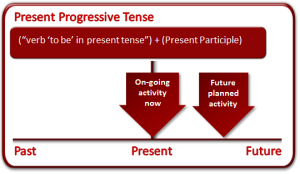
“If you’re not sure where the Present Progressive Tense fits into the timeline, I have a useful chart for you to study.”

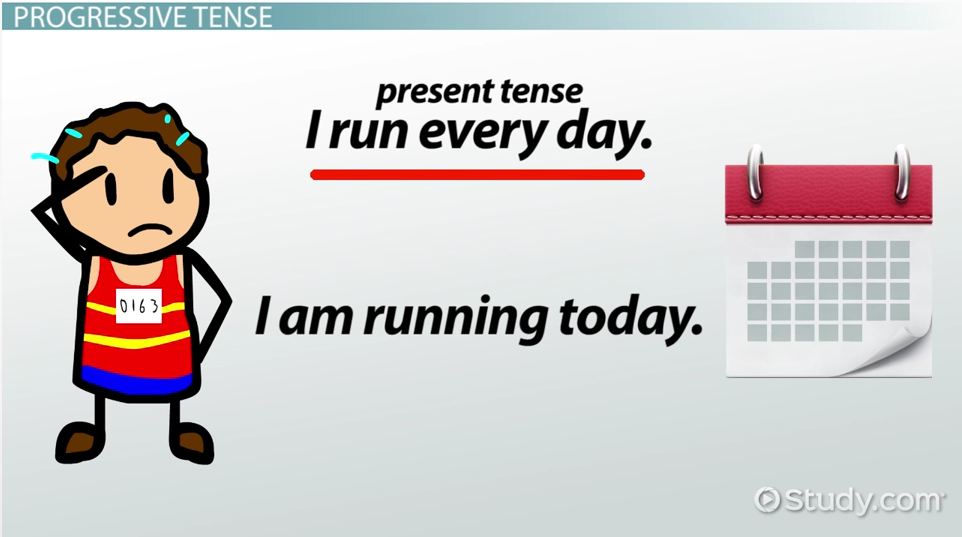
As a student of the English language, once you’re able to understand and use the ‘Simple Present Tense’ with proficiency and are ready to move on to the next grammar step, it would be wise to start learning about the ‘Present Progressive Tense.’ This particular grammar tense can help you to describe a number of different topics and can be used in a variety of ways. By studying the examples listed in this blog post and knowing when to apply the present progressive tense, you’ll be able to advance and get better in your study of English grammar rules.

The ‘Present Tense’ is divided into two kinds: the ‘Simple’ present tense and the ‘Continuous’ or ‘Progressive’ present tense. In order to fully understand the present tense grammar form, it’s important to understand both the ‘simple’ and ‘progressive’ aspects to this concept. Please follow along and read through this blog post if you’re a student of English grammar and want to better understand the ‘Present Progressive Tense.’ We will start by looking at a couple of examples regarding how this grammar tense is supposed to be structured. I would recommend that you copy these particular examples so you have some idea on how to use the present progressive tense in a sentence.

Examples

  1. I am going to the store today.
  2. We are planning on coming to your wedding tonight.
  3. What are you doing for dinner later this evening?

For the actual structure of the Present Progressive tense, it’s a little bit different when compared to the Simple Present tense. It’s necessary to begin the sentence with the ‘subject’ word whether it is “I, You, We, They, He / She, etc.” and you can also use the question form as well with “What, When, Where, Why, etc.” at the beginning of a sentence. The auxiliary verb, which is supposed to be conjugated in the Simple Present tense would come next and is modified depending upon which ‘subject’ word is used at the beginning of the sentence.

The auxiliary verb “to be” is the most popular form when it comes to the present tense so it is meant to be used often when it comes to creating the sentence. When you conjugate “to be” in the simple present form, you’ll end up with “is, are, am, etc.” depending upon the subject word. The auxiliary verb is always followed by the main verb, which is supposed to be displayed in present participle form. When we mention the present participle form, it basically involves the verb such as “do” and adding an “ing” to the end of the verb.

For negative sentences, the form of the present progressive sentence is a little bit different compared to regular sentences. It’s necessary to put the word ‘not’ in between the auxiliary verb and the main verb in order for the sentence to make grammatical sense.

Examples

  1. I am not dancing at the ball tonight.
  2. You are not playing basketball tomorrow.

If you’re thinking about making a question sentence with the present progressive tense, there’s a clear step that you need to take in order to make it work. The ‘subject’ at the beginning of the sentence must be exchanged for the ‘auxiliary verb’ due to a necessary change in the structure of the sentence in order to make the question work.

Examples

  1. Am I doing the right thing?
  2. Are you playing the piano for the recital?

As you can see, the ‘am’ which is the auxiliary verb comes at the beginning of the sentence this time and the ‘I’ word comes after and becomes secondary in terms of its’ placement. The positive and negative forms of the present progressive tense are quite similar to each other with the only difference being that the ‘not’ is added into the structure of the sentence in order to create that difference but the actual structure of the present progressive tense does not change at all. When it comes to the question form however, there is a change in the actual structure of the present progressive tense with the fact that the ‘subject’ and the ‘auxiliary verb’ essentially change places in order to form the actual question.

Now that we know the structure of the present progressive tense in its’ main forms of usage, how do we know when to put this grammatical tense into action? Well, it’s quite simple actually. There are some fundamental principles that guide the use of the present progressive tense in formal sentences. The present progressive tense can describe actions that are happening in real time and are continuing into the near future.

These could be actions or occurrences that are happening right now and have not been finished yet. These are actions that are in progress and have not reached the completion stage yet. This is why we add the –ing to our verbs to indicate that the action is ongoing and hasn’t reached an end yet.

Examples

  1. The wheels are spinning.
  2. The tables are turning.
  3. The guns are firing.

In addition to those actions that are occurring right now, there are also actions that have no set time frame or completion date yet but are ongoing and will require some time to finish. This is the most popular use for the –ing form and there are a lot of examples that can be construed from it.

Examples

  1. John is taking Salsa lessons.
  2. Martha is learning how to cook.
  3. Bob is starting a new job.

Despite being known as the ‘present progressive’ tense, this grammatical tense can also be used to describe actions or habits that will be occurring in the near future. In order to make this work though, you must add a word to indicate that something will happen in the future. Some examples of these words include ‘tonight, tomorrow, next week, this weekend, two days from now, etc. Usually, you are describing something that has been planned out to occur in the future with a specific date or timeframe in mind. People are long-term planners and thus, we are able to talk about actions that we will take in the future having made the plans ahead of time.

Examples

  1. I am going to attend university next August.
  2. I am planning to go to Mexico this winter.
  3. We are thinking about having our honeymoon in Hawaii next month.

The plan has already been set in motion and that’s why you’re discussing what you’re going to be doing but at a future time and place. It’s vital to remember that the present progressive tense does not exist without adding -ing to any verb regardless of which verb it is. The present progressive tense may not be the most popular grammatical tense but it is extremely important to practice, create examples, and master it both in its’ written form and its’ spoken form. Before you can go on to the ‘past’ and ‘future’ grammatical tenses, I believe that it’s necessary to have a good handle on the present progressive tense first before moving on to something else. Keep my explanations and examples in mind and look out for another ‘English Corner’ coming to you all soon.

English Corner – Simple Present Tense

wordle1
“Hobbies, routines, and daily habits are key actions that are described by the simple present tense.”

If you’re a student of the English language, chances are good that you’re familiar with the ‘Present Tense’ grammar form. In order to form basic sentences in your writing or to make yourself understood verbally when speaking to a native speaker, it’s important to learn the ‘Present Tense’ especially before moving on to the ‘Past’ and ‘Future’ tenses which is slightly more advanced and complicated to master.

The ‘Present Tense’ is divided into two forms: the ‘Simple’ present tense and the ‘Continuous’ or ‘Progressive’ present tense. In order to fully understand the present tense grammar form, it’s important to understand both the ‘simple’ and ‘continuous’ aspects to this concept. Please follow along and read through this blog post if you’re a student of English grammar and want to better understand the ‘Simple Present Tense.’ For next month’s edition of English Corner, we will focus on the ‘Present Continuous Tense’ and how that grammar tense is formed correctly.

The Simple Present tense is regarded as being the easiest to learn and most vital tense to master in order to the basics of English grammar down. For example, the simple present tense uses verbs like “to be” and changes the form into singular or plural depending on if you are referring to one more person or more.

For Example:

  • He is on his way to the store to pick up some fruits and vegetables.
  • They are at the ballpark tonight to watch the baseball game.

We can see from these examples how the verb “to be” is put into the simple present tense using the word ‘is’ or ‘are’ depending on if the subject of the sentence is singular or plural. For the subject ‘He’, the corresponding simple present tense form of “to be” would be is which is singular. For the subject ‘They’, the corresponding simple present tense form of “to be” would be are which is plural. With the subject word ‘I’ which is singular, we will use the word am which is singular but is different from the word ‘is’ which is used for ‘he’, ‘she’, or ‘it.’ The subject words of ‘they’, ‘you’ or ‘we’ would be used for the word ‘are’ as mentioned before.

The structure of the present simple tense is quite easy to form correctly when compared to other English tenses. You simply need to put the subject and the main verb together to form the basis of a sentence. This goes for positive sentences which don’t have a negative connotation or which form the basis of a question.

For Example:

1) I do like to swim with my friends at the lake.

The subject for this sentence is the word ‘I’ and the verb form is ‘do’ and it is possible sometimes to follow one verb with another verb or two verbs, as is the case with this sentence. ‘Do’ and ‘like’ can be together as well as ‘to swim’ and then to finish off the sentence with ‘my friends’ who are the objects and ‘at the lake’ which is the location along with a prepositional phrase.

The first verb in a sentence when there are other verbs after is known as the auxiliary verb, which comes before the main verb(s). Once again, it’s important to note that ‘I do’ can change form into becoming ‘He does’ or ‘She does.’ It is a common rule that the verb must be modified to change depending on which subject word in English is being used.

If you need to make a simple present sentence negative, it’s important to add the word ‘not’ after the auxiliary verb of ‘to do.’

For Example:

1) I do not like to dance because the basic moves are hard for me.

2) He does not want to go to work because he does not like his boss.

Regardless of the subject word being ‘I’ or ‘He’, there will always be a ‘not’ after the auxiliary verb. You can have multiple verbs being used in a simple present sentence as well. There is no limit to the amount as long as the sentence makes grammatical sense to the audience.

In order to form a question using the simple present tense, the order of the sentence needs to change slightly in order to reflect this shift. Instead of the ‘subject word’ leading off the sentence, the auxiliary verb of ‘to do’ must be at the beginning. You can either put ‘do’ or ‘does’ at the beginning of a simple present tense sentence. After that, you can place the subject word whether it is ‘I’ or ‘you’ right after the auxiliary verb. In this case, after the auxiliary verb and the subject comes the main verb and then finally the object which is wrapped up with a question mark to finish the sentence.

For Example:

1) Do you like to go skiing?

2) Does he know who you are?

It’s important to remember that the positive form of a simple present tense sentence doesn’t have an auxiliary verb in it while there is one in both the negative and the question form of the sentence. With the main verb for the positive form, it’s important to add an ‘s’ to the end of the word especially if it’s a third-person subject like ‘it’, ‘he’ or ‘she’ in order to make the sentence grammatically correct.

For Example:

  • He likes to dance salsa on Saturday night.
  • She knows that it’s important to study for the Chemistry exam.

When it comes to the negative and question forms of the simple present tense, certain rules must be observed. The auxiliary verb form must be used in both cases and also needs to be conjugated. The main verb form does not change and often comes in its’ normal form which is ‘to ____’. For negative sentences, the word not must come between the auxiliary verb and the main verb for the sentence to be coherent. Lastly, The auxiliary verb has to come at the beginning of a question sentence while the subject comes afterwards which is a reversal of what you would see in a positive or negative form of the simple present tense.

In terms of using the simple present tense correctly, it’s best usage comes in terms of describing general times and situations. Action verbs like ‘to do’, ‘to eat’, ‘to work’, ‘to dance’, and ‘to swim’, etc. are apart of the simple present tense umbrella of usage. This grammar tense is instrumental in describing a statement, which is always true as well as describing actions, which are continuous, habitual, or come from a routine. The simple present tense is most often associated with the verb ‘to be’ which can describe whom somebody is, what they do, where are they going, and why they are unique. The simple present tense can describe those actions, which happen in all forms of time whether it is the past, present, and future.

Out of all English grammar forms, the ‘Simple Present’ tense forms the base of a simple sentence. For any Basic English language student out there, it’s a necessity to master this concept before moving on to other forms of the present tense. After successfully understanding the methodology and the usage behind the simple present tense, an English learner will be ready to move on to the next challenge: The ‘Present Continuous’ tense.