I’ll Take Kind Gestures Over Kind Words Any Day

“When was the last time someone let you merge into traffic or grabbed you a coffee without asking? Too long, right? Small gestures like these can make your day or even your week. We’re taught from a young age that kind words keep the world turning, but words are just the starting point.”

When was the last time someone let you merge into traffic or grabbed you a coffee without asking? Too long, right? Small gestures like these can make your day or even your week. We’re taught from a young age that kind words keep the world turning, but words are just the starting point.

Even rarer than kind words are kind actions. Post-COVID, people’s social skills have atrophied, making everyday courtesies harder to come by. Things like holding the door, walking on the right side of the sidewalk, or letting someone merge on the highway might seem small but they matter far more than words alone, and we could all use more of them.

Having these kinds of gestures be optional instead of compulsory represents an overall reflection of the fracturing of what used to be common courtesy along with the kind of bare minimum expectations we have of one another too often. Instead of kind gestures, we often have the opposite now: people being loud in public places, not using earphones or headphones on their meetings or in the music they listen to, or just not minding their body language or others’ personal space. I value the importance of these basic gestures because they take such little time or self-awareness yet have become harder to find even when I consider them to be increasingly important to societal harmony.

It’s one thing for strangers to abstain from kind gestures or words but it’s entirely another when they come from business associates, colleagues, family, or friends. Taking the initiative and building a two-sided friendship or relationship, professional or personal, doesn’t take much to sustain but it truly can make a world of difference to the other person(s). Such kind gestures mean more than the average word could ever and people really remember those sincere actions more than giving a basic compliment or heaping on effusive praise.

These kind gestures depend on the kind of relationship you have with the person or group in question, but sending business associates a holiday card or remembering their birthday can strengthen the relationship significantly. You could also offer to buy them coffee or tea for providing advice or mentorship with your work or business. With work colleagues, it doesn’t hurt to share your appreciation in giving a kind word for them, but it could mean much more to bring in food or drinks for lunch or help them with a problem they are having on a difficult project. If you’re a manager, kind words are nice to hear but recognizing your employees with a bonus, a promotion, or just an award or other kind of real recognition can make a huge difference with morale building or employee retention at your firm.

With one’s family and friends, it’s always important to say ‘please’, ‘thank you’ and show your appreciation for their presence in your life. However, it’s always better to take the initiative to ask them out for a dinner or a concert or just to give them a call consistently to check-in with them and see how they’re really doing. Keeping a friendship or family relationship in good shape is hard to do but at least making the effort to see each other and to do so in a two-way manner is key to keeping it sustainable.

Being complimentary, supportive, and positive are all great with your words but real actions or gestures will always speak loudest. That’s especially the case when you’ve known that person a long time and have a history together. Sometimes, friendships end out of nowhere and family bonds are breakable by one party or the other, but if you want to make a real effort, make sure to rely on kind gestures primarily because they mean a lot more to someone than your words.

These days, it’s hard to get kind words out of strangers or people you don’t know and even more so when it comes to expecting basic social graces or gestures of kindness. As a result, we are starved for those kinds of gestures and actions that are unprompted, considerate, and relevant to us. We need those friends, family, and even close associates doing kind things for us and for them to be reciprocated as well because it helps foster our happiness, joy, and overall life satisfaction more than we think.

Kindness begets kindness. While words can move the needle, gestures, actions, and time spent together make a world of difference. Remember: kind words are the minimum of a polite society but making kind gestures second nature to you, especially for the people in your orbit, will make your life richer and fuller. Tomorrow, remember to hold the door for someone, send that quick ‘thank you’ note if someone did something kind for you, or buy a mentor or a friend a cup of coffee. Small gestures always make a big impact, which makes life better for everyone.

Real vs. Performative Patriotism in the Modern Era

“In today’s hyper-visual and hyper-fast world, it is usually the performative type of patriotism being showcased as a badge to wear or a symbol to show off.”

Picture this scenario: one person is screaming, “I love my country” while wrapping the flag around them at a rally and dressed up in that country’s colors, while another person nearby in the same city or town is quietly volunteering to mentor at a local school or makes a habit of voting in each election. Who is the patriot here? While you might say, “well, they both love their country and they’re both patriotic.” I would say in response, yes, they’re both patriotic but only one of them is performing real patriotism compared to performative patriotism. In today’s hyper-visual and hyper-fast world, it is usually the performative type of patriotism being showcased as a badge to wear or a symbol to show off.

This contrasts with how real patriotism is more about showcasing the values to live by which the nation stands for and in providing acts of service to your nation, in whatever way you can contribute. There’s nothing wrong with waving the flag, wearing your country’s colors, or showing love for one’s country in whatever way you deem fit but it’s not the same kind of patriotism as real acts that take blood, sweat, and sometimes tears in the work done to better one’s nation. I will explore the fundamental differences in terms of real and performative patriotism, and why real acts of patriotism are needed more than ever before.

Let me define first what I mean by real patriotism and performative patriotism. Both forms of patriotism do have a love of country as I had mentioned earlier. However, real patriotism as I define it is a love of country demonstrated through actions, responsibilities, sacrifice, and a willingness to critique the nation when necessary and work to improve it too. Performative patriotism, by contrast, involves loud declarations of loyalty, proudly showing symbol displays, and actions that focus on mainly visually promoting the nation as it is rather than working to improve or better the nation in some real way.

The tenets of real patriotism show up in different ways and are varied depending on the nation itself. However, real patriotism often focuses primarily on service to one’s community and the country, having constructive criticism and acknowledging the country’s faults, being a responsible and engaged citizen over making symbolic acts, and promoting unity and common ground rather than stoking division and distrust.

Whether it is military service, civil service in government, volunteering time and/or money to a cause, being civically engaged about the issues of the day, these are all different ways to serve your country responsibly. No country in the world is perfect but being able to criticize one’s nation freely is an act of patriotism because you care enough to acknowledge your home country’s flaws and desire to make it better. Being an activist and standing up for basic rights in one’s country, being a whistleblower, or a public reformer are all acts of patriotism that we should consider both real and integral.

It is one thing to wave a flag and shout your country’s name and it’s a whole other commitment to vote in every election regardless of whether it’s a local or national election. In addition, being educated about the civics process and your country’s government is key along with being a taxpayer of course and protecting the rights of your fellow man or woman. Any of these real actions as a citizen drive a country forward and make it a better place for all citizens. One quality of real patriotism that I find is overlooked is bringing people together, especially of different backgrounds, ethnicities, or religions. Real patriots do not tear their fellow citizens down or make their lives worse. Real patriots promote common ground, working together, and trying to find real solutions to the nation’s issues, whatever they may be.

Performative Patriotism has its time and place but if you are only performing and not putting in the real work around patriotism then you cannot be a patriot. Wearing flags, singing the anthem, making a pledge is all well and good but being able to put substantive action behind those symbolic gestures and will make a bigger difference than these performative acts. It has also become popular to virtue signal love of country on social media or at political events, to be seen showing off your patriotism rather than to do the hard work that takes days, months, weeks, and even years at a time to make the country better.

Supporting one’s country is great but the “my country, right or wrong” mindset also discourages admitting flaws, working to progress the country forward, and discourages actual dissent too. In addition, using divisive language that pits citizens against each other or scapegoats them for the problems that the nation is facing is not patriotism at all and is unjust and wrong. Patriotism should not be associated with exclusionary or divisive language but sadly that seems to be the case in the modern era.

Examples of real patriots for me include the civil rights movement during the 1960’s in the United States who worked to open the doors of opportunity and justice for every American and fought and sometimes bled to make America a more just and fair country. Teachers, health care workers, civil servants, and veterans are all real patriots who work jobs that improve and better the nation because of the work that they do. It’s also the volunteers who perform acts of service each day to clothe people, feed and shelter the homeless, and clean our streets, towns, and cities who are real patriots who often are not recognized for the work that they do.

Examples of performative patriots who say they care about the country but don’t put the work in are those who hide behind the flag without putting acts of service or work in to make the nation better. Protestors who act violently against their fellow citizens in clashing protests who claim they do it out of love of the country but who fan the flames of hatred, discord, and division. It’s also the companies and people who believe they are patriots by supporting political candidates but spend untold amounts of money to tip the scales in their favor because they know they can and think they are doing the right thing even when they are gaming the political system because of their wealth and influence.

Why should this classification of real vs. performative patriotism matter? Because I’ve found that in recent years performative patriotism has been used to divide people, rather than unite people for betterment of their country. This is not an isolated issue, and it isn’t going away. People need to start equating patriotism with real acts of duty, service, and sacrifice rather than thinking that flag waving and wearing or being loud about your opinion is being patriotic instead of focusing on the responsibilities of citizenry.

I believe that symbolic acts and gestures, while they have their place, have taken priority over actions that would unite people in a common cause, make their country better, and improve the state of their communities too. Social media, sports, and entertainment tend to focus on performative patriotism rather than real patriotism too partly because performative patriotism is loud, quick, and anyone can do it easily. Real patriotism takes hard work, sacrifice, and consistent efforts that often go unnoticed and unappreciated.

How do we spread real patriotism instead of performative patriotism? I think it’s important to dive into the full history and politics of a country rather than shying away from certain events or certain ways of thinking. It’s important to not only focus on the myths of a nation but the messy truths and sometimes ugly events which we need to learn from. If we forget the ugly parts of a country’s history, it is more than likely the nation itself will be doomed to repeat them in one form or another. It is also key to promote acts of civic engagement like voting in each election (making it easier for citizens to vote too), supporting local activism that is peaceful rather than vilifying it, and increasing access to community work and volunteering opportunities, which is something I think 99% of us, maybe universally, would support in our respective countries.

Additionally, we should not only honor military members and recognize veterans but also remember those people working in the public sector who do the hard work behind the scenes to keep a country running and who work hard to better it each day too. Whether it is civil servants, police, firefighters, teachers, doctors, nurses, and sanitation workers, they each are doing their patriotic duty each day even if we don’t recognize them as patriots, they are. Real patriotism is often quiet, not loud. You don’t need to scream and shout to show you love your country deeply.

Real patriotism is rather about showing up each day, doing the work well, and contributing to the betterment of society and the country. Let’s not mistake flag waving and noise making as solely showing love of one’s country going forward. A flag in your yard or waving on your porch means nothing if your neighbor is suffering and you do nothing about it to lend a hand to him or her. Real patriots acknowledge and fix what’s broken about a nation. They do the hard work and can still wave the flag too if they want to because they put in the effort and can say they have invested the blood, sweat, and tears to make their nation better. Can a performative patriot say the same? I don’t believe so.

English Corner – Using Prefixes -Un, -In, -Il to Begin Words

“Unbeknownst to most English learners, the English language has multiple ways of changing a word’s meaning just by adding a few letters to the beginning of the word itself.”

When you are looking to improve your English vocabulary by knowing how to create a negative or neutral meaning, you should consider the usage of changing words by adding -Un, -In, -Il to the beginning of each word to change the actual meaning of it. Unbeknownst to most English learners, the English language has multiple ways of changing a word’s meaning just by adding a few letters to the beginning of the word itself.

In this ‘English Corner’ post, I am going to go over specific examples of how to change these words and their meaning with -Un, -In, -Il although there are other ways to do that. I’ll save more of these word beginnings for another article but let’s get started with these three I’ve listed above.

To get started, let us look at -Un to change English words. There are several words that adding -un to the beginning of would change how we see that particular word. Here below I will list a few words that -un can be added to and how the meaning of the word changes as a result.

  • Unequal (Not equal, not the same)
  • Unavailable (Not available, not ready, not accessible)
  • Untamed (Not controllable, too wild, or crazy)
  • Unimaginable (Not to be imagined, not possible)
  • Unbelievable (Defies belief, similar to Unreal)

As you can see from the examples provided, putting -Un in front of the words listed negated things being equal, people being available, animals being tamed, events being believed, etc. If you look at -Un, it is often negative or neutral in its connotation. There are also a lot of similarities between words like Unreal, Unimaginable, Unbelievable, etc. so you can be sure that you can use -Un before multiple words and have the meaning be similar or the same even if the rest of the word is different.

Let’s continue with another word beginner known as -In, which is more neutral than negative but is not at all positive in terms of its total word when you add it as a syllable to beginning of any word. To use a quick example, adding -In to ‘different’ would make the actual meaning to indicate that you are neutral or not caring about one outcome or another. If you are indifferent to someone or something, then you are neutral to that someone or something and could care less about what is going on for the rest of that sentence or expression.

This tends to be the case with other words that start with -In as well and I will point out each of their meanings to be similar in terms of overall neutrality or indifference below in the list for -In words.

  • Inarticulate (Unable to be understood, confusing)
  • Inhospitable (Not comfortable, lack of good accommodations)
  • Intolerant (Not fair to others, prejudiced, not accepting)
  • Indisposed (Not available, out of commission or service)
  • Insupportable (Not able to provide justification, lack of support or effort given)

Given these examples for -In, you can see that a lot of the words are not just neutral but also negative as well. -Un words tend to be wholly negative in almost all definitions while -In words tend to be a mix of neutral and/or negative in their meanings. Still, being able to add an -In to ‘supportable’, ‘tolerant’ ‘hospitable’ will make your vocabulary that much better by being able to know the difference in English with how to make a word become negative if needed rather than just positive in its meaning when you consider the meanings of words such as ‘tolerant’, ‘supportable’ or ‘hospitable.’

Lastly, while -In and -Un are similar, you cannot make up words where you change the -In for -Un or vice versa. If you change them, they will not be grammatically correct even if the meaning does not change. You must be sure that you do not put an -Un in front of ‘Articulate’ by accident or a ‘In’ in front of ‘Imaginable.’ To master this kind of vocabulary, you should encourage yourself to make a list of English words that begin specifically with -In as well as words that specifically begin with -Un too to not make silly mistakes when it comes time to write them in sentence or use them in conversation.

To finish off with the last of the word beginners, -Il is a commonly used one similar to -In or -Un to negate a word or convey a serious issue or problem that can arise before the main word itself. For example, ‘legal’ means something in society is permissible and can be done without error or penalty. If you put an ‘Il’ in front of that word, then you are forbidden to take that action or do that thing in society, or you will face the consequences if you are found to be guilty of that action. ‘Illegal’ means what is not permissible by law while ‘Legal’ is the opposite in that it is an action that is permitted by the society in question, and which does not carry any punishment such as a fine or imprisonment.

Let us look at other examples where ‘Il’ when placed at the beginning of an English word has a similar effect that ‘Illegal’ would have when it is placed together.

  • Illegitimate (not authorized by law or not in agreement with rules or standards)
  • Illiterate (Not able to read or understand how to write)
  • Illogical (Not comprehensible, without logic or reason)
  • Illusive (Not able to be captured, contained, or deceptive by nature)
  • Illiberal (Undemocratic, authoritative, unprogressive)

Not every word beginning with -Il will have a negative or neutral meaning but there are a lot of them which will change the meaning of the main word to have the opposite meaning after it is written. -Il, like -Un or -In, carries the weight of making words that much different just by changing the beginning of the word with those two letters.

For the average English learner, having lists of the vocabulary words that begin with either -un, -in, or -il is an important step towards improving your knowledge in this proficiency area. Once you understand how the meaning of the word(s) change as a result, you can then be able to use it yourself in a sentence, either spoken or written. Once you memorize the words, the meanings, and the context, you will be well on your way to becoming that much more proficiency in the English language. There are other word beginners to cover besides these three important ones so be sure to check out another article in the future, which will cover this topic within English vocabulary.

English Corner – Showing Compassion and Kindness with Words

“When you learn English as a Second Language, your vocabulary to express kindness, compassion, and understanding towards others should be a top priority.”

One of the key parts of English vocabulary that a new learner to the language should focus on is to how to be compassionate and kind to other people. When you learn English as a Second Language, your vocabulary to express kindness, compassion, and understanding towards others should be a top priority. Expressing kindness in English or in any language will get you very far with other native speakers and can help you in any situation. When you do your best to treat others in ways that they would like to be treated such as with kindness and respect, you will likely not run into any serious conflicts or issues. There may be misunderstandings and ‘lost in translation’ moments but if you are able to make amends for it with your English vocabulary, you will be forgiven by other people and they’ll often give you a second chance.

To give you some ideas, I’m going to break this article down into two parts. I will begin with compassion, which means showing sympathy and concern for other people who may be going through a rough time or having issues in their life. There are multiple ways to express compassion in the English language and I’m going to give examples of both words, phrases, and sentences that express compassion clearly and deeply. When you are compassionate towards other people without expecting anything in return, that is truly what it means to be a mature human being who is also emotionally intelligent.

Words of Compassion:

  • Feeling
  • Empathy
  • Remorse
  • Sorrow
  • Forgiveness
  • Regret
  • Mercy
  • Benevolence
  • Sympathy
  • Mercy

Phrases of Compassion:

  • Feel better soon!
  • Wish you well!
  • Things will get better!
  • Stay positive!
  • I hear you!
  • I’m with you!
  • I am so sorry!
  • Please forgive me!
  • I didn’t mean to!
  • Will you forgive me?

Sentences of Compassion:

  • I am sorry if I hurt you in any way.
  • I didn’t mean to cause you any pain or sorrow.
  • I feel a lot of remorse for what I did and hope you can forgive me someday.
  • Please know that I am thinking of you and your family in these tough times.
  • My thoughts and prayers are with you all.
  • I did not mean to cause you any harm or any offense. If I did, I am very sorry.
  • I would like to ask for your forgiveness.
  • Please have mercy on me as I did not mean any wrongdoing.
  • I hear where you are coming from and see that what I did was wrong.
  • Please know that you have my deepest sympathies in these difficult times.

Showing compassion in English is all about having empathy for another person whether you were right or wrong. It means showing emotions that are genuine, which may lead to someone forgiving you or seeing your point of view, but it will definitely show that you are a mature person who is capable of admitting their mistakes and seeking forgiveness rather than being stubborn about it.

When it comes to kindness, it always goes a long way whether it is made up of individual words, a few words, or in complete sentences. Showing kindness will open up more doors for you in the English language than any other kind of vocabulary. However, it must be earnest, it must be done without expectation of return, and it must be consistently used in your daily usage of the language. Without kindness, you will not be able to fully utilize English and it is unlikely you’ll be able to learn other vocabulary within the language itself. When you have kindness in your personal vocabulary, everything else will come shortly after and other English speakers will be willing to help you out so that you will become a better learner and keep being a better person.

Words of Kindness:

  • Patient
  • Understanding
  • Pleasant
  • Nice
  • Generous
  • Charitable
  • Humane
  • Decent
  • Warm-Hearted
  • Altruistic

Phrases of Kindness:

  • I’ll help you.
  • Let me assist you.
  • How are you?
  • You look well.
  • Do you feel good?
  • How have you been?
  • I’m here to help.
  • How’s your family?
  • Give my best to him/her.
  • My house is your house.
  • Thank you very much.
  • Excuse me.
  • Please!
  • I appreciate it.

Sentences of Kindness:

  • I am here to help you and your family.
  • I’m giving to charity because I think it’s a worthy cause.
  • I would like to volunteer on the weekends because it’s the right thing to do.
  • Helping people out is the best way to make someone else’s day.
  • I enjoy getting out of my seat on the bus to give it to an elderly person.
  • Giving back to others without expecting anything in return is true generosity.
  • Before you do anything else in your day, you should be kind first.
  • My job is to help people with their luggage as a doorman and it makes my day.
  • I’m cleaning out the trash in the neighborhood park because I care about my community.
  • Before you criticize the world around you, think about how you can make it better with simple kindness.

With Kindness and Compassion, you can go far in this world in any language but especially with the English language. I believe it is truly important to have this post as a separate article because before you dive into any other type of English vocabulary, you should be willing to learn the basics of being kind and compassionate and to use it as much as you can. I promise you will not regret it and you’ll be much better off for studying this particular kind of English vocabulary.

English Corner – Using Words of Encouragement

A letter, essay, e-mail or other written form of encouragement in English serves the following purposes:

-An expression of approval and support.

-An act of giving hope or support to someone.

We use encouraging words in the English language for helping someone out especially when they are not doing well. We want to encourage each and every person to keep on doing their best.

Some Examples:

-Do not give up faith.

-Do not be discouraged.

-Do not lose hope as there will many more opportunities again.

-It has been a great incentive to get a bonus for my extra sales and I hope that this continues.

-I am confident that our Sales / Marketing team will have no trouble accepting this challenge.

-I am confident that you will make an excellent host.

-Your hard work and determination are greatly valued.

Ten Main Expressions of Encouragement to Use in Your Speaking and Writing

-You’re coming along nicely.

-Keep up the good work.

-That’s good effort on your part.

-You are showing real improvement.

-You’re on the right track.

-Keep going and do not give up.

-Come on, you can do it

-Give it your best shot

-What have you got to lose?

-If at first you don’t succeed, then you must try, try again.

Some Phrases to inspire people.

(You wouldn’t use these phrases often in regular conversation, but when you are writing speeches or creating motivational essays, they sound very inspirational.)

  • Always follow your dreams.
  • You should reach for the stars.
  • Do the impossible.
  • Believe in yourself.
  • The sky is the limit.

How To Use These Encouraging Phrases In English:

Phrases to use when someone hasn’t started yet.

(You can say these phrases to someone who is trying to figure out whether or not to do something that seems difficult or risky.)

1. Give it a shot.

Example: Your friend has never asked a girl out for coffee before. You offer to introduce him to your friend since she is single.

2. Go for it.

Example: One of your colleagues at work is looking for a raise and is thinking of asking his boss for one. You encourage him to do so.

3. Why not do it?

Example: Your wife asks you if she should enroll in a cooking class on the weekends. You tell her why not do it and see what happens.

4. It’s worth a shot.

Example: Your brother wants to try out for the Varsity basketball team at his high school but is not sure if he should do it. You tell him that it is worth a shot.

5. What are you waiting for?

Example: You are waiting for your friend to go down the waterslide and have some fun. You ask him ‘what are you waiting for?’

6. What do you have to lose?

Example: Your brother asks you whether or not he should take his girlfriend on a nice vacation to Italy this Summer. You tell him, “What do you have to lose?”

7. You might as well.

Example: Your professor asks you to see her after class to do some extra work so you can understand the class material better. “You might as well” to get a better grade.

8. Just do it.

Example: The famous Nike slogan but whenever you are put to the challenge physically or mentally, you say to yourself or others, “Just do it.”

Phrases to use when someone is already doing well.

(You can “encourage” someone to continue doing what they are already doing.)

1. There you go!

Example: You hit a home run to tie the baseball game and your teammates cheer you on.

2. Keep up the good work.

Example: You get an ‘A’ on your history exam and your professor commends you for your good work.

3. Keep it up.

Example: You are running in a Track and Field race and you have one lap to go. Your coach urges you to finish strong.

4. Good job!

Example: You improve your Grade Point Average (GPA) by a few percentage points and your parents want to congratulate you.

5. I’m so proud of you!

Example: You tell your grandmother about you getting in to your dream college and she exclaims how proud of you she is.

Phrases to use when someone is having trouble.

(These phrases are ways to tell someone to keep doing something even when it is difficult.)

1. Hang in there.

Example: Even though you have to hike for another hour, you need to ‘hang in there.’

2. Don’t give up.

Example: Life can be difficult but you need to persevere through its challenges by not giving up.

3. Keep pushing.

Example: Even though the weights you are lifting are very heavy, keep pushing and get them done.

4. Keep fighting.

Example: You have three rounds left to fight against the heavyweight champion of the world.

5. Stay Strong.

Example: I know losing a pet is very sad and difficult but you have to stay strong for your siblings.

6. Never give up. Never give in.

Example: Even when you have schoolwork, a job, and a mortgage to pay, don’t give up or give in.

7. Never say ‘die’.

Example: Anything is possible in life so there is a chance that your dreams can come true.

8. Come on! You can do it!

Example: When you have 500 meters left to swim and you’re in first place. You have the ability to win the race.

Phrases to use when someone is facing a hard decision.

(These phrases are ways to tell someone to keep trying)

1. I will support you either way.

Example: If you choose not to go to college and join the Army instead, I will support you either way.

2. I’m behind you 100%.

Example: Your family should be behind you 100% as long as you are working hard to better yourself.

3. It’s your call.

Example: I’m not sure where to go out tonight, sweetheart, ‘it’s your call.’

As you can see, there are numerous examples in English of this kind of supportive language. Words and phrases of encouragement play a key role in showing the person(s) or people that you care about them and that you want them to succeed. If you have a friend, family member, or a work colleague who is a native English speaker and you want to encourage them to improve, get better, or to do their best, you’ll want to use some of these examples listed above.

There’s not much that can make a person’s day more than receiving some encouragement so they can face their challenges head on and succeed in their goals. This list of vocabulary words and phrases will help you do just that as an English learner in both your speaking and writing abilities. In the English language, there are dozens if not hundreds of these vocabulary words but if you are able to put them to good use, you’ll be seen as being more proficient in the language. You will also be better able to connect emotionally with people and gain a few new friends through your kind words and actions.

If you would like to improve your English skills especially with regards to your grammar and vocabulary, check out my English grammar course offerings on Teachable:

https://english-from-a-to-z.teachable.com/ 

English Corner – Countable and Uncountable Nouns

It’s important to distinguish between countable and uncountable nouns in English because their usage is different in regard to both the determiners and the verbs. Countable and Uncountable nouns are grammatical topics that are likely to come up again and again in your studies so it’s important to know the main differences between them. If you are looking to improve your usage of numbers and to know how to use them to refer to person(s), place(s), and things(s), which are one or more in amount, then you will need to have a good grasp of countable and uncountable nouns.

Compared to many other grammar topics, countable and uncountable nouns are among the easiest to master but they are also the easiest ones to make careless mistakes about. By not paying enough attention to these basic rules, you will put yourself at risk of not referring to them correctly in either a direct or indirect manner. Please be sure to use the examples below to better your understanding and to also write out your own example sentences as well to get more practice. With enough effort, you’ll be able to tell the difference between the significance of one cow and five pencils. Most nouns are countable but there are a few exceptions which are not countable which you will find out more about in the rest of this ‘English Corner’ blog post.

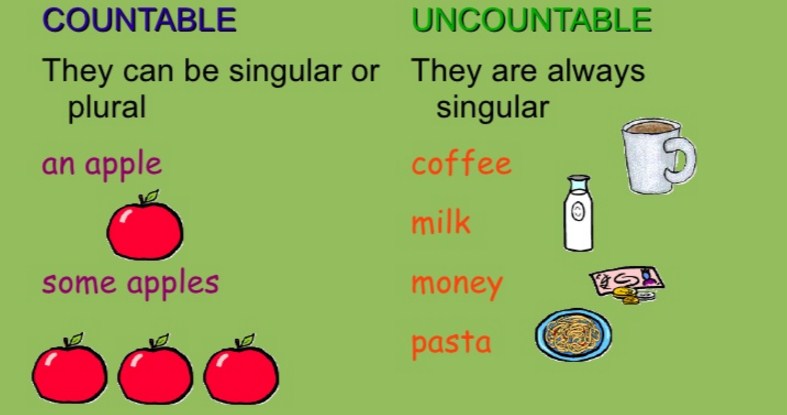
Countable nouns are for things we can count using numbers. They have a singular and a plural form. The singular form can use the determiner “a” or “an”. If you want to ask about the quantity of a countable noun, you ask “How many _______?” combined with the plural countable noun.

Singular: One cat, one woman, one job, one store, one idea.

Plural: Two cats, three women, four jobs, five stores, six ideas.

She has three dogs. I own a house. I would like two books please. How many friends do you have?

Examples of Uncountable Nouns: tea, sugar, water, air, rice, knowledge, beauty

We cannot use a/an with these nouns. To express a quantity of an uncountable noun, use a word or expression like some, a lot of, much, a bit of, a great deal of, or else use an exact measurement like a cup of, a bag of, 1kg of, 1L of, a handful of, a pinch of, an hour of, a day of. If you want to ask about the quantity of an uncountable noun, you ask “How much?”

-There has been a lot of research into the causes of this disease.

-He gave me a great deal of advice before my interview.

-Can you give me some information about uncountable nouns?

-He did not have much sugar left.

-Measure 1 cup of water, 300g of flour, and 1 teaspoon of salt.

-How much rice do you want?

Exceptions to the Rule of Countable v. Uncountable

Some nouns are countable in other languages but uncountable in English. They must follow the rules for uncountable nouns.

The most common ones are:
accommodation, advice, baggage, behavior, bread, furniture, information, luggage, news, progress, traffic

  • I would like to give you some advice.
  • How much bread should I bring?
  • I didn’t make much progress today.
  • This looks like a lot of trouble to me.
  • We did an hour of work yesterday.

Be careful with the noun hair, which is normally uncountable in English, so it is not used in the plural form. However, It can be countable only when referring to certain examples such as the individual hairs on someone’s head.

Examples:

1) Did you wash your hair last night?

2) Your dad is getting some grey hairs on his beard.

As shown in the multiple amount of examples, Countable nouns can be singular or plural although they mostly are plural in usage. This is in contrast with uncountable nouns which are only singular in their nature and can never be plural. This is an important grammatical distinction which will help you to understand the main difference between these two types of nouns. Do your best to study these examples, create your own sentences, and know why countable nouns are singular and plural while uncountable nouns are only singular. Whether it’s one potato or a hundred potatoes, you have to be able to count both.

English Corner – The Rules of Capitalization

Understanding the rules of capitalization is a key part of taking your English grammar understanding to a very advanced level. If you are able to know when, where, and how to capitalize letters and words correctly, you will definitely be ahead of most other English learners.

Some people may tell you that there are far more than just the main ten rules of capitalization in English, which may in fact be true. Other folks may say that there are only three rules of capitalization, and they may also be correct. However, The truth is that, depending on how you organize the rules, the rules of capitalization may be many or few based on how narrow or broad your definition of these rules are.

Most of the things we capitalize in English are what we refer to as ‘proper nouns.’ They are the names of specific and unique things.

  • If you are talking about one specific mountain (Mt. Fuji), state (Idaho) or street (Atlantic Avenue), use a capital letter for every word in the name.
  • However, when you are talking about a common thing of which there are many of them- like a mountain, a state or a street – you don’t have to use a capital letter for those words.

It’s important to remember as well that Capital letters are not used for articles (a, an, the) or for prepositions (of, on, for, in, to, with, etc.).

The Ten Main Rules

  1. Names or titles of people

This one may seem obvious, but there’s also a catch. Of course, you capitalize the first letters of a person’s first, middle and last names (John Quincy Adams), but you also capitalize suffixes (Jr., the Great, Princess of Power, etc.) and titles.

Titles can be as simple as Mr., Mrs. or Dr., but they also apply to situations wherein you address a person by his or her position as though it’s their first name. For example, when we talk about President Lincoln, we are using his role as though it were a part of his name. We don’t always capitalize the word president. Indeed, we could say, “During the Civil War, President Lincoln was the president of the United States.”

Another way to look at capitalizing job titles is to look at the position of the job title in the sentence in reference to the person’s name.

  • You should capitalize the title when it comes immediately before or after someone’s name.
  • You don’t have to capitalize the job title if it comes after the word “the.”

For example:  “Dr. Rogers was the Cardiac Surgeon.” “The cardiac surgeon allowed me to come into the room and observe the patient.”

  1. Names of mountains, mountain ranges, hills and volcanoes

Again, we’re talking about specific places. The word ‘hill’ is not a proper noun, but Bunker Hill is because it’s the name of one specific hill. Use a capital letter to begin each word in the name of a mountain (Mt. Olympus), mountain range (the Appalachians), hill (San Juan Hill) or volcano (Mt. Vesuvius).

  1. Names of bodies of water (rivers, lakes, oceans, seas, streams and creeks)

From here, it gets pretty easy. The same rules that apply to mountain names also apply to water names. A river is just a river, but the Mississippi River is a proper noun and must be capitalized, just like Lake Erie, the Indian Ocean and the Dead Sea.

  1. Names of buildings, monuments, bridges and tunnels

Man-made structures also often have names. The White House, The Eiffel Tower, The Statue of Liberty, The Golden Gate Bridge and The Lincoln Tunnel are a few good examples.

  1. Street names

It’s necessary to capitalize both the actual name part of the name (Capital) and the road part of the name (Boulevard); both are necessary for forming the entire name of the street (Capital Boulevard).

  1. Schools, colleges and universities

All of the words in the name of the educational institution should be capitalized. For example, Harvard University, Wilkesboro Elementary School, Cape Fear Community College.

  1. Political divisions (continents, regions, countries, states, counties, cities and towns)

As is the case with regions of a country, the divisions may not always be political, but you get the idea. When you refer to New England, the Midwest, the Pacific Northwest or the South as a region (as opposed to a compass direction), you capitalize it. Also, continents (South America), countries (Belgium), states (Wisconsin), counties (Prince William County), cities (London) and towns (Lizard Lick) get capitalized.

  1. Titles of books, movies, magazines, newspapers, articles, songs, plays and works of art

This one’s a little tricky when ‘and,’ articles or prepositions are involved. If ‘the’ is the first word in the given name of a work, it must be capitalized (The Washington PostThe Glass Menagerie). If ‘a’ or ‘an’ is the first word, it too is capitalized (A Few Good Men), and if a preposition leads the way, you guessed it: Capitalized (Of Mice and Men). However, if any of these words come in the middle of the title, it is not capitalized.

  1. The first letter in a sentence

The last two rules are easy. Always capitalize the first letter of a sentence. If the sentence is a quotation within a larger sentence, capitalize it, but only if it’s a complete sentence. If it’s merely a phrase that fits neatly into the larger sentence, it does not require capitalization. Study the following two examples for clarification:

  • The waiter said, “My manager will be here shortly,” but he never came.
  • The waiter told us that his manager would “be here shortly,” but he never came.
  1. The pronoun ‘I’

It’s only necessary to capitalize other pronouns when they begin a sentence, but ‘I’ is always capitalized.

Remembering the Rules

How can you possibly remember all these rules? Well, first of all, you should ask yourself three questions:

  • Is this the first letter in a sentence? If the answer is yes, capitalize.
  • Is this the pronoun I? If yes, capitalize.
  • Am I using a name that someone gave to this thing or person? If yes, capitalize.

And if you want to remember all the specific categories, try memorizing one of the following sentences.

  • “For Bob Barker, the price is wrong sometimes,” Adam says.
  • Susan Sarandon bought my wife fancy toilet paper in Boston.

The first letter of each word stands for a category:

  • F– First letter in a sentence
  • B– Buildings (and other man-made structures)
  • B– Borders (of regions, states, countries, etc.)
  • T– Titles
  • P– People
  • I– I
  • S– Schools
  • W– Water
  • M– Mountains
  • S– Streets

Other Examples of Capitalization

First Word of a Sentence

The cat is sleeping in my bedroom.

Where did I put that book?

Hey! It’s great to see you! How have you been?

Names and Personal Pronouns

My favorite author is Jonathan Franzen.

Tom and Diane met at Jill’s house.

Have you met my dog, Barry?

The First Word of a Full Quote

Mario asked, “What is everyone doing this weekend?”

Stacy answered, “My sister and I are going to the theme park.”

Days, Months, and Holidays

I hate Mondays!

Harry’s birthday is in July.

Oh no! I forgot about Mother’s Day!

Words in Formal Titles

Lord of Rings is better than A Song of Ice and Fire.

The first movie of the series is Harry Potter and the Sorcerer’s Stone.

Cities, Countries, Nationalities, and Languages

English is made up of many languages, including Latin, German, and French.

My mother is Italian, and my father is German.

The capital of Ethiopia is Addis Ababa.

Time Periods and Events

Most of the World War I veterans have now passed away.

In the Middle Ages, poor hygiene was partly responsible for the spreading of the black death.

High school history students often enjoy studying the social changes that took place during the Roaring Twenties in the United States.

In this article, it is not just the ten main rules of capitalization that we have to be aware of. There are many other additional rules where you can use capitalization on a consistent basis. The examples shown above should help you, the reader, to understand when and where these words can be capitalized and to notice a pattern in terms of how these rules can be applied. 

Overall, capitalization is a very tricky topic to fully master but if you know the rules and you know when not to capitalize at all just for definite / indefinite articles along with prepositions, you will be well on your way to having a handle on this advanced grammar topic. It’s important to not be overwhelmed by all of the rules out there including the additional ones that were highlighted here. Starting off with the ten main rules of capitalization is a sufficient enough starting point to focus on. With Capitalization, you do not want to bite off more than you can chew and while the ‘additional rules’ of this grammar topic are important, it’s best to focus on the main rules such as geographic features, names of people / titles, the first letter in any sentence, etc. Good luck!

English Corner – Question Words

Knowing how to pose a question in English is a key component towards developing proficiency in the language. You’ll be able to better get around a city, ask for directions, find nearby places, and ask for the meaning of something among other uses. When it comes to getting the specifics in characteristics, times, places, people, and things; having the ability to create a question is a key part towards getting the information you need to make a decision or understand something new.

In order to do that, we need to become familiar with the different options for question words in English. Question words mainly come at the beginning of a sentence and come in seven different forms although there are variations within each question word. For this article, we will be focusing on the seven main question words: ‘why, when, where, what, who, which, and how.’ Each of these seven question words are used under different circumstances and for different reasons. First, I’ll break down how we use each question word and also give examples about how to use each of these words in a basic sentence.

Why

When you use the question word ‘why’, you’re trying to get a reason, a meaning, or an explanation from someone about something that happened. You are trying to get the purpose out of what has happened or occurred. ‘Why’ is most often used in the past tense and can be related to a prior event or procedure. If you’re looking to understand what the cause or reason for something is, you’ll want to use ‘why’ for this kind of question.

Examples:

  • Why did you cheat on your final exam?
  • Why is he not telling the truth?
  • Why were you chewing gum during class?

When

For the question word ‘when,’ its usage centers around being able to know about a general or specific time and/or place. If you’re on public transportation, ‘when’ would definitely come in handy when you need to ask about the arrival or departure of a bus, plane, or train. Asking about a person’s preferences when it comes to how they manage their time is also useful for ‘when.’ The past, present, and future tenses can all be used with ‘when’ as well with no problem.

Examples:

  • When are you and your friends going to the movies later?
  • When did your flight arrive from Istanbul?
  • When will the next train be leaving the station?

Where

If you want to inquire specifically about places and locations, you’ll need to use the question word of ‘where.’ In order to get to know somebody better, you can also ask about where they have been to as well as where are they going. ‘Where’ is often focused about inquiring about places but it can be used to get to know somebody better as well.

Examples:

  • Where is the bathroom?
  • Where did you go on vacation this year?
  • Where is your family from?

What

Out of all of the question words, the word ‘what’ has the most potential uses compared to the others. You can ask about people’s preferences such as their likes and dislikes. You can use ‘what’ in order to describe people, places, and things in greater detail. The physical and character descriptions are easy to make when you ask the question starting with ‘what.’ Lastly, one can inquire about the kind / type of people, place or thing by beginning the question with ‘what’ in order to get more details.

Examples:

  • What does she do for fun on the weekend?
  • What were the Pyramids in Egypt like?
  • What does New York City look like?
  • What kind of person is Jack?

Who

For the question word of ‘who’, you’re always going to be using it to ask about people. You’ll never be using ‘who’ to describe a thing or an object. With ‘who’, you’ll mainly be making object kind of questions as ‘who’ will form the subject and which will also form the answer to this question. The person’s name and/or their personal preferences will be highlighted in the answer to a ‘who’ question.

Examples:

  • Who does Tina like?
  • Who is studying both Spanish and Portuguese?
  • Who went to the post office earlier today to send the package?

Which

The last of the –Wh question words is ‘which.’ While it may be the least used of all English question words, its purpose is quite important. If you’re making a choice between a number of options such as people, things, or objects, you’re going to start this kind of question off with ‘which.’ Additionally, if you’re inquiring about the type or the kind of an object or thing, you will use ‘which’ to understand the specific model or function.

Examples:

  • Which boy did Tim choose for his Kickball team?
  • Which Harry Potter book did you like the best?
  • Which kind of sports car do you want to buy?

How

Not every question word in the English language begins with –Wh and so last but not least, we have the important question word of ‘How.’ When you use this question word, you usually combine ‘How’ with an adjective right after to form the sentence. The main usage of ‘How’ is to ask about the specific characteristics, qualities, and quantities of persons, places, or things. When it comes to discussing a price, a length of time, a frequency of an event, or height / weight measurements; using ‘How’ would be your best bet.

Examples:

  • How old are you?
  • How long was the drive from New York to California?
  • How much does this fruit cost?

In order to use question words, we first must understand and memorize why and how they are used. The functions of each question word are very important to know about. Without a base knowledge of their similarities and differences to each other, it will be much more difficult to form the correct question. These seven question words in English have a lot of overlap but it’s important to know how they are unique as well as how they can best be used to make sure you’re understood.