English Corner – Creating a Resume

What is a resume? To sum it up, it is the backbone of your professional background and experience summed up in a one or two-page document which you will be showcasing to potential employers and/or co-workers. It is not the sum total of who you are as a person but rather who you are as a worker and what professional skills you have to offer and to whom your skills would be useful for. In order to get a better job, to get a better salary, or to get that promotion to take the next step in your career, a good resume could make the difference between a ‘yes’ or a ‘no’ answer when it comes to you getting that employment opportunity.

The resume is how you showcase yourself to the professional world and let companies and organizations know what your value would be to them. It’s a document that is the heart of your application, but it’s not the only piece of the puzzle to getting a job. The ideal resume by U.S. standards is 1 to 2 pages length and nothing longer than that. The CV (Curriculum Vitae) is different from a resume.

Again, a resume should highlight your professional experience, educational background, job skills and knowledge, and your technical capabilities. You can create different resumes depending upon the job you’re applying to especially if you can only highlight certain previous work experiences. Without the interview or direct networking, the resume and the cover letter, if requested, are the only ways that you will be able to reach potential employers.

It’s a summation of who you are professionally, what you can offer in business, and should showcase your work effort and drive. It is also a great way for employers to verify that you are qualified for the job opening and that you would be an asset to them rather than a liability.

Compared to less qualified candidates, if your resume looks good on paper, you’ll be able to stand out for a potential interview when your qualifications are better than the other applicants.

When you first beginning writing out your resume, you are going to want to make sure to use action words to highlight those professional experiences and your previous accomplishments you’ve had as well. These actions words should not be the same each sentence and you should never repeat the same one more than once. Also, it is important to use the present tense or past tense correctly based upon if you are still doing the same job or if it was done previously and that you are no longer there.

There are hundreds of action words in the English language and learning a good amount of them is a great way to ensure that you have a good resume. In order to keep the interviewer interested, you do not want to repeat the same action word twice or three times so be sure to do your best to learn as many as you can and know what the meaning of those words are too.

Your action word is a key component of making the resume look legitimate to the reader. The action word should always go at the beginning of the sentence (i.e. next to the bullet point) during the ‘work experience’ part of the resume. If you are currently working at a job but are applying to change to a new job, the action word must be in the present tense. However, if you are writing about previous work experience in your resume, your action words should be in the past tense. Without using action words, your resume won’t look as persuasive or as actionable as it could be otherwise. Your employer will want to know what you bring to the table based on your past work experiences.

Here is a list of good action words you can use in your resume if they apply to what your profession does, it is a small sample list but includes many words that commonly come up in professional resumes and accurately depict what some jobs do:

  • assemble
  • assist
  • build
  • cook
  • drive
  • fly
  • operate
  • program
  • repair
  • sell
  • sew
  • supervise
  • translate

Action Word – Sentence Examples

  • Assemble the cars in the manufacturing plant before they can be inspected.
  • Assembled over 10,000 cars in the manufacturing plant before they were inspected.
  • Cook meals that were prepared by hand without any outside training.
  • Cooked dozens of meals per day that were prepared by hand without any outside training.
  • Lead a Sales team of five people to sell medical device products to clients.
  • Led a Sales team of five people in selling hundreds of medical device products to clients in biomedical industry.
  • Develop software products to make it easier for customers to order their groceries online.
  • Developed ten different software products that made it easier for customers to order their groceries online.

In the introduction of a resume, you will want to be able to do many things well to set it up on sound footing before getting to the heart of your resume by introducing yourself and your current skillset. You will want to have a statement of one to two sentences discussing who you are and what you can offer to the employer. It’s basically a summary of your resume and a short summary of what your professional skillset is.

“My name is John Anderson and I have over 10 years of experience in digital marketing focusing on SEO, social media, and advertising campaigns. I am a dependable, hard-working, and motivated individual looking to expand my knowledge and expertise.”

Remember to include at the top of your resume your full name, address, e-mail address, and cell phone number so the employer may be able to contact you.

Headline Example:

John Doe

22 Winston Way, Toronto, Canada 24589

   John.Doe@gmail.com

                                                  +( ) (   ) (   ) (    ) –> Phone Number

 The body part of your resume should focus on two major parts: your professional experiences as well as your educational background. At the top of your resume, you’ve introduced yourself and your professional profile but now you want to go more into detail.

Make sure to include relevant bullet points regarding actions you undertook in each of your previous jobs as well as what goals you were able to accomplish. Remember to write in complete sentences and use a timeline in chronological order from most recent to furthest away in terms of commitment.

For example: Bachelor of Arts Degree, Stanford University; Biochemistry (Major), Physics (Minor). 2011 – 2015.

In the conclusion, you want to highlight what your area of expertise is. You want to leave the reader aware of what kind of professional abilities, skills, and technical capabilities you have. Also, if you have any awards or earned any professional honors, you will want to list them in chronological order from most recent to furthest in the past.

If your work has been published or if you have any items in your professional portfolio, you’ll want to highlight the title of these articles as well as for which publication they were featured in. Depending upon what kind of employer you are focusing on, it’s sometimes beneficial to list what kind of hobbies and interests you have even if they are not professionally related. Regarding coding or foreign languages, you should highlight by the end of your resume which languages you know whether its Python (coding) or Spanish (foreign language) to stand out from the competition.

With a great resume, you will have a much better chance of landing that dream job. While it is not guaranteed, if you can explain yourself well professionally with good vocabulary with the correct action words as well as few or no grammatical errors, it’s likely you will be called in for an interview or be able to take that pivotal next step towards landing your next employment opportunity.

English Corner – Creating a Cover Letter

What is a cover letter? Why is it important for an English learner to know about it and also how to create a good one? Well, a good cover letter can make the difference between landing that dream job or hitting refresh on the search results again to find the next job opportunity. Your experience and your professional background need to be succinct and summed up in a well-written way and the cover letter is your best way of doing that. It is an excellent way in which for you to improve your English writing skills and to prove that you can handle your future job’s writing components which there is likely to be many of them since you are a worker during an age of e-mails, 24 hour communications, and instant messaging services.

A cover letter is an opportunity for you to go into more detail about yourself and your experience(s) and background, both professionally and personally. However, your cover letter should focus on the job you are applying for as well as why you are interested in the particular company that you intend to work for. Your cover letter should be a balance of who you are as a professional, what you can offer for the job you’re applying to, and what your interest in the company is. It’s a balancing act between these two objectives and you should remember to personalize your cover letter depending on where you are applying to.

You may be asking yourself as you read this blog post: Why do I need a cover letter and what benefit(s) do I get from creating a worthwhile one? Well, there are a number of reasons for it which I will list below but be sure to note that it’s more than just a chance to land a good job but it’s a chance for yourself to become a better writer and know how to sell your abilities and skills.

Your cover letter is different from the resume in that it allows you to go more in-depth about yourself and why you’re a good fit for the job. Instead of short bullet points, you can highlight your experiences in broader detail. Employers will also expect why you would like to work for their company and how your skills line up with their requirements. It’s a chance to tell your story to them while interweaving how their company or organization aligns with your professional goals. In addition, you have the ability to showcase how good of a writer you are because the cover letter is more grammatically, and vocabulary focused than your resume.

Action words will make up a large component of your cover letter’s sentences so please be sure to put these verbs to good use. Here below are just a sampling of them listed below but remember that there are hundreds that can be used within the context of a regular cover letter. Try not to repeat yourself too much and to keep your usage of action words fresh and consistent throughout the letter.

Sample Action Words

  • Activate
  • Compose
  • Communicate
  • Develop
  • Direct
  • Manage
  • Organize
  • Review
  • Systemize
  • Test
  • Verify
  • Value

Note: Remember to add –d or –ed to the end of the action verb if using it for the past tense.

In addition, you have to be able to choose and use some phrases and sentences that will come in handy either at the beginning or end of the cover letter so that you will come off as being both professional and serious. You do not have to use all of them but there are a number of them that are cordial in nature that a potential employer will expect from you to see when they read it during their evaluation.

Here are some key useful phrases/sentences that you can use for your average cover letter:

  • Dear Sir or Madam…
  • I am applying for this ________________ opening with _______________ for the purpose of __________________________________.
  • This job appeals to me because ________________________.
  • Your company / organization / firm is my top choice because ____________________________________.
  • I believe that I offer a lot to this position based on my skills and qualifications.
  • For example, last year, I was tasked with ____________________________________ and I was able to help by ______________________________________.
  • Please do not hesitate to let me know if you have any questions or comments about my application.
  • Thank you for your consideration of my application for this _________________ position with ________________ and I look forward to hearing from someone soon.
  • Sincerely, __________________ (Your Name).

To give you reading at home a better idea of what the content and the structure of a cover letter looks like, I have included two sample cover letter excerpts that will show you how it can be written and what to write about potentially if you are still struggling for ideas as to how the cover letter should be shaping up.

Sample Cover Letter Excerpts

  • “I have over five years of management experience and led my team of software developers to develop a successful mobile application. This mobile application was instrumental in connecting doctors with patients in an online booking system that took out the middle man from participating in this previously onerous process.”
  • “I believe your company, Syntax Inc., has been successful in implementing various infrastructure projects related to bridges and tunnels throughout the Middle East. These kind of projects are related to what I hope to do with my career and I think that this work is very important to the future.”

Remember that you should know who your audience is and tailor your phrases to reflect who you are writing the cover letter for. Always use formal language such as sir, madam, sincerely, respectfully, please, thank you, etc. Go into detail about the job you are applying for and give different reasons on what you bring to the table for the position opening. Structure the cover letter into multiple paragraphs with an introduction, body paragraph(s), and a conclusion. The cover letter is a formal piece of writing so it should be structured as a formal letter whereas a resume is less substantive and more general.

In the introduction of the cover letter, remember to always put your full name, your current mailing address, your cell phone number, and your e-mail address at the header of the cover letter. The date at which you are sending out the cover letter should go next in the left hand part of the cover letter below your header. Then, you should begin the cover letter with “Dear Sir or Madam..” or “To Whom It May Concern”, or “Dear Mr. or Mrs. ________” if you know who specifically the cover letter should be addressed to. The introduction should be a paragraph or two focusing on what position you are applying to, the company associated with the position, and for which reasons you are applying for this specific position. You can also add the person or place that referred you to this job application especially if the person works for the company you’re applying to.

The body paragraph(s) of the cover letter should be a few paragraphs in total length but not be too lengthy or repetitive. Each paragraph should cover a different part of your professional or educational background and highlight what these experiences meant to you and what skills you developed. You should give a few examples of where you showed leadership, where you completed a successful project, and what you took from the experience. Do remember to not discuss every professional experience or educational program you’ve gone to but instead highlight the relevant ones related to the job application in question. Always use complete sentences for this part of the cover letter and check it over for grammatical coherence and correct vocabulary usage.

When it comes to a cover letter’s conclusion, you’ll want to re-state again why you are applying to this particular position and company. Discuss which characteristics, skills, and personal traits you have that will make you stand out as a job candidate. The conclusion of your cover letter should indicate gratitude and thankfulness for being able to apply and that you hope to hear back soon from the employer. Sign off with a salutation such as Sincerely, Best regards, Warm regards, Best wishes, Cordially, etc. and re-state your full name at the end of the cover letter. Don’t be too presumptuous that you will land the position but let your experiences, skills, and qualifications speak for themselves.

Your cover letter is what you make of it really and if you want the job bad enough, it will come through in your writing and in your sincerity. The point of becoming a better English learner is to put yourself to the test and to make the most of your abilities in this language and developing a good cover letter is a great way to do that. If you follow this advice, practice until there are few if no mistakes at all, and revise multiple times what you have written, you will be well on your way to having better success in your professional career in the English-speaking world.

English Corner – An Introduction to Rhetorical Techniques

Rhetorical techniques are used in English writing to convey a meaning or a sentiment that the reader understands and is able to relate to emotionally or otherwise. A technique like a metaphor or a simile is used to persuade a reader to consider the topic being addressed from a different point of view(s).

There are numerous techniques out there, but I would like to focus on the most important ones that come up the most in English writing. Out of the dozens of rhetorical techniques in the English language, I will highlight the most commonly used and the most popular ones that you should know of as a writer.

The first rhetorical techniques I would like to introduce focus on the type of ideas you use in your writing, the emotions and feelings that you are describing, the characterization of the people you are referencing as well as their credibility, and the strength of your argument. These particular techniques are known as Logos, Pathos, Ethos, and Kairos, which are all likely to come up during your writing exercises. You should keep each of them in mind when you are writing and to know which rhetorical technique is which when you use them in your writing.

  • Logos – Logical and Consistent Ideas
  • Pathos – Emotions and Feelings
  • Ethos – Plausibility and Credibility, characterization of the person(s) involved
  • Kairos – Timeliness and relevance of your argument

Here are some additional and commonly used rhetorical techniques as well as some examples of each of them in action when used in a normal sentence.

  • Metaphor – a figure of speech in which a word or phrase is applied to an object or action that is not literally applicable.

Example: He is suffering from a broken heart.

  • Cliché – Not an original thought, an opinion or a sentence that has been used many times before.

Example: They really lost track of time when they were studying for the test.

  • Pun – A joke that plays on the possible meanings of a word or a fact.

Example: “I asked my French friend if she wanted to play video games. She said Wii.”  (Oui)

  • Euphemism – A polite or indirect word, expression that is a substitute for something more blunt or severe.

Example: My grandfather passed away last year sadly. (died)

  • Alliteration – The occurrence of the same letter and/or sound at the beginning of closely connected words.

Example: Alice’s aunt ate apples and almonds.

  • Simile – A different figure of speech in which two different, unlikely things are compared to one another.

Example: Her smile is like the shining sun.

  • Analogy – Making a similarity between the features of two things or people and which a comparison can be made.

Example: “Just as a sword is the weapon of a warrior, a pen is the weapon of a writer.”

  • Allegory – A story, poem, or picture that can be interpreted to have a hidden meaning.

Example: “When Jack finally finished climbing up the beanstalk even when his Father told him not to, he found an unwelcome surprise at the summit that reminded him of his father’s warning…”

  • Irony – A state of events that seem deliberately contrary to what one expects and is often amusing or bewildering as a result.

Example: Even though John had overslept for the exam and ran all the way to the school to take the exam, his teacher belatedly told him that it was tomorrow, and that today was Sunday.

  • Sarcasm – The use of irony to mock someone or show contempt.

Example: “Tina asked her mother how much her purse had cost her when she bought it. Her mother responded playfully that it was about $20,000 and she had to use Tina’s college savings fund to help pay for it. Tina was upset about her mother’s joke and that she wasn’t being serious with her.”

Here are some of the last major rhetorical techniques to consider during your English grammar studies for writing purposes:

  • Synonyms – Similar in meaning and context with Vocabulary words.
  • Antonyms – Opposite in meaning and Context with Vocabulary words.

Strong – Weak (Antonym)                         Intelligent – Smart (Synonym)

Big – Small (Antonym)                              Caring – Kind (Synonym)

Tall – Short (Antonym)                              Sad – Unhappy (Synonym)

Fat – Thin (Antonym)                                Funny – Humorous (Synonym)

Remember to keep your sentences short and concise as a beginner. As you improve and use correct punctuation, your sentences can become longer and more detailed. Please be sure to focus on the rhetorical techniques that are used the most. There are more than a dozen techniques that you should now be familiar with so try to memorize how, when, and where you use each of them.

Don’t try to memorize all of them but try to become more and more knowledgeable of a few that you recognize that keep coming up again and again. Lastly, do not forget TOP or “Techniques, Order, and Punctuation”, which are the three main concepts that form the basis for correct English writing structure.

English Corner – The Utility of Commas

The Comma is an integral part of any English language sentence and while it may not come up all the time, it is likely to come up many of your sentences especially if they are longer than 10 sentences. The comma helps us to avoid run-on sentences or sentences that are too long-winded, which will distract the reader, and take away from the meaning of your sentence(s).

Commas should be used moderately to not to introduce many pauses within your sentences. You should be looking to use conjunctions in lieu of commas or with them depending upon the context. What you do not want to do is not use commas at all or use them too much. There is a key balance there that a writer in the English language must learn through trial and error as they develop their grammar proficiency.

What a comma (,) does in not just English but in other languages as well is to break down sentences into individual clauses with the comma acting a pause in the action to let the reader catch his or her breath. Commas are used in several scenarios but none as so important as forming a list of two or more items. In a list type of sentence, the comma is effective in separating the people, places, or things into an order from first to last to differentiate them.

If there are two or more items in the list, the comma will come before the conjunction (and, but, or) to finish out the sentence properly. This kind of arrangement forms the basis of the ‘oxford comma’, which is still being debated by English grammar scholars, but for which is popular with some English language students and is advocated for by certain teachers. The comma + conjunction combo is not only just for the oxford comma but for a wide variety of sentences.

If you had to summarize the main uses of commas in sentences, they function in terms of being placed between items for formal lists and they also establish separate yet interdependent clauses within a single sentence. The supplementary uses for commas involve being used between parts of speech such as adjectives, adverbs, and before quotations. Commas can also be used for dates related to days, months, and years in terms of how it is written.

Let’s break down the different uses of commas but listing a few examples for each type of popular usage:

Main Uses

1.      Building lists

·        Not only was Jenny captain of the Varsity soccer team but she was also President of the Chess club, and a member of the National Honor Society.

·        Felix had several things to get from the supermarket today: eggs, milk, bread, meat, and soft drinks for his daughter’s birthday party.

·        I think my grandmother, Jean, will be there along with my grandfather, Patrick, and my mother, Eunice.

2.      Separating the clauses

·        Jack wanted to go out with his friends to the movies, but he couldn’t do so because he had to finish his homework.

·        Lying to other people is not a good idea, and it often hurts other people’s feelings.

·        They were lost in the woods, hoping to get home by morning, but they were out of food and without a compass to guide them.

Supplementary Uses

1.      Adverbs and Adjectives

·        However, he was not guilty of the crime they thought he committed.

·        Moreover, they apologized to him and let him go free.

·        The dreary, sad day was encapsulated by the rainy weather.

·        President Franklin Roosevelt was fervent, unwavering in his belief in the American people’s ability to contribute to the war effort.

2.      Quotations and Dates

·        Mr. Johnson told his students, “You should always know how to use commas in sentences.”

·        LeBron was dismissive of the reporters stating, “I scored 50 points and did my best to help the team win the game.”

·        Abraham Lincoln was born on February 12th, 1809 in Hodgenville, Kentucky, United States.

·        Independence Day happened on July 4th, 1776 as the United States declared its independence from the British Empire.

As you can see from these examples, commas play a really important role in both English writing and in English grammar. There are several main uses and supplementary uses that the English language learner should be aware of. You must be able to practice each of these comma uses regardless of the purpose. In order to use commas properly, you must write your own sentences, make corrections if necessary, and get feedback from your teacher or your other classmates.

Each comma use is important whether its to separate sentence clauses, making a list of items, putting them with adjectives and adverbs, or using them for quotes or dates in those type of sentences. Without commas, you won’t have a complete sentence and you’ll run the risk of having a run-on sentence, which is what you want to avoid as much as possible in mastering English grammar and writing.

The Power of An Idea

According to the University of Southern California’s Laboratory of Neuroimaging, the average person has about 70,000 thoughts per day. That is about 45 thoughts per minute and 2,700 thoughts per hour. Most likely, 90% of those thoughts are focused on the day-to-day habits and responsibilities that we take upon ourselves out of necessity. Where we go to eat, where we go shop for food, what to clean and how to clean it, and the need to brush, dress, and groom ourselves so that we look presentable to the world. However, what makes us stand out as a species is our ability to pull a few ideas from these thousands of thoughts that end up changing the world in some measurable way.

Thoughts can be random, scattered, and hard to quantify but with concentrated effort and documentation, these thoughts become ideas that later can become a reality. How does an idea turn into a real thing? Well, one part of making an idea real is jotting it down on paper or even on a smartphone today and really spending a lot of time focusing on the plausibility of it. Ideas can make the best sense in the world to you but if they are not popular or don’t transcend just your belief in them, they will go nowhere fast.

Ideas are meant to be tested, changed, and optimized so that people believe in them, for better or for worse. The paradox that is inherent with ideas is that they are very similar to human nature. They can be used for the greatest good or the greatest evil. Ideas are so powerful that wars have been waged over them, millions have lost their lives, and untold amounts of money have been spent to promote or degrade them.

When you really think about it, ideas that are put into action have caused changes to human civilizations throughout the millennia. Whether its education, health, infrastructure, scientific advancement, community building, ideas are at the forefront of upending the status quo and changing human lives, sometimes for the better or sometimes for worse. While I just mentioned the positive advancements that come from ideas, it is also valid that ideas have led to war, poverty, inequality, destruction, and multiple isms that have caused conflict and strife among nations, races, and religions.

You may be reading this article and wondering that maybe it’s best to not contribute your ideas to the world in some way. I think this is a false dichotomy because I like to think that if your ideas are not harming people, are not harming the planet, and can lead to a better community, country or world, then you should try out your ideas and see what happens. The key part to realizing an idea of yours is to see how other people react to it. Are they happier because of your idea? Are they healthier because of it? Are they better educated because of your idea?

You should be asking yourself: Is my idea doing some sort of measurable good for the world and how can I improve upon it? Ideas start out as being imperfect but once you start acting to make those ideas a reality in the world, you will soon learn that implementation of those ideas will take serious hard work and effort. Getting feedback from unbiased users or participants is a key step to see whether the idea is worth merit and whether it is sustainable or not in the long-term. Imposing your idea on the world without substantive feedback or without understanding how your idea fits in to your specific niche will end up in failure.

If you have an idea, remember to write it down and construct how it could work and whether it would be worth pursuing. Similar to starting a business or launching a campaign, you have to test drive the idea first to see if people would be interested in what you have to offer whether they are paying customers or voters from the town you are running your campaign in. Careful assessment and fleshing out of your idea will make a better idea and will make your idea stand out from others that are similar or may be able to usurp yours.

Ideas do not always have to be original but there must be some added benefit or advantage that hasn’t been tried before or could change the status quo in some positive way. There is a rightful stigma against ideas, but it is important to realize that our faith in ideas is crucial to keeping civilization going even when some ideas turn out to be bad for us. Our shared belief in ideas is what leads to massive companies like Google or Apple becoming the most influential or profitable in the world and has led to nation-states forming in the past few centuries such as the United States of America or the United Kingdom.

Without thoughts that turned into ideas which turned into actions, where would humanity be? Our ability to analyze, process, and think about how to change the world or how to introduce something new in the world is what sets us apart from other species on the planet. Essentially, the story of human progress could be argued to revolve around how to maximize the impact and spread of good ideas and how to minimize the influence and the source of bad ideas. Most of us tend to shy away from sharing our ideas or trying them out but I think having a more entrepreneurial and innovative vision is a key part of being self-actualized as a person.

Having a sense of belief in your ideas and how you can leave the world better than you found it is extremely powerful. While working on the ideas of others and promoting them to the world is also very useful, I tend to think that each and every one of us has a good idea that could be fleshed out, tried out, and implemented with the help of others, which would play a key part in making the world a better place.

Because the world is so interconnected, ideas spread so rapidly that it can be overwhelming with how much is out there. However, the ideas that stick around are the ones that take time to develop, that are tweaked with, that refine their logic and their execution, and for which have gained a solid following of people who believe in those ideas. An idea that has a powerful story which resonates with people can also withstand the test of time.

The next time you have an idea, think deeply about it. Maybe you’re on your commute to work or you’re in the bathroom, or you’re on a walk in the local park, but don’t let it slip away if you think that it can serve a positive purpose and if it is actionable. Ideas can come and go in a millisecond so being able to concentrate on the idea, remember it, and write it down as soon as possible could pay off in a big way. Another way to let your ideas form is to focus on the impact that it could have and how people could benefit from the idea(s). I believe that the more observant you are of your surroundings, the better your ideas will be. Another part of gaining traction with your ideas is reading books, whether they were entrepreneurs, inventors, politicians, and reformists from different eras of history.

You may find that your idea is not so unique and may date back a few decades or even a few centuries but maybe that idea never took off. You are eager to learn more about that so you do your research, you find out more about the history of the idea, and you decide why it may be right for the present and into the future based on changes to society. Just because an idea failed in the past doesn’t mean it can’t make a return with a few useful tweaks. From the electric car to virtual reality to smartphones, these kinds of ideas have their roots buried firmly in previous unsuccessful efforts in the past only to be revived because of inventors and thinkers who thought of how to adapt these inventions to the modern era.

Ideas are powerful because of are shared belief in them and how they can change the world. However, without serious action, commitment, and hard work, ideas of ours will just stay like that as ideas alone. Ideas without belief or without support from others will go nowhere. The key to implementing good ideas in our era is that they have been tested, have some measurable benefit to humanity, and have staying power because of their relevance to our societies. If you are not sure that you are an ‘ideas’ person, try to concentrate on your thoughts and remember whether there are any of them in your daily life that could become a reality.

You must decide if any of these ideas of yours could be written down, planned out, implemented, and eventually supported by the work of others. Once you go through that chronological checklist, you will be ready to start putting those ideas into action. Your ideas may ultimately fail and you may get discouraged but if your idea(s) were able to have a kind of positive impact on someone or something because of that thought that you first had go through your mind, you will know that it will have been worth the effort of carrying it out in the first place.

English Corner – Utilization, Not Memorization

Many English language learners and students are taught from a young age to memorize, repeat, and regurgitate what they have been assigned by their teachers. When it comes to the main focus of English as a Second Language, there is a tendency for educators in this field to focus on having memorization be the main focal point of an English student’s language base when it should not be this way. Instead of memorization and repetition, we should instead focus on helping English language learners with utilization, which means putting the English grammar and vocabulary they have acquired for actual use.

While learning different types of English vocabulary and understanding English grammar rules are very important parts for a beginner student to master, instead of focusing on fill-in-the-blank, matching, and multiple choice questions, teachers should instead focus on putting the English student in situations where they need to use this vocabulary or remember these grammar rules so they’ll better be able to retain the knowledge they have gained. Relying too heavily upon vocabulary sheets or grammar rules sheets for too long will disengage the students from enjoying the process of mastering a foreign language.

A good lesson should encompass grammar and vocabulary together, but for which leads to a chance for the students in the class to be put in activities or lessons where they need to use what they have learned right away so they retain it better. There are numerous examples out there on how to achieve this kind of lesson plan but a good one would involve speaking and writing parts, so students not only engage with the material alone but also with each other or in small groups. English does not have to be boring but a strict curriculum with the same activities over and over again will not help students to improve their retention of the language.

Students have the responsibility to study the grammar and vocabulary that the teacher has assigned in class, but it is the teacher’s responsibility to mix the subject matter up enough so that the students will have enough chances to let the material sink in over time so that they can absorb it better. In addition to speaking and writing exercises, utilizing listening and reading activities are crucial too. To break up the monotony of continuous vocabulary and grammar exercises, a good English teacher will mix it up in different ways to make the class more fun and interactive.

In my experiences as an English as a Second Language teacher, I have noticed a deficit in some cases where the students are able to do well on grammar and vocabulary assignments but struggle greatly when it comes to utilizing these lessons to improve their speaking and writing capabilities. By incorporating related speaking and writing activities to supplement the new material, students will better able to progress in these areas as well. Going through the textbook, doing the same kind of activities over and over again is no recipe for a proficient English learner.

When it comes to speaking, if you are doing a unit on types of food and drinks, it’s good to do an activity where students ask each other questions and get answers from their classmates. They could ask, “what is your favorite food?”, “what do you like to eat for breakfast / lunch / dinner?”, “What supermarket do you go to?”, “Do you like to cook? why or why not?” These question and answer activities are extremely effective in keeping the students engaged and allow them to put their grammar and vocabulary knowledge to good use by actually applying it in a real-life situation.

For grammar retention, writing sentences and even essays are a key aspect to utilizing the grammar lessons that they have learned in the past and applying them in the present. For example, if you introduce an essay topic or question such as “Where do you see yourself in ten years?, what will you be doing with your life, and what would you like to do?”, this essay assignment is a great way to jog the student’s memory so that they remember how to use verb tenses such as the ‘simple future tense’ or the ‘future progressive tense.’ Letting students use the future tense to describe their future selves is a great way in engaging them honestly and utilizing their understanding of English grammar by putting it into the written form.

Your English students will also be more engaged when they can utilize their base grammar and vocabulary knowledge to both read and listen. Having high levels of comprehension in these two areas is crucial in becoming a proficient learner of this language. For Reading, it’s important to incorporate different forms of reading for your class such as poetry, short stories, interesting magazine articles, and relevant newspaper articles.

For example, if your class is learning about how to describe weather in English, it would be good to share the newspaper section, which covers the weather specifically, and have the students describe the weather in different cities and towns from reading the descriptions in the newspaper. Having the students read newspaper articles about current events and other news will help satisfy their curiosity about English-speaking cultures and countries. There are numerous speaking and reading activities that can be done together to utilize what the student has learned to be put to good use.

Lastly, being able to utilize listening to music, audiobook passages, or news reports will do a great job in allowing the students to hear the grammar and vocabulary necessary to further their comprehension. You can get very creative with listening lessons and add on speaking and writing components to give your students more chances to utilize their English language skills in different ways. Testing the students without multiple choice, matching, or fill-in-the-blank activities can be done by assessing their comprehension of listening passages. Listening and repetition is also another way to help students retain their vocabulary and grammar knowledge.

A huge reason why English as a Second Language students struggle with retaining their knowledge of the language is that they are simply not utilizing it enough. Teachers should be aware that endless vocabulary and grammar lessons that are based around memorization and repetition are not helping their students but hurting them instead. In addition, focusing only on teaching to the test is a recipe for disaster and students will not enjoy actually learning the language if the teacher is not utilizing creative lesson planning, fun activities, and group cooperation when it comes to improving their students’ English skills.

In order for students to keep their English skills going into the future, teachers should focus on speaking, writing, listening, and reading lessons so that students will not only utilize the language in various ways but to also remember and use it years into the future long after they finish working with that teacher.

English Corner – Five English Mistakes That Can Be Easily Fixed

New students of the English language are destined to make mistakes when practicing their skills and abilities in building up their proficiency. There’s nothing wrong with making mistakes but I’d like to share the five most common mistakes that are easily fixable given my experience in teaching English as a Second Language. Instead of letting these mistakes continue unabated, it’s important for teachers such as myself to correct our students right away so as to not let these small mistakes become bad habits. When you have a small error, usually grammatical in nature, it’s necessary for the teacher to use his or her expertise to correct the student right away and show them the difference between the right approach and the wrong approach to the mistake.

You should always be correcting the student politely and then showing them where exactly did they go wrong, and how they can avoid the same mistake again. Hopefully, English as a foreign language student will be able to avoid some of these five mistakes but I would say that it is quite likely that they will commit one or two of these five errors. Luckily, these mistakes are easy to fix and once you do, the student can move on to more intermediate and advanced challenges.

            1.) Neglecting both indefinite and definite articles: Some non-native speakers of English have a bad habit of leaving out the ‘a’, ‘the’, or ‘an’ at the beginning of their sentences. They may state their sentence as being “Economy performed very well.” While it’s easy to understand the sentiment of the sentence and the meaning will come across to the native speaker, it won’t be grammatically correct. It’s always necessary to put a definite article like ‘the’ before the word ‘economy’ in order for it to sound like a sentence that a native speaker would put together. “The economy performed very well,” should be the sentence that the foreign learner of English must use to be grammatically correct and fully understood.

This is an easy mistake to correct but if left unchecked, the non-native speaker will forget many times to add ‘a’, ‘an’, or ‘the’ at the beginning of their spoken or written sentences. For ESL teachers, this is a key mistake that students will make especially from language backgrounds where ‘definite and indefinite articles’ are not used. Another example of an indefinite article not being used is a sentence like “I have cat.” While we know that person has a cat, there is the key ‘a’ word missing to make it grammatically correct. The student should then be correct for the sentence to be “I have a cat.” While these are not major mistakes, by showing your students the correct structure, you will be doing them a big favor and helping them to become better English learners.

            2.) Mixing up singular and plural noun usage: Another slight mistake that ESL students make as beginners is to mix up singular and plural nouns. Knowing when and when not to use the ‘s’ at the end of nouns is key to having a grammatically correct sentence. It should be made clear that the letter ‘s’ should only be added to the end of a noun when there are more than one item, place, or thing being referenced. The key difference from one example would be ‘You eat one cookie’ and then ‘You eat two cookies’, with ‘s’ only being added to the noun ‘cookie’ when there is more than one being referenced.

You can also use ‘many, a few, a lot of’ before the noun ‘cookies.’ Countable and uncountable nouns go hand in hand with singular and plural nouns as grammatical concepts. ‘Countable’ nouns are usually plural meaning referencing more than one in number while ‘Uncountable’ nouns are usually singular in nature and can’t reference multiple persons, places, and things. Being able to use singular and plural nouns in written and/or spoken sentences is key because it will come up very often. If you make a small mistake with this concept of mixing up their usage, it should be corrected as soon as possible in order to not become another bad habit.

            3.) Forgetting to use prepositions and conjunctions: Before you can speak and write with some authority, you will need to study, use, and memorize the correct prepositions and conjunctions. Oftentimes, ESL students can forget the need for prepositions, conjunctions in a regular sentence but that will mean your sentence won’t be grammatically correct. A sentence like this one as an example would not work without prepositions or conjunctions. “He left me didn’t return I was not afraid I knew he would be back.” There are four prepositions and conjunctions missing from that example sentence and it can still work as a sentence, but it is fundamentally incomplete and would raise some eyebrows from native English speakers.

These are small errors but would hurt your ability to be understood or seen as an intermediate or advanced English learner. In order to change this example for the better, we need to make the sentence have both prepositions and conjunctions. “He left me and didn’t return but I was not afraid because I knew he would be back.” These two grammatical functions add a lot of substance to your sentence and makes it flow that much better. If you leave these conjunctions and prepositions out of your sentences, it will hurt your proficiency and you won’t be able to correct these particular mistakes.

            4.) Changing the order of the sentence from (Subject – Verb – Object): Spoken and written sentences in English have a strict order in terms of formation like any other language. While other languages could be ‘subject – object – verb’ or ‘verb – subject – object’ in official syntax, English, as a language, follows the strict format of ‘subject – verb – object’ at all times especially if you’re looking to form a complete sentence. You can form sentences in English in another order and you may be understood by a native speaker, but it won’t be grammatically correct, and you will be creating yet another bad habit that can be easily corrected. Every language has a basic structure and it needs to be observed at all times. You can’t cut around the edges in terms of the sentence structure or it will stand out as a huge error.

Basic sentence order should be memorized when you are first studying a foreign language and that includes English. A wrong sentence in terms of basic order would look like this as an example: “Store goes to the he.” You have the ‘object’ at the beginning which is wrong, the verb in the middle which is correct, yet the subject is at the end of this example sentence when it should be at the beginning. The sentence order is completely wrong here, but it is easily fixable in the following manner: “He goes to the store.” SVO or ‘Subject – Verb – Order’ is a clear and concise grammar rule that is fundamental in order to master the basic sentence structure instrumental in creating good sentences. A basic mistake like changing the order of a sentence form unnecessarily can be fixed quite easily. subject (he), verb (goes to), and object (the store). You just have to switch the order around a bit if it is incorrect and then you’ll be ready to move on to the next sentence while keeping the right order.

            5.) Capitalizing the wrong words in a sentence: Let’s remember that correct capitalization can be quite easy to do but it remains as a difficulty for many English as a second language students to master due to how, when, and where to capitalize words. It’s not a huge mistake so students may commit the error thinking that it’s not a big deal, yet correct capitalization can set you apart in terms of your writing proficiency from other learners. To neglect the basic rules of capitalization sets you up for bigger and more costly grammar mistakes. If you are able to take care of the basics and capitalize words throughout the sentence, then you’ll be well on your way to becoming a great English learner. An example of poor capitalization in a sentence would be as follows: “i Went to the grand canyon and it was Fun.” There are a few errors here that should stand out to you and are easily fixable, but a few students may choose to not revise the errors and leave the sentence wrongly capitalized. The key fixes are easy to implement for this sentence and would like the following revised sentence: “I went to the Grand Canyon, and it was fun.”

The changes I made include ‘I’ as capitalized, ‘went’ as not being capitalized, ‘Grand Canyon’ as being capitalized, and ‘fun’ as not being capitalized. In keeping with the basic rules of capitalization, proper nouns (Grand Canyon) should be capitalized, as well as the first word in any sentence, ‘I’ in this case, and to recall that ‘went’ as a verb should not be capitalized along with an adjective such as ‘fun’ when it comes at the end of the sentence. Conjunctions, or a preposition such as ‘and’ should also never be capitalized in a regular sentence.

Taking the time to take care of capitalization errors will put you ahead and establish your English language proficiency as improving by fixing your mistakes. If you have the time to write, speak, and use the English language, you should also use that time to revise, fix, and correct your errors to become a better student and a better learner.

———————————————————

If you are interested in taking a private English lesson, check out my teachers page here where you can learn with me in a one-on-one hour session: Learn English with Ben

Lastly, please check out my Udemy courses on ‘Beginner Grammar’, ‘Intermediate Grammar’, and ‘Advanced Grammar’ here: My Udemy Courses

English Corner – The Passive Voice

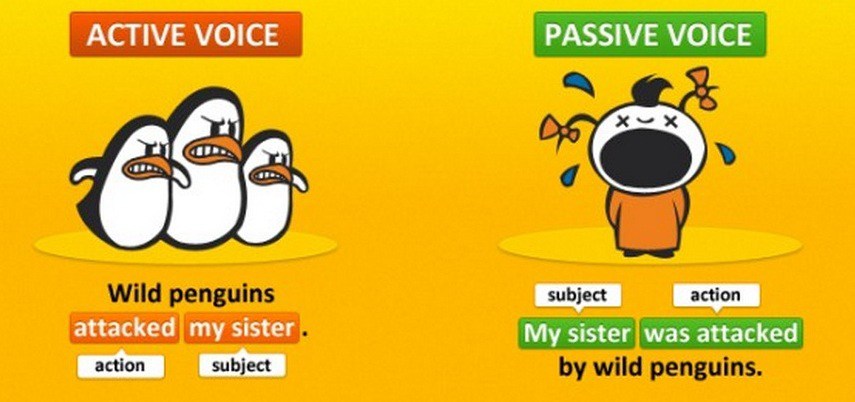
The passive voice occurs when you make the object of an action into the subject of a sentence. This is because of whoever or whatever is performing the action is not the grammatical subject of the sentence. Take a look at this passive rephrasing of a familiar joke in the English language:

Why was the road crossed by the chicken?

Who is doing the action in this sentence? The chicken is the one doing the action in this sentence, but the chicken is not in the spot where you would expect the grammatical subject to be. Instead, the road is the grammatical subject.

The more familiar phrasing (why did the chicken cross the road?) puts the actor in the subject position, the position of doing something—the chicken (the actor/doer) crosses the road (the object). We use active verbs to represent that “doing,” whether it be crossing roads, proposing ideas, making arguments, or invading houses (more on that shortly).

Once you know what to look for, the passive voice is easy to spot. Look for a form of “to be” (is, are, am, was, were, has been, have been, had been, will be, will have been, being) followed by a past participle. (The past participle is a form of the verb that typically, but not always, ends in “-ed.” Some exceptions to the “-ed” rule are words like “paid” (not “payed”) and “driven.” (not “drived”).

Here’s a sure-fire formula for identifying the passive voice:

Form of “to be” + past participle = passive voice

For example:

The metropolis has been destroyed by the dragon’s fire blasts.

When her house was invaded, Penelope had to think of ways to delay her auction.

Not every sentence that contains a form of “have” or “be” is passive!

Let’s briefly look at how to change passive voice sentences into active ones. You can usually just switch the word order, making the actor and subject one by putting the actor up front:

The metropolis has been destroyed by the dragon’s fire blasts.

The passive sentence, when converted into an active sentence:

The dragon destroyed the metropolis with his fire blasts.

When her house was invaded, Penelope had to think of ways to delay her auction.

This passive sentence, when it is converted into an active sentence:

After robbers invaded her house, Penelope had to think of ways to delay her auction.

To repeat, the key to identifying the passive voice is to look for both the form of “to be” and the past participle, which usually, but not always, ends in “-ed.”

Sometimes, the passive voice is the best choice. Here are a few instances when the passive voice is quite useful:

1. To emphasize an object. Take a look at this example:

60 Senate votes are required to pass the bill.

This passive sentence emphasizes the number of votes required. An active version of the sentence (“The bill requires 60 votes to pass”) would put the emphasis on the bill, which may be less dramatic.

2. To de-emphasize an unknown subject/actor. Consider this example:

Over 120 different contaminants have been dumped into the river.

If you don’t know who the actor is—in this case, if you don’t actually know who dumped all of those contaminants in the river—then you may need to write in the passive voice. Please remember though, if you do know the actor, and if the clarity and meaning of your writing would benefit from indicating him/her/it/them, then use the active voice.

Also, please consider the third example which is listed below:

3. If your readers don’t need to know who’s responsible for the action.

Here’s where your choice can be difficult; some sentences are less clear than others. Try to put yourself in the reader’s position to anticipate how he or she will react to the way you have phrased your thoughts. Here are two examples:

(passive) Baby Sophia was delivered at 3:30 a.m. yesterday.

(active) Dr. Susan Jones delivered baby Sophia at 3:30 a.m. yesterday.

The first sentence might be more appropriate in a birth announcement sent to the family and friends—they are not likely to know Dr. Jones and are much more interested in the “object” (the baby) than in the actor (the doctor). A hospital report of yesterday’s events might be more likely to focus on Dr. Jones’ role in delivering the baby.

Active and Passive Voice Examples – Different Grammar Tenses

Simple Present TenseTwice a month, Brian cleans his apartment. (Active)

Twice a month, the apartment is cleaned by Brian. (Passive)

Simple Past Tense – John fixed the doorknob. (Active)

The doorknob was fixed by John. (Passive)

Simple Future Tense / will – He will finish his job by 5 PM today. (Active)

The job will be finished by 5 PM today. (Passive)

Simple Future Tense / going toJackie is going to cook dinner tonight. (Active)

Dinner is going to be cooked by Jackie tonight. (Passive)

Present Progressive TenseAs of now, Corey is creating a Science project. (Active)

As of now, the science project is being created by Corey. (Passive)

Past Progressive TenseThe detective was working on the mystery murder case when his partner picked up another clue. (Active)

The mystery murder case was being worked on by the detective when his partner picked up another clue. (Passive)

Future Progressive Tense (will)

At 10:00 PM tonight, HBO will be airing the new Vice special. (Active)

At 10:00 PM tonight, the new Vice special will be airing on HBO. (Passive)

I hope that this ‘English Corner’ blog post has made clear when to use the passive voice and under which circumstances can its usage best be applied. As an English language learner, you’ll need to be comfortable with using both the passive voice and the active voice in order to become a better English writer and speaker. Please use the examples given to better your understanding of this English topic as well as how the active and passive voices are set up in the past, the present, and the future tenses. 

English Corner – The Active Voice

Every writer has a voice but it’s important to be able to distinguish which is the correct voice to use depending upon the context. There are two main voices in English writing to be aware of: the active voice and the passive voice. In this ‘English Corner’ blog post, we will be focusing specifically on how to use the active voice in your writing, which means that the subject of the sentence is actually creating the action and not the other way around.

The ‘active voice’ adds more impact to your writing, which is why most writers use the active voice instead of the passive voice. Overall, I would argue that the active voice is more important than the passive voice yet you should know how to use both effectively as an English writer.

Active Voice Usage

Sentences written in an active voice flow better and are easier to understand. When you use the active voice, the emphasis is on the subject of the sentence, which is doing the action itself. This makes the sentence straightforward and concise. Examples are:

  • I really love this TV show.
  • Gorillas live in the jungle. 

Sentences that use a passive voice are often harder to understand. Passive voice can make a sentence awkward and vague. The emphasis of the sentence changes to the receiver of the action. Some examples are:

  • This TV show is loved by me.
  • The jungle is where the gorillas live.

Passive sentences usually have more words than active ones, which is one reason why the reader has to work harder to get the meaning of the sentence, and the sentence structure can seem disorderly. If you have a composition that is too difficult to understand, you may be able to change some passive sentences to active ones. Two examples are:

  • The electoral ballots were counted by the volunteers. (passive)
    The volunteers counted the electoral ballots. (active)
  • The flowers were stepped on by the dog. (passive)
    The dog stepped on the flowers. (active)

Active Voice Adds Impact to Your Writing

The active voice adds substantial impact to your sentence; however, you may sometimes want to use the passive voice to lessen the impact of your sentence.

  • Sometimes the active voice is used to deliberately obscure who is responsible for an action, like if a politician said, “Mistakes were made” or “Shots were fired.”
  • Businesses may use the passive voice to lessen their impact like “Your service will be shut off” which is passive, rather than “We are going to shut off your service.” which is active.
  • In crime reports, a policeman would write, “the bank was robbed” because he does not know who actually robbed the bank.
  • In a mystery novel, you may want to place the emphasis on what was taken, like “the jewels were taken” rather than focus on the unknown person who took them.

In most English sentences with an action verb, the subject performs the action denoted by the verb. These examples show that the subject is doing the verb’s action:

The boy must have eaten all of the hot dogs.

            The boy (subject) is doing the eating (verb).

Jennifer mailed him the love letter.

            Jennifer (subject) is doing the mailing (verb).

Colorful iguanas live in the Amazon rainforest.

            Iguanas (subject) are doing the living (verb).

Because the subject does or “acts upon” the verb in such sentences, the sentences are said to be in the active voice. As you go through an individual essay, article, or paper, please be sure to check that you are primarily using the active voice. The passive voice definitely has its place but if you are especially trying to be persuasive, make a congruent argument, or back up your hypothesis, then you should mainly be using the active voice in those types of writing. 

If you find that the ‘subject’ of your sentence is clearly not at the beginning and your action / object is taking its place, then your sentence is not an active one by a passive one instead. The active voice always places the subject within the first word or two at the beginning of the sentence so that the reader will be well aware of who is committing the action. Please keep in mind how to use the active voice in terms of the sentence structure, what the examples show above, and in which types of writing the active voice is mainly used. If you would like to take your English writing to the next level, you must first know what the active voice is and in a later ‘English Corner’ post, the passive voice will be discussed in terms of its usage and some examples.

Lastly, think of the ‘active voice’ and the ‘passive voice’ as the Yin and the Yang of English writing. Both have their separate and unique uses but you can’t only have one in your writing. You must be able to know how to use both because there cannot be one without the other. 

English Corner – The Rules of Capitalization

Understanding the rules of capitalization is a key part of taking your English grammar understanding to a very advanced level. If you are able to know when, where, and how to capitalize letters and words correctly, you will definitely be ahead of most other English learners.

Some people may tell you that there are far more than just the main ten rules of capitalization in English, which may in fact be true. Other folks may say that there are only three rules of capitalization, and they may also be correct. However, The truth is that, depending on how you organize the rules, the rules of capitalization may be many or few based on how narrow or broad your definition of these rules are.

Most of the things we capitalize in English are what we refer to as ‘proper nouns.’ They are the names of specific and unique things.

  • If you are talking about one specific mountain (Mt. Fuji), state (Idaho) or street (Atlantic Avenue), use a capital letter for every word in the name.
  • However, when you are talking about a common thing of which there are many of them- like a mountain, a state or a street – you don’t have to use a capital letter for those words.

It’s important to remember as well that Capital letters are not used for articles (a, an, the) or for prepositions (of, on, for, in, to, with, etc.).

The Ten Main Rules

  1. Names or titles of people

This one may seem obvious, but there’s also a catch. Of course, you capitalize the first letters of a person’s first, middle and last names (John Quincy Adams), but you also capitalize suffixes (Jr., the Great, Princess of Power, etc.) and titles.

Titles can be as simple as Mr., Mrs. or Dr., but they also apply to situations wherein you address a person by his or her position as though it’s their first name. For example, when we talk about President Lincoln, we are using his role as though it were a part of his name. We don’t always capitalize the word president. Indeed, we could say, “During the Civil War, President Lincoln was the president of the United States.”

Another way to look at capitalizing job titles is to look at the position of the job title in the sentence in reference to the person’s name.

  • You should capitalize the title when it comes immediately before or after someone’s name.
  • You don’t have to capitalize the job title if it comes after the word “the.”

For example:  “Dr. Rogers was the Cardiac Surgeon.” “The cardiac surgeon allowed me to come into the room and observe the patient.”

  1. Names of mountains, mountain ranges, hills and volcanoes

Again, we’re talking about specific places. The word ‘hill’ is not a proper noun, but Bunker Hill is because it’s the name of one specific hill. Use a capital letter to begin each word in the name of a mountain (Mt. Olympus), mountain range (the Appalachians), hill (San Juan Hill) or volcano (Mt. Vesuvius).

  1. Names of bodies of water (rivers, lakes, oceans, seas, streams and creeks)

From here, it gets pretty easy. The same rules that apply to mountain names also apply to water names. A river is just a river, but the Mississippi River is a proper noun and must be capitalized, just like Lake Erie, the Indian Ocean and the Dead Sea.

  1. Names of buildings, monuments, bridges and tunnels

Man-made structures also often have names. The White House, The Eiffel Tower, The Statue of Liberty, The Golden Gate Bridge and The Lincoln Tunnel are a few good examples.

  1. Street names

It’s necessary to capitalize both the actual name part of the name (Capital) and the road part of the name (Boulevard); both are necessary for forming the entire name of the street (Capital Boulevard).

  1. Schools, colleges and universities

All of the words in the name of the educational institution should be capitalized. For example, Harvard University, Wilkesboro Elementary School, Cape Fear Community College.

  1. Political divisions (continents, regions, countries, states, counties, cities and towns)

As is the case with regions of a country, the divisions may not always be political, but you get the idea. When you refer to New England, the Midwest, the Pacific Northwest or the South as a region (as opposed to a compass direction), you capitalize it. Also, continents (South America), countries (Belgium), states (Wisconsin), counties (Prince William County), cities (London) and towns (Lizard Lick) get capitalized.

  1. Titles of books, movies, magazines, newspapers, articles, songs, plays and works of art

This one’s a little tricky when ‘and,’ articles or prepositions are involved. If ‘the’ is the first word in the given name of a work, it must be capitalized (The Washington PostThe Glass Menagerie). If ‘a’ or ‘an’ is the first word, it too is capitalized (A Few Good Men), and if a preposition leads the way, you guessed it: Capitalized (Of Mice and Men). However, if any of these words come in the middle of the title, it is not capitalized.

  1. The first letter in a sentence

The last two rules are easy. Always capitalize the first letter of a sentence. If the sentence is a quotation within a larger sentence, capitalize it, but only if it’s a complete sentence. If it’s merely a phrase that fits neatly into the larger sentence, it does not require capitalization. Study the following two examples for clarification:

  • The waiter said, “My manager will be here shortly,” but he never came.
  • The waiter told us that his manager would “be here shortly,” but he never came.
  1. The pronoun ‘I’

It’s only necessary to capitalize other pronouns when they begin a sentence, but ‘I’ is always capitalized.

Remembering the Rules

How can you possibly remember all these rules? Well, first of all, you should ask yourself three questions:

  • Is this the first letter in a sentence? If the answer is yes, capitalize.
  • Is this the pronoun I? If yes, capitalize.
  • Am I using a name that someone gave to this thing or person? If yes, capitalize.

And if you want to remember all the specific categories, try memorizing one of the following sentences.

  • “For Bob Barker, the price is wrong sometimes,” Adam says.
  • Susan Sarandon bought my wife fancy toilet paper in Boston.

The first letter of each word stands for a category:

  • F– First letter in a sentence
  • B– Buildings (and other man-made structures)
  • B– Borders (of regions, states, countries, etc.)
  • T– Titles
  • P– People
  • I– I
  • S– Schools
  • W– Water
  • M– Mountains
  • S– Streets

Other Examples of Capitalization

First Word of a Sentence

The cat is sleeping in my bedroom.

Where did I put that book?

Hey! It’s great to see you! How have you been?

Names and Personal Pronouns

My favorite author is Jonathan Franzen.

Tom and Diane met at Jill’s house.

Have you met my dog, Barry?

The First Word of a Full Quote

Mario asked, “What is everyone doing this weekend?”

Stacy answered, “My sister and I are going to the theme park.”

Days, Months, and Holidays

I hate Mondays!

Harry’s birthday is in July.

Oh no! I forgot about Mother’s Day!

Words in Formal Titles

Lord of Rings is better than A Song of Ice and Fire.

The first movie of the series is Harry Potter and the Sorcerer’s Stone.

Cities, Countries, Nationalities, and Languages

English is made up of many languages, including Latin, German, and French.

My mother is Italian, and my father is German.

The capital of Ethiopia is Addis Ababa.

Time Periods and Events

Most of the World War I veterans have now passed away.

In the Middle Ages, poor hygiene was partly responsible for the spreading of the black death.

High school history students often enjoy studying the social changes that took place during the Roaring Twenties in the United States.

In this article, it is not just the ten main rules of capitalization that we have to be aware of. There are many other additional rules where you can use capitalization on a consistent basis. The examples shown above should help you, the reader, to understand when and where these words can be capitalized and to notice a pattern in terms of how these rules can be applied. 

Overall, capitalization is a very tricky topic to fully master but if you know the rules and you know when not to capitalize at all just for definite / indefinite articles along with prepositions, you will be well on your way to having a handle on this advanced grammar topic. It’s important to not be overwhelmed by all of the rules out there including the additional ones that were highlighted here. Starting off with the ten main rules of capitalization is a sufficient enough starting point to focus on. With Capitalization, you do not want to bite off more than you can chew and while the ‘additional rules’ of this grammar topic are important, it’s best to focus on the main rules such as geographic features, names of people / titles, the first letter in any sentence, etc. Good luck!