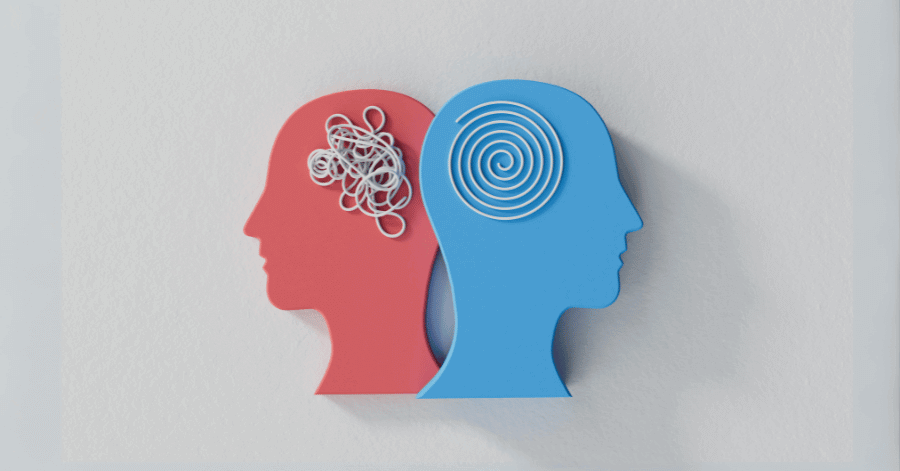
Cause, Chaos, and Consequence: Ripple vs. Butterfly Effect Explained

“I’ve written about the Ripple Effect before but while they sound like each other, The Butterfly Effect is far from being the same thing as a concept. They are philosophical cousins to be honest but while they are related, they were both raised in different households.”

I’ve written about the Ripple Effect before but while they sound like each other, The Butterfly Effect is far from being the same thing as a concept. They are philosophical cousins to be honest but while they are related, they were both raised in different households.

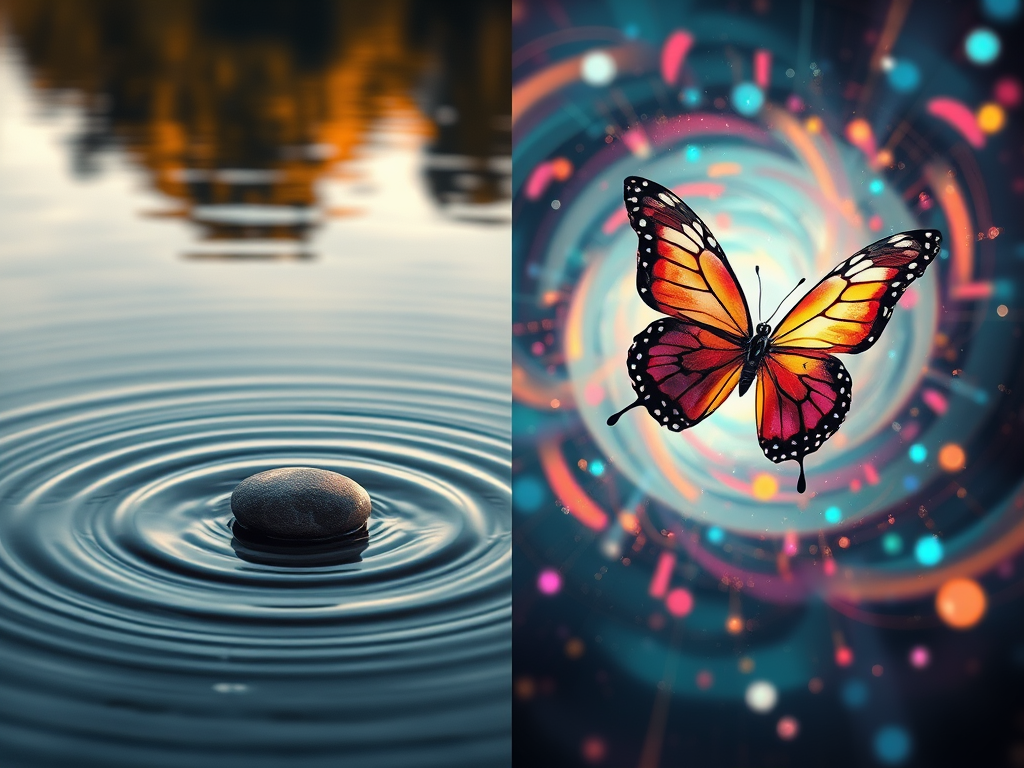
To give some further background on the Ripple Effect, it is one action that causes a series of consequences that spread outward like ‘ripples on the water.’ These are both linear and observable consequences that are clear to see, like water droplets hitting the ocean. For an example of this phenomenon, if you donate to a college scholarship fund, that money would directly help a student go to a college or university. Maybe that student goes on to start a non-for-profit because of the help you gave to help hundreds of other students who were in the same position as he or she was when you donated the money. The effects of your one action spread out logically from the original action taken. The ripple effect has been used in the social sciences, in business development, and in personal decision-making each day.

When it comes to the Butterfly Effect, the definition of it pertains to a very small or slight change in the initial conditions of someone’s day or a event that was rather small or insignificant at the time that ends up causing unpredictable and massive effects down the line affecting untold numbers of people. The key idea for this phenomenon is that events can be nonlinear and cause chaotic consequences when you think the effects would have been minimal or nonexistent instead. For an example, a butterfly flapping its wings in Mexico could theoretically start a chain of atmospheric events that cause a tornado to occur across the border in Texas. The Butterfly Effect is often used in describing chaos theory, meteorology, or how complex systems work together succinctly or can become dysfunctional rather rapidly.

AspectRipple EffectButterfly Effect
DefinitionOne action causes a series of predictable consequencesTiny change leads to massive, unpredictable outcomes
Nature of ImpactLinear and logicalChaotic and nonlinear
PredictabilityGenerally predictableHighly unpredictable
ExampleHelping one student who then impacts othersBeing late to an event and missing a life-changing meeting
Field of OriginSocial sciences, psychology, personal developmentChaos theory, meteorology, complex systems
Visual MetaphorPebbles dropped in water creating wavesButterfly flapping wings triggering a tornado
Control Over OutcomeModerate to high: effects unfold over timeLow: small causes can lead to wildly disproportionate results
Typical UsageCause-and-effect logic in planning or strategyDescribing randomness or complexity in systems

Regarding the main difference between The Ripple Effect and The Butterfly Effect, ripple effects are much more predictable to the average person, and you can trace the causality more easily. Butterfly effects and their events are unpredictable, chaotic, and can happen when you least expect them yet have been put into motion for quite some time. To sum it up, Ripple effects have an obvious cause and effect that are easy to explain and observe while butterfly effects show how tiny inputs or changes can lead to wildly disproportionate outcomes.

To explain how this would play out in the real world, a Ripple Effect in one’s personal life would be deciding to go to the gym three times a week consistently. You start to feel healthier, have more energy, sleep better at night, improve your mood, you’re more productive at work, which leads to a monetary raise or even a promotion in your title. That one small but consistent change to your lifestyle with a new habit consistently done can ‘ripple’ out across your whole life in a predictable way given the known yet useful benefits of consistent exercise. 

As for the Butterfly Effect example when it comes to your personal life, let’s say you show up five minutes late to an important networking event. As a result, you may miss meeting someone who could have been a business partner for your new venture. Your career ends up going in a completely different direction because of that missed opportunity. Because of that, you end up having to move and live in a different city, with different friends, and a different lifestyle, all because of that five-minute delay that happened once in your life. This is a key example of an unpredictable event with unforeseen consequences. You probably or will never realize how your life changed as a result unless someone observing your life full-time could tell you about the chain reaction that occurred because of that late networking event arrival.

We can also look back at history for key examples where the ripple and butterfly effects were present in what happened in retrospect. With regards to the ripple effect, the Civil Rights movement in the United States leads to the Civil Rights Act being passed by Congress. This law causes desegregation to take place in public schools, which opens more education and job opportunities for minority students and eventually leads to more diverse leadership in both government and business. It’s a chain of predictable and traceable events that go back a few decades, but for which still resonates up through the modern era.

A famous example of the Butterfly Effect in action from world history was when an obscure Serbian nationalist, Gavrilo Princip, assassinated the Archduke Franz Ferdinand of Austria, in 1914. After that momentous but surprising event happened, Austria-Hungary declared war on Serbia, alliances with France and Russia kicked in, which lit the spark that consumed Europe during the first World War.

This momentous event of World War I then led to the fall of empires like the Ottoman and British empires over time, the stale peace that led to World War II, and then the rise of Communism and the Cold War. Would a war have started regardless of if Franz Ferdinand had not been assassinated that day? Most likely, but there was a chance that it would not have happened had the assassination not occurred. That one moment created chaos and unforeseen consequences that no one in Europe or around the world could have foreseen at that time in 1914.

Understanding the differences between the ripple effect and the butterfly effect isn’t just academic, it’s practical for your own life. In our personal lives and careers, most of us try to make thoughtful choices, expecting reasonably predictable outcomes. That’s the ripple effect in action: you invest time in learning a skill, and it pays off in future opportunities. However, life doesn’t always play by those rules. Sometimes, a seemingly insignificant decision, sending a message, missing a meeting, crossing paths with someone new, spirals into consequences no one could’ve predicted. That’s the butterfly effect crashing into the party to say it has arrived. Knowing both concepts helps us become more intentional with what we can control while remaining humble about what we can’t control. It’s the mental toolkit for navigating both stability and chaos in this uncertain world.

The truth of the matter is that life is shaped by both ripples and butterflies. Some of your actions will create steady waves of impact over time while other choices might unleash unpredictable storms. That doesn’t mean you should live in perpetual fear of chaos or paralysis over tiny choices. It does mean though that we should approach life with a mixture of clarity and curiosity: plant the seeds you can in life, but don’t be shocked if something unexpected grows.

As the saying goes, “We make plans, and the universe laughs.” Still, you should plan anyway and be prepared with the awareness that every choice matters, even when the outcome doesn’t go according to plan. You might be one ripple away from changing your community or your world, or one butterfly flap from a wild new chapter in your life.


Control What You Can Control

“Instead of trying to change things that we cannot control, it is best to focus solely on things that we can control and hope that we can make a positive impact on the people around us and the wider world through this kind of ‘ripple effect.’”

There is only so much that we have control over in our lives. We are constantly being influenced and affected by factors outside of our control for which we may not even have any awareness of. There are events that take place each day of our lives that can change our trajectory without us even knowing. We try to make sense of the lack of control we have but it does no good to constantly be wishing things were different if you were to have control where none exists. Instead of trying to change things that we cannot control, it is best to focus solely on things that we can control and hope that we can make a positive impact on the people around us and the wider world through this kind of ‘ripple effect.’

Life is unpredictable each day, filled with uncertainties and unknowns that can provoke anxiety, frustration, and stress within us. From work pressures to global events, it’s easy to feel overwhelmed by circumstances that appear beyond our control or influence. In this chaotic and ever-changing world, I believe it’s important to adopt the mindset of “control what you can control” to foster both resilience and personal fulfillment. By focusing on what is within our reach, we gain clarity on what is most important, reduce stress, and strengthen both our mental and physical health, preparing us to navigate the complexities of life.

It’s natural to feel compelled to try to control everything or as much as we can in life, especially in a world that rewards constant achievement and control over one’s surroundings. However, trying to control things that lie outside our influence can lead to a never-ending cycle of frustration and disappointment. Conversely, focusing on what we can control allows us to feel grounded and empowered, fostering inner peace despite external turbulences.

By narrowing our focus on what we have control over, we can manage our energies better and put it toward actions that genuinely make a difference in our lives and for those around us. Concentrating on our own responses, attitudes, and habits lets us sidestep the paralyzing effect of factors beyond our control. This approach is about freeing us from wasting energy on things that simply cannot be changed. Adopting this mindset is not about giving up or avoiding the ills around us but about creating a more productive and healthy approach to life’s challenges.

It’s a fair question to ask at this point in what do we have control over? It is more than you would think based on this list below of what we can control in our life.

  1. Our Attitudes and Perspectives

How we perceive situations has a profound effect on how we experience them. While we may not control the events, we do have control over how we interpret and react to them. Developing a positive or growth-oriented mindset allows us to find lessons, strength, or motivation even in difficult situations. When we focus on what can be gained or learned from the events, setbacks become opportunities for growth rather than new sources of despair.

  1. Our Reactions and Behaviors

Our reactions are among the most tangible aspects we can control in life. Although emotions often arise involuntarily without much forethought, we can practice responding to situations in ways that align with our values. Choosing how to react, rather than allowing automatic responses to take over, is a skill that can be developed with focusing on mindfulness. This life skill enables us to handle our challenges more constructively, turning potential stressors into manageable experiences.

  1. Our Habits and Choices

The habits and routines we cultivate each day play a significant role in our quality of life. We control what we eat, what we drink, how much sleep we get, and how we manage our free time. Positive routines, such as regular exercise, limiting social media content, focusing on healthy eating, and setting aside time for relaxation, create a foundation for resilience and better health. When we invest in these areas of life, we build a stronger buffer against the impact of unexpected difficulties and changes.

  1. Our Goals and Efforts

While outcomes that happen to us or that which affect us are not always within our control, our efforts are in our control. Setting personal goals and consistently working toward them provides us with a sense of purpose and direction. Focusing on the quality of our work, rather than obsessing over the potential results, ensures that our self-worth remains stable regardless of external factors. This effort-oriented mindset helps us feel accomplished and satisfied even in unpredictable and changing environments.

Understanding what lies beyond our control is essential in practicing acceptance and letting go of what is beyond our grasp. These examples include:

  1. Other People’s Actions, Behaviors, and Opinions

Attempting to control how others think, feel, behave, or act is an exhausting and fruitless endeavor. People are influenced by their own experiences, beliefs, and emotions, which we cannot change. Rather than trying to shape others’ opinions or actions, focusing on tolerance, self-respect, and authenticity allows us to establish genuine connections without feeling responsible for people’s behaviors.

  1. External Circumstances and Events

Natural events, market trends, or political shifts are all examples of uncontrollable circumstances that happen to all of us. While we can adapt to these realities and prepare for them to some extent, we cannot dictate or know when they will occur or what the outcome(s) will be. Learning to accept and know that the world will continue to evolve with or without our influence is liberating; it relieves the pressure of feeling responsible for the many forces beyond our own reach.

  1. What Happened In The Past and What Will Happen In The Future

The past is unchangeable as we cannot go back to change anything about it and the future remains uncertain at best. While reflecting on our past experiences can provide insight and comfort to us; dwelling on past mistakes or obsessing over potential future scenarios drains our energy that could be used in the present to improve our daily lives. Embracing the present moment enables us to shape our future without being paralyzed by what it may be or what you think it could be.

When we focus on controlling what is within our reach, we naturally turn inward to cultivate resilience especially when times are tough. Investing in our mental and physical health creates a solid foundation that allows us to weather the storms of life, even those we cannot control at all.

Practicing mindfulness and self-care helps us stay present and reduces anxiety about both the present and future. Activities such as meditation, journaling, painting, or simply spending time in nature help to cultivate a calmer mind. Regular acts of self-care, such as setting boundaries, prioritizing rest, and engaging in hobbies helps nurture a strong mental state. When our minds are balanced, we’re better equipped to face challenges with a clear, calm perspective.

Physical health also supports mental resilience, making daily exercise, balanced nutrition, and sufficient rest, vital components of handling stress and anxiety. Physical exercise releases endorphins, boosts our mood, and reduces out stress. When our bodies are well-nourished and strong from exertion, we can face life’s uncertainties and changes with more stamina and energy.

We can always control who we spend time within our personal lives. Building meaningful connections with others we care about creates a network of support, which is especially important when facing various challenges. We cannot control how others act, but we can control the energy we put into cultivating positive relationships. Trusted friends, family, or networking groups offer encouragement, perspective, and comfort during tough times.

Developing a growth mindset will serve you well throughout life especially in being able to exert more control in areas of professional and personal development. It is key to have an openness to learning from every situation, which helps us adapt and thrive both in the workplace and at home. Life rarely goes exactly as planned, but those who can adapt to those changes we cannot control maintain resilience and will be better off as a result. Investing time in learning new skills, embracing change as much as possible, and nurturing a lifelong curiosity and inquisitiveness empowers each of us to see life’s challenges as opportunities for growth and improvement.

Adopting this philosophy of “control what you can control” is not easy to do but it does empower us to live more peaceful, healthy, and balanced lives. By focusing on what we truly have influence or control over such as our attitudes, learning, reactions, habits, and health builds resilience and clarity. Accepting that certain aspects of life are beyond our control frees us from futile worry and frustration as a result. In this way, we prepare ourselves to not only withstand life’s uncertainties but to thrive amid them, cultivating inner strength and well-being. In the end, it is not about being able to control life itself; rather it is about becoming the best stewards of ourselves as we navigate the beautiful, unpredictable, and uncertain journey that is life itself.

Some Thoughts On “This Too Shall Pass”

“The main message of the quote is meant to be comforting to those who hear the words strung together either in a poem, a speech, a song, or a fable, and it is supposed to let us all know that whatever we are experiencing or feeling at the moment, whether it is positive or negative, good or bad, happy or sad, “this too shall pass.”

A favorite quote of mine in the English language, originally adapted from Farsi / Persian centuries ago, has been used by both Sufi poets and American presidents alike to describe the impermanence of everything. The main message of the quote is meant to be comforting to those who hear the words strung together either in a poem, a speech, a song, or a fable, and it is supposed to let us all know that whatever we are experiencing or feeling at the moment, whether it is positive or negative, good or bad, happy or sad, “this too shall pass.”

The human condition is ever evolving and what we experience one moment, one hour, or one day can be drastically different later from what was before. Nothing is permanent as we all know because one of the first things we become sentient of is our own mortality and our own impermanence on Earth. While this can fill us with existential dread and despair, it can be a blessing too because the pain, the suffering, and other negative emotions we experience in this life are not for forever. Just as we can’t be experiencing euphoria in the form of only good things happening every moment of our life, the same can be said for having everything go wrong throughout life.

What happens to us in life is largely beyond our control but what we can control is how we react to life and its challenges. In addition, we should remind ourselves that tough times are not forever and if you stay in the game, you keep moving forward, you give yourself a chance of pulling yourself out of a bad rut or a down time. I find it healthy emotionally to remember the Persian and now translated to English saying of, “this too shall pass.” It is a good reminder for us all about the impermanence of all things we experience including life itself.

In addition, this quote of “this too shall pass” can be correlated to “carpe diem” because we must do our best to enjoy life despite its challenges because we never know how many days will be given to live this life. You may not know what life will throw your way day by day, but you should be prepared to make the most of it, to ‘seize’ it, and to have an impact on it in whatever way you can.

The impermanence of everything in life should make us savor the good moments more whenever they come to us. We can remind ourselves that the bad times don’t last forever too and that good times can be just around the corner if we believe in ourselves to turn things around. Being more grateful, more appreciative, more kind, and being a better person even when we don’t feel like karma or life itself is reflecting the good that we’re doing should not mean we stop trying. The reward of life is to live it to the fullest and to do it well even with the inevitable ups and downs, the highs and lows that come with it.

We must refuse to give up or surrender when the bad times in life challenge us, sometimes beyond what we would ever want to endure. We must believe in doing good and being good even when bad things or times happen to us. Life is a gift; however we are affected by existing and living day by day, we must make the most of it and to continue making our lives better even when times are tough on us. Those four words of “this too shall pass” have comforted people in different cultures and in different languages throughout the centuries.

The human condition is not the same day by day and what we experience today will not be what we experience tomorrow. Time can blend, routines can become suffocating, and experiences can become mundane in life, but it is up to you and you alone first to make changes to your life, to make different choices to how you react to life, and to form different habits that could make what looks like a permanent situation turn into a temporary blip in your life trajectory. We may think that we are on a set course, but we have agency, and nothing is permanent, and we can make our lives what we wish if we decide to act and make change to go from good to bad or bad to good depending on how we act on both our actions and choices.

“This too shall pass” is a timeless piece of wisdom that resonates deeply with the human experience and has done so for centuries. At its core, this universal phrase has served as a powerful reminder to all human beings of the impermanence of all things and of life itself. By acknowledging that both good and bad moments are fleeting, we cultivate a healthier and balanced perspective on life. When faced with the challenges life throws at us each day, remembering that “this too shall pass” helps us to endure the hardships with greater resilience, humility, and patience. It encourages us to stay grounded, knowing that difficult times will not last forever. This outlook can alleviate the weight of anxiety and stress, providing a sense of hope, belief, and a clear mind to navigate through life’s adversities.   

Similarly, this kind of wisdom also teaches us to cherish the happy and joyful moments more fully, understanding that they are both precious and temporary. It fosters an appreciation for the present moment we are living in, urging us to savor the beauty and happiness we encounter even in a minute way. By internalizing this phrase in our lives, we become more mindful and grateful for the positive experiences in our lives when they occur.

Incorporating “this too shall pass” into our mindset every day can lead to a more balanced emotional and mental state. This quote promotes resilience by reassuring us during tough times and maximizing our joy by reminding us to live in the present, whether good or bad. Ultimately, this simple yet profound wisdom from earlier times in the history of humanity helps us embrace the ebb and flow of life with grace and humility, transforming how we approach both our triumphs and our trials.

The Virtue of Showing Emotional Restraint

“It’s important to explore the concept of having emotional restraint when facing criticism, the benefits of not escalating the situation to make it worse than it needs to be, and how it demonstrates maturity and grace when you can show restraint in the face of judgment or criticism, whether deserved or not.”

In both professional and personal settings, criticism is an inevitable part of life. Whether it comes from a colleague, a friend, or a family member, criticism can be challenging to navigate but important to embrace if it is justifiable. However, it can be especially difficult when the criticism is unwarranted or unjustified. Therefore, it is crucial to show emotional restraint in these situations, even when it feels difficult, rude, or unfair.

It’s important to explore the concept of having emotional restraint when facing criticism, the benefits of not escalating the situation to make it worse than it needs to be, and how it demonstrates maturity and grace when you can show restraint in the face of judgment or criticism, whether deserved or not.

Emotional restraint is known as the ability to control one’s emotions, particularly in challenging situations. When faced with criticism of something you did or something you said, it is natural to feel a range of emotions, including anger, frustration, and sadness. However, acting on these emotions and turning it back on the person(s) doing the criticism of yourself can often lead to negative outcomes. For example, responding to criticism with anger or defensiveness can escalate the situation and damage relationships, sometimes permanently. It can also lead to regrettable actions or words that cannot be taken back without regret or remorse.

On the other hand, showing emotional restraint allows individuals to respond to criticism in a calm, cool, and collected manner. This kind of attitude change can lead to more productive conversations and resolutions to problems that can arise. It also demonstrates emotional maturity and self-control, which are valuable traits in both personal and professional settings that will serve you well in life.

Emotional restraint is crucial in various everyday situations, as it helps maintain composure and fosters healthy relationships with other people. Here are a few examples where having good restraint in everyday situations can come in handy:

  1. Workplace Criticism: When receiving feedback or criticism from a colleague or a supervisor, it’s essential to remain calm and composed and to not react. Reacting impulsively or defensively can escalate the situation and damage your professional relationships. Instead, by showing emotional restraint, it allows for a more constructive dialogue and a better understanding of the feedback that you are getting, whether you feel it’s warranted or not.
  2. Family Disagreements: In family settings, disagreements are common, but reacting emotionally can lead to unnecessary conflict and trauma. By showing emotional restraint, individuals can avoid saying hurtful or insulting things they may regret later and work instead towards a resolution calmly and rationally that will maintain the relationship rather than rupture it.
  3. Social Media Interactions: Online interactions can often lead to heated debates or arguments especially since they are being done behind a screen and not face to face with that person or a group of people. Instead of engaging in a war of words that can seemingly go on forever and escalate to be rude, nasty, or involve insults, you should be exercising emotional restraint, which can help maintain a respectful discourse and prevent the situation from escalating to bullying or harassment.
  4. Customer Service Interactions: Dealing with difficult customers or clients in your work or volunteering often requires having emotional restraint. Remaining calm, kind, and empathetic can help resolve issues more effectively and maintain a positive reputation for the business or company that you’re working or volunteering for.
  5. Traffic Incidents: Road rage is a common issue in our society, but showing restraint can prevent dangerous or deadly situations. Taking a deep breath, maintaining your focus on what you can control on the road, and staying calm and relaxed can help avoid confrontations and maintain safety on the road and help save yourself from an accident or a crash. You never know who you’re dealing with the other car or truck or bus so it’s best to not yell, engage them further, or leave the vehicle at any time to escalate such a dicey situation when it comes to ‘road rage.’

In any of these types of situations, having emotional restraint allows you to handle conflicts and criticism more effectively, fostering healthier relationships, and promoting a more peaceful environment. When faced with receiving criticism which will happen both professionally and personally, it can be tempting to respond in kind or to escalate the situation with the other party. However, this rarely leads to a positive outcome and can make the situation worse. Instead, it often leads to a cycle of negativity and conflict. By showing emotional restraint and not responding in kind to get into an argument or worse, individuals can break this difficult cycle of bad behavior and create a more positive environment.

Not escalating the situation also allows individuals to maintain their dignity and self-respect. It shows that they are confident in themselves and their abilities, and that they do not need to resort to negative behavior to defend themselves from criticism, whether it is justified or not from the other party. This kind of attitude can earn them respect from others including co-workers, romantic partners, or friends, and help to build and maintain stronger relationships when you show positive characteristics in your behavior by not reacting in a negative way.

Emotional restraint is both a sign of emotional maturity and grace. It shows that the person in question can control their emotions and can respond to criticism in a thoughtful and measured way to learn from their mistakes or to just take it in stride by not losing control of their emotions. This can be especially challenging when the criticism is unwarranted or unjustified. However, by showing emotional restraint, individuals can rise above the situation and demonstrate their maturity and grace in their dealings with other people.

Emotional restraint also shows that someone can put the needs of the relationship above their own ego. It shows that they are willing to listen to others’ feedback and consider the other person’s perspective, even if they disagree with it or won’t change because of it. This can lead to more open and honest communication, and ultimately, stronger friendships and relationships.

Overall, it is necessary these days to have emotional restraint as it is a valuable skill that can help individuals navigate criticism in both professional and personal settings. By showing emotional restraint, individuals can respond to criticism in a calm, cool, and collected manner, and avoid escalating the situation further. This kind of behavior from mature adults can lead to more productive conversations, problem solving, and better resolutions, and ultimately, a healthier and happier life by having this kind of outlook on managing your emotions well.

Emotional restraint demonstrates the need for having both maturity and grace and shows that someone should be able to put the needs of the relationship above their own ego or beliefs. Having the capacity for emotional restraint is an important life skill that can help individuals navigate criticism with both dignity and decency.  

Don’t Look Back In Anger

“Instead of spreading that anger and letting it spread elsewhere, the anger you feel should instead be reversed to acting out in happiness and caring to keep that specific ‘ripple effect’ of anger from spreading.”

Anger is an emotion that we all experience at one point or another in our lives. While it’s inevitable to experience this emotion, but what is especially important is how we use that emotion and how we deal with it. Instead of letting it stir within us or to lash out to that person who angered us or for those close to us who we vent to, I believe it’s best to take that anger and channel it into something positive. Instead of spreading that anger and letting it spread elsewhere, the anger you feel should instead be reversed to acting out in happiness and caring to keep that specific ‘ripple effect’ of anger from spreading.

Instead of taking that anger you receive as a reflection of who you are as a person and letting it bring you down, try to let it reflect not on you but on the person doling it out to make you angry. The anger that they give out is more likely than not about you but about how they are feeling or what’s happened to them before. Anger is not often personal but often about how that person is being treated and instead of breaking the cycle, they continue to take their anger they received and spreading it to other people.

Perhaps in other cases, that person’s anger at you is justified if you did something wrong or erred in some way but their anger is not likely to change your behavior and may backfire if you take offense at their tone. When receiving someone’s anger, it’s important to respond rationally that you understand their frustrations at see what their criticism is about but that you don’t appreciate the way they are going about airing their grievances with you in that manner. It is important to explain that if they are angry about you, they can voice it in a measured tone without yelling or being contemptuous as that will prevent you from taking their anger seriously.

When receiving someone’s anger, do your best to hear them out and to apologize if you were in the wrong but don’t get angry if you can and don’t redirect that anger back or to hold it in you that it affects your mood for days, weeks, or months. As you go through life, you are going to be likely on both ends of anger as an emotion but it’s best to realize that anger is not a good emotion to experience and it’s best to avoid even if you’re frustrated or disappointed or annoyed with someone or something. It’s likely that you will experience anger on your own but to not let that anger grow or linger or eat you up inside. On top of that, if you receive anger whether you feel you deserve it or not, you cannot take that anger from someone else and let it stay with you for very long.

As one of my favorite sayings in English goes, you should not ‘look back in anger’ and to let it consume you. Any anger you’ve had or received needs to fade away and you must let go of it or else it will worsen your life on top of your present and future relationships with other people. Letting go of grudges, not dwelling on past blowups, or forgiving people from wrongful words or actions is a key part of maintaining a healthy attitude towards anger. Part of that attitude towards anger is forgiving yourself for past transgressions related to your anger and then forgiving others as much as possible for their anger towards you, deserved or otherwise. Often, you will have to give people the benefit of the doubt and realize that some people don’t control their anger well or lash out at you or others because they don’t have a healthy attitude towards that emotion.

However, instead of letting others have their anger spiral out of control or to let yourself get angry in response, it’s best to not be angry in response or to just breathe, take time to think it through, and respond in a way that does not let your emotions take control of your words. You should try to prevent yourself from letting your anger get the best of you and to say something to somebody that you cannot take back and ruin your relationship or friendship with them. Noticing that you’re angry with them is enough to at least have a conversation with the person in a mature and measured way without letting that anger boil to the surface.

Quite simply, the anger needs to dissipate, or it will infect other parts of your life and cause you to lash out at other people who don’t deserve your anger or are unrelated to what caused that anger in the first place. You would be better off when you stop holding on to that anger or looking back on it. If you can let it go, let it go completely but if you can’t, try not to think about it and remember that all emotions come and go and that is the way it should be. Anger can be channeled into more productive uses of your life like going to the gym to release the tension, writing your thoughts down and working through your emotions and reflecting why and how your anger came to be, or just talking through your anger with a trusted friend or a family member who you feel comfortable sharing that emotion with.            

Being able to channel your anger into something positive or something worthwhile is a key test of being a mature individual. Anger is a negative emotion but that doesn’t mean it has to go on forever or cause you to be a negative person. Knowing how to deal with it at first, react to it in a measured manner, and then eventually letting it go to leave it in the past where it should remain will help you to not look back on anger and to keep it from reaching the surface of your emotions again. As the famous Oasis song goes for which this blog article was inconspicuously titled regarding how to deal with anger at someone close to you whom you’ve grown apart from, “Don’t look back in anger, I heard you say…, at least not today.”

Stay on Top of Things

“Staying on top of the things in your life from finances to exercise to managing your home are all ways to have peace of mind. There are a lot of things in life we have no control over so I encourage you all reading this article to put those things you can control on your to-do list each day and each week.”

It can be hard for a lot of us these days given what’s going on in the world. It is easy to be stressed out, anxious, and generally worried about the future. I would say that on the whole people don’t do well with uncertainty and not knowing what the future holds. It can be quite daunting not know what will happen a month from now, six months from now, or even a year from now. When I think of myself who prefers certainty and planning things out on a week-by-week basis, it can be frustrating to have to change or amend plans due to lack of feasibility or to remember that the world has changed, and you have to adapt to it.

Instead of fighting an uphill battle against the various changes going on in our society right now not alone to due to the pandemic but other economic and social factors, you have to learn to swim with the tide and to adapt as best as you can. Part of doing that is also knowing what it is strictly under your control each day and exercising that kind of control as best as you can. Given a lot of things in our lives now are out of our own control, the best way to combat that fact is to stay on top of the things we can control and to do them to the best of our abilities.

As I’ve mentioned in a previous article about the common-sense kind of wisdom of U.S. Navy Admiral William McRaven, who said that the best way to start your day is “to make your bed” and it relates to having a sense of control in a world where we often lack control. It is also a larger part of staying on top of things or tasks in your life that will always need your attention and won’t get done without your effort. Making your bed is a good habit to build each day and will make you feel better right away for taking action over a thing that you have direct control over.

Other things involve getting enough sleep each night (7-8 hours preferably) and managing that aspect of your life well so you can perform better in your work or schooling. Staying on top of things also involves our diet and our exercise routine. These things are more open ended but establishing what is a good diet for you, buying the food items each week that contribute to your diet, and then cooking the meals to reflect that diet are important things to stay on top of in your life. The general guidance for exercise is 3-4x a week and I’ll leave it up to you to decide how you exercise whether its weightlifting, yoga, running, sports, or even martial arts. The important thing to do is to keep track of how much exercise you’re getting each week, how consistent you are being with it, and whether you are seeing any improvement(s) in your life based on your exercise regime.

I also want to prioritize the importance of control over one’s domain or where you are living. You will feel better when your place is clean, when things are organized, and when you are not living in a place that is messy and unkempt. Part of being a responsible adult is to independently take care of yourself with your grooming, your appearance, but also your abode. Don’t let another thing that you have control over fall by the wayside. Take the necessary time to clean and to tidy your place up from the bathroom to the kitchen to the living room. Your self-esteem will be raised from doing that and you’ll be better off for exercising control of your living space, which is an important place where now we are working from more often and also studying from in this time of the pandemic.

When it comes to staying on top of things, it means making sure too that you are managing your finances whether it’s saving more money, not spending beyond your means, and recording your budget on a weekly or monthly basis. Financial management is a key thing to stay on top of and it will help you to organize your life in another necessary way. It is also a way to be in control because it’s your money and only you know where it’s going each month and how much money you have available to you.

Our own relationships with friends and family members are another aspect of our lives that we often overlook our control of. We can choose to associate with people who value us, respect us, and care about us and I would say that it’s important to prioritize those people, whether family, friends, or general acquaintances who value not only our time but who we are as human beings. You can control who you give your time and effort to in relationships and it’s important to exercise that right to let those people into your life who treat you well, who like you for who you are, and don’t try to belittle or demean you.

Lastly, I do want to mention that beyond taking care of your bed, your sleep, your diet and exercise, your finances, and your relationships, you have to take care of yourself. Mental health is extremely important as well as physical health these days and it’s important that you make time in your life to check in with yourself, to go easy on yourself in terms of not beating up on yourself too much for past mistakes. If you need to meditate or treat yourself to a movie or a video game or a hike on your own, I believe you should do so. If you need to talk to someone about your mental health in a private manner, I encourage it as well. Talking to a licensed professional is something you always have control over so you should feel free to do so if you need to help your mental health. There is absolutely nothing wrong with doing that and it should not carry with it any kind of stigma or reservation.

Staying on top of the things in your life from finances to exercise to managing your home are all ways to have peace of mind. There are a lot of things in life we have no control over so I encourage you all reading this article to put those things you can control on your to-do list each day and each week. Please make it a priority to handle those pending things in your life that you alone are responsible for and don’t let these small things pile up.

You will feel better and happier for handling the small things well before you take on the big things. If you want to make a difference in the world, start by making a difference in your own life and see how that positive momentum will carry you forward. If you can handle your own business successfully, you will gain more confidence and be more self-reliant, which are positive traits when it comes to handling uncertainty, unease, or the inability to know what the future holds. Take things on one day at a time and do the things you can to the best of your ability as often as you can.

The Why of Doing Mundane Tasks

“When the famous American inventor and politician, Benjamin Franklin, indicated that the two certainties in life were ‘death and taxes’, I think he forgot to mention an overlooked third one that we all experience at one point or another: mundane tasks.”

How much of our lives are made up of dull and repetitive tasks that we would rather not do? How often during the day, the week, the month, or the year are made of things that we have to do out of lack of choice but also an obligation? Whether it is an obligation based on our work, our homes, our hobbies, or our businesses; mundane tasks are simply part of life’s overall equation. When the famous American inventor and politician, Benjamin Franklin, indicated that the two certainties in life were ‘death and taxes’, I think he forgot to mention an overlooked third one that we all experience at one point or another: mundane tasks.

Whether it is going to pick up the newspaper or taking the mail in or dropping off something at the post office, these little errands or tasks are unavoidable and are not the most stimulating to go through. Other tasks like going to the supermarket, cleaning out a pool or cleaning your pool, doing the laundry, washing the dishes are all repetitive but if you notice how mundane they are, you will likely have a worse time doing them all and forget how important they are.

While we may think that we lack control over these dull tasks, the truth is we often do control our attitude to these mundane tasks and how we go about doing them. We control if we do them at all, how we do them, and how fast it will take us to do them. We can make them fun or enjoyable with the help of some music or even a game to see if you or a friend or a family member can do them faster than you. If you think about these tasks, we often feel better about ourselves for having done them afterwards and feel like our days were more accomplished because we were able to complete these tasks as a habit of ours rather than going out of the way to do them like an abnormal chore.

Tasks are meant to be completed but in many of these cases, without our actions, perhaps our lives will be more disorderly and disorganized without finishing these small tasks first. How can we accomplish great tasks in our day-to-day if we can’t get the little things done first? If we want to tackle issues in our community, our country, or even for the world, should we not start with making our bed first consistently first or being able to cook for ourselves with relative ease?

“If you want to change the world, start off by making your bed.” This particular excerpt of a great speech by United States Navy Admiral and Former JSOC Commander William H. McRaven puts the utility of these mundane tasks in our daily lives in perspective. The focus of his commencement speech was about how by accomplishing these tiny tasks, preferably at the beginning of our day, you start to gain more momentum to complete bigger and bigger tasks by the end of that day. Making your bed is just one of those many mundane tasks that we are faced with in our lives and that we usually have control over doing or not doing.

If we choose to not do them, this lack of confidence or a lack of accomplishment can carry over to the bigger and more pressing tasks that we have to handle later on, often in the span of minutes or hours, at work or in our relationships. As a former Navy SEAL, McRaven saw the bed-making procedure as key to the rest of his day. While at first, he thought of the task of being forced to make his bed tedious and maybe beneath him as a future SEAL, it later taught him necessary skills such as compliance, confidence, and reinforced habits.

Our mundane tasks that we have to do our based on our autonomy in that no one else can do them for us. By doing these tasks on a consistent basis, we build upon our good habits instead of bad habits. Perhaps most importantly, we learn that we do in fact have some control over our lives. While the big things in life can challenge and thwart us again and again, we know that we can handle basic tasks that make us feel better and give us the confidence to try and try again at the bigger tasks that are more complex and complicated.

If we cannot handle the small stuff no matter how tedious it is, we likely will not be able to handle the bigger tasks, which may be even more tedious. The mundane tasks are easy, repetitive, and do not take as much time usually. It goes without saying that if you can start to do them once or twice, you can start to build up that habit muscle and then you will be on your way to doing these tasks on a consistent basis making them easier and less daunting.

In a lot of ways, we overlook the little moments in life which tend to be the most endearing and the most special. It’s important to not do that as well with the little tasks such as making your bed, taking out the trash, or paying your bills. The little things are easy to accomplish when you measure them up against the harder tasks like running a marathon, becoming a millionaire, or having a successful business or career. Once you take care of the little things though, you may be in store for a positive ripple effect that could lead to wins or gains in the harder areas. Even if you have bad days or expectations of your day fall short, at least at the end of the day, you will know that you took care of the small stuff and can be proud of those small victories which keep us going during rough times, especially now in this perilous year of 2020.

Lastly, doing different mundane tasks on different days can help us as well give us that continued sense of accomplishment and meaning that we can often lack on certain days if we don’t have anything to do. Spreading out the mundane parts of life instead of saving them all for a weekend or one day in particular will also ease your stress levels and cause you to feel more evened out as you go through your week. You won’t be stressing out about 5 or 7 mundane tasks you have to do at the end of the week if you do one of them each day to balance it all out.

Nobody likes mundane tasks including myself, but they do serve a purpose in making you a more responsible adult and a better human being. You get better at them the more you do them and which also tends to make them less tedious over time. Unfortunately, we all find out in life that it is not all fun and games and part of life has to be drudgery, but it doesn’t always have to be doom and gloom. Throw on some music or your favorite podcast, use a cup of a coffee or a fruit juice to get you going and make your bed first thing in the morning to get the day started. I promise that with a little self-motivation and self-determination, life will look less daunting and your confidence will start to grow the more mundane tasks you accomplish on a daily and weekly basis.