Mi Sexto Conjunto de Poemas en Español (My Sixth Set of Spanish Poems)

My sixth set of Spanish poems focused on showing attention to your beloved, having a queen in your life, the fight of your life, dignity being everything, and escaping when it’s necessary.

  1. Óyeme bien

Óyeme bien
Óyeme bien, finalmente,
Estamos juntos de nuevo.
¿Qué puedo contarte todo de mi corazón?
Mis orejas podrán aguantar eso.
Sin ti, no tengo nadie a quien contar mis secretos.
Óyeme bien con tu voz bonita y fiel.


2. ¿Dónde está mi reina?

¿Dónde está mi reina?
Mi reina de mi corazón.
Ninguna persona es como mi reina.
Mi reina de mi felicidad.
Puedo luchar por mi reina para siempre.
Porque para mí, mi reina es todo el mundo.


3. La lucha de mi vida

La lucha de mi vida
¡Sube al ring,
Ponte los guantes!
Mantén la guardia alta,
Nunca temas el golpe.
La vida te golpeará duro,
¡Asegúrate de devolver el golpe con más fuerza!


4. ¡La dignidad lo es todo!

¡La dignidad lo es todo!
Respeta a la gente que trabaja,
Respeta a la gente que estudia,
Respeta a la gente que hace que la vida sea lo que es.
Todo trabajo tiene dignidad,
Toda persona tiene dignidad, igual.
No lo olvides ni por un minuto.


5. Afuera de aquí

Afuera de aquí
Ya no hay nada para nosotros.
Solo violencia, dolor y miseria aquí.
Recuerden lo que nos arrebataron a nosotros y a ustedes.
Almas atrapadas aquí para siempre, lastimosamente.
Aún tenemos una opción para sobrevivir y vivir.
Salgan de aquí ahora, antes de que sea demasiado tarde.

You Don’t Owe The World A Status Update

“You should not be performing for other people and achieving goals for their attention. The ‘likes’, the ‘emojis’, the ‘congratulations’ are all well and good but when it comes down to it, you don’t owe the world a status update.”

Not everything in your life needs to be broadcast to other people, especially strangers. It’s preferable even to move in silence while you work towards achieving your personal goals or achievements. True self-growth is about achieving your wins in life because of your own hard work and desire and not just to seek validation from others. You should not be performing for other people and achieving goals for their attention. The ‘likes’, the ‘emojis’, the ‘congratulations’ are all well and good but when it comes down to it, you don’t owe the world a status update.

You build a legacy for yourself and not for chasing the validation of others, whether they end up giving it to you or not when your success comes to fruition. We live in a world where broadcasting every tiny move is celebrated, which is fine for those who choose to engage in it, but that’s not what your life should be focused on.

Telling people too much, especially too soon, can be bad for your goal setting and put undue pressure on you to reach that goal even more. If you fail, everyone will know who you shared the original goal with which could sting. While telling people can provide external motivation, at the same time, you are also putting a lot more stress and anxiety on yourself to perform for others because of how public you made your goal.

In my view, overexposure kills momentum and the energy you give towards outside attention can distract you from setting and achieving your goals. To give a personal example, in the past, I let some people I trusted in my life know about my goals, especially when it comes to launching a business or passing a certification for professional reasons. While I enjoyed letting those people I cared about know, I should have waited until I had achieved my goals in both areas before making it public even to close friends and family.

The sting of failure or falling short is accepted best by those closest to you but it can still hurt knowing that you may have let them down by promising more than you could deliver. Often, it’s best to wait until the goal is achieved, like having a profitable business or acing your certification before you let others know you were even working on that accomplishment to begin with.

Some things in life need space, time, and most importantly, privacy to develop like the roots of a tree as they form the foundation for growth. Self-improvement can be shared publicly but it should be thought of primarily as a private contract within yourself, and not public performance. Real growth takes a lot of time and achieving tough goals takes years, decades, and sometimes an entire lifespan.

Updating others constantly will get boring too and if you are going to update others, make sure you are only doing it when you achieve something along the path to success. Progress should be boring and predictable, and you shouldn’t need applause or praise to keep going towards your goal or objective as well.

I find that the most successful people often work in silence until its time to deliver the final result, not announce to the world that it’s in progress. Whether it’s Albert Einstein working on the e=mc(squared) result, Michael Jordan putting in the years as a teenager and college basketball player to make it to the NBA and become a legend there, or even Steve Jobs getting rejected multiple times for what would become world renowned tech products like the iMac and iPod.

These legends in different fields of mathematics, technology, and sports did not announce to the world when they made progress towards their goals, they only announced to the world that they had made it when they achieved their goals. For a personal example, I didn’t tell the world when I started a martial art, I only let it be known to people when I had been doing it for a few years and had some progress or goal achieved to show for the efforts I had made. It’s great to start towards a goal but only announce it after you’ve been grinding for a while and have achieved a result with that job or activity or passion.

Let the results do the talking when you work in silence. When your final product or achievement is ready, it’ll speak louder than any fan or hater will have to say about it when it becomes public. Again, don’t tell people or especially strangers on the Internet your plans, show them the outcomes and the results that you have achieved and maybe how you got there if you want to give that away too. I think it’s best for anybody to be devoted to improving themselves and bettering their lives with real goals is to build in peace and quiet.

Keep your head down, have a steady heart, work consistently towards your goals, whatever they may be, and do so only loud enough for you to hear them constantly, until they echo for everyone else once you’ve achieved what you set out to accomplish.

America Off Track – Why It Needs a Nationwide High-Speed Rail Network

“In an age where it’s hard to agree about anything, I do think having nationwide high-speed rail as the rule rather than the exception is something most Americans would support if given a choice of whether to fund it.”

Introduction: Connectivity Beyond Broadband and Rocket Ships

Connectivity in the modern age is more than high speed broadband or rocket ships that can go to the Moon or Mars, it can be as simple as connecting major towns and cities together. It is a simply an economic win-win when you think about having high speed rail being as common as any kind of subway, commuter rail, or streetcar. It is an economic investment that pays for itself over time and is a great way to support local to national economies. It is the exact kind of rail that I believe America is lacking outside my home region of the Northeast and which continues to be neglected despite the benefits far outweighing the costs. In an age where it’s hard to agree about anything, I do think having nationwide high-speed rail as the rule rather than the exception is something most Americans would support if given a choice of whether to fund it.

From Railroad Pioneers to Going Off the Rails

Long ago, the United States was the leader in rail across the board especially when the transcontinental railroad was first established connecting the continental nation together from east to west in the late 1860s. Fast forward to the mid-20th century, America decisively turned away from rail and embraced cars and planes as symbols of modernity and freedom. The construction of the Interstate Highway System in the 1950s, along with generous federal subsidies for aviation, made driving and flying faster, cheaper, and more convenient than taking the train. As families moved to the new and sprawling suburbs, car ownership exploded, and passenger rail ridership collapsed.

Meanwhile, freight railroads, struggling with shrinking margins, often abandoned or neglected passenger services. Amtrak’s creation in 1971 was a last-ditch effort to save intercity rail travel, but chronic underfunding, outdated equipment, and lack of political will left it unable to compete with well-funded highways and airports. This shift cemented a car-and-plane culture in the United States, relegating trains to a niche role in the American transportation landscape rather than the preferred mode of transportation. Unfortunately, today, it continues to be a disappointing national story as trains and train speeds here are some of the slowest, most infrequent, and bordering on dysfunctional in the modern era.

There are a whole host of factors and finger pointing to go around in terms of how we got to where we are as a nation in 2025 from NIMBYism to the airline and auto lobbies to cost overruns that drain support for any of these high-speed rail projects. However, I’d like to focus first on where America stands now compared to other developed nations and how far the U.S. needs to go to catch up to other nations who have surpassed us in this key area of development.

China Leads, Europe Excels

China is currently the world leader in high-speed rail with the biggest network of high-speed trains on Earth with top speeds clocking in at around 220 miles per hour (350 kilometers an hour). If you look at any map of Chinese high-speed rail, all major cities are connected to each other by a train and often for one day, multiple trains serve each city at different times a day making it a better option than flying within the country. Many more cities in China are connected by high-speed rail than American cities and the trains are much faster by comparison.

Unfortunately, this is not only the case in China but in also much of the European Union. France, Germany, Spain, and Italy all have high speed rail networks that are extensive, fast, and reliable, whose coverage far exceeds the U.S. when you do an overlay of their networks compared to the regional networks in the U.S. or per capita in terms of access despite the size difference. Other major players in high-speed rail include Japan, South Korea, Indonesia, with Thailand, Vietnam, and India looking to start building their ‘bullet’ trains in the 2020s. Even developing nations in Africa such as Morocco have invested in having their own high-speed rail with Morocco’s Al-Boraq line between Casablanca and Tangier having opened in 2018, which is the first high speed train in Africa (approx. 180 miles per hour / 300 kilometers per hour) and not likely to be the last.

High-Speed Rail: A 21st Century Economic Engine

As we get close to being well into the second half of the 2020s-decade, high speed rail investment makes more sense and not less sense. It is a win-win to me economically when you can create jobs in construction, project management, and other related industries. As more economies pivot to clean energy, I find that high speed rail is a more efficient, less polluting form of travel that is also extremely safe and reliable if run well. Regional and local economies can flourish more especially when high speed rail comes to their communities’ bringing tourists and possibly new businesses to set up shop there.

Business travel can expand as well when you don’t have the options of only relying on renting a car, taking a bus, or flying on a plane to get to a conference or a meeting in another city in the same day. Cutting carbon emissions is a goal almost universally shared in 2025 so a keyway to do it is embracing forms of travel that are better for the environment such as high-speed rail. Multiple studies in Europe show that every dollar or euro spent on high-speed rail returns multiple dollars in long-term economic gains. The overall return on investment speaks for itself and that’s why more than ever, nationwide high-speed rail efforts should become a national priority.

America’s Missed Opportunities in High Speed Rail

My love for the Northeast’s Amtrak lines as someone who rides multiple times a year, especially the Acela and Northeast Regional, comes from knowing how liberating it feels to speed past gridlocked highways and soul-crushing airport security. However, I would like to be clear in that what we have in the Northeast United States is the exception, not the rule. The rest of the nation is left with woefully inadequate or non-existent passenger rail options, especially no high-speed rail train options.

California’s notorious and still unfinished high-speed rail project, originally envisioned to connect Los Angeles and San Francisco in under three hours, has become a cautionary tale of political infighting, spiraling costs, and endless delays, now more than fifteen years since voters approved it, the line remains incomplete as of this writing. Texas’ proposed Dallas-to-Houston bullet train, based on Japan’s Shinkansen technology, has been mired in lawsuits and land disputes, while Florida’s once-promising plan for a Tampa-Orlando-Miami high-speed corridor was killed by politics despite federal funding being on the table. These failures aren’t just isolated missteps; they’re a systemic reflection of America’s inability to plan, fund, and execute transformative infrastructure projects in the 21st century.

A Vision of a More Connected America

Imagine for me now a future United States where a high school student in Indianapolis could visit Washington, D.C. on a field trip by getting there in 4-5 hours, or where a business traveler could commute between Atlanta and Charlotte in 90 minutes, turning what’s now a grueling four-hour drive into a swift and productive journey. France’s TGV system, which I have been lucky enough to ride from Bordeaux to Paris has long proven that high-speed rail is profitable and competitive with air travel for distances up to 600 miles, drawing millions of passengers who might otherwise fly or drive in that country.

China’s network, the world’s largest as mentioned earlier, has shrunk travel times dramatically: for example, the 819-mile Beijing–Shanghai route, once a ten-hour slog by conventional train, now takes just four and a half hours. A similar Chicago–New York high-speed line, roughly the same distance, could cut today’s fourteen-hour Amtrak ride by more than two-thirds if it were ever developed and invested in.

The creation and development of a nationwide rail grid could connect major population centers such as Houston, Dallas, Austin, Chicago, Detroit, Miami, Atlanta, Denver, and Los Angeles with frequent, fast trains. This would wholeheartedly reshape the American economy as we know it and foster new hubs of innovation, tourism, and opportunity in cities both large and mid-sized, and if smaller cities can be added to a more local line with more stops, that’s a positive as well.

Overcoming America’s High Speed Rail Barriers

There’s no denying the hurdles that exist and will continue to slow the development of a nationwide high speed network: federal and state governments have rarely aligned on rail priorities; outdated regulations, such as the Federal Railroad Administration’s archaic crash standards, make it difficult to adopt off-the-shelf European or Asian trainsets; and NIMBYism often turns local communities into fierce opponents of new rail lines.

However, none of these obstacles are insurmountable if America learns from the examples set by other nations. Spain’s national AVE system, for instance, was built with robust public support and clear national commitment, resulting in more than 2,000 miles of high-speed track in a country with less than a seventh of America’s population. Japan’s initial Shinkansen line was completed in just five years, transforming travel patterns permanently, and this is despite being a mountainous island nation where political gridlock can also occur.

America could adopt federal legislation to streamline permitting, incentivize public-private partnerships, and dedicate a long-term funding mechanism like the Highway Trust Fund to ensure reliable and consistent investment. Beyond these present technicalities, it will take real leadership willing to communicate to the American voter that high-speed rail is not a luxury for a developed nation, but a real necessity for economic growth, energy security, and national competitiveness in the 21st century.

Conclusion: It’s Time to Board the Train of Real Progress

I am writing this article on an Amtrak Northeast regional train to Washington, DC ironically but not intentionally because as someone who treasures the unique sense of freedom and connection offered by train travel in the Northeast United States, I believe deeply that every American deserves the same opportunity. This should be the case whether they live in Houston, Detroit, or Los Angeles. We have the financial resources, the technology, and the know-how; what we lack is the political resolve to make high-speed rail a reality nationwide.

Our tax dollars should be able to build systems that make our daily lives better, and there are few investments more transformative than modern, fast, reliable trains that knit together our cities and regions. High-speed rail would give Americans more options, less stress, and cleaner air, while restoring our global reputation as a nation of builders and innovators. It’s time for the United States to leave the station of outdated thinking, board the train of progress, and embrace a future where high-speed rail is not the rare exception, but the expectation for every American traveler.

Note: The views expressed in this article are entirely my own and do not reflect the opinion(s) of any outside organization, firm, or entity.

Works Cited / Endnotes (MLA)

  1. “China’s High-Speed Rail Development.” China Railway Corporation, 2023, www.china-railway.com.cn/en/high-speed-rail/.
  2. “TGV: The French High-Speed Train.” SNCF, 2024, www.sncf.com/en/trains/tgv.
  3. International Union of Railways (UIC). “High-Speed Rail in Europe: A Competitive Advantage.” UIC Publications, 2023, uic.org/IMG/pdf/high-speed-rail-in-europe.pdf.
  4. “Al Boraq, Africa’s First High-Speed Train.” Office National des Chemins de Fer (ONCF), 2019, www.oncf.ma/en/Projects/High-Speed-AlBoraq.
  5. Hurst, Dana. “Morocco Opens First High-Speed Rail Line in Africa.” BBC News, 15 Nov. 2018, www.bbc.com/news/world-africa-46227056.
  6. California High-Speed Rail Authority. “Project Update Report to the Legislature.” CHSRA, March 2024, www.hsr.ca.gov/docs/about/legislative_reports/2024_Project_Update_Report.pdf.
  7. Swarts, Jonathan. “Texas’ Bullet Train Faces Legal, Financial Roadblocks.” Texas Tribune, 20 Apr. 2024, www.texastribune.org/2024/04/20/texas-high-speed-train-lawsuits/.
  8. United States Government Accountability Office (GAO). “Intercity Passenger Rail: Amtrak’s Challenges in Implementing High-Speed Rail.” GAO-21-480, Sept. 2021, www.gao.gov/assets/gao-21-480.pdf.
  9. International Energy Agency. “The Future of Rail: Opportunities for Energy and the Environment.” IEA, 2019, www.iea.org/reports/the-future-of-rail.
  10. European Commission. “White Paper on Transport: Roadmap to a Single European Transport Area.” Publications Office of the European Union, 2011, ec.europa.eu/transport/themes/strategies/2011_white_paper_en.
  11. Pew Research Center. “Most Americans Support Investments in Infrastructure, Including Public Transit.” 15 June 2021, www.pewresearch.org/2021/06/15/public-views-on-infrastructure/.
  12. American Public Transportation Association (APTA). “Economic Impact of High-Speed Rail.” APTA Reports, 2022, www.apta.com/research-technical-resources/research-reports/economic-impact-of-high-speed-rail/.


Why It’s Important to Romanticize Life a Little (While Not Losing Your Grip on Reality)

“When I say romanticize life, it’s about choosing a balance between being aware of suffering and cruelty in all its forms but not letting it steal our joy or every drop of beauty we should experience during our short time we are living on this planet.”

A star-filled sky, a sunset that looks like a colorful painting come to life, a delicious cup of coffee on a patio or rooftop, a smile from a stranger, or a song that just puts you in a good mood; romanticizing life itself is important to maintaining one’s contentedness. Romanticizing life itself isn’t about deluding oneself about the ills of our troubled world or denying that life has its problems, but it’s about choosing meaning, joy, and pleasure in a chaotic thing that we call existence. When I say romanticize life, it’s about choosing a balance between being aware of suffering and cruelty in all its forms but not letting it steal our joy or every drop of beauty we should experience during our short time we are living on this planet.

What does it mean exactly to romanticize life itself? For me, it’s about viewing life not only through its troubles, struggles, and effort, but also about embracing wonder in all its forms, keeping your imagination going, and living life with intention to observe joy and be appreciative of being able to exist in this moment. Being able to romanticize life does not come easy and we can lose track of how precious life really is. However, you can appreciate life more when you’re able to enjoy the small rituals and little moments that bring you a sense of calm and contentedness.

Maybe it’s your morning coffee or your daily walk around the neighborhood. If you’re a parent, maybe it’s the sound of your child’s laughter or if you’re married, your partner smiling at you. In those precious moments, you are left with a sense of what the good stuff in life is and that it can be good. You know those moments don’t last forever so it’s important to recognize them when they happen and to find enjoyment in them. I also think romanticizing life is about embracing yourself as the ‘main character’, which I have written about in a previous article. Being able to embrace new places, new foods, new cultures, and new adventures can give your life much more volume of good memories, meaningful connections, and some amazing stories to tell upon your return.

Life isn’t perfect and neither is your own, but it’s important to remind yourself daily of the good stuff even if it’s minor things in your routine and daily rituals. Even if life seems bad, I always think there’s the ‘little’ things in life to be grateful for and to remind yourself of what to be fortunate for even if things can look bleak at times. Romanticizing life matters even more in today’s world in my view. Modern life is designed to overwhelm us seemingly everyday and can drain our joy completely if we are not careful.

A lot of us are burnt out from work, overstimulated by 24/7 news cycles, and overwhelmed by the technological change going on around us. Romanticizing life is not about ignoring these changes going on around us but to remember exactly why life is still beautiful and how to find out what inspires us, moves us, and allows us to embrace the good things in our world.

It is also a good antidote to apathy, nihilism, and numbness to the problems in our society because remembering the good things in life and what’s worth fighting for. We cannot control the world or right every wrong, but we can control how we experience and move through the world in our own way. Being able to romanticize life and the good it can offer us encourages positive feelings of gratitude, mindfulness, and presence especially when there are so many distractions around that can cause us to lose sight of what we really should be focusing on.

While I advocate for romanticizing life, I’ll never shy away from acknowledge the pain and suffering we all inevitably go through in life. However, we cannot let ourselves be consumed by the pain we experience or seek to escape reality in unhealthy ways. Remember to be able to hold the good and the bad of life in you, the joy and the grief, stress and peace, happiness and sadness.

Don’t romanticize life to escape your problems or the pain you experience but instead use it as a tool to ground yourself, to have perspective, and to think in a more balanced way rather than ‘everything is terrible’ or ‘everything is perfect.’ For some examples of this you may experience in life, you can still pay your bills and light a candle for a nice dinner in the same day. You can still enjoy Paris while it’s raining down on you and you’re late for a tour. You can still have a bad day and still journal your thoughts down while being grateful for the good things you have in your life overall.

As the famous philosopher Albert Camus once wrote, “There is no love of life without despair of life.” To me, this quote represents that you can still be in touch with life’s beauty and joy without being broken by the pain and sorrow you experience that’s a part of life too. This is the kind of perspective that you should be cultivating like Mr. Camus in that you need to be romanticizing the ordinary and mundane of life and to find some beauty in it if you can.

How to do this exactly? Well, I like to write and observe to romanticize and find joy in the world. For others, it could be reading literature, watching films, or learning about art. Even better than that is to create these types of output yourself and to collaborate and work with others because building out human connection through these endeavors makes life more enjoyable and makes it easier to romanticize it all.

Romanticizing life does not mean broadcasting for the world every photo you take, every meal you consume, or every sunset you enjoy. It’s about living in the moment, not being performative or fake about what you experience, and taking the time to really embrace beauty wherever it can be found. It’s about being intentional in how you embrace life, little by little, the good and the bad. You need to have perspective in that things are never as bad as they seem nor as good as they seem. Romanticizing life is not about pretending bad things don’t exist or that good things don’t exist, but it’s about believing in that there is good in the world still and it’s worth taking pleasure in.

If you’re into romanticizing life through travel and adventure, do more of that, and for others it could be the comfort of family and friends, while others can do it more simply with watching the passing of a cloud or the blossoming of a flower, you need to find one small way each day to bring some good energy to your life and to uplift oneself when you can. Life is not meant to be an endless grind where we are meant to struggle endlessly without taking some time to reflect, be present, embrace beauty when we see it, and to live life with as much passion  as you can muster when we find things worth enjoying, both big and small, both random and planned, and above all else, reminds us that while life can be tough, it can also be beautiful too.

Anatomy of a Scene – ‘How you been, ya know, besides work?’ (True Detective)

“However, they both are excellent detectives, dedicated to solving crimes, and are each other’s yin and yang by keeping the other one honest.”

True Detective, Season 1 on HBO aired over ten years ago but it’s still regarded as one of the best TV drama seasons of all time. Part of its lore lies in its storyline and direction, but a lot of credit also should go to the lead actors, Matthew McConaughey and Woody Harrelson. The two actors who play Rustin ‘Rust’ Cohle and Martin ‘Marty Hart’ respectively do an excellent job of showing these actors at different periods in their lives and careers as detectives with the Louisiana State Police. Both men appear to be opposites at the start and the friction(s) that they have intensify over the year. However, they both are excellent detectives, dedicated to solving crimes, and are each other’s yin and yang by keeping the other one honest.

Few shows since that season of True Detective or the seasons of the popular anthology series since the 1st season with Rust and Marty have achieved the same level of on-screen chemistry and presence. It helps that off-screen both actors are close friends and have known each other for decades. They’ve been quoted as almost being like ‘brothers’ sharing the same sense of humor, profession, and having different hobbies in common. While True Detective with Marty and Rust happened over ten years ago, there are rumors swirling around that both characters could come back in the future for another story by showrunner Nic Pizzolatto.

One scene on the show that really sums up their rocky relationship and occurs later in their troubled careers. Not only do they have unfinished business with each other in terms of reconnecting and perhaps getting over their troubled past but also to attend to possibly solving a murder mystery central to the season’s plot. At this point in the season, they are older, not on the force anymore as detectives, and life has both affected them in different ways including estranging them from their former family and friends.

Marty Hart, for example, is balding, lives alone after separating from his now ex-wife, and doesn’t have sole custody of his daughters anymore. He doesn’t cook much (it’s implied), likes to fish for a hobby, has trouble finding purpose in his current job, and has resorted to online dating (unsuccessfully so far) even though he insists it’s ‘casual’, but likely wants to have a new relationship via Match.com. Rust Cohle, has grown his hair and beard out, looks a bit older due to his smoking and drinking habit, owns a bar in rural Louisiana, is isolated but does seem to enjoy the quiet of living by himself and spending time watching the sunset each night while drinking a beer.

You can tell by the montage of this scene in the show that as the years gone by, they’ve lost connection not only to their purpose and to each other, but also to what made truly worth living. They may have other jobs and maybe some other things keeping them going, but they miss the work they did, the past relationships they squandered, and even each other begrudgingly.

While the montage showing them settling into middle age monotony may be unsettling, the short scene does give them a chance to reconnect again, get to know each other on a personal level outside of detective work, and work together to find a purpose again. In this case, there’s a murder mystery to solve and they cannot do it by themselves. Since they both are single, one divorced and the other non-committal to it, seemingly estranged from their current work and lacking purpose, they need each other ten years later more than they could ever know.

Life can get lonely without friends or family but especially if there’s no one around to help you find your purpose. I think that’s why this scene is so key within the show is that it shows Marty and Rust may feel like they’re alone, but they do have each other despite their past differences. Sometimes, you must go through some solitary times in life to find out what you really want to do or who you really want to spend your time with. Rust knows he is alone as the scene makes clear, but he has made peace with the loneliness even if he might wish for a girlfriend or a friend to drop by the bar after it closes. Marty had a marriage and a good relationship with his children but unfortunately, he was not able to balance it with his work life and his infidelity.

The scene’s montage shows the years have been a bit hard on Marty as he tries to rekindle what he once had but being unsuccessful at doing so. The montage shows you just how precious our situation can be with work, with love, and with family, and that you can’t go back and change the past. As much as you might wish to catch lightning in the bottle twice as is the case with Marty in terms of finding love or companionship, sometimes, those second chances never come around. The fact that they each have each other in their lives again, even with their storied pasts, is a good thing and shows that they still have an innate purpose regarding their work as detectives and that they are better off working together than being apart. In time, they will get back their skillset, work to solve the case, and even become friends again, which can help put their loneliness at bay.

While this scene of them living isolated lives may be looked on as depressing, I think it is a realistic look at how life can get as you get older. You may have to deal with periods of loneliness or getting swept up in a routine that grows stale. However, it’s important to remember for all of us watching is that life throws us curveballs sometimes and you never know who will appear in your life again or what kind of purpose and worth you can find in the most unlikely of places. For Marty, it was seeing Rust’s trust again on the road after ten years as they drove on the same road, and there was more to their story together, and they think they were both happy to find each other again and work towards getting their sense of purpose back together.

My Second Attempt at English Poetry (June 2025)

My second attempt at writing English poetry and covering different topics such as the open road, nature, love, summertime, and the stillness of life.

1. Silence on the Open Road in Iceland

No horns, no hurry, no traffic rush, just endless sky,
Lava fields hush as the glaciers sigh.
Each mile whispers what words cannot say,
The road and I just slip away.


2. The Peace and The Quiet

No noise, no news, no fuss,                                                                                                   only my breath and the calm breeze.
The world exhales at once,                                                                                                     putting me at ease.
In stillness, truth begins to speak,
The loudest peace is soft and sleek.


3. The Majesty of Nature

Snowcapped Mountain peaks glimmer far and wide,
Wild rivers roar and tumble with pride.
Bold explorers yearn for each high crest,
to leave a mark, and to pass the test.
Bow to the wind, the sky, the flame,
this wild world remembers your name.


4. Summer Breeze

My warm hands go across your soft skin,                                                                            a flirty tease, a calming sense of ease,
salt, sand, and sun felt in a lazy breeze.
Time forgets to check the clock,
Summer sighs and slips its lock.


5. My Blue-Eyed Baby

Your blue eyes flash, like a new day’s dawn,                                                                        Pure joy and glee I see, you could never do wrong.
One smile, the world turns sweet and slow,
you’ve got that magic, baby, don’t you know?

How Iceland Replenishes the Mind, Body, and Soul

“Iceland is one of those countries that can combine stunning landscape contrasts with sheer natural beauty, putting the average traveler at ease and offering you unique opportunities to rejuvenate physically, mentally, and spiritually through its landscapes, culture, and way of life.”

Few places on Earth these days can put you in supremely natural environments for which you can really feel at ease in nature that has been properly conserved and taken care of. You can be far away from technology, city life, and cover a wide variety of landscapes in just a few hours. Iceland is one of those countries that can combine stunning landscape contrasts with sheer natural beauty, putting the average traveler at ease and offering you unique opportunities to rejuvenate physically, mentally, and spiritually through its landscapes, culture, and way of life.

It hits you the moment to fly into Keflavik International Airport like you stepped on to a new planet that is both desolate but alluring in its other worldly landscapes. You see the molten rocks, the green moss, and the blue lagoons, and think to yourself, where did I just end up? The whole country can captive you on a trip like few others can by offering ways to put your mind, body, and soul at ease. Away with the office, away from the hustle and bustle, and able to tap fully into nature and your surroundings like few other places I’ve ever been to personally.

Being able to hike, swim, kayak, rock climb, and engage in a variety of other outdoor activities throughout the year makes Iceland a physical playground to enjoy. You can rest or exert yourself or do both to give your body a healthy experience on top of being able to put your mind at ease by being away from your devices by tapping into your natural surroundings because they are just that engaging and varied. Iceland provides your soul a reset where you can forget your own troubles and that of the world’s for a while to focus on feeling better, relaxing, or living in the moment, and experiencing what it is to be disconnected.

When it comes to reinvigorating yourself physically, you have a wide variety of ways to do so while in Iceland. You can enjoy a large variety of geothermal pools and hot springs such as the Blue Lagoon, Secret Lagoon, Sky Lagoon, etc. In the Summer months, there are also several pools around the country that may be open to the public including tourists to relax and enjoy the long summer nights, where daylight is every present. After having partook in a few lagoon visits in my recent trip, I can say for sure that your body feels cleaned and refreshed after soaking in the mineral-rich waters and combining that with the country’s culture of saunas, steam houses, and the occasional cold plunge.

It is an impressive combination of thermal relaxation letting you fully destress and decompress for a few hours but with residual health benefits for months or years to come. In addition, Iceland prides itself on healthy, local, and pesticide-free cuisine from fresh seafood to Skyr yogurt, as well as farm-to-table and greenhouse-to-table dishes. As mentioned earlier, there are tons of outdoor activities promoting physical health such as hiking, golfing, swimming, horseback riding, and rock climbing among others.

Everyone needs peace and quiet in their life and Iceland provides that in spades. I believe the country can nourish the mind by allowing you to bask in the solitude that you can find in Iceland’s varied landscapes from waterfalls, glaciers, black sand beaches, and fjords. There are numerous psychological benefits to disconnect every now and then from modern technology and the stresses of urban life and I felt a lot better not being on my phone during my time in Iceland. Though I did need my phone for photos and GPS, the beautiful surroundings allowed me to put my phone away and really live in the moment to enjoy the gorgeous landscapes I was able to visit.

The pace of life is also much slower in Iceland and there is a cultural emphasis on being mindful, engaging with other people, and slow living. When you drive there, you don’t see road rage, people yield to each other in traffic, and the rules of the road are observed since there is no ‘rushing around’ without end that you find in other cultures. Because of the natural beauty and slower pace of life, there are many more opportunities to reflect and think while enjoying the expansive natural visits. Taking time away from technology and the ‘hustle and bustle’ can allow you to reflect on life and enjoying the moment more fully.

Our soul needs to experience awe and joy. I believe Iceland’s natural phenomena and beauty from the Northern Lights to the Midnight Sun really can provide that to each person who visits. This kind of perspective is reflected in Icelandic sagas, myths, and folklore about having reference for nature, being in touch with those people in your life who matter to you and living in a sustainable or balanced way with nature. Iceland is an extremely environment conscious country and should be commended for being clean, approaching net zero carbon emissions, and working to be sustainable in its relationship with nature.

People in Iceland live in harmony with each other and with nature from what I noticed and are a progressive nation in that they are tight knit, looking out for their neighbors, and want everyone to be lifted in their society. These kinds of actions culturally are good for the soul and the soul of any nation. While the weather can be rather unpredictable, costs can be high to visit, and the lack of sun in the Winter is challenging, Iceland is a spectacularly beautiful and welcoming country that I hope to visit in the future.

Iceland is a holistic country to visit that can really make you better off in mind, body, and soul for having spent some time there. It is a rejuvenating kind of travel experience that I hope you’ll consider giving a chance for yourself. We need these kinds of retreats in life where you have real time to relax, reflect, disconnect and focus on yourself without outside distractions. Whether its soaking in the blue lagoon, hiking on top of a glacier, or going fishing on a charter boat to catch fresh seafood for your next meal, Iceland is a country where you can really be at ease with yourself and the world around you. Take a week or two from your busy schedule and come discover the land of Fire and Ice; I promise you won’t regret it.

Life, Subscribed: How Everything Became a Recurring Fee

“Welcome to the age of subscriptization: a world where the default mode of engagement is no longer ownership, but ongoing payment(s).”

Okay, not literally everything, but it’s certainly starting to feel that way. Remember that feeling you had as a kid or teenager picking up a compact disc (CD), a DVD, or a book from the local school fair. You paid for it only once and then you owned it for life or if you didn’t sell it to someone else or lose it entirely. I get nostalgic for those days when ownership of items was the priority in this economy. We used to buy things.

Now, we rent or subscribe to experiences, housing, streaming services, and even our identity, one monthly or yearly payment at a time. From software and streaming to meals, mattresses, and meditation, life itself has undergone a quiet revolution from owning to subscribing. Welcome to the age of subscriptization: a world where the default mode of engagement is no longer ownership, but ongoing payment(s).

At first glance, this model seems like a win to anyone. Why drop hundreds upfront on a good or service when you can pay $9.99 a month forever? Subscription services promise convenience, affordability, and flexibility, and they’ve reshaped how we consume as a society. Need entertainment? Subscribe to Netflix. Need groceries? Subscribe to weekly HelloFresh deliveries. Therapy? BetterHelp sessions, available by month or more. Transportation? Try Tesla’s subscription model. It’s not just media and goods anymore; it’s your health, your fitness, your mental well-being, and your relationships.

However, beneath the surface of ease lies a subtler transformation if you haven’t noticed it already, one that touches everything from personal finance to cultural values. Subscriptions create the illusion of choice and control while tethering us to an endless cycle of micropayments that add up over time and can lead to a financial trap. They can fragment our budgets, blur the line between need and want, and slowly chip away at your financial autonomy. When every facet of life comes with a recurring fee or payment, you may never feel “caught up” or always feel like you need to add one more service to make your life more convenient. There’s always one more plan, one more upgrade, one more renewal reminder in your inbox making it harder and harder to unsubscribe entirely.

Beyond our bank statements, the subscription model is rewiring our expectations and sense of satisfaction with our choices. We’ve become conditioned to expect instant access, regular updates, and constant novelty, whether it’s a new show to binge, a wardrobe refresh, or the latest application feature update. That “always something new” mindset can quietly foster impatience, restlessness, and even entitlement. Why wait for anything or stick with something you buy once when everything can be delivered, streamed, or unlocked for a monthly fee? This kind of mindset creates a culture that prizes immediacy over depth, reducing life’s experiences to transactions, and undermining the joy that can come from delayed gratification or from rewarding true craftmanship.

As people, we are also internalizing the logic of subscriptization in how we relate to ourselves and others. Self-improvement has become something you can subscribe to, through fitness applications, meditation platforms, career coaching, or therapy on demand. While these tools have value as subscriptions, they often position growth as something you consume, not something you do. There’s a growing risk that we start seeing our personal progress as another product, measurable, trackable, and cancelable, rather than as a slow, often uncomfortable process that lasts a lifetime.

This recent economic shift also speaks volumes about our societal mindset. In an era marked by career instability and a gig-based economy that more people must participate in to survive and make ends meet, people are more hesitant to commit entirely for the foreseeable future, whether it’s to a car, a house, or a romantic partner. Socially, we now navigate dating and relationships through platforms that resemble subscription services themselves, where matches, friends, or followers can be swiped, upgraded, or ghosted as easily as deleting your Spotify playlist.

The emotional consequences of this wide shift are still unfolding, but the early signs suggest it’s making genuine connection more fragile, and commitment feel optional entirely. Subscriptions cater to our age of societal anxiety, offering an easy way out at any time. Don’t like it? Cancel it. Swipe left. Move on. That same disposability in what we subscribe to may be eroding our sense of permanence, ownership, and investment, in both materialistic and emotional ways.

Meanwhile, companies aren’t just selling services, they’re collecting our data for months and years because of the subscription model. Every subscription is a pipeline of behavioral intelligence; when you watch, what you skip, how often you order, when you’re most likely to purchase. Algorithms then feed this data back into your shopping, dating, or entertainment experience, shaping your preferences before you even know you have them. It’s a form of consumer surveillance masquerading as personal freedom.

The subscriptization of life isn’t inherently evil, but it’s worth examining the consequences of moving more and more to a subscription-only economy. As we increasingly trade ownership for access to services and goods that we need rather than just want, and permanence for flexibility, we must ask ourselves: what are we gaining with this model, and what are we losing? Subscriptions might make life smoother, more convenient, but they can also make it shallower, more transactional, and harder to disconnect from. It is also possible that we end up paying more for these goods and services in the long run every week, month, or year, rather just one-time only.

The question isn’t whether we’ll return to owning everything again as that ship has sailed. In this new economy of access, the challenge is to subscribe with real intention, not out of pure habit. Because if everything is on auto-renew, or there’s no longer a ‘buy now’ option, it might be time to ask: who’s really in control of our choices as consumers?

More importantly, we need to consider what kind of life we’re curating through this endless stream of monthly and yearly commitments. Are we building something lasting or simply paying to keep the lights on in a lifestyle we don’t fully own? The convenience is real, especially for those who benefit from seamless access. However, so is the quiet erosion of autonomy when we outsource our decisions to algorithms, platforms, and plans we barely remember signing up for. At some point, the goal should be more than just temporary access. It must be about intentionally creating meaning, through what we purchase, who we support, and how we contribute. And meaning, as it turns out, isn’t something you can just rent or subscribe to.

Real vs. Performative Patriotism in the Modern Era

“In today’s hyper-visual and hyper-fast world, it is usually the performative type of patriotism being showcased as a badge to wear or a symbol to show off.”

Picture this scenario: one person is screaming, “I love my country” while wrapping the flag around them at a rally and dressed up in that country’s colors, while another person nearby in the same city or town is quietly volunteering to mentor at a local school or makes a habit of voting in each election. Who is the patriot here? While you might say, “well, they both love their country and they’re both patriotic.” I would say in response, yes, they’re both patriotic but only one of them is performing real patriotism compared to performative patriotism. In today’s hyper-visual and hyper-fast world, it is usually the performative type of patriotism being showcased as a badge to wear or a symbol to show off.

This contrasts with how real patriotism is more about showcasing the values to live by which the nation stands for and in providing acts of service to your nation, in whatever way you can contribute. There’s nothing wrong with waving the flag, wearing your country’s colors, or showing love for one’s country in whatever way you deem fit but it’s not the same kind of patriotism as real acts that take blood, sweat, and sometimes tears in the work done to better one’s nation. I will explore the fundamental differences in terms of real and performative patriotism, and why real acts of patriotism are needed more than ever before.

Let me define first what I mean by real patriotism and performative patriotism. Both forms of patriotism do have a love of country as I had mentioned earlier. However, real patriotism as I define it is a love of country demonstrated through actions, responsibilities, sacrifice, and a willingness to critique the nation when necessary and work to improve it too. Performative patriotism, by contrast, involves loud declarations of loyalty, proudly showing symbol displays, and actions that focus on mainly visually promoting the nation as it is rather than working to improve or better the nation in some real way.

The tenets of real patriotism show up in different ways and are varied depending on the nation itself. However, real patriotism often focuses primarily on service to one’s community and the country, having constructive criticism and acknowledging the country’s faults, being a responsible and engaged citizen over making symbolic acts, and promoting unity and common ground rather than stoking division and distrust.

Whether it is military service, civil service in government, volunteering time and/or money to a cause, being civically engaged about the issues of the day, these are all different ways to serve your country responsibly. No country in the world is perfect but being able to criticize one’s nation freely is an act of patriotism because you care enough to acknowledge your home country’s flaws and desire to make it better. Being an activist and standing up for basic rights in one’s country, being a whistleblower, or a public reformer are all acts of patriotism that we should consider both real and integral.

It is one thing to wave a flag and shout your country’s name and it’s a whole other commitment to vote in every election regardless of whether it’s a local or national election. In addition, being educated about the civics process and your country’s government is key along with being a taxpayer of course and protecting the rights of your fellow man or woman. Any of these real actions as a citizen drive a country forward and make it a better place for all citizens. One quality of real patriotism that I find is overlooked is bringing people together, especially of different backgrounds, ethnicities, or religions. Real patriots do not tear their fellow citizens down or make their lives worse. Real patriots promote common ground, working together, and trying to find real solutions to the nation’s issues, whatever they may be.

Performative Patriotism has its time and place but if you are only performing and not putting in the real work around patriotism then you cannot be a patriot. Wearing flags, singing the anthem, making a pledge is all well and good but being able to put substantive action behind those symbolic gestures and will make a bigger difference than these performative acts. It has also become popular to virtue signal love of country on social media or at political events, to be seen showing off your patriotism rather than to do the hard work that takes days, months, weeks, and even years at a time to make the country better.

Supporting one’s country is great but the “my country, right or wrong” mindset also discourages admitting flaws, working to progress the country forward, and discourages actual dissent too. In addition, using divisive language that pits citizens against each other or scapegoats them for the problems that the nation is facing is not patriotism at all and is unjust and wrong. Patriotism should not be associated with exclusionary or divisive language but sadly that seems to be the case in the modern era.

Examples of real patriots for me include the civil rights movement during the 1960’s in the United States who worked to open the doors of opportunity and justice for every American and fought and sometimes bled to make America a more just and fair country. Teachers, health care workers, civil servants, and veterans are all real patriots who work jobs that improve and better the nation because of the work that they do. It’s also the volunteers who perform acts of service each day to clothe people, feed and shelter the homeless, and clean our streets, towns, and cities who are real patriots who often are not recognized for the work that they do.

Examples of performative patriots who say they care about the country but don’t put the work in are those who hide behind the flag without putting acts of service or work in to make the nation better. Protestors who act violently against their fellow citizens in clashing protests who claim they do it out of love of the country but who fan the flames of hatred, discord, and division. It’s also the companies and people who believe they are patriots by supporting political candidates but spend untold amounts of money to tip the scales in their favor because they know they can and think they are doing the right thing even when they are gaming the political system because of their wealth and influence.

Why should this classification of real vs. performative patriotism matter? Because I’ve found that in recent years performative patriotism has been used to divide people, rather than unite people for betterment of their country. This is not an isolated issue, and it isn’t going away. People need to start equating patriotism with real acts of duty, service, and sacrifice rather than thinking that flag waving and wearing or being loud about your opinion is being patriotic instead of focusing on the responsibilities of citizenry.

I believe that symbolic acts and gestures, while they have their place, have taken priority over actions that would unite people in a common cause, make their country better, and improve the state of their communities too. Social media, sports, and entertainment tend to focus on performative patriotism rather than real patriotism too partly because performative patriotism is loud, quick, and anyone can do it easily. Real patriotism takes hard work, sacrifice, and consistent efforts that often go unnoticed and unappreciated.

How do we spread real patriotism instead of performative patriotism? I think it’s important to dive into the full history and politics of a country rather than shying away from certain events or certain ways of thinking. It’s important to not only focus on the myths of a nation but the messy truths and sometimes ugly events which we need to learn from. If we forget the ugly parts of a country’s history, it is more than likely the nation itself will be doomed to repeat them in one form or another. It is also key to promote acts of civic engagement like voting in each election (making it easier for citizens to vote too), supporting local activism that is peaceful rather than vilifying it, and increasing access to community work and volunteering opportunities, which is something I think 99% of us, maybe universally, would support in our respective countries.

Additionally, we should not only honor military members and recognize veterans but also remember those people working in the public sector who do the hard work behind the scenes to keep a country running and who work hard to better it each day too. Whether it is civil servants, police, firefighters, teachers, doctors, nurses, and sanitation workers, they each are doing their patriotic duty each day even if we don’t recognize them as patriots, they are. Real patriotism is often quiet, not loud. You don’t need to scream and shout to show you love your country deeply.

Real patriotism is rather about showing up each day, doing the work well, and contributing to the betterment of society and the country. Let’s not mistake flag waving and noise making as solely showing love of one’s country going forward. A flag in your yard or waving on your porch means nothing if your neighbor is suffering and you do nothing about it to lend a hand to him or her. Real patriots acknowledge and fix what’s broken about a nation. They do the hard work and can still wave the flag too if they want to because they put in the effort and can say they have invested the blood, sweat, and tears to make their nation better. Can a performative patriot say the same? I don’t believe so.

Cause, Chaos, and Consequence: Ripple vs. Butterfly Effect Explained

“I’ve written about the Ripple Effect before but while they sound like each other, The Butterfly Effect is far from being the same thing as a concept. They are philosophical cousins to be honest but while they are related, they were both raised in different households.”

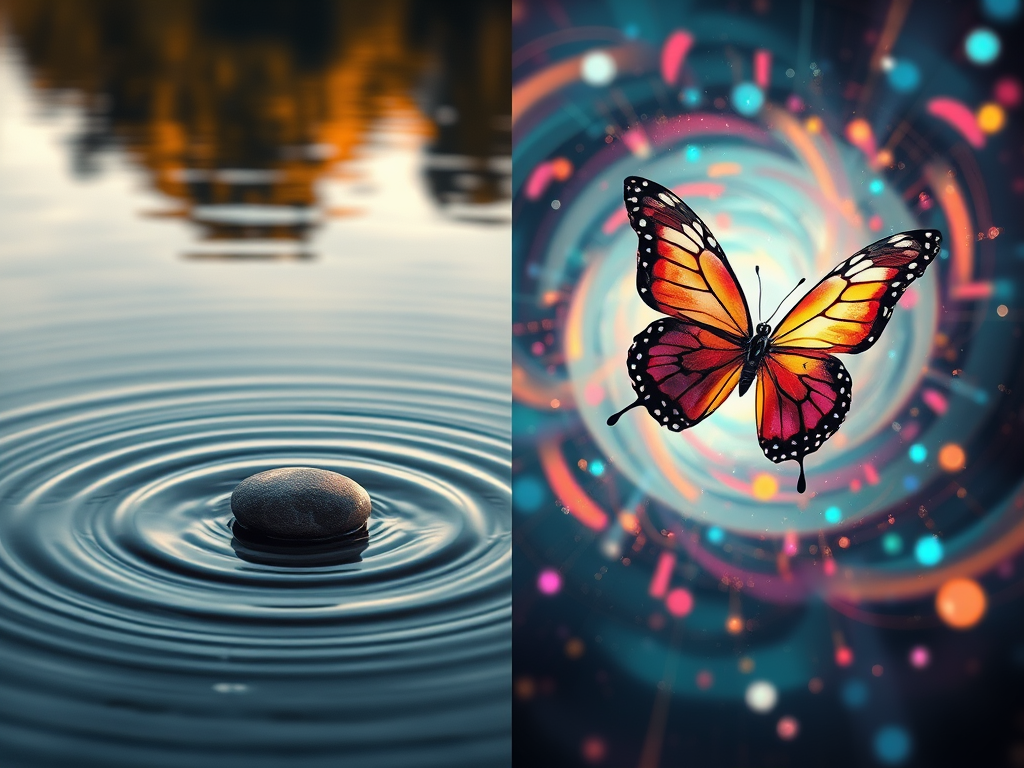
I’ve written about the Ripple Effect before but while they sound like each other, The Butterfly Effect is far from being the same thing as a concept. They are philosophical cousins to be honest but while they are related, they were both raised in different households.

To give some further background on the Ripple Effect, it is one action that causes a series of consequences that spread outward like ‘ripples on the water.’ These are both linear and observable consequences that are clear to see, like water droplets hitting the ocean. For an example of this phenomenon, if you donate to a college scholarship fund, that money would directly help a student go to a college or university. Maybe that student goes on to start a non-for-profit because of the help you gave to help hundreds of other students who were in the same position as he or she was when you donated the money. The effects of your one action spread out logically from the original action taken. The ripple effect has been used in the social sciences, in business development, and in personal decision-making each day.

When it comes to the Butterfly Effect, the definition of it pertains to a very small or slight change in the initial conditions of someone’s day or a event that was rather small or insignificant at the time that ends up causing unpredictable and massive effects down the line affecting untold numbers of people. The key idea for this phenomenon is that events can be nonlinear and cause chaotic consequences when you think the effects would have been minimal or nonexistent instead. For an example, a butterfly flapping its wings in Mexico could theoretically start a chain of atmospheric events that cause a tornado to occur across the border in Texas. The Butterfly Effect is often used in describing chaos theory, meteorology, or how complex systems work together succinctly or can become dysfunctional rather rapidly.

AspectRipple EffectButterfly Effect
DefinitionOne action causes a series of predictable consequencesTiny change leads to massive, unpredictable outcomes
Nature of ImpactLinear and logicalChaotic and nonlinear
PredictabilityGenerally predictableHighly unpredictable
ExampleHelping one student who then impacts othersBeing late to an event and missing a life-changing meeting
Field of OriginSocial sciences, psychology, personal developmentChaos theory, meteorology, complex systems
Visual MetaphorPebbles dropped in water creating wavesButterfly flapping wings triggering a tornado
Control Over OutcomeModerate to high: effects unfold over timeLow: small causes can lead to wildly disproportionate results
Typical UsageCause-and-effect logic in planning or strategyDescribing randomness or complexity in systems

Regarding the main difference between The Ripple Effect and The Butterfly Effect, ripple effects are much more predictable to the average person, and you can trace the causality more easily. Butterfly effects and their events are unpredictable, chaotic, and can happen when you least expect them yet have been put into motion for quite some time. To sum it up, Ripple effects have an obvious cause and effect that are easy to explain and observe while butterfly effects show how tiny inputs or changes can lead to wildly disproportionate outcomes.

To explain how this would play out in the real world, a Ripple Effect in one’s personal life would be deciding to go to the gym three times a week consistently. You start to feel healthier, have more energy, sleep better at night, improve your mood, you’re more productive at work, which leads to a monetary raise or even a promotion in your title. That one small but consistent change to your lifestyle with a new habit consistently done can ‘ripple’ out across your whole life in a predictable way given the known yet useful benefits of consistent exercise. 

As for the Butterfly Effect example when it comes to your personal life, let’s say you show up five minutes late to an important networking event. As a result, you may miss meeting someone who could have been a business partner for your new venture. Your career ends up going in a completely different direction because of that missed opportunity. Because of that, you end up having to move and live in a different city, with different friends, and a different lifestyle, all because of that five-minute delay that happened once in your life. This is a key example of an unpredictable event with unforeseen consequences. You probably or will never realize how your life changed as a result unless someone observing your life full-time could tell you about the chain reaction that occurred because of that late networking event arrival.

We can also look back at history for key examples where the ripple and butterfly effects were present in what happened in retrospect. With regards to the ripple effect, the Civil Rights movement in the United States leads to the Civil Rights Act being passed by Congress. This law causes desegregation to take place in public schools, which opens more education and job opportunities for minority students and eventually leads to more diverse leadership in both government and business. It’s a chain of predictable and traceable events that go back a few decades, but for which still resonates up through the modern era.

A famous example of the Butterfly Effect in action from world history was when an obscure Serbian nationalist, Gavrilo Princip, assassinated the Archduke Franz Ferdinand of Austria, in 1914. After that momentous but surprising event happened, Austria-Hungary declared war on Serbia, alliances with France and Russia kicked in, which lit the spark that consumed Europe during the first World War.

This momentous event of World War I then led to the fall of empires like the Ottoman and British empires over time, the stale peace that led to World War II, and then the rise of Communism and the Cold War. Would a war have started regardless of if Franz Ferdinand had not been assassinated that day? Most likely, but there was a chance that it would not have happened had the assassination not occurred. That one moment created chaos and unforeseen consequences that no one in Europe or around the world could have foreseen at that time in 1914.

Understanding the differences between the ripple effect and the butterfly effect isn’t just academic, it’s practical for your own life. In our personal lives and careers, most of us try to make thoughtful choices, expecting reasonably predictable outcomes. That’s the ripple effect in action: you invest time in learning a skill, and it pays off in future opportunities. However, life doesn’t always play by those rules. Sometimes, a seemingly insignificant decision, sending a message, missing a meeting, crossing paths with someone new, spirals into consequences no one could’ve predicted. That’s the butterfly effect crashing into the party to say it has arrived. Knowing both concepts helps us become more intentional with what we can control while remaining humble about what we can’t control. It’s the mental toolkit for navigating both stability and chaos in this uncertain world.

The truth of the matter is that life is shaped by both ripples and butterflies. Some of your actions will create steady waves of impact over time while other choices might unleash unpredictable storms. That doesn’t mean you should live in perpetual fear of chaos or paralysis over tiny choices. It does mean though that we should approach life with a mixture of clarity and curiosity: plant the seeds you can in life, but don’t be shocked if something unexpected grows.

As the saying goes, “We make plans, and the universe laughs.” Still, you should plan anyway and be prepared with the awareness that every choice matters, even when the outcome doesn’t go according to plan. You might be one ripple away from changing your community or your world, or one butterfly flap from a wild new chapter in your life.