Self-Awareness is a Key Trait to Cultivate

“In a world where everyone has an opinion on every imaginable topic, but very few people have genuine self-awareness, that quality now feels like a rare mineral. True self-awareness is valuable, hard to find, and even harder to refine if you do not cultivate it like copper or silver.”

In a world where everyone has an opinion on every imaginable topic, but very few people have genuine self-awareness, that quality now feels like a rare mineral. True self-awareness is valuable, hard to find, and even harder to refine if you do not cultivate it like copper or silver. At its core, self-awareness is simply understanding your thoughts, emotions, habits, and personal blind spots without flinching or ignoring them. It’s the ability to see yourself honestly instead of through the fog of ego, insecurity, or willful ignorance. That sounds simple, but anyone who’s confronted with their own emotional patterns knows that simple isn’t easy. In terms of personal traits that will serve you well at home, in the workplace, or in public, exercising self-awareness makes a huge difference and is a net positive in one’s life.

Self-awareness is rare today for a few reasons. First, distraction is the default setting of modern life. Between social media, nonstop notifications, and the pressure to perform instead of looking inward about their behavior, most people never slow down long enough to reflect or contemplate who they are or how they act. Secondly, ego protection kicks in for many of us. It’s uncomfortable to recognize that you might be wrong, inconsistent, reactive, or stuck in old habits that drain you or other people. Thirdly, our individualistic culture rewards projection over introspection and putting on an act over being yourself. Being loud, visible, and “on brand” is praised more than being grounded or honest with oneself. The result is a society full of people acting on autopilot, repeating the same behavioral patterns, and wondering why life keeps giving them the same lessons. Introspection is hard to do but it could help get you off an autopilot setting.

When life turns upside down, that’s exactly when self-awareness becomes most valuable. When the world is chaotic, clarity becomes a superpower. The more you understand yourself along with your triggers, your strengths, your weaknesses, your values, the better decisions you will make. You react less to external circumstances and respond more from a place of self-assurance by knowing who you are and what you want to be. Your relationships improve because you’re paying attention to how your behavior affects others. Even your career trajectory changes: self-aware people take feedback well, adapt quickly, and build trust, which quietly but consistently pushes them upward.

The good news for us all in this? Self-awareness isn’t fixed and it’s a muscle you can train. It’s a skill you can cultivate intentionally but you must make a consistent effort to do so successfully. At work, start doing quick “post-project or post-task reviews” for yourself: what went well, what drained you, what you’d do differently, what could be better next time, and how well did you work with others. Ask trusted people for feedback and instead of defending yourself, listen to what they have to say first and what they are genuinely telling you. Notice your stress triggers and learn to pause before reacting, whether it’s in meetings, emails, or elsewhere in your workplace.

I’ve had my own moments at work where I reacted prematurely instead of responding thoughtfully, only to later realize that having self-awareness could’ve saved me a headache. Instead of interrupting, acting abrasive, and preventing a real discussion, think about where they are coming from and why they think of you the way that they do. Focus on the ways that you can improve when they have legitimate critiques and suggestions for improvement in your work performance.

In your personal life, carve out time for your own reflection. Making that kind of effort will pay off tenfold by turning inwards to discover more about your mindset, your thought process, and your personal habits, good or otherwise. Even five minutes of journaling can reveal emotional patterns you never noticed. Try also meditation or silence at the beginning or end of your day and in just ten uninterrupted minutes, it can be surprisingly revealing. Pay attention to your relationships and friendships as well: where you feel energized, where you feel defensive, and where conflicts repeat with the people in your life. Life is too short to be around people who avoid self-awareness. If you are making the effort to be introspective and try to be a better person with self-awareness, you should gravitate to those people in your life who are making that effort too, friends, family or acquaintances especially.

Ultimately, self-awareness isn’t about perfection; it’s about alignment with who you are and how others see you. The more honest you are with yourself, the easier it becomes to make choices that fit the life you want. Know yourself deeply. Pause often for self-reflection. The world will stop dictating your path and you finally begin choosing it. 

Being a Specialist vs. a Jack of All Trades in 2025

“There’s a saying that’s been repeated so often it’s lost its bite these days: “A jack of all trades is a master of none.” However, what most people forget is the full quote: “…but oftentimes better than a master of one.” That second half hits home for me as someone who likes to consider myself a man of many interests and likes.”

There’s a saying that’s been repeated so often it’s lost its bite these days: “A jack of all trades is a master of none.” However, what most people forget is the full quote: “…but oftentimes better than a master of one.” That second half hits home for me as someone who likes to consider myself a man of many interests and likes. I’ve been a jack of all trades most of my life, by design, and not by accident. I’ve always had too many interests to narrow myself into one lane, from teaching English and managing international projects to running side businesses, writing, and exploring new skills like photography and video creation. In 2025, this flexibility isn’t a flaw but rather its survival and adaptation in an ever-changing and acceleratingly fast world.

Let’s be real here too: the world doesn’t reward loyalty to one craft the way it used to in my parents or grandparents’ generations. The days when someone could spend thirty years perfecting a single skill at one company and retire with a gold watch are long gone. Industries move at the speed of AI updates and quarterly market shifts. The specialist like the surgeon, the dentist, the coder, the data scientist still has immense value, of course, and they should be commended for their craft and their dedication to their field.

Those are the people who go deep rather than wide, mastering one corner of a field to the point where they can innovate within it and do so for decades luckily. However, the specialist also lives or dies by their niche or calling. When that niche collapses, loses favor in terms of employability, or evolves faster than they can adapt to the changes to the industry, their expertise in one area can quickly become a liability.

On the other hand, generalists or ‘jack of all trade’s types, people like me, tend to thrive when change is the only constant in life. We’re used to juggling multiple domains, learning on the fly, and connecting dots others don’t even see or don’t wish to see. When AI starts writing code or generating content faster than humanly possible, the jack of all trades doesn’t panic; they pivot to adapt to that change and to see how they can go with the flow. They find new intersections where creativity, management, and soft skills still matter in a world that is increasingly tech-first, question later. In 2025, the ability to synthesize ideas across fields like education, technology, business, culture is arguably more valuable than mastery of just one skillset.

Still though, let’s not sugarcoat it: being a generalist or ‘jack of all trades’ comes with tradeoffs. You’re rarely the “go-to” expert in the room. You may not command the highest salary, or you may constantly feel spread thin, working to keep up with several evolving interests instead of going all-in on one interest. There’s a sense of restlessness built into the generalist’s DNA. However, that same restlessness is what keeps us generalist types adaptable and flexible. We’re built for the gig economy, the hybrid or remote workplace, the new industries, and the unpredictable career paths that define this modern era.

Specialists, for their part, enjoy a kind of depth that the generalists envy. They can focus, dig deep, and master a single language, whether that’s the language of law, medicine, finance, or engineering. Their work can bring a deep sense of purpose and respect that comes from being the person that people rely on when things get complex or challenging. Specialization can be a trap too though as it can make you resistant to change, or worse, blind to possible opportunities outside your comfort zone. The moment your expertise or your sole skillset is no longer in demand, your value can plummet unless you reinvent yourself and to do so quickly.

The reality is that 2025 doesn’t belong exclusively to either camp of ‘generalists’ or ‘specialists’. It belongs to the hybrids instead, who the ones who know enough across different professional disciplines to connect the dots and have enough depth in one or two areas to back it up with credibility and experience. The future as I see it will reward those people who can learn fast, adapt faster, and translate knowledge across industries.

Also, if you know how to communicate well, can solve problems, and meet deadlines consistently, you will always be in demand in my view to work for a company, organization, or other professional body. Whether you’re a generalist who’s learning to specialize or a specialist learning to broaden your scope beyond your field, the key remains the same as you should stay curious, stay humble, and never stop evolving.

Yes, I’m a jack of all trades and I don’t see that changing anytime soon in my own life. If anything, I’ve learned to wear it as armor in a world that’s constantly trying to box people into a corner. I’ve been told I should “pick a lane,” specialize, and double down on one thing alone but that’s never been me or my personality. My curiosity doesn’t fit neatly into a job title or a sole industry. I like moving between worlds, connecting people and ideas that weren’t supposed to meet in the first place.

I’ve realized that being a generalist isn’t about doing everything halfway; it’s about mastering having adaptability itself. It’s about knowing enough across fields to spot the patterns others miss and having the guts to reinvent yourself when the winds change direction. Specialists might thrive when the road is straight and predictable, but I thrive when the map is being redrawn in real time. So no, I don’t apologize for my curiosity or for the eclectic path I’ve taken in life so far. Being a jack of all trades in 2025 isn’t a weakness, rather, it’s an operating system for the modern world. In a time when rigidity gets punished and reinvention gets rewarded; versatility isn’t just a skill; it’s a survival strategy to get by. Honestly, I wouldn’t have it any other way.

Does He or She or It Spark Joy for You?

“Just like keeping a clean house or organizing your closet is what helped American homeowners create joy in their home lives, I fully believe Kondo’s asking of “does it spark joy?” can be reframed for our friendships, relationships, and our hobbies.”

I’ll be honest in that I never really watched Marie Kondo’s famous show, “Tidying Up”, and while I do respect her commitment to reducing clutter and helping hoarders get rid of their extra junk, I am going to focus more on who or what sparks joy for you beyond just household items. Just like keeping a clean house or organizing your closet is what helped American homeowners create joy in their home lives, I fully believe Kondo’s asking of “does it spark joy?” can be reframed for our friendships, relationships, and our hobbies.

You should never want to exert too much effort into someone or something that doesn’t provide ‘joy’ or at least ‘contentedness’ and while ‘joy’ like any feeling is ephemeral, we should work to maximize the ‘joy’ we feel in life. If you are not getting that ‘joy’ at all from that relationship, that friend, or that job, you got to do some soul searching to see if it’s worth the effort involved to keep it going. You can’t choose your family, your coworkers, or even where you live at times so instead of finding ‘joy’ only there, find those things and people that are voluntarily in your life and where you can better evaluate if they are worth your time.

If you find you are spending your limited time with people who are as dull as dishwater or are even putting you down, you need to cast them aside like old clothes that Marie Kondo would want you to discard from your closet. Now, this does not mean being mean, cutting off contact without a reason, or just straight up ending on bad terms, it’s rather about letting them know that the relationship, the friendship, or the hobby you’re doing isn’t worth the effort anymore. Very few things in life are permanent and if it does not spark any kind of joy for you, you should not keep pursuing it to no fulfilling end.

Instead, I believe it is key to find those people or those activities that continue to give you some joy or happiness. I would classify it as giving you a ‘real shot of life’ and making you feel more alive. It’s not an easy thing to be conscientious of but you’ll often know when someone or something is breathing life into you rather than leaving you drained of it.

Not everything or everyone you interact with in life will give you that ‘spark of joy’ or a ‘shot of life’ but your job is to work hard in those interactions that you do control such as a friendship or a relationship to choose wisely and to do so discerningly. Your boss or your tax attorney is rarely going to spark that ‘joy’ but you’re going to have to interact with them regardless because it’s necessary in life. What you can do instead in your free time is to maximize ‘joy’, ‘happiness’ or just ‘fulfillment’ with people, places, and hobbies that make you feel most alive.

It really is a rare thing in our technologically driven, profit maximizing, socially shallow, and standardized daily routine to find those people who leave a big impression on you, but you got to put yourself out there to receive those kinds of connections. Build a life around trying to find interesting people who inspire you, who make you laugh, who you want to learn from, who you enjoy being around, and for you to be the same to them.

Life is too short to be around ‘joyless’ people who you could choose not to be around instead and to commit yourself to prioritizing those people who make you happy or joyful because of how they make you feel. The same can be said of those activities, hobbies, or interests that brighten your day and that you can look forward to. Routine in adulthood is monotonous, contrite, and not joyful, but you can still find those moments, those hobbies, and those people who make your life that much richer and more colorful.

At the end of the day, Marie Kondo had it right. Joy should be the filter through which we decide what stays and what goes in our life. The difference is that life’s clutter isn’t just found in closets or drawers of hoarders whose houses are too full; rather, it’s in the people we chase, the jobs we keep, and the habits we cling to long after they’ve stopped serving us. Maybe the real act of tidying up isn’t just folding shirts; it’s clearing out the emotional junk that keeps us from feeling alive and fulfilled. When you ask yourself what sparks joy as Marie Kondo does to her clients, don’t stop at your wardrobe or your closet. Ask it instead about your world, your personal life, your hobbies and don’t be afraid to get rid of the extra clutter.

A Little Solitude Can Be Good for You

“As much as it is important to socialize and be around friends, it can also be good to be alone, focus on yourself, and enjoy a little solitude.”

Sometimes, it’s good to recharge your batteries alone. We all need real social connection and friendship, that is for certain, but there is nothing wrong with seeking out solitude to enjoy your alone time. Everybody has a different tolerance for how much time alone they can handle before they seek out a social event, gathering, or activity to dust off the cobwebs and not let one’s social skills atrophy. As much as it is important to socialize and be around friends, it can also be good to be alone, focus on yourself, and enjoy a little solitude.

Solitude often has a negative connotation, and it is often associated with having it imposed on you or having it done without consent such as the similar phrasing of ‘solitary confinement.’ That kind of solitude is denigrating to one’s spirit and causes one to mentally break over time. Just like endless solitude is harmful to one’s health, I also think that is true for the opposite side of the spectrum when you are constantly surrounded by other people, some of them mere acquaintances or coworkers for which you are forced to be around and whose company you do not enjoy. There are many forms of loneliness, and it is true that you can be as lonely by yourself as you can in a room full of people who don’t care for you, or you don’t care for them.

If you are around people who constantly want something from you or need something from you, that can be as draining as it is to have no one to talk to or to share life with. Just as a balance of having some social activity is good for you, it is as important to be on your own sometimes and enjoy one’s own company. There have been times in my own life where I have sought to be on my own deliberately, not because I didn’t enjoy being around others, but that I needed the time alone to meditate, to think, to reflect, to problem solve, and to more fully observe the world around me. In extroverted cultures including in the United States, this kind of activity can be thought of as strange or unusual, but I find that my best ideas or my most relaxing moments can be on my own and even when doing nothing but just the art of being present in the world.

We constantly are having our attention pulled to the next meeting, the next call, the next trip, the next gathering that we can forget to take the time to be on our own in whatever form that may take. Solitary kind of activities have gone out of style lately for some people whether that is reading, writing, walking, meditating, or just doing nothing (looking at your phone doesn’t count here). While these things can be done in concert with other people around, these activities are best done alone in my view and help me to recharge so I can be more present and engaged when seeing friends or family members.

You shouldn’t wait on other people to live your life too even if it’s by yourself. If you must be alone for a little while on a trip, at a concert, in the library, and generally out in public by yourself, it is not the end of the world. No one is judging you for doing life solo sometimes and it can be healthy to do so. Rather than giving too many people too little of your attention or having it split too often, why not focus all of your attention on something singular such as the footsteps you take on a walk, the thoughts in your head as you absorb a good book, and the clacking of a keyboard as you work on your novel.

Being alone all the time is not healthy, I want to make that clear, but it’s also not healthy either to be surrounded by people all the time. Part of being a healthy adult is working to have a little solitude, a little social life, and mix it all together to rewarding yet refreshing lifestyle. By being on your own sometimes, you’ll be more reflective, more observant, more self-aware, and treasure those social moments more when you’re more present, more engaged, and happier to have that social muscle stimulated.

I’ve always been an advocate for a moderate and balanced life and that is why solitude should not always be shunned for someone to progress as a person. Our deepest thoughts, our brightest ideas, our healthiest habits aren’t always cultivated around other people, which is why it is important to use one’s solitude to see if you can think deeper, live better, and build more because your attention is focused inwards rather than outwards. Find out what your tolerance for solitude is and then see what it can give you when you’re alone, because you would be surprised how relaxing and necessary it can be, especially when you put that solitary time to good use.

Why You Need Something To Look Forward To In Life

“Life is not just about paying bills, taking care of errands, and going to and from work or school. No, life is more than just going through the motions.”

Life is not just about paying bills, taking care of errands, and going to and from work or school. No, life is more than just going through the motions. As an adult especially, you must have a life beyond the daily grind. You must be going out of your way to make time to enjoy life and to have something to look forward to, as frequently as possible. Life is short and days, weeks, and months can pass you by without taking full advantage of it. As you get older, it becomes not just about being successful and finding purpose but finding enjoyment out of it before your time is up here.

Enjoyment doesn’t have to lead to you spending your money needlessly. It could be going on a walk, a hike, or chatting with a friend on a park bench. You can enjoy the sunrise, the sunset, or take the time to exercise and feel good about yourself as a result. These are all things that you can look forward to without spending your hard-earned money. While there is nothing wrong with using money to have fun and relax a bit, it’s not the end all be all with looking forward to a gift, a purchase, or a subscription. If it brings you happiness and you’re responsible for it, monetary or not, you should always be marking your calendar each day to at least one thing or event or person you’re looking forward to interacting with.

Clearly, man or woman is not a machine and grinding endlessly just to sustain us alone is not healthy in the long-term. You can be a hard worker and still take the time to enjoy life even when you have a busy schedule. However, you need to also set boundaries and be willing to look at your time honestly to figure when and where you can fit this downtime in. You can easily get overwhelmed with errands, chores, duties, work, and other obligations and not carve out any time for yourself but that is no way to go through this life.

We all need our down time to reset, enjoy, and relax without feeling guilty for having done so. No one in your life is going to plan out your fun experiences or down time for you so you need to be actively doing so yourself. Managing your calendar well is part of that and being conscious of what brings you joy and happiness. Other people will often dictate for you what they think will bring you fulfillment outside of work or school, but you need to decide for yourself the best uses for your free time.

For some people, that could be playing tennis on a weekly basis, for others, it could be catching up with different friends over a drink or coffee over the course of a month. You should always be looking to make time for your fun and enjoyment as you see it best. It takes effort, communication, and planning but it’s better than just going through the motions without breaking up the daily grind a bit.

Being able to plan a vacation, a concert, a hike, or just time spent with loved ones is what really will fuel you through the ups and downs of professional and academic life. You need interests, hobbies, experiences, and people you like to get more out of life beyond the briefcase or backpack. We were not meant to live to work and earn our daily bread alone. Take the time out when you can to have something to look forward to doing, experiencing, or enjoying, whatever that may be, guilt free.

There will always be plenty of hours to give for that job, that class, or that bill payment, but there is less time for our free time by and large. That is why it’s important to plan out your free time well, to have a life beyond the grind, and to create fun, joy, and laughter wherever you can, whenever you can. Enjoy your free time and make the most of it because it’s not for forever and you need to make the most of the time we are given to pursue our own happiness.

Cause, Chaos, and Consequence: Ripple vs. Butterfly Effect Explained

“I’ve written about the Ripple Effect before but while they sound like each other, The Butterfly Effect is far from being the same thing as a concept. They are philosophical cousins to be honest but while they are related, they were both raised in different households.”

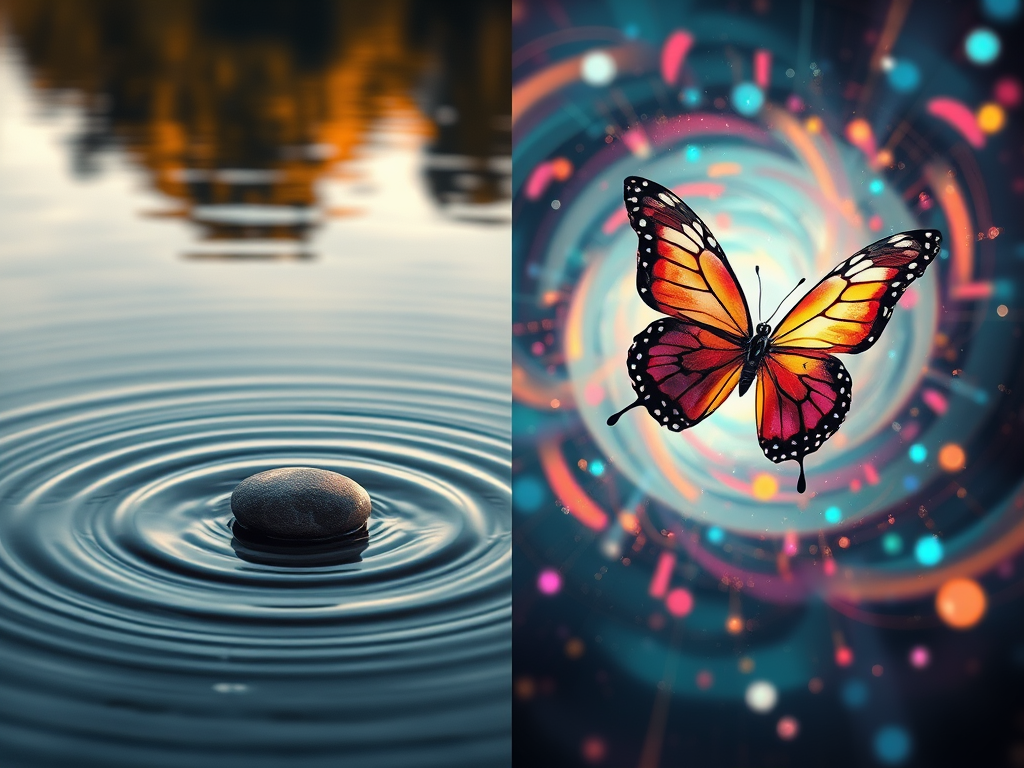
I’ve written about the Ripple Effect before but while they sound like each other, The Butterfly Effect is far from being the same thing as a concept. They are philosophical cousins to be honest but while they are related, they were both raised in different households.

To give some further background on the Ripple Effect, it is one action that causes a series of consequences that spread outward like ‘ripples on the water.’ These are both linear and observable consequences that are clear to see, like water droplets hitting the ocean. For an example of this phenomenon, if you donate to a college scholarship fund, that money would directly help a student go to a college or university. Maybe that student goes on to start a non-for-profit because of the help you gave to help hundreds of other students who were in the same position as he or she was when you donated the money. The effects of your one action spread out logically from the original action taken. The ripple effect has been used in the social sciences, in business development, and in personal decision-making each day.

When it comes to the Butterfly Effect, the definition of it pertains to a very small or slight change in the initial conditions of someone’s day or a event that was rather small or insignificant at the time that ends up causing unpredictable and massive effects down the line affecting untold numbers of people. The key idea for this phenomenon is that events can be nonlinear and cause chaotic consequences when you think the effects would have been minimal or nonexistent instead. For an example, a butterfly flapping its wings in Mexico could theoretically start a chain of atmospheric events that cause a tornado to occur across the border in Texas. The Butterfly Effect is often used in describing chaos theory, meteorology, or how complex systems work together succinctly or can become dysfunctional rather rapidly.

AspectRipple EffectButterfly Effect
DefinitionOne action causes a series of predictable consequencesTiny change leads to massive, unpredictable outcomes
Nature of ImpactLinear and logicalChaotic and nonlinear
PredictabilityGenerally predictableHighly unpredictable
ExampleHelping one student who then impacts othersBeing late to an event and missing a life-changing meeting
Field of OriginSocial sciences, psychology, personal developmentChaos theory, meteorology, complex systems
Visual MetaphorPebbles dropped in water creating wavesButterfly flapping wings triggering a tornado
Control Over OutcomeModerate to high: effects unfold over timeLow: small causes can lead to wildly disproportionate results
Typical UsageCause-and-effect logic in planning or strategyDescribing randomness or complexity in systems

Regarding the main difference between The Ripple Effect and The Butterfly Effect, ripple effects are much more predictable to the average person, and you can trace the causality more easily. Butterfly effects and their events are unpredictable, chaotic, and can happen when you least expect them yet have been put into motion for quite some time. To sum it up, Ripple effects have an obvious cause and effect that are easy to explain and observe while butterfly effects show how tiny inputs or changes can lead to wildly disproportionate outcomes.

To explain how this would play out in the real world, a Ripple Effect in one’s personal life would be deciding to go to the gym three times a week consistently. You start to feel healthier, have more energy, sleep better at night, improve your mood, you’re more productive at work, which leads to a monetary raise or even a promotion in your title. That one small but consistent change to your lifestyle with a new habit consistently done can ‘ripple’ out across your whole life in a predictable way given the known yet useful benefits of consistent exercise. 

As for the Butterfly Effect example when it comes to your personal life, let’s say you show up five minutes late to an important networking event. As a result, you may miss meeting someone who could have been a business partner for your new venture. Your career ends up going in a completely different direction because of that missed opportunity. Because of that, you end up having to move and live in a different city, with different friends, and a different lifestyle, all because of that five-minute delay that happened once in your life. This is a key example of an unpredictable event with unforeseen consequences. You probably or will never realize how your life changed as a result unless someone observing your life full-time could tell you about the chain reaction that occurred because of that late networking event arrival.

We can also look back at history for key examples where the ripple and butterfly effects were present in what happened in retrospect. With regards to the ripple effect, the Civil Rights movement in the United States leads to the Civil Rights Act being passed by Congress. This law causes desegregation to take place in public schools, which opens more education and job opportunities for minority students and eventually leads to more diverse leadership in both government and business. It’s a chain of predictable and traceable events that go back a few decades, but for which still resonates up through the modern era.

A famous example of the Butterfly Effect in action from world history was when an obscure Serbian nationalist, Gavrilo Princip, assassinated the Archduke Franz Ferdinand of Austria, in 1914. After that momentous but surprising event happened, Austria-Hungary declared war on Serbia, alliances with France and Russia kicked in, which lit the spark that consumed Europe during the first World War.

This momentous event of World War I then led to the fall of empires like the Ottoman and British empires over time, the stale peace that led to World War II, and then the rise of Communism and the Cold War. Would a war have started regardless of if Franz Ferdinand had not been assassinated that day? Most likely, but there was a chance that it would not have happened had the assassination not occurred. That one moment created chaos and unforeseen consequences that no one in Europe or around the world could have foreseen at that time in 1914.

Understanding the differences between the ripple effect and the butterfly effect isn’t just academic, it’s practical for your own life. In our personal lives and careers, most of us try to make thoughtful choices, expecting reasonably predictable outcomes. That’s the ripple effect in action: you invest time in learning a skill, and it pays off in future opportunities. However, life doesn’t always play by those rules. Sometimes, a seemingly insignificant decision, sending a message, missing a meeting, crossing paths with someone new, spirals into consequences no one could’ve predicted. That’s the butterfly effect crashing into the party to say it has arrived. Knowing both concepts helps us become more intentional with what we can control while remaining humble about what we can’t control. It’s the mental toolkit for navigating both stability and chaos in this uncertain world.

The truth of the matter is that life is shaped by both ripples and butterflies. Some of your actions will create steady waves of impact over time while other choices might unleash unpredictable storms. That doesn’t mean you should live in perpetual fear of chaos or paralysis over tiny choices. It does mean though that we should approach life with a mixture of clarity and curiosity: plant the seeds you can in life, but don’t be shocked if something unexpected grows.

As the saying goes, “We make plans, and the universe laughs.” Still, you should plan anyway and be prepared with the awareness that every choice matters, even when the outcome doesn’t go according to plan. You might be one ripple away from changing your community or your world, or one butterfly flap from a wild new chapter in your life.

Be Bold and Take Chances in Life

“Nothing will ever be given to you on a plate whether that’s a new job, a pay raise, acceptance to your preferred college, or achieving a new professional certificate. You have more say over your life than you think with the effort you put into it.”

I want everyone reading this article to succeed in life. I want you to make good choices and not be to rash in your decision making as well. However, to foster new opportunities, you have to take the initiative, be bold, and take chances to really get ahead in this world. Nothing will ever be given to you on a plate whether that’s a new job, a pay raise, acceptance to your preferred college, or achieving a new professional certificate. You have more say over your life than you think with the effort you put into it.

Nowadays, you can’t be too complacent especially with the pace at which we are going through life. Time speeds up the older you get, and you have to make the most with the time given to you. You must be bold, take some chances, and see if it pays off. You don’t want to go all-in per say and take too much risk on to achieve a goal, but you also don’t want to never try at all so be sure to balance your desire to take chances with your need to preserve your livelihood. Going all-in without doing your research, not knowing your limits, or being unprepared is a recipe for disaster and that is the opposite of being bold, it is being foolhardy instead.

Calculated risk-taking is what you should be striving for in your life and to prepare yourself to succeed in whatever you choose to pursue to give yourself the best shot at success. Being bold is not about going all-in with no resources or preparation but it’s rather about taking a shot where you feel as if you have a realistic chance of succeeding. You should always think about what I am getting out of this pursuit, is it worth the risk, and what happens if I succeed or fail? You want to make sure that you can bounce back if it doesn’t turn out well and you still have the means to try again.

To cite a personal example from my own life, I prepared myself for the project management professional (PMP) certification for months, took multiple preparatory exams, enrolled in an intensive course, and took evenings and weekends to study the exam material. It was a good strategy because I didn’t go all-in without preparing myself first and reminding myself that if I fail, it’s not the end of the world and I can try again.

I also thought if it was worth the investment and if passing the exam and getting certified would benefit me in my own professional pursuits. I did the analysis before spending the money and the time to get ready for the certification exam and to go through the steps also to qualify to sit for the exam. Was it easy? No, not at all, but I’m glad I took the time to take and pass the exam because I knew that this kind of chance was worth it and would benefit me in the long run.

You will find that to be bold in life, you may have to suffer to achieve or do something truly great. Whether that is starting your first business, applying for that dream job, moving to a new city, or just asking that girl or guy out who you’ve been meaning to talk to but haven’t yet. Doing anything worthwhile in life is far from easy and often will be painful and difficult. However, the alternative of doing nothing, never trying at anything you want to do, and going through your life thinking of ‘what if?’ is no way to live your life.

I am so adamant about this topic because I’ve been through a lot of these situations I’m describing, and it required a lot of boldness to do it. You have to be bold often to get what you want out of life, especially since nothing is going to be handed to you. Make sure you take measured risks and think before you take upon a challenge as well. Boldness isn’t thoughtlessness or recklessness. Rather, it’s about thinking about what challenges you wish to take on, being realistic about your success chances, and coming up with a plan to give yourself the best shot at being successful.

Whatever dreams, goals, or ambitions you currently have, think about what it would take to make them a reality. Come up with a few steps on how to achieve your goal(s), eventually formulate a plan with further details, and then execute to the best of your ability. Sometimes, your bold decisions will be more instantaneous such as networking on the fly, asking someone out by introducing yourself and being vulnerable, or pitching your supervisor at your job about why you deserve that promotion in a one-on-one conversation.

It’s better to look back on your life and think of ‘how it happened’ rather than ‘why didn’t it happen?’ You want to live life with fewer regrets as you get older and avoid ‘what if?’ in your thoughts as much as possible. That is why I stress to you about the importance of being bold, taking an action, and working hard on what you really want out of life. If you fail, at least you gave it the best effort that you could, and the next time you try, it will be less painful, you’ll have more confidence and you’ll likely have a better chance of success the more times you take the initiative. Good luck and remember to be bold!

Emulating ‘The Most Interesting Man in The World’

“You don’t have to be the most interesting man or woman in the world, but I think these commercials did do a good job of why it’s necessary in life to embrace curiosity, experience, adventures, and being charismatic.”

I am not a big fan of commercials or advertisements generally, however, if they can be humorous or insightful, such as one kind of commercial that has captivated me for years, on what it is like to be ‘the most interesting man in the world’. I have long had a soft spot for the now defunct ‘Dos Equis’ beer commercials focusing on the character of “The Most Interesting Man in The World.” These commercials were not only humorous but also served as a cheesy yet truthful take in my view regarding how to be a more well-rounded, open-minded, confident, curious, and adventurous person. You don’t have to be the most interesting man or woman in the world, but I think these commercials did do a good job of why it’s necessary in life to embrace curiosity, experience, adventures, and being charismatic.

“The police often question him because they find him interesting.” In many of the ‘Most Interesting Man in The World’ commercials, you see the character actor, Jonathan Goldsmith engaged in various activities such as climbing Mount Everest, arm-wrestling a military general, or flying a plane. The character thrives on experiencing life and all it has to offer despite the risk(s) and danger(s) involved.

Whether its fencing, sea diving, or rescuing a lion, he thrives on novelty and making the most out of what life is all about. I don’t see anything wrong with you incorporating this kind of mindset such as seeking out new hobbies or interests, traveling to unique places, and learning new things to make life more exciting and fulfilling. You don’t need to be the most interesting man or woman in the world to do that, but you do need to take action to make that happen.

“He has inside jokes with complete strangers.” Having charisma, being appealing to other people, and showing confidence in your actions will carry you far in life. What ‘The Most Interesting Man in The World’ commercials show us is that it does help to be charismatic, confident, and able to handle social situations with ease. This kind of character takes time to develop and won’t come easily, but like ‘the most interesting man’, it can pay off for you when you invest in your social life and take time to get better at building those social skills. The character in the commercial is not doing these activities alone and he is not at the bar or restaurant alone. He is self-assured, confident, telling a story, and being humorous to enhance his relationships. You should work on doing the same in terms of having those characteristics in both your personal and professional relationships. You never know when having these kinds of interpersonal skills will come in handy, but I can guarantee it will help you in life in one way or the other.

“He can speak French…in Russian.” The character himself is well versed in those activities and is knowledgeable in many fields such as learning languages, playing sports, or knowing different instruments. These commercials, while funny, do show the viewer the value of being a lifelong learner as it will make you a more well-rounded person. Being able to ride widely on different subjects, picking up new skills over the years, and engaging in a wide array of activities will make you stand out in a good way in terms of forming a holistic personality. If the character can do it, you can make it happen as well though take it one step at a time in terms of becoming a Renaissance person. You may not get there right away with being well-rounded, but years or decades of work will help you get there most often.

“People hang on his every word, even the prepositions.” The most interesting man in the world doesn’t boast and talk at length without being prompted first to share his adventures and experiences. He is intriguing because he is mysterious and saves his best stories for those, he wants to share them with. Even in these commercials, the actor has a real presence about him, partly because of his age but also because of his body language. You do not need to overshare with the average person or stranger, but you should intrigue people with your aura and your confidence. You can let someone new know a little bit about you without giving everything away. It takes time to get good at that, but you should save your best stories for your most intimate friendships or relationships. You should divulge a little bit about yourself at a time while maintaining some mystery for those people who really care to get to know you better.

“His blood smells like cologne.” When you dress well like the character does, when you have strong composure and when you carry yourself with both dignity and respect, people will treat you better and take you seriously. Remember to boost your confidence this way by paying more attention to how you present yourself, how you speak, and how you think you’re being perceived. You don’t need to be a fashion icon but like ‘the most interesting man in the world’, you have it in your power to dress well, have more refined taste, and present yourself as best as possible. Having good body language, dressing well, and being confident may not make you the ‘most interesting person’ but it will make you much more appealing and intriguing to know more about.

“Presidents take notes when he speaks.” Everything about these commercials suggest that ‘The Most Interesting Man in The World’ has a legacy worth remembering and that his persona lives on long after he’s gone. The idea of having a legacy, contributing to something bigger than yourself, and being part of a greater mission are all themes from these commercials. Being remembered well, pursuing meaningful work, helping others who are less fortunate, and making bold choices should never be shied away from. You don’t have to be a fictional commercial character to do all these things.

The overall message behind this part of the character is something that we all can relate to in our lives. We want to have a positive impact in the world and leave something good behind whether that’s a family, a garden, or a charity. Whatever legacy you intend to have, ‘The Most Interesting Man in The World’ encourages us all to life a life worth remembering and one in which we have a positive and memorable impact on the lives of other people.

At the end of the day, The Most Interesting Man in the World may be a fictional character from a beer commercial, but the essence of his magnetic and charismatic persona offers real life lessons. By embracing curiosity, confidence, and a spirit of adventure, anyone can cultivate a richer and more well-rounded life by following this example.

Whether it’s learning a new skill, traveling to unfamiliar places, or simply carrying yourself with both charisma and composure, you can become more interesting as a result, man or woman. The key to remember here is to stay open to new experiences and never stop growing as a person. You don’t have to be the most interesting person in the world or even the most likable person in the world but by following the character’s example, you just might become the most interesting person in the room and that’s a big deal. Stay curious, stay bold, and of course, stay thirsty, my friends.

Avoiding Analysis Paralysis

“We also often must think if the choice or decision we make is ‘perfect’ but to put it bluntly, no choice or decision is ever perfect.”

With the rapid pace of change and constant streams of information coming at us each day, it leads a lot of us to overthink decisions and choices to the point of inaction. There are too many choices we have to make, sometimes big and sometimes small, but we can easily get overwhelmed by the fear of making the wrong decision or if it’s better to avoid deciding altogether. We also often must think if the choice or decision we make is ‘perfect’ but to put it bluntly, no choice or decision is ever perfect.

Everyday, we are faced with hundreds or even thousands of choices such as choosing what to eat, what to wear, to what to do with your life, career, or school choices. Major life decisions should always take precedence in terms of your focus and your analysis, but you have to make the decision at some point regarding career, school, investments, and relationships. You must be able to prioritize effectively the decisions you have to make in the order of what’s more urgent and what’s most important. Smaller choices should deserve some time, but they should take away from the big choices we have to make day in and day out. Prioritization, knowing when to limit the time spent on a choice, and embracing choices or decisions that are ‘good enough’ over ‘perfect’ will help prevent you from falling into an ‘analysis paralysis.’

I believe that ‘analysis paralysis’ is more common than ever due to several factors. We have too much information and it’s overloading our thought process because it’s seemingly endless with regards to the Internet and it’s harder than ever to filter out good information from bad. The fear of missing out (FOMO) has us thinking that we have endless choices in life rather than a few immediate choices we should focus on that affect our lives.

Social media makes it seem like we have endless time or endless options to consider but we must reframe it as these are the choices I can make that are within my control and for which directly impact me. Society tends to reward those people who seem to have made the best decisions even when we know we don’t know the full story behind the choice because social media and the Internet don’t give us everything regarding how a person decided or made a choice to begin with.

Too many choices each day of life, which society can thrust upon us all at once, is a modern problem especially regarding how many streaming services, career paths, educational options, and other non-essential choices that flood our attention spans. While it’s important to make choices, you should not waste more time than you need analyzing every option out there because it would be a waste of your time.

As I mentioned earlier, to avoid analysis paralysis, you have to choose only on what you can control or have an impact on your life to decide upon immediately. You got to set time limits on these decisions you can make and are relevant to your life at the time. There is also no such thing as a ‘perfect’ choice or decision and every decision we make has positives and negatives to it as well as unknown factors that we cannot foresee upon making the choice.

You should be identifying the key factors of the choice and what impacts it’ll have from making one choice or the other, but for which truly matters rather than analyzing what could be or should be without knowing what those unknowns may lead to. Identifying what truly matters and really impacts you day to day should be priority in your decision making and should be based on relevant information that is creditable and trustworthy too.

Taking small choices or decisions can make it easier as well to handle bigger decisions but both need to be happening in your life. You can’t ignore the big choices or the small choices and often they will need to be made at the same time or same day. Breaking down your decisions and the steps that lead to them will reduce the chances of you being overwhelmed by making them. Take the decision-making process one step at a time, especially for the big decisions, will make it less daunting and give you more confidence in how you analyze the choices you have.

Limit the amount of information you expose yourself to and make sure the information you get is trustworthy before making your choice or decision. There is too much information out there for every choice we could make in this information age so make sure you trust your sources, limit them to a handful, and try to analyze both sides of the choice without delaying it too much.

By recognizing what ‘analysis paralysis’ is, how often it can affect us in our daily lives due to living through the ‘information age’ and taking steps to overcoming this paralysis one choice or decision at a time, you can improve the quality of your life immensely. Go easy on yourself and try to make the best decisions you can with the best information you can get. We all make mistakes in our choices and our decisions because we’re human but it’s important also to learn from past mistakes and do the best we can each day we make a choice or decision.

Anatomy of a Scene – ‘Family, Jimmy, Family’ (The Wire)

“This scene that I’ve titled, ‘Family, Jimmy, Family’ feels like it’s not just about the character, Jimmy McNulty, one of the leading roles of the show and a deeply flawed one at that but also could reflect on our own lives and who we prioritize in them.”

Sometimes, it takes a great work of fictional television to cause the viewer to do some soul searching themselves. ‘The Wire’ is not only an excellent crime drama and takes a critical lens to different facets of American society, but there are also multiple scenes that stand out for how they deliver truths to each of their characters for what they themselves are ignorant of or choose to forget. One of those scenes is short but whose succinctness of its message and point-blank delivery is something that you could do a deep analysis of. This scene that I’ve titled, ‘Family, Jimmy, Family’ feels like it’s not just about the character, Jimmy McNulty, one of the leading roles of the show and a deeply flawed one at that but also could reflect on our own lives and who we prioritize in them.

For a little bit of background before diving into the scene itself, which takes place in ‘The Wire’ Season 5, Jimmy McNulty is an obsessive workaholic and a functional alcoholic. His thirst for booze rivals his own thirst for self-satisfaction in being able to solve murders as a detective in the Baltimore Police Department. While he does crave justice, he craves adulation, admiration, and boosting his ego too because of his natural talents with regards to being a lead detective. However, without getting into too many details, the stress of the job, the clashes with his bosses, and the long hours cause him to drink heavily, carouse with random women, and cause him to lose control of his relationship with both his ex-wife and his children.

Jimmy loves being a detective, the purpose that comes with the badge, and the colleagues who he handles cases with. It’s also about the camaraderie that he finds in the work, the all-consuming nature of the work, and by outsmarting criminals and thugs who think they have successfully outwitted him and the police. The thing with letting work consume you is that it takes over your life and suffocates the rest of your identity with it. Jimmy is a great detective but throughout the show, the job takes a toll on his personal life and about separating work from his time out of work. When you have nothing but the job and the people in it, is it really a good life?

The scene I refer to titled, ‘Family, Jimmy, Family’ is instrumental in telling Jimmy McNulty what he needs to hear and what other workaholics need to hear: “The job won’t save you.” It takes five seasons but Beadie Russell, a Baltimore Port Authority police officer, introduced in season two, but for which her and Jimmy start to become romantically involved does what no one else in the show has the courage to do, tell Jimmy that the job isn’t everything.

“In the end, they’re not going to be there either.” Beadie sums it up in less than a minute with this scene but reminds Jimmy that the drinking pals at the bar, the workmates who he shares a patrol car with and shares stories, or even the girls he’s met for quick flings, they won’t be there when he really needs it. Yes, you can have fun, enjoy their company, and make the most of the work hours, but those people won’t be there for you when it comes to your health, wellness, and your overall fulfillment as a person. Beadie indicates to Jimmy that his workaholic behavior and his propensity for alcohol won’t save him and won’t give him the internal satisfaction he is always looking for.

“Family, that’s it. Family, and if you’re lucky, one or two friends who are the same as family. That’s all the best of us get. Everything else just…” Beadie pauses at the end of this scene and lets it all sink in for Jimmy. She knows she has reached him and lets him know that at your funeral or in your last days, you won’t have the girls you dated, the workmates or bosses, or the casual bar buddies you swap stories with there. If you’re lucky, you may have close family to care for you and maybe one or two close friends and that’s the truth of this scene not just for Jimmy McNulty of ‘The Wire’ but for all of us.

Beadie makes it clear that everything else goes away at some point once the job is done, the glasses are empty, and everybody goes their separate ways. Nothing is permanent but maybe your family will be there for you through most of it, thick and thin of life, if you’re lucky and until your dying day if you are truly blessed in that regard. Jimmy knows by the end of the scene that he needs to shift his priorities based on his body language.

He does not say anything back to Beadie, but he knows what she is saying as his new girlfriend is 100% true. It’s been a while since anyone has laid it out to him that clearly, but she gets through to him by telling him the unvarnished truth that he has refused to face up until that point. Like Beadie, we all need someone to cut through the nonsense and tell us what we really need to hear and if you watch this scene from ‘The Wire’, it’s not just Jimmy who this scene can reflect upon but maybe for our own lives too.

We all want to have productive work lives, make friends, and enjoy the fruits of our labor, but we must remember that it all does go away, and that family can be the most important and reliable thing we have throughout our lives if we’re lucky. Workmates, casual buddies and flings, and even friends come and go, but family can sustain us if we nurture those relationships and don’t let them atrophy and go away too.

Beadie reminds Jimmy to not let the work and the environment around his work consume him entirely. She saves him from himself to some degree but telling him what he needs to hear before he spirals out of control as a functioning alcoholic and workaholic. I think we all need a Beadie Russell in our lives to tell us what we need to hear rather than what we want to hear so that we can get that needed support to help reassess our priorities in life and change ourselves for the better.